
Apaloosa Builds a Forest-Edge Retreat from Compacted Earth and Pink Stucco in Chiapas
Villa Luciérnagas in San Cristóbal de las Casas pairs local earth block construction with rainwater systems and solar energy for Airbnb-ready living.


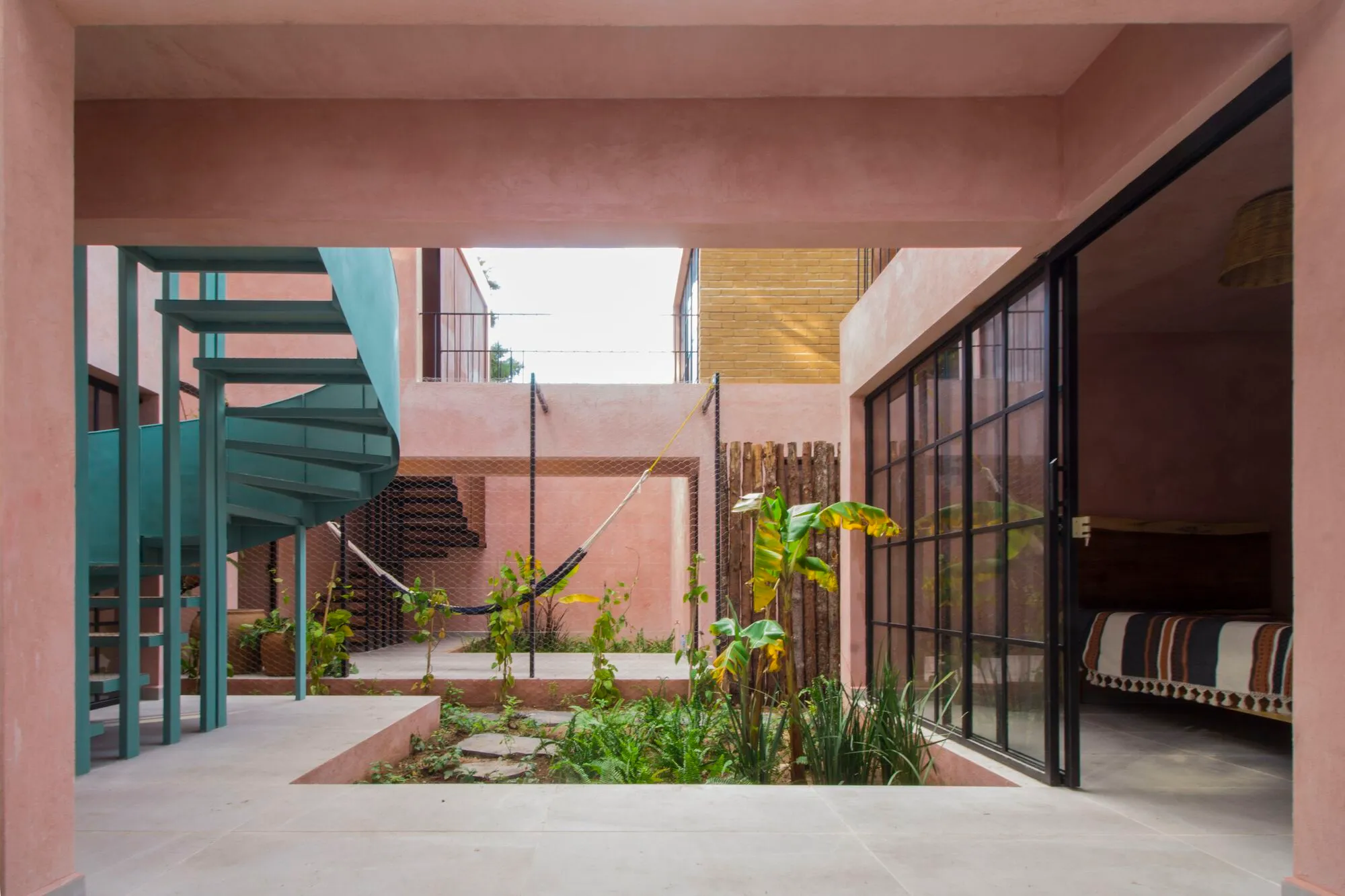
At the edge of a coniferous reserve in San Cristóbal de las Casas, Apaloosa Estudio de Arquitectura y Diseño has assembled a 183 m² compound that refuses to turn its back on the forest. Villa Luciérnagas, completed in 2021, is designed to host families and tourists through Airbnb, which makes its construction logic doubly interesting: every decision, from the compacted earth block walls to the solar panels and biodigester, is calibrated to reduce operating costs and accelerate the client's return on investment. That kind of pragmatism rarely produces architecture this vivid.
The project's most legible move is reorienting the user's visual horizon toward the adjacent reserve. Instead of conventional room-facing-street layouts, Apaloosa split the program into separate volumes organized around a central courtyard, threading planted gardens and corridors between them. The result is a building that feels porous: you are always aware of the pines overhead, the light shifting on pink stucco, and the ground underfoot.
Pink Stucco and the Courtyard Sequence
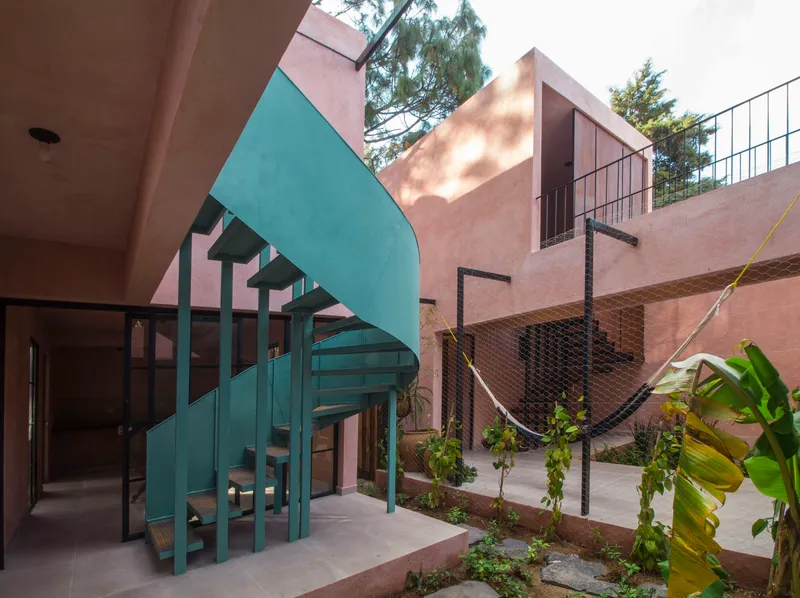
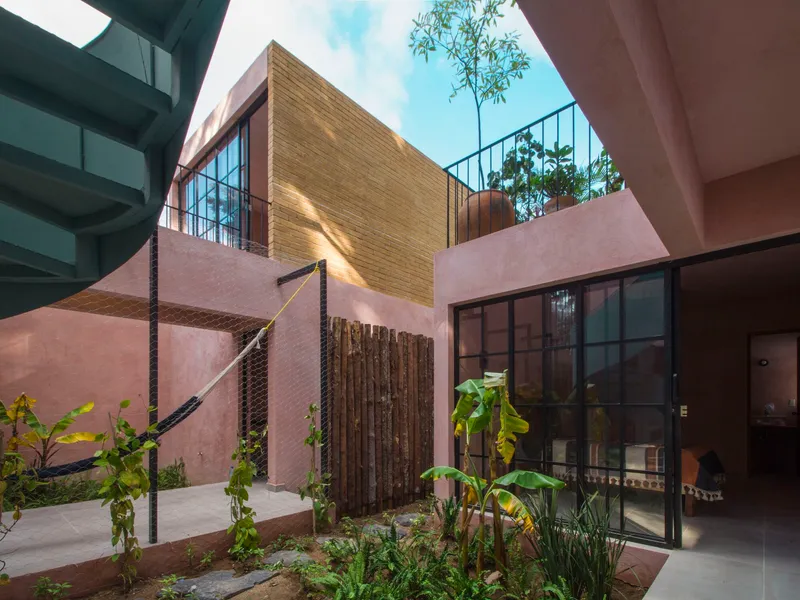
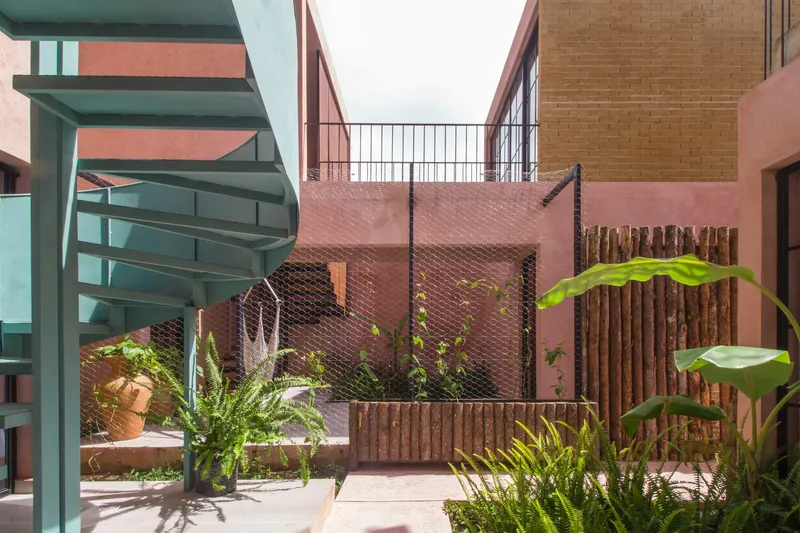
The courtyard is the organizational spine of Villa Luciérnagas. Pink stucco volumes frame it on multiple sides, creating an outdoor room that is simultaneously living space, garden, and circulation. Hammocks stretch between walls, potted tropical plants soften the mineral surfaces, and bamboo screening filters views without sealing them off. The pink is not decorative whimsy: it anchors the compound's identity, distinguishing these new volumes from the existing sheet metal warehouse that was already on site.
What works here is the compression and release. Narrow passages squeeze between walls before opening into the central court, giving a 183 m² project a spatial generosity that belies its footprint. The corridor confined between departments, as the architects describe it, is not leftover space. It is the primary experience.
Earth Blocks and Regional Masonry
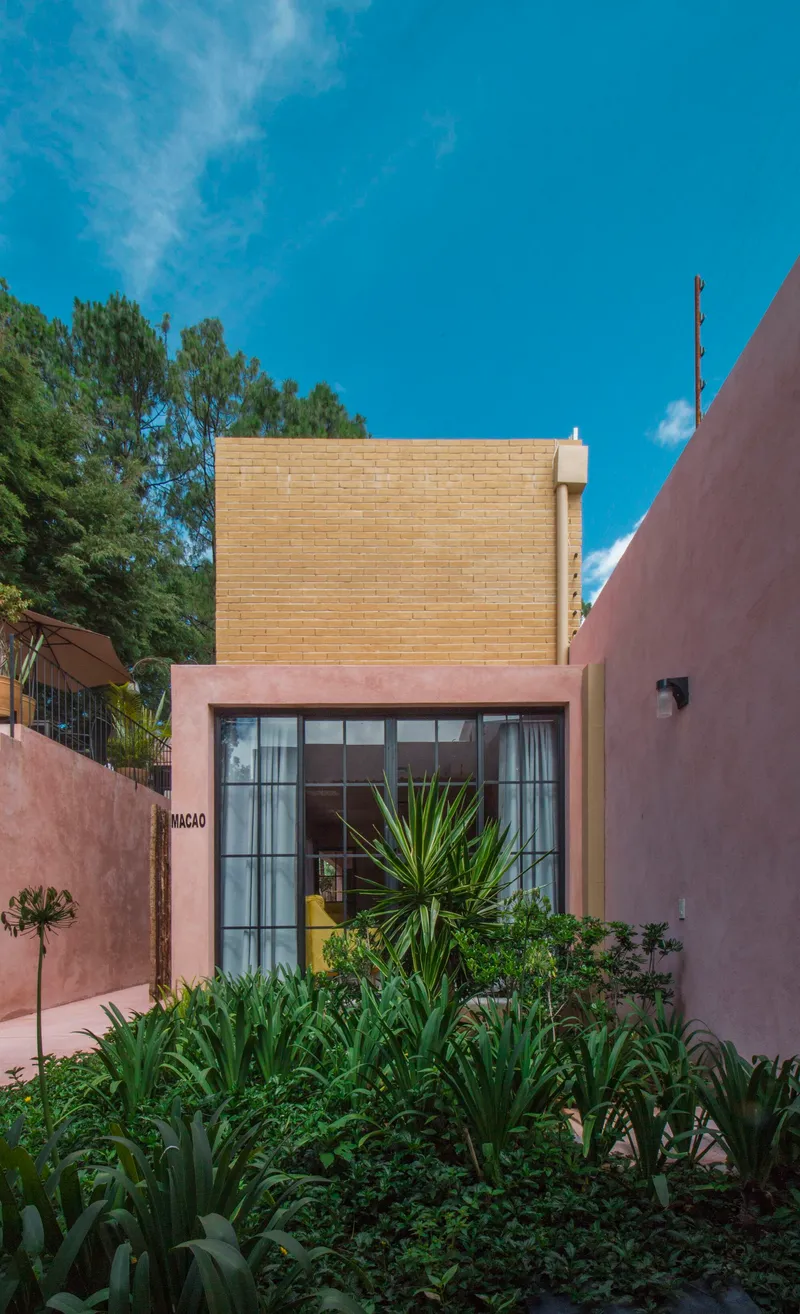
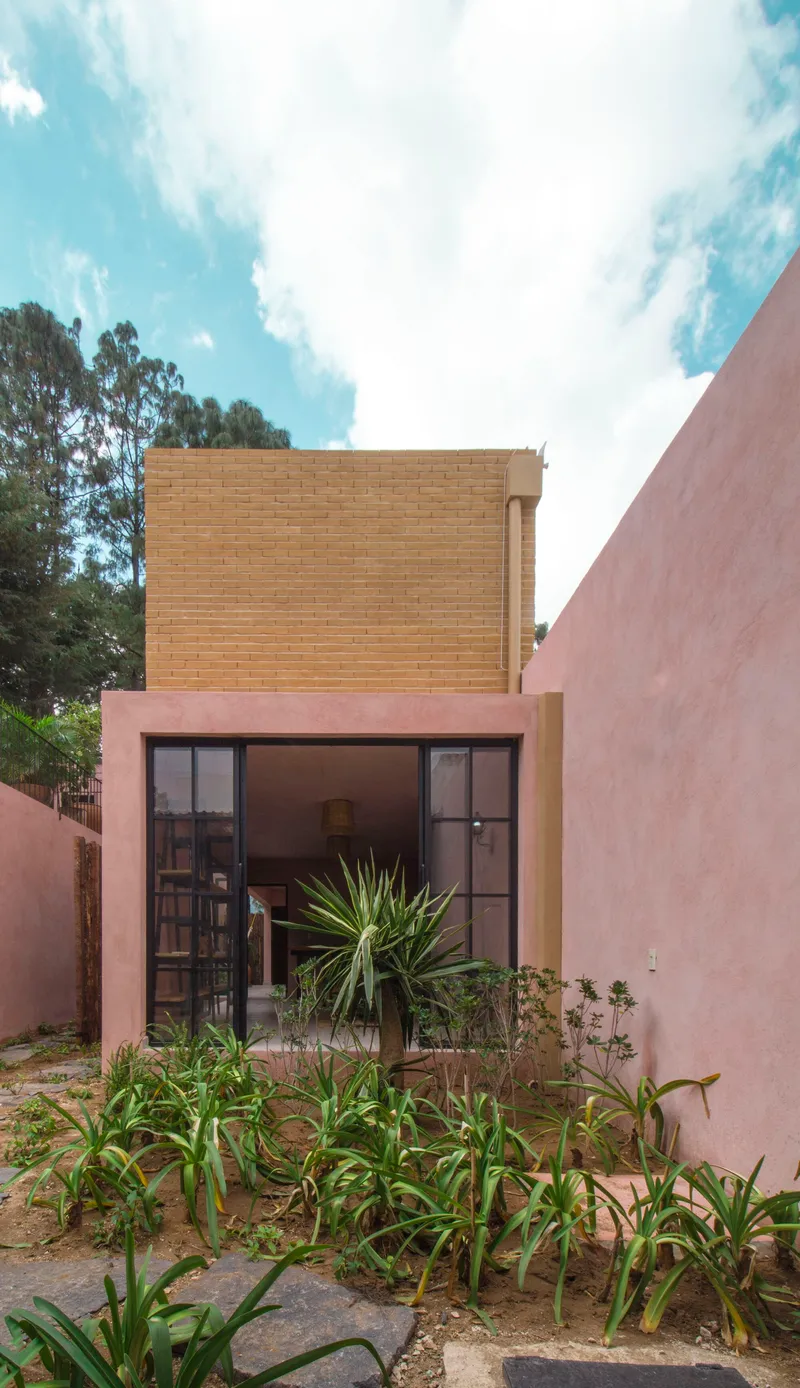
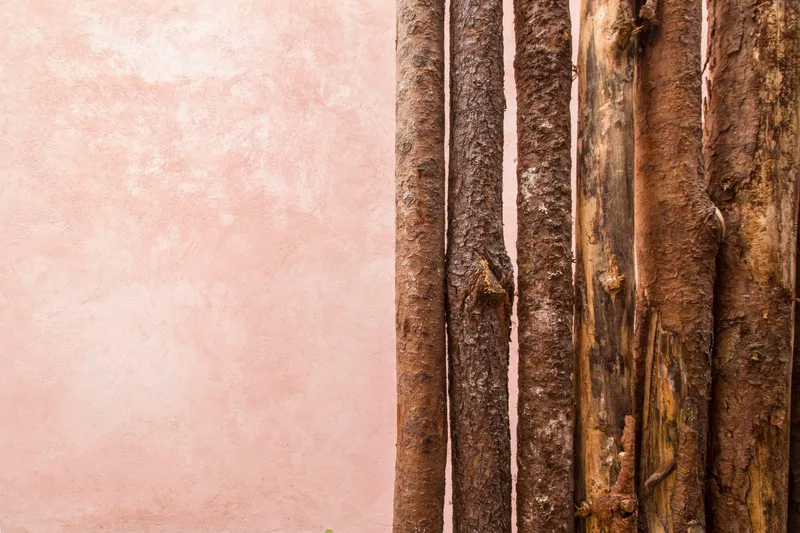
The BTC (compacted earth block) system is the structural backbone. Blocks are fastened with white adhesive and grouted with their own dust, a technique that keeps the material palette honest. Steel reinforcement rods at 60 cm intervals run through the blocks' alveoli, cast into concrete so the wall acts as a fully reinforced plane. The architects describe these rods as functioning like a "trachea," an apt metaphor for walls that breathe while carrying load.
The tan and yellow brick volumes that emerge above the pink stucco base signal this earth construction clearly. Regional block masonry, logs harvested from the site itself, rigid reinforced concrete frames: the material list reads like an inventory of what is available within a short radius of San Cristóbal. That is not austerity. It is strategic economy that lets the budget go toward things that matter, like the steel-framed glazing and the energy systems.
The Teal Spiral and Vertical Circulation
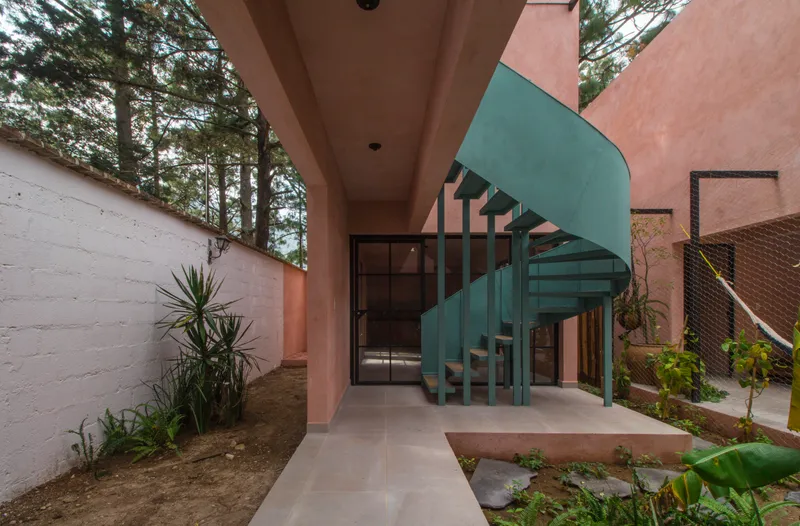
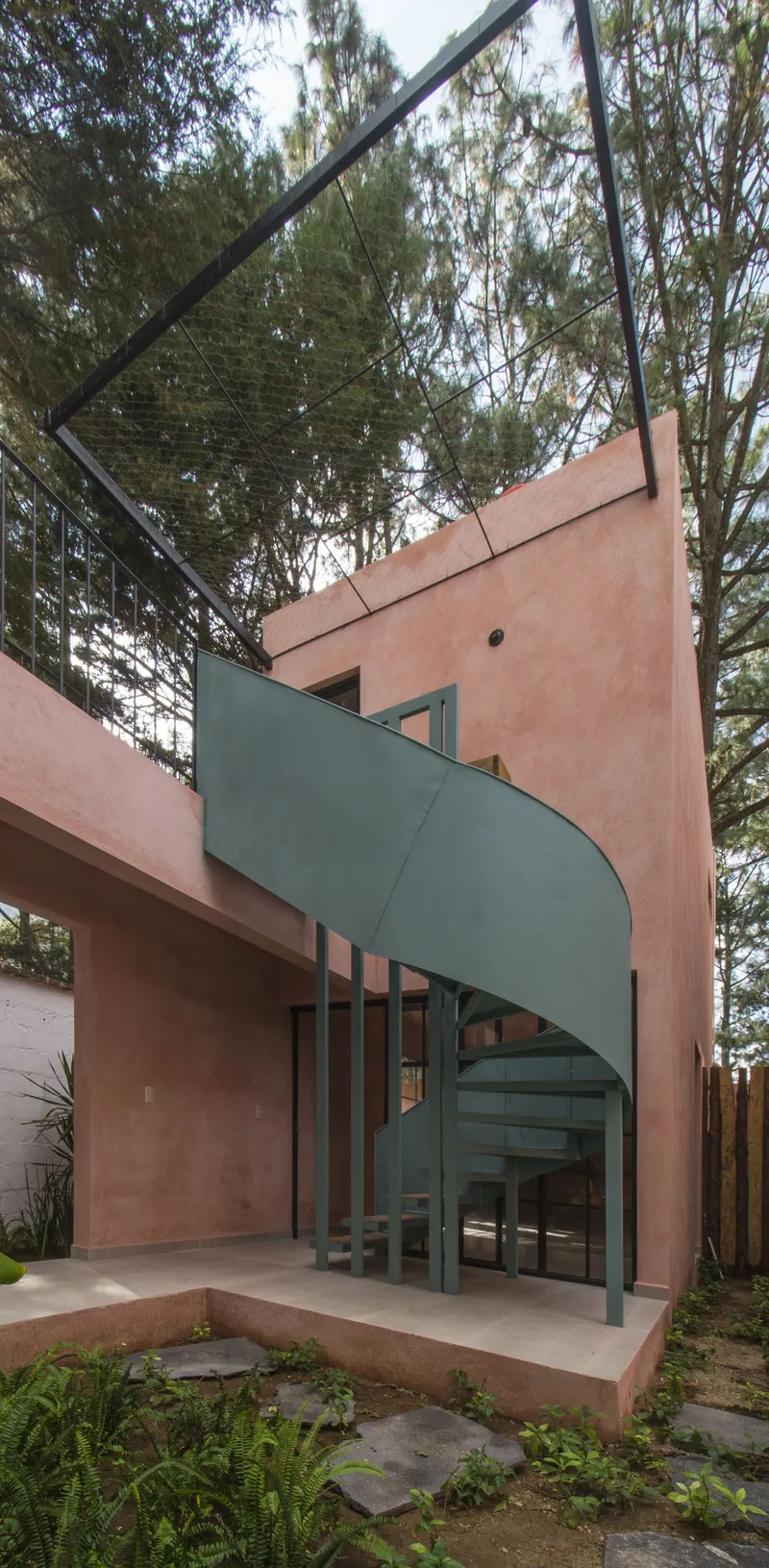
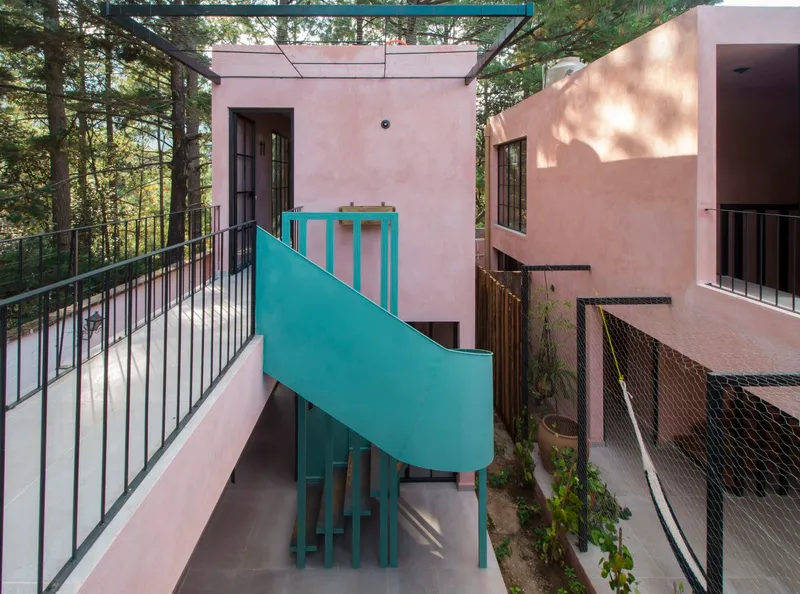
The teal spiral staircase is the project's most photogenic element, and it earns that attention. Placed in the courtyard between pink volumes, it connects ground level to the upper terraces while acting as a vertical landmark within the compound. Its color is a deliberate counterpoint to the warm stucco, making the circulation legible from every angle. Ascending between the walls, you are surrounded by pine canopy and dappled light, which transforms what could be a purely functional element into a moment of spatial pleasure.
Additional open-tread steel stairs appear throughout, reinforcing the idea that moving through this building is not something you do quickly between rooms. The overhead walkways with metal railings connect upper volumes and terraces, creating a second layer of circulation that looks down into the courtyard. It is a small building with the sectional complexity of a much larger one.
Interior Thresholds
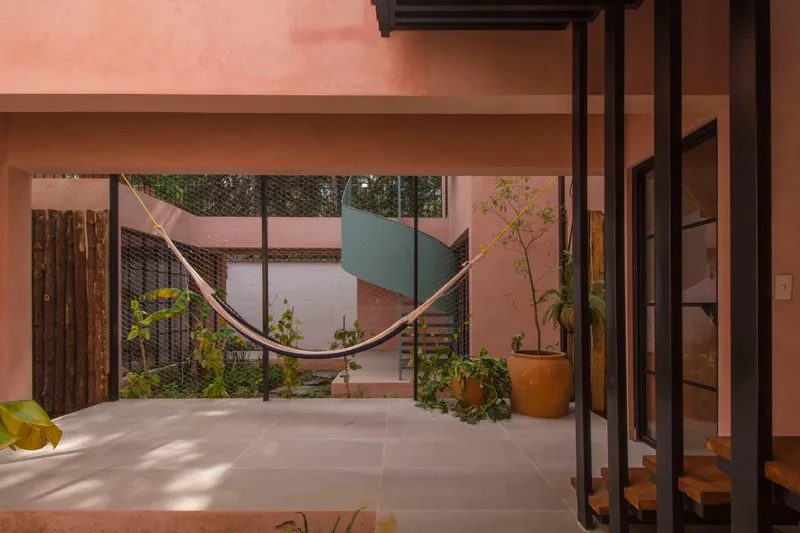
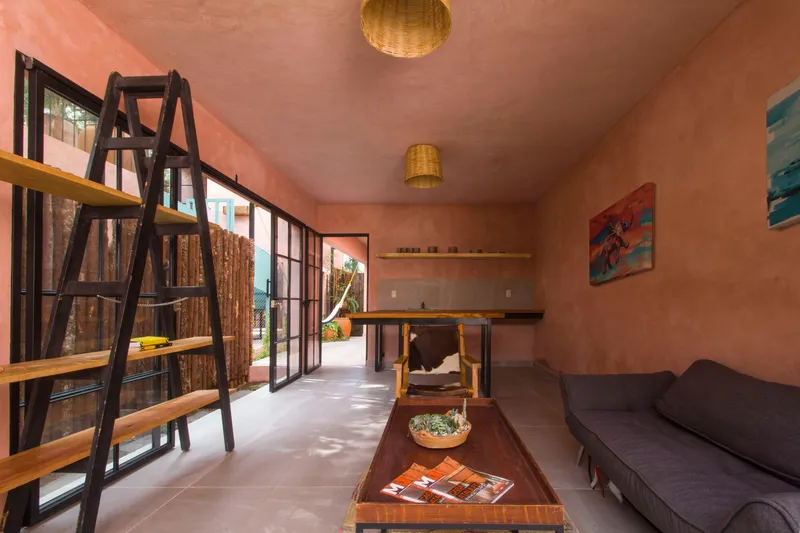
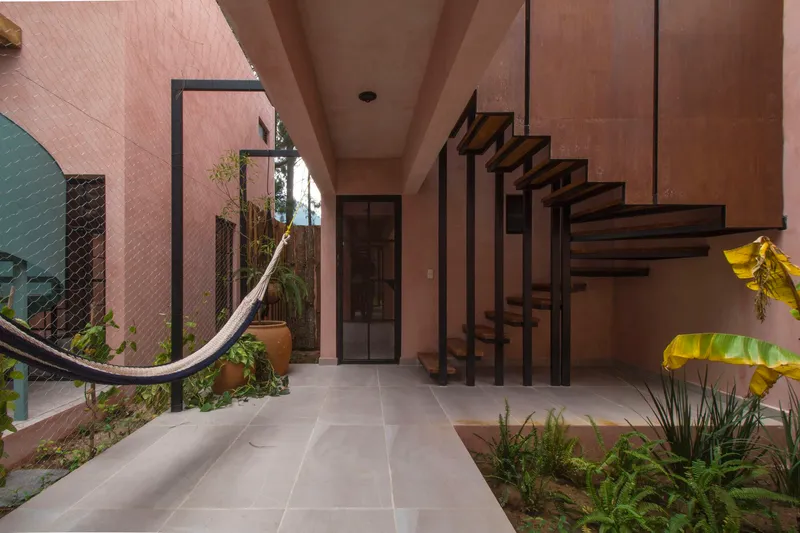
Steel-framed glazing defines the boundary between interior and exterior, and Apaloosa uses it to keep that boundary negotiable. From inside, the courtyard is always present: hammocks, spiral stair, planted beds, and tropical greenery are visible through large glass panels. The interiors themselves are modest, with woven pendant lights, ladder shelving, and exposed pink stucco walls. Nothing competes with the view out.
The tiled passageways that connect rooms double as informal living spaces, furnished with hammocks and plants. For a project built to accommodate rotating guests, these in-between zones are critical. They slow people down, invite lingering, and give the compound a sense of generosity that a conventional apartment layout would not.
Terraces and the Forest Canopy
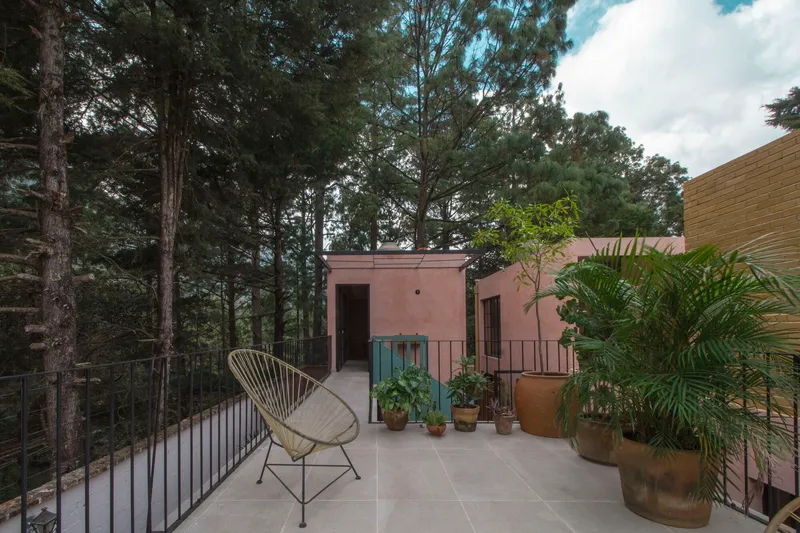
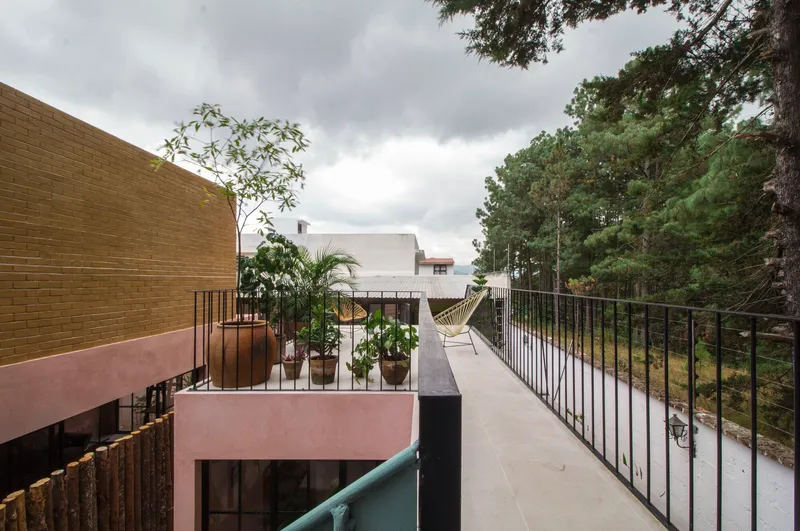
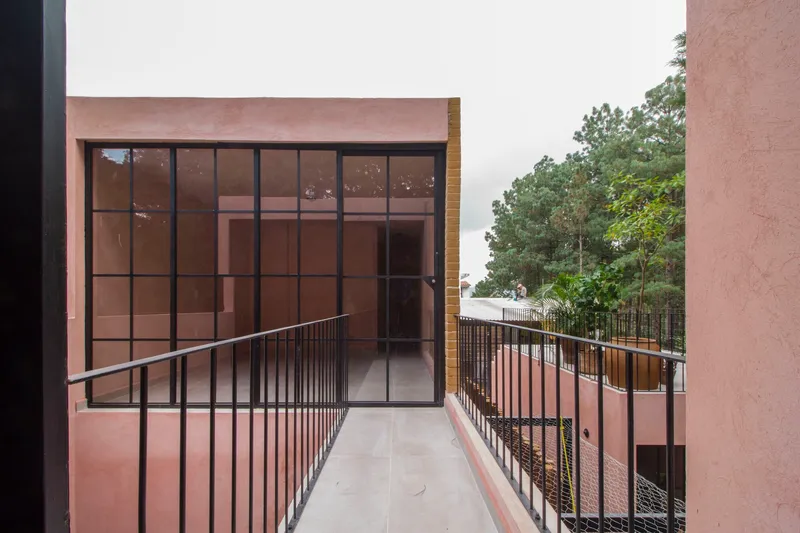
The rooftop terraces are where the project's relationship to the coniferous reserve becomes most direct. At the upper level, metal railings frame views of the surrounding forest, and potted palms and wire furniture suggest an outdoor room suspended among the treetops. The strategy is simple: push living space upward to the canopy line, where the reserve is not adjacent but immersive.
Solar panels for electricity and hot water sit at this level too, though they stay out of the primary views. The 5,000-liter cistern, reused from the pre-existing site condition, collects rainwater for garden irrigation and apartment cleaning. Grey water from sinks and showers feeds the internal side gardens. These systems are not afterthoughts; they are the economic engine that makes the Airbnb model viable over time.
Pathways and Planted Edges
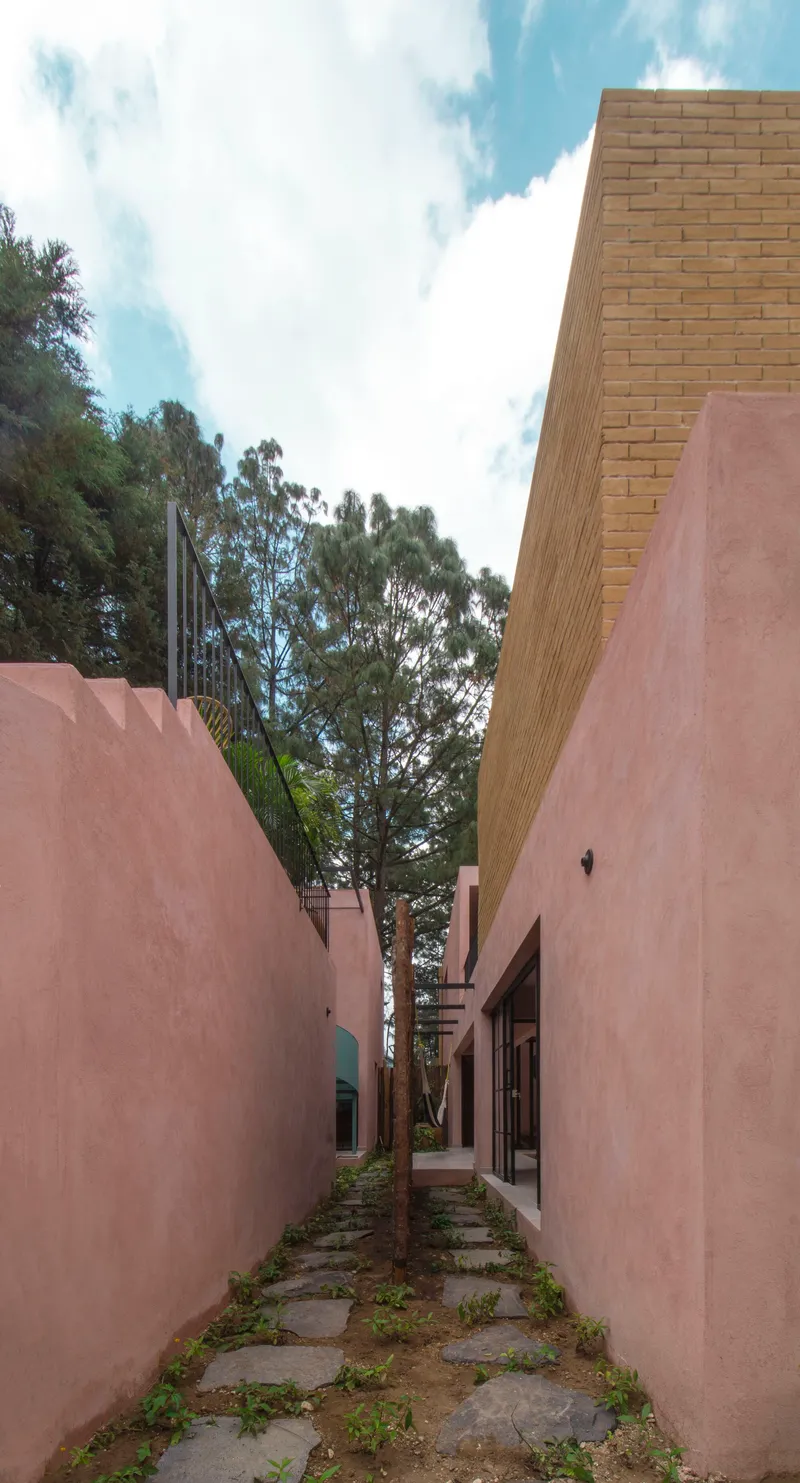
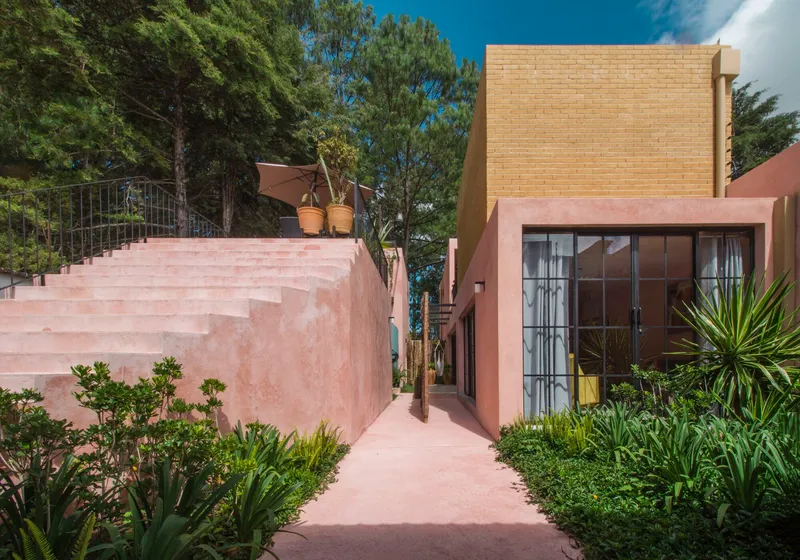
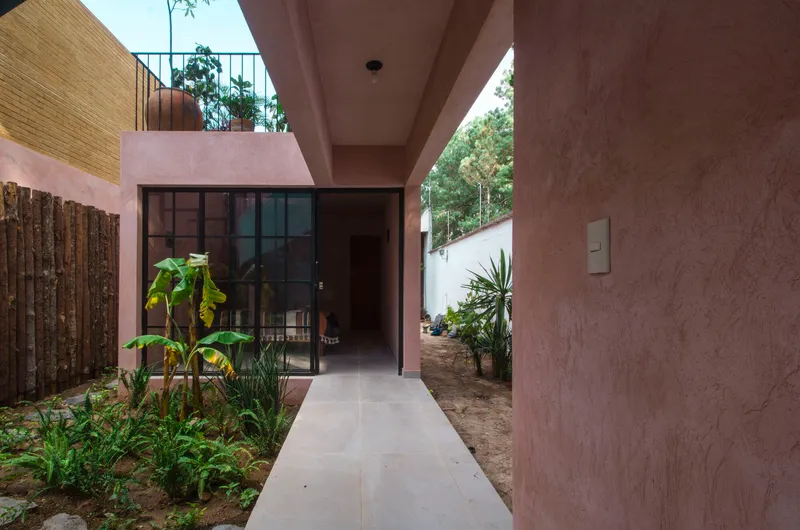
Narrow passages wind between volumes, their stone pavers and planted beds softening what could feel like service corridors. The side accesses are deliberately separated from pre-existing adjoining walls, a detail that keeps the new construction structurally and visually independent. Banana plants, yucca, and agave line these paths, creating a landscape that is productive as well as ornamental since the grey water irrigation system feeds it.
The compound's entry sequence deserves mention. A concrete path threads through a garden courtyard before arriving at a black-framed glass door, a compressed journey from street to interior that establishes the project's priorities before you even cross the threshold. The forest is not a backdrop. It is the organizing principle.
Stairs, Porches, and Outdoor Rooms
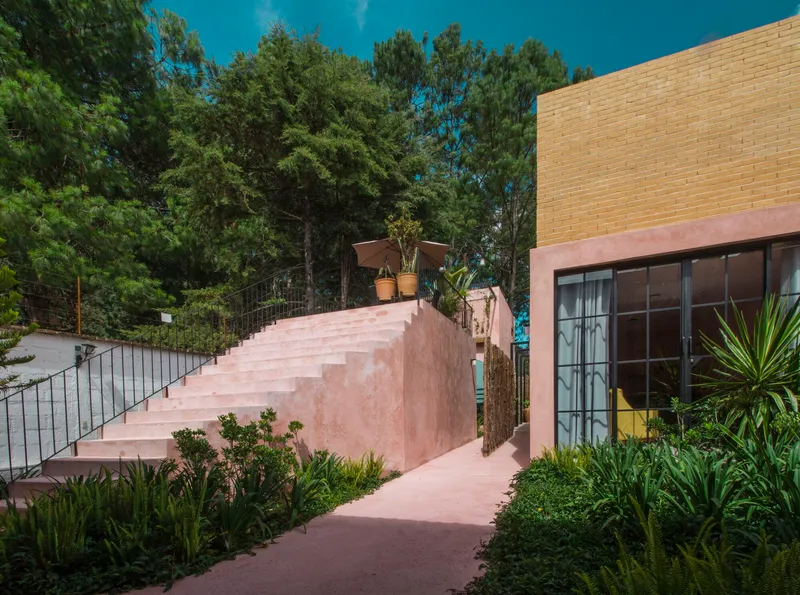
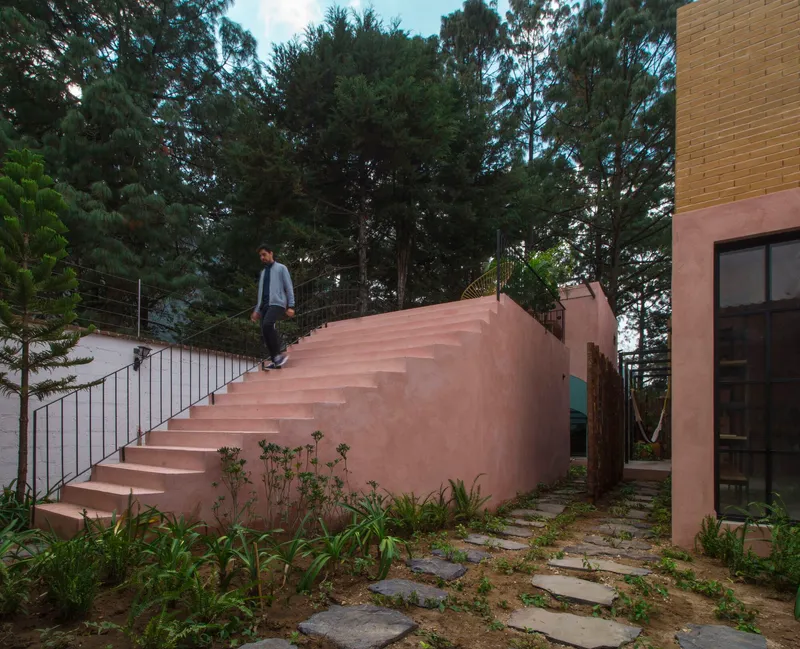
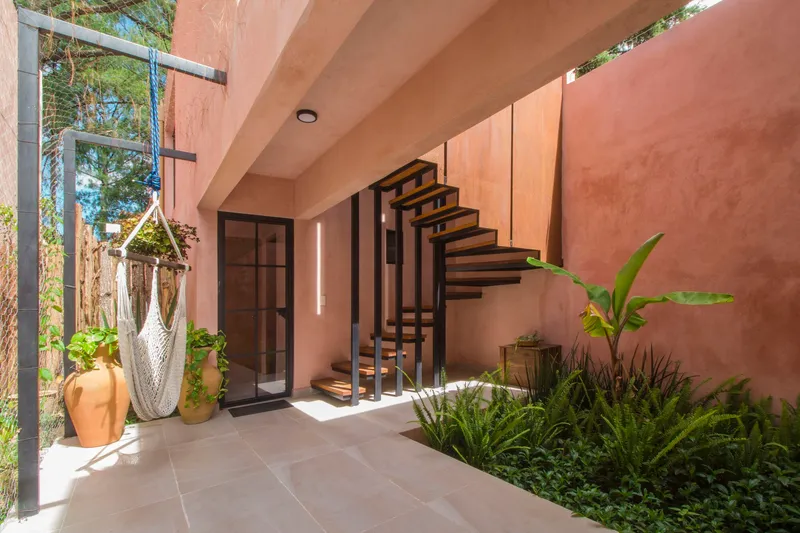
Wide pink stucco stairs ascending between planted beds, cantilevered metal staircases beside covered porches, open-tread steel treads dappled with midday sun: Villa Luciérnagas has an unusually high ratio of circulation to enclosed space. That ratio is deliberate. In a climate like San Cristóbal's, where outdoor living is comfortable for much of the year, the covered terraces and porches are the primary living rooms. The enclosed apartments are for sleeping and for rain.
Plans and Drawings
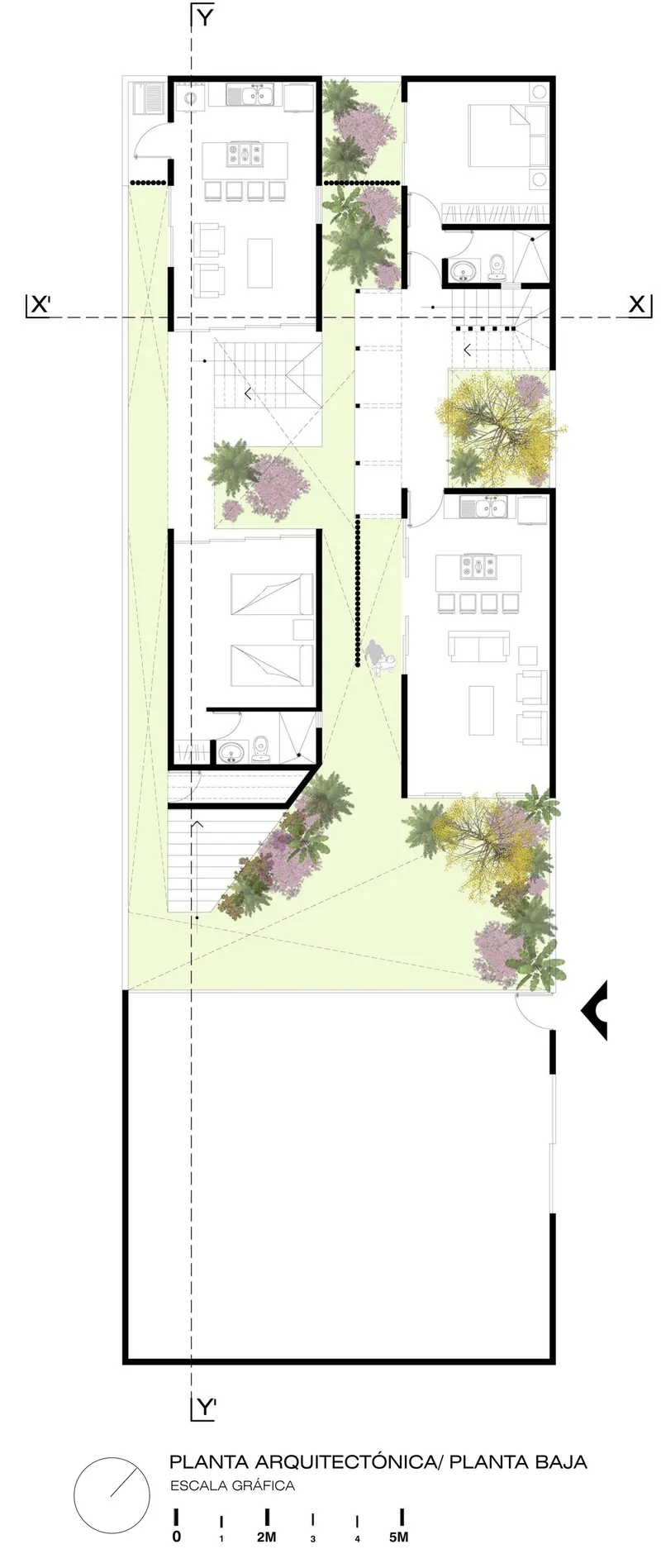
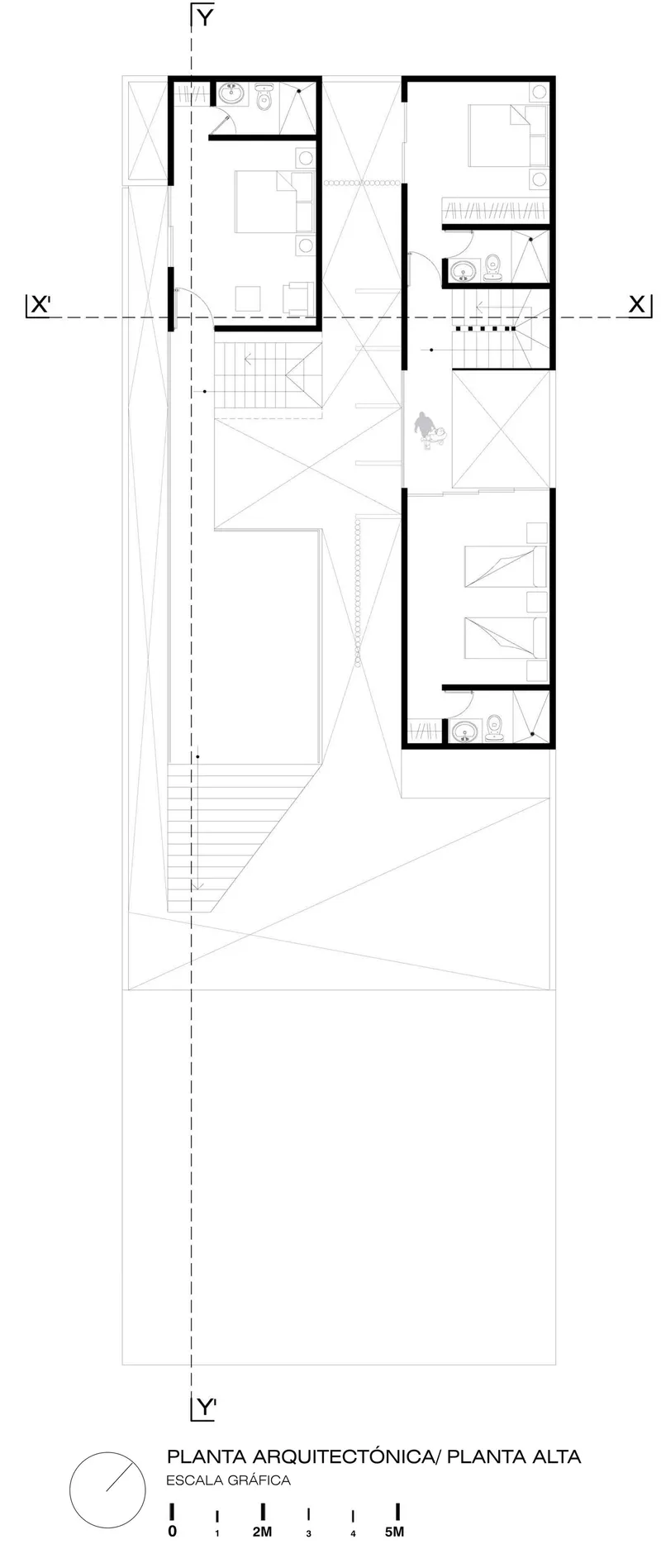
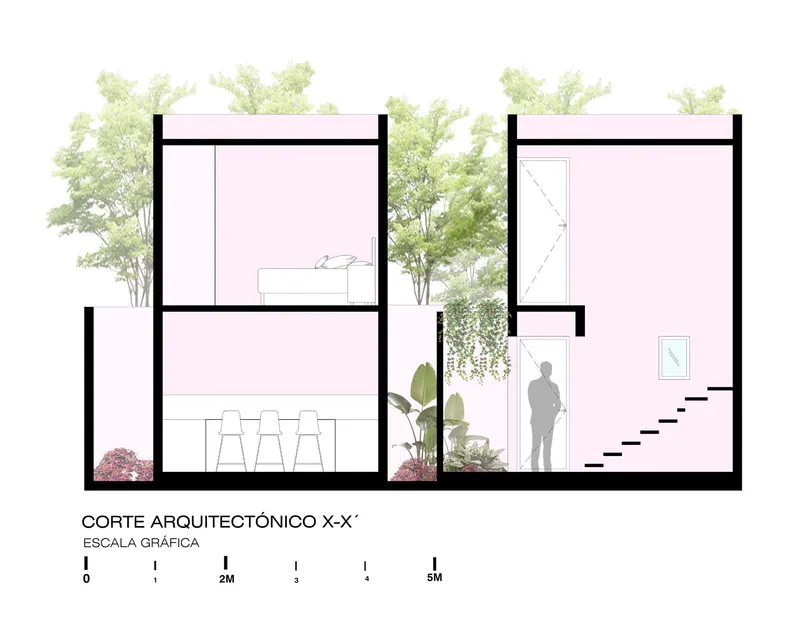
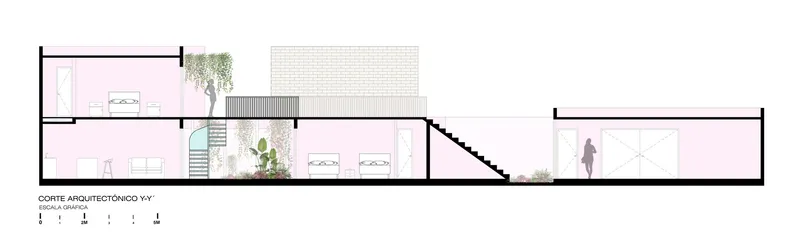
The floor plans reveal the diagonal circulation paths that connect separate apartment bodies, with the courtyard occupying a generous portion of the footprint. Purple and yellow flowering trees in the ground floor plan are not ornamental gestures; they mark the locations irrigated by the grey water system. The sections are equally telling: double-height spaces, split-level volumes, and a central courtyard that functions as a light well, ventilation shaft, and social space simultaneously. Rooftop trees appear in section, confirming that the landscape is not confined to grade but extends vertically through the building.
Why This Project Matters
Villa Luciérnagas operates at a scale where every decision is visible and every shortcut would be obvious. Apaloosa chose to invest in compacted earth blocks, solar infrastructure, and water recycling not because these technologies are fashionable but because they make the building's economic model work. That alignment between environmental ambition and financial logic is rare, and it gives the project a credibility that purely aesthetic sustainability gestures lack.
More broadly, the project demonstrates that Airbnb-oriented architecture does not have to default to generic interiors and neutral palettes. The pink stucco, teal staircase, and earth block walls create a specific identity rooted in place, material, and climate. Guests will remember where they were. That is architecture doing its job.
Villa Luciérnagas by Apaloosa Estudio de Arquitectura y Diseño. San Cristóbal de las Casas, Chiapas, Mexico. 183 m². Completed 2021. Photography by Carlos Berdejo Mandujano.
About the Studio
Share Your Own Work on uni.xyz
If projects like this are the kind of work you want to make, uni.xyz is a place to publish your own, find collaborators, and enter design competitions.




Popular Articles
Popular articles from the community


Lunar Spiral: Space Architecture Shaped by the Mathematics of the Universe
Lunar Spiral reimagines space architecture through Fibonacci geometry, lunar regolith, levitating habitats, and self-sustaining Moon living.

Riyadh For All: Intergenerational Urban Design for Active Aging in Rabat
Riyadh For All reimagines urban design in Rabat with intergenerational co-living, adaptive courtyards, and Moroccan cultural exchange today.

Co-life: Sustainable Architecture for Age-Friendly Community Living
Co-life reimagines sustainable architecture for seniors through courtyards, rammed earth, shared gardens, and spaces designed for belonging.

Conexión: Biophilic Design Reimagines High-Rise Living in Hong Kong
Conexión reimagines high-rise living in Hong Kong through biophilic design, green facades, shared spaces, daylight, water and nature within.


Similar Reads
You might also enjoy these articles

Bao Huynh Watercolor Atelier: A Serene Art Retreat in Hội An
Bao Huynh Watercolor Atelier in Hội An blends multifunctional art spaces, sustainable design, local materials, and family-friendly living in a serene environment.

Atelier Macri Concept Store Interior Design by CASE-REAL
Atelier Macri store features a "ko" counter, walnut wood details, cork displays, blending retail, gallery, and seamless customer experiences.

Manuel Vargas Izquierdo Stadium and High-Performance Sports Center: Architectural Excellence in Jalpa de Méndez
The Manuel Vargas Izquierdo Stadium blends sustainable design, inclusive sports facilities, and cultural-inspired architecture, revitalizing Jalpa de Méndez’s public spaces.

KAKR Buluh Awar Hall: Revitalizing Community and Ecology Through Bamboo Architecture
Community built bamboo hall revitalizes Buluh Awar village, empowering youth, restoring ecology, celebrating vernacular craftsmanship through sustainable architecture and culture.



Comments (0)
Please login or sign up to add comments
No comments yet. Be the first to comment!