

a2o architecten Builds a Concrete and Brick Wunderkammer in the Belgian Countryside
House Be in Flanders treats dwelling as a Romantic act, threading rooms along a central axis that opens gradually toward a restored landscape.


There is a particular strain of Belgian residential architecture that refuses to choose between rigor and warmth. a2o architecten's House Be, completed in 2022 in Flanders, belongs firmly to that tradition. Organized as a central trunk with branching wings, the house draws its inhabitant along a carefully calibrated axis: from an entrance courtyard, past the kitchen and living areas, into a double-height garden room that the architects describe as a contemporary Wunderkammer. The sequence is not just spatial but perceptual. Light, views, and proximity to planting shift with every step, so that you never feel you are simply walking through a plan.
What makes the project genuinely interesting is the tension it sets up between a heavy concrete skeleton and the landscape it frames. The board-formed concrete is visible everywhere: in the facade columns, the interior ceilings, the covered passageways. Yet rather than reading as monolithic, the structure is deliberately porous. Large glazed openings, internal courtyards, and planted roofs allow the garden, designed by BuroLandschap, to infiltrate the building at every turn. The architects invoke the Romantic motif of the 19th century arts, that sensitive friction between sublime nature and human presence. It is a lofty reference, but the house earns it through the sheer discipline of its material choices and spatial choreography.
Concrete Frame, Open Threshold


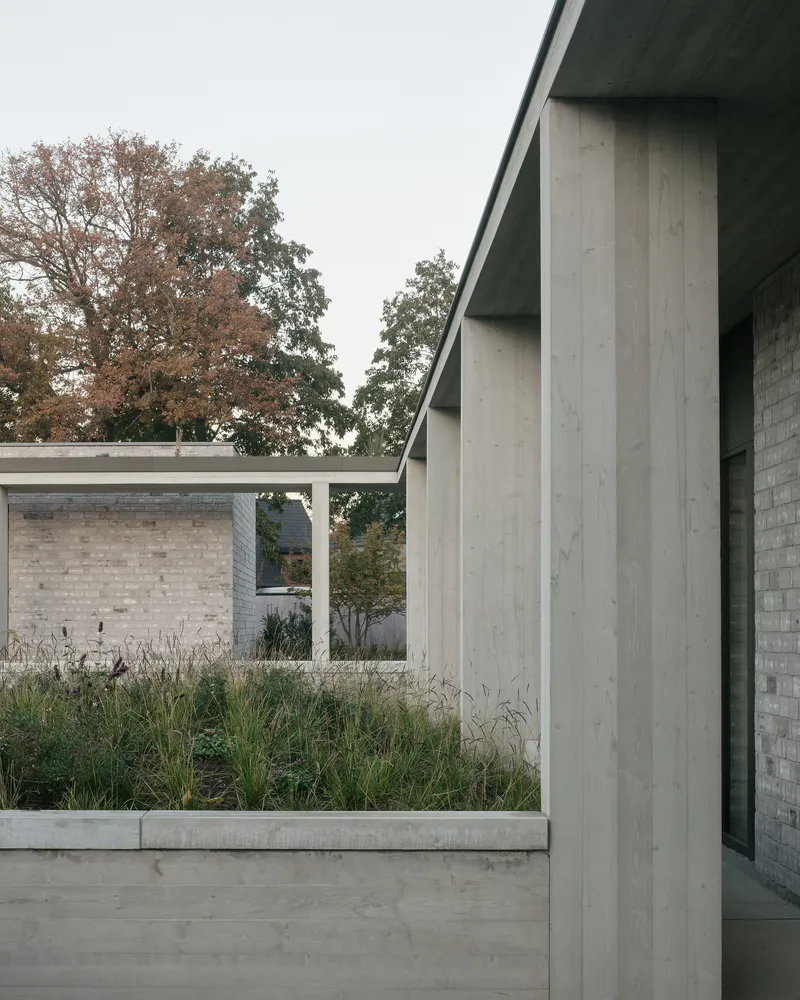
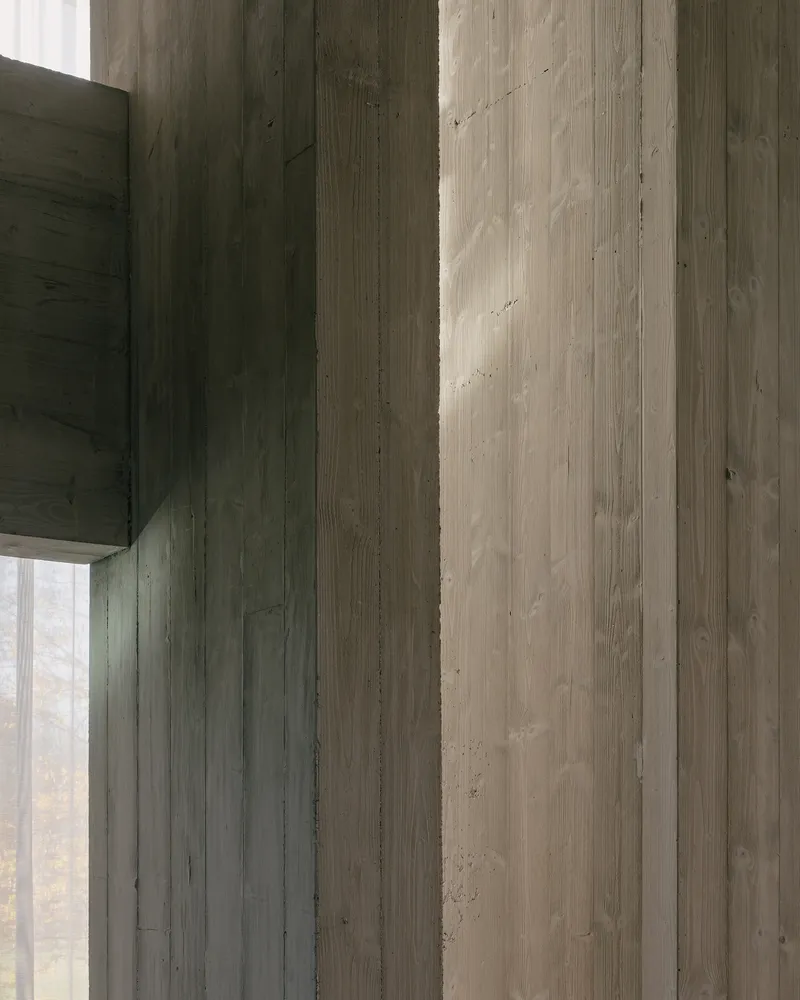
The concrete skeleton is the first thing you register and the last thing you forget. Board-formed with wooden planks, it carries a vertical grain that softens what could have been a brutalist monolith. The frame does double duty: structurally, it creates deep overhangs and covered terraces; aesthetically, it establishes a rhythmic colonnade that mediates between interior comfort and the wild grasses outside. Custom-made bricks, fired in a traditional Belgian ring oven and matched to a light grey tone, fill the gaps between concrete members. The result is a facade that reads as both heavy and breathable.
At dusk, the canopy and columns create a threshold that is neither fully inside nor fully out. Dormant ornamental grasses press against the concrete edges, and the planted beds beneath the colonnade feel like excavations rather than additions. The building does not sit on its landscape so much as interlock with it.
The Garden Room as Culmination

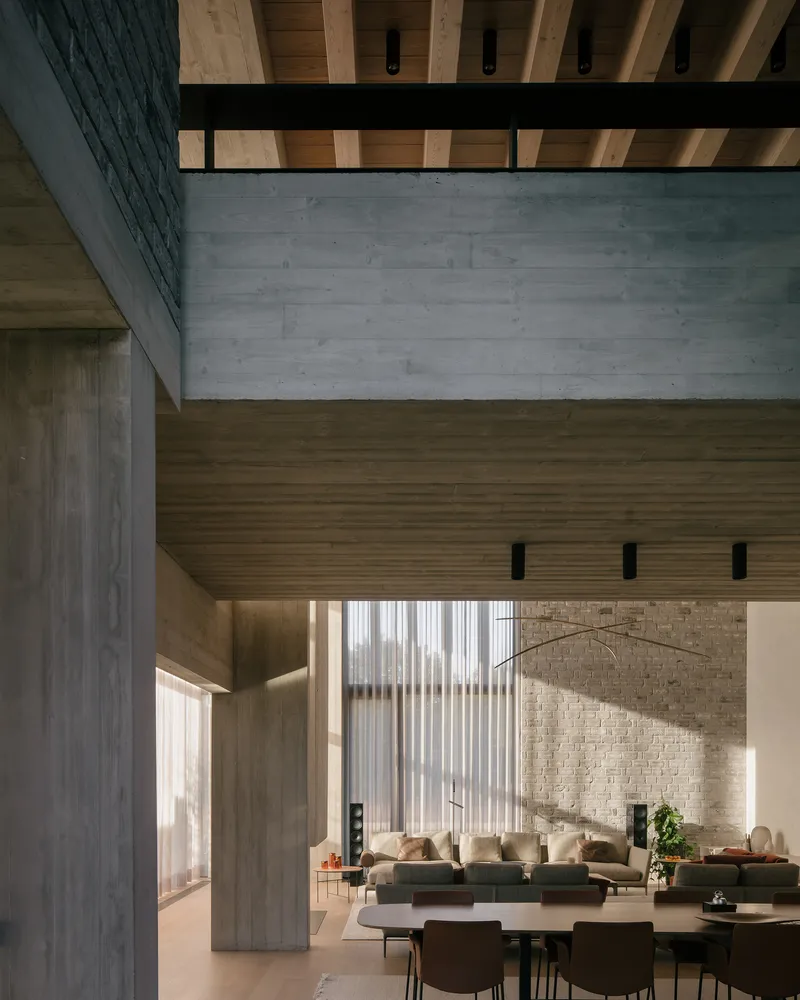
The central axis terminates in a double-height garden room that is the emotional core of the house. Floor-to-ceiling glazing dissolves the boundary between the interior and a small ornamental garden of flowers and rose bushes just beyond the glass. Exposed timber ceiling beams span the full width, their warm tone counterbalancing the cool grey of the concrete columns below. Sheer curtains filter afternoon light into something almost gaseous, diffusing hard shadows and lending the room a quality closer to a greenhouse than a living space.
A floating concrete fireplace anchors one side of the room, accompanied by a brass light artwork that hints at the Wunderkammer conceit: the space is furnished not merely for comfort but for contemplation, in the tradition of cabinets of curiosity found in old Flemish mansions. A free-standing spiral staircase connects this room to the basement and first floor, turning vertical circulation into a sculptural event.
Courtyards and Filtered Light
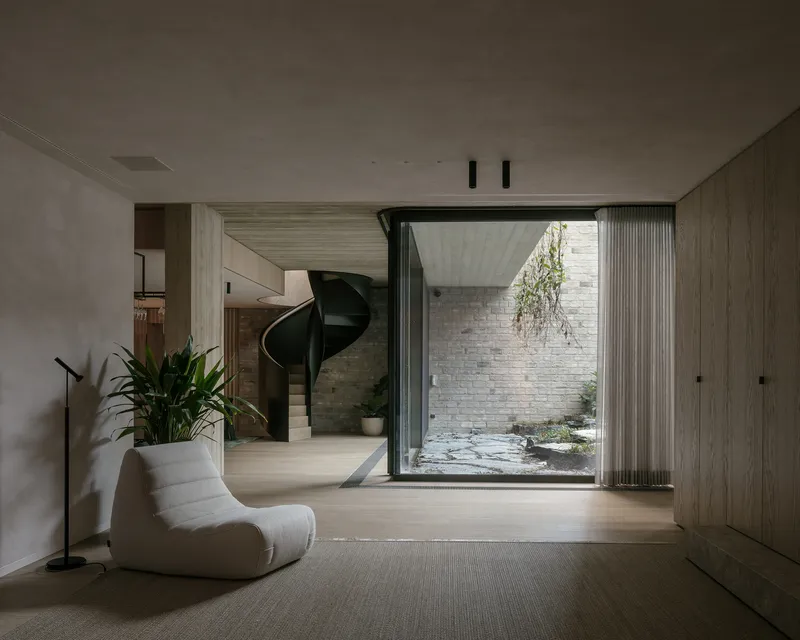

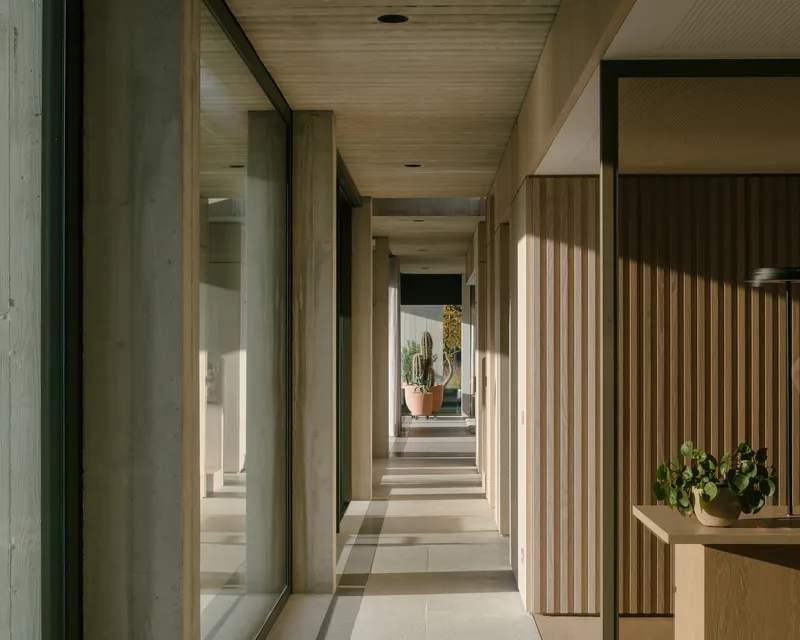
The plan deploys internal courtyards as light wells, ventilation channels, and moments of visual relief along the trunk. One court, framed by brick walls and hanging greenery, is visible from the entrance zone and establishes the relationship between interior and planting before you reach the main living areas. Another, more contemplative, holds a single small tree and stepping stones, framed entirely by full-height glazing. These are not leftover voids. They are rooms without roofs, calibrated to pull daylight deep into corridors that would otherwise rely on artificial illumination.
Vertical timber slat screens line the corridors flanking these courtyards, creating a secondary rhythm against the concrete grid. The slats filter sightlines without blocking them, so movement through the house is always accompanied by a flickering awareness of green. Each room is oriented differently, varying the incidence of light and the character of the view, a strategy that keeps the plan from feeling repetitive despite its strict axial logic.
Timber, Stone, and the Art of Restraint
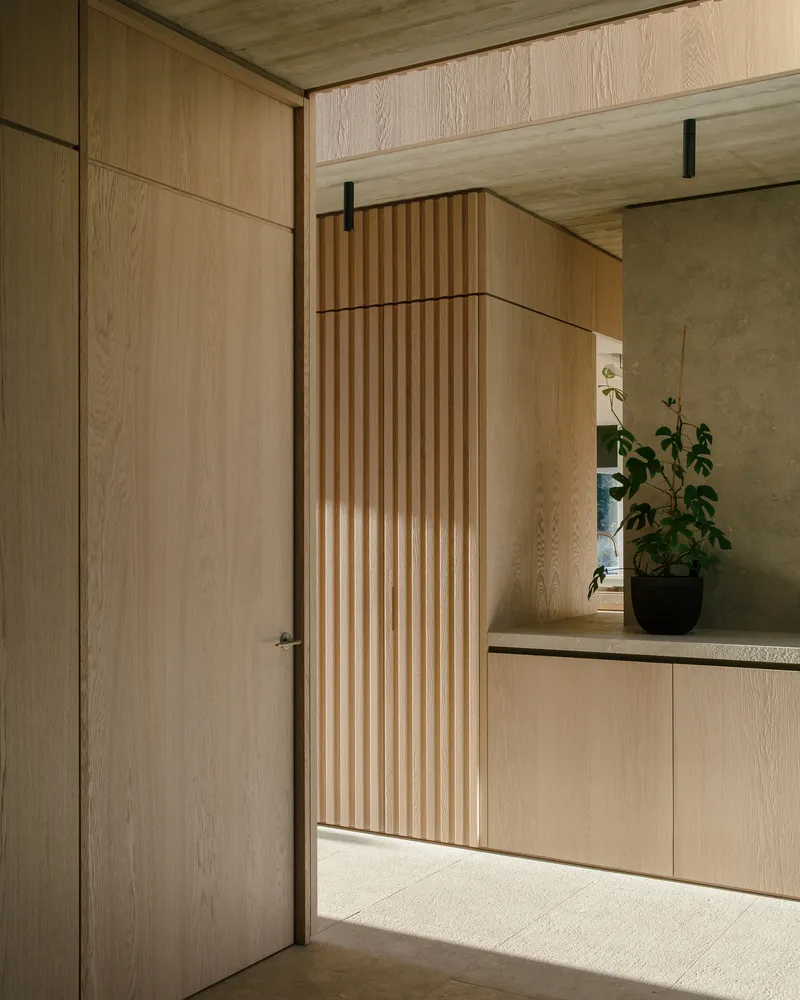


The interior material palette is narrow and deliberate. Brushed oak joinery appears in flush doors, slatted partitions, and wall panels. Natural limestone floors run continuously through the ground level. The woodwork is simple, with no excessive frills: doorways are accentuated, cupboard doors carry wooden slats and visible handles. These are details that reward touch as much as sight, a special tactility that the architects clearly consider essential to the project's character.
A block of green-veined marble meeting a pale stone wall becomes a material study in itself: angular shadows trace the junction, and the contrast between the stone's organic veining and the geometric precision of the cut reveals the care taken in proportioning even the smallest elements. Throughout the house, materials are applied in what the architects call a rough but refined way. Nothing is polished to a mirror finish; nothing is left truly raw. It is a careful middle ground that gives the interiors their particular warmth.
The Spiral Stair and Vertical Detail

The black metal spiral staircase with timber treads is the most explicitly sculptural element in the house. Set against a white brick wall and flanked by vertical timber panels, it reads as an industrial counterpoint to the otherwise warm palette. Its slender profile keeps it from dominating the garden room, functioning instead as a piece of furniture that happens to connect three levels: the basement spa and bar, the ground floor living areas, and the first floor bedrooms.
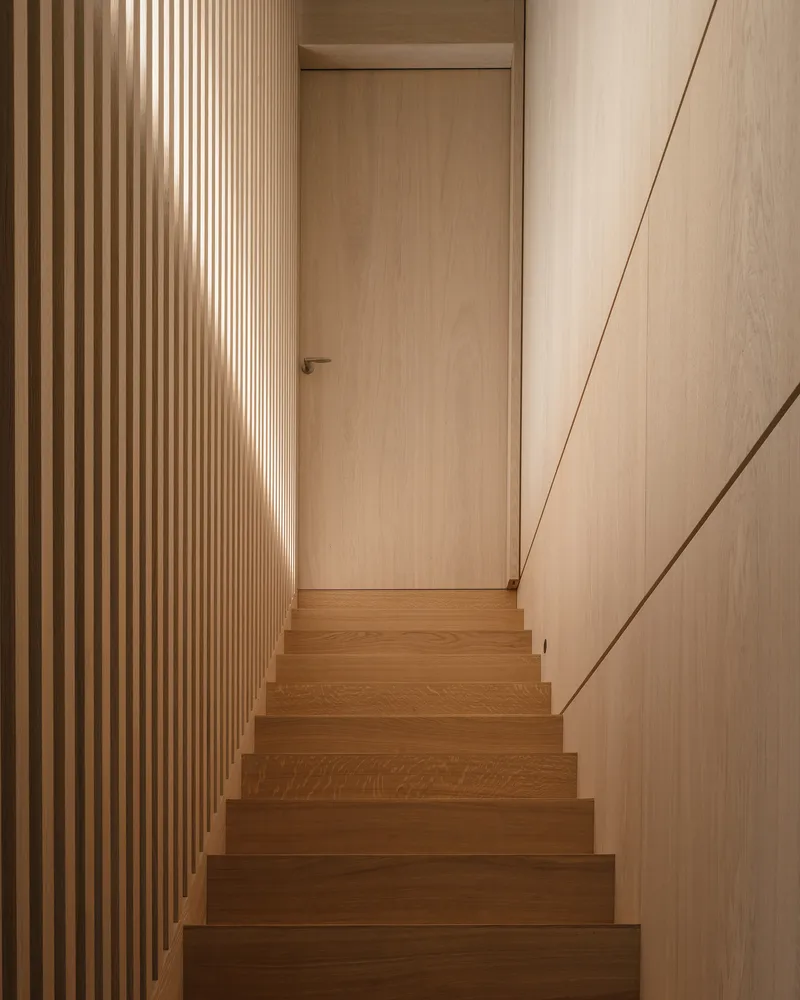
A secondary timber staircase, tucked between a slatted wall and an angled paneled surface, serves the private wing. The detailing here is quieter, almost domestic in scale, and the change in material signals the transition from the public trunk to the private branches of the plan. Nearby, a board-formed concrete wall and beam junction exposes the vertical formwork texture in natural light, a moment where the construction process becomes ornament.
Landscape as Architecture

The garden facade tells the story most clearly. Full-height glazing, vertical timber screening, and a mature tree in autumn foliage collapse the distinction between building and site. Roofs overgrown with flowers and plants extend the garden upward, making the house a piece of topography as much as a piece of architecture. BuroLandschap's restored landscape wraps the structure in ornamental grasses, small flower beds, and a Japanese garden that serves the basement patio, creating distinct outdoor rooms at every level.
The outdoor kitchen and terrace, sheltered beneath a concrete awning, reinforce the idea that the house's program does not end at the glass line. Living space flows outward through covered thresholds, planted courts, and garden rooms, blurring the envelope until the building feels less like an object placed on a site and more like a clearing in a landscape that has always been there.
Plans and Drawings
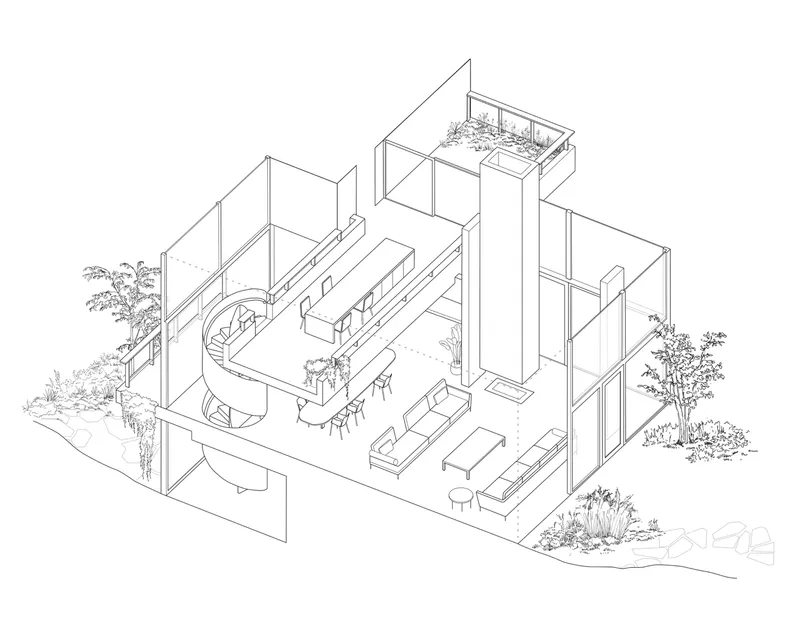
The axonometric drawing reveals the branching logic of the plan with clarity that the photographs, by their nature, can only hint at. The central trunk runs from the entrance courtyard through the kitchen and living areas to the garden room, while workrooms and the night hall deflect from this axis to maintain separation between public and private life. The spiral stair appears at the intersection of trunk and garden, confirming its role as the spatial hinge of the house. Planted terraces and courtyard voids are legible as integral parts of the floor plate, not afterthoughts.
Why This Project Matters
House Be is not the first Belgian home to use concrete, brick, and timber in concert, and it will not be the last. What sets it apart is the conviction with which it pursues a single idea: that a house can be simultaneously a heavy, grounded structure and a transparent frame for the landscape around it. The Romantic reference is not decorative posturing. It is embedded in the plan's sequential unfolding, in the way views are withheld and then released, and in the insistence that every room have a distinct orientation to light and greenery.
The project also demonstrates that material richness does not require material excess. Three primary materials, concrete, brick, and oak, carry the entire palette. Their textures are allowed to speak because the detailing is restrained: no gratuitous reveals, no overwrought junctions. For architects working on residential projects in similar rural contexts, House Be offers a clear lesson in how discipline at the level of the detail can produce a building that feels generous, even luxurious, without ever resorting to spectacle.
House Be by a2o architecten, Flanders, Belgium, completed 2022. Photography by Stijn Bollaert.
About the Studio
Share Your Own Work on uni.xyz
If projects like this are the kind of work you want to make, uni.xyz is a place to publish your own, find collaborators, and enter design competitions.


Popular Articles
Popular articles from the community


The Amber Palace Opera: A Geological Fiction Surfaces on Tallinn's Baltic Waterfront
Pierre Brillard reimagines a Baltic legend as a public landscape, opera house, and waterfront promenade rooted in Tallinn's coastal identity.

Aquadapt: An Underwater Habitat That Rewrites Its Rooms by the Hour
Curved modules ring the seabed while one shell shifts from breakfast room to cinema, farm and football pitch as residents' needs change.


Cube Design Draws an Ecological Corridor Between Two Shenzhen Hills with the Nankai Building
Beside Shenzhen's container docks, the Nankai Building pairs stacked balconies with a climbing green screen to connect two hillsides across its height.

FCC Arquitectura Expands a Portuguese Granite House with a Board-Marked Concrete Wing
In Portugal, JV House pairs a cleaned-up whitewashed and granite dwelling with a timber-shuttered concrete extension, courtyards and a garden pool.

Similar Reads
You might also enjoy these articles

LAVA Architecten Gives Vocational Education a Sawtooth-Roofed Face on a Mechelen School Campus
In Mechelen, Belgium, a 2,053 m² STEM school on a 6×6 m grid turns workshops and classrooms into rooms that can be rearranged as teaching changes.

KEMA Studio Turns a Derelict Marvila Attic into a 60 m² Lighthouse Apartment Above Lisbon
In Lisbon's Marvila district, a rebuilt roof, four skylights and two plywood volumes turn an unlivable attic into a bright home facing the Tagus.

Pixel Gardens: One Repeated Module Stacked Into a Terraced Social Housing Tower for Famagusta
Salem Bader's shortlisted housing tower builds a vertical neighbourhood from one repeated module, offsetting units to carve terraces, light and air.

Bao Huynh Watercolor Atelier: A Serene Art Retreat in Hội An
Bao Huynh Watercolor Atelier in Hội An blends multifunctional art spaces, sustainable design, local materials, and family-friendly living in a serene environment.


Comments (0)
Please login or sign up to add comments
No comments yet. Be the first to comment!