
HEIMA Architects Scatters Four Oak-Shingled Pavilions Among the Pines of Northern Lithuania
A 150-square-meter guest house on a Lithuanian hilltop splits into four volumes to preserve every tree on the site.


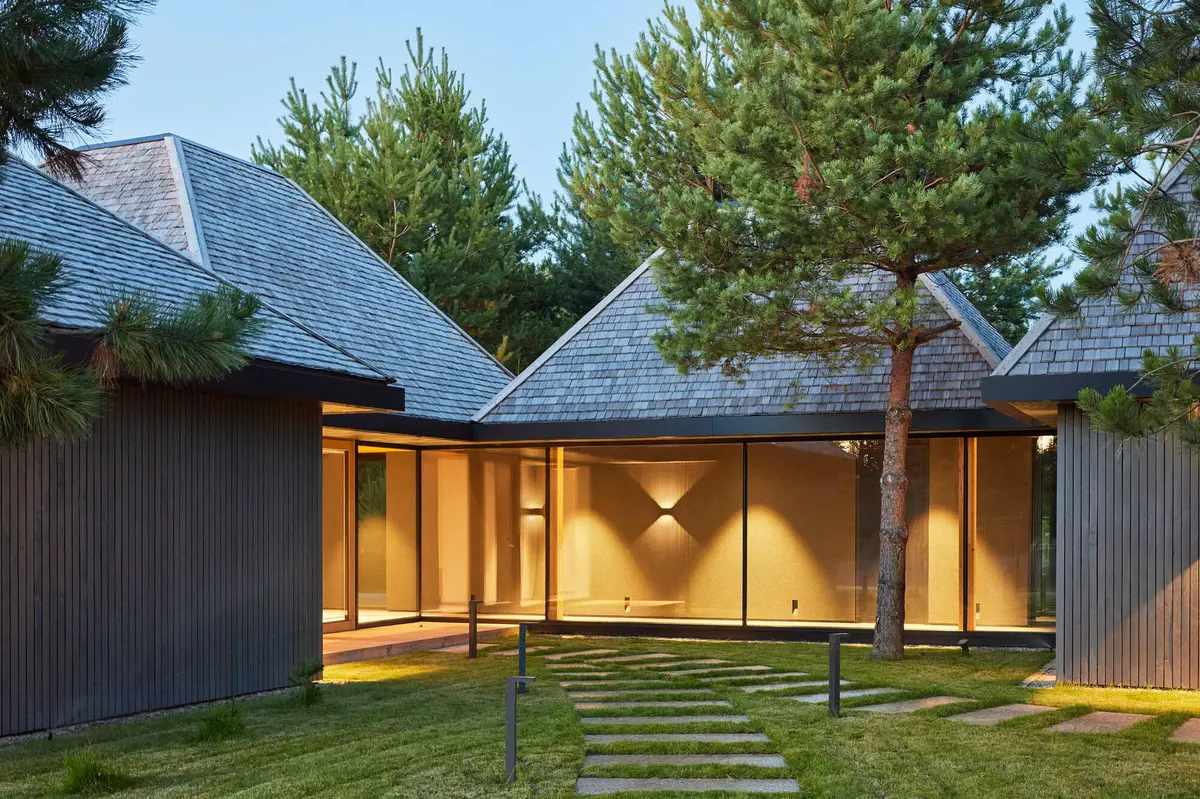
There is something quietly radical about a building that refuses to clear its own site. On a hilltop in northern Lithuania, overlooking a valley and a water basin, HEIMA architects designed a 150-square-meter guest house by breaking it into four distinct volumes and threading them between the existing pine trees. The result is not one building but a small constellation: three bedrooms with private bathrooms and a shared kitchen-parlor, all linked by glazed corridors and anchored by a generous timber terrace that wraps around trunks rather than cutting them down.
What makes the project genuinely interesting is its refusal to treat landscape as backdrop. The architecture is shaped by the trees, not the other way around. Each volume takes a different footprint and orientation, determined less by compositional preference than by what was already growing there. The oak-shingled pyramidal roofs give the cluster a familial identity while the skylights punched into each peak flood the interiors with overhead light, pulling the sky into rooms that are already opening laterally onto forest. It is a guest house that behaves more like a clearing than a structure.
A Cluster, Not a Building

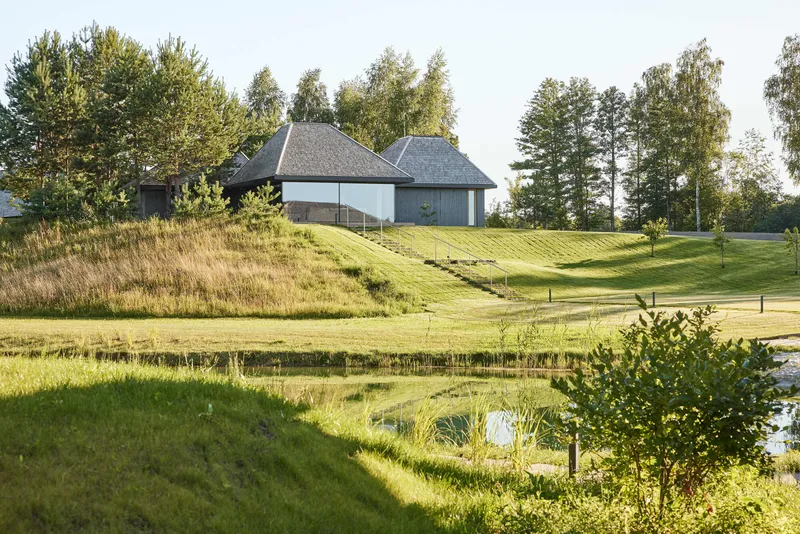

From the air, the four pyramidal roofs read as a deliberate scattering, their oak shingles aging toward the same grey-brown as the surrounding bark. The choice to split the program into separate volumes rather than consolidate it under a single roof is the project's foundational move. It preserves the tree canopy, creates sheltered courtyards between pavilions, and gives each bedroom its own sense of isolation. The cluster sits on the highest point of a larger recreational compound, which means these small roofs, rather than one long elevation, punctuate the ridgeline.
Seen from the pond below, the volumes group into a silhouette that could almost be mistaken for a stand of unusual trees. The conical rooflines are steep enough to shed rain and snow but also steep enough to register as vertical forms against the landscape, not horizontal intrusions. That distinction matters: they belong to the hill instead of sitting on it.
Between the Volumes
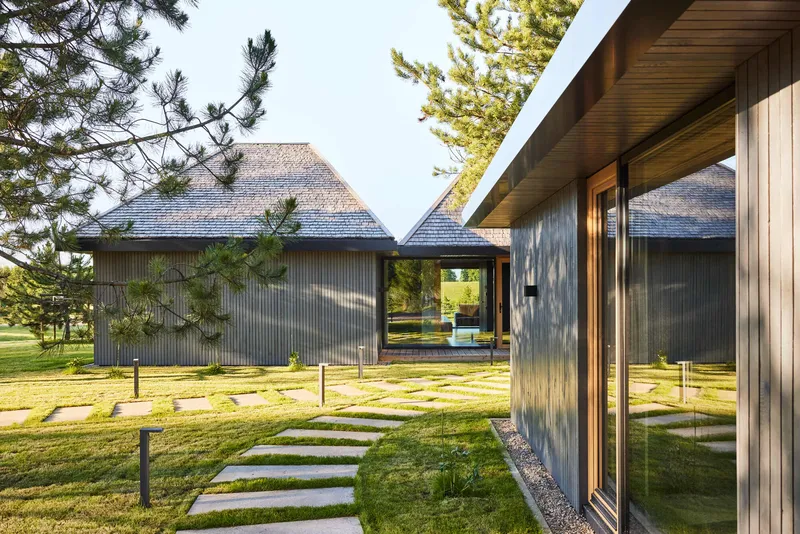
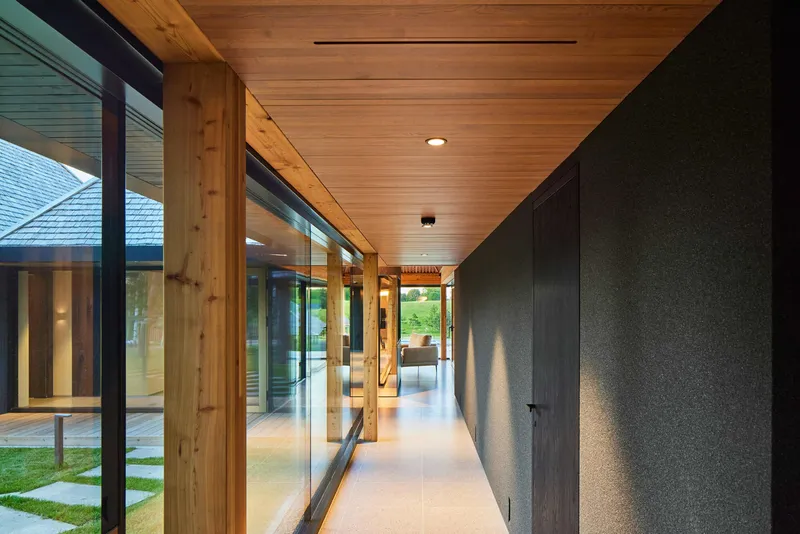

The glazed corridors that connect the pavilions are as important as the rooms they serve. These walkways are not just circulation; they are the project's social infrastructure, the places where guests cross paths moving between private sleep and communal gathering. At dusk, the corridors glow, turning the connective tissue into the most visible part of the building. Timber posts and plank ceilings give them a covered-porch character, somewhere between interior and exterior.
Stepping-stone paths wind through the courtyards, setting a slower pace. You do not stride from bedroom to kitchen here. You step outside, register the weather, notice the light through the pines, and then duck back under a roof. The architecture insists on this rhythm, and the whole experience of being a guest is colored by it.
Timber Ceilings and Overhead Light
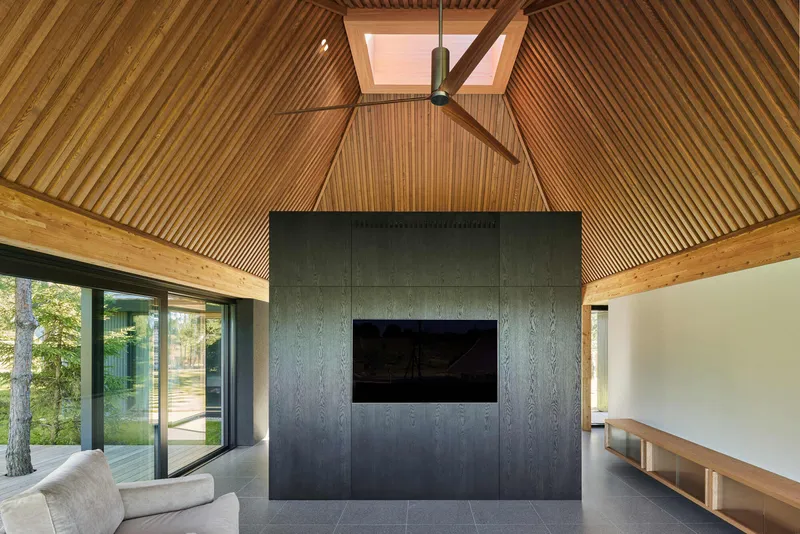
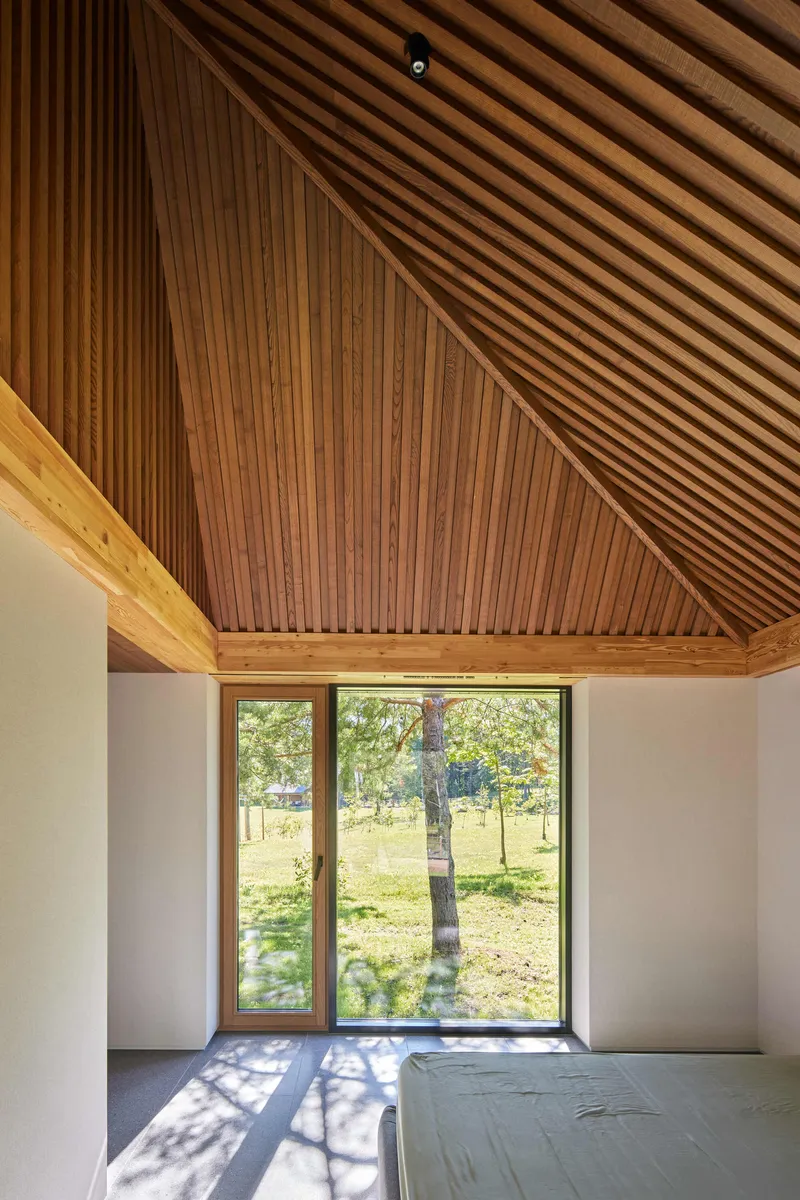

Inside each volume, the pyramidal roof becomes the dominant spatial event. Slatted timber ceilings rise toward a central skylight, compressing at the walls and opening at the apex. The geometry creates rooms that feel taller than their footprint suggests, an economy of drama that suits a guest house where the stay is short and the first impression needs to land. Lead architect Povilas Žakauskas keeps the palette to dark panels, white walls, and warm timber, letting the sloped ceiling do most of the expressive work.
The skylights are not merely decorative. In a forested site at Lithuanian latitudes, pulling light from above is a practical necessity. The trees filter most of the lateral sun, so the rooftop apertures ensure each room has consistent daylight even on overcast days. A ceiling fan mounted below the skylight in the living room hints at summer use, when the warm season opens the living area onto the terrace.
The Terrace and the Trees


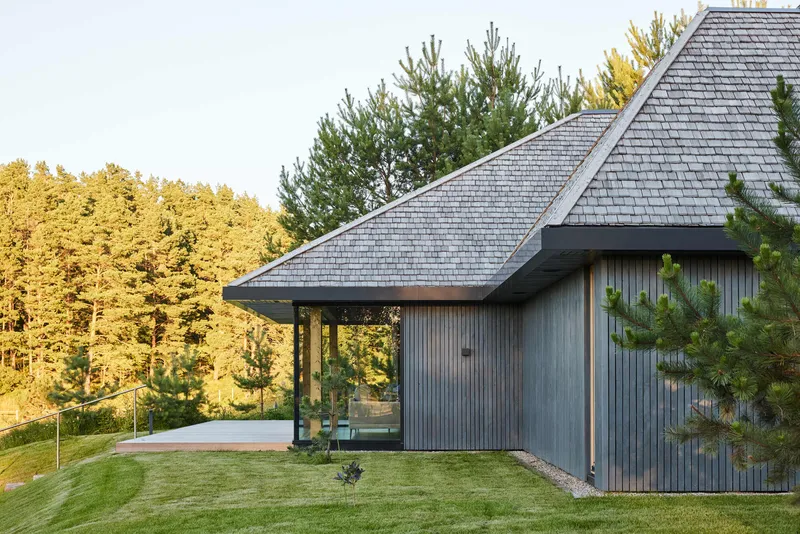
The large timber deck is arguably the project's best room. Pine trunks rise straight through the planking, their canopy providing shade that no pergola could replicate. At night, the surrounding glass walls of the pavilions cast warm light across the deck, and the trees become silhouettes inside a domestic glow. A reflecting pool at one edge ties the terrace visually to the pond below, extending the sense of landscape continuity.
Preserving the trees was not a sentimental gesture. Their root systems stabilize the hilltop soil, their canopy moderates summer heat, and their presence gives the architecture a maturity that a new planting scheme could not deliver for decades. The terrace works precisely because the trees were there first.
Material Honesty at Close Range

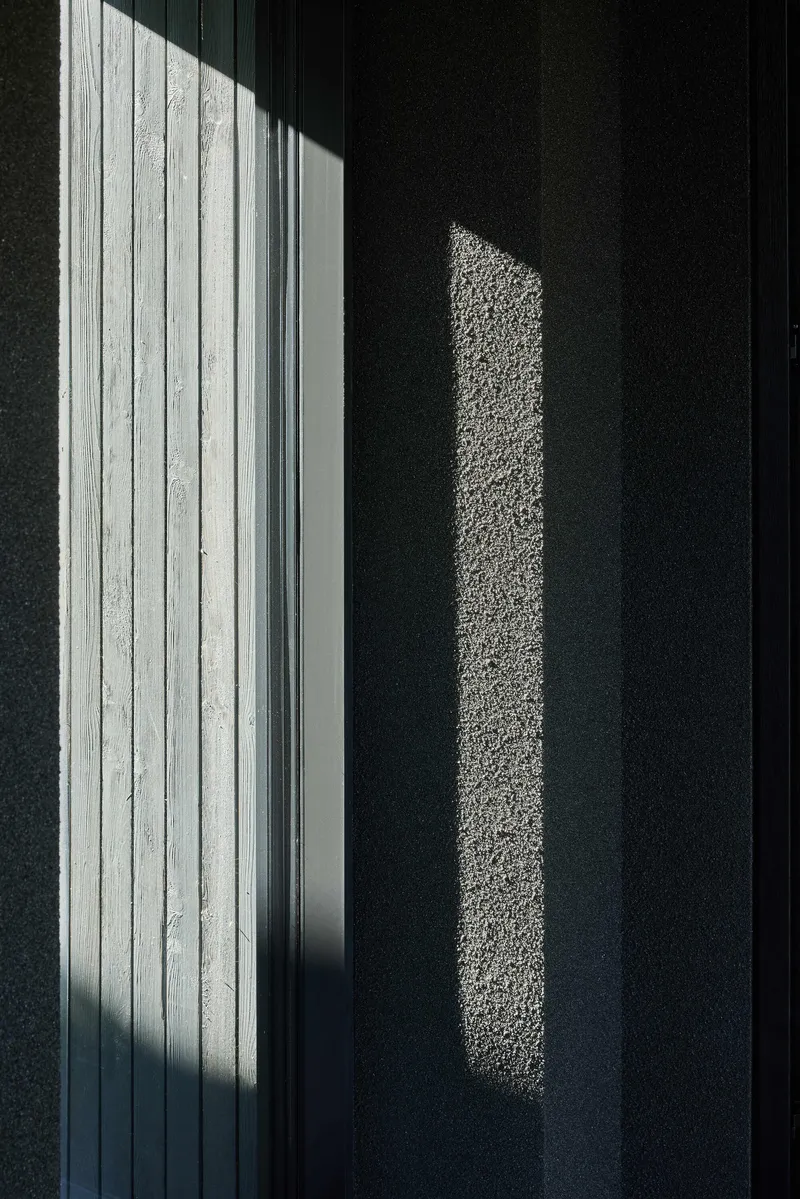
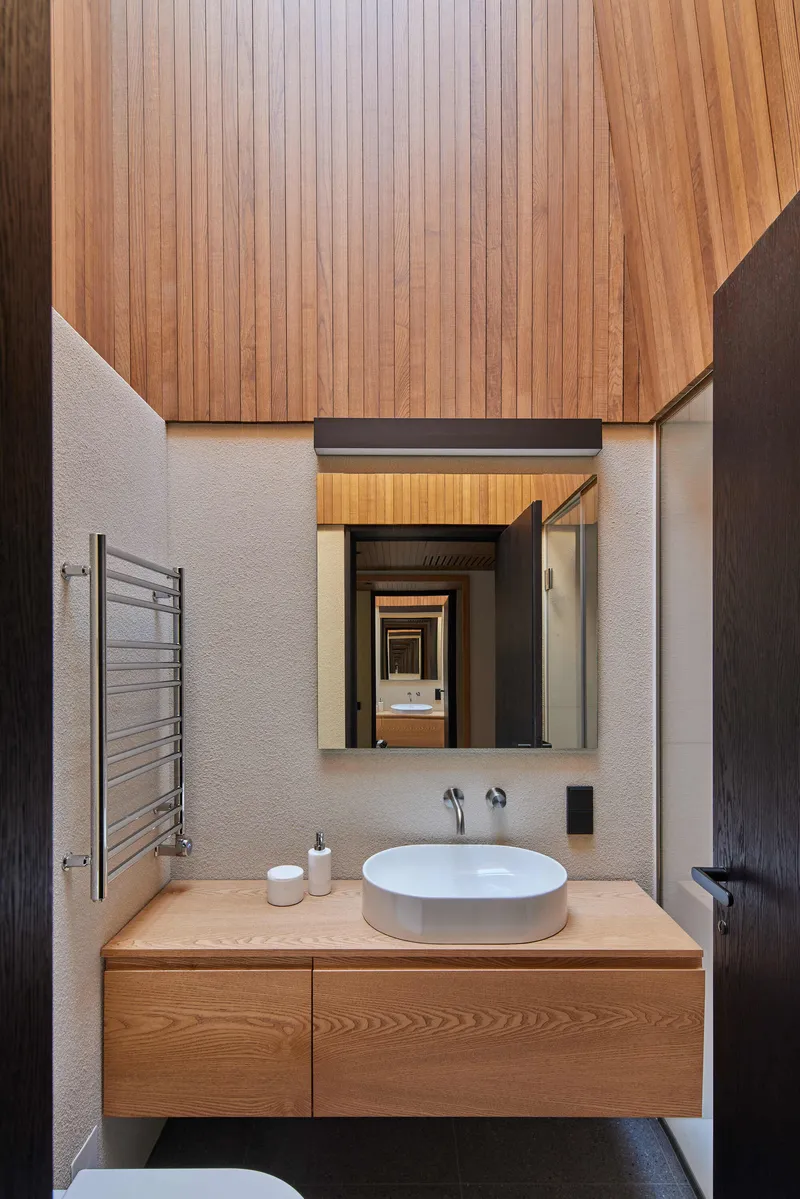
HEIMA's detailing rewards proximity. The vertical timber cladding outside transitions into slatted timber ceilings inside, establishing a material continuity that blurs the threshold. Dark cabinetry in the corridors provides storage without visual clutter, and the bathroom interiors, spare and precise, let the angled ceiling geometry carry the spatial interest. A white basin under a timber ceiling: simple, but the proportions are considered.
One image captures sunlight cutting sharp diagonal shadows across a dark textured wall beside white timber boards. It is a moment that reveals how much attention went into surface selection. The interplay of matte dark and light planes creates depth without ornament, relying instead on the Lithuanian sun to animate the surfaces throughout the day.
Dusk and the Double Life of Transparency


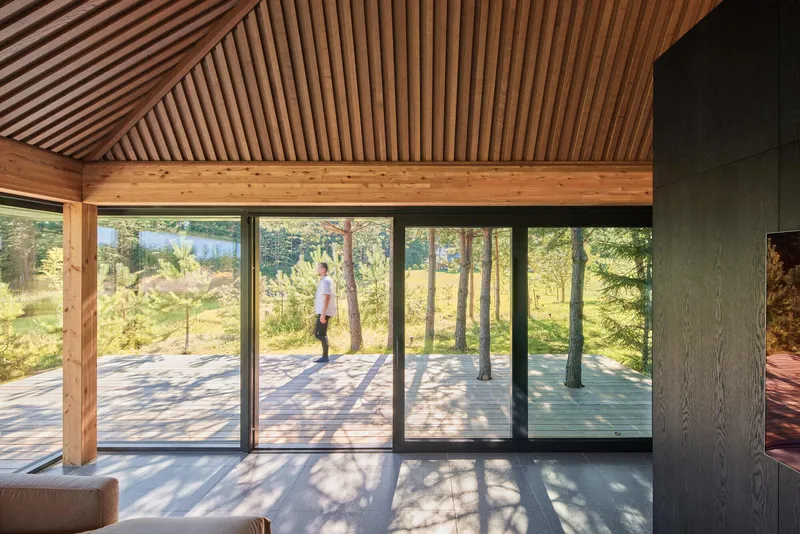
During the day, the generous glazing serves the occupants, framing views of birch trunks and pine canopy. At dusk, the equation inverts. The pavilions become lanterns, their interiors visible from the garden and the valley below. The architecture takes on a second identity: no longer shelter but signal, a warm presence among the darkening trees. The covered walkways, lit from within, trace the plan on the ground like a drawing rendered in light.
The floor-to-ceiling glass panels along the terrace dissolve the wall entirely, turning the living space into an extension of the deck. A figure standing outside, seen through the glass from within, becomes part of the interior composition. That permeability is the point: the guest house does not separate you from the landscape; it situates you inside a more considered version of it.
Plans and Drawings

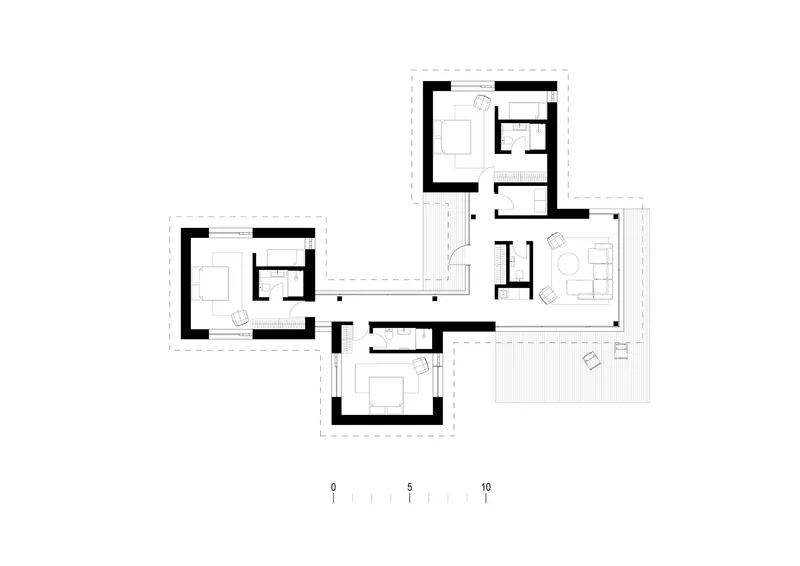



The exploded axonometric reveals the structural logic: each pavilion is a simple timber frame topped by a pyramidal roof, with the skylights acting as the apex detail. The floor plan confirms what the aerial photographs suggest: the four volumes are not arranged on a grid but staggered, their connecting corridors bending to navigate around tree positions. The section drawing shows how the steep roof pitch creates a vertical interior proportion that belies the modest 150-square-meter total area. The elevation drawing, with its rhythmic pitches and vertical cladding, demonstrates how the cluster maintains a coherent identity despite each volume's distinct footprint.
Why This Project Matters
The Guest House is a compact proof that architecture can defer to its site without becoming passive. Every significant decision, the split into four volumes, the pyramidal roofs, the glazed corridors, the terrace threaded through tree trunks, stems from a commitment to working with what was already there. That commitment produces a building that could not exist in any other configuration on any other site, which is the best thing you can say about a work of architecture.
For a profession that still too often begins a project by clearing the land, HEIMA's approach offers a useful corrective. The trees are not landscaping added after construction; they are the armature around which everything was organized. The result is a guest house that feels inevitable rather than imposed, and a stay that is less about the rooms than about the forest you never leave.
Guest House by HEIMA architects, lead architect Povilas Žakauskas. Located in northern Lithuania. 150 m². Completed in 2022. Photography by Norbert Tukaj.
About the Studio
Share Your Own Work on uni.xyz
If projects like this are the kind of work you want to make, uni.xyz is a place to publish your own, find collaborators, and enter design competitions.


Popular Articles
Popular articles from the community


Architekt Andreas Gruber Scatters 23 Dark Timber Chalets Across a South Tyrolean Forest Edge
In Molini di Tures, Amonti Chalets breaks a resort into a hamlet of gabled timber houses, with parking, storage and services pushed into the slope.

David Ortega Stacks a Two-Story Mexico City Penthouse Around a Steel Stair and a Pergola-Shaded Roof Terrace
In Colonia Roma, a 300 m² penthouse uses oak joinery, a planted steel stair and a slatted roof pergola to make a new-build apartment feel like a house.

GROUP A Strips a 1969 Rotterdam Harbor Headquarters to Its Frame and Wraps It in Timber Louvers
In Rotterdam's M4H harbor district, Ferro Offices reuses a 1969 frame, adds one timber storey and reaches BREEAM-NL Outstanding.

Cube Design Draws an Ecological Corridor Between Two Shenzhen Hills with the Nankai Building
Beside Shenzhen's container docks, the Nankai Building pairs stacked balconies with a climbing green screen to connect two hillsides across its height.

Similar Reads
You might also enjoy these articles


LAVA Architecten Gives Vocational Education a Sawtooth-Roofed Face on a Mechelen School Campus
In Mechelen, Belgium, a 2,053 m² STEM school on a 6×6 m grid turns workshops and classrooms into rooms that can be rearranged as teaching changes.

KEMA Studio Turns a Derelict Marvila Attic into a 60 m² Lighthouse Apartment Above Lisbon
In Lisbon's Marvila district, a rebuilt roof, four skylights and two plywood volumes turn an unlivable attic into a bright home facing the Tagus.

Pixel Gardens: One Repeated Module Stacked Into a Terraced Social Housing Tower for Famagusta
Salem Bader's shortlisted housing tower builds a vertical neighbourhood from one repeated module, offsetting units to carve terraces, light and air.

Bao Huynh Watercolor Atelier: A Serene Art Retreat in Hội An
Bao Huynh Watercolor Atelier in Hội An blends multifunctional art spaces, sustainable design, local materials, and family-friendly living in a serene environment.

Explore Plug-In House Competitions
Discover active competitions in this discipline

Comments (0)
Please login or sign up to add comments
No comments yet. Be the first to comment!