
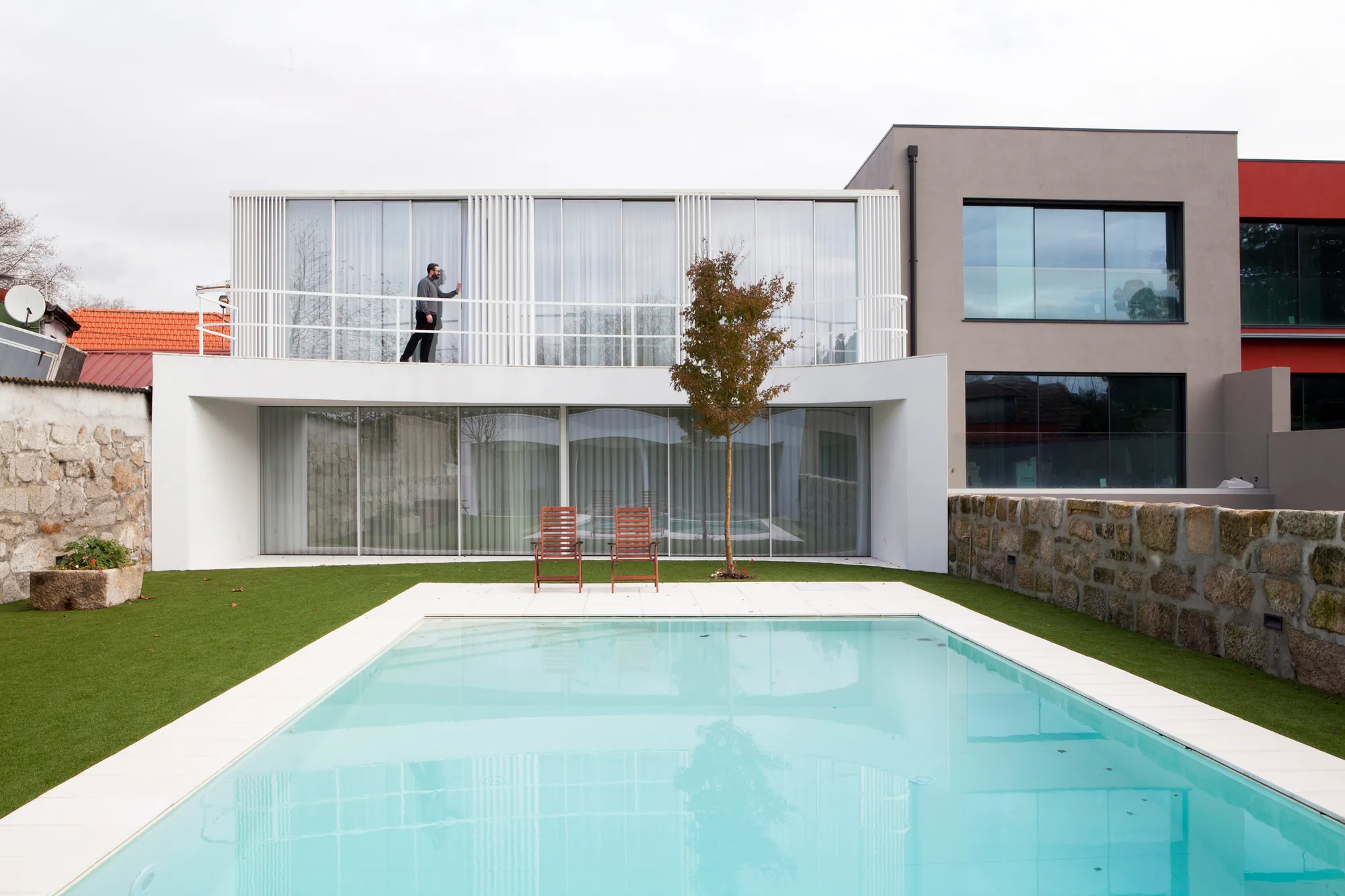
A2OFFICE Curves a Porto House Around a Preserved Tree and an Open Patio
Two volumes dance around a central courtyard in a transforming Porto neighborhood, preserving fragments of the old facade within the new.


Most residential projects in Porto's shifting urban fabric try to fit in. A2OFFICE, led by architect Alberto Dias Ribeiro, chose instead to make Vilarinha House a quiet act of negotiation: between old and new, between solid and void, between the street and the private garden behind it. The result is a 296 m² house that reads as two distinct volumes bracketing an unbuilt patio, connected by a long wall that threads the entire depth of the plot. A six-year design and construction process (2016 to 2022) gave the team time to respond to a neighborhood in flux, where new neighboring constructions were appearing around them as they built.
What makes the project genuinely interesting is how A2OFFICE resolves a complicated brief through a single formal gesture: a curved canopy that contours an existing tree on the site. That curve recurs in the annex roof, producing what the architects describe as a "dance" between the two volumes. It is a useful metaphor. The house never stands still conceptually. It shifts between transparency and enclosure, between preserved granite fragments and crisp white plaster, between the intimacy of a skylit stairwell and the openness of full-height glazing onto a rear garden with a pool.
Street Face: Layers of Privacy
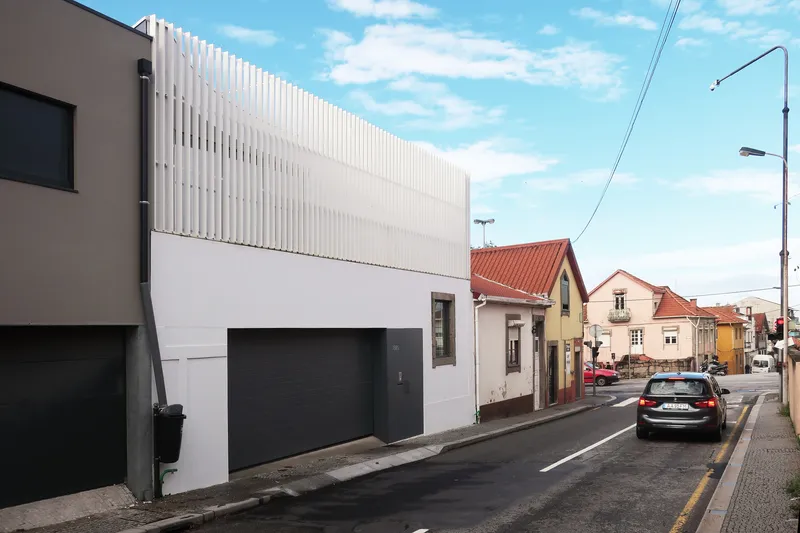
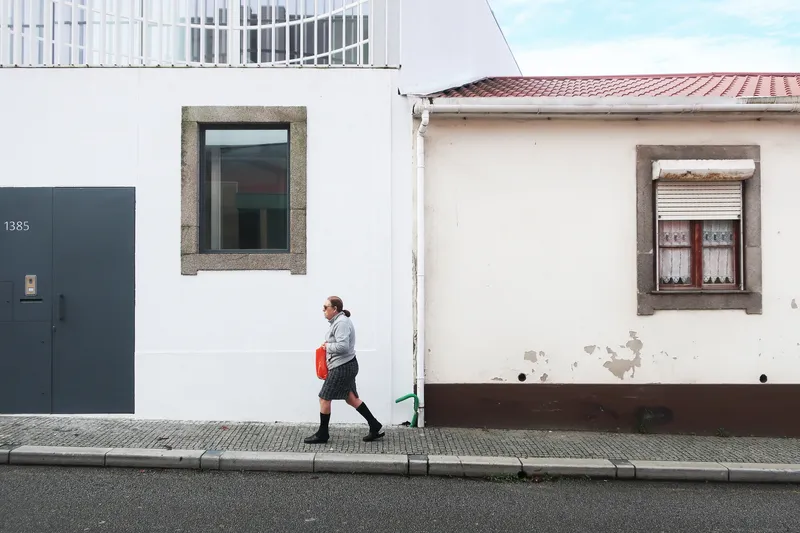
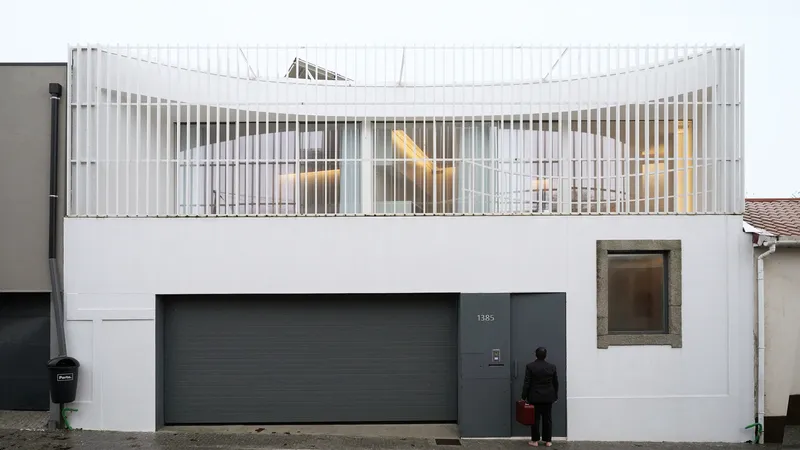
From the street, Vilarinha House reveals itself in layers. The ground floor presents a white plastered surface punctuated by a granite-framed window, a direct fragment from the original facade that once stood here. Above it, vertical metal louvers create a screen that filters light and views, giving the upper floor a semi-opaque presence that reads as neither fully closed nor fully open. The strategy is deliberate: in a neighborhood where plot boundaries sit close to the sidewalk, the louvers act as a visual negotiation between the public street and domestic life.
At dusk, the logic becomes clearer. The curved balcony screen glows from within, and the house transforms from a reserved white box into a lantern. A figure standing at the entrance gives a sense of the human scale the architects were after. The building sits between pitched-roof neighbors, and the corrugated metal upper volume neither mimics nor ignores them. It is its own thing, but it knows where it is.
The Courtyard as Organizing Principle
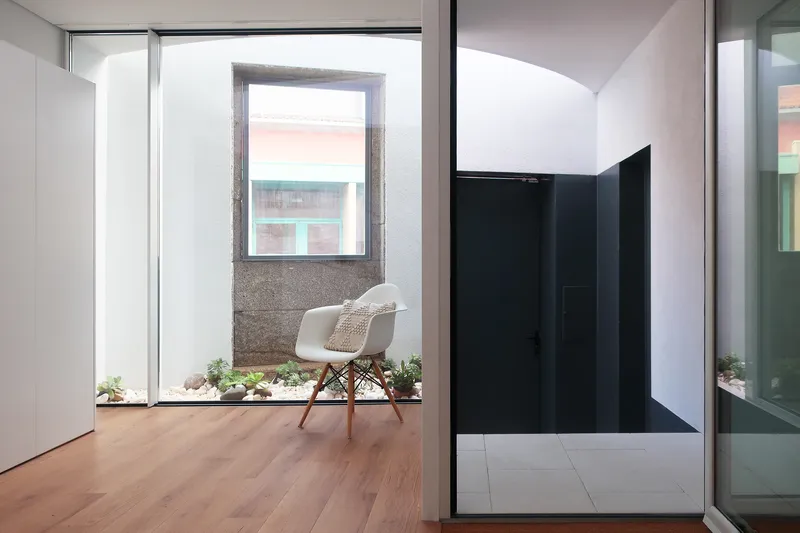
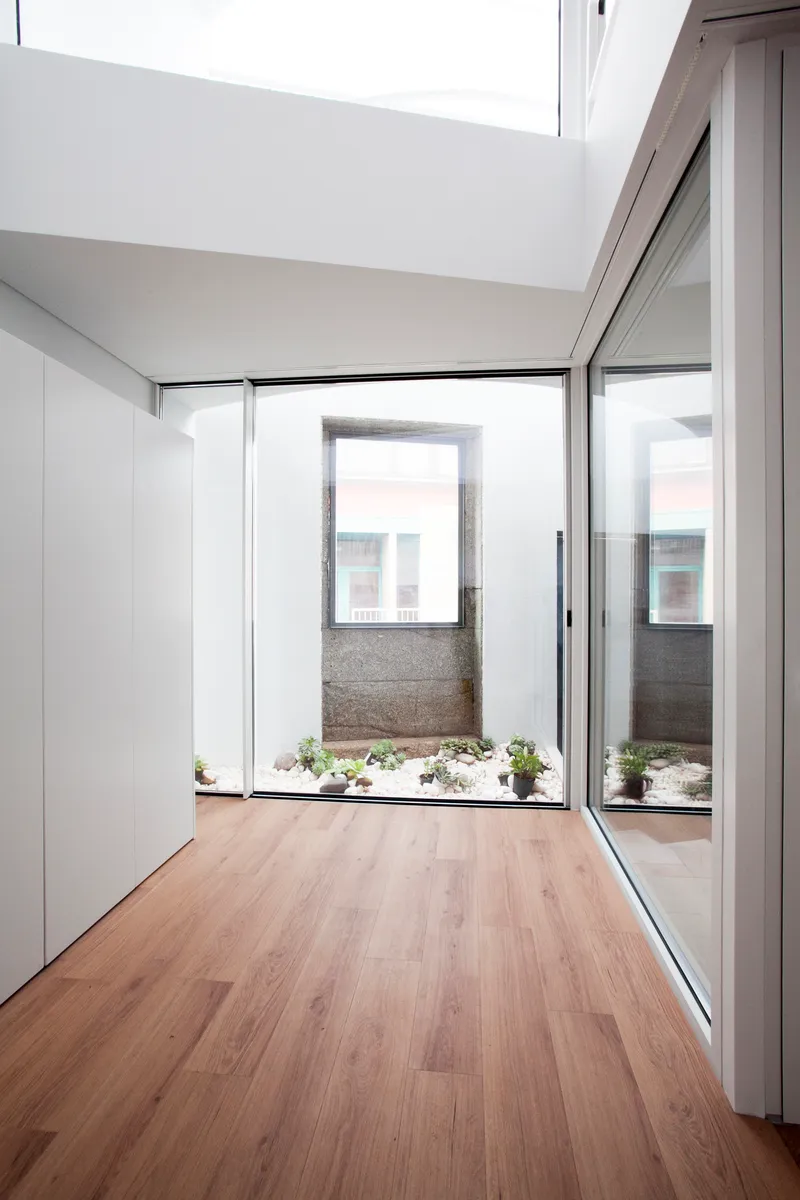
The patio is the project's structural idea, not just its spatial one. It separates the two built volumes at ground level, creating a semi-covered outdoor room at the entrance that opens through a slab perforation to the sky above. The courtyard walls are finished in white, and granite walls from the original construction appear where the new meets the old, giving the threshold a material depth that a purely contemporary surface would lack.
Interior corridors frame views back into this void, with planted beds at the base of stone walls pulling greenery into the heart of the plan. A timber-floored passage leads to the courtyard from the main living spaces, ensuring the patio is never a leftover space but a destination. The effect is of a house that breathes through its center.
Living Spaces and Garden Connection
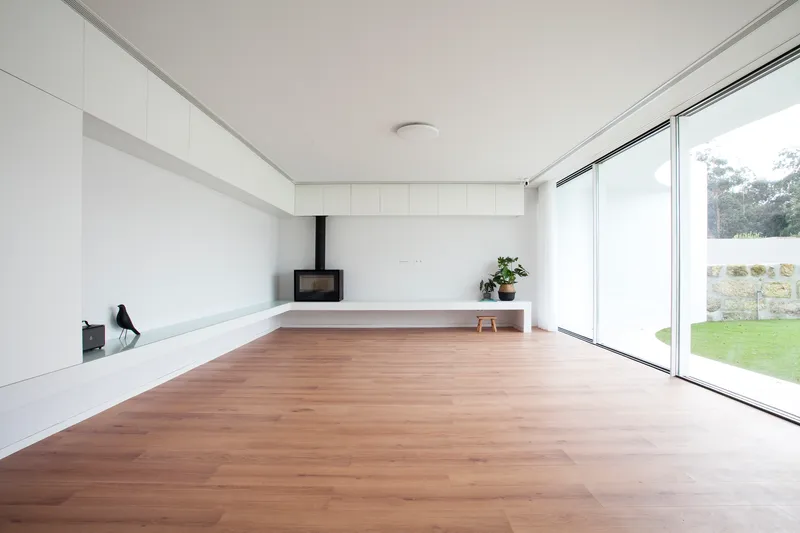
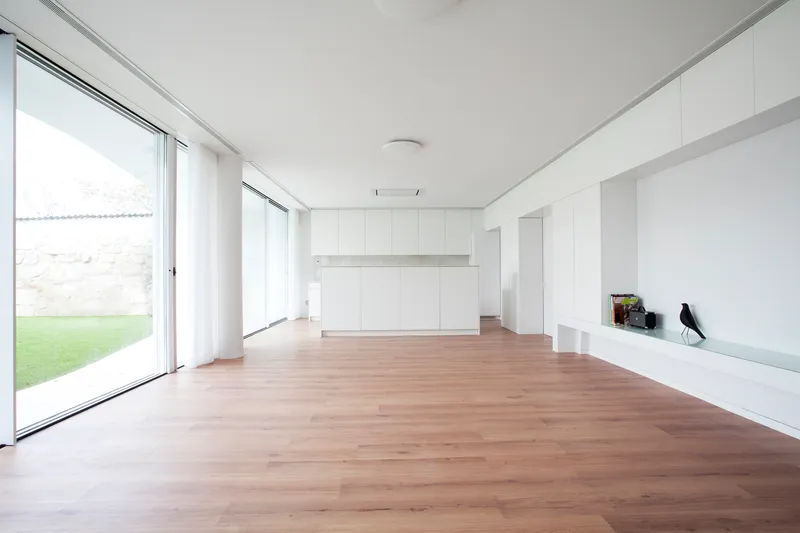
The main living area occupies the ground floor's rear volume, where floor-to-ceiling glazing dissolves the boundary between interior and garden. A freestanding stove anchors the room, its chimney reading as a vertical line against the horizontal expanse of glass. The pale timber flooring runs continuously from inside to the threshold, reinforcing the sense of spatial continuity.
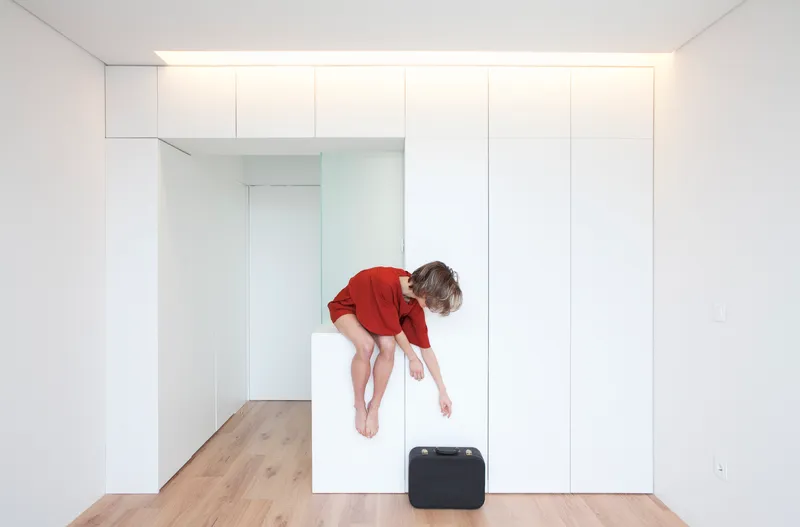
White built-in storage walls line the opposite side, keeping the visual field clean so that the garden becomes the dominant presence. Under overcast Porto skies, which is most of the year, the glazing pulls diffused light deep into the plan without glare. The curved canopy overhead provides shading when direct sun does arrive, doubling as the structural floor of the upper balcony.
The Curved Canopy and Upper Terrace
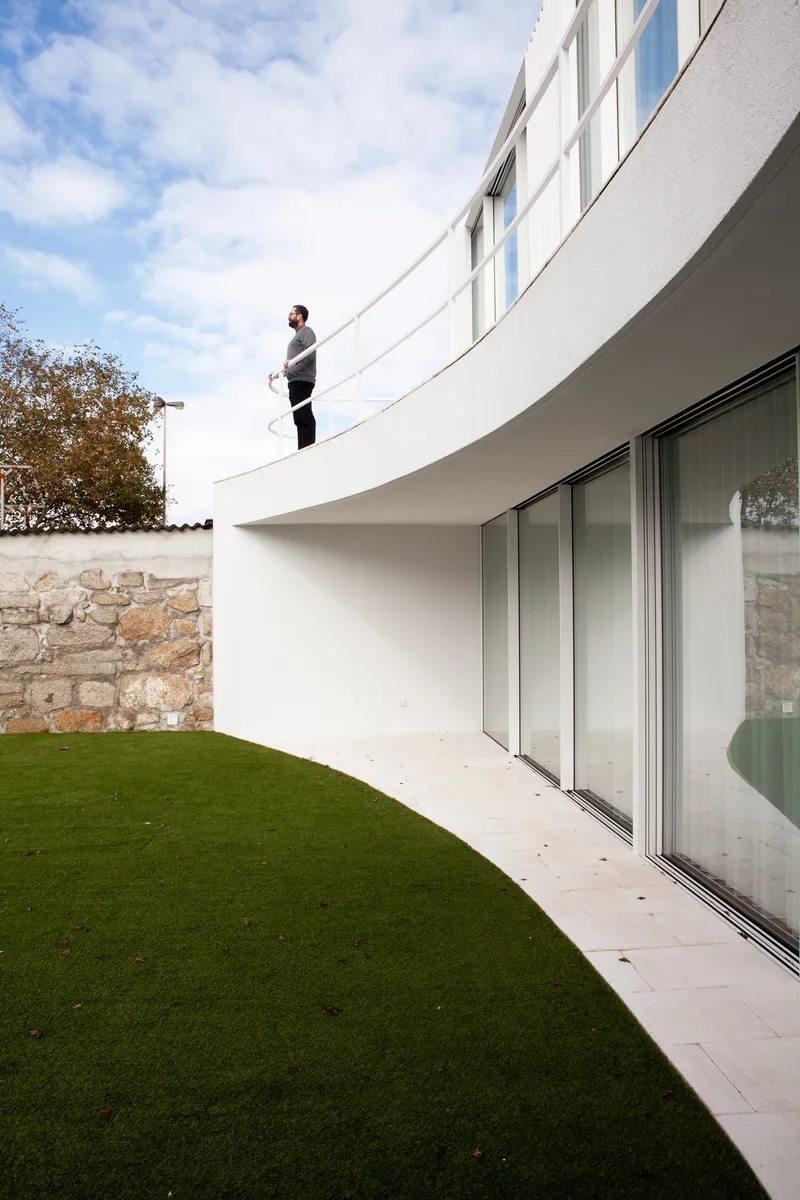
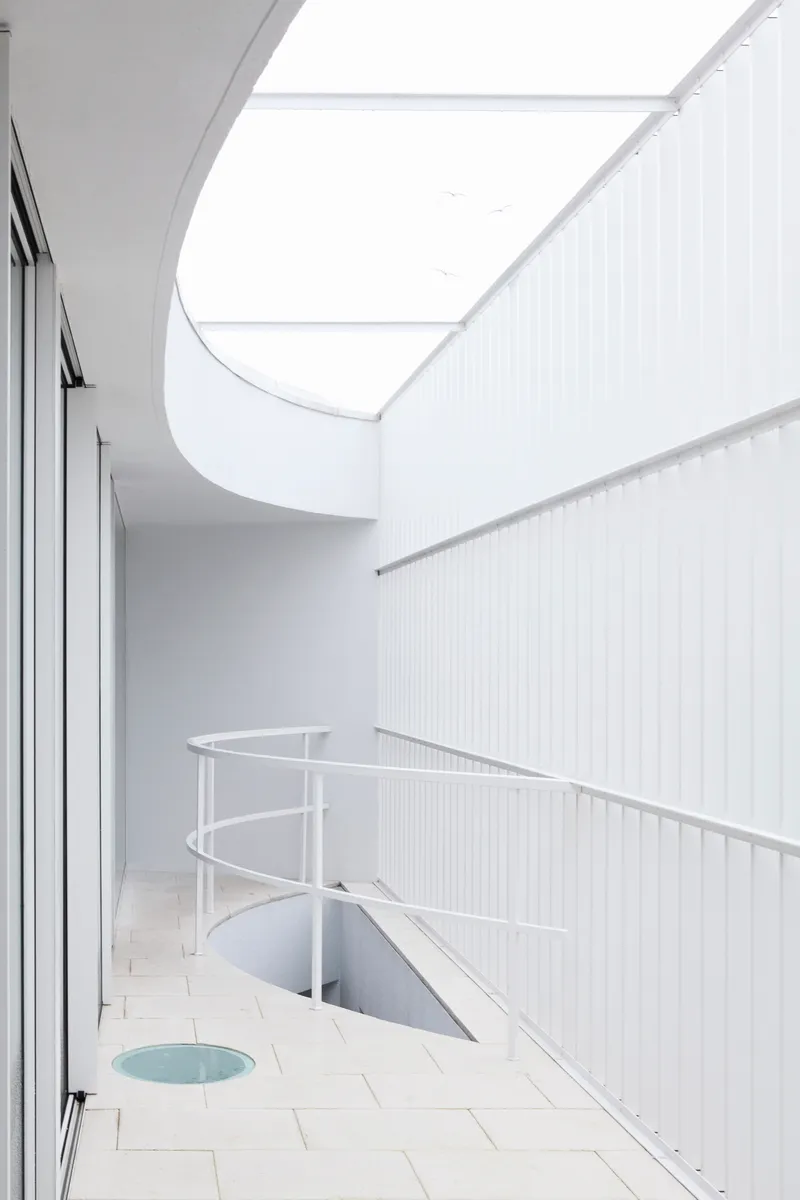
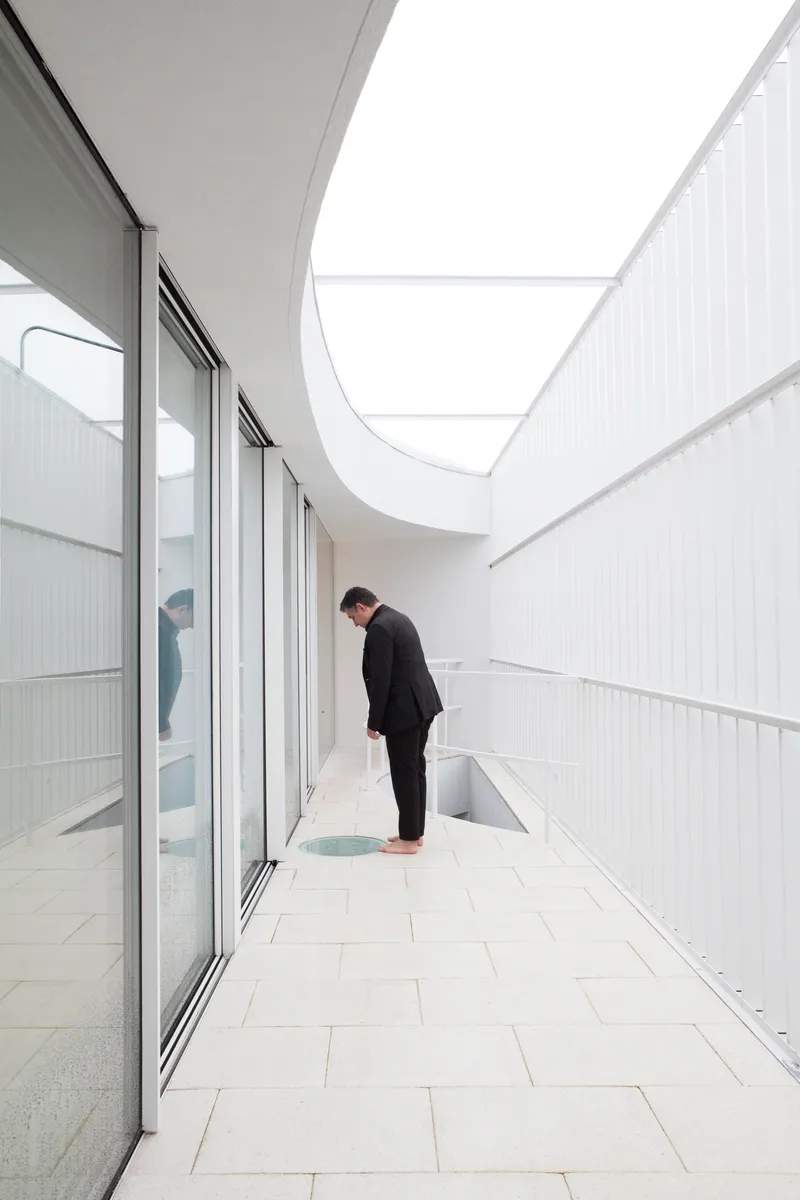
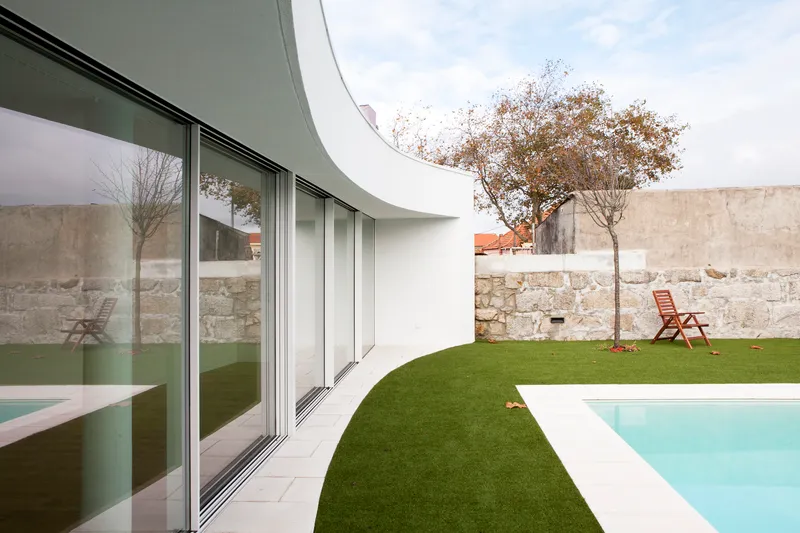
The canopy is the house's signature move. Its curve is not arbitrary: it traces the crown of an existing tree that A2OFFICE insisted on preserving. On the upper level, this translates into a terrace with a tiled floor, a metal balustrade, and a skylight opening cut into the slab that pulls light down to the ground floor below. The curved roof of the adjacent annex responds in kind, completing the formal dialogue between the two volumes.
Standing on the upper terrace, you look out over the rear garden, the pool, and the stone boundary wall that edges the property. The curved overhang frames this view without dominating it, and the skylight opening at your feet connects you visually to the rooms below. It is a well-calibrated piece of section design, where structure, climate response, and spatial experience all converge.
Vertical Circulation and Light
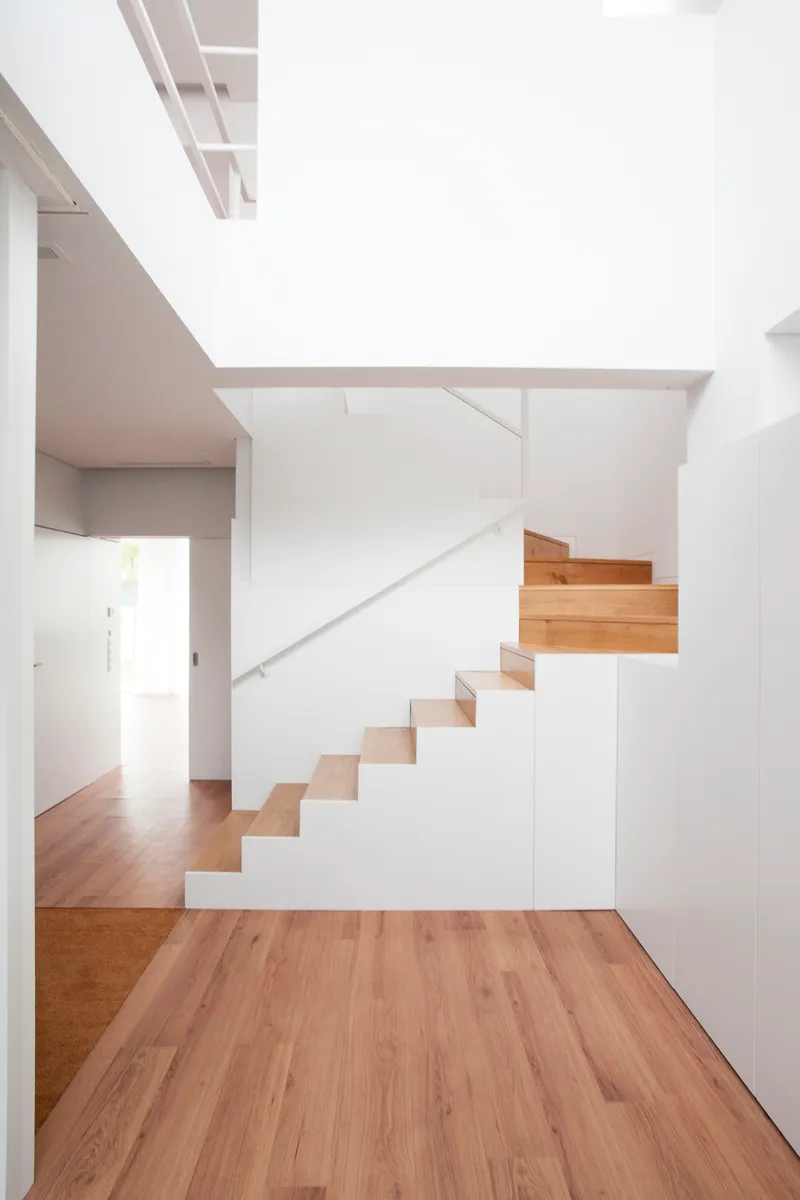
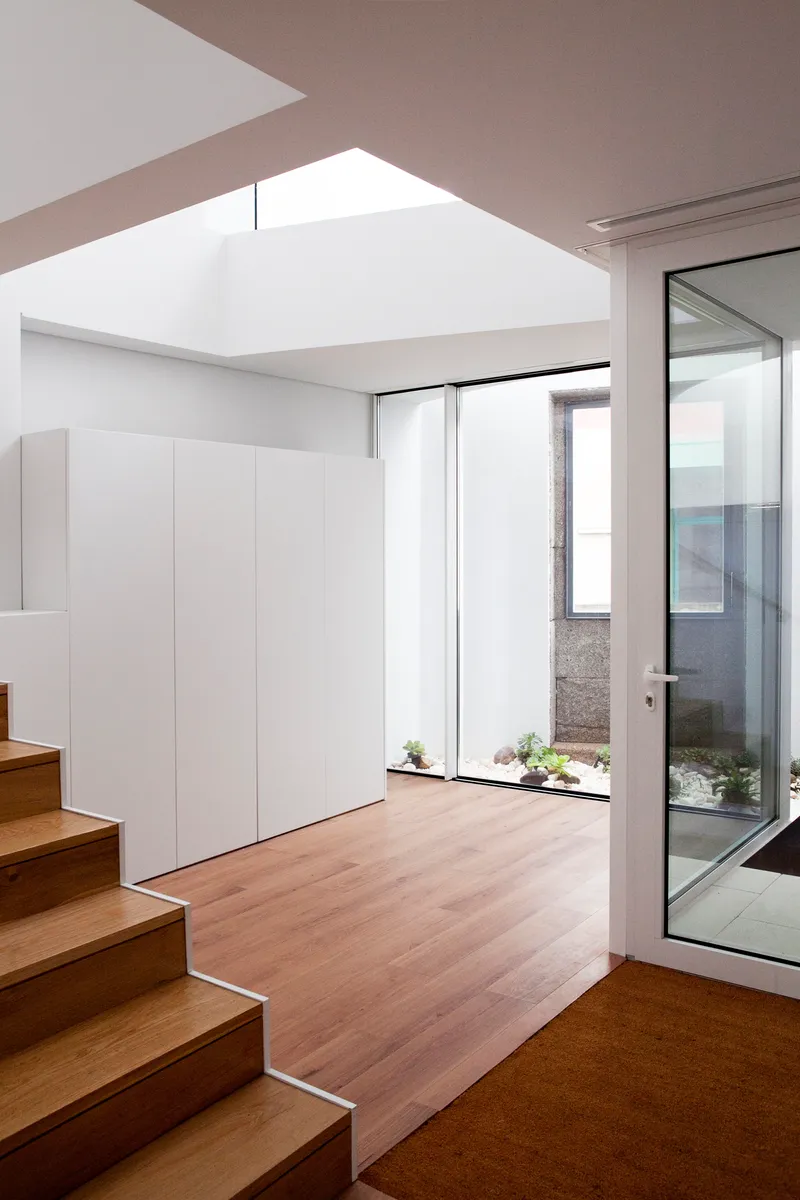
The staircase is more than a connector between floors. Built from timber treads with integrated storage beneath, it sits beside a white wall that conceals wardrobes and utilities, keeping the volume around the stair uncluttered. A skylight overhead washes the stairwell in natural light, and the timber and white palette gives the circulation core a warmth that balances the cooler tones of the living areas.
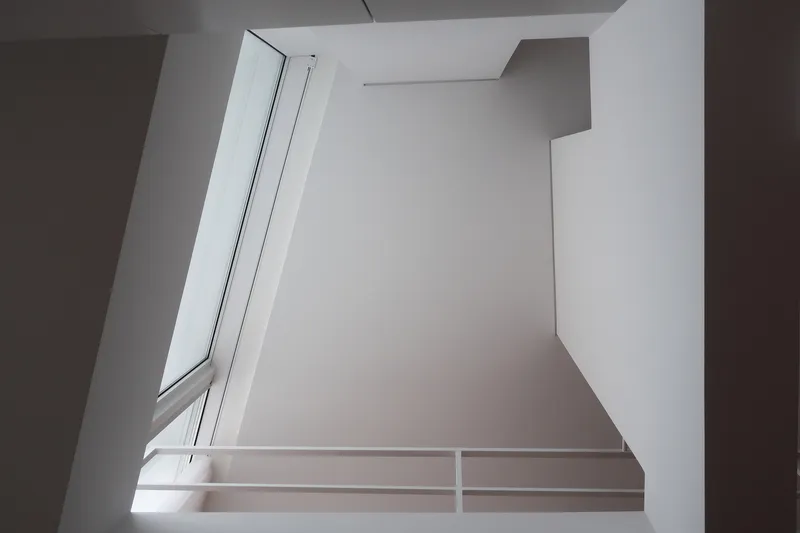
The double-height void adjacent to the stair amplifies this effect. Angled clerestory windows above pour light across the white walls, creating shifting patterns through the day. From the upper landing, a white tubular steel railing allows visual continuity down into the stairwell and across to the glazed courtyard wall, so the vertical and horizontal axes of the house remain legible from any point.
Upper Rooms and the Garden Facade
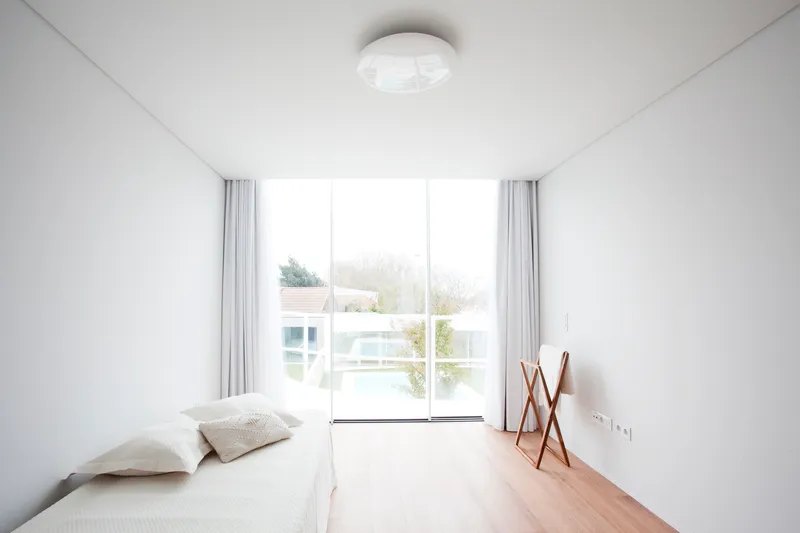
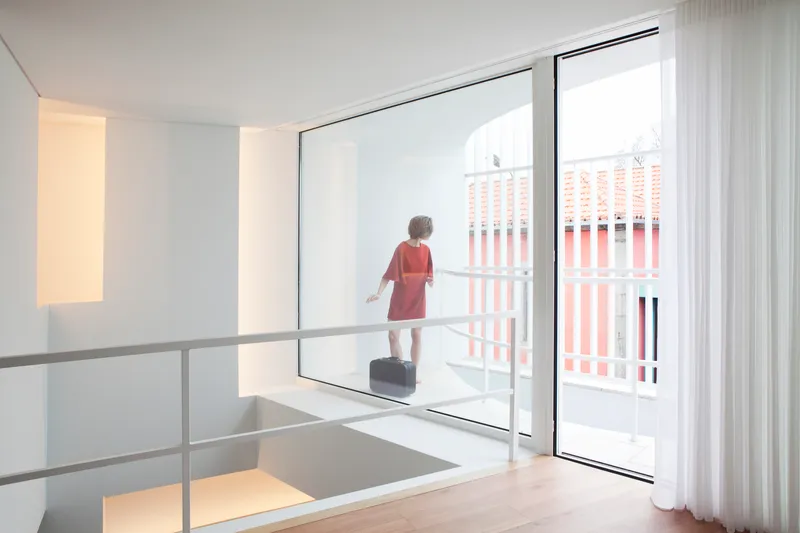
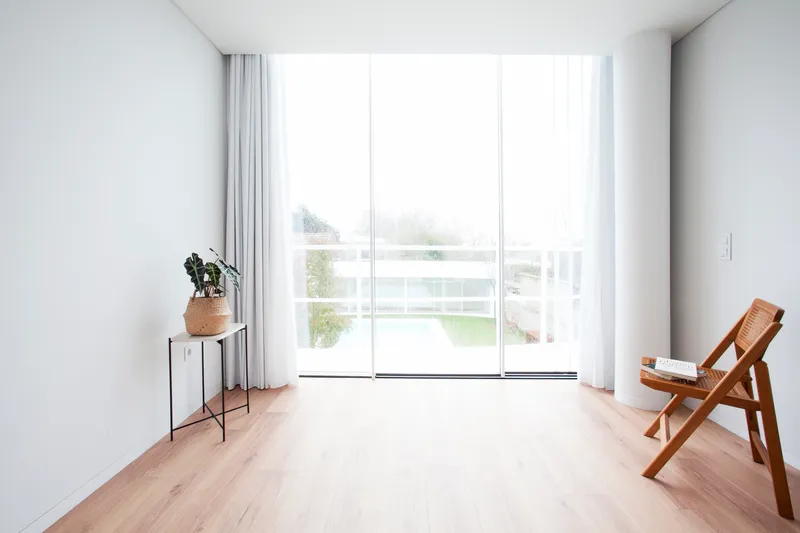
Upstairs, bedrooms open through glazed doors onto planted terraces, extending the living space outward. One room frames a child standing at the balcony threshold, looking down through glass to the street below, a reminder that A2OFFICE designed this house for a family, not for a photograph. The proportions are generous but not extravagant, and the detailing, Cortizo aluminum windows by Vetec Alunion, handleless cabinetry, flush storage, is consistently restrained.
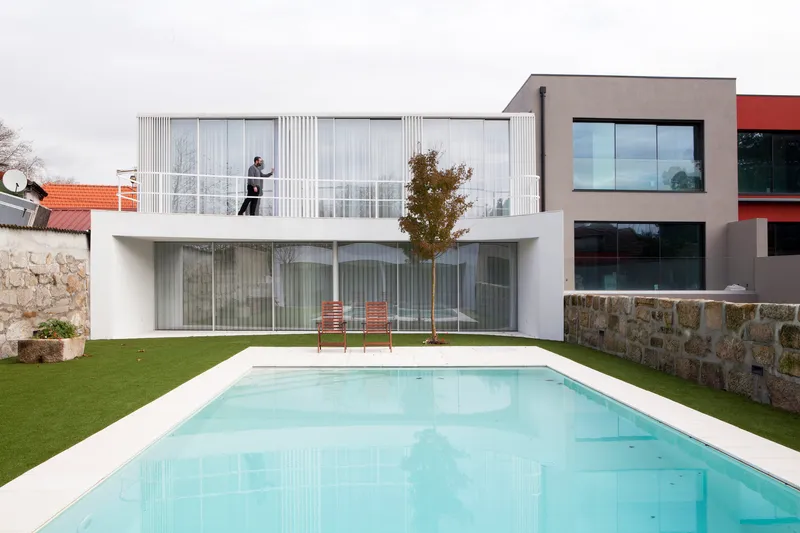
From the garden, the rear facade reveals the house's full sectional ambition. The pool sits at grade level, flanked by vertical aluminum louvers that rhyme with the street-side screen. The two stacked volumes read clearly, with a figure on the upper balcony providing scale against the curved canopy above. The preserved tree stands at the edge of the lawn, its canopy confirming the geometry that shaped the roof above it.
Garden, Pool, and Site Boundary
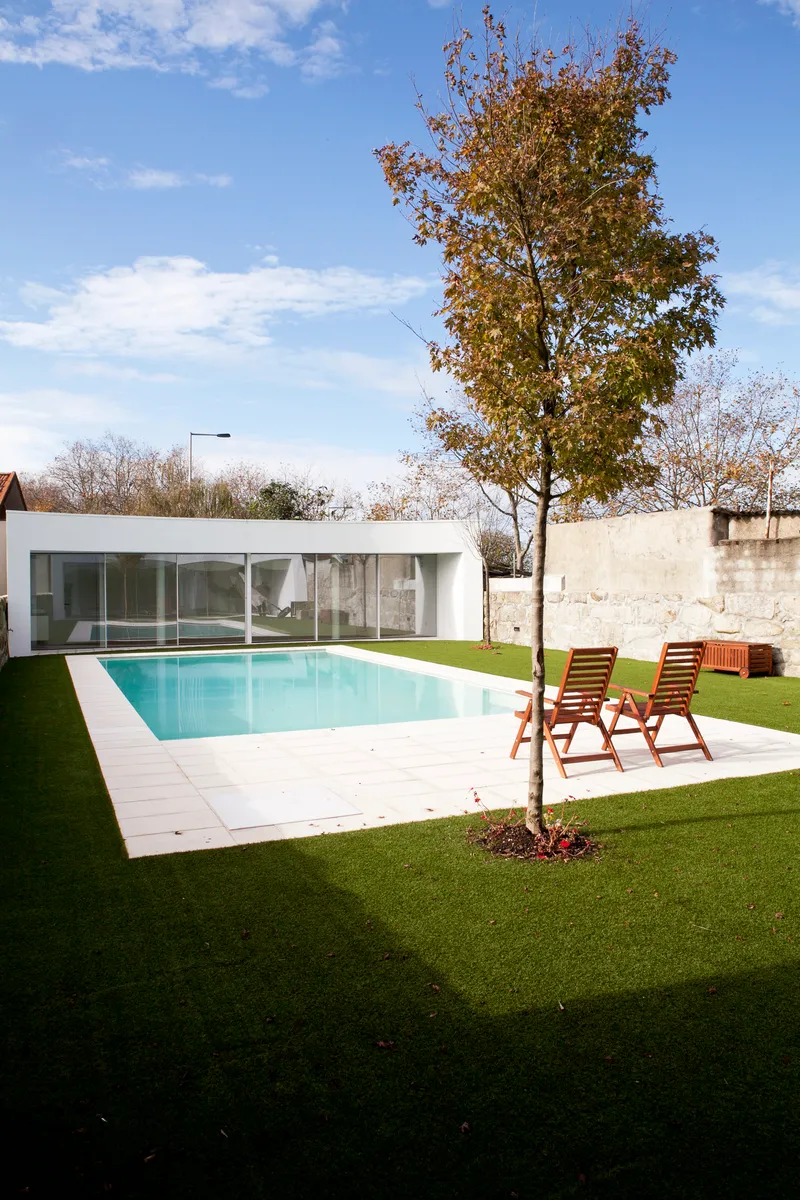
The rear garden is compact but effective. A planted tree, a poolside deck, and a low white pavilion sit under autumn skies, giving the outdoor space a layered quality that avoids the monotony of a single-surface lawn. The stone boundary wall at the perimeter ties the new construction back to the materiality of the neighborhood, grounding the project in its immediate context.
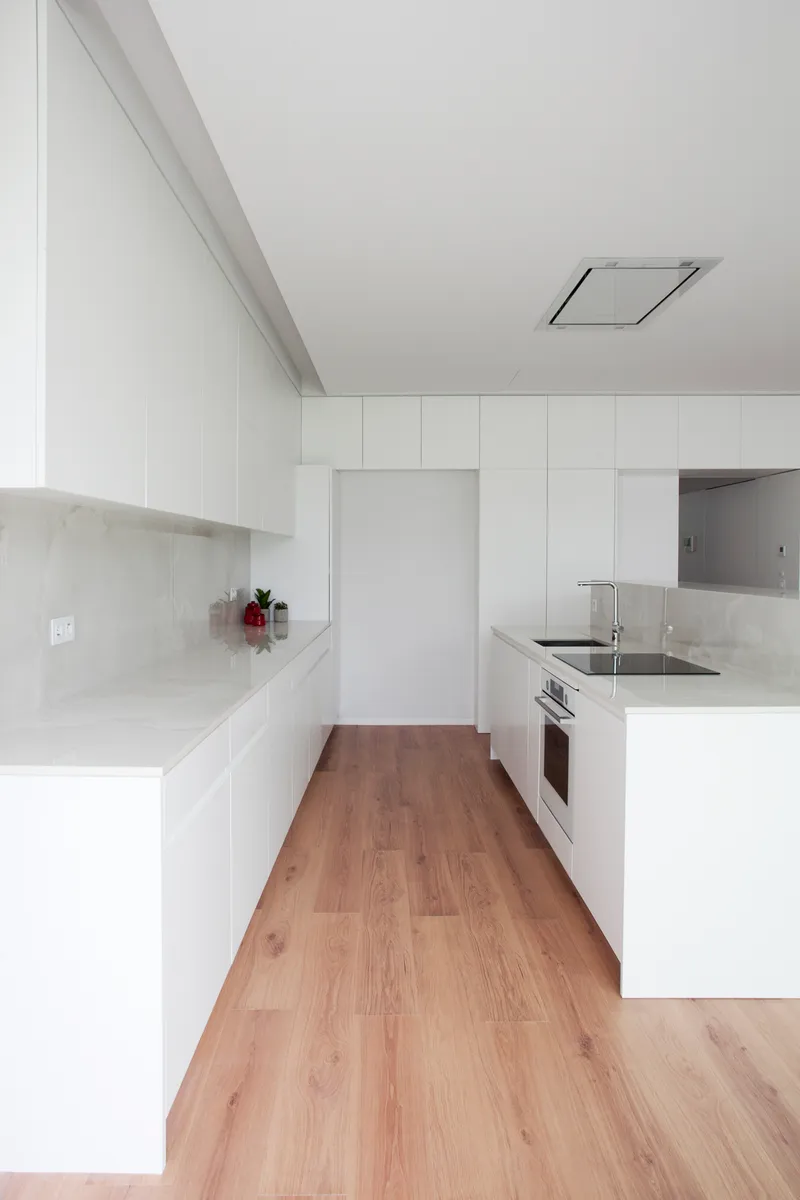
Inside, the white kitchen exemplifies A2OFFICE's commitment to clean detailing. Handleless cabinetry, a recessed ceiling vent, and pale timber flooring create a room that functions as background to daily life rather than a showpiece. The ALBA by Falmec appliances and Quadro 45 electrical fittings by EFAPEL are specified with the same discipline that governs the larger architectural decisions.
Plans and Drawings
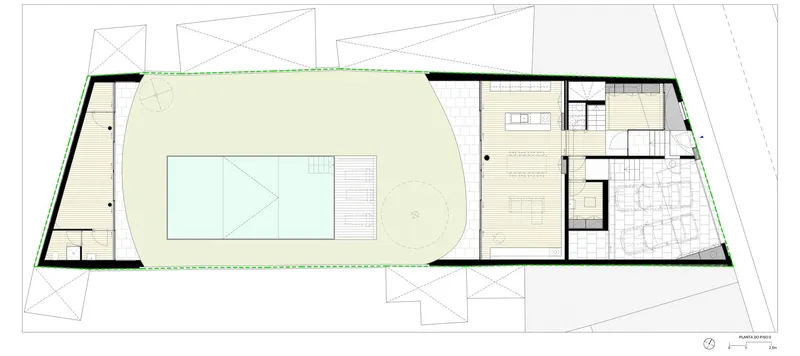
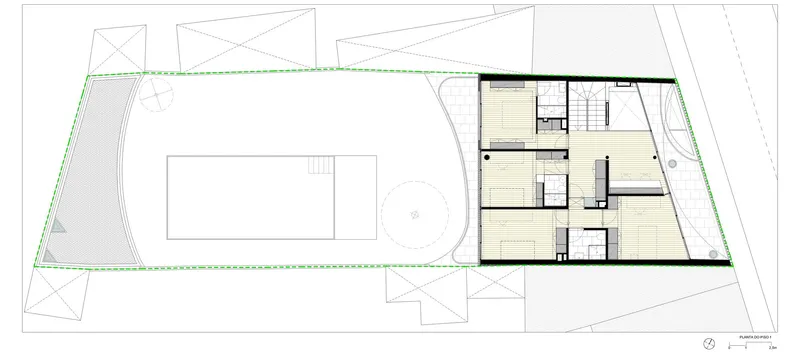
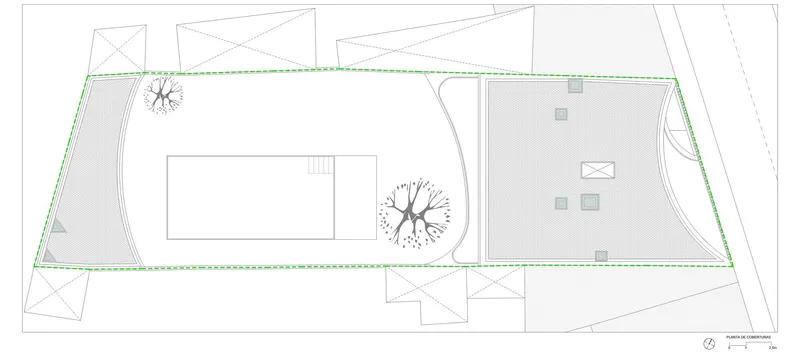
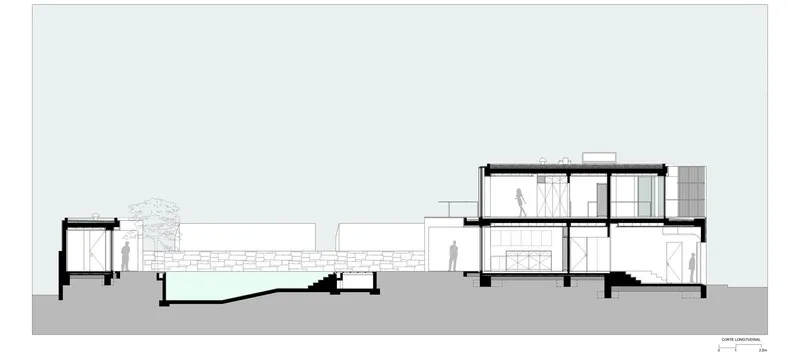
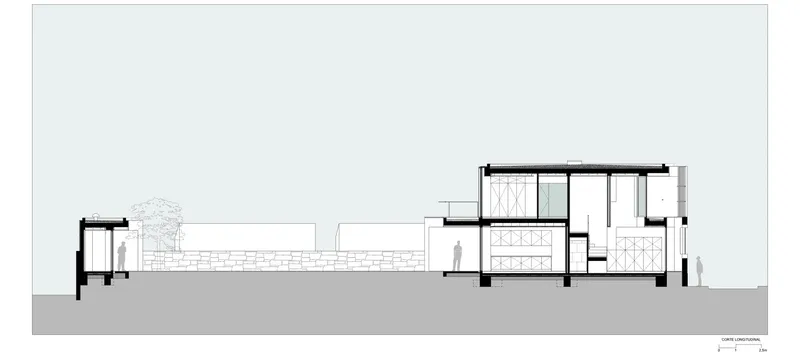
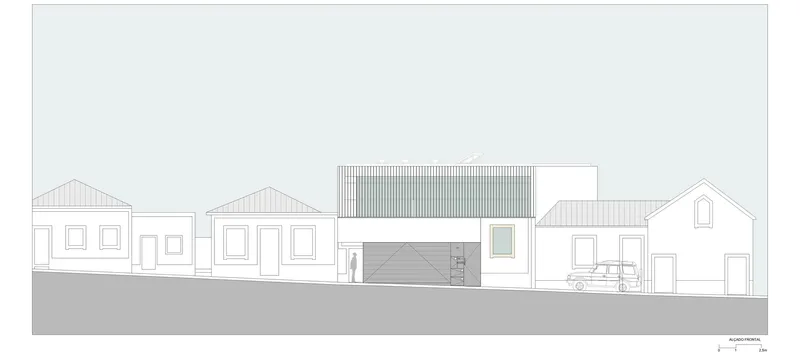
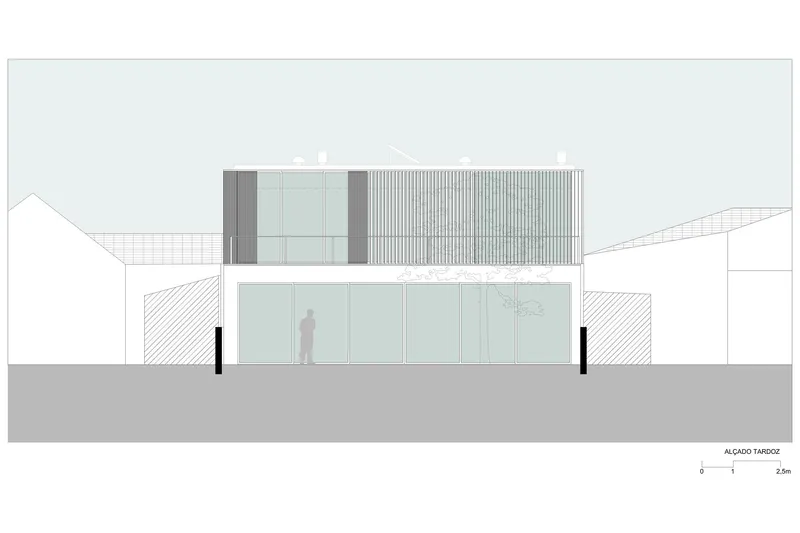
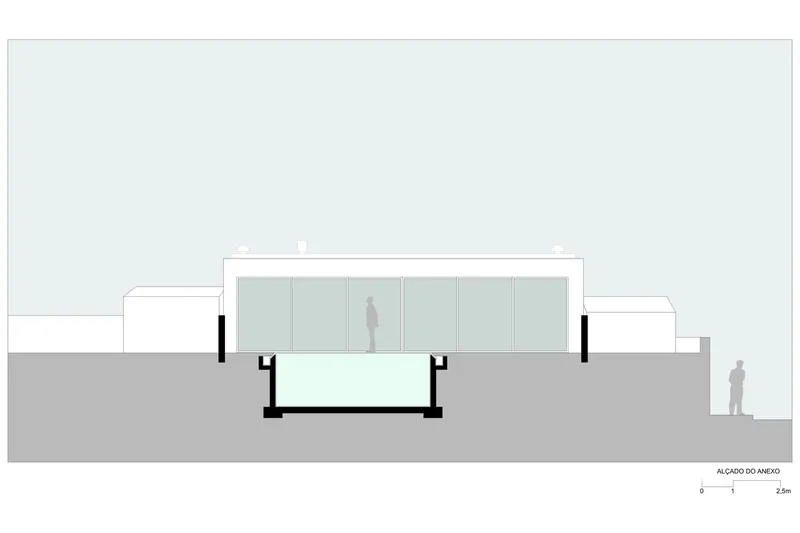
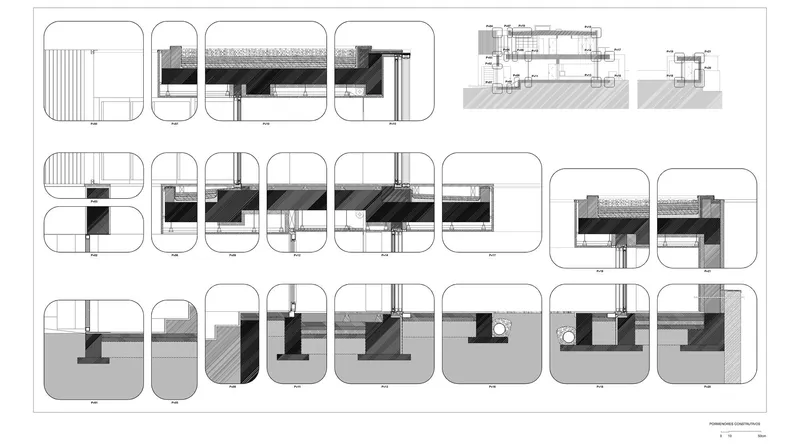
The floor plans reveal how precisely A2OFFICE organized the program around the central patio. The ground floor places the pool and lawn on one side of the plot, with kitchen, living, and stair in the main volume, connected by the courtyard. The first floor distributes bedroom suites around a double-height void above the pool, and the terrace occupies the curved canopy zone. The roof plan clarifies the tree's position relative to the curved slab, confirming that the geometry is genuinely derived from the existing landscape.
The longitudinal sections are the most revealing drawings. They show the two-story volumes connected by the long horizontal wall, with the tree standing between them. The split-level condition between the volumes becomes legible in section, as does the relationship between the cantilevered floor plate of the upper terrace and the glazed pavilion below. The street and rear elevations document the corrugated metal upper volume set between pitched-roof neighbors, and the construction details, showing junction conditions at roof, wall, and foundation, speak to a level of technical resolution that matches the conceptual clarity of the project.
Why This Project Matters
Vilarinha House earned a 2023 International Residential Architecture Award and a 2022 Gold Winner at the Architecture & Design Collection Awards, recognition that reflects its careful balance of ambition and restraint. In a city where historic fabric is under pressure from development, A2OFFICE made a house that incorporates fragments of the original facade, preserves a mature tree, and produces its formal logic from those inherited conditions rather than imposing a shape from outside. That discipline is rare.
The project also demonstrates that a medium-sized residence can carry real architectural ideas without relying on scale or budget to make its point. The curved canopy, the courtyard section, the layered street facade: each operates at a domestic scale but with a precision that rewards close attention. For architects working on constrained urban plots, Vilarinha House offers a clear lesson: start with what is already there, and let the geometry of preservation generate the geometry of the new.
Vilarinha House by A2OFFICE (architect Alberto Dias Ribeiro), Oporto, Portugal. 296 m², completed 2022. Photography by AL.MA Fotografia | Alexandra Marques.
About the Studio
Share Your Own Work on uni.xyz
If projects like this are the kind of work you want to make, uni.xyz is a place to publish your own, find collaborators, and enter design competitions.



Popular Articles
Popular articles from the community


The Earth Pod: 3D Printed Homes for Resilient Refugee Communities
The Earth Pod reimagines refugee housing through 3D printed homes made from clay, combining resilience, self-sufficiency, and rapid shelter.

The Musturak Paradise: Senior Living Architecture for a Connected Future in Temara, Morocco
The Musturak Paradise reimagines senior living architecture in Temara via private homes, social spaces, culture, community, and shared care.

Lunar Spiral: Space Architecture Shaped by the Mathematics of the Universe
Lunar Spiral reimagines space architecture through Fibonacci geometry, lunar regolith, levitating habitats, and self-sustaining Moon living.

Play: Fragments of Their World
Familiar architecture becomes modular playground design, creating safe spaces where displaced children can learn, connect, imagine and play.

Similar Reads
You might also enjoy these articles

Bao Huynh Watercolor Atelier: A Serene Art Retreat in Hội An
Bao Huynh Watercolor Atelier in Hội An blends multifunctional art spaces, sustainable design, local materials, and family-friendly living in a serene environment.

Atelier Macri Concept Store Interior Design by CASE-REAL
Atelier Macri store features a "ko" counter, walnut wood details, cork displays, blending retail, gallery, and seamless customer experiences.

Manuel Vargas Izquierdo Stadium and High-Performance Sports Center: Architectural Excellence in Jalpa de Méndez
The Manuel Vargas Izquierdo Stadium blends sustainable design, inclusive sports facilities, and cultural-inspired architecture, revitalizing Jalpa de Méndez’s public spaces.

KAKR Buluh Awar Hall: Revitalizing Community and Ecology Through Bamboo Architecture
Community built bamboo hall revitalizes Buluh Awar village, empowering youth, restoring ecology, celebrating vernacular craftsmanship through sustainable architecture and culture.



Comments (0)
Please login or sign up to add comments
No comments yet. Be the first to comment!