
A4 Architects Stacks Five Generations of Living into a 3.6-Meter-Wide Hanoi Tube House
TamHouse negotiates privacy and togetherness for a multigenerational family on one of Hanoi's characteristically narrow urban plots.

Hanoi's urban fabric is defined by the tube house: deep, narrow plots that line tight alleys, often no wider than a motorbike. At 3.6 meters by 16 meters, TamHouse by A4 Architects is an extreme case even by local standards, yet lead architect Nguyen Huu Tien has managed to fit three generations of one family into the footprint without making anyone feel squeezed. The trick is not compression but orchestration, a vertical sequence of planted voids, split levels, and perforated screens that trade raw floor area for the more valuable currencies of light, air, and selective privacy.
What makes TamHouse worth studying is not the constraint itself. Narrow houses are everywhere in Vietnam. The project is interesting because it treats the section as a social diagram. Communal gathering happens at certain strata, individual retreat at others, and a continuous planted courtyard void stitches the whole stack together so that no floor ever feels isolated from the family life above or below. It is a house designed less around rooms than around the distances between people.
A Facade That Breathes
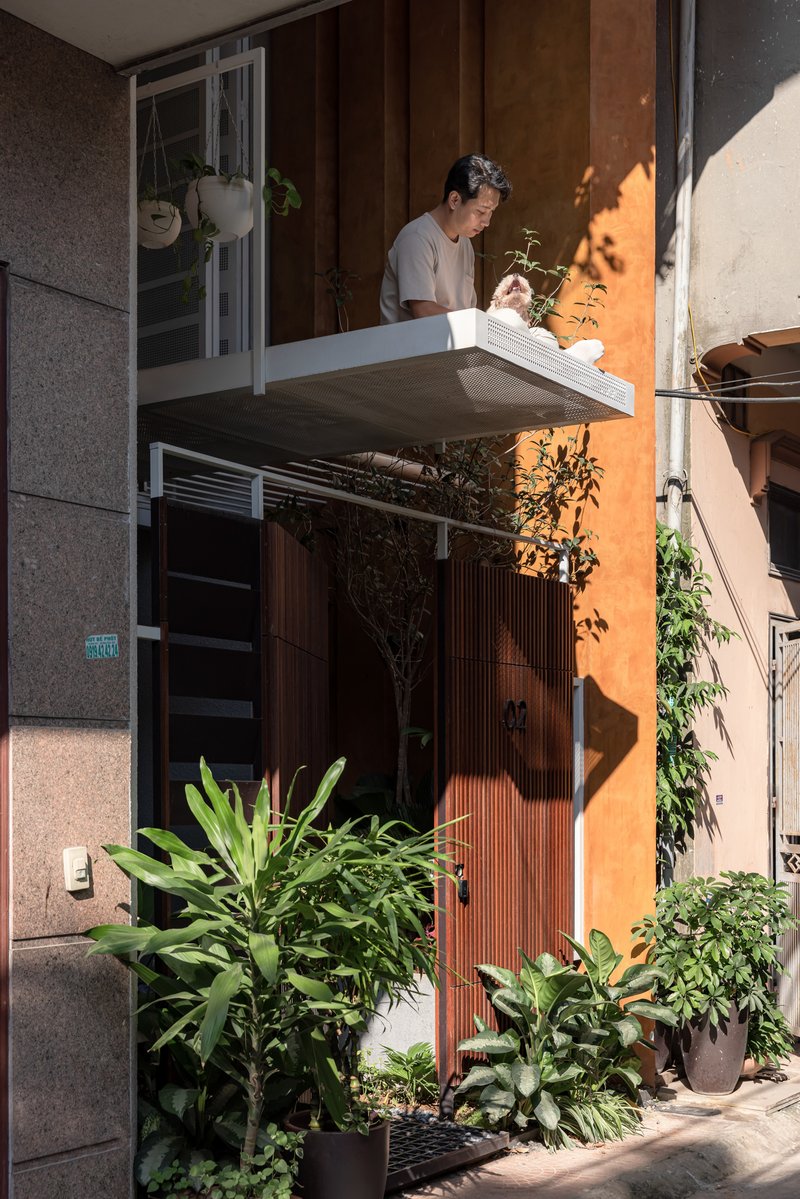
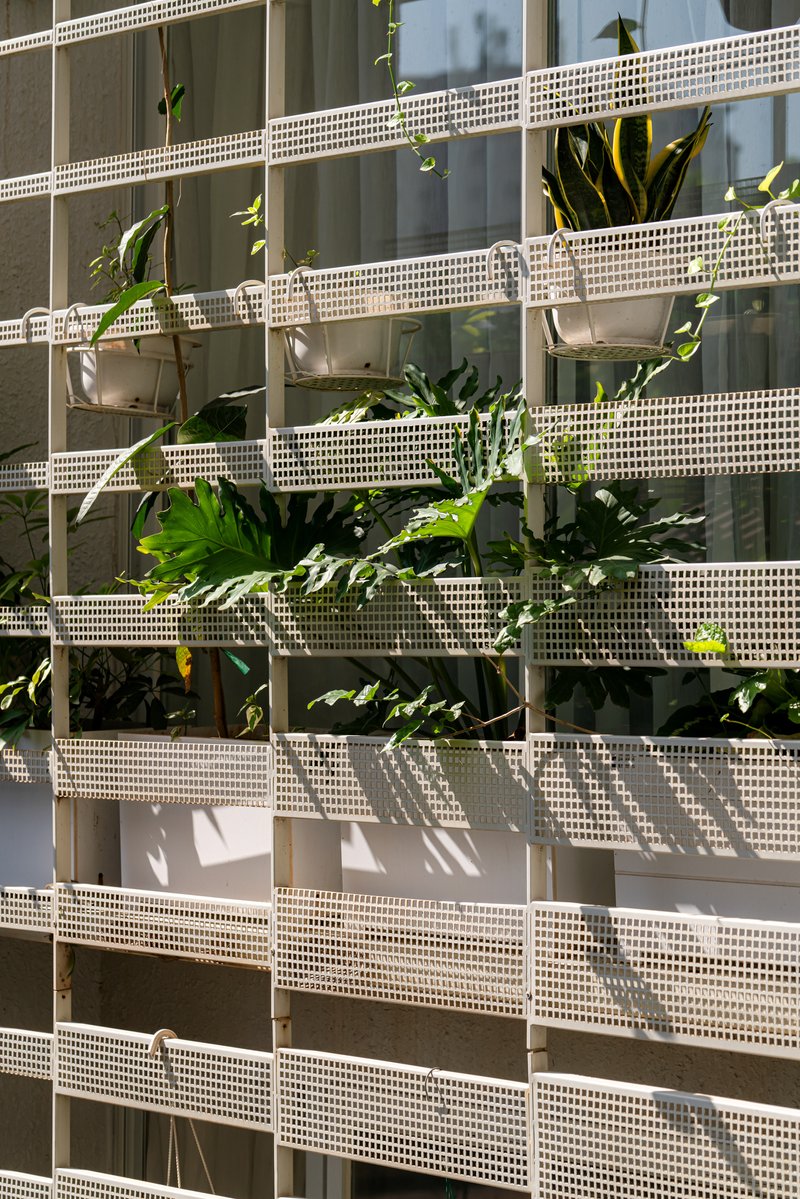
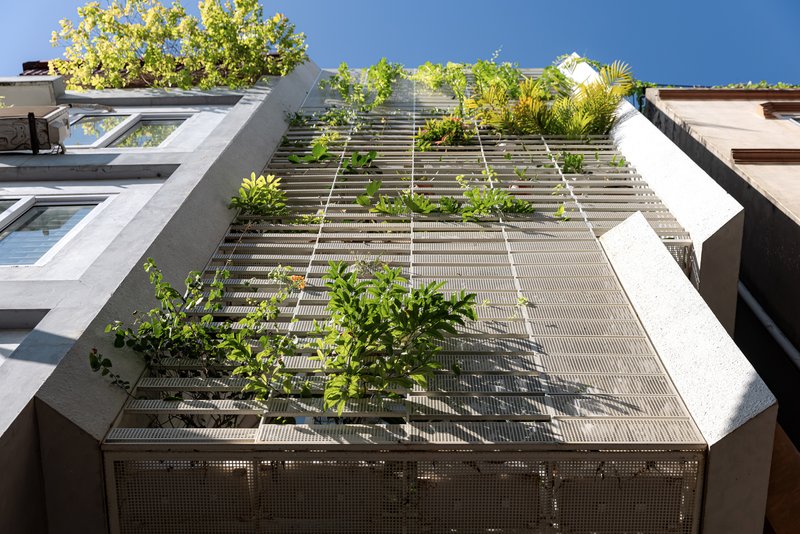
From the street, TamHouse presents itself as a stack of white perforated metal screens punctuated by horizontal bands of tropical planting. The screens do several things at once: they filter the harsh Hanoi sun, they allow cross ventilation through the building's shallow section, and they give the facade a layered depth that dissolves the hard edge between interior and alley. At different times of day the screens read as opaque or translucent depending on the angle of light, granting the family a degree of visual privacy without shutting out the neighborhood.
Balconies sit behind and between these panels, each one planted with ferns and palms that spill outward as they grow. The effect is less architectural screen and more vertical garden frame. It is a deliberate softening of what could easily have been a blunt concrete wall on a very narrow lot.
The Entry Sequence
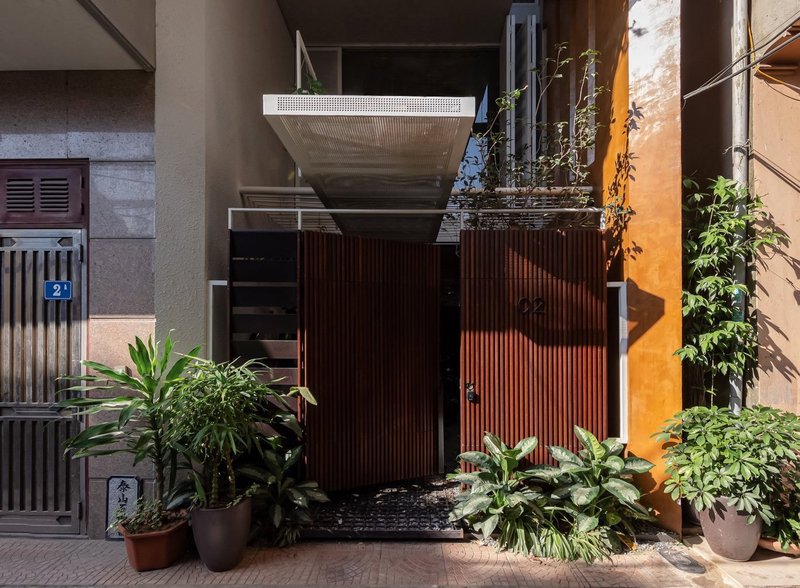
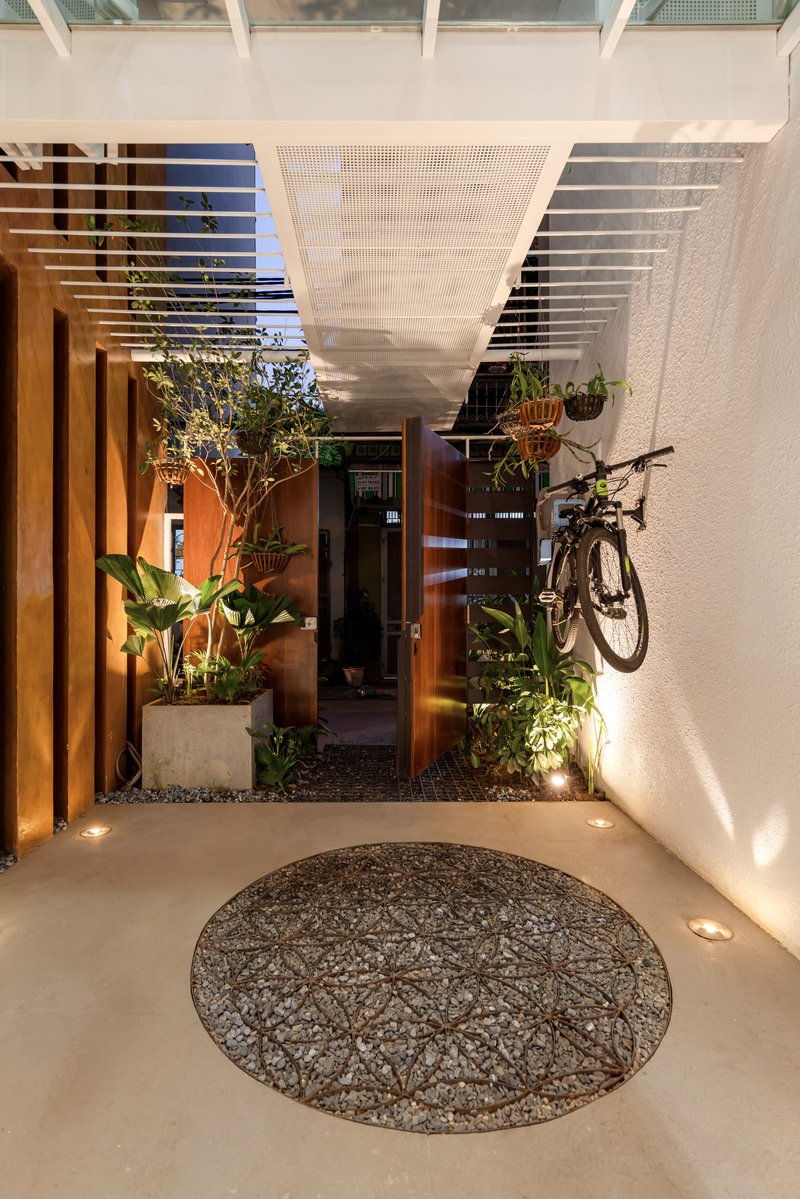
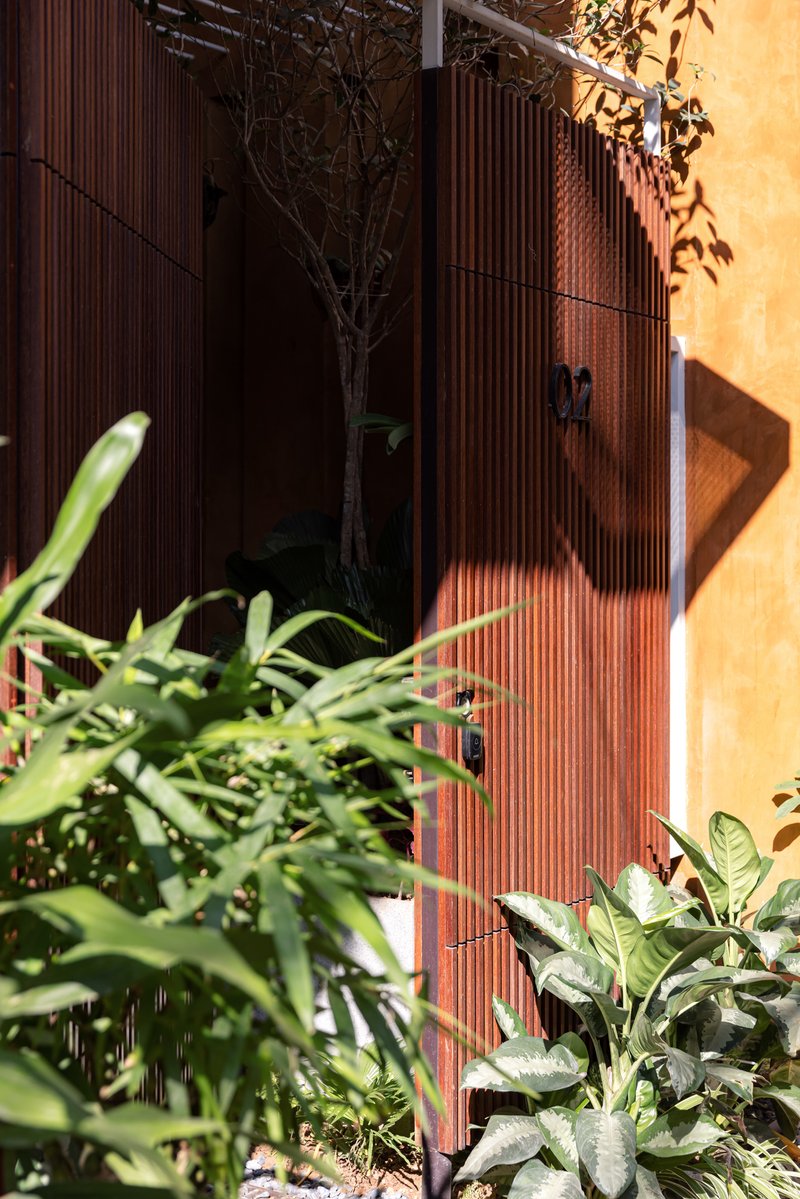
You enter through a corrugated metal gate into a ground-level courtyard that functions as a decompression chamber between the noisy alley and the domestic interior. A circular pebble feature sits at the center, surrounded by potted plants and framed by timber slatted screens overhead. At dusk the space glows warmly, and it becomes the threshold where shoes are left, motorbikes are parked, and the psychological shift from city to home begins.
The vertical timber slat door that marks the inner boundary is a detail worth noting. Its proportions are generous for such a tight plan, and the shadow lines it casts onto the terrazzo floor beyond set up a rhythm of solid and void that recurs throughout the house.
The Central Void as Social Spine
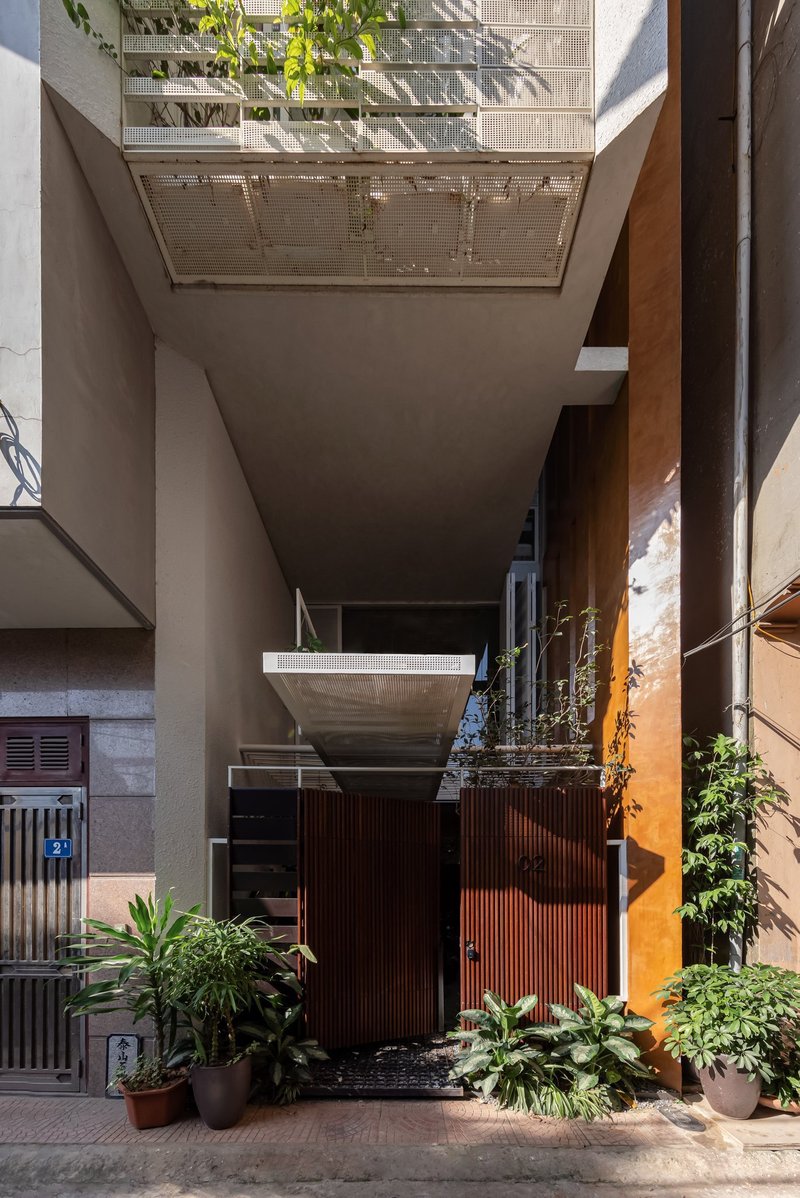
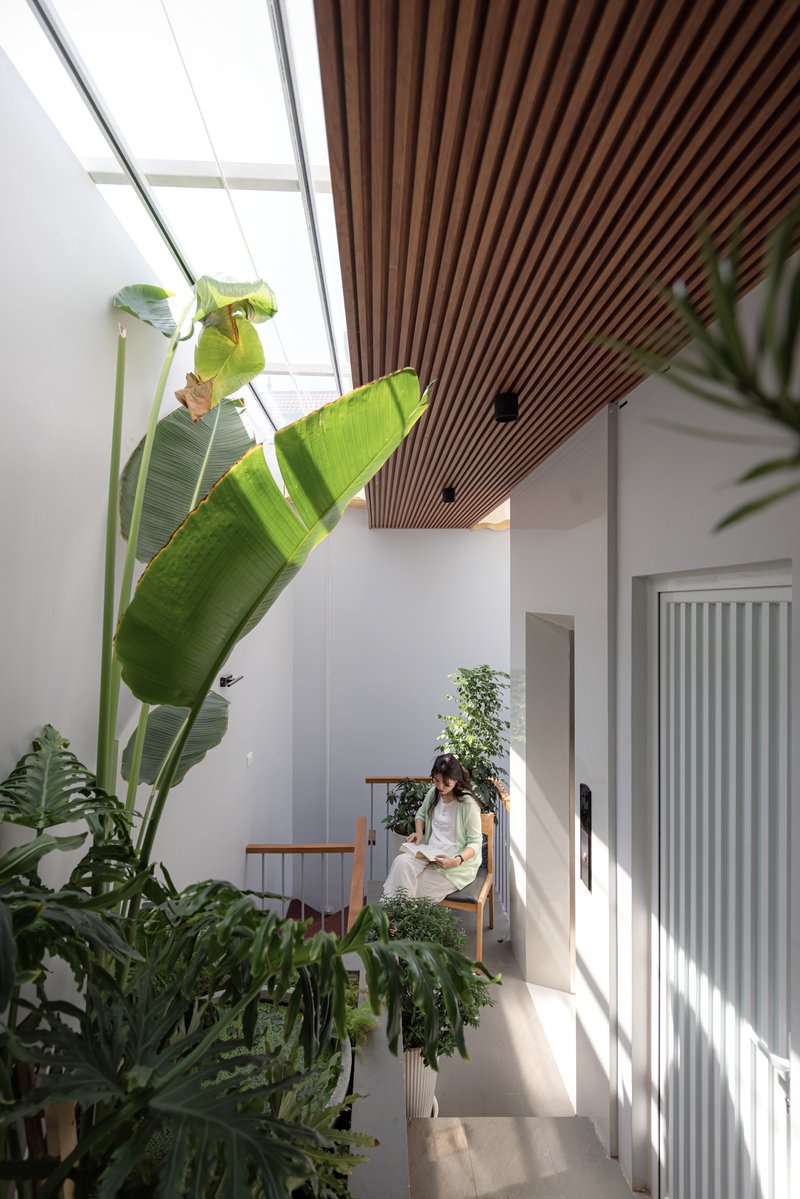
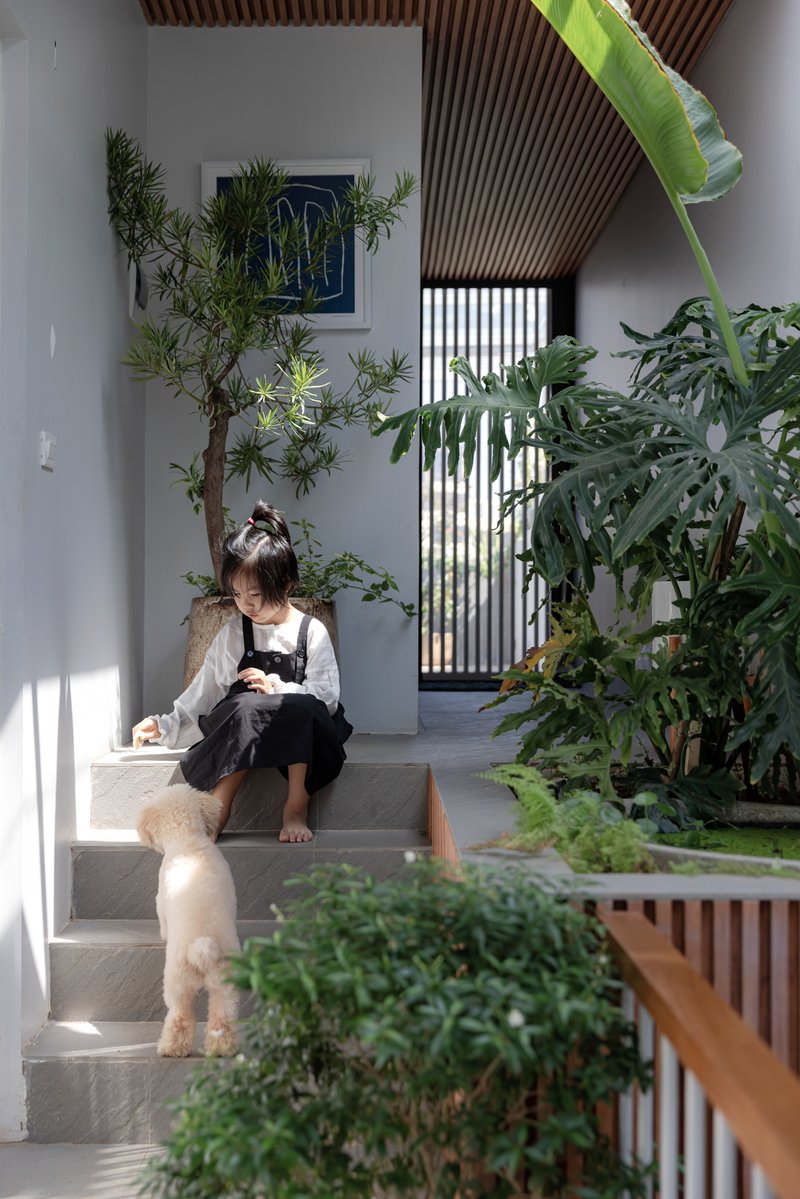
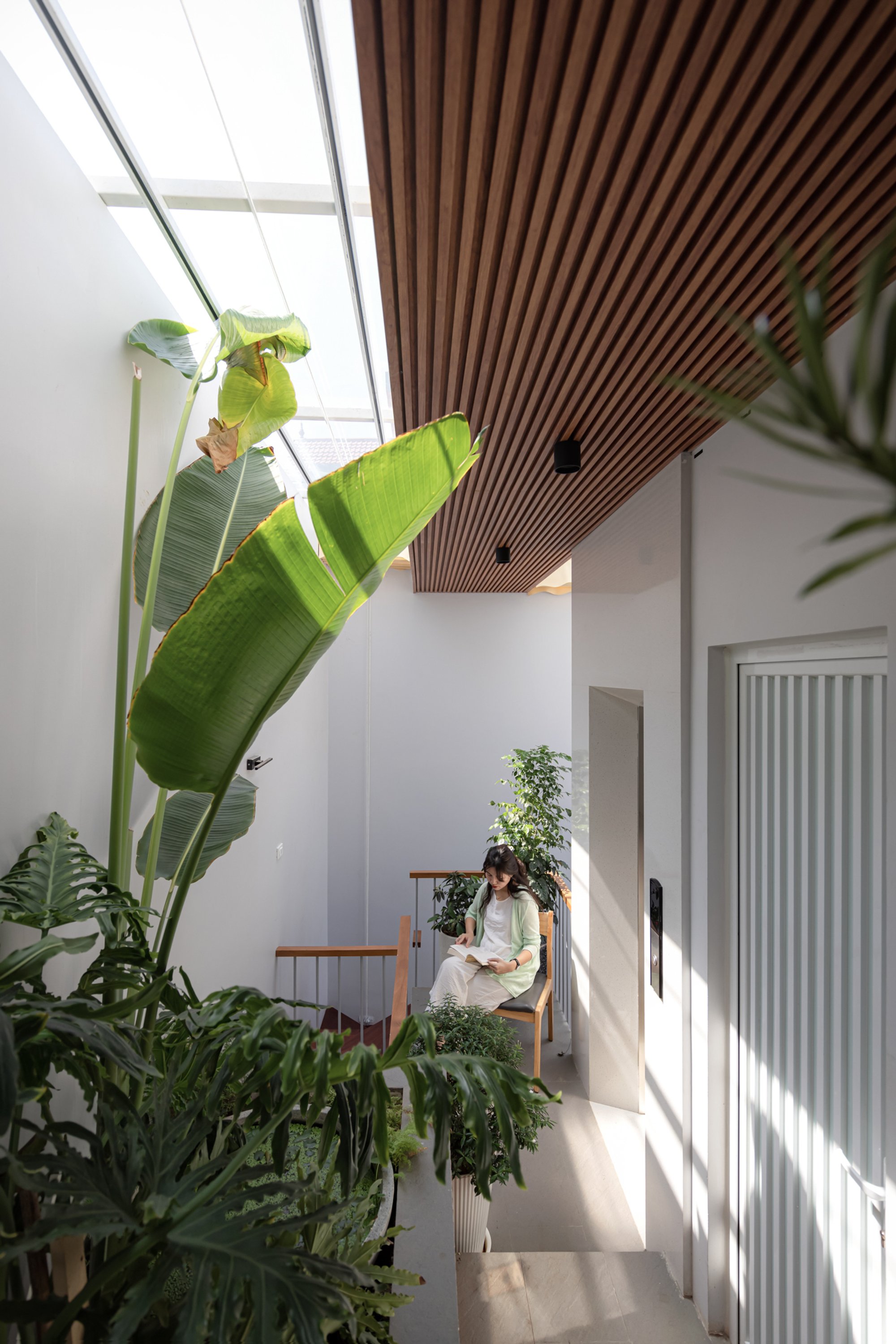
The defining move of TamHouse is a planted courtyard void that rises through the full height of the building, capped by a skylight at the roof. Banana plants, ferns, and creeping vines occupy its base, and perforated metal floors on the upper levels let light and air pass through uninterrupted. From below, looking up, you see a column of green punctuated by the silhouettes of family members on different floors. From above, looking down, you see pebbles, planting, and the domestic life of the ground floor.
This void is not decorative. It is the house's primary climate device, generating a stack effect that pulls hot air upward and out through the rooftop while drawing cooler air in at the base. In a city where air conditioning bills are a significant household expense, the void is as much an economic strategy as a spatial one. It also ensures that every room, no matter how deep in the plan, has a connection to natural light and a visual relationship with the rest of the house.
Living Rooms That Merge with Green
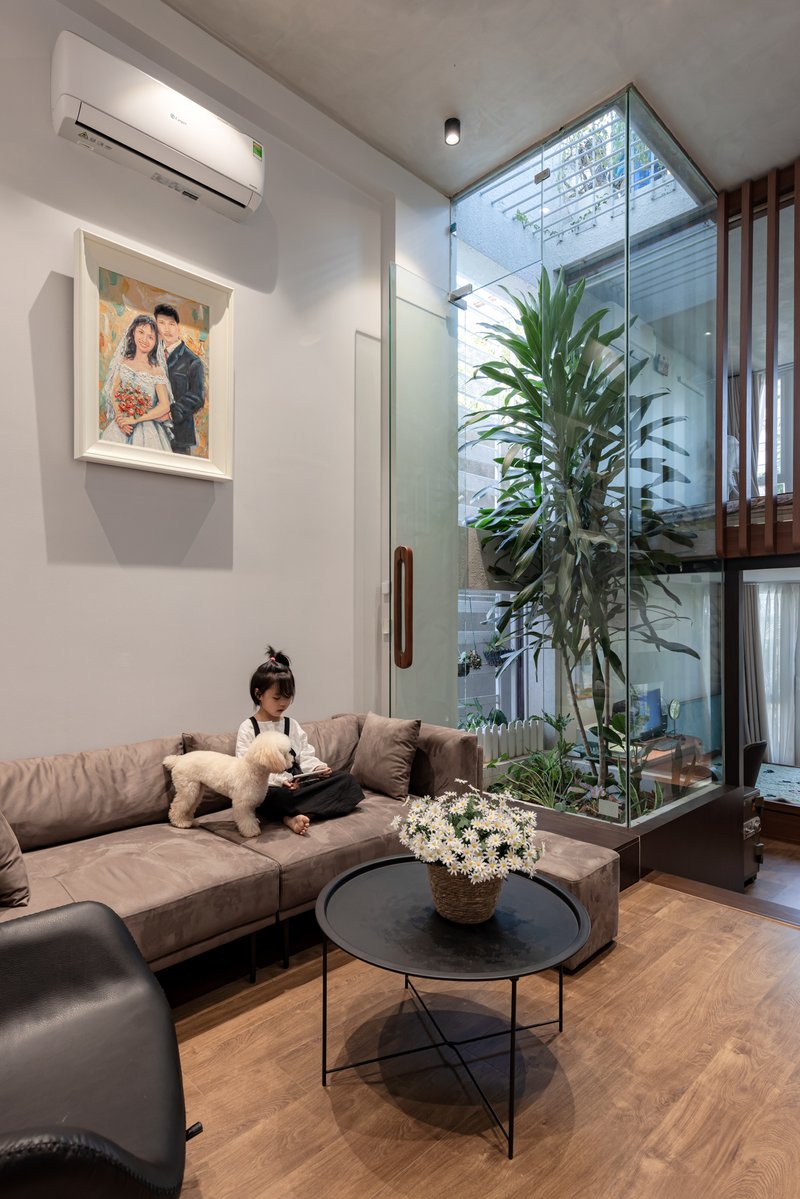
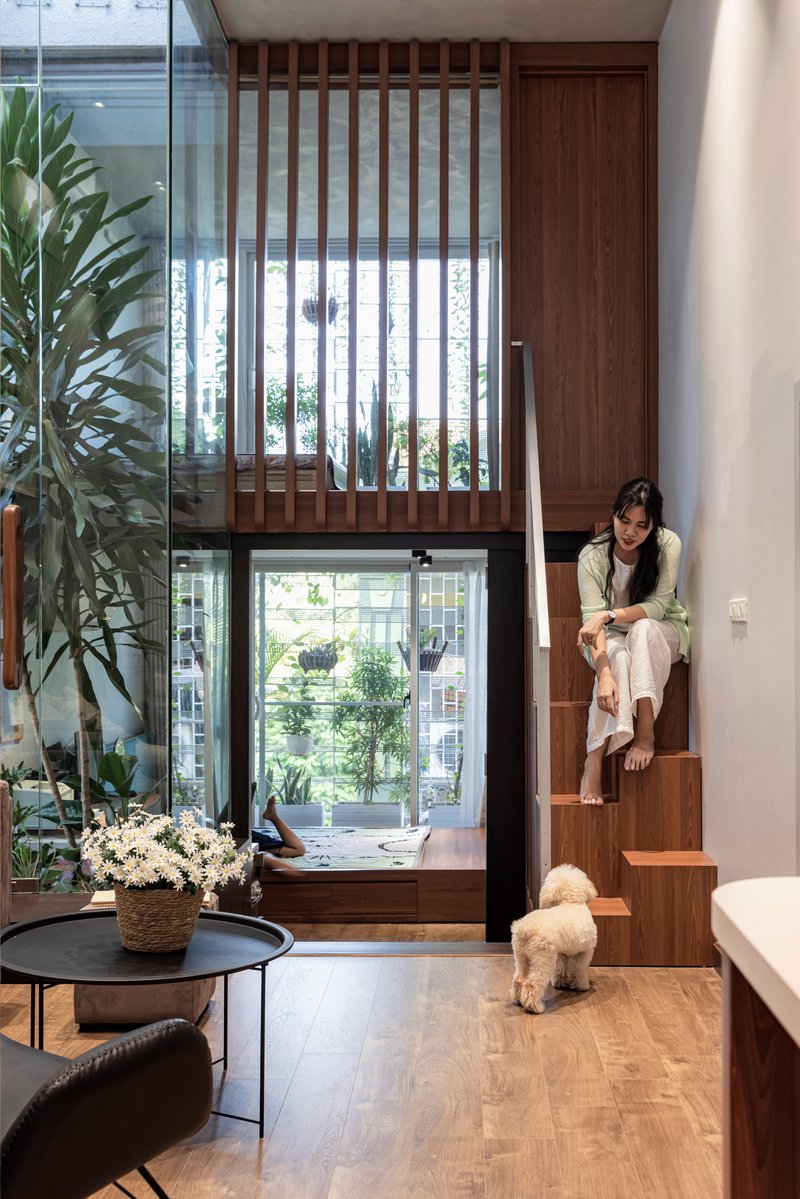
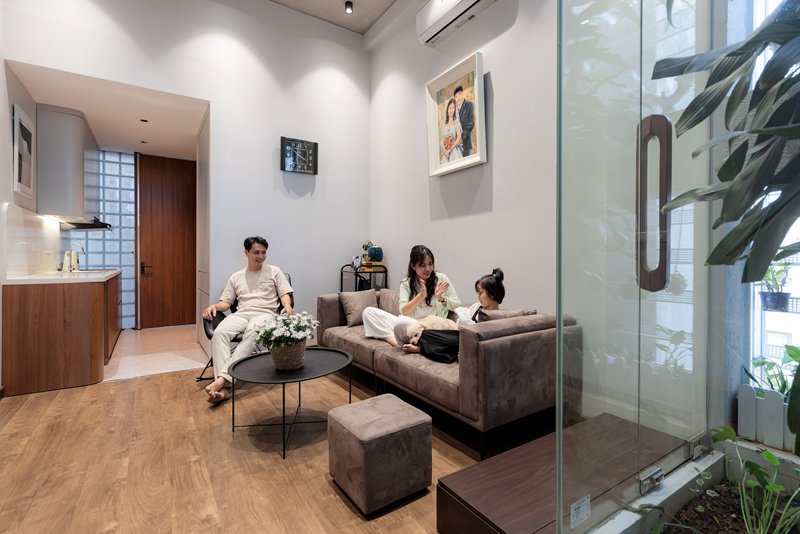
The communal living spaces are positioned to directly engage the courtyard void. Tall glazed walls open onto the planted beds so that the boundary between interior and garden evaporates. Timber slatted ceilings overhead add warmth and acoustic softness, while terrazzo flooring keeps the ground plane cool underfoot. The palette is restrained: tan leather, dark marble, sage upholstery, natural timber. Nothing competes with the greenery.
One of the more successful moments is a double-height living area where a woman sits on a timber stair beside her dog, the full height of the void visible above. The space feels generous despite being barely wider than a parking space. Scale, in this house, is produced by vertical proportion and borrowed views rather than by plan dimensions.
Staircase as Architecture
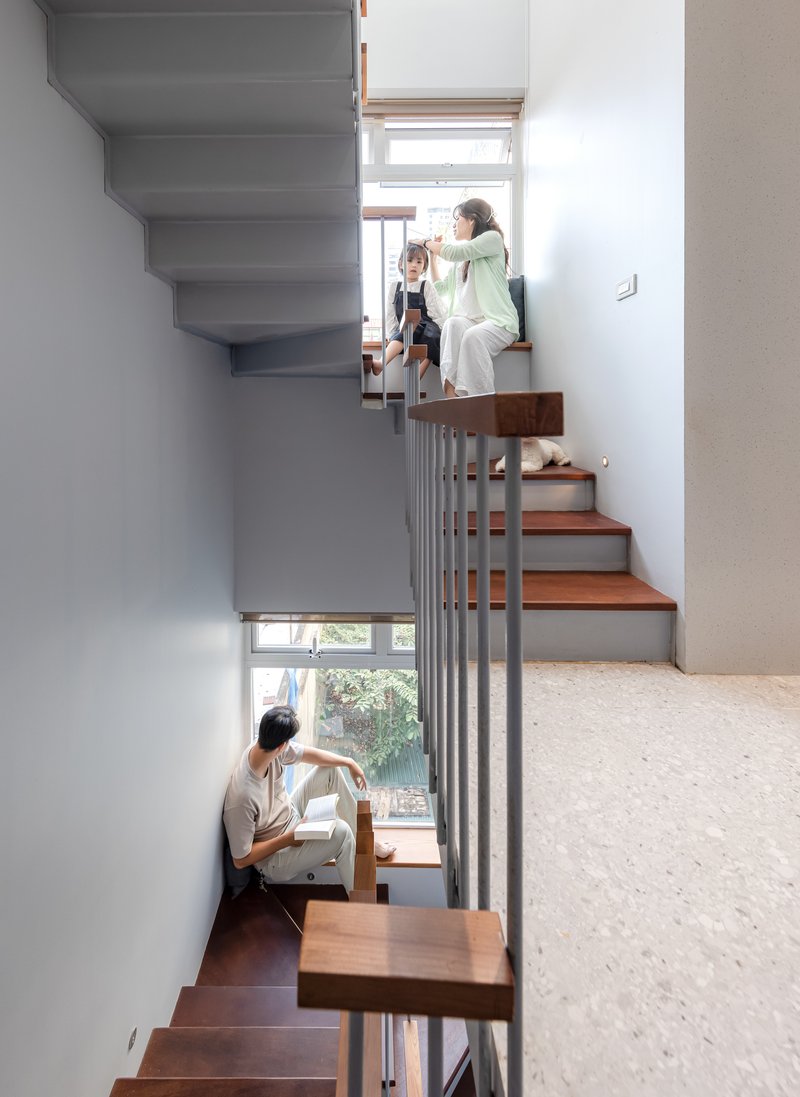
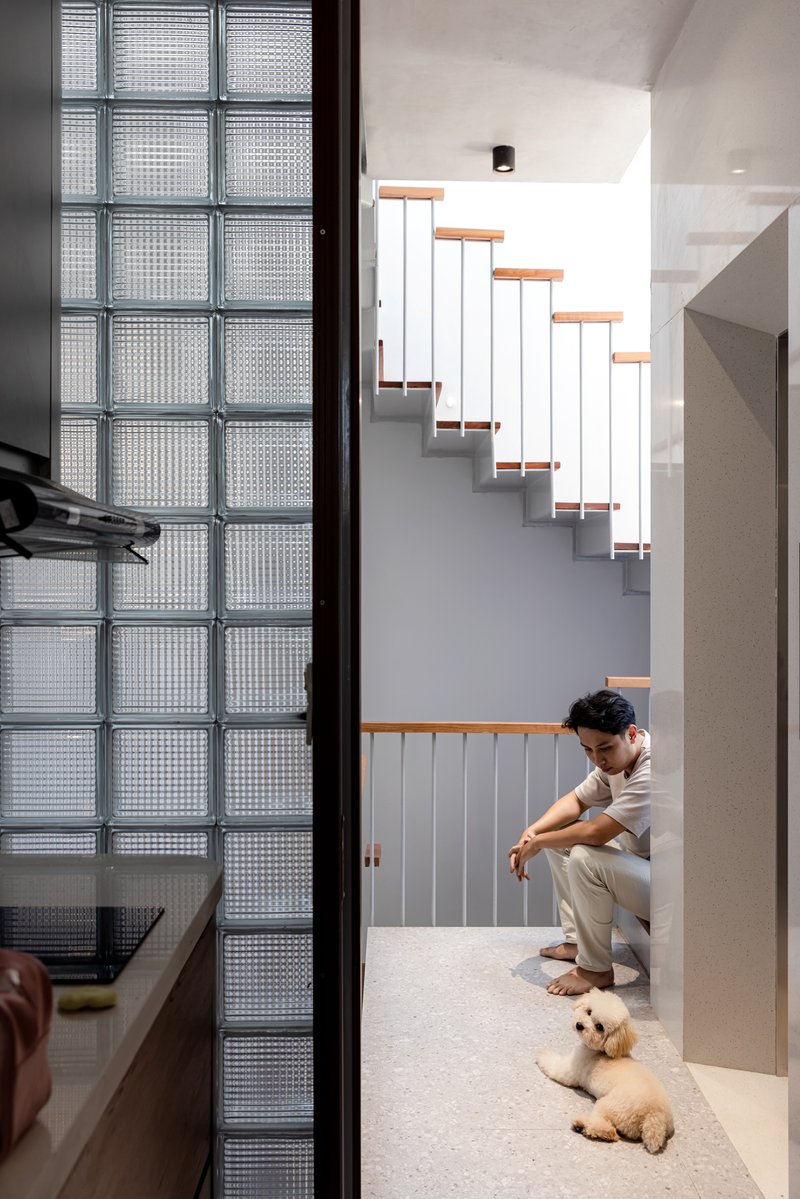
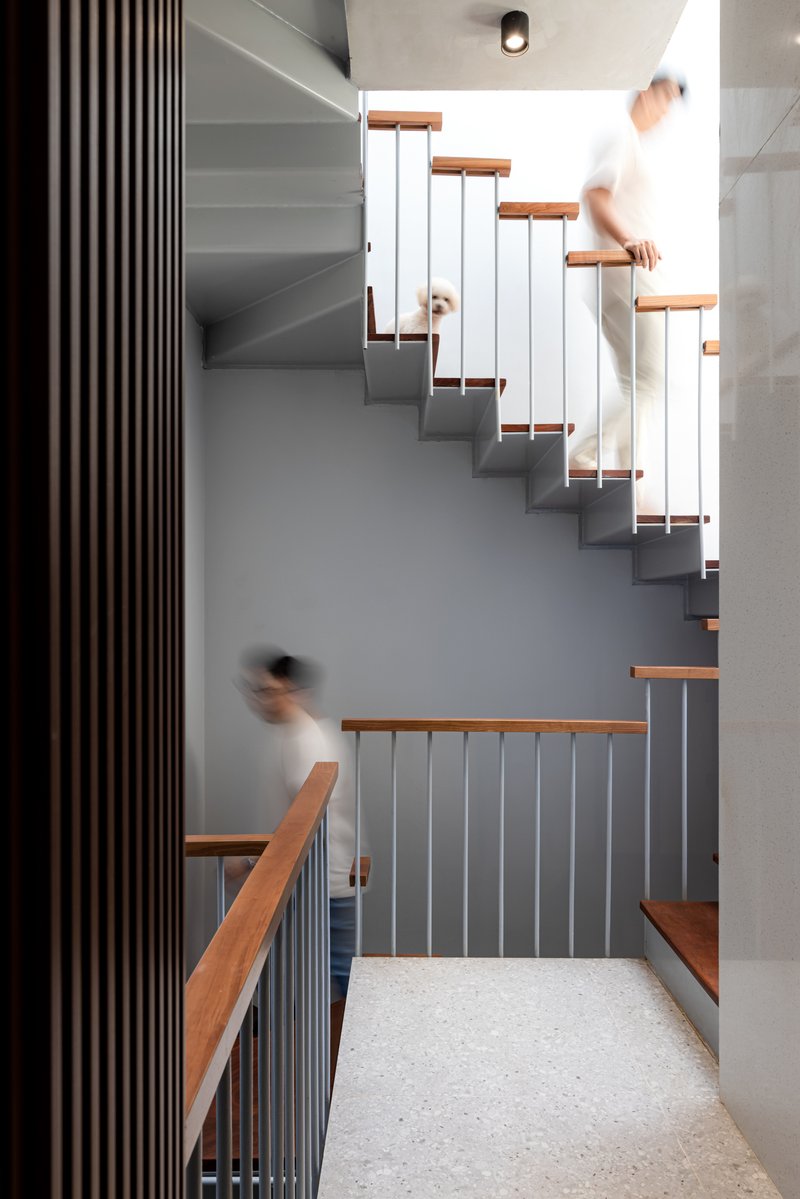
In a house this narrow, the stair consumes a significant fraction of every floor plate, so it had better earn its keep. A4 Architects treat it as a piece of furniture and a spatial event rather than a mere circulation chore. Timber treads float on cantilevered steel supports, vertical steel rod balustrades keep sightlines open, and split-level landings create pausing points where family members can sit, read, or simply watch people pass.
Viewed through the glass block wall on the adjacent boundary, the stair becomes a play of silhouettes and filtered light. The textured glass blocks admit daylight from the neighboring property without sacrificing privacy, turning a fire-separation wall into an atmospheric asset. It is a small detail that transforms what could have been a dark vertical shaft into one of the most photogenic moments in the house.
Upper Floors: Kitchen, Dining, and Walkways
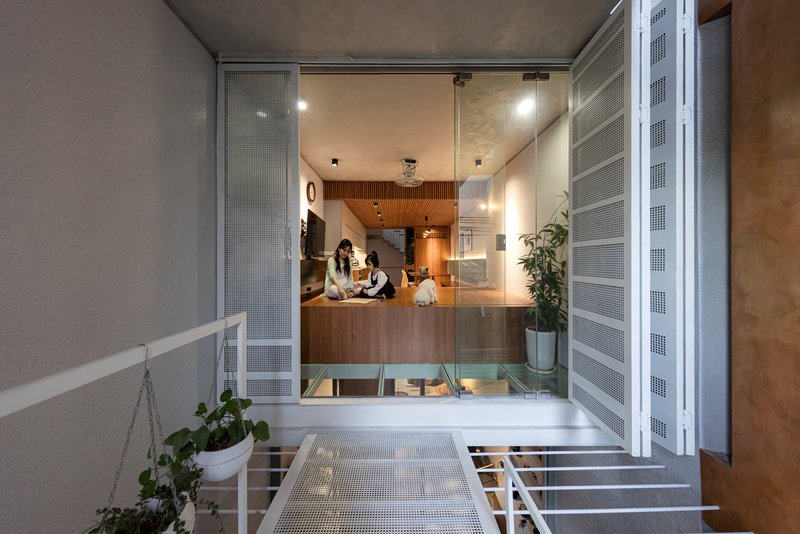
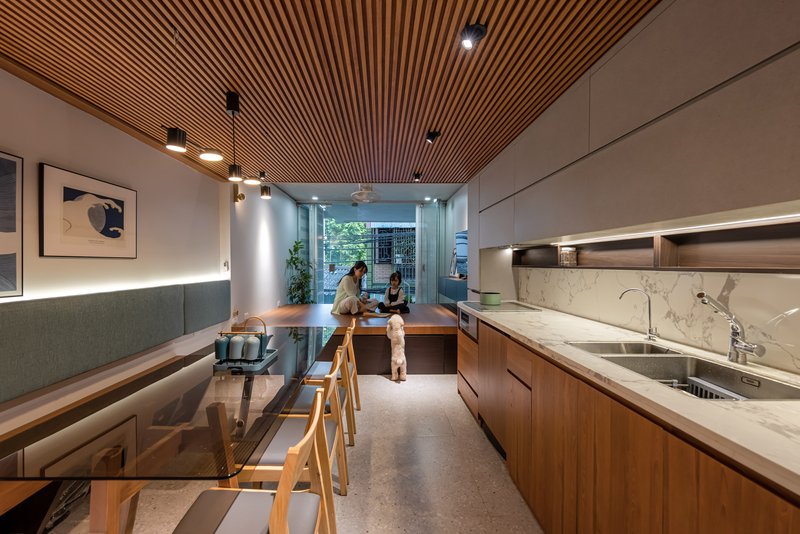
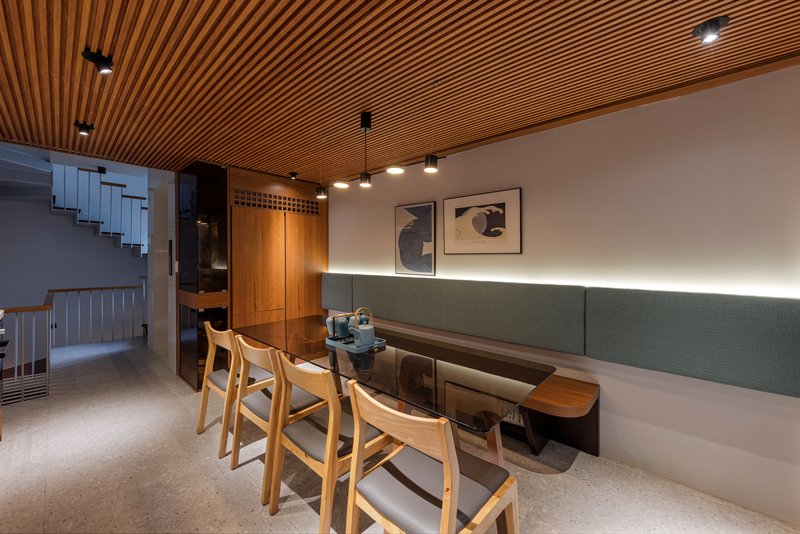
An aerial walkway with perforated metal grating bridges across the void to connect the kitchen zone, giving the upper levels a loft-like openness. Below the grating you can see planting and the floors beneath, reinforcing the vertical transparency that holds the house together. The kitchen and dining area sit under a timber slat ceiling, with marble countertops providing a durable work surface and two people comfortably seated at the table. For a family of three generations, this shared eating space is the social heart.
A built-in banquette with sage upholstery offers a secondary gathering spot, tucked into a quieter corner. It is the kind of space where a grandparent might sit with a grandchild while the kitchen operates a few steps away. These micro-territories of togetherness and retreat are what make the house livable at this density.
Material Palette and Interior Detail
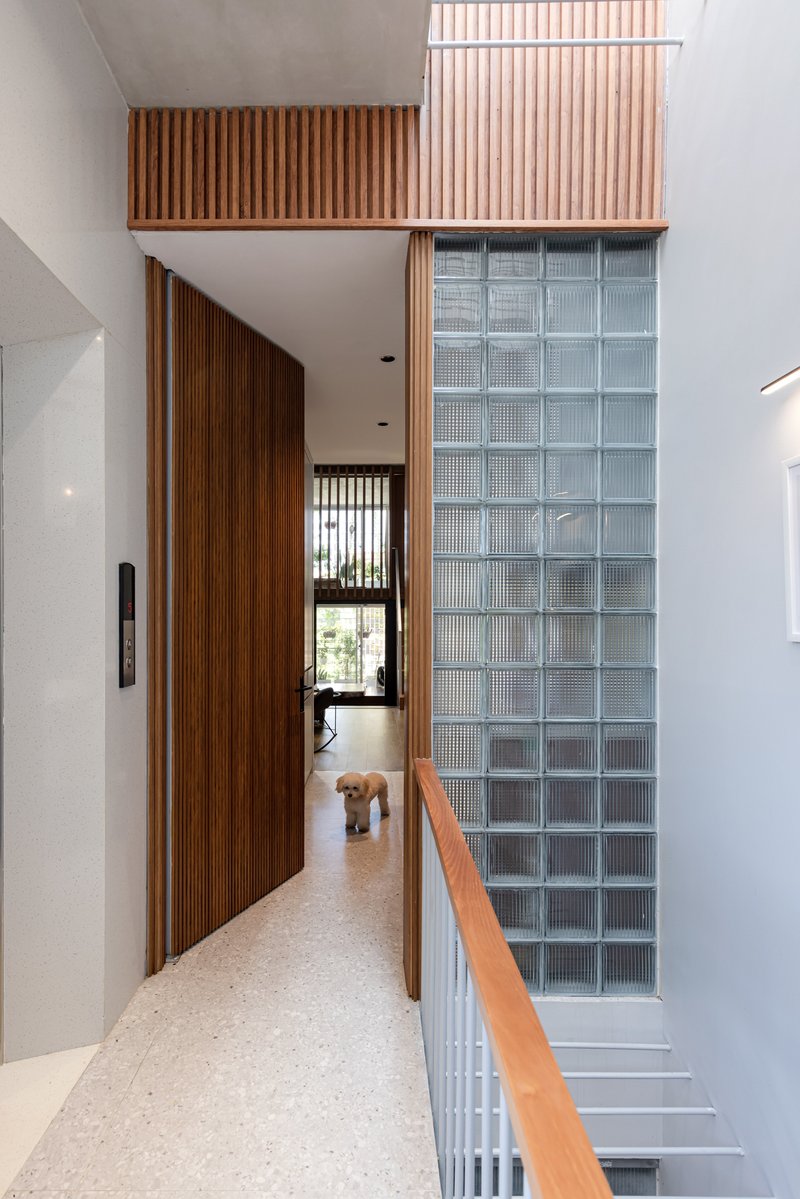
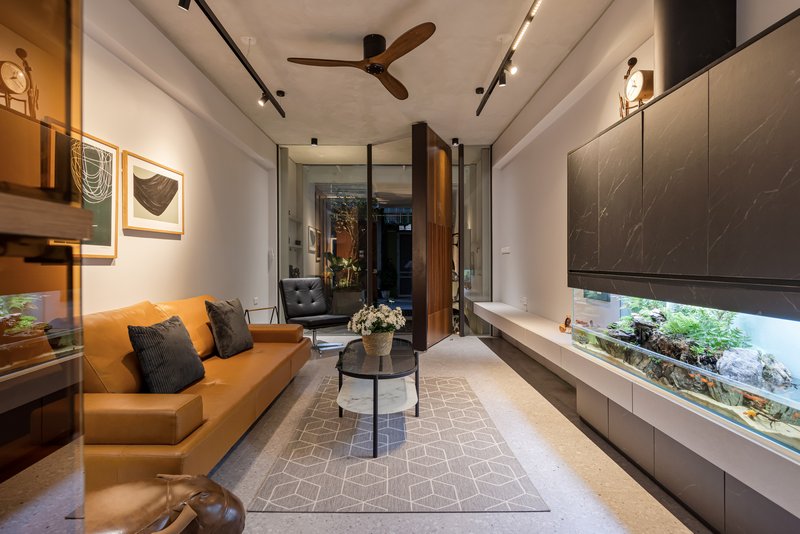
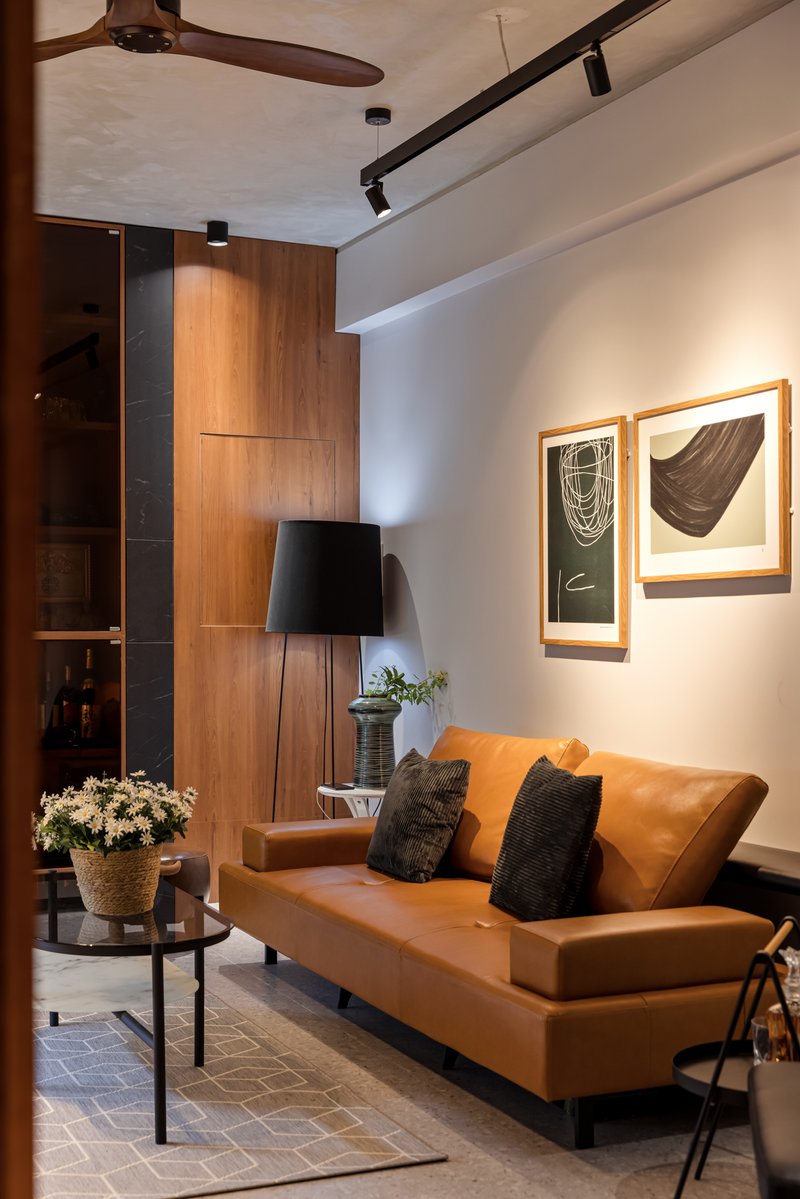
The interior material language is intentionally quiet. Terrazzo floors, timber slat walls, glass block windows, and dark marble accent surfaces repeat across the levels without variation, giving the house a coherent identity from ground to roof. Track lighting keeps fixtures minimal. A hallway shot captures the strategy perfectly: the dog walking through a corridor of terrazzo and timber slats, with a glass block wall admitting a soft, milky light. Nothing here is extravagant, but everything is considered.
The tan leather sofa, the framed artwork, and the timber storage wall in the living room suggest a family that values warmth over ostentation. The house supports that sensibility by keeping its structural moves visible, its surfaces tactile, and its proportions honest.
Perforated Balconies and Overhead Views
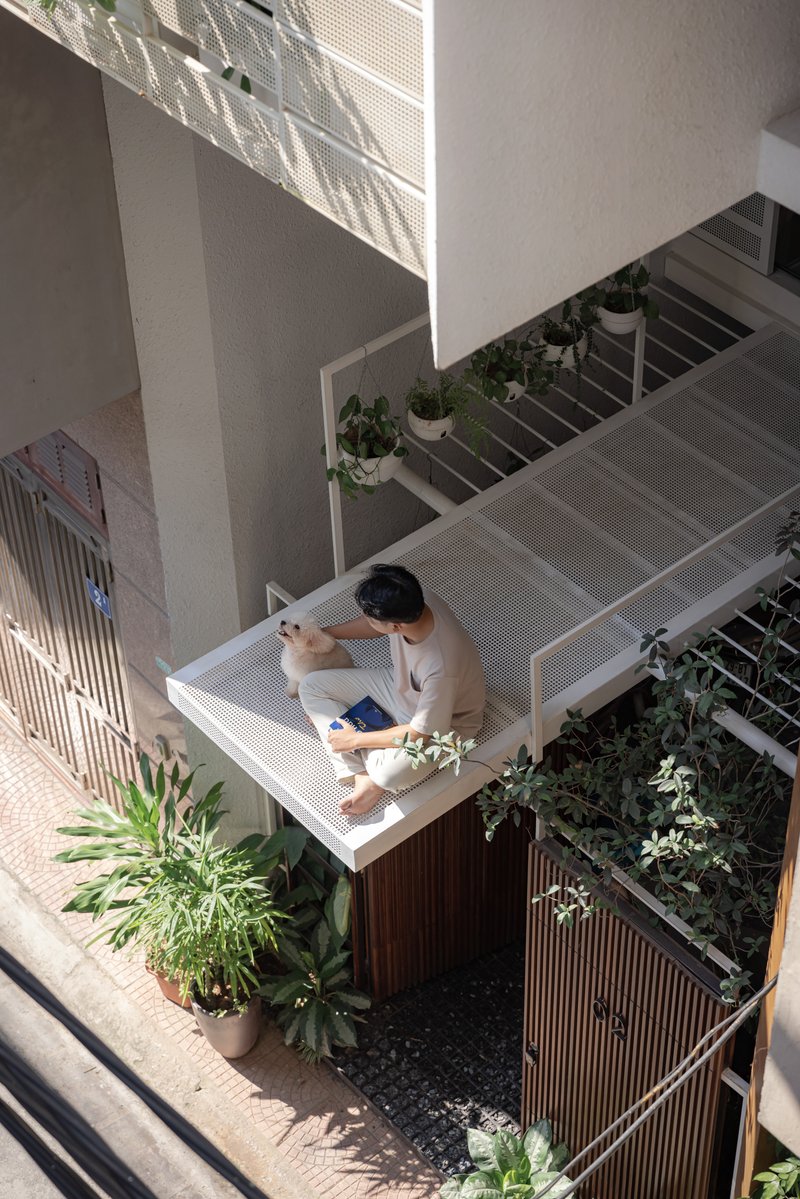
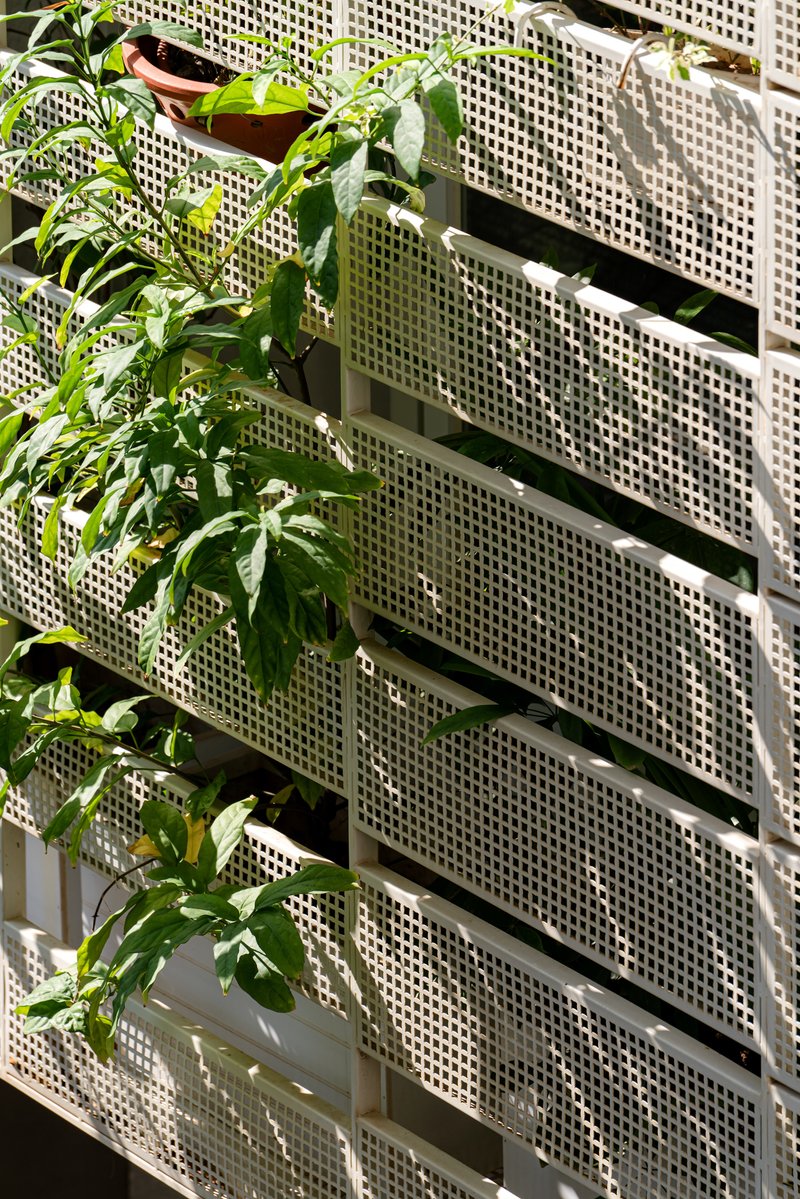
Seen from overhead, the perforated metal balcony platforms reveal the house's layered logic. A resident sits cross-legged on one platform, surrounded by planters and pebble ground visible below. The punched holes in the metal allow rain to drain, light to filter, and air to circulate, all while giving each balcony the feeling of a suspended garden rather than an enclosed room. The white perforated screen panels, when viewed from the interior side, frame the planted terraces beyond like a series of botanical vitrines.
Plans and Drawings
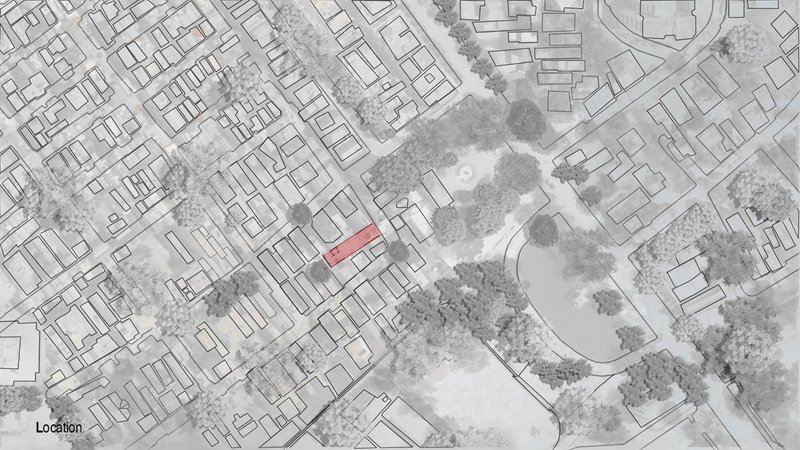
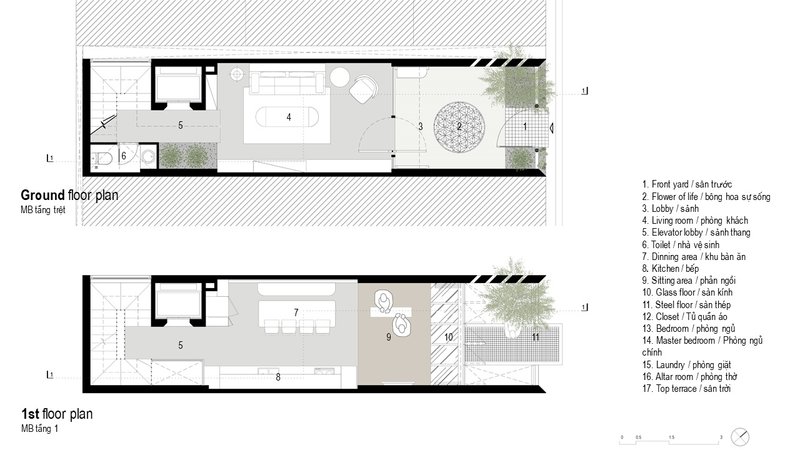
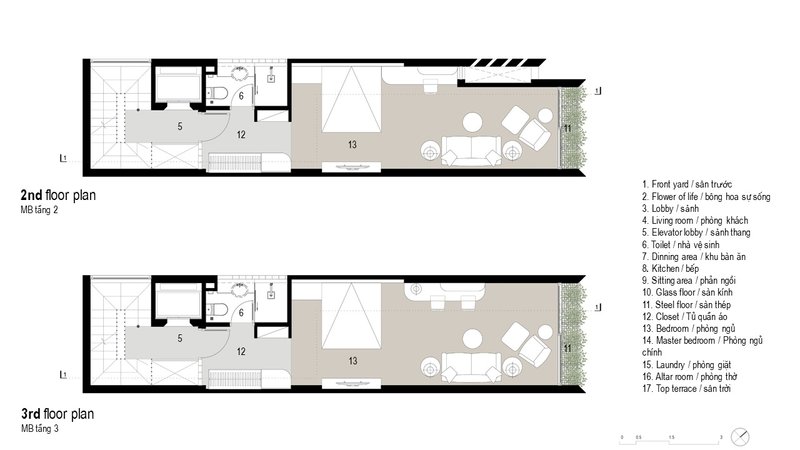
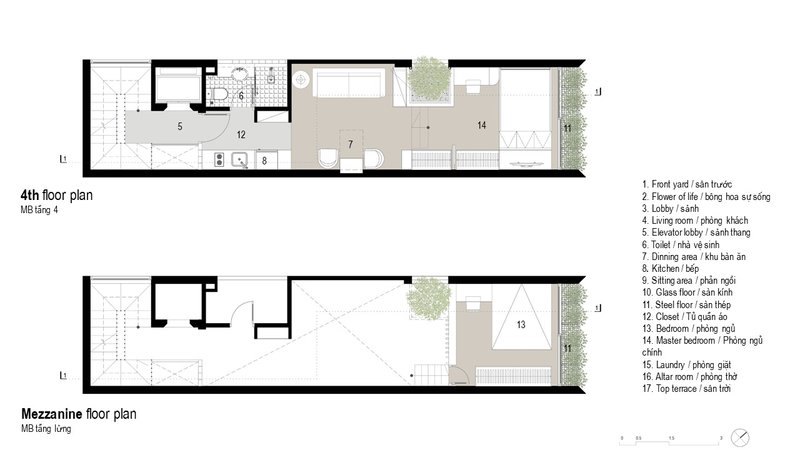
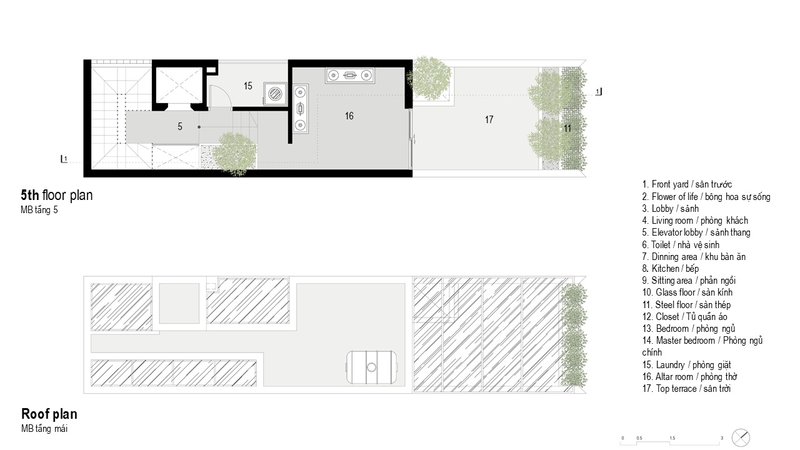
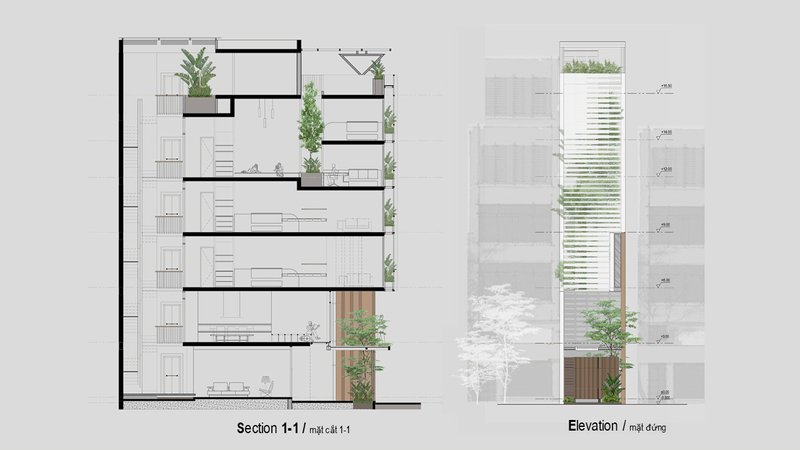
The site plan makes the constraint vivid: a thin red sliver embedded in a dense carpet of neighboring rooftops, with the alley as its only breathing space. The floor plans across five levels and a mezzanine show how the stairwell, courtyard void, and planted terraces are threaded through the section to create spatial relief on every floor. The section drawing is the most revealing document, illustrating how the planted voids stack from ground to skylight and how the louvered facade regulates the building's relationship with the street. Each floor takes on a distinct programmatic role while remaining connected to the others through the central cut.
Why This Project Matters
TamHouse matters because it refuses to treat the narrow urban lot as a problem to be tolerated. Instead of maximizing floor area and hoping for the best, A4 Architects carved away significant portions of the plan to create a void that supplies daylight, ventilation, greenery, and visual connection between generations. The trade is counterintuitive: give up built area, gain livability. In a city where developers routinely fill every centimeter of a plot, that decision is both a design argument and an ethical stance.
More broadly, the project offers a replicable model for multigenerational living on constrained urban sites across Southeast Asia. The strategies it deploys, perforated screens, planted voids, split levels, passive ventilation through section design, are not proprietary inventions. They are intelligent recombinations of well-understood techniques, applied with discipline to a specific family's needs. That is, in the end, the most useful kind of architecture: not a signature gesture but a transferable idea.
TamHouse by A4 Architects, lead architect Nguyen Huu Tien. Located in Xuân La, Hanoi, Vietnam. Plot area 3.6m x 16m. Completed 2021. Photography by Vu Nguyen.
About the Studio
Share Your Own Work on uni.xyz
If projects like this are the kind of work you want to make, uni.xyz is a place to publish your own, find collaborators, and enter design competitions.



Popular Articles
Popular articles from the community

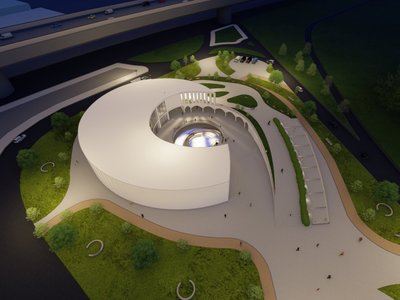
The Heart of Milano: Slow Fashion Architecture for a New Circular Culture
The Heart of Milano turns slow fashion architecture into a civic landmark where learning, making, sharing, and circular culture meets daily.
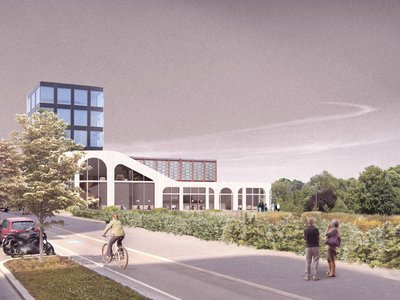
The Flow: Coffee Shop Interior Design Where Time, People, and Process Intertwine
The Flow reimagines Viennese coffee culture through arched forms, warm interiors, music, reading, work, and social gathering.

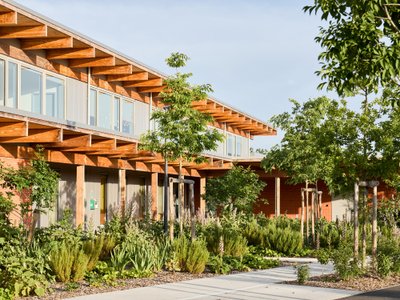
GGR Architectes Anchors a New Neighborhood in Frouzins with a Brick and Timber School Complex
A cruciform plan of terracotta brick and exposed wood frames four courtyards for 140 students outside Toulouse, France.
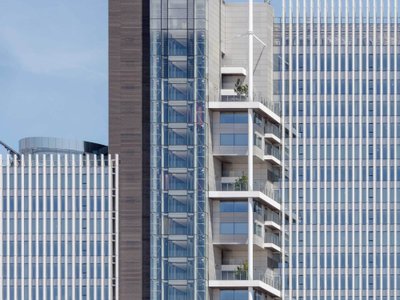
Cro&Co Architecture Builds a 150-Meter Tower on Top of a Seven-Lane Highway in La Défense
Trinity Tower reimagines the office high-rise as a bioclimatic organism threaded with terraces, trees, and public ground in Paris's business district.


Similar Reads
You might also enjoy these articles
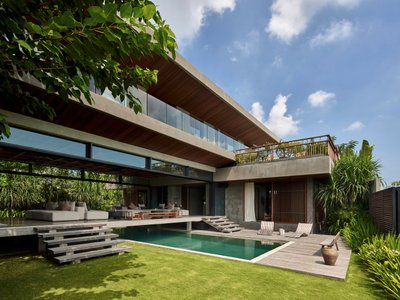
Freebird Residence by Alexis Dornier: A Tropical Modernist Sanctuary in Bali
Floating living pavilion above pool anchors H-shaped tropical villa, blending Japanese minimalism, sustainable strategies, lush landscape, and sculptural interiors.
127af Flips a Tiny Bagnolet Rowhouse Upside Down with a Handcrafted Roof Extension
A 55-square-meter terraced house on the edge of Paris gains a luminous upper living floor through lightweight timber and steel.
1.61 Design Workshop Wraps a 600-Square-Meter Café in Vietnam in Sculptural Burgundy Drama
Reden Café & Bistro pairs a helical staircase, mosaic floors, and deep red interiors to rethink Vietnamese hospitality space.

The Unbound Brain: A School Shaped by Cognitive Architecture
Cylindrical learning pods radiate like neurons from a central cortex, turning the floor plan into a spatial model of human thought.
Explore Residential Building Competitions
Discover active competitions in this discipline




The Global Benchmark for Architecture Dissertation Awards


Challenge to design mud housing for contemporary communities
Comments (0)
Please login or sign up to add comments
No comments yet. Be the first to comment!