
AABHAS-a sense of home
A sustainable model for migrant construction workers

THE CONCERN
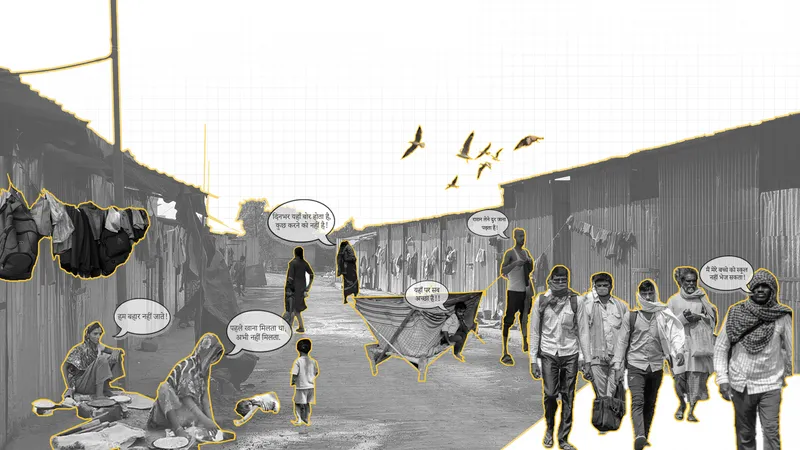
They raise our skylines, yet sleep under tarps. Their homes are temporary, their futures uncertain. With no access to stable housing, education, or safe spaces, migrant construction workers and their families remain on the margins-building the nation while being denied a place within it.
Women walk in fear, children play among hazards, and families endure without privacy, sanitation, or safe air to breathe. What should be spaces of rest become sites of risk-where dignity is stripped away in silence.
India’s rapid pace of urbanization has transformed the skylines of its cities, but this transformation rests on the invisible shoulders of millions of migrant construction workers. As villages lose their ability to sustain livelihoods due to agricultural decline, climate change, and lack of opportunities, large numbers of people are forced to migrate to cities in search of work. Urban centres, hungry for expansion, absorb this influx of labour into one of the most demanding industries-construction.
The construction industry has become the second largest employer in India after agriculture, driven almost entirely by migrant labours. Families move from rural areas to cities, often without security or stability, and find themselves employed on building sites where work is plentiful but exploitative. Men are largely absorbed as masons, helpers, and daily-wage labourers, while women are engaged in carrying loads and performing tasks that require physical endurance but offer little pay. Children, too, are often drawn into this cycle, either left out of school or forced to assist their families informally. This movement of people is a direct response to the pull of urban growth and the promise of employment, yet it results in precarious living conditions.
Urbanization has undoubtedly fuelled economic growth and created massive employment in construction, but it has also reinforced cycles of inequality. Migrant workers, who build homes, offices, and infrastructure, live in temporary shelters on the very edges of these developments. Their settlements-labour camps and makeshift shacks-are rarely equipped with proper sanitation, water, or spaces for education. This disconnect exposes a deep paradox: while urban expansion thrives because of their contribution, the workers remain excluded from the benefits of the city they help create.
The concern of this thesis lies here-addressing the living conditions of migrant construction workers, who remain on the margins of urban life despite being central to its growth. By rethinking housing, sanitation, education, and community spaces within labour settlements, the aim is to propose architectural models that bring dignity, stability, and inclusivity to those who are too often overlooked. It is about bridging the gap between urban prosperity and the people who make it pos
THE APPROACH
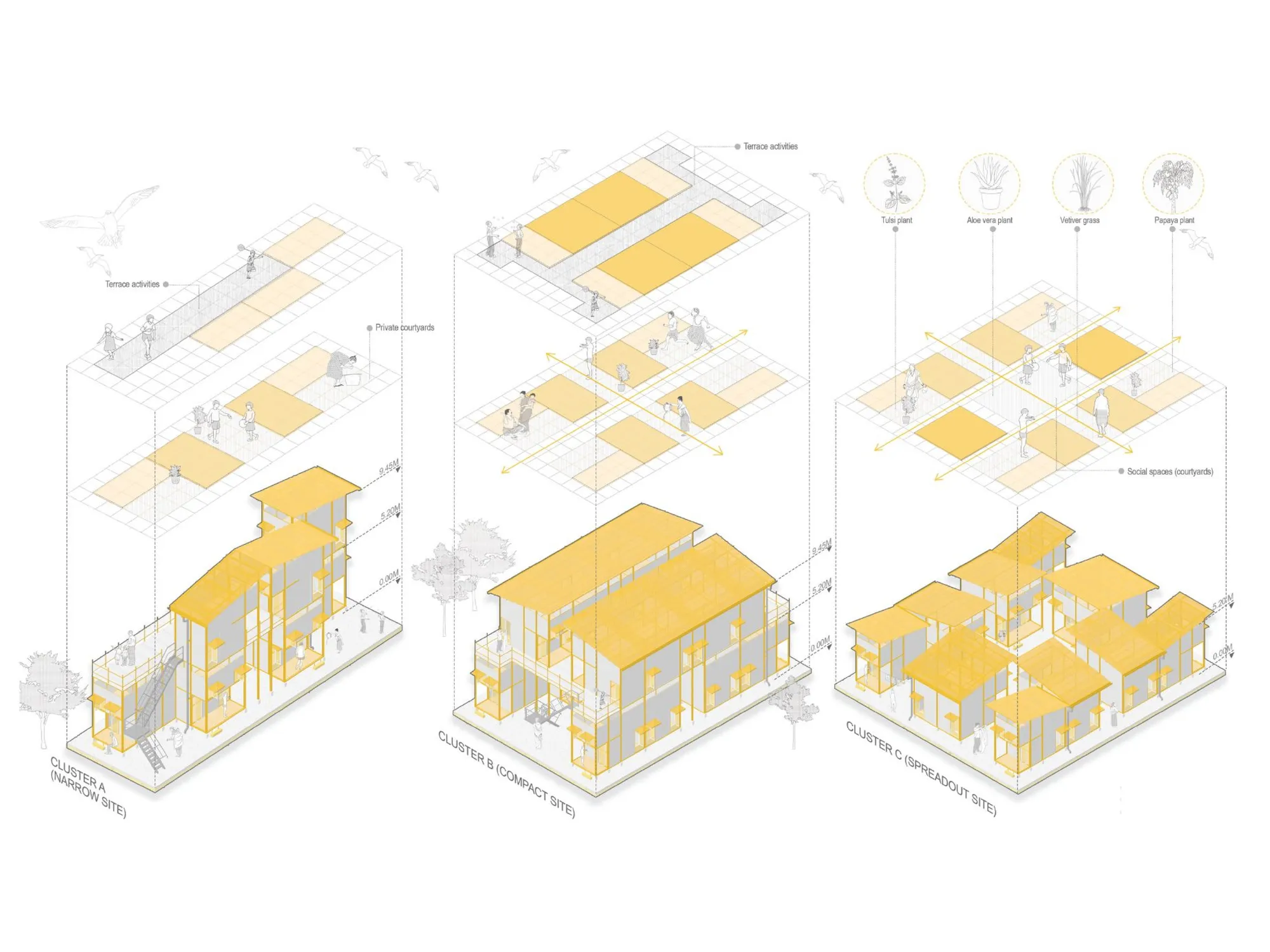
Site - The chosen site acts as a staging ground for possibilities, offering three distinct labour camp settings-linear, compact, and spread-out. Each type presents unique challenges, allowing exploration of cluster formations, density variations, and site arrangements. The design tests both ground-level and G+1 structures, linked by pathways that double as social corridors and enhanced with plantations for shade and comfort.
Units and clusters - The approach of this thesis is rooted in designing for temporality-responding to the transient nature of migrant construction worker’s lives while ensuring comfort and adaptability. The project moves forward with a deep understanding of user needs, where every decision reflects scalability, anthropometry, economy, adaptability, portability, and the ease of assembly and disassembly. The unit is conceived as a self-built prototype, empowering users to participate in it’s making and alter spaces as their requirements evolve.
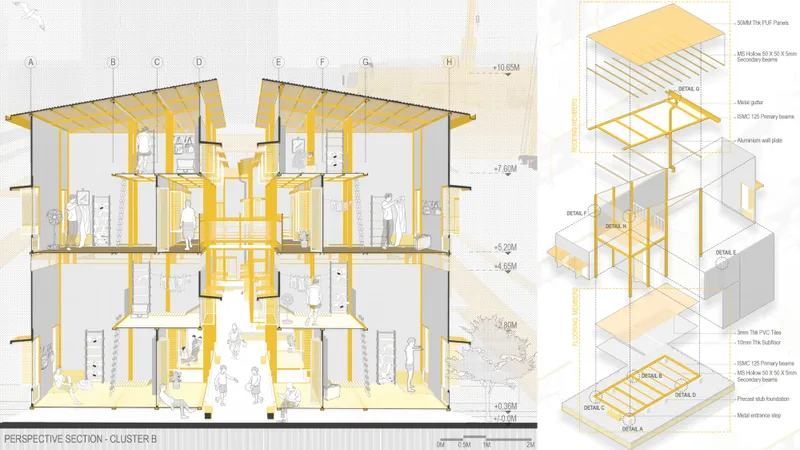
Material selection is guided by a certain criteria- affordability, durability, thermal comfort, and local availability, ensuring that the construction remains practical and sustainable. The design adopts a 1.2m × 1.2m modular grid, derived from panel sizes, making the system flexible. This allows the module and cluster to scale up or down seamlessly, accommodating varied family sizes and site conditions.
Seven types of panels form the building blocks of the unit, connected through dry plate-and-bolt joineries. These joints are simple enough for workers themselves to assemble, dismantle, or reconfigure without dependence on specialized skills or heavy machinery.
The programme of this thesis extends beyond the idea of providing shelter. While housing forms the core, the design is imagined as a living, breathing environment that nurtures community, culture, and identity. For migrant workers, home is never just a roof and four walls-it is also the comfort of belonging, the familiarity of shared traditions, and the dignity of personal space. This project therefore seeks to create a home away from home, where users are not only accommodated but also empowered to shape their surroundings with their own practices and memories.
The spatial framework is designed with verandas, terraces, and courtyards that act as thresholds for interaction. These become places where daily routines overlap-where children play, women dry papads, families gather for prayer, or neighbours share stories at dusk. The clusters are designed to provide both private and semi-private courtyards, ensuring a balance between solitude and togetherness.
Beyond the living units, the programme integrates communal facilities that address the broader needs of workers and their families. Community kitchens, creches, medical rooms, and toilets ensure that basic needs are met, while recreational and gathering spaces invite people from different states, religions, and languages to connect. Within these spaces, religious and cultural practices-whether a corner for evening aarti, a courtyard for Eid gatherings, or a shaded space for festivals-are accommodated with sensitivity, reinforcing a sense of belonging.
Versatile design and planning - The design is envisioned as a universal system-a framework that can be adapted to any site, condition, or climate through a set of simple thumb rules and the inherent flexibility of its modular structure. Flexibility is embedded at multiple levels. The module itself is multifunctional: the same frame can become a sleeping unit, a kitchen, a store, or a creche, depending on partitions and furniture arrangements. This interchangeability ensures that spaces evolve with users rather than being rigidly fixed.
To suit diverse climates, simple orientation and placement rules are applied. Verandas, windows, and ventilators can be oriented toward prevailing winds for ventilation or shaded from harsh sun for thermal comfort. In humid regions, courtyards and raised plinths improve airflow and drainage, while in colder climates, compact clustering reduces heat loss.
The site arrangement clusters units around shared courtyards, turning them into active social spaces. These courtyards adapt with occasion-on ordinary days they host meals, conversations, and children’s play; during festivals they transform into vibrant hubs of prayer, colour, and celebration. At night, a white cloth screen turns them into open-air theatres, echoing the spirit of village chaupals with cricket cheers and cinema nights. By opening edges to the street, the courtyards also invite cultural exchange, where women from Bihar, UP, and Jharkhand share crafts and flavours of home. More than circulation spaces, they become anchors of belonging, allowing families to recreate a home.
ALL TOGETHER IT FORMS AN ECOSYSTEM DESIGNED TO UPLIFT.
Services - Services are designed to suit the temporary nature of the settlement-efficient, low-cost, and easy to set up or dismantle. Pathways use repurposed construction waste, making them sustainable and site-responsive. Sanitation is handled through mobile FRP bio-digesters placed between toilet blocks and near kitchens, ensuring safe waste treatment. Water use is minimized with pour-flush toilets (6–8L vs. 15L) and bucket baths (10–15L vs. 40L showers). Deployable water tanks (500L–50,000L) provide flexible storage for drinking, harvesting, and firefighting. The planting strategy relies on fast-growing, short-lifespan species-neem, bamboo, papaya, tulsi, aloe, vetiver-that add shade, food, health benefits, and cooling. Together, these services create a sustainable, adaptable, and resource-efficient system tailored for temporary living.
THE ARCHITECTURAL LANGUAGE
The architectural language of this thesis is defined by modularity, adaptability, and dignity. A 1.2m × 1.2m grid sets the rhythm, allowing units and clusters to scale, shift, and reconfigure with ease. Seven panel types, joined with dry plate-and-bolt connections, create a vocabulary of light, flexible, and self-buildable structures. Materials-bison board, PUF panels, bamboo louvers, and steel frames,are chosen for economy, durability, and thermal comfort, giving the shelters a pragmatic yet humane character. Spatially, the language thrives in in-between spaces-verandahs, courtyards, and terraces-that echo village patterns, nurturing belonging and community. It is a language of clarity, resilience, and cultural resonance.
This project is my answer — not of sympathy, but of responsibility.
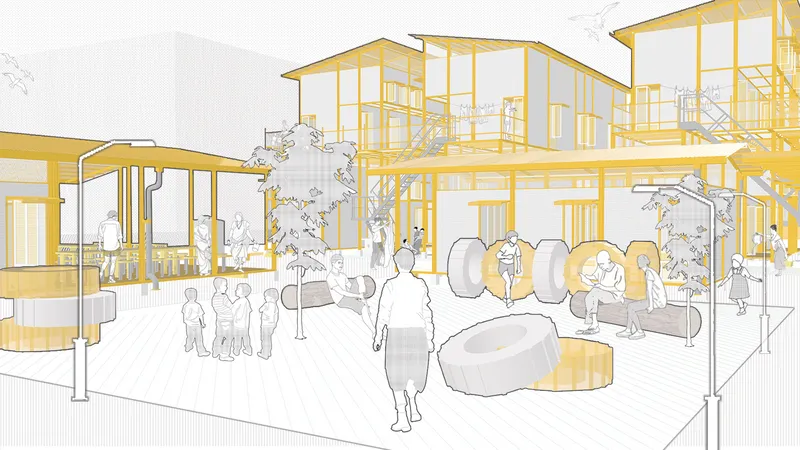
An architectural response that does not treat labour housing as an afterthought, but as an ecosystem of life and potential.


Popular Articles
Popular articles from the community


Hill & Cross Opera: Sculptural Opera House Architecture Shaped by Tallinn’s Landscape and Identity
Hill & Cross Opera reimagines opera house architecture in Tallinn through its sculptural hill, civic plaza, glass wave and a luminous cross.

The Musturak Paradise: Senior Living Architecture for a Connected Future in Temara, Morocco
The Musturak Paradise reimagines senior living architecture in Temara via private homes, social spaces, culture, community, and shared care.

Lunar Spiral: Space Architecture Shaped by the Mathematics of the Universe
Lunar Spiral reimagines space architecture through Fibonacci geometry, lunar regolith, levitating habitats, and self-sustaining Moon living.

The Earth Pod: 3D Printed Homes for Resilient Refugee Communities
The Earth Pod reimagines refugee housing through 3D printed homes made from clay, combining resilience, self-sufficiency, and rapid shelter.

Similar Reads
You might also enjoy these articles

The Rhythm of Seasons
A Farmers' Market Connecting Nature and the City

More Than a Building-Designing a Living System
More Than a Building-Designing a Living System
Base Beyond
DESERT COMPOUND ARID: TOURISM OF ABSENCE AND ABUNDANCE
Explore Architecture Competitions
Discover active competitions in this discipline




Challenge to reimagine the Iron Throne


Photograph architecture without architects


Illustrate the lost glory of Angkor Wat - Render Challenge


Design challenge to reuse E-waste
Comments (0)
Please login or sign up to add comments
No comments yet. Be the first to comment!