

AACM Carves a 50-Square-Meter Ceramic Workshop from Curved Timber and Shadow in Milan
Ekadea Studio wraps the ritual of ceramics in charred wood, vaulted plaster, and circular portals tucked inside a Milanese courtyard.


Fifty square meters is not a generous brief. It is barely enough for a bedroom and a bathroom in most Milanese apartments, yet AACM (Atelier Architettura Chinello Morandi) has compressed an entire ceramic workshop, tea ceremony space, and sunken courtyard into exactly that footprint. Ekadea Studio, completed in 2025 and photographed by Catalogo, does not try to feel bigger than it is. Instead, it leans into enclosure, treating smallness as a spatial virtue rather than a constraint.
What makes the project genuinely interesting is the way it collapses architecture into craft. The walls are not containers for ceramic work; they are ceramic-adjacent objects themselves, charred timber planks bent into curves that echo the thrown forms produced inside. Every threshold is a circular portal, every surface darkened to suppress the room's edges and foreground the objects within it. The result is a space that behaves more like an instrument than a room, tuned specifically to the slow tempo of clay and tea.
The Oval and the Circle

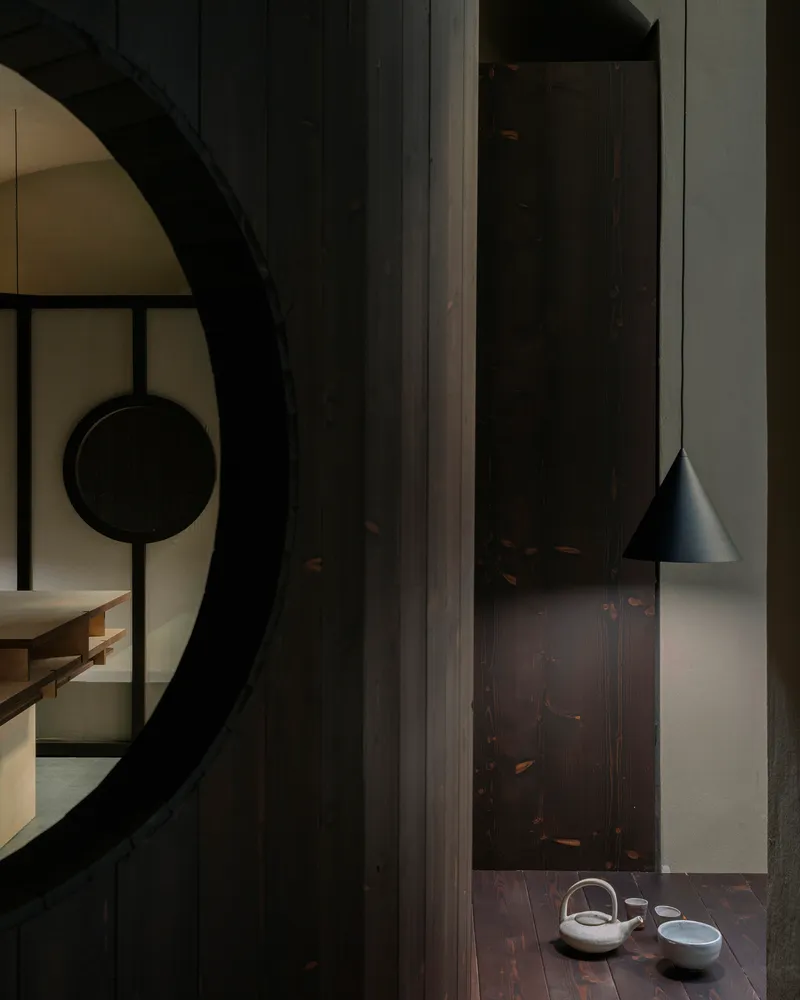

The plan is organized around an oval vault, a geometry that eliminates corners and generates a continuous interior horizon. Within this curved envelope, circular openings act as both windows and thresholds, framing views between rooms in a telescopic sequence. A conical pendant lamp drops into the center of one portal, turning a simple doorway into a composed still life that changes with the angle of approach.
These circular cuts are doing double duty. They control sightlines in an extremely compact plan, giving each zone visual depth without physical distance. They also rhyme with the wheel-thrown ceramics displayed on every surface, so the architecture and its contents speak the same formal language without resorting to literalism.
Charred Timber as Interior Landscape

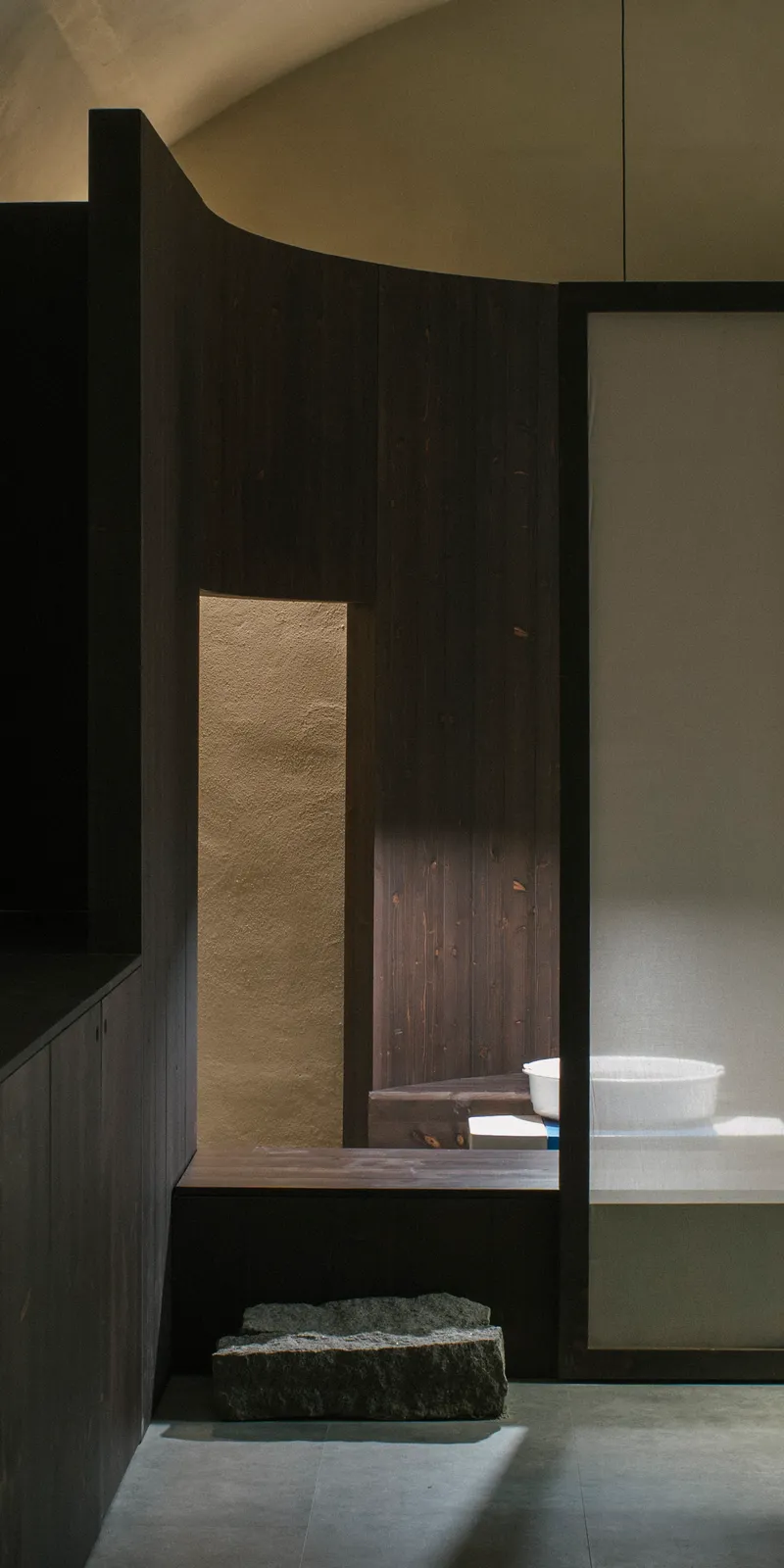
The dominant material is dark, vertically planked timber, its surface suggesting a yakisugi or shou sugi ban treatment that absorbs light rather than reflecting it. Where the charred planks meet arched plaster ceilings, the joint is surprisingly soft, as though the wood were bending up into the vault of its own accord. The effect is cave-like without being oppressive: daylight from the skylight and courtyard perforates the darkness just enough to maintain legibility.
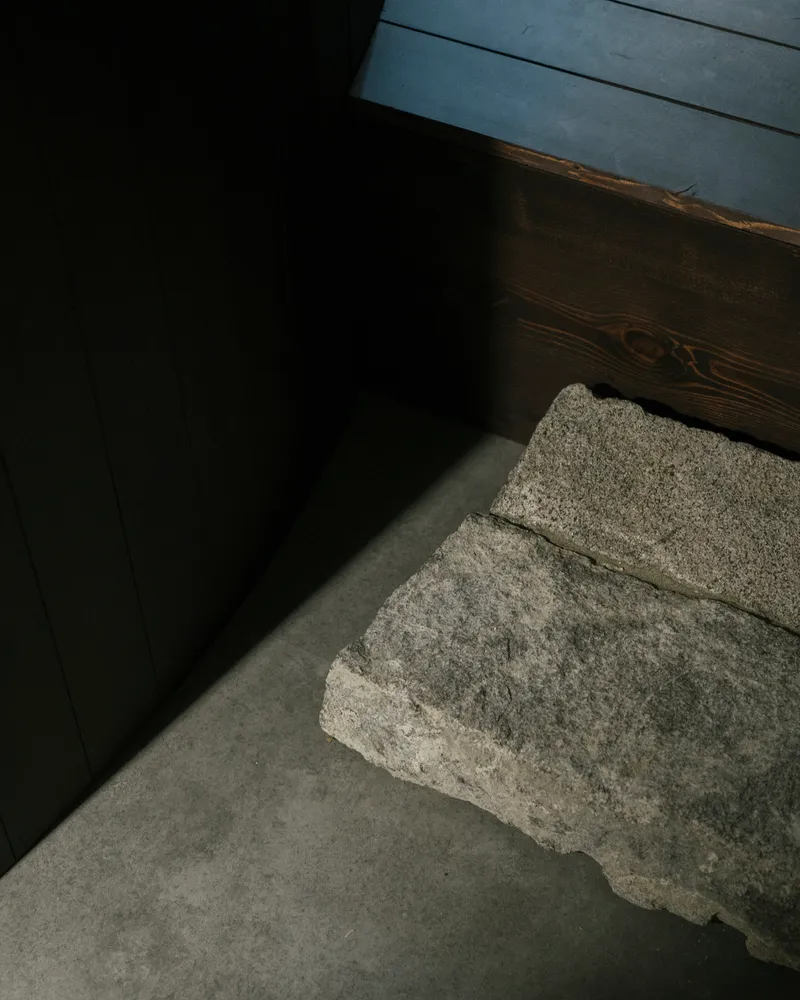
A rough stone block sits at the base of one wall, its geological weight contrasting with the precision of the milled planks above. The palette, dark timber, grey concrete, raw stone, white plaster, is deliberately restrained. It reads as monochrome until your eye adjusts and begins to differentiate textures rather than colors. That perceptual shift is the whole point: this is a space designed for close looking.
A Courtyard Compressed


The sunken courtyard is a stroke of spatial economy. Viewed from above, it is a tight rectangle of timber decking bordered by white gravel and perforated metal grilles, with wall-mounted spherical lights adding a quiet nocturnal register. From inside, the courtyard is experienced through a decorative grille and a planted threshold that filters the Milanese street noise into something close to silence.
In fifty square meters, dedicating any area to open air is a bold allocation. But the courtyard anchors the plan, providing the natural light and ventilation that makes the deep, dark interior habitable. It also introduces a moment of seasonal change: rain on the gravel, light shifting across the rendered wall. The workshop is not sealed from Milan; it simply mediates the city on its own terms.
Thresholds and Light
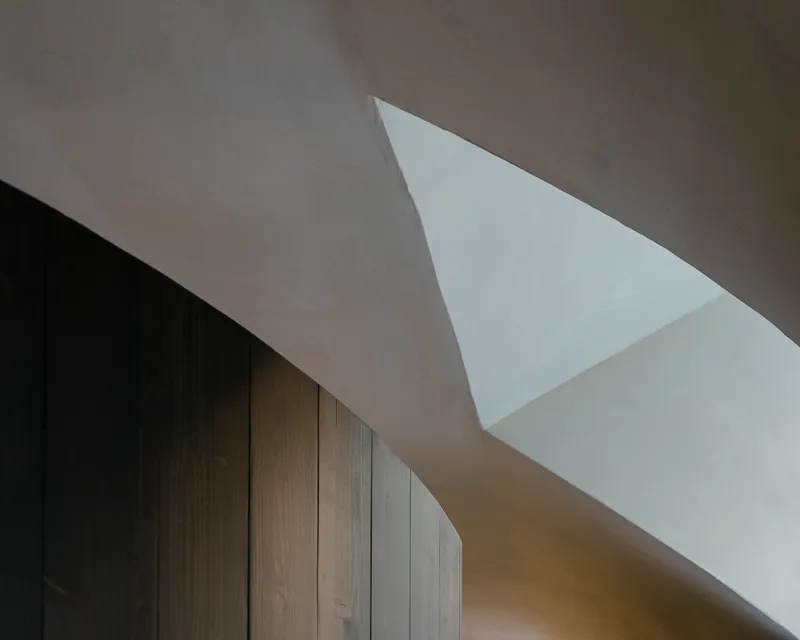
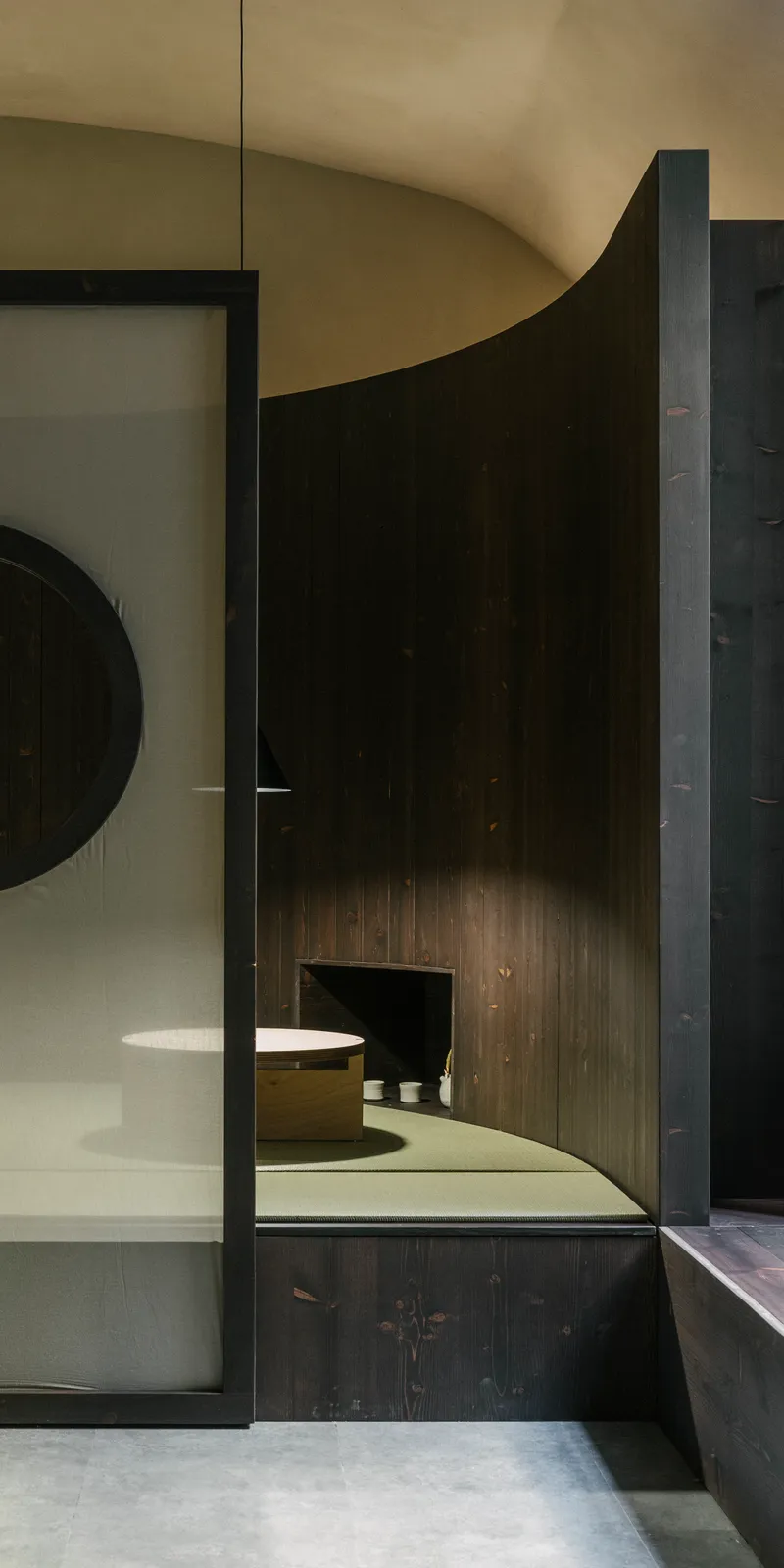
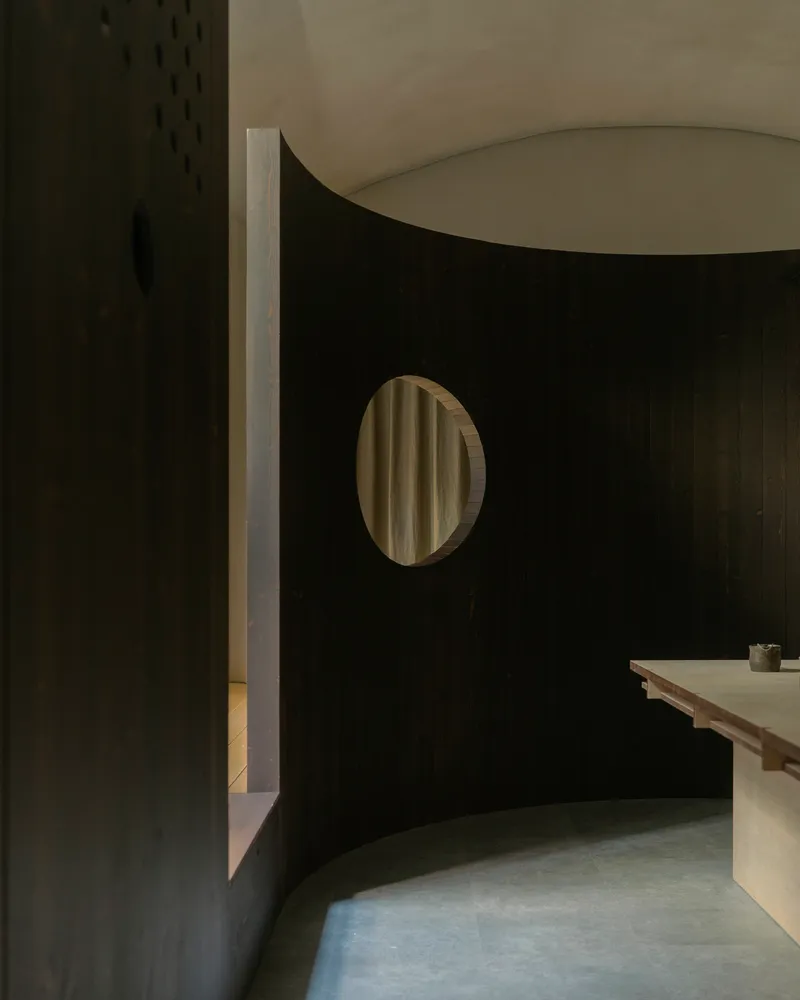
A triangular skylight punctures the white plaster ceiling, introducing a blade of light that hits the charred timber below at an acute angle. It is a precise, almost surgical intervention: a single geometric cut that animates the entire section. The vaulted ceiling amplifies the effect, bouncing indirect light deeper into the plan.
Glass partitions between zones maintain acoustic separation while preserving visual continuity. A curved dark timber wall with built-in seating visible through one such panel reads like a fragment of furniture scaled up to architecture. Elsewhere, a circular window in a partition catches the reflection of curtains beyond, momentarily confusing interior and exterior. These small perceptual tricks give the studio a spatial richness that belies its actual dimensions.
Objects and Rituals


The tea ceremony runs through Ekadea Studio like a second program. Low stone tables set with ceramic cups and teapots are composed against painted scrolls and dried branches with the deliberateness of an ikebana arrangement. The architecture does not merely house these rituals; it stages them. Dark cabinets, pendant lamps, and vases of dried flora are placed so that each vignette rewards attention from a specific vantage point.
There is an obvious debt to Japanese spatial sensibility here, the emphasis on threshold, shadow, and ritual. But the project avoids pastiche because the material language remains rooted in Italian craft: plaster vaults, stone tabletops, and a color palette that could belong to a Lombard farmhouse as easily as a Kyoto tea house.
Material Details


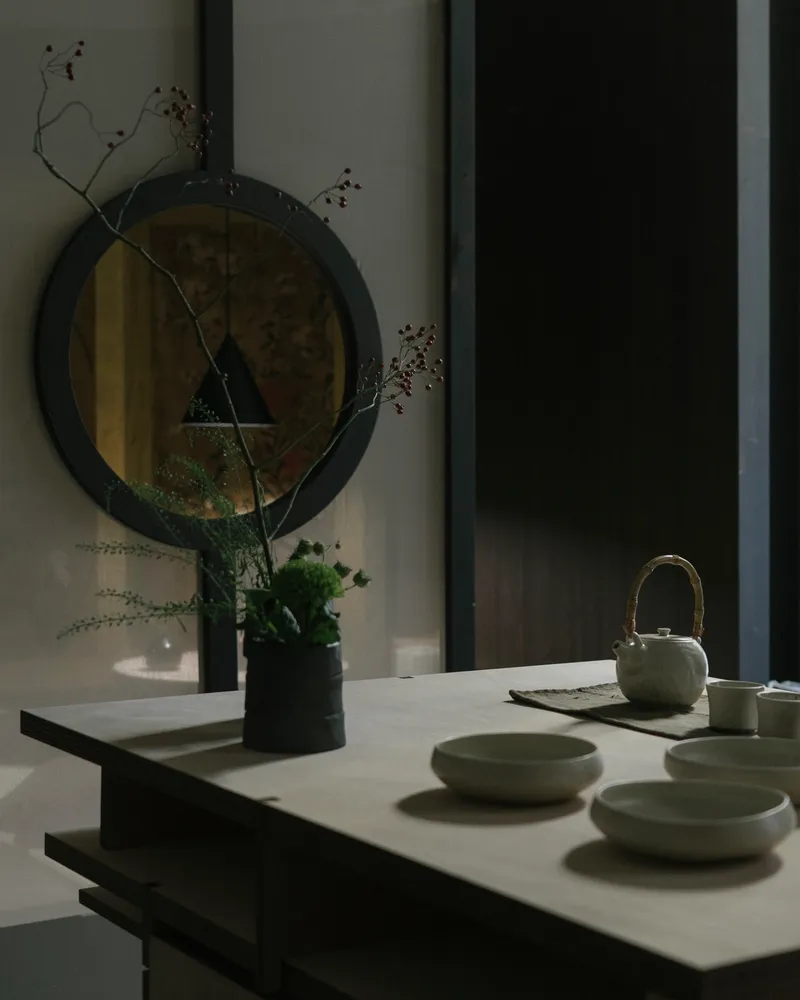
A circular mirror mounted on a vertical steel bar casts a long shadow over a concrete counter, turning a functional object into a graphic composition. Nearby, a circular stone tabletop on a black steel base sits heavily on textured flooring, its mass a quiet counterpoint to the lighter timber surfaces above. Every element is resolved to the level of a furniture piece, which is appropriate for a studio where the line between architecture and object is deliberately thin.
Plans and Drawings


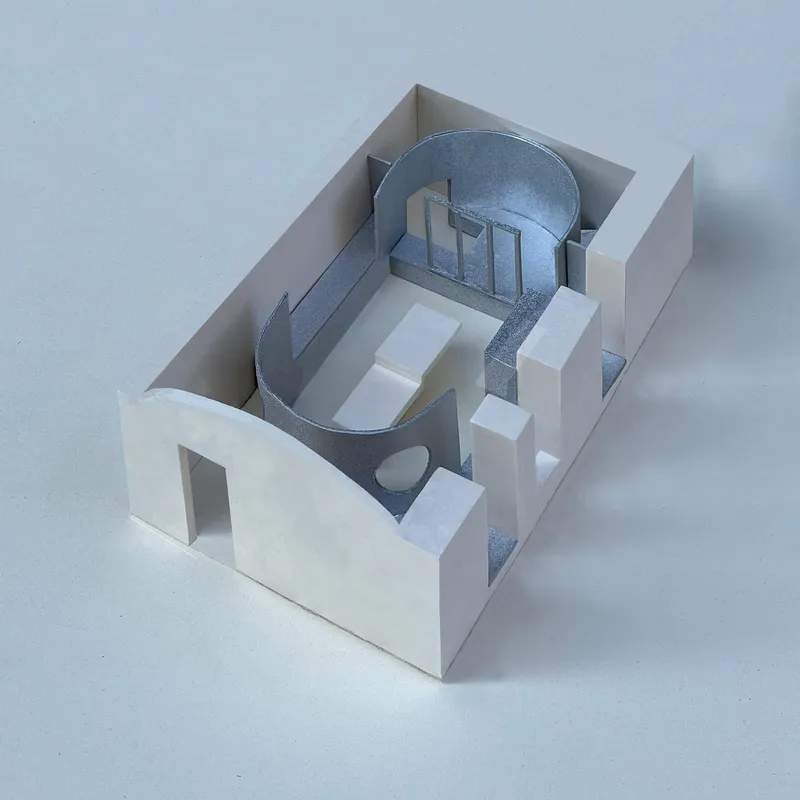
The conceptual sketches reveal the generative logic: overlapping ovals and arrows tracing movement through curved enclosures. The site plan locates the studio within Milan's dense urban grid, confirming how little physical real estate was available. In plan, the oval central space reads clearly, flanked by rectangular service volumes and accessed by an exterior stair that separates the workshop from the street.
The two section drawings are the most revealing. They show a single arched vault spanning the oval room, with vertical timber partitions and circular openings creating a layered spatial sequence within a continuous shell. A physical model in white and grey materials demonstrates the tectonic relationship between the oval vault and its rectangular enclosure, a hybrid geometry that gives the project its distinctive character.
Why This Project Matters
Ekadea Studio is proof that spatial intensity does not require spatial excess. In an era when architecture's relevance is often measured in square meters or budget, AACM demonstrates that a 50-square-meter brief can carry as much design ambition as a museum commission. The project's circular portals, charred timber surfaces, and compressed courtyard are not gestures of minimalism for its own sake; they are calibrated decisions that serve a specific program of making and contemplation.
More broadly, the project offers a compelling model for how craft-based workspaces can be designed without defaulting to the generic white box studio. By giving the workshop the spatial intensity of a sacred room, AACM argues that the act of making ceramics deserves an architecture as considered as the objects it produces. That is a small but worthwhile claim, and Ekadea Studio backs it up completely.
Ekadea Studio by AACM (Atelier Architettura Chinello Morandi), Milan, Italy. 50 m², completed 2025. Photography by Catalogo.
About the Studio
Share Your Own Work on uni.xyz
If projects like this are the kind of work you want to make, uni.xyz is a place to publish your own, find collaborators, and enter design competitions.


Popular Articles
Popular articles from the community


Manzana Morphosis: Stretching Barcelona's Grid into a Living Landscape for 2050
A radical reworking of the Eixample manzana turns density into a tool for generous public space, vertical ecology, and environmental performance.

The Amber Palace Opera: A Geological Fiction Surfaces on Tallinn's Baltic Waterfront
Pierre Brillard reimagines a Baltic legend as a public landscape, opera house, and waterfront promenade rooted in Tallinn's coastal identity.

Tsunami Convergenics: Turning Catastrophic Ocean Forces into Underwater Housing Infrastructure
A speculative underwater settlement off the coast of Onagawa, Japan, treats tsunamis and typhoons as energy sources rather than threats.

Opera by the Sea Estonia: Three Shells Dissolving Architecture into Tallinn's Coastline
A winning opera house proposal replaces monumental form with interconnected shells that blur the boundary between building, park and Baltic Sea.

Similar Reads
You might also enjoy these articles

Pixel Gardens: One Repeated Module Stacked Into a Terraced Social Housing Tower for Famagusta
Salem Bader's shortlisted housing tower builds a vertical neighbourhood from one repeated module, offsetting units to carve terraces, light and air.

Bao Huynh Watercolor Atelier: A Serene Art Retreat in Hội An
Bao Huynh Watercolor Atelier in Hội An blends multifunctional art spaces, sustainable design, local materials, and family-friendly living in a serene environment.

Atelier Macri Concept Store Interior Design by CASE-REAL
Atelier Macri store features a "ko" counter, walnut wood details, cork displays, blending retail, gallery, and seamless customer experiences.

Manuel Vargas Izquierdo Stadium and High-Performance Sports Center: Architectural Excellence in Jalpa de Méndez
The Manuel Vargas Izquierdo Stadium blends sustainable design, inclusive sports facilities, and cultural-inspired architecture, revitalizing Jalpa de Méndez’s public spaces.

Comments (0)
Please login or sign up to add comments
No comments yet. Be the first to comment!