

About the Fences – Clara Campoamor Square in San Silvestre de Guzmán by estudio veintidós
A contemporary public square blending vernacular stone fences, native vegetation, and water elements, reconnecting San Silvestre’s heritage with sustainable urban design.


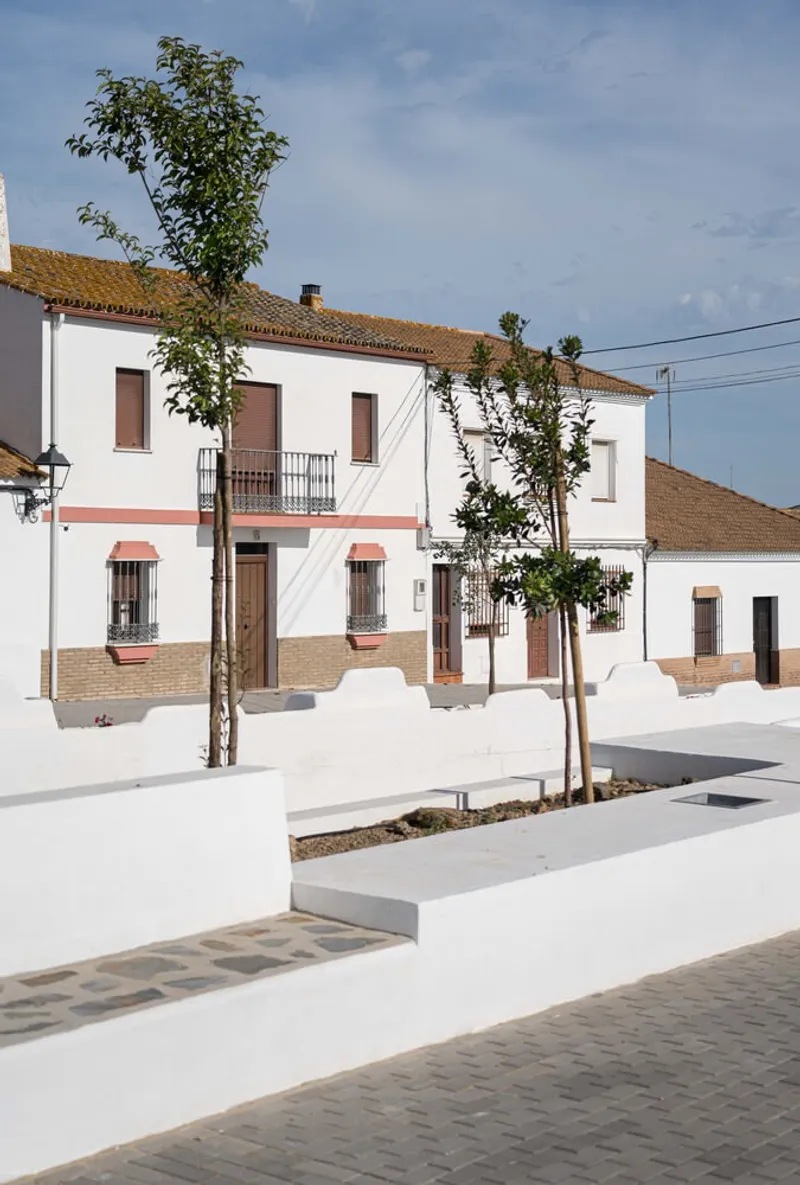
In the heart of San Silvestre de Guzmán, the Clara Campoamor Square project by estudio veintidós revitalizes the town’s public space through a sensitive interpretation of local architectural traditions. Situated in the Andévalo region of Huelva, this urban intervention draws inspiration from the historical landscape, where stone fences, shale and lime walls, traditional mills, clear water troughs, and wells define the rural surroundings. These elements, historically tied to agriculture and livestock management, form the cultural fabric of the area and are seamlessly integrated into the square’s contemporary design.

Reimagining Rural Public Space Through Local Heritage
About the Fences – Clara Campoamor Square by estudio veintidós redefines the meaning of public space in San Silvestre de Guzmán, a small town in the Andévalo region of Huelva, Spain. Drawing inspiration from the traditional stone fences, shale and lime walls, and ancient wells that characterize the local landscape, the project transforms vernacular construction techniques into a contemporary architectural language for community interaction and environmental integration.

The architects sought to reconnect the town’s public realm with its agricultural and territorial identity, blending history, ecology, and social use into one cohesive spatial narrative.

Integrating Local Identity into Urban Regeneration
The design concept emerged from observing how, over generations, fences and boundary walls became multifunctional elements — acting not only as enclosures but also as benches, planters, and landscape dividers. estudio veintidós reinterprets this humble yet poetic typology to regenerate Clara Campoamor Square, creating a new border element that seamlessly connects with existing urban forms while enhancing the social and environmental quality of the space.
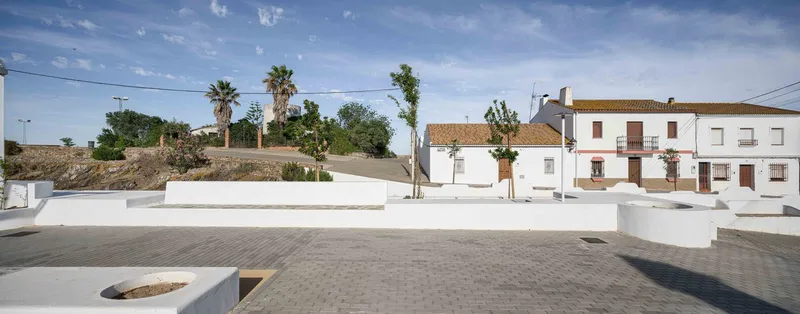
The intervention establishes a continuous perimeter that both frames and protects the square, integrating seating areas, planted boundaries, and water features. These architectural gestures invite residents and visitors alike to pause, rest, and engage with the surrounding landscape.

Designing with Nature: Shading, Water, and Local Vegetation
To shield the square from the noise and pollution of nearby roads, the architects introduced a layered landscape of native vegetation — including strawberry trees, holm oaks, and rosemary — all species native to the Andévalo region. The inclusion of tree pits, water points, and shaded seating areas transforms the space into a microclimate of comfort and reflection.
A permeable earthen pavement forms the ground plane, creating an “earthen carpet” that encourages natural water drainage while defining a central social area open to the town. A long continuous bench anchors the square’s composition, its base enriched with shrubs that add color, fragrance, and texture throughout the seasons.
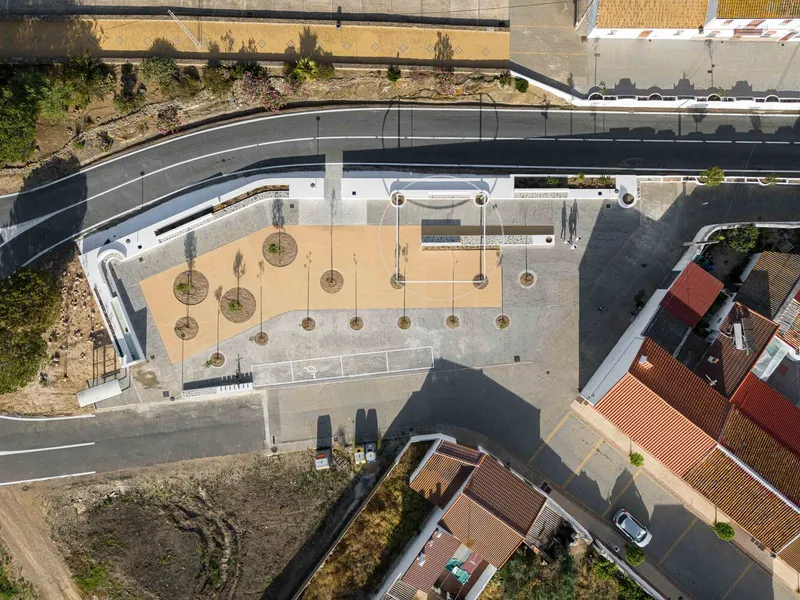
Above it, a vegetal pergola provides essential sun protection, offering cool shaded zones during Andalusia’s hot summers. The design culminates under a canopy of existing pine trees, where a fountain and water pillar introduce sound, moisture, and sensory richness — bringing vitality to the town’s edge.

A Dialogue Between Tradition and Contemporary Design
About the Fences exemplifies a sensitive approach to rural urbanism, where the boundaries between architecture, landscape, and memory blur to form a living space that evolves with the community. estudio veintidós uses the language of local materials and forms — stone, lime, and vegetation — to design a square that belongs to its people and place, fostering continuity between past craftsmanship and future use.


All photographs are works of Juanca Lagares


Popular Articles
Popular articles from the community


Faces of the Soviet Avant-Garde: Turning Moscow's Street Names into an Open-Air Museum
A network of sculptural installations across a Moscow residential district transforms forgotten architect names into spatial encounters with cultural memor

Opera by the Sea Estonia: Three Shells Dissolving Architecture into Tallinn's Coastline
A winning opera house proposal replaces monumental form with interconnected shells that blur the boundary between building, park and Baltic Sea.

Opera on the Sea: Driftwood Logic Shapes a Timber Opera House on Estonia's Coast
Trevor Orgill's opera house translates the entangled drift of floating timber into a civic building where wood, water, and music converge.

Extended Shell: Retrofitting Kolkata's Balconies as Living Urban Thresholds
A modular retrofit system recovers the social and environmental intelligence of Kolkata's historic verandas for contemporary Park Street residents.

Similar Reads
You might also enjoy these articles


Hodi-Mandai Geram
Project Function: Preservation and revitalization of the Intangible heritage and socio-spatial identity of the Hodi by Housing, Cultural Memory Center, Sacred Grove, landscape, local tourism economy


Olio Towers: A Mid-Rise for Performers That Fuses Housing, Rehearsal, and Stage
Located blocks from Houston's Theater District, this modular tower stacks living units around a central performance atrium.

Oasis: Modular Green Housing Carved into Dhaka's Urban Fabric
A shortlisted Plugin Housing entry reclaims unauthorized settlements in Dhaka with stepped concrete volumes, green roofs, and ventilation-driven design.

Black Hole: A Floating Megastructure for the Post-Physical Era
Emiliano Mazzarotto envisions a spherical, self-scaling arena where e-sports, digital hotels, and holographic stadiums replace traditional public space.

Explore Plaza Competitions
Discover active competitions in this discipline

Challenge to reimagine the Iron Throne

Photograph architecture without architects

Illustrate the lost glory of Angkor Wat - Render Challenge

Design challenge to reuse E-waste
Comments (0)
Please login or sign up to add comments
No comments yet. Be the first to comment!