
acau architecture Reclaims a Swiss Parking Lot as a Village Gateway with Local Oak and Fir
A 63-square-meter cottage and reimagined station square in Pregny-Chambésy reconnect a railway stop to its historic village core.


For fifteen years the land around Chambésy station served as a parking lot and a dumping ground for Swiss Federal Railways infrastructure. That is a long time for a village entrance to say nothing at all. acau architecture was brought in not simply to renovate a neglected cottage but to rewrite the spatial sequence between train and old village, turning asphalt into a civic threshold that makes arriving on foot feel like the obvious choice.
What makes this project worth studying is not its scale but its discipline. The entire cottage measures 63 square meters and carries no thermal insulation. The square is paved in deactivated concrete using two local aggregates. The facade is built from Geneva-sourced oak cut in collaboration with local foresters. Every decision funnels through a single question: what can this place do with what already exists here? The answer turns out to be a surprising amount.
A Public Square Where a Parking Lot Used To Be


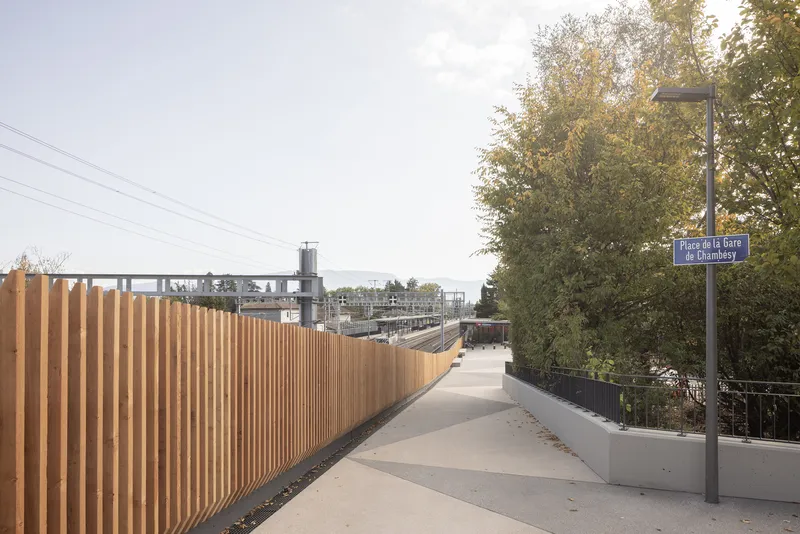
The new station square absorbs what were once public parking spaces into two large tree-lined triangles, using the vocabulary of orchards rather than urban plazas. Perennials and planted trees claim the ground, and a bi-color paving pattern in deactivated concrete traces the underlying geometry of the land. The result reads less like a designed square and more like a clearing that was always there, waiting to be found.
A continuous timber screen runs along the elevated pedestrian walkway, mediating between the railway infrastructure and the new public ground. The screen does double duty: it gives the square a coherent vertical edge while filtering the visual noise of passing trains and parked scooters. It is civic furniture, fence, and facade all at once.
The Sixty-Meter Bench
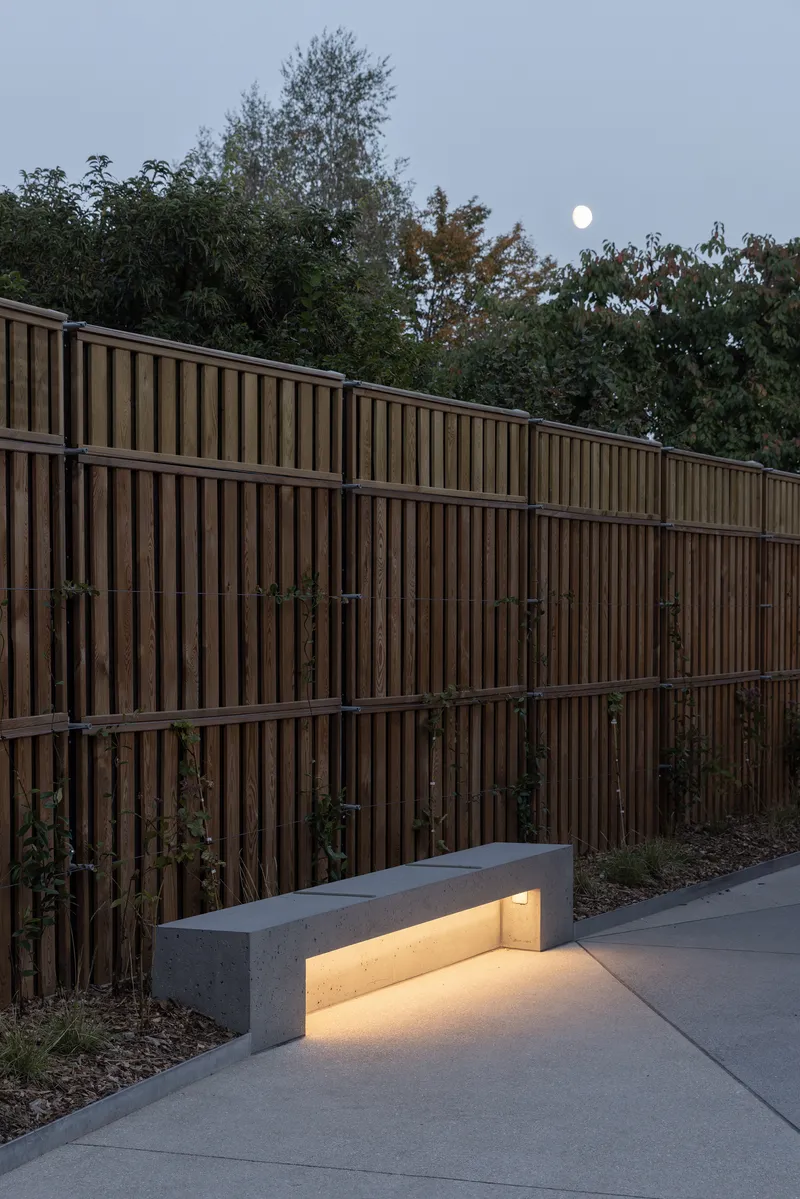
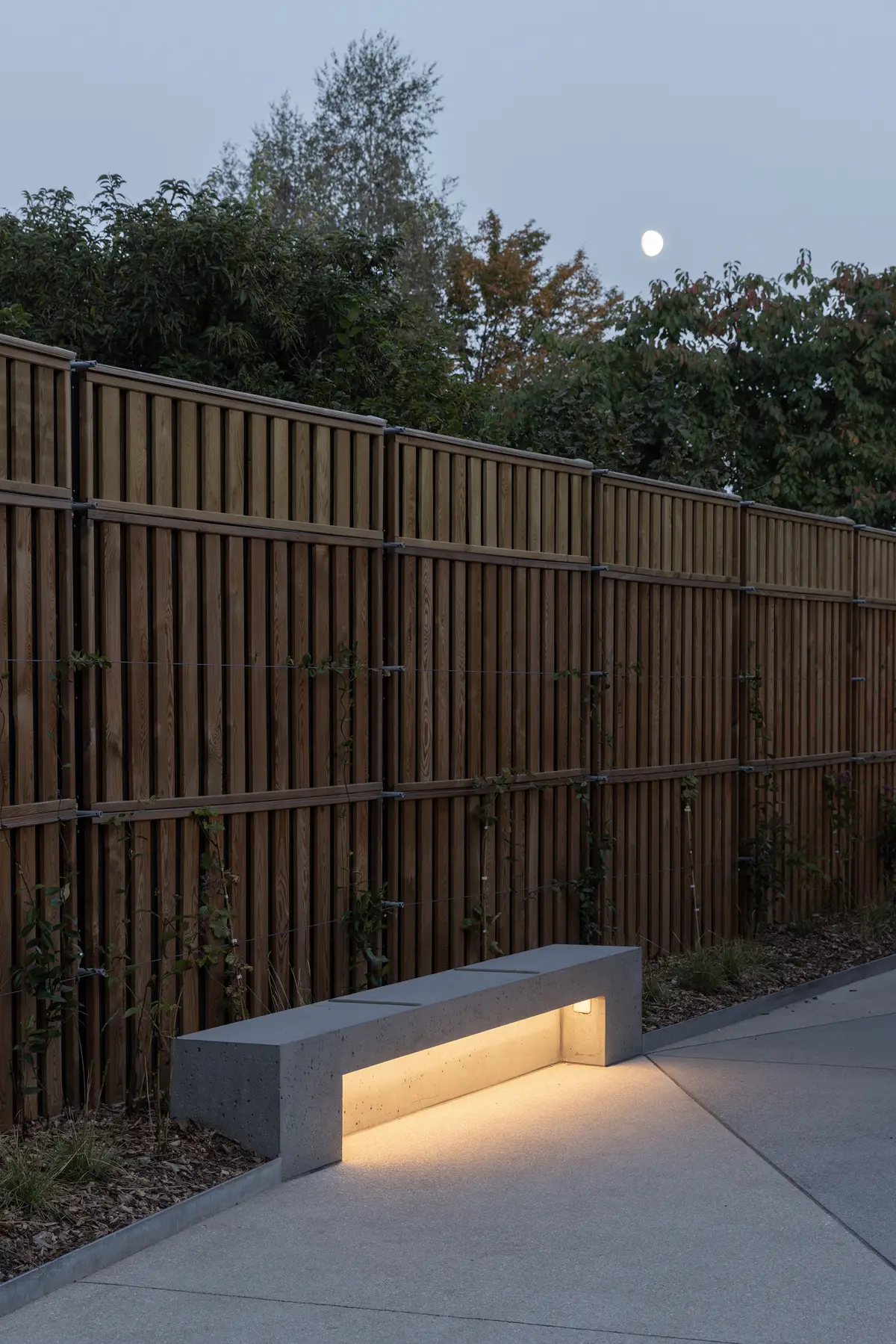
A tinted concrete bench stretches sixty meters along the edge of the square, integrating lighting at its base so the line reads clearly after dark. Sixty meters is long enough to become topography rather than furniture. It stitches together the cottage, the walkway, and the tree plantings into a single datum that anchors the whole composition. The material, tinted concrete, ages gracefully alongside the deactivated concrete paving without pretending to be something it is not.
Cottage as Civic Threshold


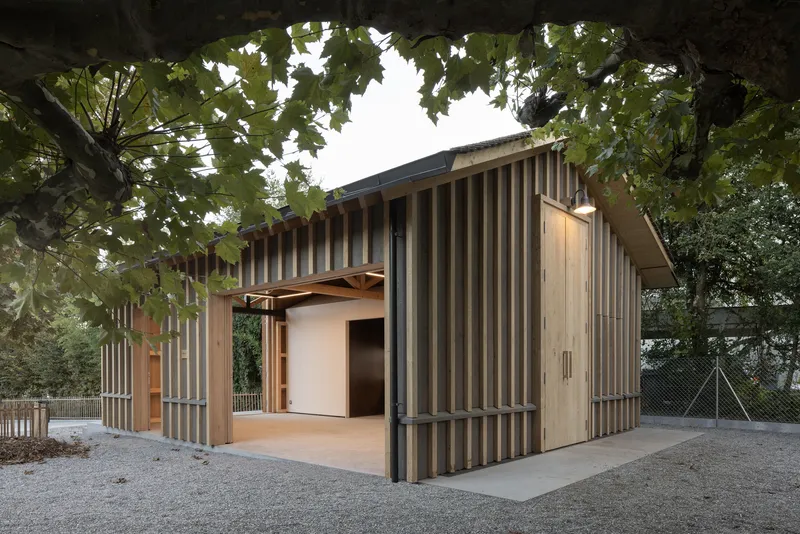
The cottage sits between the station square and a shaded restaurant terrace, functioning as a multipurpose kiosk open to public space rather than a private enclosure. Its position in the sequence from train platform to village is deliberate: you pass through its zone of influence on your way in. acau architecture completely dismantled the original structure, sorted reusable parts, and rebuilt it with solid fir complements using traditional joinery details identical to the existing construction. The result is a building that carries the memory of its predecessor without being a restoration in any academic sense.
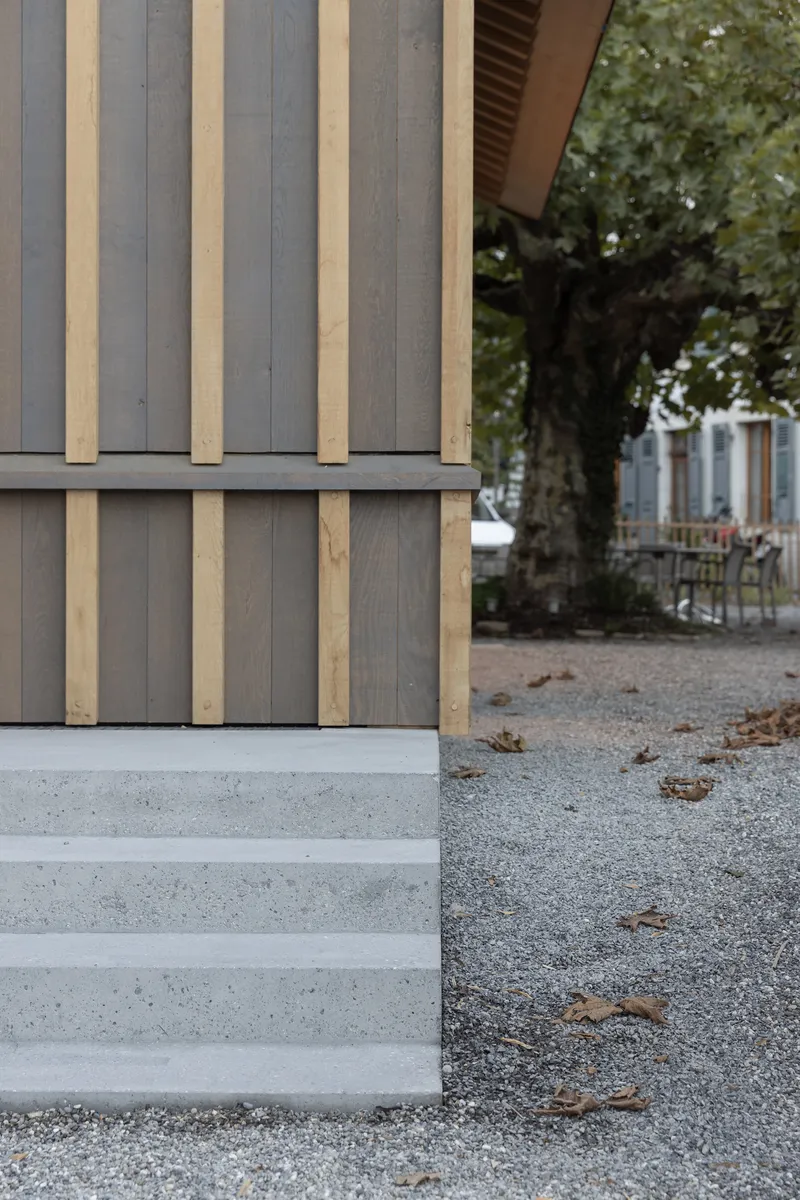
The facade alternates between grey and light oak vertical slats, a rhythm that breaks the cottage's small volume into something textured and visually permeable. Fallen autumn leaves collect at its base alongside concrete steps, and the building looks completely at home under mature trees. This is a heritage-protected context (4BP), and the design earns its place by refusing to compete with what surrounds it.
Local Oak, Visible Structure


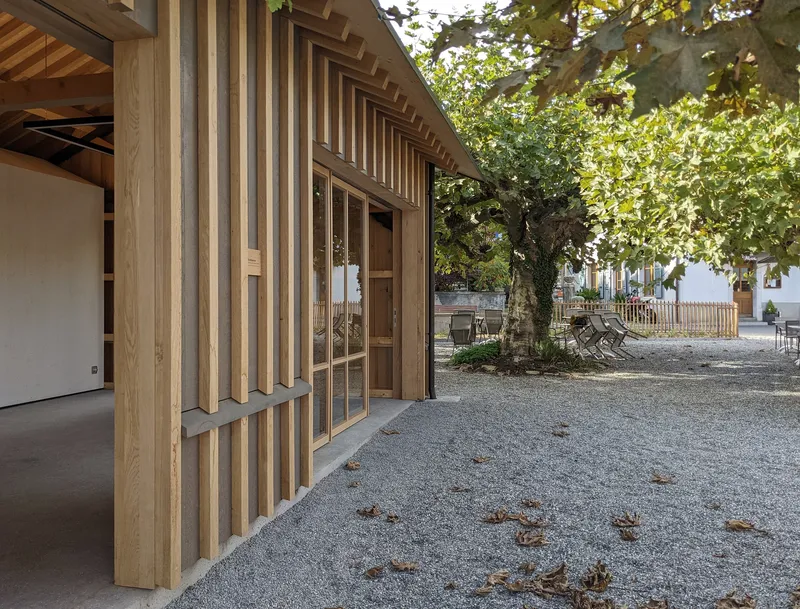
The municipality of Pregny-Chambésy has a stated policy of promoting short circuits in construction supply chains, and this project takes that policy seriously. Local foresters sourced the oak; the Geneva wood industry processed it. The facade construction is entirely oak, from cladding to rafters, and the material is left to weather naturally. The vertical slat pattern creates a slatted envelope that modulates light and privacy without glazing where it is not needed.
At the rear gable, a tall timber door panel and tight vertical slats create an almost fortified elevation, all wood grain and shadow. The entry facade, by contrast, opens up with floor-to-ceiling glazed doors set within the slat rhythm, pulling daylight deep into the interior. The overhanging eaves provide just enough shelter to blur the line between inside and out.
Interior: Structure as Furniture


Inside, the facade structure is fully visible, and some members are intentionally oversized to double as shelves. This is a building with no thermal insulation and no drywall to hide behind. The exposed timber truss ceiling gives the 63-square-meter interior a vertical generosity that the footprint alone would not suggest. Plywood walls catch dappled light through the slat facade, and the whole space reads as a single honest room.
An illuminated counter sits in an alcove beneath the exposed roof structure, ready for whatever kiosk or community function the village needs next. The architecture does not prescribe a program so much as provide a well-built frame that can absorb one. There is something quietly radical about delivering a public building that trusts its users enough to leave the walls bare and the structure showing.
Dusk and the Quality of Light
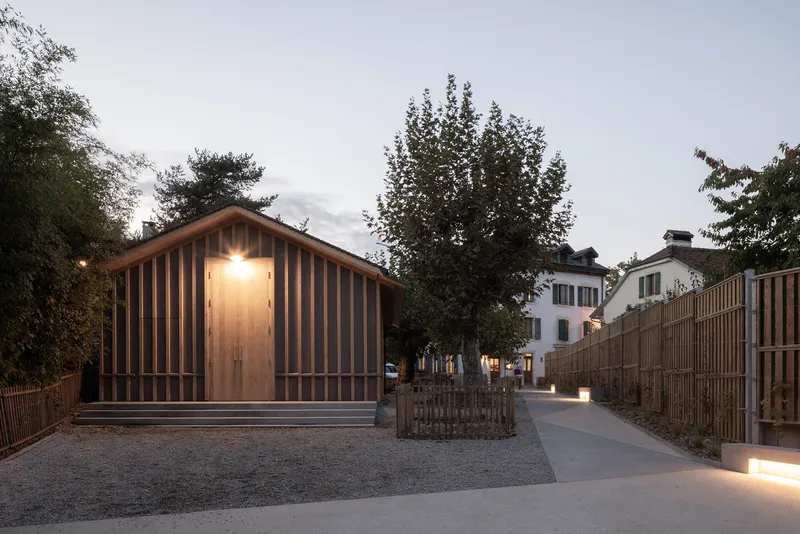
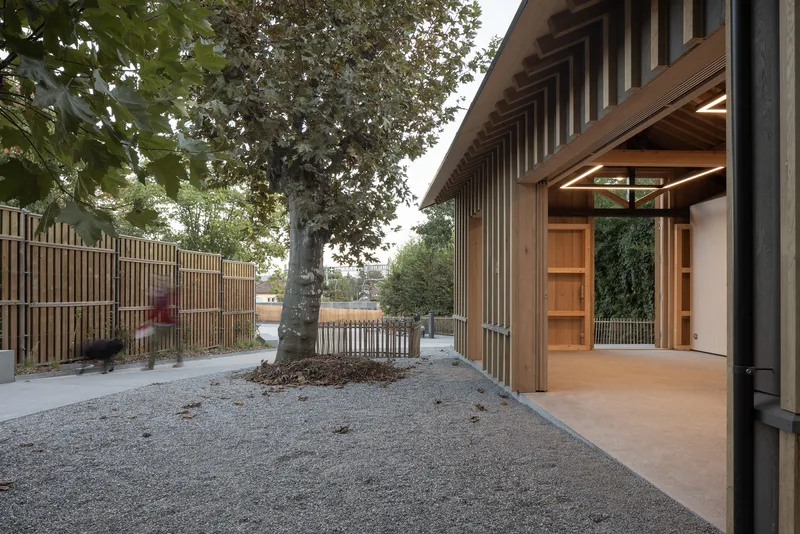
The project's nighttime character deserves its own note. At dusk the timber cladding catches warm artificial light from within, and the vertical slats glow like a lantern set among trees. The bench lighting at ground level reinforces the sixty-meter line, turning the square into a navigable space after dark without resorting to pole-mounted fixtures. The cottage becomes a beacon for the village entrance, signaling that this is a place worth arriving at, not just passing through.
Plans and Drawings
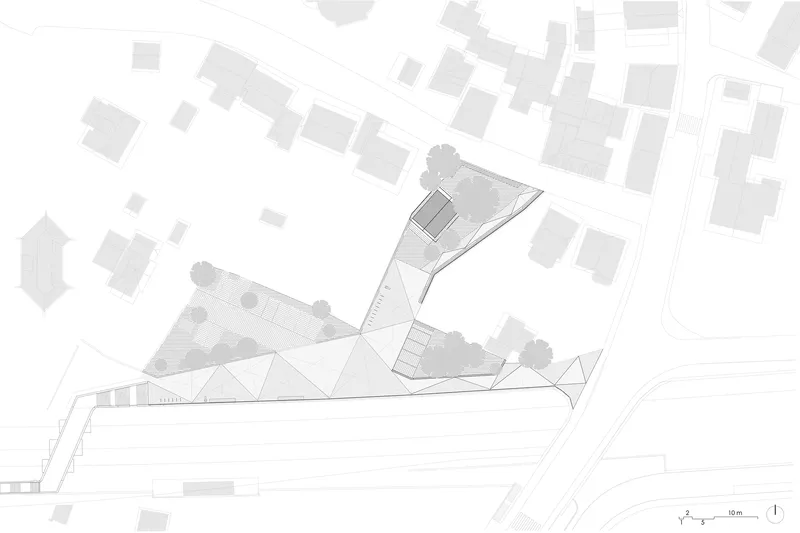
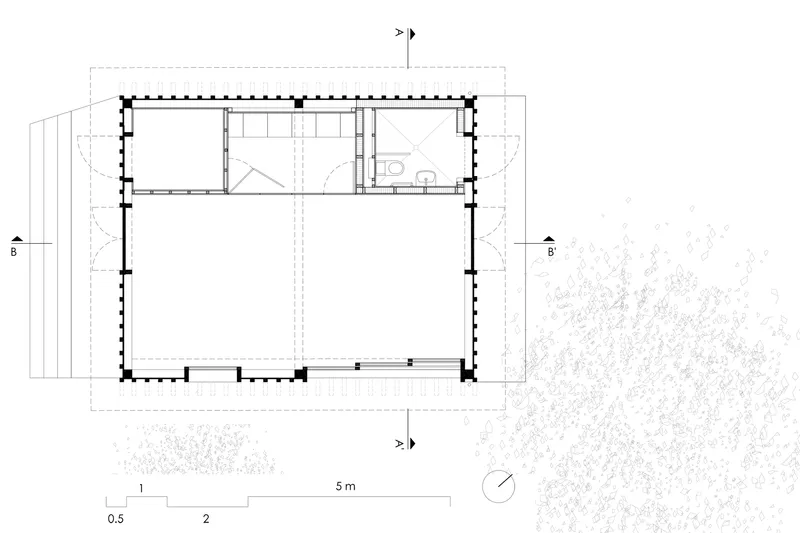


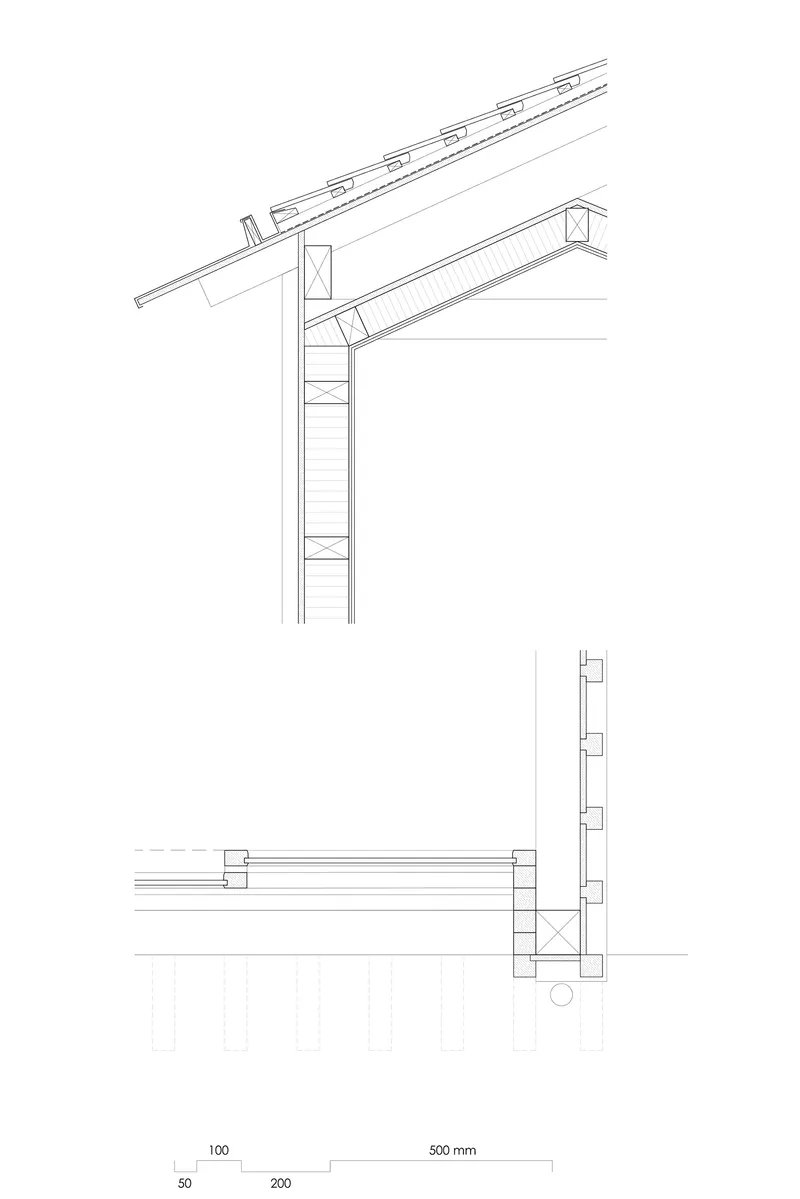
The site plan reveals how the angular building and its surrounding tree plantings negotiate the triangular geometry of the land between railway and village. The floor plan is disarmingly simple: a single rectangular hall with service rooms and storage packed along one edge, leaving the main volume unobstructed. Two section drawings show the pitched roof structure with exposed trusses, confirming that the spatial generosity felt inside is a direct product of the roof geometry rather than any spatial tricks. The construction detail at the eave connection shows how the oak slat facade meets the roof assembly, a junction that looks effortless in photographs but required careful coordination between traditional joinery and contemporary expectations.
Why This Project Matters
Chambésy Station Square is a case study in what happens when a municipality commits to soft mobility as policy and then follows through with architecture that makes walking from the train feel like a civic act. The project does not rely on grand gestures. It plants trees where cars used to park, builds a bench long enough to become landscape, and renovates a tiny cottage with enough care that it earns a second century. The whole thing costs less ambition than most projects its size and delivers more.
For architects working in heritage-protected contexts, acau's approach offers a useful model: dismantle honestly, salvage structurally, rebuild with local materials and traditional techniques, and leave the insulation out if the program does not demand it. The result is a building and a square that feel inevitable rather than imposed, which is the hardest quality to design and the easiest to recognize.
Chambésy Station Square and Cottage Renovation by acau architecture. Pregny-Chambésy, Switzerland. 63 m². Completed 2021. Photography by Nicolas da Silva Lucas.
About the Studio
Share Your Own Work on uni.xyz
If projects like this are the kind of work you want to make, uni.xyz is a place to publish your own, find collaborators, and enter design competitions.


Popular Articles
Popular articles from the community


Jaramillo Van Sluys Arquitectura and Urbanismo Turn a Demolished Registry Lot in Quito into an Orchard Plaza
In Quito's Centro Histórico, a 2,800 m² plaza exposes the San Agustín convent wall and redraws its lost Augustinian orchard in volcanic stone.

David Macias Steps a Doorless Stone and Plaster House Down a Tropical Colombian Hillside
In the humid hills of Colombia, Threshold House replaces the front door with an open void and terraces its 850 m² down the slope instead of fighting it.

longwave studio Reorganizes a 112 m² Tainan Apartment Around the Daily Routines of a Family and Two Cats
In Tainan, Taiwan, birch plywood, rust-red furniture and a freestanding plaster wall link arrival, storage, work and family life in one apartment.

GROUP A Strips a 1969 Rotterdam Harbor Headquarters to Its Frame and Wraps It in Timber Louvers
In Rotterdam's M4H harbor district, Ferro Offices reuses a 1969 frame, adds one timber storey and reaches BREEAM-NL Outstanding.

Similar Reads
You might also enjoy these articles


LAVA Architecten Gives Vocational Education a Sawtooth-Roofed Face on a Mechelen School Campus
In Mechelen, Belgium, a 2,053 m² STEM school on a 6×6 m grid turns workshops and classrooms into rooms that can be rearranged as teaching changes.

KEMA Studio Turns a Derelict Marvila Attic into a 60 m² Lighthouse Apartment Above Lisbon
In Lisbon's Marvila district, a rebuilt roof, four skylights and two plywood volumes turn an unlivable attic into a bright home facing the Tagus.

Pixel Gardens: One Repeated Module Stacked Into a Terraced Social Housing Tower for Famagusta
Salem Bader's shortlisted housing tower builds a vertical neighbourhood from one repeated module, offsetting units to carve terraces, light and air.

Bao Huynh Watercolor Atelier: A Serene Art Retreat in Hội An
Bao Huynh Watercolor Atelier in Hội An blends multifunctional art spaces, sustainable design, local materials, and family-friendly living in a serene environment.

Explore Renovation Competitions
Discover active competitions in this discipline

Challenge to design mud housing for contemporary communities

Challenge to design luxury tourism on rails

VR headsets Storefront design competition

Designing a staircase for a client
Comments (0)
Please login or sign up to add comments
No comments yet. Be the first to comment!