

Ex-American Cinema Modular Housing: Living Units Plugged into Industrial Bones
An abandoned factory's eclectic façade becomes the shell for a modular residential grid that floods interiors with golden light.


What happens when you slot prefabricated housing modules into the skeleton of a derelict factory? You get an architecture that refuses to choose between memory and utility. The Ex-American Cinema Modular Housing project takes an abandoned industrial building, keeps its eclectic-style façade standing, and fills the void behind it with a grid of residential units designed to capture golden sunlight deep into every corridor. The result is a hybrid structure where heritage masonry and contemporary steel framing coexist in productive tension.
Designed by Cristian Cruz Gonzalez and Cristóbal Hernández, the project was shortlisted in the Plugin Housing Challenge 2020. The competition asked entrants to rethink how modular, plug-in strategies could address urban housing needs. Gonzalez and Hernández responded by targeting underutilized urban fabric rather than empty lots, proposing that existing structures can become frameworks for dense, flexible living.
Black Steel Bridges Stitching Levels Together
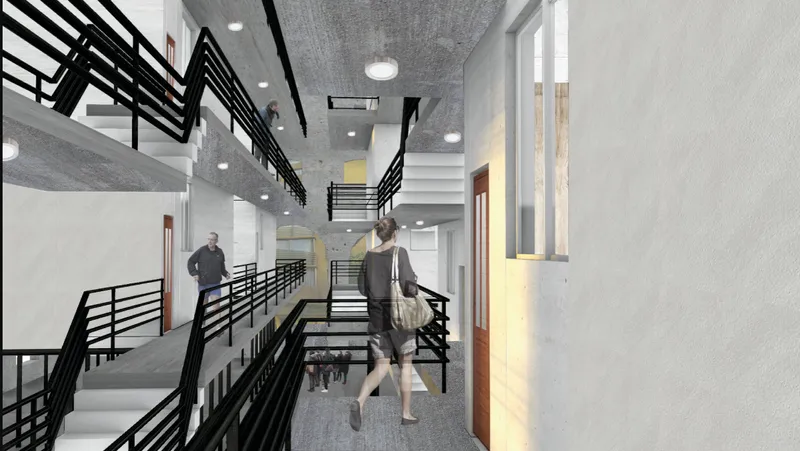
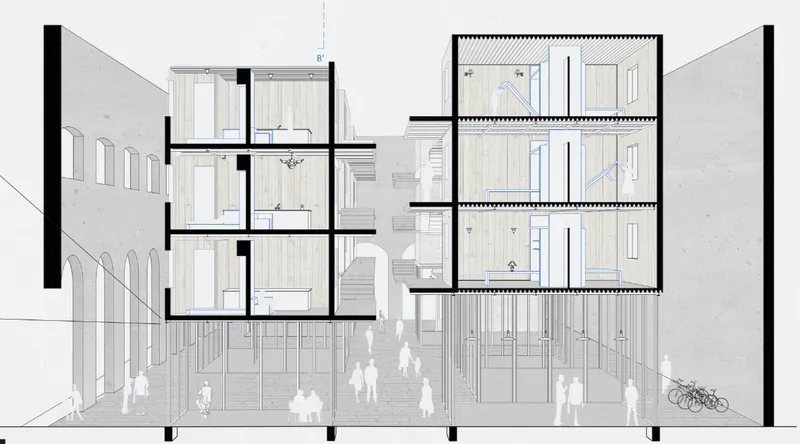
The interior corridor view reveals the project's circulatory logic: black metal railings and walkway bridges span between residential levels, creating a network of connections that feel more like an inhabited scaffolding than a conventional hallway. Figures traverse these bridges at multiple heights, suggesting a vertical neighborhood where chance encounters happen not just on the ground floor but three or four stories up. The section drawing clarifies the strategy. Residential units are inserted within an existing arched arcade structure, stacking above a public ground level that remains open and permeable. The old building's bones do the heavy structural work while the new modules plug into bays like drawers sliding into a cabinet.
Concrete Arches Frame a Public Ground Floor
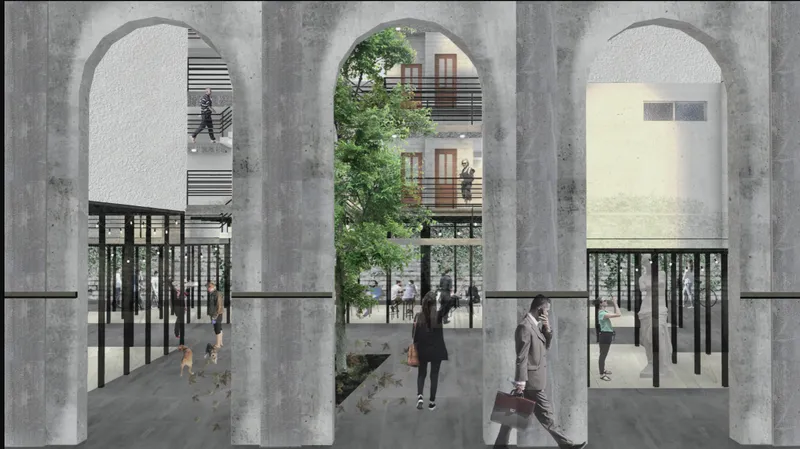
At street level, the design carves out a generous arcade defined by concrete arches that frame views toward a central courtyard planted with greenery. Pedestrians move through this covered ground plane freely, and the arches establish a rhythm that recalls the factory's original industrial bays. It is public space earned from private structure, a ground floor that serves the neighborhood rather than walling it off.
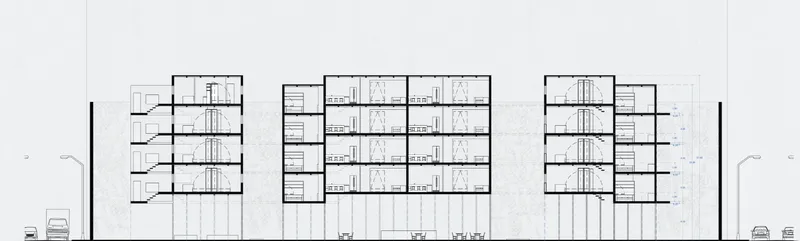
The elevation drawing maps three residential blocks behind the preserved façade, each organized around central circulation cores. Repeating unit layouts stack in a clear modular cadence. The repetition is deliberate: prefabricated modules gain efficiency through standardization, and the drawing makes visible how that logic plays out across the full width of the building. Variation comes not from bespoke unit shapes but from the interplay between old masonry and new insertions.
A Covered Street Between Heritage and Module
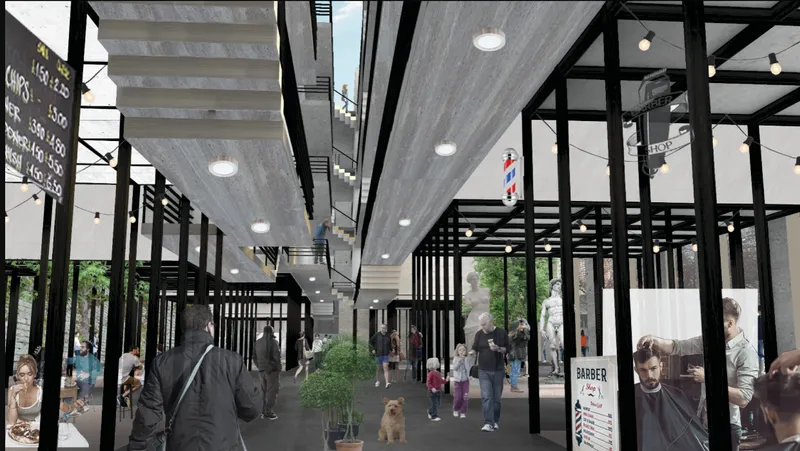
One of the most compelling moments in the project is the covered street condition, where black structural frames and concrete ceiling panels create a sheltered passageway at grade. A barber pole punctuates the scene, hinting at small commercial life woven into the residential program. The space reads as neither fully interior nor fully exterior, a threshold zone that invites occupation and micro-enterprise.
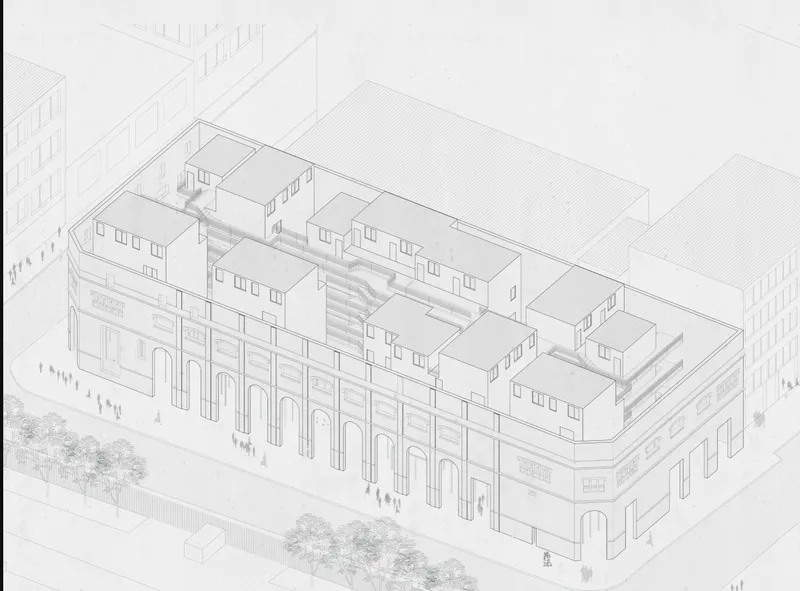
The axonometric drawing pulls these layers apart for inspection. The arched façade sits at the front, preserved and celebrated. Behind it, stacked residential volumes rise within and above the original structure's footprint. The drawing makes explicit what the renders imply: this is an architecture of two registers, one inherited and one inserted, held together by a modular grid system that maximizes spatial adaptability without erasing the building's industrial past.
Why This Project Matters
Adaptive reuse projects often default to one of two modes: either the old building becomes a decorative shell for a completely new interior, or the new program contorts itself to fit existing rooms. Gonzalez and Hernández chart a third path. Their modular grid operates as an independent structural system that negotiates with the host building rather than submitting to it. The factory provides envelope, context, and cultural continuity; the modules provide density, flexibility, and contemporary livability.
The real contribution here is the argument that plug-in housing does not require a blank site. Cities are full of abandoned cinemas, factories, and warehouses whose shells are structurally sound and culturally significant. By demonstrating how prefabricated units can inhabit these shells, this shortlisted entry makes a case for urban revitalization strategies that are simultaneously preservationist and progressive, keeping the façade and filling the volume with the homes a growing city needs.
View the Full Project
About the Designers
Designers: Cristian Cruz Gonzalez, Cristóbal Hernández
Enter a Design Competition on uni.xyz
uni.xyz runs architecture and design competitions year-round that reward proposals with spatial conviction and real site intelligence.
Project credits: Ex-American Cinema Modular Housing by Cristian Cruz Gonzalez, Cristóbal Hernández Plugin Housing Challenge 2020 (uni.xyz).


Popular Articles
Popular articles from the community


LT2A and OPEN Architectes Thread a Brick and Glass High School Through a Wooded Belgian Campus
In Braine-l'Alleud, a 3,000 m² wing for Collège Cardinal Mercier pairs pale brick with a glazed colonnade, deferring to a small chapel and a dense wood.

longwave studio Reorganizes a 112 m² Tainan Apartment Around the Daily Routines of a Family and Two Cats
In Tainan, Taiwan, birch plywood, rust-red furniture and a freestanding plaster wall link arrival, storage, work and family life in one apartment.

David Macias Steps a Doorless Stone and Plaster House Down a Tropical Colombian Hillside
In the humid hills of Colombia, Threshold House replaces the front door with an open void and terraces its 850 m² down the slope instead of fighting it.

Jaramillo Van Sluys Arquitectura and Urbanismo Turn a Demolished Registry Lot in Quito into an Orchard Plaza
In Quito's Centro Histórico, a 2,800 m² plaza exposes the San Agustín convent wall and redraws its lost Augustinian orchard in volcanic stone.

Similar Reads
You might also enjoy these articles


Vereda Arquitetos Renovates a 40-Square-Meter Apartment Inside Niemeyer's Copan Building
A compact unit in São Paulo's most iconic residential tower gets a material overhaul that pairs exposed concrete with bold blue Formica.

Shakur's House: Exposed Brick as an Interior Organiser in a 168 m² Mashhad Residence
Brick moves indoors in this Mashhad residence, where masonry walls, glass partitions and teal planes sequence a compact home without closing it off.

Day and Night Park: A Time-Based Urban Newsstand in Beijing
A temporary urban newsstand in Beijing blending travel, light, and reading through poetic colors, compact form, and community-focused design.

Modernist Patio Renovation in El Masnou, Barcelona by Oliver Segura Arquitectura + Cebrià Arquitectura
Modernist patio renovation blending tradition and innovation with a movable pool, leveled floors, and Catalan materials in El Masnou.

Comments (0)
Please login or sign up to add comments
No comments yet. Be the first to comment!