
AeroStage: An Inflatable Faceted Canopy That Folds Performance Into Public Space
A tensile pavilion system transforms Madrid's plazas into temporary stages through pneumatic geometry and adaptive ground patterns.

What if a performance venue could arrive like a breath? AeroStage proposes an inflatable tensile structure that deploys in public plazas, turning open pavement into a faceted shell for dance, music, and collective gathering. The project refuses the permanence of traditional theater architecture, instead offering a pneumatic canopy that can inflate, reconfigure, and disappear, leaving only the residual energy of the event it hosted.
Designed by Marium Azab for the Madrid Art Bioscope competition, AeroStage situates itself within the city's network of plazas and courtyards. The brief called for architectural interventions that merge art and public life in Madrid's urban fabric. Azab responds with a lightweight, repeatable pavilion system that treats the ground plane and the overhead canopy as two halves of a single spatial instrument.
A Faceted Shell Overhead, Performers Below
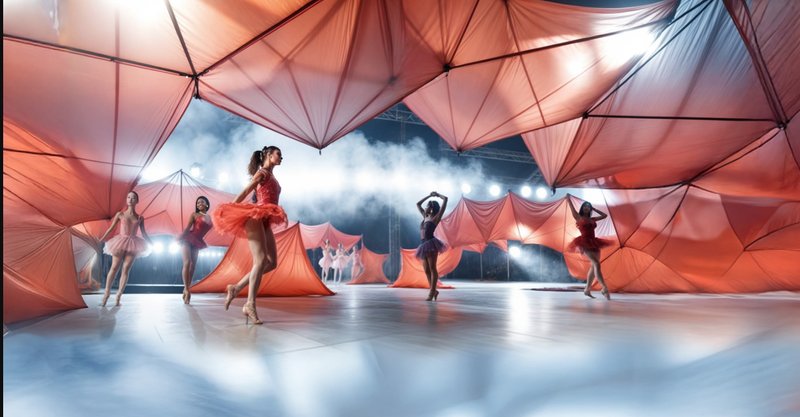
The interior view reveals the core spatial proposition: a crystalline tensile ceiling made of triangulated fabric panels that catch and scatter light across a reflective floor. Dancers occupy the space beneath, their bodies doubled in the ground surface while the faceted geometry above fractures the sky into a kaleidoscopic pattern. The effect collapses the distinction between enclosure and openness. There are no walls, yet the overhead geometry creates a palpable sense of containment, a room defined entirely by its ceiling.
The reflective flooring is a deliberate performance amplifier. It turns the ground into a second stage, making every movement visible from unexpected angles. For an audience circulating around the perimeter, the pavilion becomes a viewing apparatus as much as a shelter.
Plaza as Stage: Deploying in the Urban Grain
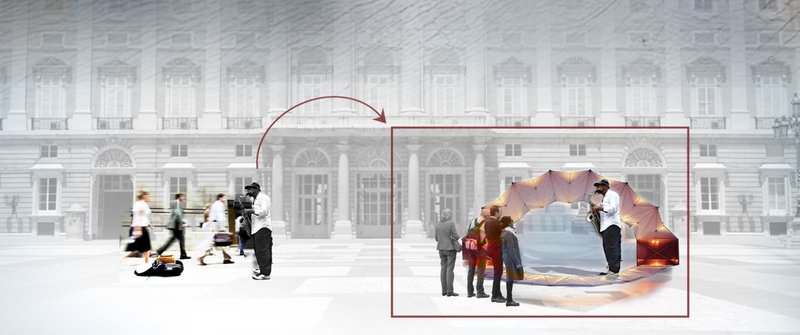
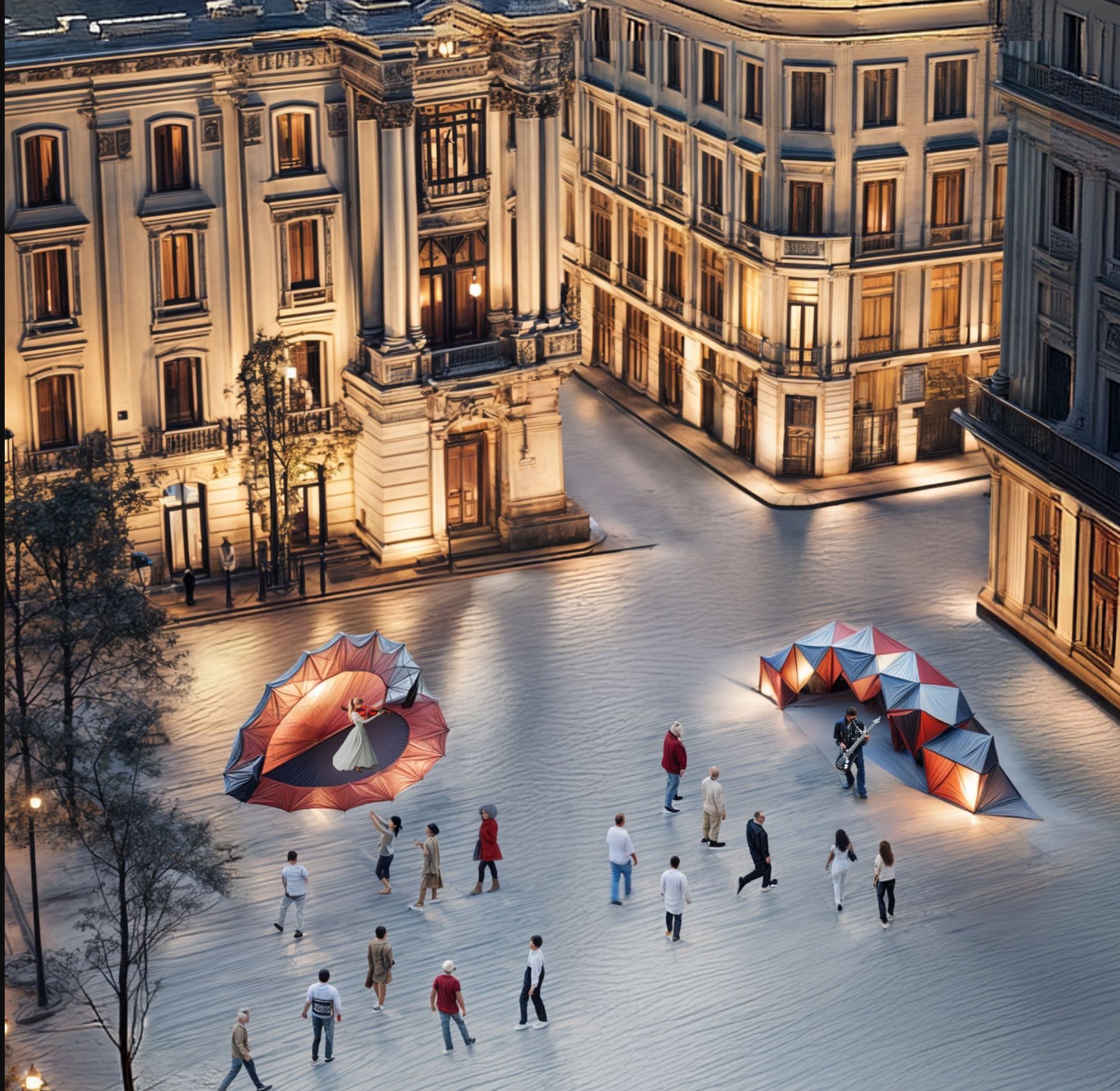
Two exterior renderings show the pavilion at different scales and times of day. In daylight, a single faceted canopy occupies a public plaza, its angular silhouette drawing pedestrians toward its perimeter. The structure reads as both sculptural object and functional shelter, low enough to feel approachable yet geometrically assertive enough to command attention against the surrounding urban facades. People gather informally, suggesting the pavilion doesn't demand a ticketed audience; it invites casual encounter.
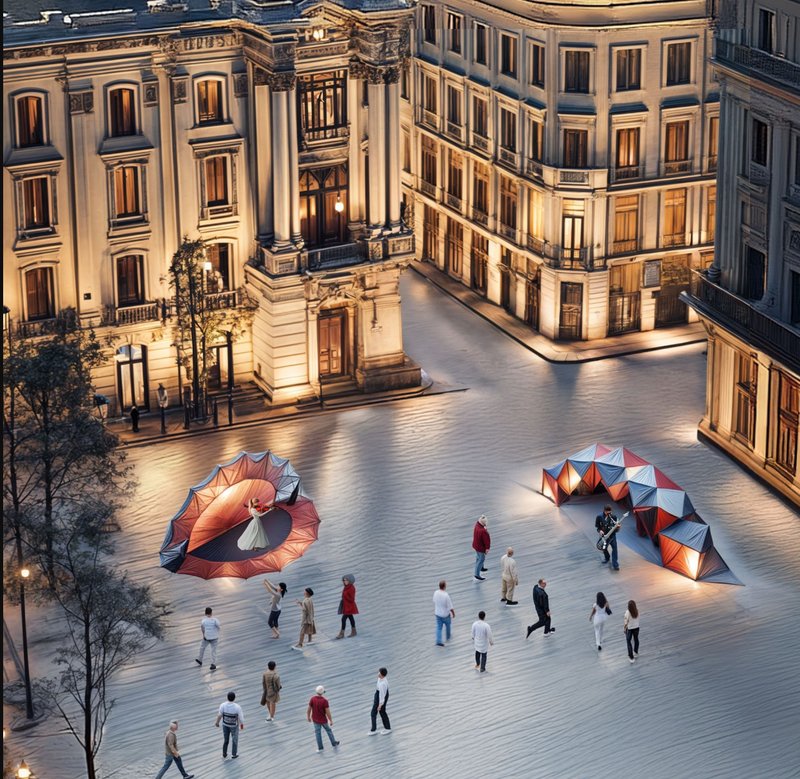
At dusk, the effect transforms. Two pavilions sit side by side on the same plaza, their translucent skins glowing from within against the warm illumination of adjacent buildings. The pairing hints at the system's scalability: one canopy for an intimate recital, two for a festival, more for a full biennial program. The faceted forms catch artificial light along their creases, turning each panel into a lantern facet. Madrid's evening plaza culture, already oriented around lingering and spectacle, gains a temporary architectural anchor.
Gradient Ground: Courtyards Woven by Color
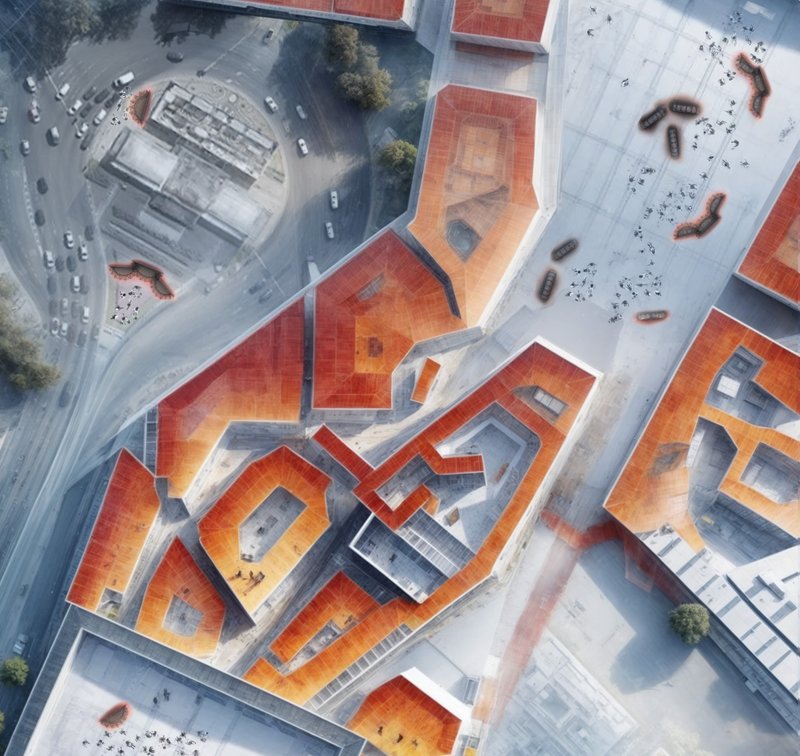
The aerial view pulls back to reveal the broader site strategy. Interconnected courtyards between existing buildings are unified by a gradient paving pattern that shifts from burnt orange to cool grey, establishing zones of activity without physical barriers. The color transitions suggest programmatic shifts: warmer tones for gathering and performance areas, cooler tones for circulation and pause. It is a legible choreography embedded in the ground itself, guiding movement before any canopy is deployed.
This ground treatment is critical because it means AeroStage operates on two temporal registers. The paving is semi-permanent, a slow infrastructure that marks the plazas as cultural sites. The inflatable canopies are ephemeral, arriving and departing with each event. Together they create a layered system where the city remembers performance even when the structures are packed away.
Why This Project Matters
Temporary performance architecture often falls into two traps: either it is so minimal it barely registers as space, or it imports the heavy machinery of festival staging that overwhelms its context. AeroStage navigates between these extremes by proposing a structure with genuine spatial interiority, the faceted ceiling, reflective floor, and open perimeter create a real room, while its pneumatic construction keeps it fundamentally portable and light on the city.
Azab's contribution to the Madrid Art Bioscope brief is the argument that infrastructure for art doesn't need to be built once and maintained forever. It can pulse: inflating for a weekend, deflating on Monday, reappearing across town the following month. In a city where public plazas are already stages for social life, AeroStage simply gives that life a more deliberate overhead geometry, then folds it away.
View the Full Project
About the Designers
Designer: Marium Azab
Enter a Design Competition on uni.xyz
uni.xyz runs architecture and design competitions year-round that reward proposals with spatial conviction and real site intelligence.
Project credits: AeroStage by Marium Azab Madrid Art Bioscope (uni.xyz).




Popular Articles
Popular articles from the community

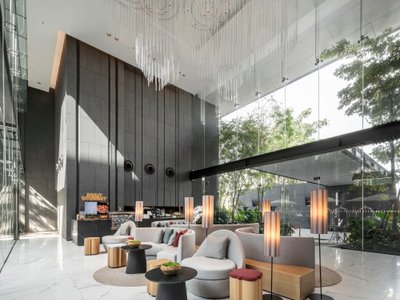
IDIN Architects Wraps a Hua Hin Hotel Around a Private Courtyard to Escape the City
Dusit D2 Hua Hin turns an urban infill site in Thailand's family vacation heartland into a self-contained resort through courtyard planning.
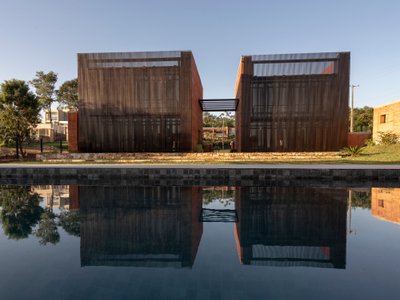
BAUEN Builds Two Rammed Earth Volumes in Paraguay Inspired by the Ovenbird's Nest
In San Bernardino, a house of compacted earth channels the instinct of a constructive bird to shelter life from the Paraguayan summer.
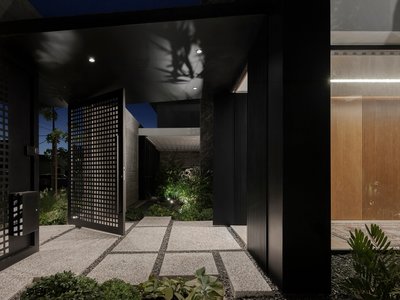
Constanti Architects Builds a Fortress of Privacy in Nicosia with House 345
A concrete and timber residence in Cyprus reinterprets the traditional introverted courtyard house for a new urban landscape.
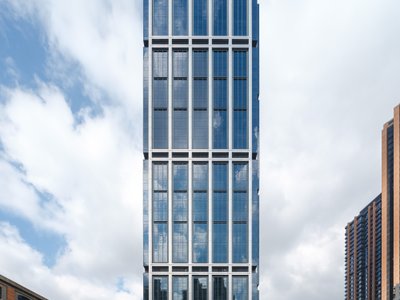
Foster + Partners Wraps a 200-Meter Shanghai Tower in Stainless Steel and Industrial Memory
The Suhe Centre Office Tower anchors a regenerated waterfront district in Shanghai with an all-steel structure that nods to local warehouse heritage.


Similar Reads
You might also enjoy these articles

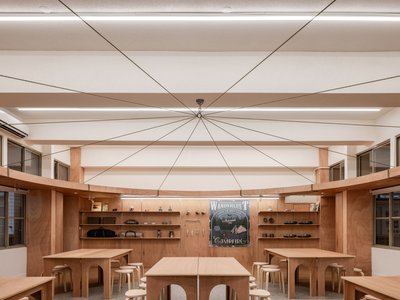
317studio Turns an 87 m² Classroom into a Forest Clearing for Scouts in New Taipei City
A rope canopy, student-made specimens, and campfire geometry replace rows of desks in this Scouting classroom in Xizhi District.
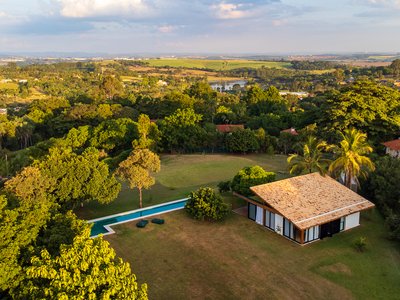
24 7 Arquitetura Builds a Timber Pavilion as a Family's First Act on a 5,000 m² Brazilian Plot
In Jaguariúna, a prefabricated glulam house nestles among mature trees as the opening move of a larger residential masterplan.
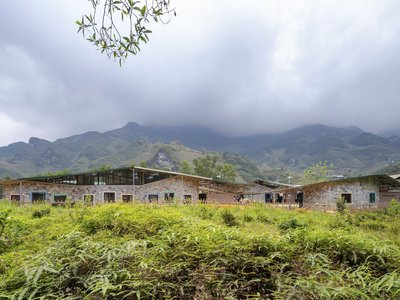
1+1>2 Architects Build a School from 900 Blocks of Hmong Stone on Vietnam's Rocky Plateau
On a barren valley in Ha Giang province, a community quarried its own stone to raise a kindergarten and primary school rooted in Hmong identity.
100A Associates Builds a Volcanic Stone Retreat on Jeju Island Rooted in Ritual and Restraint
Watarstay [Wa:Tar] in Bongseong-ri channels Jeju's basalt, reed, and hemp into a 150 m² hospitality space shaped by contemplation.






Comments (0)
Please login or sign up to add comments
No comments yet. Be the first to comment!