
AFF architekten Build a Spore-Shaped Cultural Center from Recycled Brick in Berlin-Neukölln
The Spore Initiative on Hermannstrasse pairs digitally optimized concrete ceilings with salvaged clinker brick to house a foundation for biocultural divers

A non-profit foundation dedicated to biocultural diversity needs a building that can hold an auditorium, gallery, library, workshop rooms, artist apartments, and a café without feeling institutional. On Hermannstrasse in Berlin-Neukölln, AFF architekten delivered exactly that for the Schöpflin Foundation, winning an ideas competition in 2018 and completing construction in 2023. The 4,117 square meter building sits at the entrance to the historic Jerusalem cemetery, framing a small public plaza with the neighboring Publix building and incorporating a historic light beacon mast from the former Tempelhof Airport into the ensemble.
What makes the Spore Initiative worth studying is not the program, which is generous but not unusual, but the way structural logic and material reuse operate as genuine design drivers rather than afterthoughts. The building's defining feature is a parametrically derived ribbed concrete ceiling inspired by the microscopic shape of a spore. Spanning up to 12 meters with an average slab thickness of just 14 centimeters and ribs 38 centimeters high, it eliminates columns on the ground floor and turns structure into ornament. Combined with a facade strategy that layers recycled clinker brick, new-fired brick, and structural glazing floor by floor, the result is a building that reads as both raw and precisely calibrated. It won the DAM Prize 2025 for Architecture in Germany, and the reasoning is legible from the street.
Brick Facade as Neighborhood Negotiation
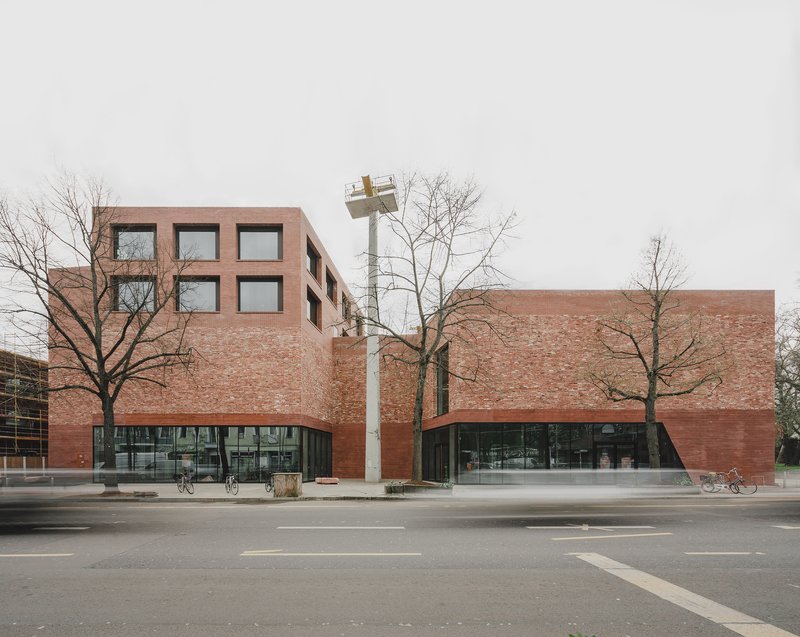
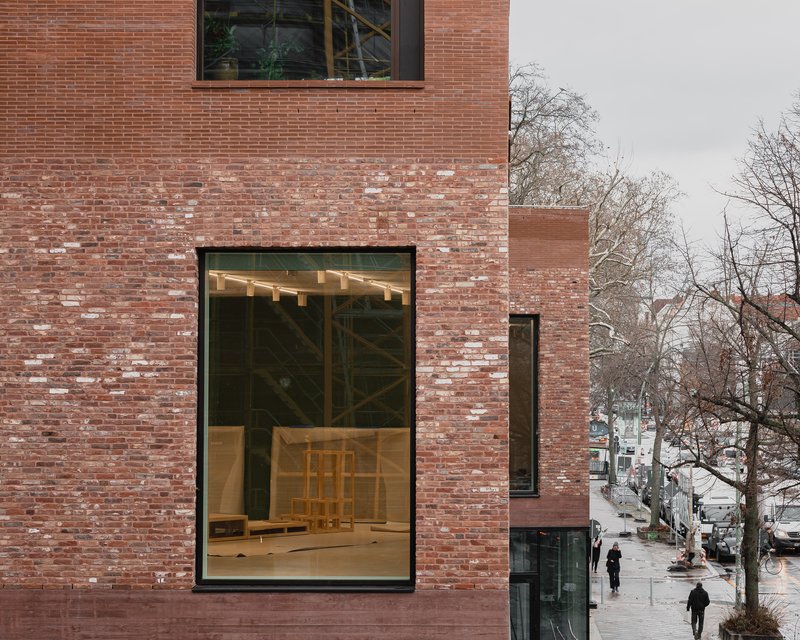
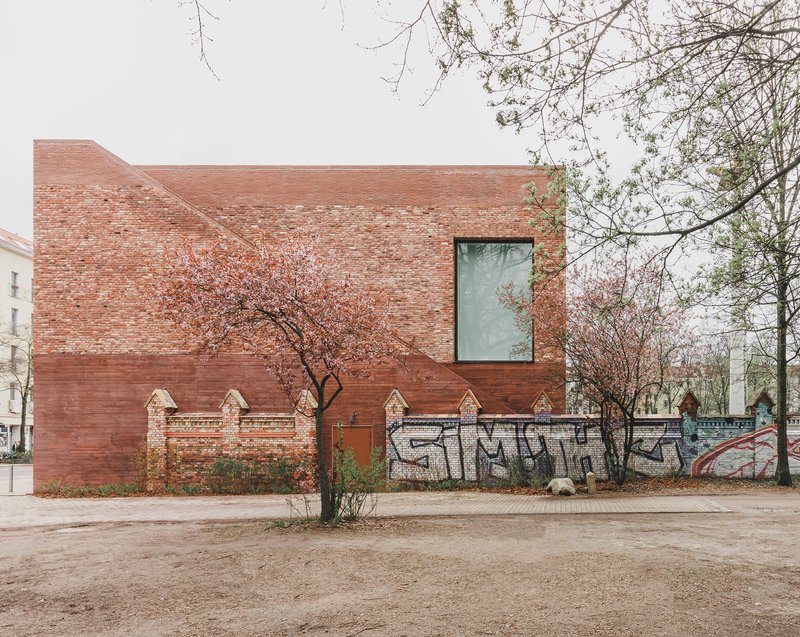
Neukölln is defined by Wilhelminian perimeter blocks, cemetery walls, and the sprawling green voids left by the disused Tempelhof Airport. AFF architekten chose red brick not as nostalgia but as context: the material echoes the cemetery buildings nearby and the public architecture of the neighborhood. The facade shifts register at each floor. Ground level is structural glazing with tall arched openings, inviting the street in. The first floor is clad in recycled clinker bricks with chipped corners and natural patina. The upper two floors use new-fired brick with a tighter grid of square oak-wood-aluminum windows.
The result is a legible stacking of public, semi-public, and private functions that you can read from the sidewalk. A remnant of the historic cemetery wall is integrated directly into the facade as a relief, a move that treats the site's archaeology not as an obstacle but as a found surface. Coatings were intentionally avoided across all exterior surfaces, so the building is designed to age visibly: the patina of recycled clinker and the slow weathering of new brick will converge over time.
The Spore Ceiling and Column-Free Ground Floor
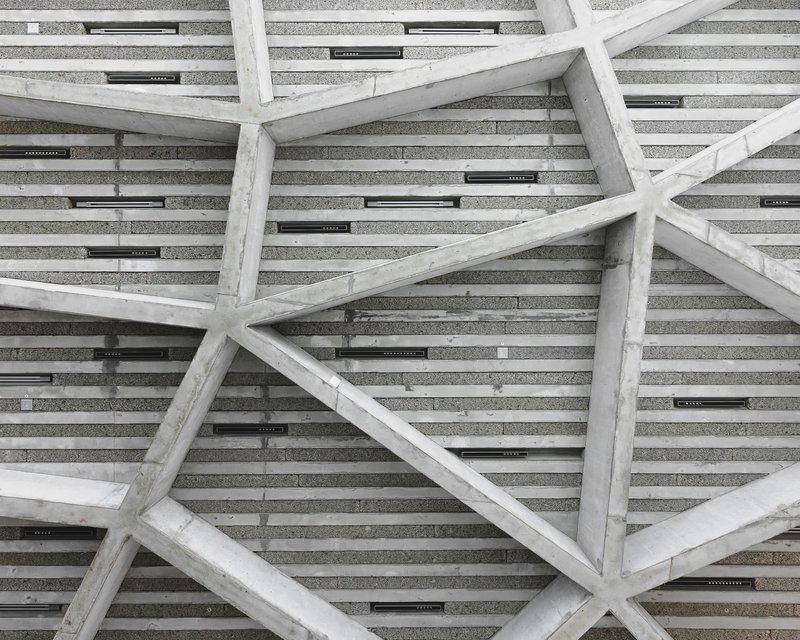
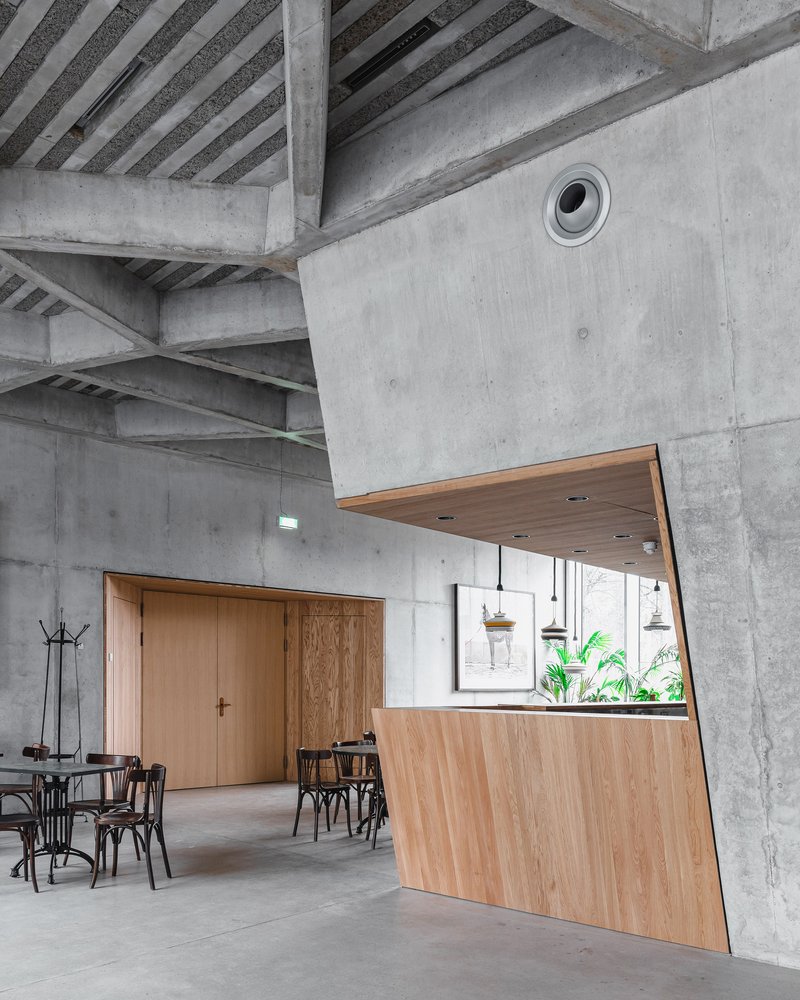
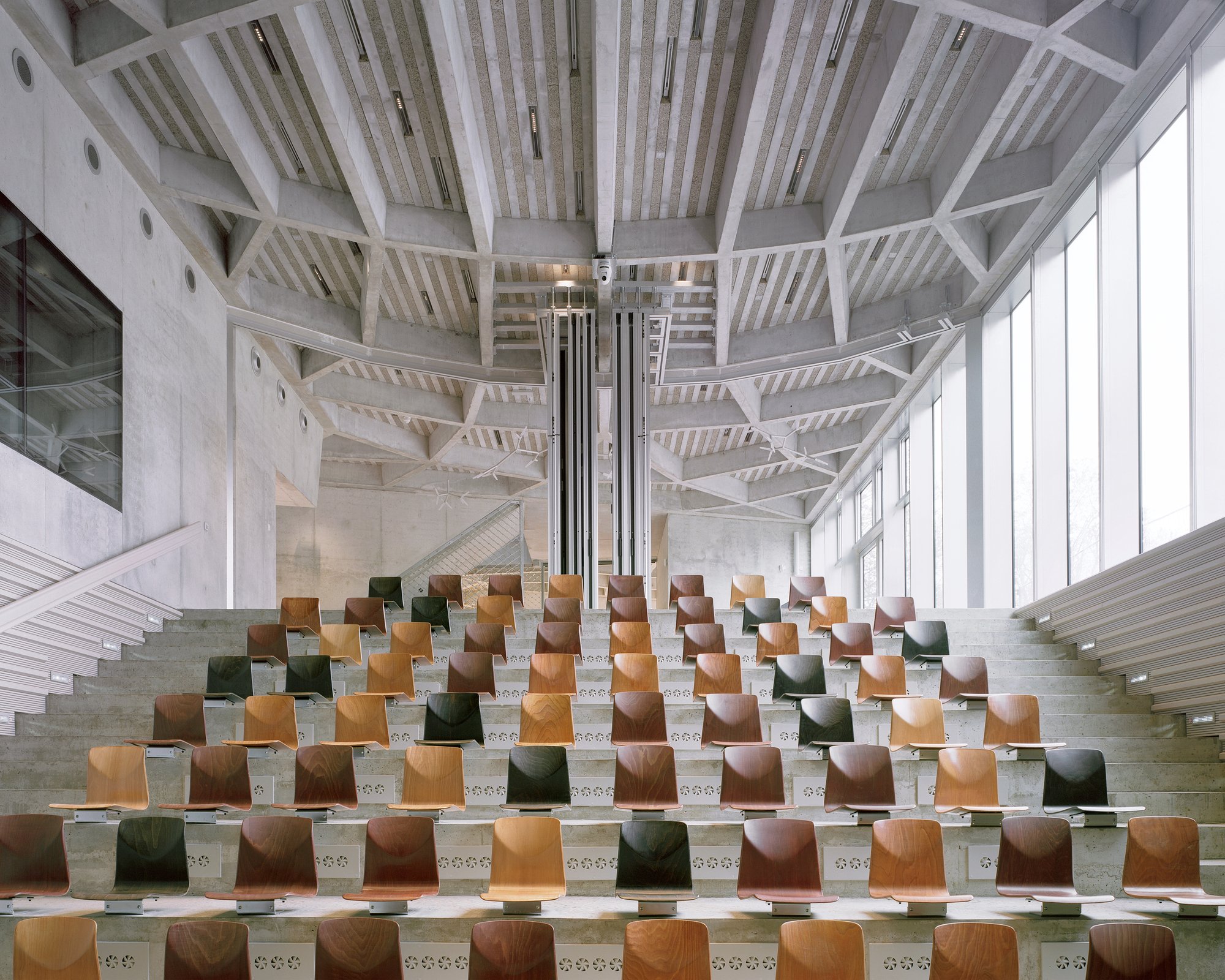
The structural ceiling is the project's most technically ambitious element. Working with Schnetzer Puskas International, AFF used parametric simulations to translate stress trajectories into a three-dimensional rib pattern. The ribs follow force distribution across the slab, creating a honeycomb-like network that optimizes material use while producing a ceiling surface of genuine visual complexity. Diagonal timber beams and integrated linear lighting reinforce the directionality, and a circular skylight above a central void pulls daylight deep into the plan.
The payoff is spatial: a column-free ground floor roughly four meters high that accommodates the foyer, auditorium, workshop spaces, conference areas, and café without partition walls dictating the sequence. A folding wall separating the auditorium from the foyer follows the curved geometry of the ribs above, so the movable partition feels like part of the structure rather than an add-on.
Auditorium and Gathering Spaces
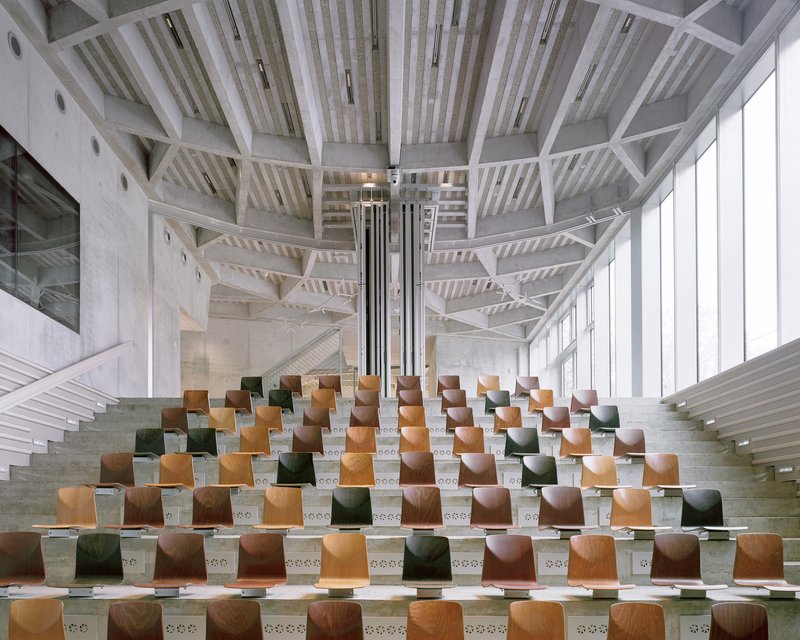
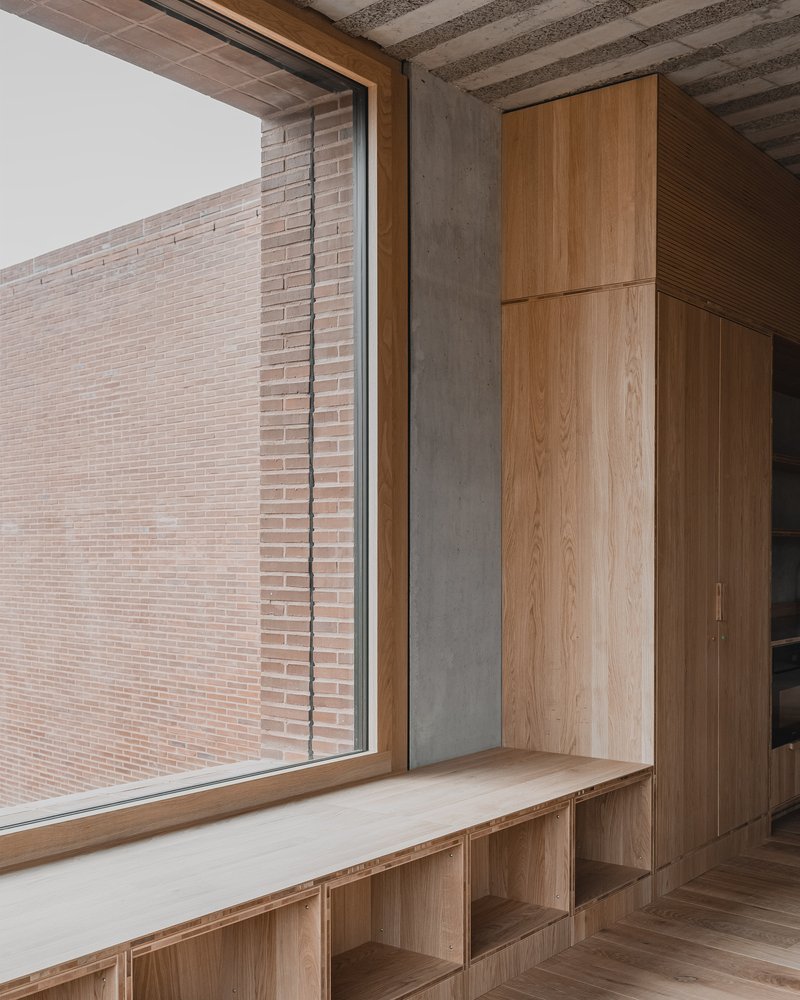
The tiered auditorium seating uses colored wooden shells sourced through reuse, collected in collaboration with product designer Ilja Oelschlägel from Leipzig. Arranged beneath the exposed concrete ribs and skylights, they give the room a warmth and informality that a uniform seating system would not. The mismatched colors are not decorative whimsy; they are a legible artifact of the reuse strategy.
Built-in timber benches and storage units appear throughout the building, positioned at windows to create incidental gathering spots. These moments of inhabitable furniture, where you can sit and look out at the brick facades or the cemetery landscape, do more to establish the building's character as a cultural living room than any signage could.
Gallery, Library, and Upper Floors
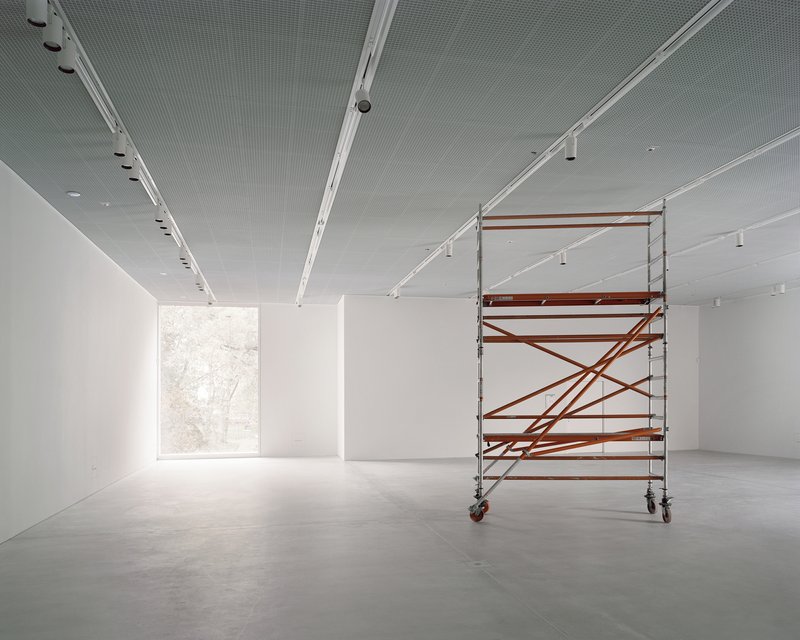
An exposed concrete staircase divides the ground floor foyer and leads to exhibition rooms on the first floor. The gallery is a restrained white volume with polished concrete flooring and track lighting, deliberately neutral to let rotating exhibitions set the tone. The recycled clinker brick on this level's exterior signals its more public character within the building's hierarchy.
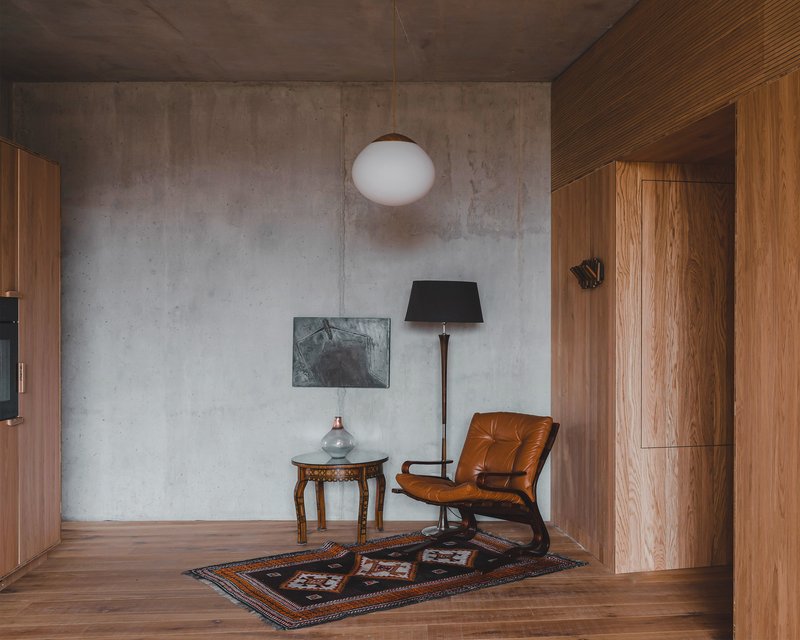
The second and third floors hold a semi-public library, lecture rooms, private office space, and two apartments for in-house artists. A corner reading nook with a leather chair, patterned rug, and timber paneling against raw concrete shows how the material palette softens as you move upward and inward. Special ventilation sashes on the upper-floor windows and wood-concrete acoustic strips in the ceilings handle climate and acoustics without concealed mechanical systems, keeping the raw surfaces legible.
Salvage as System
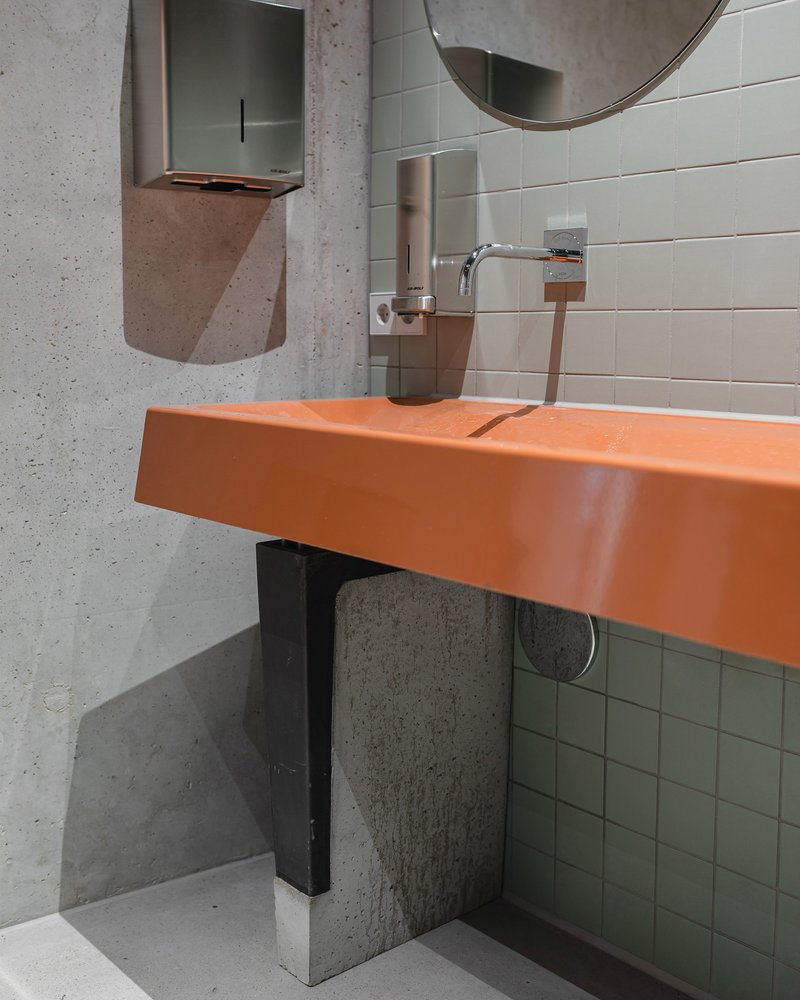
The reuse strategy here goes beyond the facade. Sanitary objects were collected and repurposed; an orange concrete sink with a wall-mounted faucet above white subway tiles reads as both designed and found. Formwork timber from the ribbed ceiling was salvaged and reused as structural timber for the roof terrace pavilion. Auditorium seating shells were sourced secondhand. The word AFF uses is "sustainable reality," a phrase that insists on material specificity over certification theater.
The result is a building where imperfection is not a concession but a strategy. Chipped edges on clinker bricks, visible formwork marks on concrete, and untreated surfaces across the interior establish a tactile register that rewards close looking. It also sets an honest baseline for aging: there is no pristine finish to degrade, only surfaces that will accumulate history.
Plans and Drawings
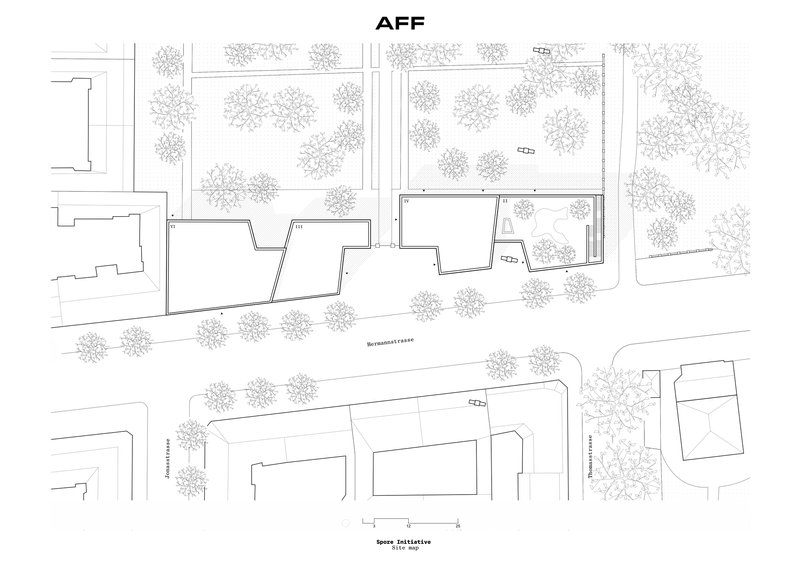
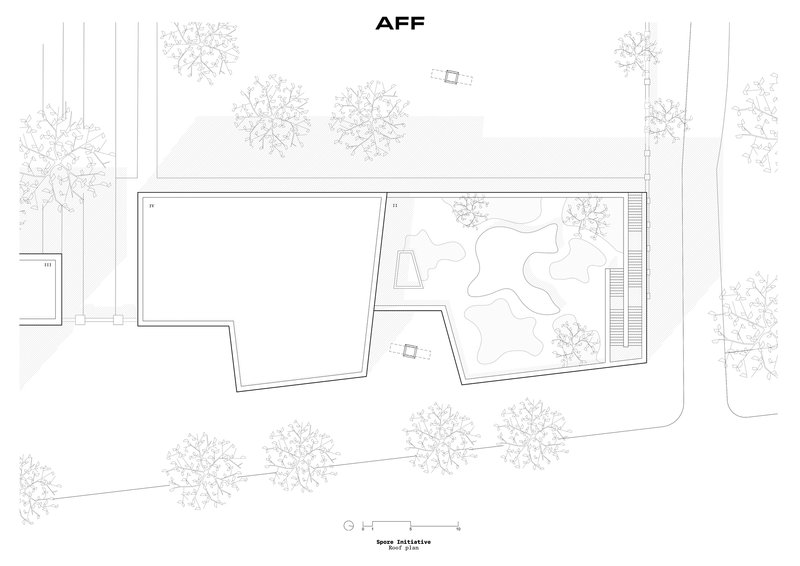
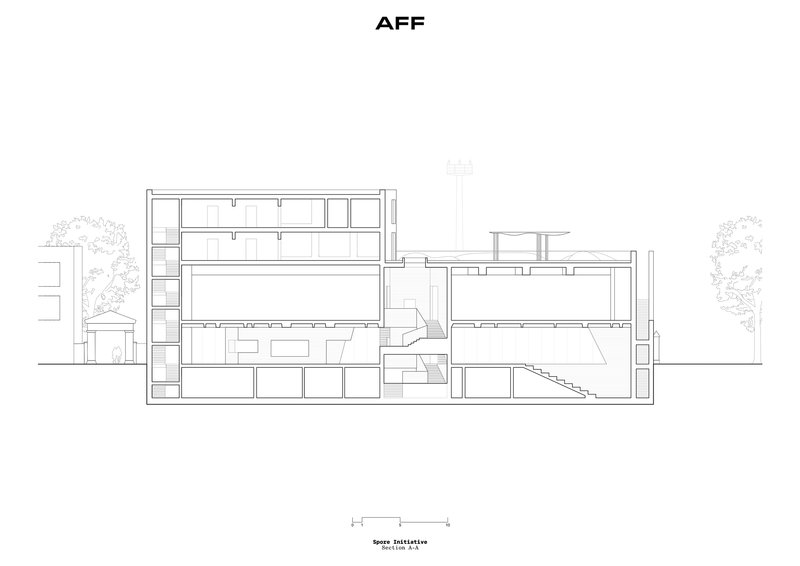
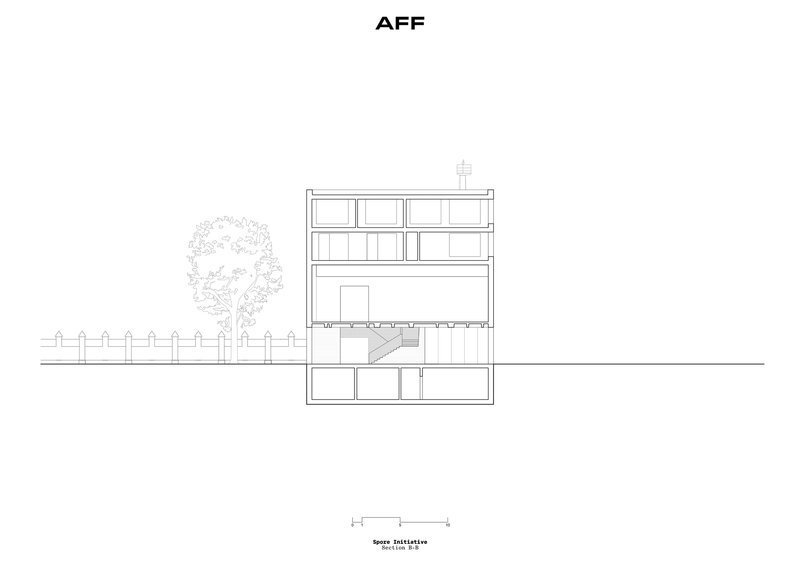
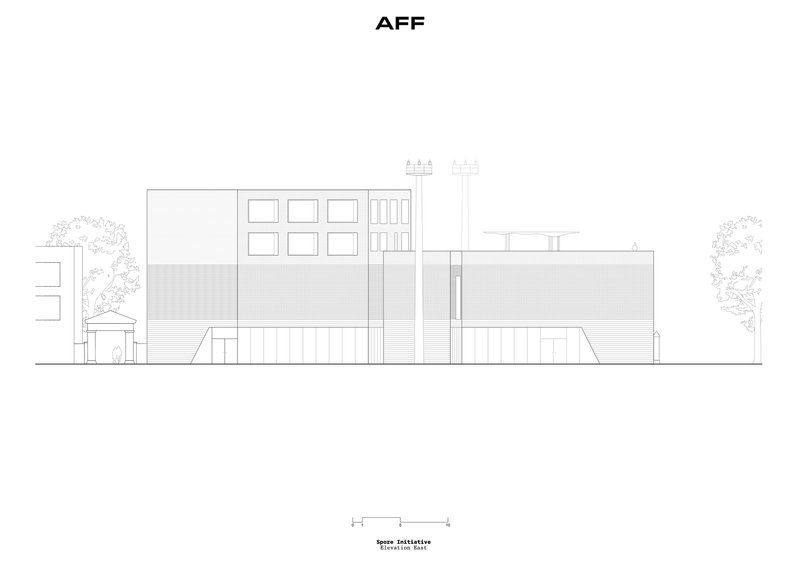
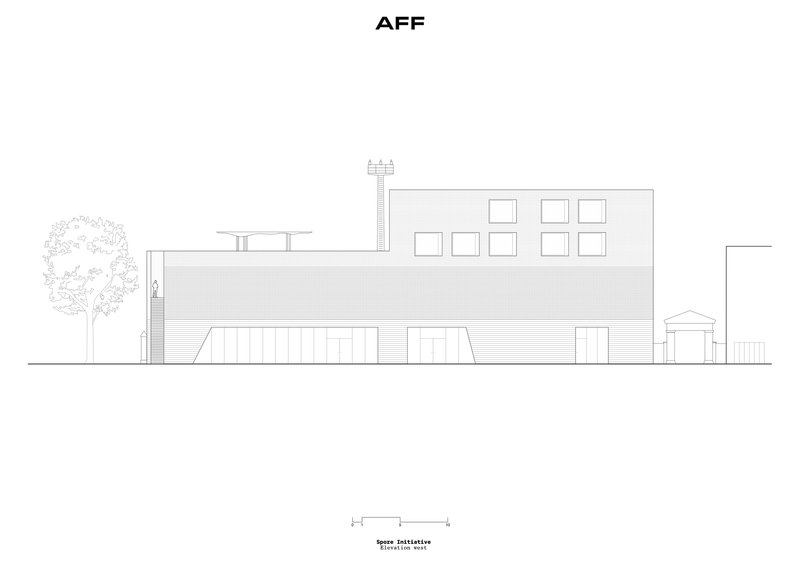
The site plan reveals how the building and the neighboring Publix structure together frame the cemetery entrance and create a public forecourt on Hermannstrasse. The ground floor plan shows the two main volumes flanking courtyard spaces, with landscape by Pola Landschaftsarchitekten extending the public ground into the cemetery zone. The section drawing makes clear the four-meter ground floor height and the way the skylight above the central void distributes light vertically through the building.
The elevation drawings are particularly revealing. The street-facing facade clusters square windows in an irregular but rhythmic pattern that avoids the monotony of a standard grid. Horizontal banding marks the material transitions between recycled clinker and new brick. The restrained language of the elevations confirms what the photographs suggest: this is a building that earns its complexity through material and structural decisions, not formal gymnastics.
Why This Project Matters
The Spore Initiative demonstrates that material reuse and computational structural optimization are not competing agendas. You can digitally derive a ribbed ceiling that minimizes concrete use and simultaneously build a facade from salvaged clinker bricks with chipped edges. The synthesis of high-tech engineering and handcrafted materiality produces a building that is both precise and imperfect, and that tension is what makes it compelling. In a German architectural landscape where sustainability often defaults to Passivhaus standards and timber construction, AFF architekten offer a different model: one rooted in local recycling, exposed structure, and the deliberate acceptance of aging.
For a neighborhood like Neukölln, which is transforming rapidly and unevenly, the building also sets a civic tone. It is open at the ground floor, graduated in its privacy upward, and materially continuous with the cemetery buildings and apartment blocks around it. It does not announce itself as a cultural institution through spectacle but through generosity of space and seriousness of construction. The DAM Prize 2025 recognized what is apparent on site: this is a building that operates at the scale of the street and the scale of the microscope simultaneously, and finds coherence at both.
Spore Initiative by AFF architekten. Berlin, Germany. 4,117 m². Completed 2023. Photography by Hans-Christian Schink and Tjark Spille.
About the Studio
Share Your Own Work on uni.xyz
If projects like this are the kind of work you want to make, uni.xyz is a place to publish your own, find collaborators, and enter design competitions.



Popular Articles
Popular articles from the community

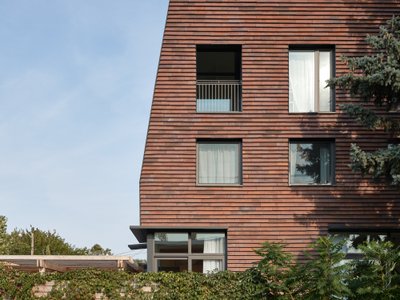
LGA Architectural Partners Build Toronto's First Multiplex Condo on a Single-Family Lot
Ulster House packs five zero-carbon units into a Harbord Village lot, proving gentle density can be market-ready and livable.
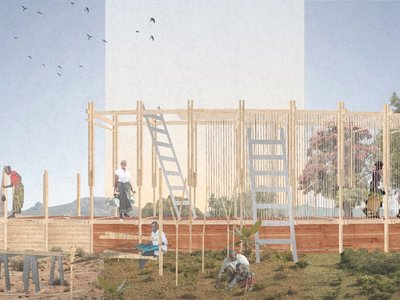
Healing Façade: Sustainable Architecture for Reforestation, Community, and Sacred Ecology in Ethiopia
Healing Façade reimagines sustainable architecture as a living wall that restores soil, catches water and renews Ethiopia's forest churches.
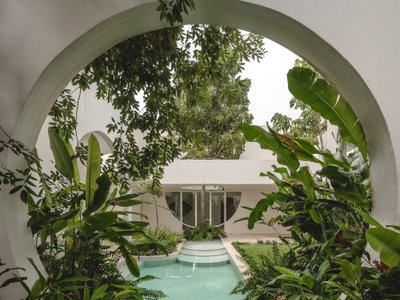
Etea and Ghostframe Carve a Surreal Domestic World from Arches and Circles in Mérida
Casa Eclipse wraps 385 square meters of sculptural living space around a lush courtyard pool in Mexico's Yucatán Peninsula.
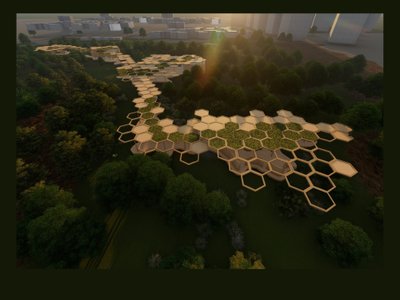
Eco Chapel: A Green Architecture Pavilion Designed in Symbiosis with the Forest
Eco Chapel uses green architecture to weave prayer, learning and reuse into a forest pavilion shaped by modular hexagonal canopies for life.


Similar Reads
You might also enjoy these articles

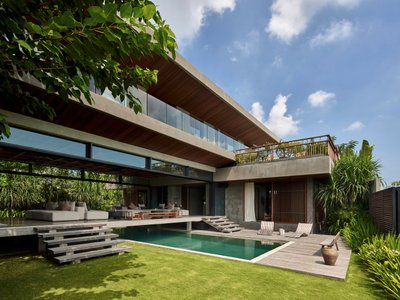
Freebird Residence by Alexis Dornier: A Tropical Modernist Sanctuary in Bali
Floating living pavilion above pool anchors H-shaped tropical villa, blending Japanese minimalism, sustainable strategies, lush landscape, and sculptural interiors.
127af Flips a Tiny Bagnolet Rowhouse Upside Down with a Handcrafted Roof Extension
A 55-square-meter terraced house on the edge of Paris gains a luminous upper living floor through lightweight timber and steel.
1.61 Design Workshop Wraps a 600-Square-Meter Café in Vietnam in Sculptural Burgundy Drama
Reden Café & Bistro pairs a helical staircase, mosaic floors, and deep red interiors to rethink Vietnamese hospitality space.

The Unbound Brain: A School Shaped by Cognitive Architecture
Cylindrical learning pods radiate like neurons from a central cortex, turning the floor plan into a spatial model of human thought.

Explore Architecture Competitions
Discover active competitions in this discipline




The International Standard for Design Portfolios


The Global Benchmark for Architecture Dissertation Awards


The Global Benchmark for Graduation Excellence


Challenge to reimagine the Iron Throne
Comments (0)
Please login or sign up to add comments
No comments yet. Be the first to comment!