
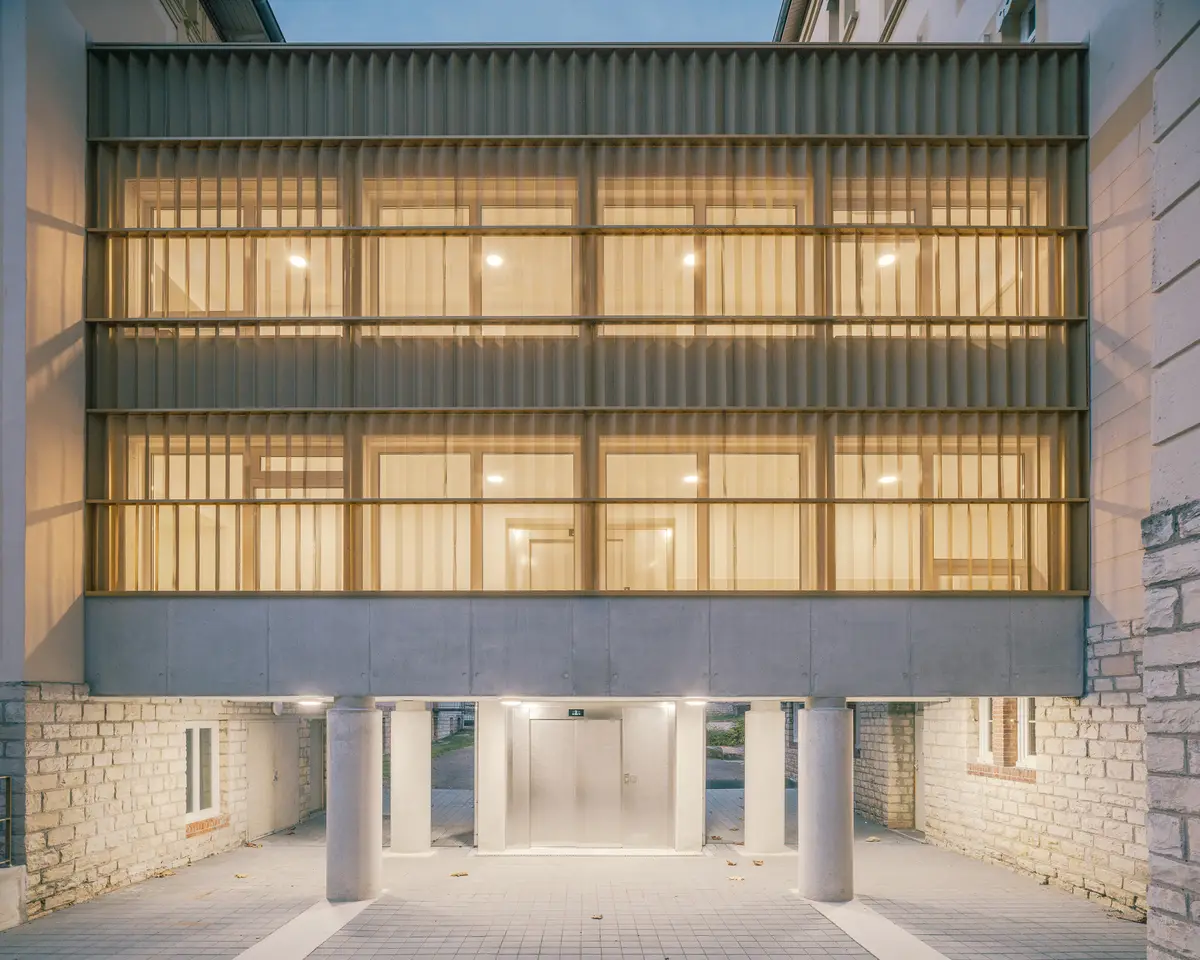
Agence Vulcano-Gibello Threads a Timber Gallery Between Heritage Wings of a Burgundy Retirement Home
An 80-square-metre connecting volume in Santenay, France lifts itself off the ground to link early 20th-century buildings without touching their character.


Retirement homes rarely make it onto architecture desks as glamour commissions, and connecting corridors between existing buildings make it onto even fewer. Yet the Connecting Gallery at Les Verdaines in Santenay, Burgundy, is precisely the kind of small intervention that deserves close attention: 80 square metres of program that had to negotiate a heritage campus, two misaligned building wings, mature sycamores, and the daily rhythms of elderly residents. Agence Vulcano-Gibello responded not with the cheapest possible link but with a considered timber volume that sits lightly on slender columns, refusing to compete with its early 20th-century neighbours while still announcing itself as something unmistakably new.
What makes the project interesting is its position on two axes simultaneously: the vertical axis, where it lifts off the ground to preserve the courtyard's porosity and sightlines, and the historical axis, where it must mediate between plastered facades, a clock tower, and a chapel wing without pastiche. The answer is a louvered timber skin that filters light, creates privacy, and produces a rhythm legible from the courtyard. It is a connector that does more than connect.
Lifting Off: The Piloti Strategy


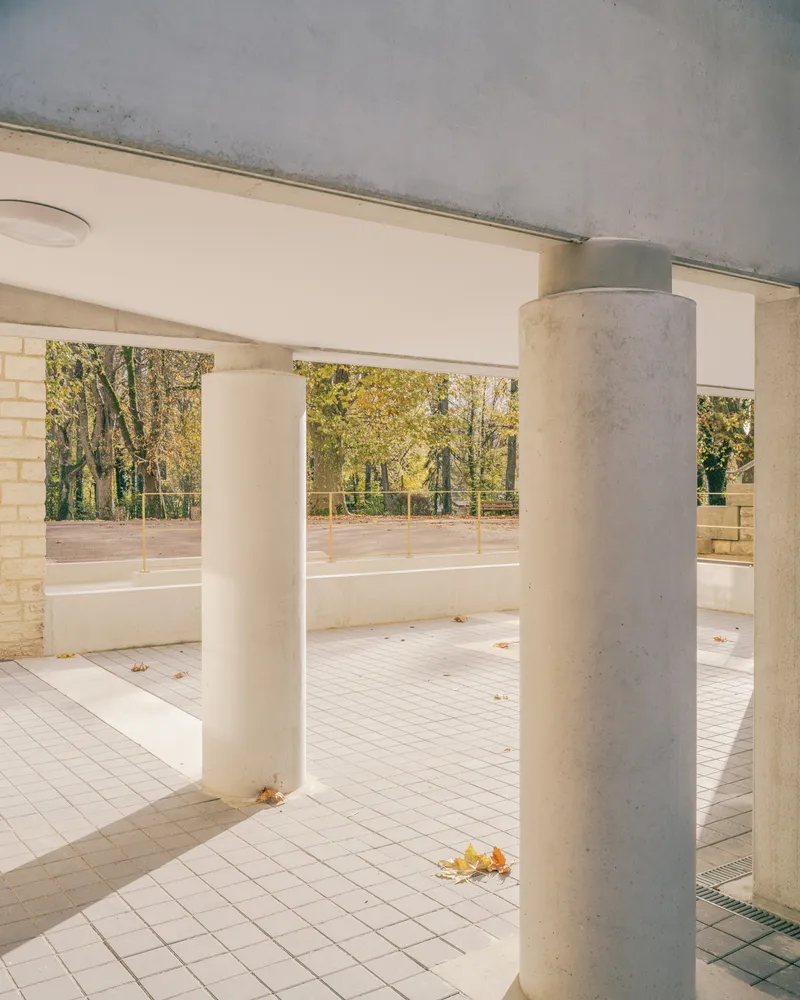
Raising the gallery above grade on cylindrical white columns is the project's most consequential decision. It keeps the courtyard surface continuous, allows autumn leaves and wheelchair routes to pass beneath unobstructed, and gives the new volume a visual lightness that the cream stucco wings beside it do not possess. From head-on, the glazed ground level reads almost as open air, making the timber box above appear to hover.
The columns themselves are deliberately spare: smooth, white, circular in section, and clearly not the load-bearing masonry of the original campus. There is no ambiguity about which century built what. Under the covered terrace they create, residents get a sheltered outdoor space framed by tree canopies, useful on cool Burgundy mornings when a walk through the courtyard might otherwise be abandoned.
Timber Skin and Filtered Light
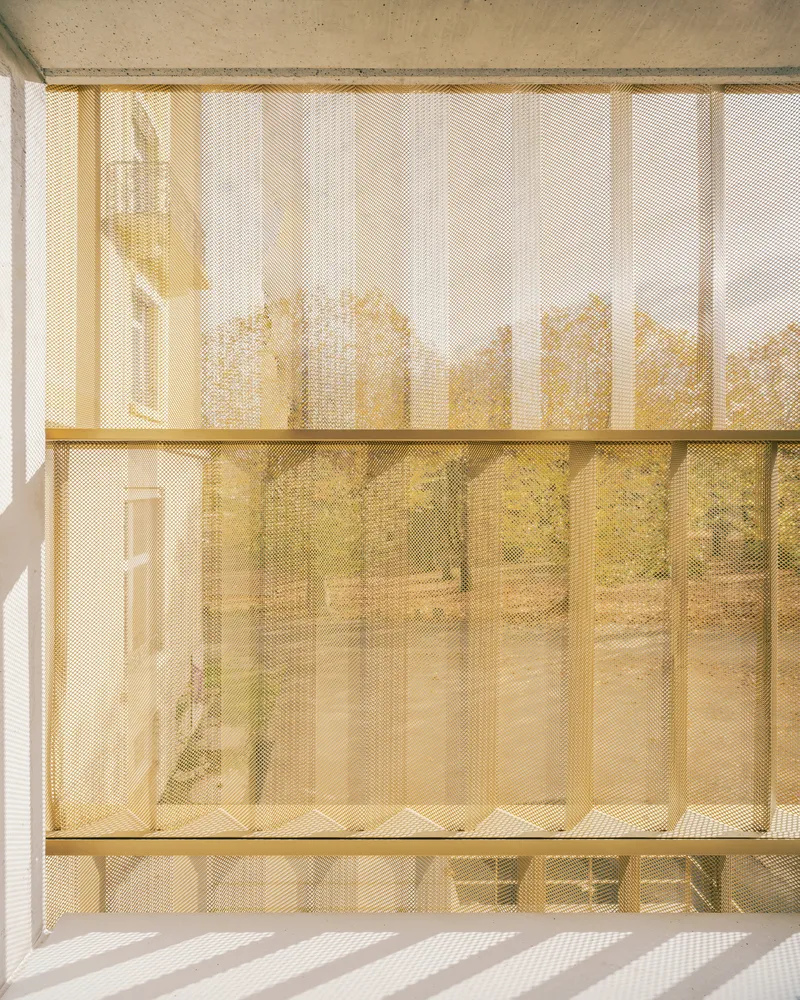
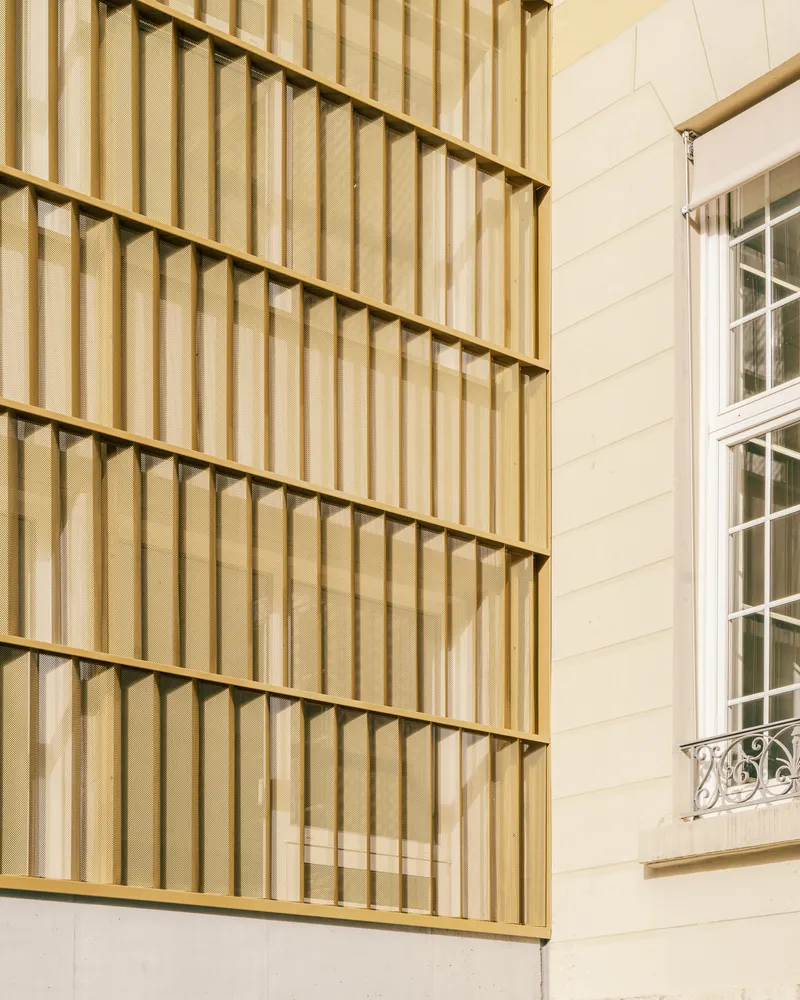

The louvered facade does triple duty. It modulates solar gain on the gallery's glazed walls, provides a degree of visual screening for residents moving between wings, and establishes a material identity distinct from the plaster and stone of the heritage buildings. Seen in close-up, the vertical timber slats produce a bronze, almost mesh-like quality as light rakes across them, while from a distance they coalesce into a warm, monolithic band.
Where the timber battens meet the white horizontal boarding of the original structure, the joint is precise but frank. No caulk-filled fudge, no decorative trim to smooth over the collision of eras. The detailing trusts the contrast to do the talking, and it does.
Campus Context and the Courtyard


Les Verdaines is not a single building but a loosely organized campus of wings arranged around a courtyard with mature trees. The gallery's insertion had to work at the scale of the whole precinct, not just the two facades it stitches together. Walking the tree-lined path, you read the timber volume as an episode in a longer sequence: chapel, link, tower, garden. It does not dominate, but it does not disappear either.
At dusk the gallery gains a second life. The fiber-cement and timber surfaces reflect ambient light differently from the pale plaster of the heritage wings, and the interior illumination behind the slats turns the facade into a lantern. This night presence gives the courtyard a focal point it lacked before, anchoring the complex's geometry without overwhelming it.
Courtyard Insertions and Materiality


Not every face of the intervention carries the same material. From the courtyard side, stacked grey concrete panels on brick bases present a more utilitarian character, acknowledging that this elevation handles service access and structural transitions rather than the gallery's public face. It is a pragmatic choice that keeps the budget honest: spend the expressive timber where residents and visitors see it, use robust concrete where it meets the ground.
The juxtaposition with the pale yellow clock tower is the project's most photogenic moment. Vertical louvered timber against rendered masonry and stone stairs reads like a textbook dialogue between old and new, but what saves it from cliché is the restraint. Vulcano-Gibello does not exaggerate the contrast with angular geometries or polished metal. The timber ages; it will eventually grey toward the stone. The conversation is designed to mellow.
Inside the Gallery


Interior photographs reveal a corridor that is far more generous than its 80 square metres might suggest. Timber-slatted doors echo the exterior louvres, creating continuity between inside and outside. Sunlight through the facade casts geometric shadow patterns on the polished floor, a moving display that marks time for residents who traverse the link several times a day. In a retirement home, where the quality of circulation space directly affects wellbeing, this is not a minor detail.
The horizontal bands of glazing visible at twilight confirm that the gallery is not a sealed tube but a space with outlook. Residents crossing from one wing to another get a framed view of the courtyard and its trees, reinforcing spatial orientation and visual pleasure even in a passage that lasts only seconds.
Plans and Drawings


The site plan reveals how the new gallery resolves a gap in the campus's perimeter, closing the courtyard loop without sealing it off entirely thanks to the open pilotis at ground level. The ground floor plan makes clear that the intervention is surgical: it occupies the narrowest possible footprint between the two existing wings, threading past trees that have been preserved in the courtyard.
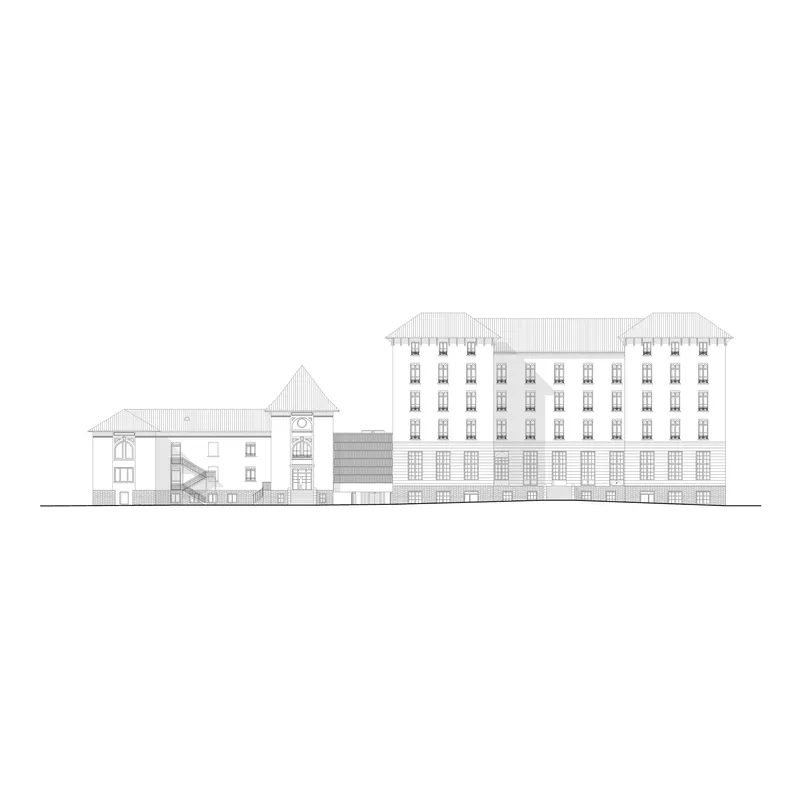
The elevation drawings are especially instructive. They show the full silhouette of the complex from chapel to main tower, with the new volume occupying a modest vertical band between stone base and upper levels. The gallery reads as an infill rather than an addition, its roofline deliberately held below the existing eaves. Nothing about the proportions shouts; everything fits.
Why This Project Matters
Architecture culture tends to celebrate the new-build residence, the museum, the tower. Connecting galleries in retirement homes sit far from that spotlight, yet they represent some of the most constrained and consequential design work a practice can undertake. At Les Verdaines, the stakes were high in a quiet way: residents who rely on indoor circulation to move between dining, care, and living spaces need that circulation to be humane, legible, and pleasant. Agence Vulcano-Gibello delivered all three at a scale that would barely register on a masterplan.
The project also offers a compact lesson in heritage adjacency. Rather than mimicking the early 20th-century campus or contrasting it aggressively, the timber gallery occupies a middle register: warm, tactile, clearly contemporary, and calibrated to age alongside its neighbours. If more interventions in historic care facilities followed this logic, the built environment of elderly care would look very different, and considerably better.
Connecting Gallery for the Les Verdaines Retirement Home, Santenay, France. Completed 2025. 80 m². Architect: Agence Vulcano-Gibello. Photography: Charly Broyez.
About the Studio
Share Your Own Work on uni.xyz
If projects like this are the kind of work you want to make, uni.xyz is a place to publish your own, find collaborators, and enter design competitions.


Popular Articles
Popular articles from the community


David Ortega Stacks a Two-Story Mexico City Penthouse Around a Steel Stair and a Pergola-Shaded Roof Terrace
In Colonia Roma, a 300 m² penthouse uses oak joinery, a planted steel stair and a slatted roof pergola to make a new-build apartment feel like a house.


Singing Woman: An Opera House That Performs Before the Curtain Rises
Ovidiu Cristian Pavel's conceptual opera house translates Estonia's choral identity into a sculpted waterfront landmark facing the Baltic Sea.

Cube Design Draws an Ecological Corridor Between Two Shenzhen Hills with the Nankai Building
Beside Shenzhen's container docks, the Nankai Building pairs stacked balconies with a climbing green screen to connect two hillsides across its height.

ETEH Reworks the Shared Spaces of São Domingos School in Brazil Around Timber, Color and Hanging Plants
At São Domingos School in Brazil, 436 m² of hall, refectory and library are recast with timber joinery, a yellow and blue code and trailing greenery.

Similar Reads
You might also enjoy these articles

LAVA Architecten Gives Vocational Education a Sawtooth-Roofed Face on a Mechelen School Campus
In Mechelen, Belgium, a 2,053 m² STEM school on a 6×6 m grid turns workshops and classrooms into rooms that can be rearranged as teaching changes.

KEMA Studio Turns a Derelict Marvila Attic into a 60 m² Lighthouse Apartment Above Lisbon
In Lisbon's Marvila district, a rebuilt roof, four skylights and two plywood volumes turn an unlivable attic into a bright home facing the Tagus.

Pixel Gardens: One Repeated Module Stacked Into a Terraced Social Housing Tower for Famagusta
Salem Bader's shortlisted housing tower builds a vertical neighbourhood from one repeated module, offsetting units to carve terraces, light and air.

Bao Huynh Watercolor Atelier: A Serene Art Retreat in Hội An
Bao Huynh Watercolor Atelier in Hội An blends multifunctional art spaces, sustainable design, local materials, and family-friendly living in a serene environment.

Explore Gallery Competitions
Discover active competitions in this discipline

Challenge to design public laboratory

Bring back Drive In's
Comments (0)
Please login or sign up to add comments
No comments yet. Be the first to comment!