

AI Academy Scarborough: A Modular School Designed to Reconfigure Itself Around How Students Learn
Hexagonal classroom modules, sliding partitions and a shared central platform turn a school into an adaptive system that stays open to its city.


Most schools are built as answers: fixed rooms for fixed subjects, sized for a timetable that rarely changes. The AI Academy Scarborough is built as a question. It treats the building as a system that responds to its inputs, much as the artificial intelligence it is named after does. Hexagonal classroom units, sliding partitions and interconnected facilities form a spatial ecosystem in which learning is decentralized and self-regulated. Students are expected to take ownership of how and where they learn, and the architecture is designed to keep up with them.
Designed by Jumbo Globe, the project was recognized as an Editor's Choice entry in School of Thought 2020, a competition that asked participants to imagine the next generation of educational institutions. Jumbo Globe's response does not rely on spectacle. It is a prototype in which auditoriums, robotic labs, maker studios and learning resource centers work as linked nodes in a larger framework. That framework serves students, the public and industry partners together, so the academy becomes a knowledge hub that reaches well past the classroom door.
Two Volumes Split From One Cluster

The massing starts as a compact cluster of modular units, which is then divided into two primary blocks. The rendering shows the outcome. Two volumes wrapped in terracotta screens stand beyond a paved plaza and lawn, with glazed upper floors that lighten the top of each mass. The screens do more than finish the surface. The project describes an interactive envelope whose facade elements adapt to environmental conditions and user needs, regulating light and communicating information. Where most smart buildings hide their technology in ceiling voids, this one puts it on the outer skin.
The plaza in the foreground matters as much as the buildings. By making the split between the two volumes a usable public ground, the design starts its argument on the outside: the school is not one closed object but a set of parts with room for people to move between them.
Circulation That Doubles as a Meeting Ground

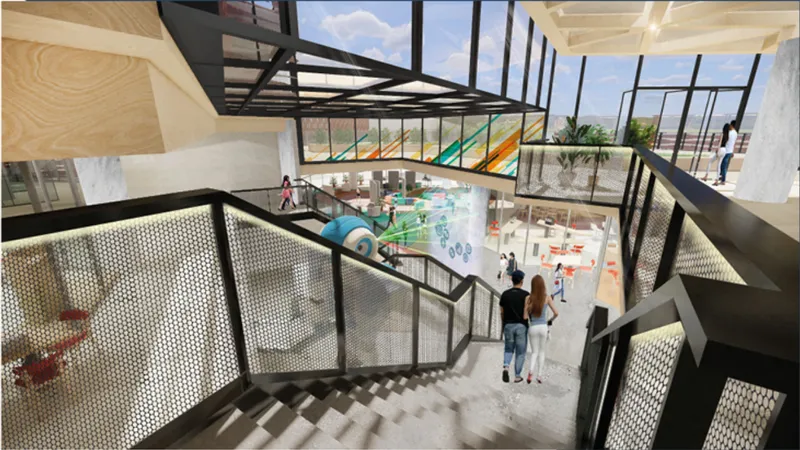
A central platform links the two blocks and acts as the primary circulation spine. The interior views show what that spine feels like. Concrete stairs run beside perforated metal balustrades, a red glazed wall marks the edge of the route, and a timber lattice ceiling softens the corridor above. Looking down the stair toward the glazed atrium, daylight from clerestory windows falls through the full depth of the section. The perforated guardrails keep sightlines open, so someone on a landing can see activity on the floors above and below.
This is where the designer's idea of the platform as a social condenser becomes convincing. Movement and encounter take place in the same space. A school that wants learning to be collaborative and spread throughout the building needs circulation that slows people down enough to meet one another, and the atrium strategy does that without adding corridors to the plan.
Graded Zones From the Amphitheater to the Quiet Corner

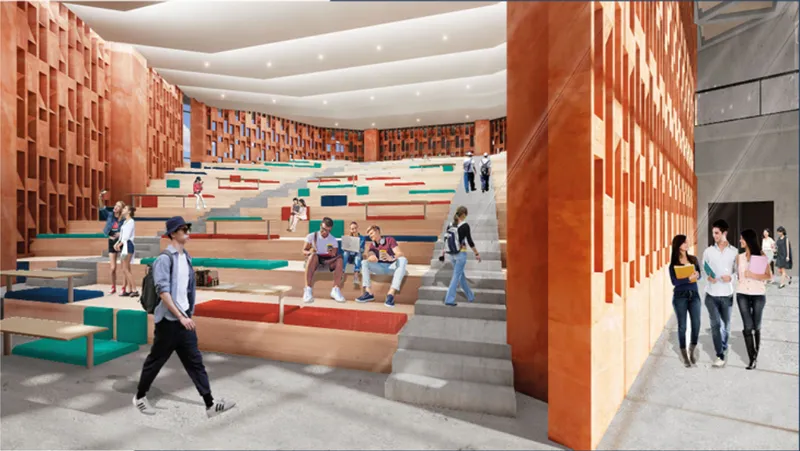
The plan works across three levels of interaction. Social spaces such as auditoriums and plazas hold events and exhibitions. Semi-social spaces such as studios, meeting rooms and collaborative classrooms support group work while keeping some privacy. Personal spaces such as quiet zones, self-study areas and library settings allow focused, individual work. The lounge shows the middle of this range: colorful seating blocks, potted plants and a timber lattice ceiling under skylights, with students reading next to others passing through. It is informal enough to linger in and open enough to stay part of the building's daily flow.
The tiered amphitheater steps carry the idea further. Colored cushions on stepped seating between terracotta perforated walls create a space that can host a lecture, a presentation or a single student working on a laptop. People walking past in the foreground stay visibly connected to whatever is happening on the steps. Paired with the hexagonal modules and sliding partitions, this flexibility means the boundaries between zones are not fixed. They can be redrawn as teaching needs change.
A School Seen From the Passing Train
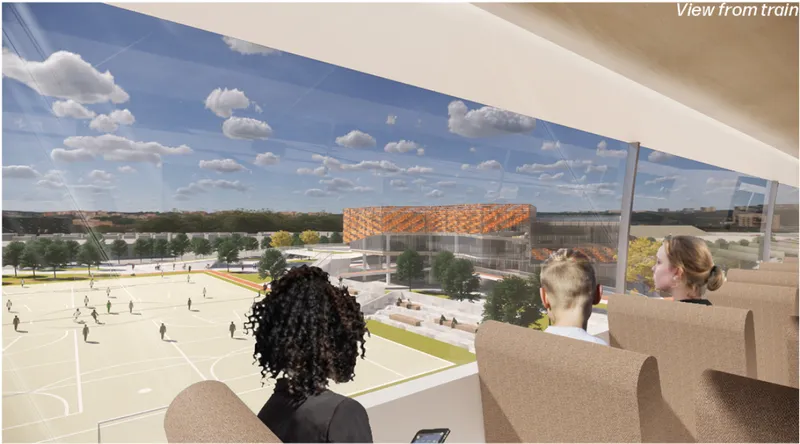
The final view is taken from a train window. It looks across a sports field toward the orange-screened building, with passengers in the foreground. The choice of viewpoint reflects the project's urban ambition. An extended running track and public pathways blur the line between institution and city, and the academy is meant to be read as an active participant in its surroundings rather than a closed campus behind a fence.
From that distance, the terracotta screen does its civic job. It gives the building a recognizable identity in the landscape, while the open field and public routes in front of it suggest that the school's edge is meant to be crossed.
Why This Project Matters
Many proposals for future schools stop at the slogan: flexible, tech-enabled, student-centered. The AI Academy Scarborough gives those words a structure. The hexagonal module sets the unit of change, the sliding partitions set how change happens, and the zoning from social to personal sets its range. Technology appears in the envelope and the systems instead of being presented as a gadget layer, which is a more honest way to build for an AI-driven pedagogy whose tools will keep changing.
The project's strongest move is spatial rather than technological. A central platform that serves as both circulation spine and social condenser, together with an atrium that pulls daylight down through the section, turns the act of moving through the school into part of the education. Whether or not artificial intelligence reshapes teaching in the way the brief imagines, a building that makes learning visible, shared and open to its city will still be useful. That is a sound reason for the Editor's Choice recognition.
View the Full Project
About the Designers
Designer: Jumbo Globe
Enter a Design Competition on uni.xyz
uni.xyz runs architecture and design competitions year-round that reward proposals with spatial conviction and real site intelligence.
Project credits: AI Academy by Jumbo Globe School of Thought 2020 (uni.xyz).


Popular Articles
Popular articles from the community

Faces of the Soviet Avant-Garde: Turning Moscow's Street Names into an Open-Air Museum
A network of sculptural installations across a Moscow residential district transforms forgotten architect names into spatial encounters with cultural memor
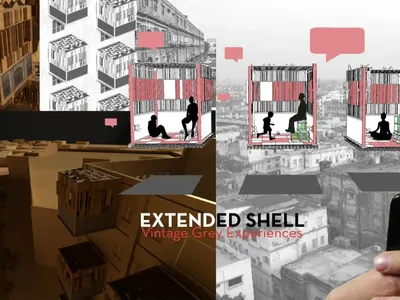
Extended Shell: Retrofitting Kolkata's Balconies as Living Urban Thresholds
A modular retrofit system recovers the social and environmental intelligence of Kolkata's historic verandas for contemporary Park Street residents.

Opera by the Sea Estonia: Three Shells Dissolving Architecture into Tallinn's Coastline
A winning opera house proposal replaces monumental form with interconnected shells that blur the boundary between building, park and Baltic Sea.

Manzana Morphosis: Stretching Barcelona's Grid into a Living Landscape for 2050
A radical reworking of the Eixample manzana turns density into a tool for generous public space, vertical ecology, and environmental performance.

Similar Reads
You might also enjoy these articles

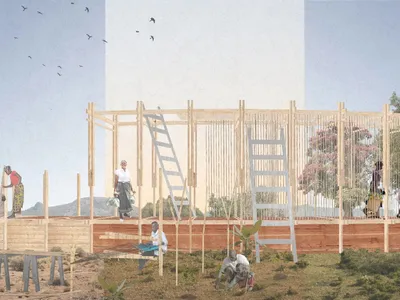
Healing Façade: A Modular Chapel System That Restores Ethiopia's Sacred Forests
Winner of the Eco-Chapel competition, this circular timber façade collects water from air to rebuild soil and reforest degraded Ethiopian landscapes.
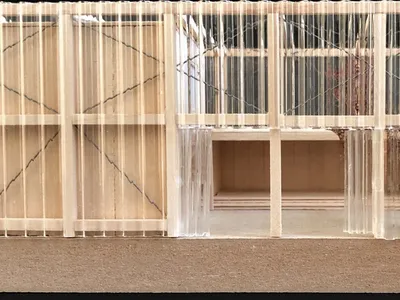
Kaffeebühnen: Where Coffee Shop Architecture Becomes a Civic Stage in Vienna
A linear sequence of timber boxes, transparent shells, and open yards turns the Viennese café tradition into a public performance space.
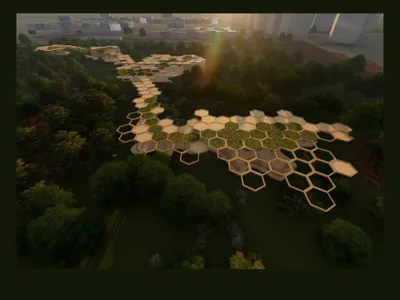
Eco Chapel: A Modular Forest Pavilion That Grows Like the Landscape It Protects
Hexagonal timber modules weave through existing trees, turning a chapel into a living system for prayer, education, and reforestation.


Urban Forest: A Vertical Ecosystem for 5,000 Workers in Singapore's Changi Business Park
Radially stacked pods and layered green decks turn a 7-acre plot into 47 acres of ecological workspace projected for 2040.

Explore Moscow Architectural Academy Competitions
Discover active competitions in this discipline

Challenge to design public laboratory

Challenge to design luxury tourism on rails

Challenge to reimagine the Iron Throne

Photograph architecture without architects
Comments (0)
Please login or sign up to add comments
No comments yet. Be the first to comment!