
Aidlin Darling Design Strips Back Decades of Clutter at Robert Mondavi Winery to Reunite It with the Land
A $200 million transformation in Napa Valley peels away ad hoc additions and rebuilds the campus from its own demolished materials.


Robert Mondavi's winery was never supposed to feel landlocked. When Cliff May drew the original campus in 1966, the white stucco arch and bell tower were meant to frame the To Kalon vineyard, a site whose name translates from Greek as "highest beauty." But decades of piecemeal expansion gradually walled the buildings off from the vines, turning a once-legible estate into a disjointed compound. Aidlin Darling Design, working alongside BAR Architects and landscape firm Surfacedesign, spent three years and more than $200 million undoing that damage. The result, completed in 2026 to coincide with the winery's 60th anniversary, is less a renovation than an act of excavation: stripping back layers to recover the clarity that was always there.
What makes this project remarkable is not its scale, though 215,000 square feet across production, hospitality, and landscape is considerable, but its commitment to reusing the very material it demolished. Concrete rubble from torn-down additions was mixed with local soils to form rammed earth walls. Oak staves from decommissioned fermentation vats became ceiling panels, their surfaces still carrying wine stains from decades of use. Heavy timbers were repurposed as bottle storage. The campus literally rebuilt itself from its own history, a strategy that gives new structures a material continuity with the old ones that no imported finish could replicate.
The Arch Reclaimed

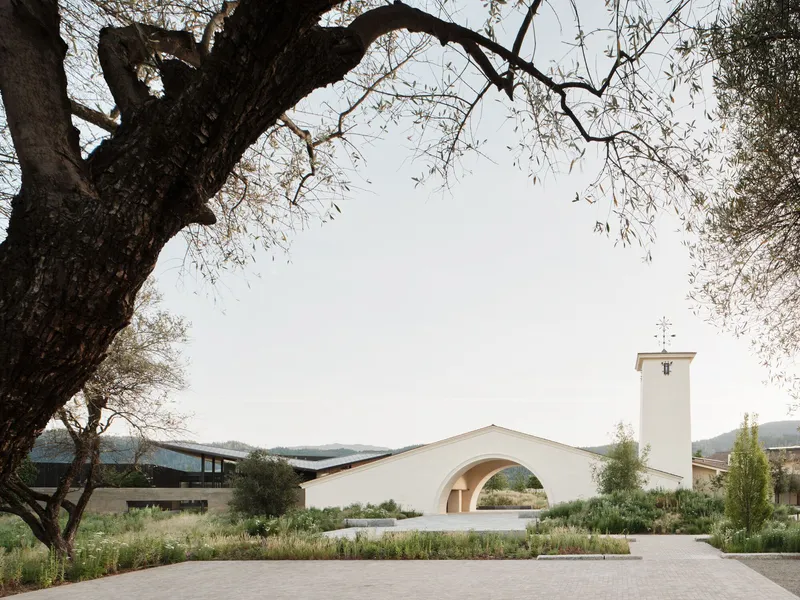
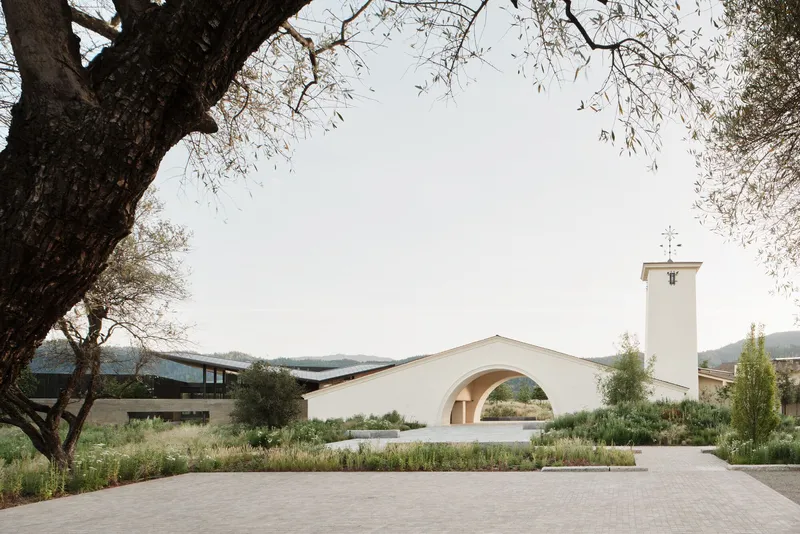
May's original arch and bell tower remain the most recognizable elements of the estate, and Aidlin Darling wisely left them alone as compositional anchors. What changed is everything around them. Thirsty lawns have been replaced with drought-tolerant native grasses and wildflower meadows that press right up to the stucco walls, softening the boundary between architecture and ground plane. The gravel forecourt and mature olive trees frame the arch as a threshold rather than a facade, restoring its intended role as a welcome gesture into the vineyard beyond.
The bell tower now doubles as a wayfinding element and houses the Tower Library, one of three new dedicated tasting spaces. It is a clever reprogramming: the most visible vertical element on a flat valley floor becomes not just symbolic but functional, drawing visitors upward into a room where wine and landscape are experienced together.
Rammed Earth and Salvaged Oak
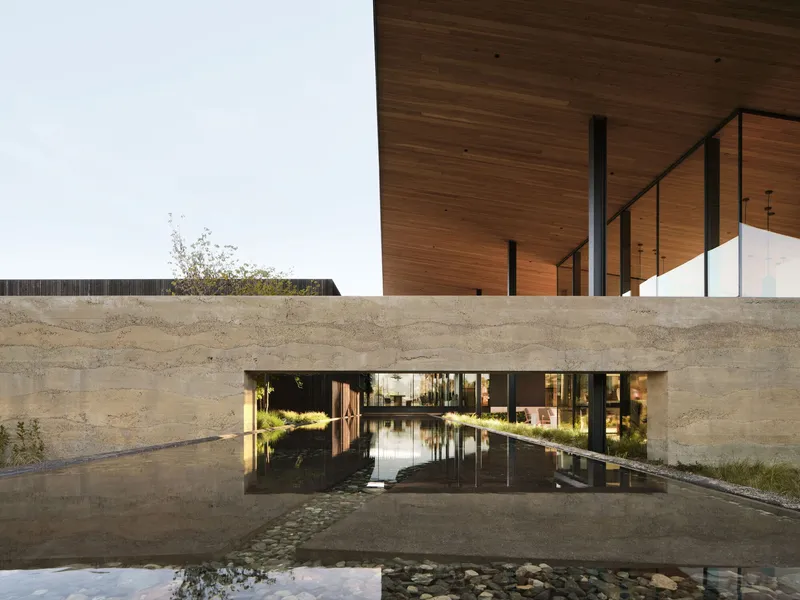
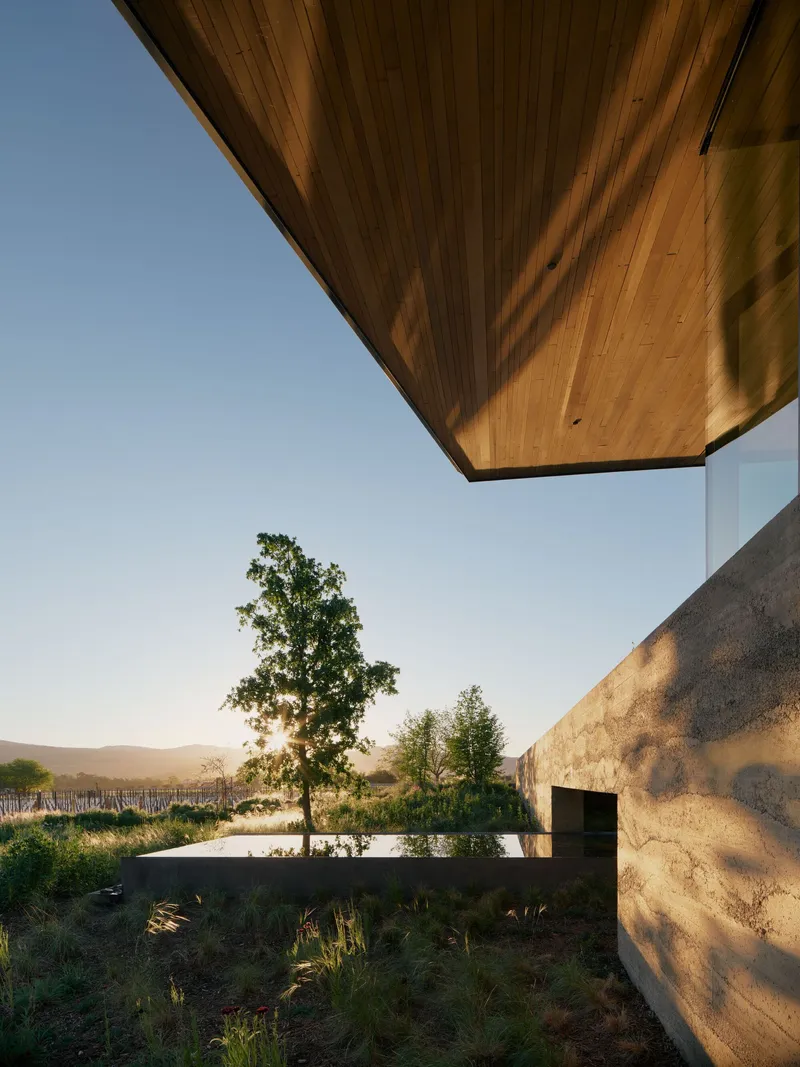
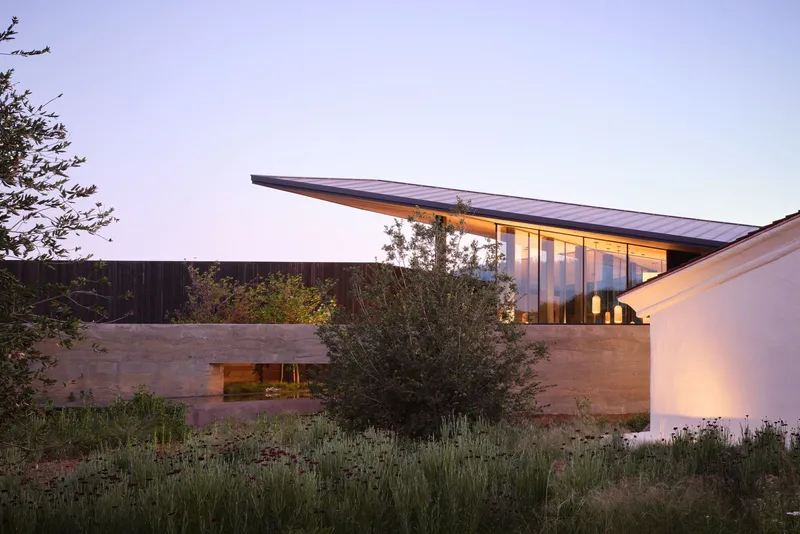
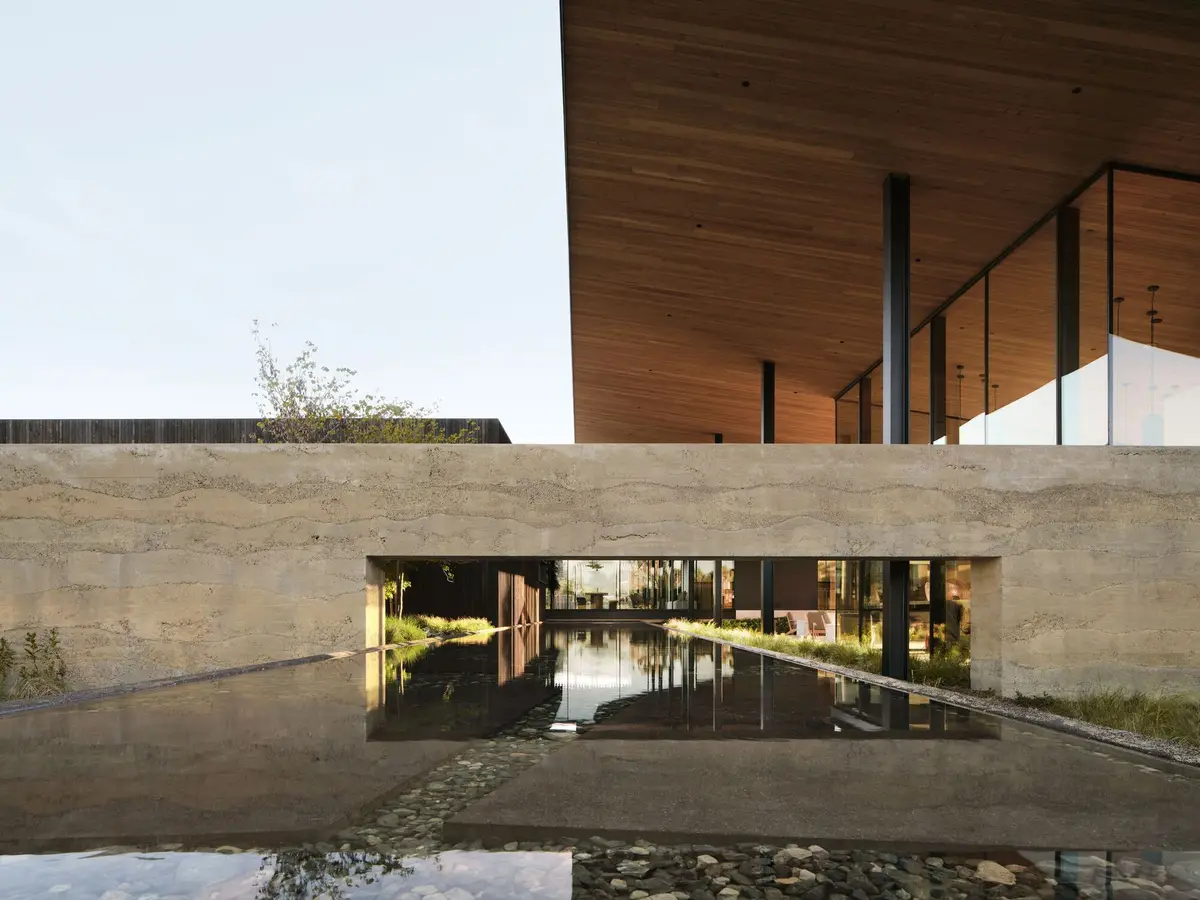
The material strategy is the project's strongest argument. Rammed earth walls, composed of local soil and crushed concrete from the demolished additions, carry a striated texture that reads as geological rather than architectural. These walls anchor the new hospitality wing, grounding it visually against the valley floor. Where they meet water, as in the reflecting pool that runs beneath a timber soffit, the effect is almost primordial: earth, water, and the fading warmth of evening light.
Above, ceiling planes are lined with staves from old oak fermentation vats salvaged from the To Kalon cellar. The wine-stained grain is left exposed, a deliberate refusal to sanitize the building's past. Adobe plaster walls complement the palette. Nothing here pretends to be new; everything insists on its own biography.
The Timber Canopy and Its Mountain Echo

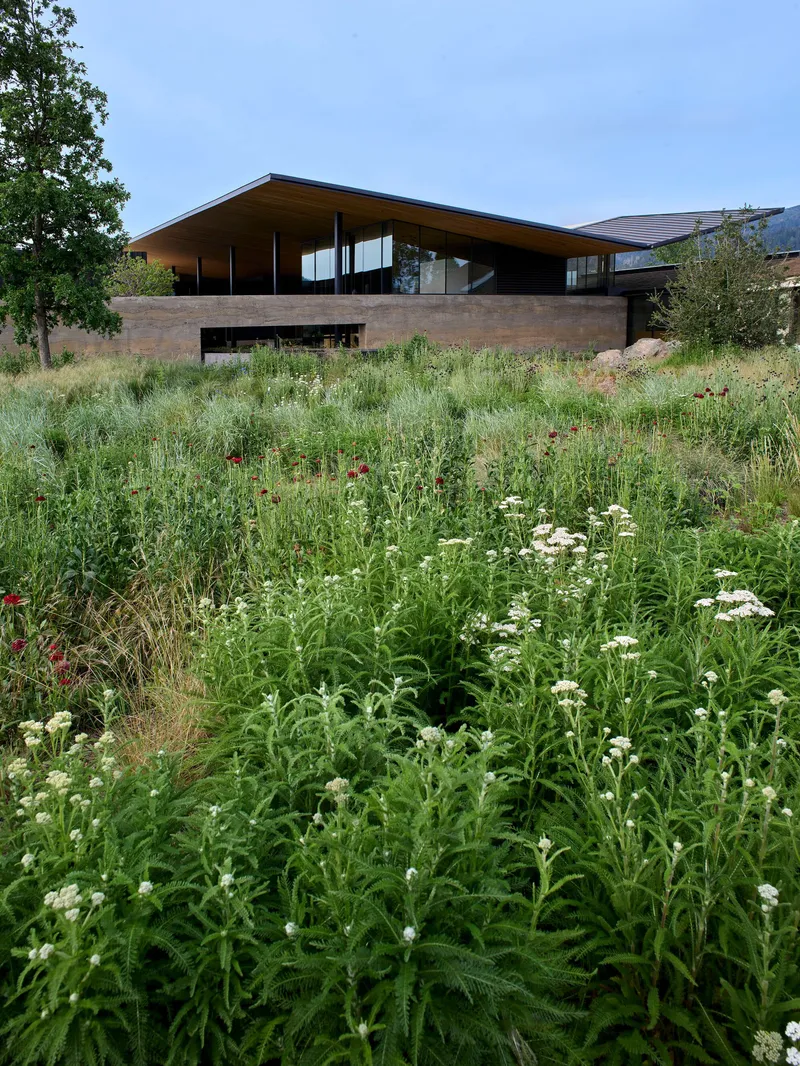

Two new gabled structures stretch outward from the arch, one housing production to the north and one hospitality to the south. Their inverted gabled rooflines perform double duty: formally, they echo the ridgeline of the Mayacamas mountains visible in every long view from the estate; functionally, the inverted profile collects rainwater, feeding it back into the campus's advanced wastewater treatment system. The architectural language makes cycles of water collection and renewal legible, turning infrastructure into expression.
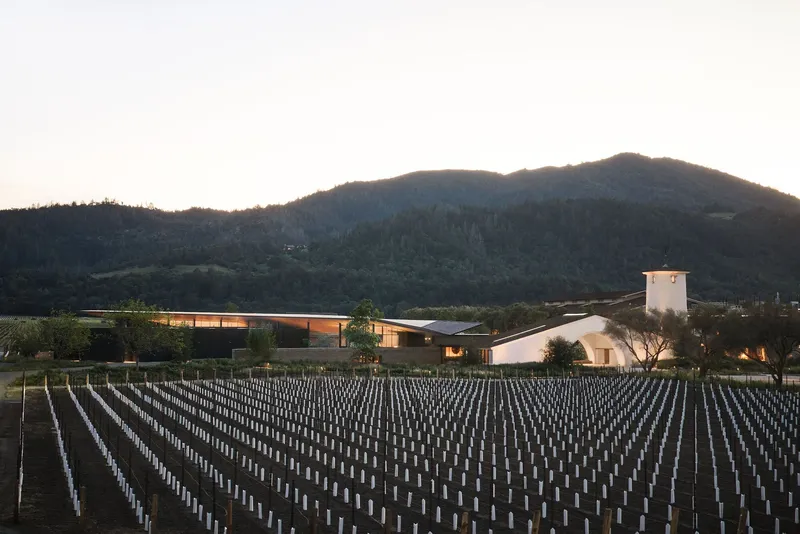
Seen from the vineyard, the low pavilions sit quietly against the forested hills, their cantilevered timber soffits hovering above meadow plantings. The restraint is deliberate. In a valley crowded with more than 400 wineries and tasting rooms, many competing for visual attention, Mondavi's new silhouette chooses to recede, letting the landscape assert itself.
Covered Terraces as Connective Tissue
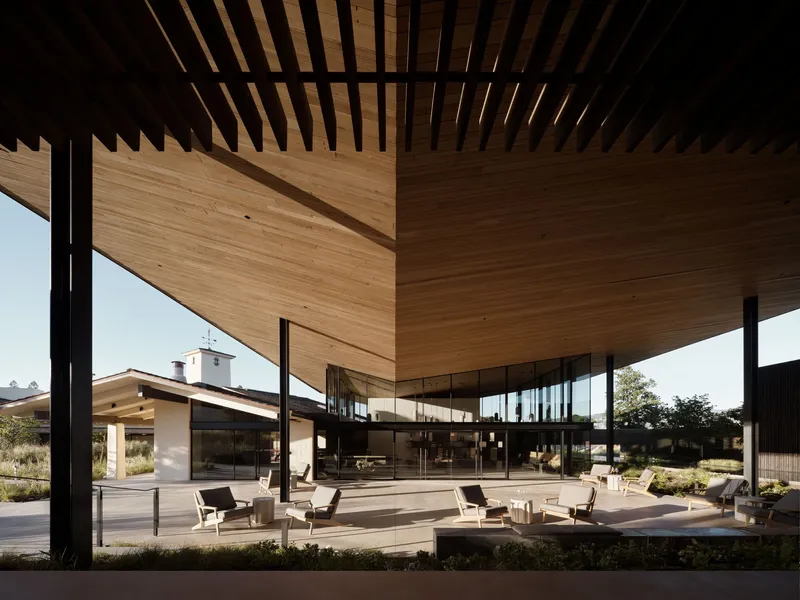


The covered terraces are the social spine of the new campus. Slender black steel columns support deep timber ceilings that shade the transition between interior tasting rooms and planted courtyards. These are not corridors; they are rooms without walls, furnished with long benches and framed views of the bell tower, the reflecting pool, and the vineyard beyond. Guests pass through them en route to a reception bar, a retail gallery, and a sequence of courtyards, each one calibrated to a different degree of intimacy.
The detailing is consistent and unfussy. Vertical slatted screens filter light without blocking it. Cylindrical pendant fixtures drop from the timber ceiling like lanterns. The proportions favor the horizontal, keeping sightlines open to the landscape at every turn. It is hospitality architecture that refuses to compete with what it is showing you.
Interior Rooms Rooted in Place
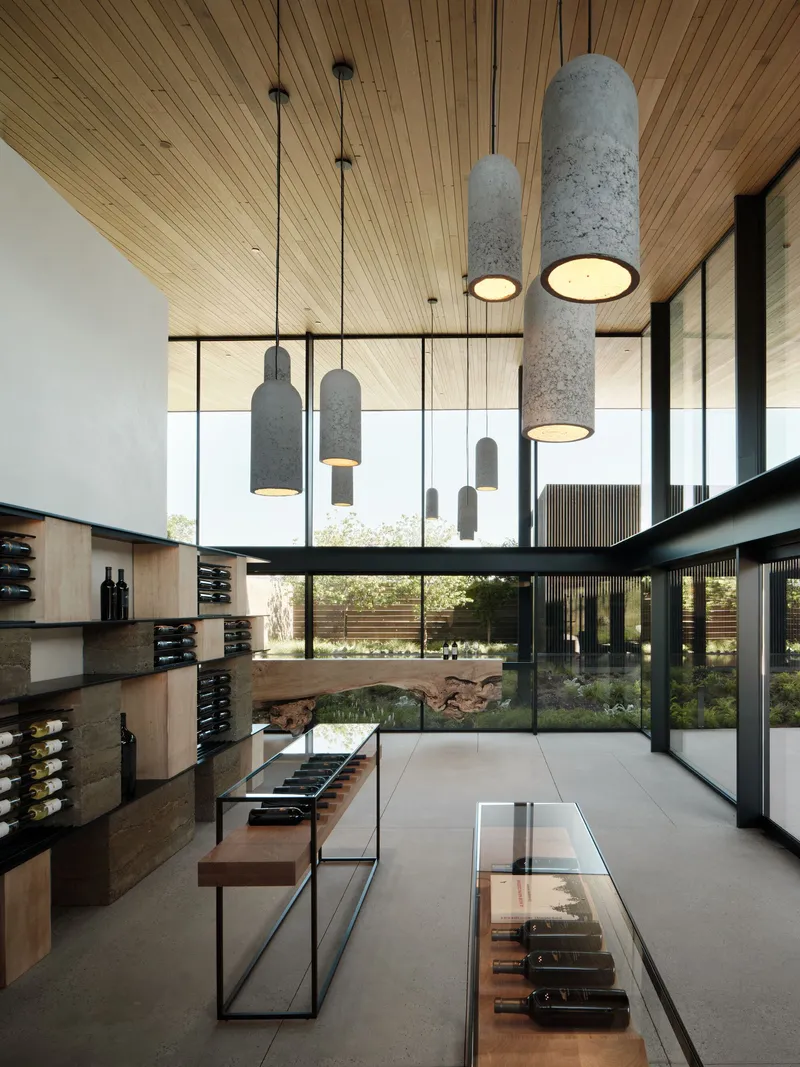
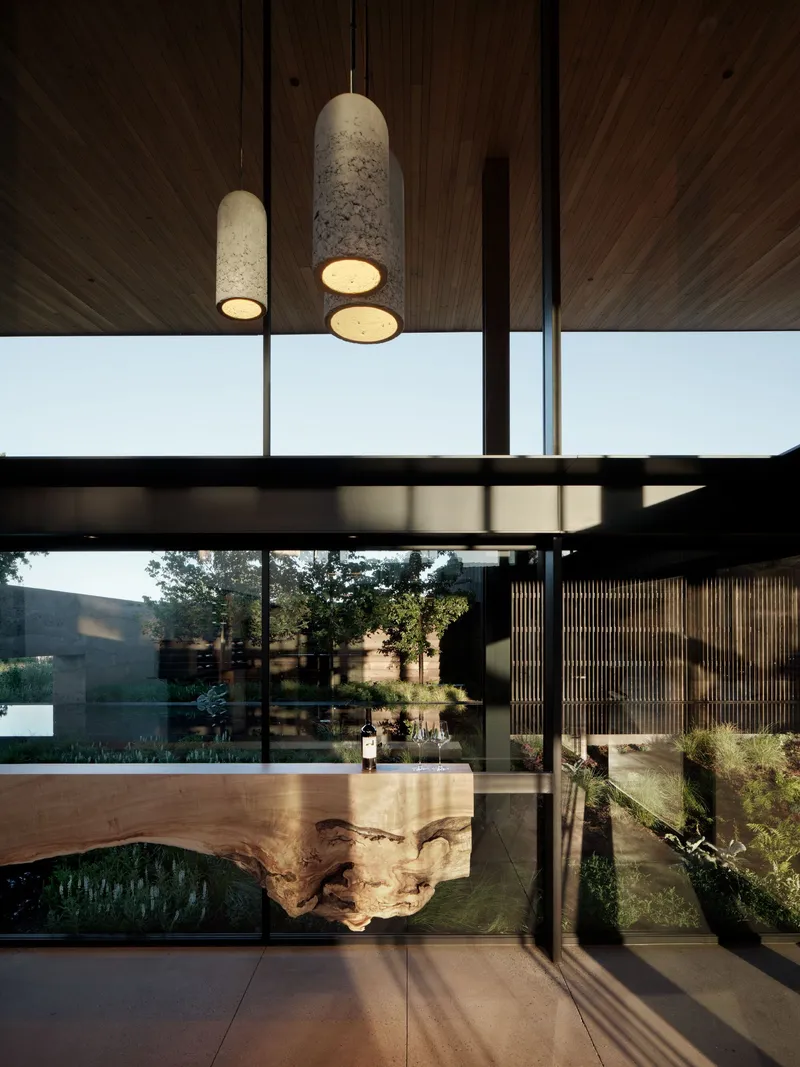
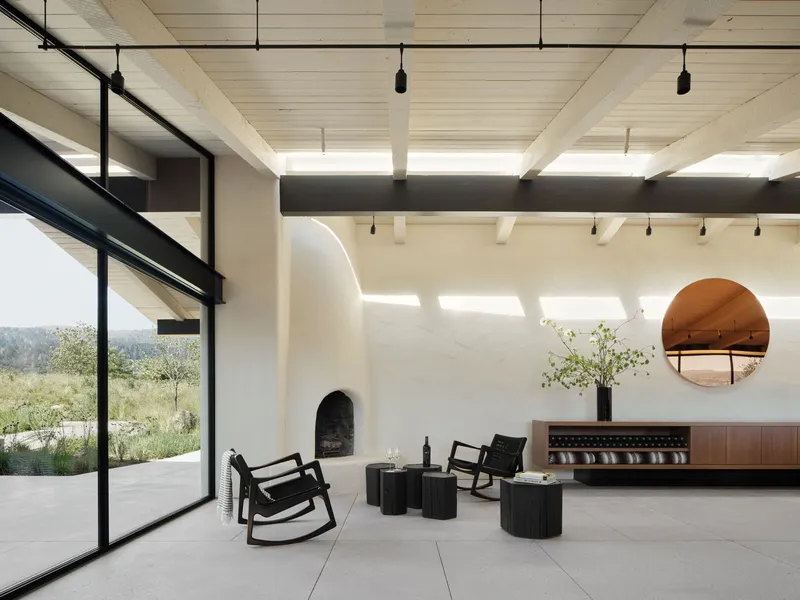
BAMO's interior furnishings reinforce the material logic established by Aidlin Darling. Live-edge wood dining tables sit beneath cylindrical stone pendant fixtures that recall wine barrels abstracted into geometry. Exposed timber ceiling beams run continuously from interior to exterior, erasing the threshold. In the double-height tasting space, tall glazing opens directly onto the courtyard garden, collapsing the distance between a glass of To Kalon Cabernet and the vines that produced it.
One room features an arched fireplace set into an adobe wall with floor-to-ceiling windows on either side, a composition that nods to May's original mission-style vocabulary without mimicking it. The interiors feel specific to this place and this program. They do not trade in generic luxury; they trade in legibility, making the relationship between land, vine, and glass the central narrative of every room.
Water, Landscape, and the Long View
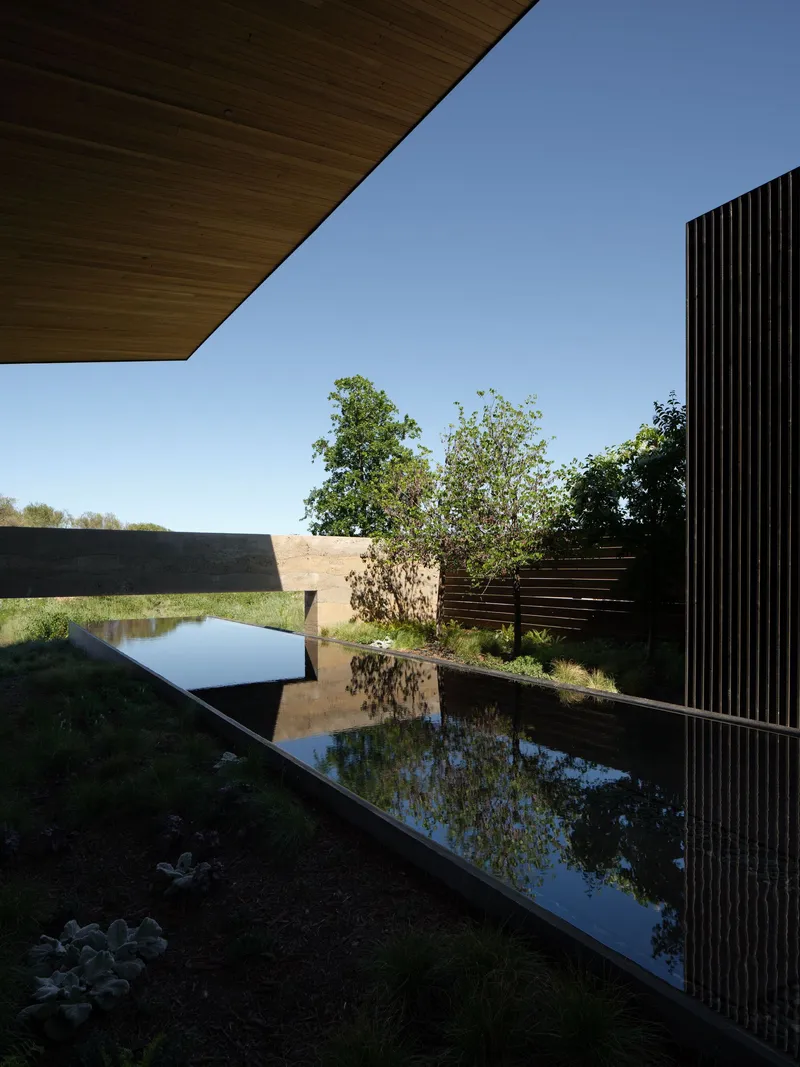
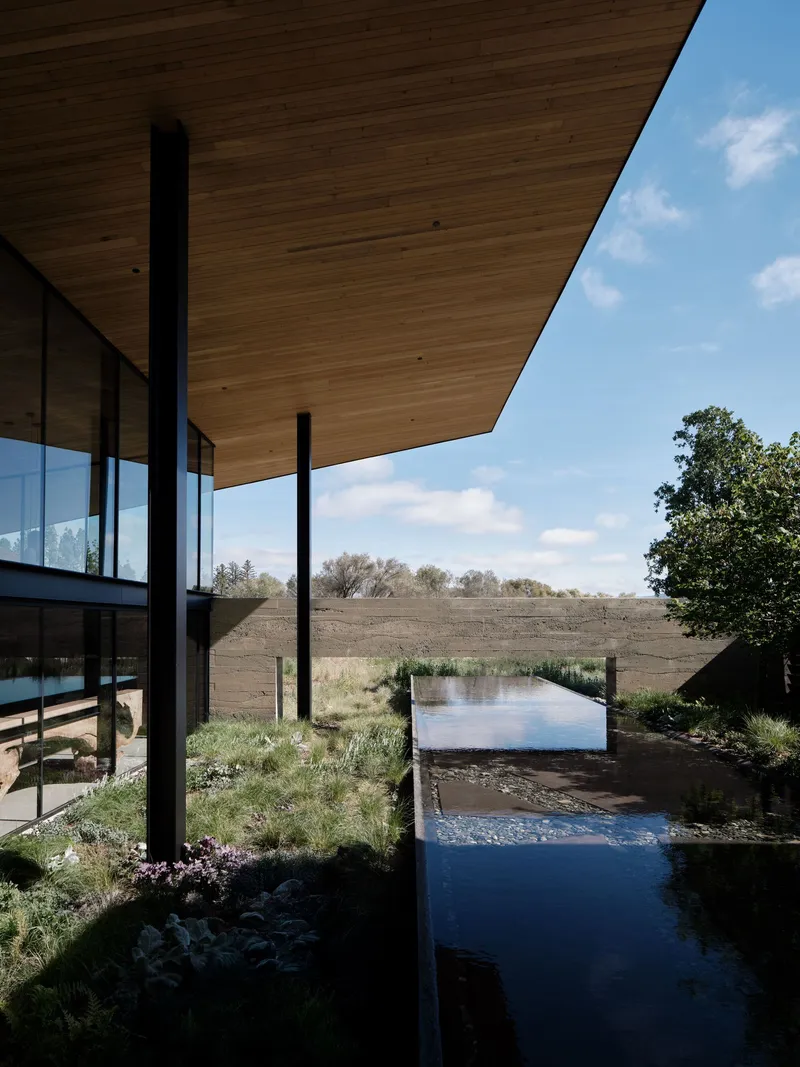
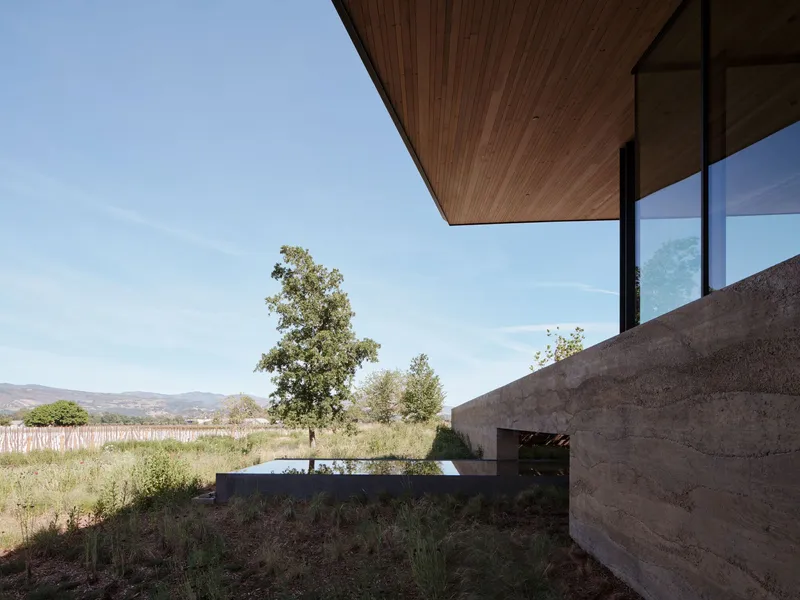
Water is used as both material and metaphor. Narrow channels and reflecting pools trace the edges of buildings, their surfaces catching the timber soffits above and the sky beyond. Concrete salvaged from paving around the arch was reused in a water feature, closing yet another material loop. Surfacedesign's landscape strategy extends the logic beyond the building footprint, replacing ornamental planting with native grasses and drought-tolerant species that restore soil vitality rather than deplete it.
The cantilever at the campus's southern edge delivers the defining moment: a deep timber overhang above a board-formed concrete retaining wall, framing a panoramic view across the vineyard to the distant hills. It is the kind of view that has always been here, 180 hectares of vines stretching toward the Mayacamas. The architecture's job is simply to stop, step aside, and let you look.
Plans and Drawings

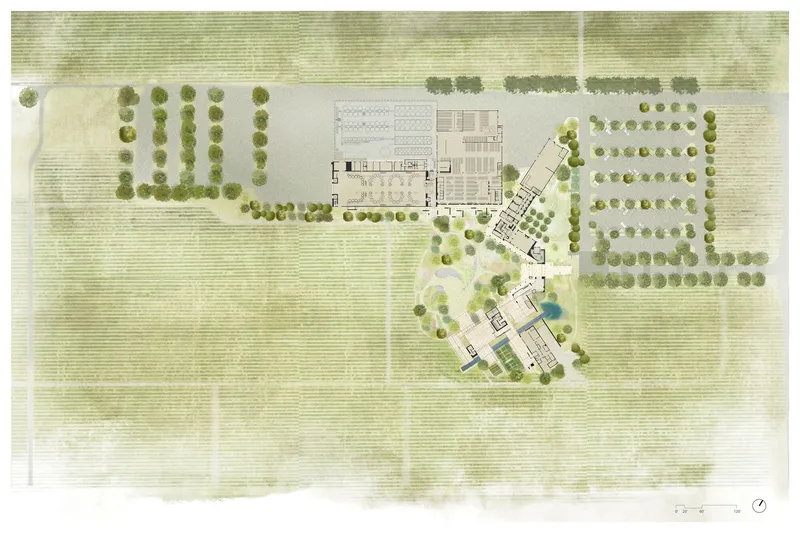
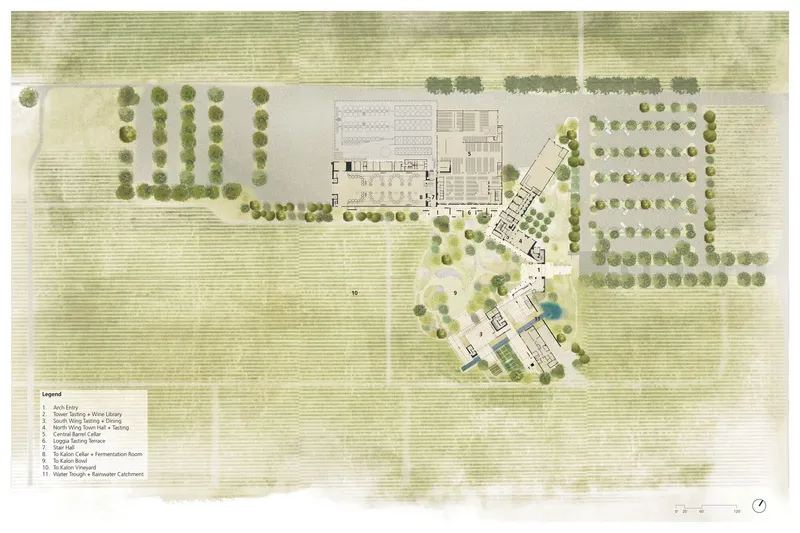
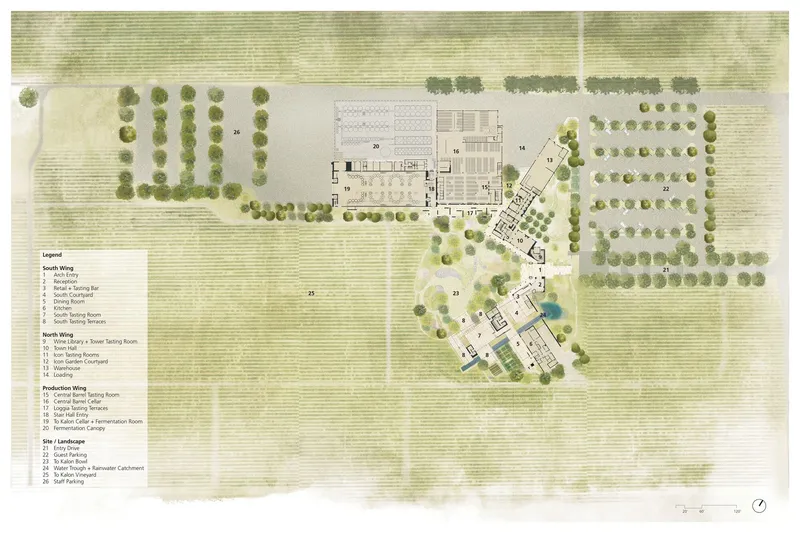
The site plans reveal how the campus is organized around three angled wings that splay outward from the arch, each oriented to engage a different segment of the surrounding vineyard and orchard grid. Production sits to the north; hospitality stretches south; between them, courtyards and planted zones create a porous, walkable sequence. The numbered room key on the final drawing makes the programmatic density clear: tasting rooms, winemaker studios, interactive production areas, and the reimagined To Kalon Bowl amphitheater are all threaded together by landscape rather than corridor. Rows of trees and orchard plantings blur the edge of the architectural footprint, reinforcing the premise that the buildings are guests on agricultural land, not the other way around.
Why This Project Matters
Napa Valley winery architecture has long oscillated between two poles: the understated barn vernacular and the imported spectacle. Mondavi's transformation charts a third path, one rooted in subtraction and material honesty. By demolishing the accretions of decades and rebuilding from their rubble, Aidlin Darling makes a case that the most compelling new architecture can be the one that refuses to import anything it does not need. The strategy is environmentally responsible, yes, but more importantly it is narratively coherent. Every wall, ceiling, and water channel tells a story about what was here before and what the land demands next.
The project also offers a lesson in institutional self-awareness. The original Cliff May campus was a statement about California modernism meeting the wine industry. Sixty years and $200 million later, the statement has shifted: architecture's role is not to announce the brand but to disappear into the landscape that gives the brand its meaning. In a valley saturated with tasting rooms, the most radical thing Mondavi could do was build something that gets out of the way. That is exactly what Aidlin Darling has done, and the result is one of the most thoughtful pieces of hospitality architecture in recent American practice.
Robert Mondavi Winery Transformation, designed by Aidlin Darling Design with BAR Architects, BAMO (interiors), and Surfacedesign (landscape). Napa Valley, California, United States. 215,000 square feet. Completed 2026. Photography by Marion Brenner and Adam Rouse.
About the Studio
Share Your Own Work on uni.xyz
If projects like this are the kind of work you want to make, uni.xyz is a place to publish your own, find collaborators, and enter design competitions.


Popular Articles
Popular articles from the community


David Ortega Stacks a Two-Story Mexico City Penthouse Around a Steel Stair and a Pergola-Shaded Roof Terrace
In Colonia Roma, a 300 m² penthouse uses oak joinery, a planted steel stair and a slatted roof pergola to make a new-build apartment feel like a house.


Opera on the Sea: Driftwood Logic Shapes a Timber Opera House on Estonia's Coast
Trevor Orgill's opera house translates the entangled drift of floating timber into a civic building where wood, water, and music converge.

graciastudio Turns a Viewless Tijuana Lot Inward Around a Courtyard of Concrete, Timber and Trees
In Tijuana, Jorge Gracia's GA2 House stacks a timber-clad private floor over exposed concrete and replaces a missing view with a planted interior patio.

Aquadapt: An Underwater Habitat That Rewrites Its Rooms by the Hour
Curved modules ring the seabed while one shell shifts from breakfast room to cinema, farm and football pitch as residents' needs change.

Similar Reads
You might also enjoy these articles

LAVA Architecten Gives Vocational Education a Sawtooth-Roofed Face on a Mechelen School Campus
In Mechelen, Belgium, a 2,053 m² STEM school on a 6×6 m grid turns workshops and classrooms into rooms that can be rearranged as teaching changes.

KEMA Studio Turns a Derelict Marvila Attic into a 60 m² Lighthouse Apartment Above Lisbon
In Lisbon's Marvila district, a rebuilt roof, four skylights and two plywood volumes turn an unlivable attic into a bright home facing the Tagus.

Pixel Gardens: One Repeated Module Stacked Into a Terraced Social Housing Tower for Famagusta
Salem Bader's shortlisted housing tower builds a vertical neighbourhood from one repeated module, offsetting units to carve terraces, light and air.

Bao Huynh Watercolor Atelier: A Serene Art Retreat in Hội An
Bao Huynh Watercolor Atelier in Hội An blends multifunctional art spaces, sustainable design, local materials, and family-friendly living in a serene environment.


Comments (0)
Please login or sign up to add comments
No comments yet. Be the first to comment!