
3mas1 Arquitectura Lifts a Caribbean Hotel on Stilts Between Jungle and Sea
Aimarawa San Antero Hotel rises on pilotis above Colombia's Gulf of Morrosquillo, stitching beach to jungle with local craft and climate-smart design.


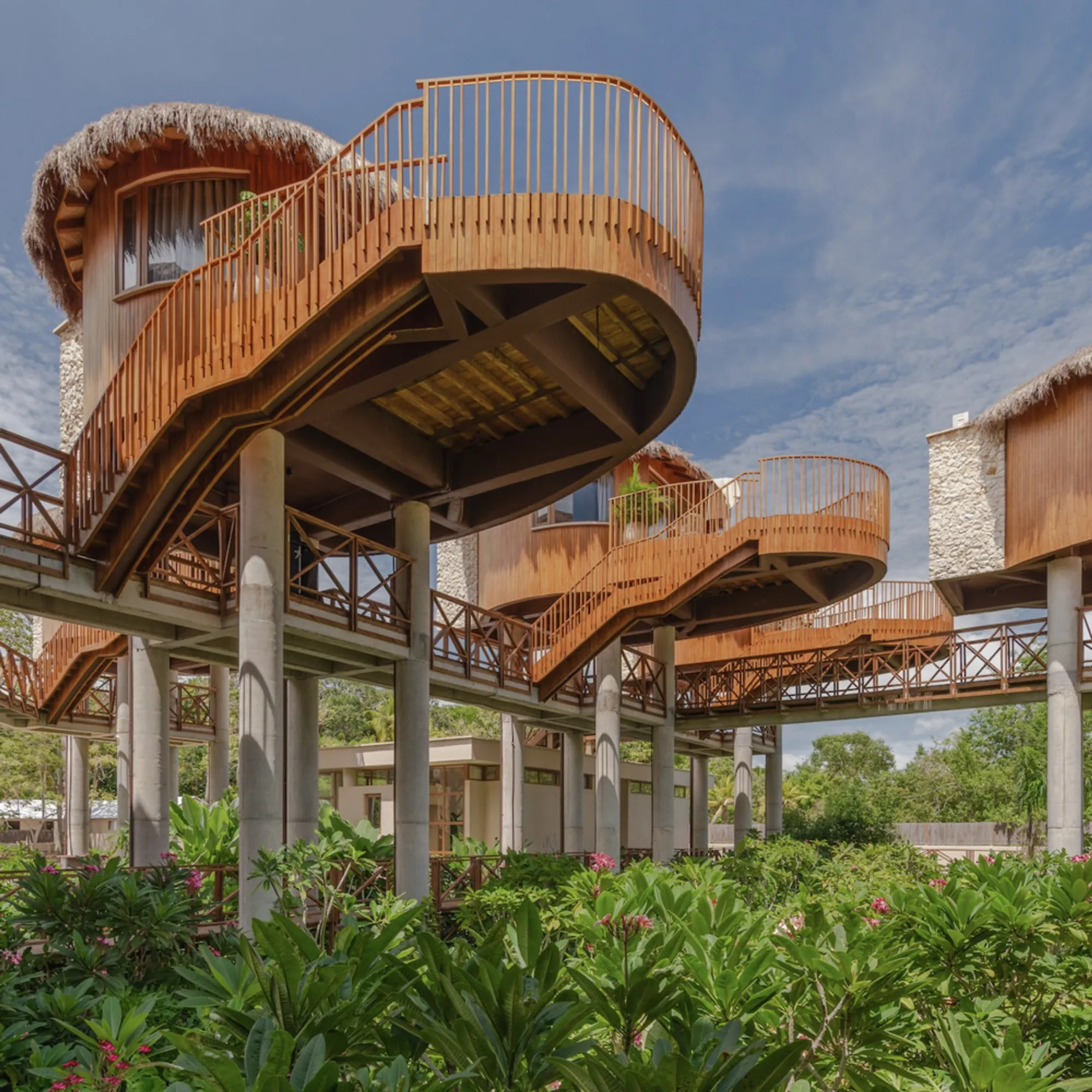
On a narrow beachfront plot at Punta Bolívar, where 63 meters of Caribbean shoreline run up against 137 meters of dense coastal jungle, 3mas1 Arquitectura had to answer a deceptively simple question: how do you build luxury hospitality on a climate-vulnerable coast without erasing the landscape that makes it worth visiting? Their answer at Aimarawa San Antero Hotel is a 5,708 square meter ensemble of thatched, stilted volumes that step upward toward the sea, treating the ground plane not as a foundation to pour concrete onto but as a garden to preserve.
What makes this project genuinely interesting is not the palm roofs or the infinity pool, both of which are standard issue in Caribbean resort architecture. It is the sectional logic. The buildings are organized in perpendicular strips that rise progressively as they approach the water, so that eight bungalows in the third line clear ten meters in height to see over the family cabins ahead of them. Beneath all of it, a continuous landscape threads from the jungle at the rear of the site to the beach at its front. The hotel sits in the canopy, not on the ground.
Circular Volumes on Concrete Pilotis
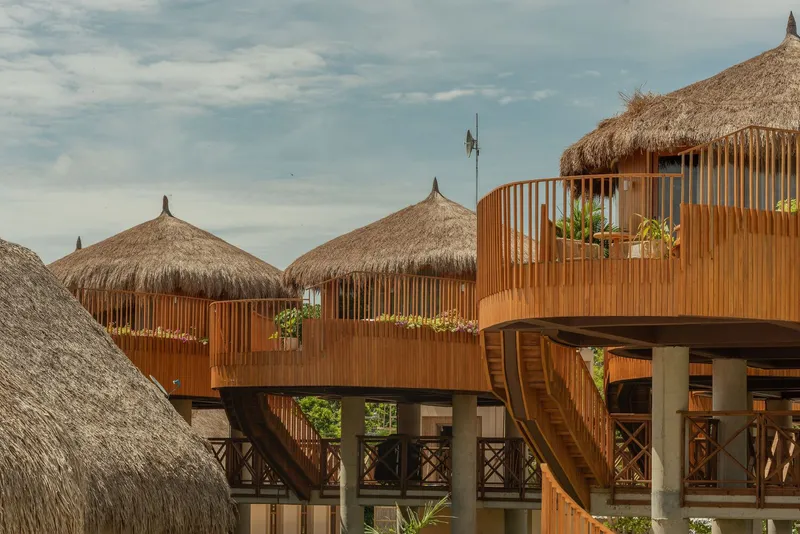
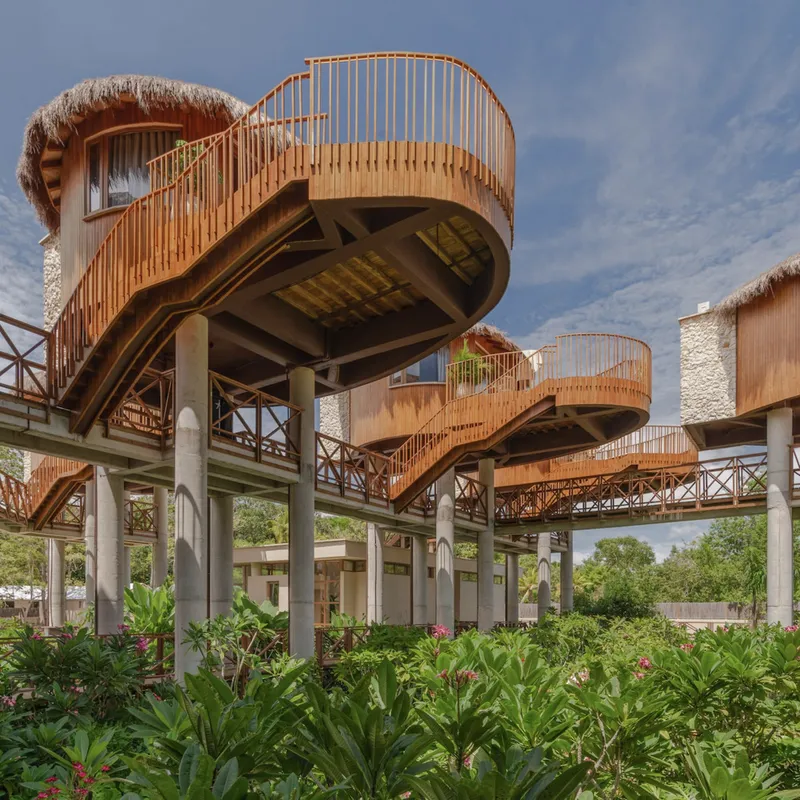
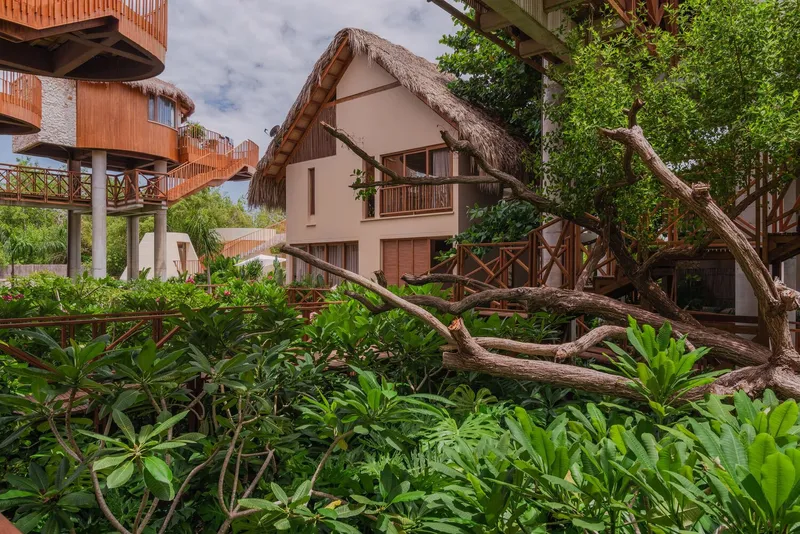
The bungalows read as a small village of circular drums, each clad in vertical timber slats and capped with thatched palm roofs. They sit on concrete pilotis that do double duty: they protect against flooding and rising sea levels while lifting the guest rooms into the breeze. The geometry is deliberate. Circular plans maximize perimeter for ventilation and views relative to floor area, and they avoid the corners where wind loads concentrate, a practical consideration on a coast that faces Caribbean storms.
Below the stilts, flowering shrubs and native planting fill what would otherwise be dead space. This is more than decoration. The gardens form a continuous ecological corridor between beach and jungle, allowing the site to function as habitat rather than hardscape. The concrete columns are left exposed and unadorned, providing a visual anchor that contrasts with the organic textures above.
Open-Plan Interiors That Breathe
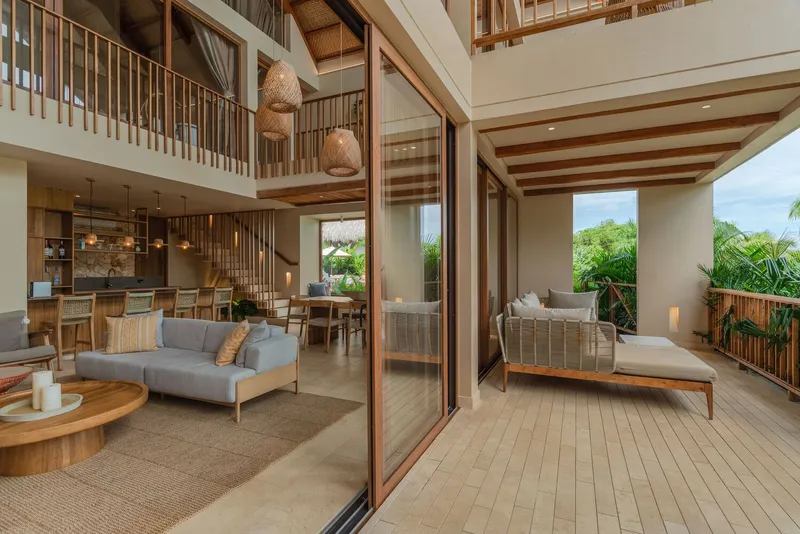
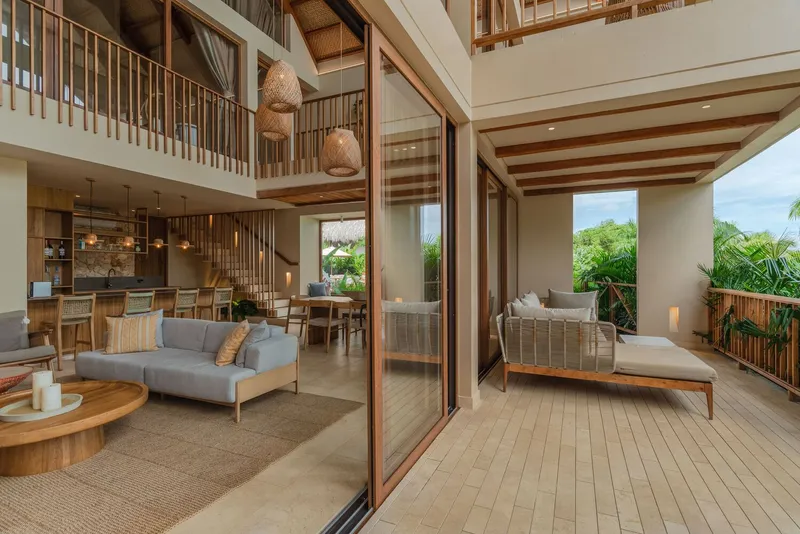
Inside the bungalows, the strategy is straightforward: remove every wall that does not need to be there. Sliding glass doors span entire facades, turning rooms into covered terraces when opened. Timber-beamed ceilings rise to the peak of the thatched roofs, and the double-height sections in the suites create a stack effect that pulls warm air upward and draws cooler air in from the shaded exterior decks. In a climate this humid, passive ventilation is not a luxury; it is the difference between comfort and air-conditioning dependency.
Vertical timber screens filter direct sunlight while preserving sightlines to the palms outside. The material palette, wood, concrete, woven palm, repeats at every scale from structural frame to furniture, giving the interiors a coherence that feels earned rather than styled. All materials were sourced locally, and local artisans fabricated the railings and screens by hand, embedding regional craft traditions into the building's DNA.
Ground-Level Landscape and Social Spaces
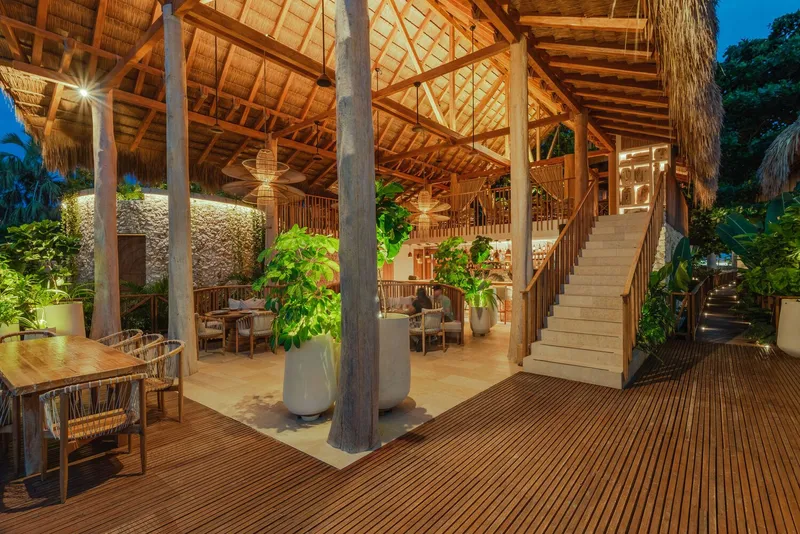
The communal program occupies the front strips closest to the water. A breakwater provides unobstructed views across the Gulf of Morrosquillo, and immediately behind it sit the pool area and bar. The open-air dining pavilion, with its thatched roof and concrete columns, reads as the social heart of the hotel: a generous, airy room that blurs the line between indoor and outdoor dining. At dusk, the timber decking glows warm against the cooling sky, and the absence of enclosing walls means guests are never more than a glance away from the sea.
The first-line pavilion with its gnarled tree branches and tropical planting introduces a deliberately untamed aesthetic. Rather than clearing the site to a manicured blank, 3mas1 worked around existing vegetation, integrating mature trees into the architecture. The artisanal timber railings reinforce the handmade character of the project, each one slightly different from the next.
Climate Strategy as Organizing Principle
The strip-based master plan is fundamentally a climate adaptation strategy. By organizing the hotel into parallel bands perpendicular to the beach, each strip can be independently elevated to its required height, allowing the entire ensemble to step up toward the sea without creating a single monolithic barrier. Wind moves freely between the buildings. Water drains through the planted ground plane beneath them. And if sea levels rise further, the pilotis provide a buffer that a slab-on-grade hotel simply cannot.
The water system underscores the point. Aimarawa converts seawater to potable water on site, avoiding any draw on local aquifers. For a coastal community where freshwater access is already precarious, this is not a marketing bullet point; it is an ethical obligation. The hotel also provides employment for the surrounding community, a region the architects describe as income-deprived, turning the project into an economic anchor as well as an architectural one.
Why This Project Matters
Resort architecture on vulnerable coastlines tends to fall into two camps: heavy concrete boxes that ignore the climate, or flimsy eco-chic structures that ignore the sea. Aimarawa San Antero avoids both traps by treating climate resilience and regional craft as the same design problem. The stilts, the strips, the thatched roofs, and the local timber are not aesthetic choices layered onto a standard hotel plan. They are the plan, derived from the specific conditions of a 63 meter Caribbean beachfront that floods, heats, and blows.
3mas1 Arquitectura has produced a project that is specific to its place in a way that most resort hotels are not. The sectional strategy, the community employment model, and the desalination system all point toward a hospitality architecture that takes its environmental claims seriously. Whether the industry follows is another question. But at Punta Bolívar, the argument is built and standing ten meters above the sand.
Aimarawa San Antero Hotel by 3mas1 Arquitectura. San Antero, Córdoba, Colombia. 5,708 m². Landscape consultant: Greenfield.
About the Studio
Share Your Own Work on uni.xyz
If projects like this are the kind of work you want to make, uni.xyz is a place to publish your own, find collaborators, and enter design competitions.




Popular Articles
Popular articles from the community


The Earth Pod: 3D Printed Homes for Resilient Refugee Communities
The Earth Pod reimagines refugee housing through 3D printed homes made from clay, combining resilience, self-sufficiency, and rapid shelter.

Hill & Cross Opera: Sculptural Opera House Architecture Shaped by Tallinn’s Landscape and Identity
Hill & Cross Opera reimagines opera house architecture in Tallinn through its sculptural hill, civic plaza, glass wave and a luminous cross.

Lunar Spiral: Space Architecture Shaped by the Mathematics of the Universe
Lunar Spiral reimagines space architecture through Fibonacci geometry, lunar regolith, levitating habitats, and self-sustaining Moon living.

Riyadh For All: Intergenerational Urban Design for Active Aging in Rabat
Riyadh For All reimagines urban design in Rabat with intergenerational co-living, adaptive courtyards, and Moroccan cultural exchange today.


Similar Reads
You might also enjoy these articles


Hodi-Mandai Geram
Project Function: Preservation and revitalization of the Intangible heritage and socio-spatial identity of the Hodi by Housing, Cultural Memory Center, Sacred Grove, landscape, local tourism economy


Olio Towers: A Mid-Rise for Performers That Fuses Housing, Rehearsal, and Stage
Located blocks from Houston's Theater District, this modular tower stacks living units around a central performance atrium.

Oasis: Modular Green Housing Carved into Dhaka's Urban Fabric
A shortlisted Plugin Housing entry reclaims unauthorized settlements in Dhaka with stepped concrete volumes, green roofs, and ventilation-driven design.

Black Hole: A Floating Megastructure for the Post-Physical Era
Emiliano Mazzarotto envisions a spherical, self-scaling arena where e-sports, digital hotels, and holographic stadiums replace traditional public space.


Explore Residential Building Competitions
Discover active competitions in this discipline


Challenge to design mud housing for contemporary communities


Challenge to reimagine the Iron Throne


Photograph architecture without architects


Illustrate the lost glory of Angkor Wat - Render Challenge
Comments (0)
Please login or sign up to add comments
No comments yet. Be the first to comment!