

MUA Architecture Splits a Georgian Village House into Three Concrete Blocks That Follow the Land
In the village of Akhaldaba, a 400-square-meter residence fragments its program across shifting volumes to hold onto a ravine landscape.


Most houses on difficult terrain pick a side: either they terrace obediently along the contour lines, or they plant a flat slab on stilts and pretend the slope doesn't exist. The Akhaldaba Private House, designed by Tbilisi-based MUA Architecture & Placemaking for a site in rural Georgia, does neither. It breaks its 400 square meters into three interlocking volumes, each rotated slightly off-axis from the next, so that the building follows the curvature of the hillside without ever mimicking it. The result is a house that reads as a single composition from the road but, up close, reveals a sequence of semi-enclosed outdoor rooms carved out by the gaps between blocks.
Completed in 2023, the project sits in the village of Akhaldaba, a settlement defined by ravines, autumn-colored tree canopies, and a terrain that punishes orthogonal thinking. MUA's response was to let the program dictate form: daytime living areas occupy one block, bedrooms split across two floors in another, and a rooftop pool and terrace cap the common volume, reachable from inside or from an external stair rising through the garden. The shifts between blocks generate views toward the road and ravine while keeping the site nearly intact, a rare gesture of restraint in a context where excavation is the default.
Board-Formed Concrete and Chartreuse Trim
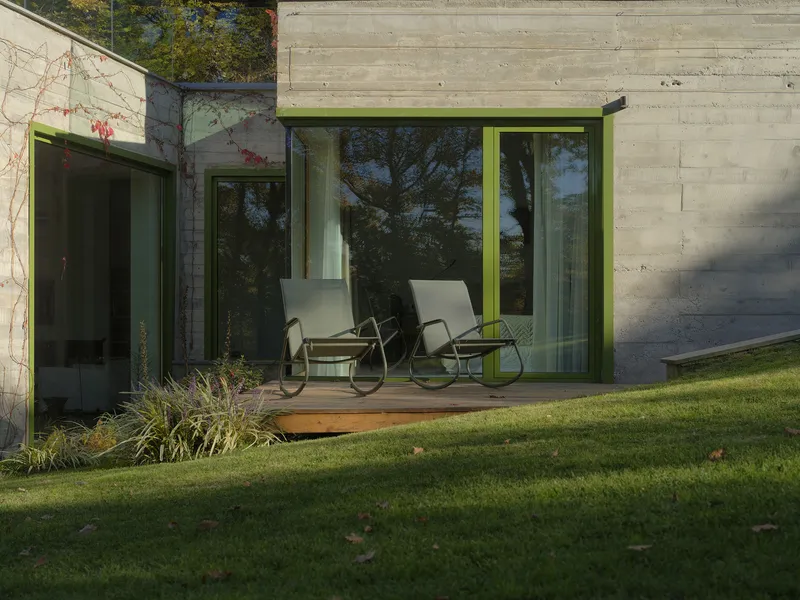
The exterior is unambiguous about its material: rough, board-formed concrete that acts as both structure and skin. Load-bearing concrete walls form the perimeter, eliminating the need for a secondary cladding system and giving the facade a blunt, geological quality that pairs well with the forested hillside. The concrete's texture is coarse enough to catch light at oblique angles, which softens what could otherwise be a monolithic mass.
What saves the palette from severity is the chartreuse-green aluminum framing every window and door. It is a bold, slightly unexpected choice, one that picks up the color of moss and new leaves rather than competing with the autumn palette. At dusk, the green trim glows against the warm light spilling from inside, turning the facade into something closer to a lantern than a bunker. MUA has also planned for climbing plants to colonize sections of the exterior over time, which means the building's relationship with its context is designed to deepen rather than remain static.
A Cantilevered Volume on Pilotis
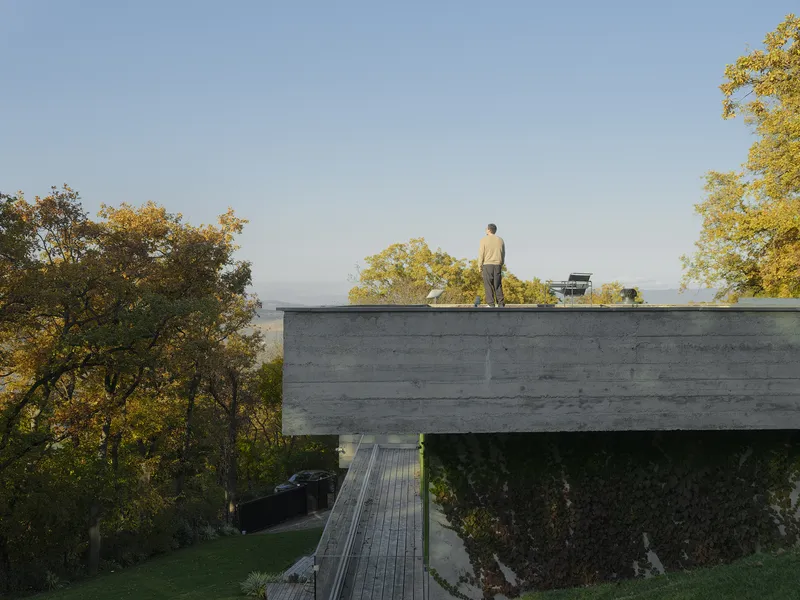
The most structurally assertive moment comes where one of the three blocks lifts off the ground on slender pilotis, cantilevering toward the ravine. A figure standing on the roof terrace above gives the image scale, and it is generous: the overhang is long enough to shelter a usable ground-level space beneath while projecting toward the treeline as if reaching for a better view. The pilotis keep the building's footprint light on the slope, allowing rainwater and grade changes to pass underneath without regrading.
Structurally, the concrete walls do the heavy lifting around the perimeter, but this cantilevered section suggests MUA introduced steel or reinforced concrete framing where the spans demanded it. The interplay between grounded mass and lifted volume gives the composition a tectonic tension that the three-block plan alone would not produce.
Living Spaces That Reward the Slope
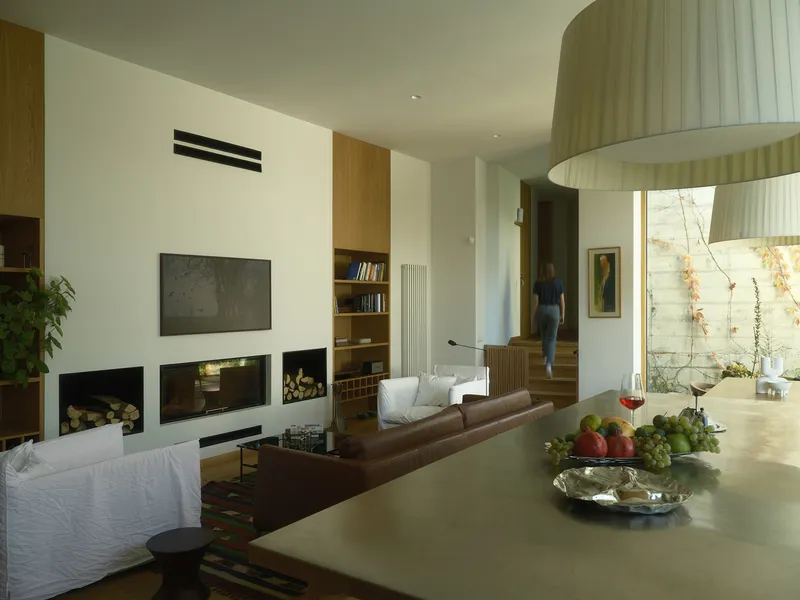
Inside, the daytime zone is organized around a recessed fireplace wall that anchors the living area while a timber staircase rises behind, connecting to the bedroom level above. The proportions are generous but not cavernous, and the material shift from concrete outside to warm wood inside is immediate. Floors, stair treads, and cabinetry share a consistent timber tone that keeps the interior cohesive without feeling monotonous.
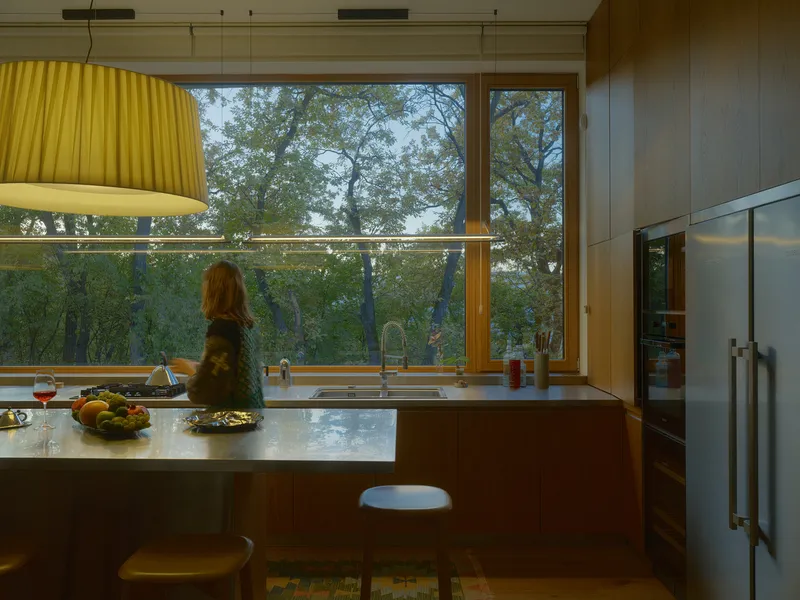
At the kitchen end, a long island faces full-height glazing that frames the surrounding trees like a slow-motion film. The dusk photograph captures this best: artificial light inside, natural twilight outside, and the green aluminum mullions acting as a thin chromatic threshold between the two. The open plan allows sightlines to run from the kitchen island through the living area to the stair, making a 400-square-meter house feel larger than its numbers.
Warmth in the Details
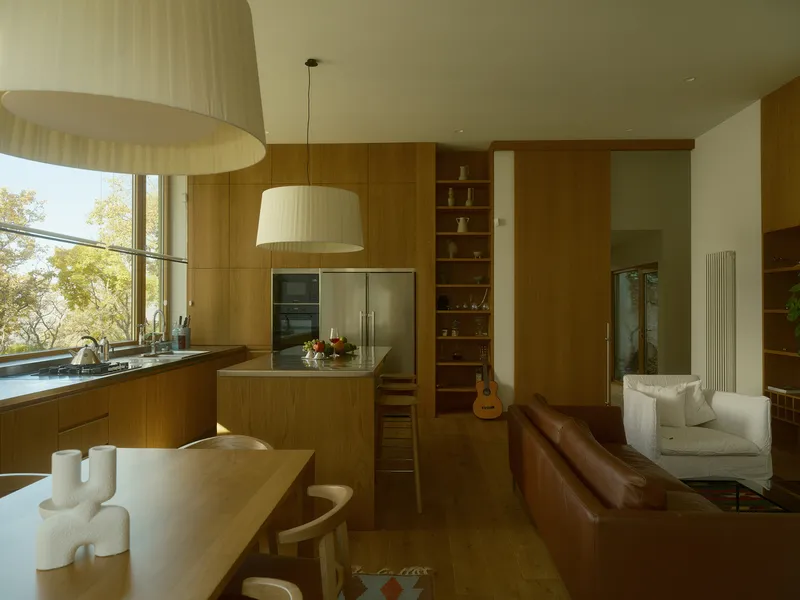
The kitchen's wood cabinetry, pendant lights, and leather seating establish a domestic register that counterbalances the brutalist shell. Nothing here reads as performatively minimal; there are objects, textures, and soft furnishings that signal a house meant to be lived in rather than photographed. The leather sofa and daybed visible from the kitchen create a gradient from functional to relaxed that the open plan makes legible.
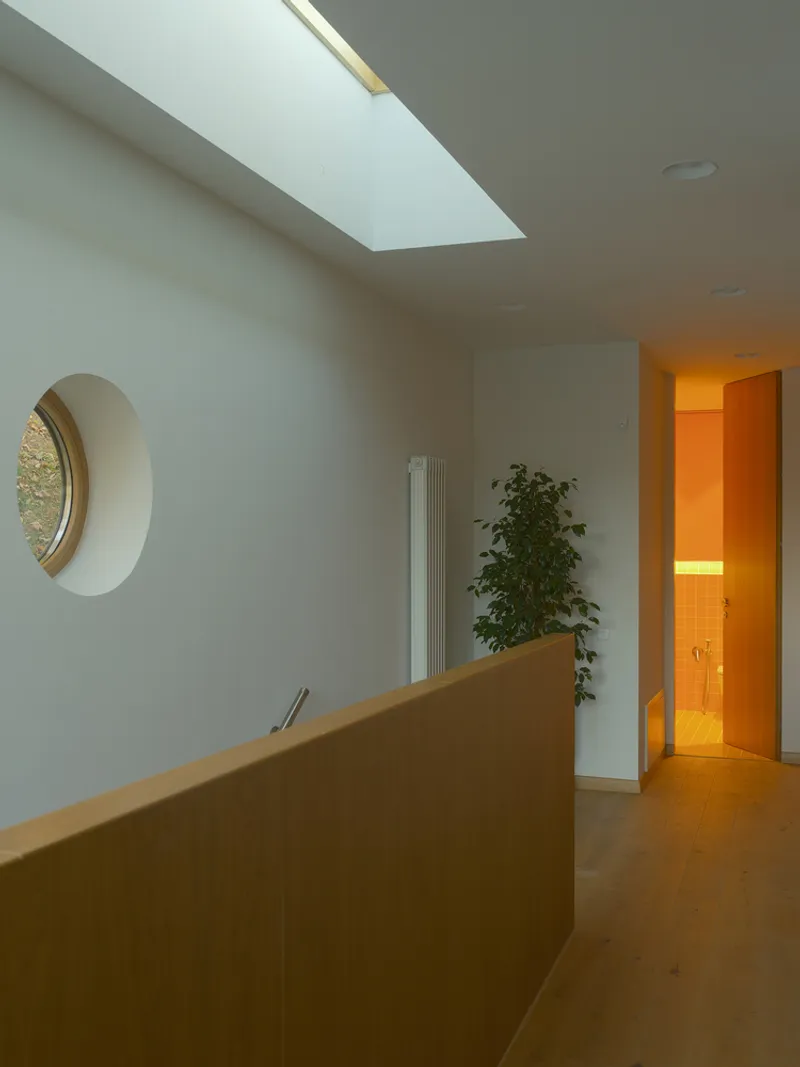
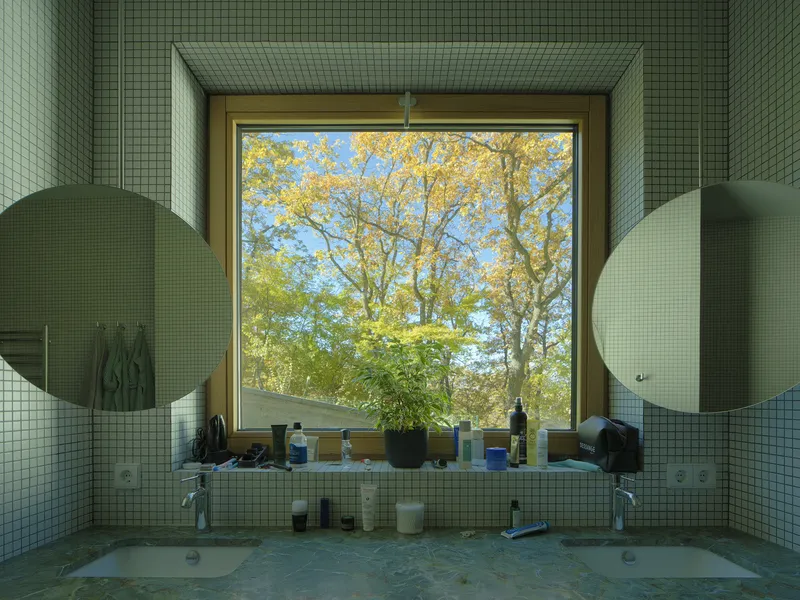
Upstairs, a corridor lit by a long skylight and punctuated by a circular window demonstrates MUA's attention to secondary circulation. The potted plant beside the timber balustrade is a small touch, but it signals that even transitional spaces have been designed for pause, not just passage. In the bathroom, green mosaic tile wraps the vanity wall, echoing the exterior aluminum frames and framing a large window that opens directly onto autumn foliage. It is the kind of detail that ties inside to outside without resorting to floor-to-ceiling glass everywhere.
Why This Project Matters
The Akhaldaba Private House makes a case for fragmentation as a site strategy. By splitting the program into three blocks and rotating each to follow the land, MUA avoided the two most common traps of hillside construction: the retaining-wall fortress and the stilt house hovering nervously above grade. The minimal earthwork, the planned integration of climbing plants, and the careful orientation toward views and ravine all suggest a design process that started with the terrain rather than a floor plan.
It also demonstrates that board-formed concrete need not default to gray austerity. The chartreuse aluminum, the warm timber interiors, and the green mosaic tile inject enough color and tactility to make the house feel welcoming, not severe. For a rural Georgian village, the building is unapologetically contemporary, yet its willingness to let vegetation grow over its walls and its refusal to flatten the site point toward a longer, more collaborative relationship with the landscape than most residential projects attempt.
Akhaldaba Private House by MUA Architecture & Placemaking, Akhaldaba, Georgia. 400 m². Completed 2023. Photography by Giorgi Mamasakhlisi.
About the Studio
Share Your Own Work on uni.xyz
If projects like this are the kind of work you want to make, uni.xyz is a place to publish your own, find collaborators, and enter design competitions.


Popular Articles
Popular articles from the community


LT2A and OPEN Architectes Thread a Brick and Glass High School Through a Wooded Belgian Campus
In Braine-l'Alleud, a 3,000 m² wing for Collège Cardinal Mercier pairs pale brick with a glazed colonnade, deferring to a small chapel and a dense wood.

Juan García Correa, John González and Claudia Rueda Sink a Circular Amphitheater into a Manizales Engineering Building
On the La Nubia campus in Manizales, Colombia, the S1 Building folds labs and offices into a hillside of ramped lawns that double as a campus route.

Architekt Andreas Gruber Scatters 23 Dark Timber Chalets Across a South Tyrolean Forest Edge
In Molini di Tures, Amonti Chalets breaks a resort into a hamlet of gabled timber houses, with parking, storage and services pushed into the slope.

longwave studio Reorganizes a 112 m² Tainan Apartment Around the Daily Routines of a Family and Two Cats
In Tainan, Taiwan, birch plywood, rust-red furniture and a freestanding plaster wall link arrival, storage, work and family life in one apartment.

Similar Reads
You might also enjoy these articles


Hodi-Mandai Geram
Project Function: Preservation and revitalization of the Intangible heritage and socio-spatial identity of the Hodi by Housing, Cultural Memory Center, Sacred Grove, landscape, local tourism economy


Olio Towers: A Mid-Rise for Performers That Fuses Housing, Rehearsal, and Stage
Located blocks from Houston's Theater District, this modular tower stacks living units around a central performance atrium.

Oasis: Modular Green Housing Carved into Dhaka's Urban Fabric
A shortlisted Plugin Housing entry reclaims unauthorized settlements in Dhaka with stepped concrete volumes, green roofs, and ventilation-driven design.

Black Hole: A Floating Megastructure for the Post-Physical Era
Emiliano Mazzarotto envisions a spherical, self-scaling arena where e-sports, digital hotels, and holographic stadiums replace traditional public space.

Explore Architecture Competitions
Discover active competitions in this discipline

Challenge to reimagine the Iron Throne

Photograph architecture without architects

Illustrate the lost glory of Angkor Wat - Render Challenge

Design challenge to reuse E-waste
Comments (0)
Please login or sign up to add comments
No comments yet. Be the first to comment!