
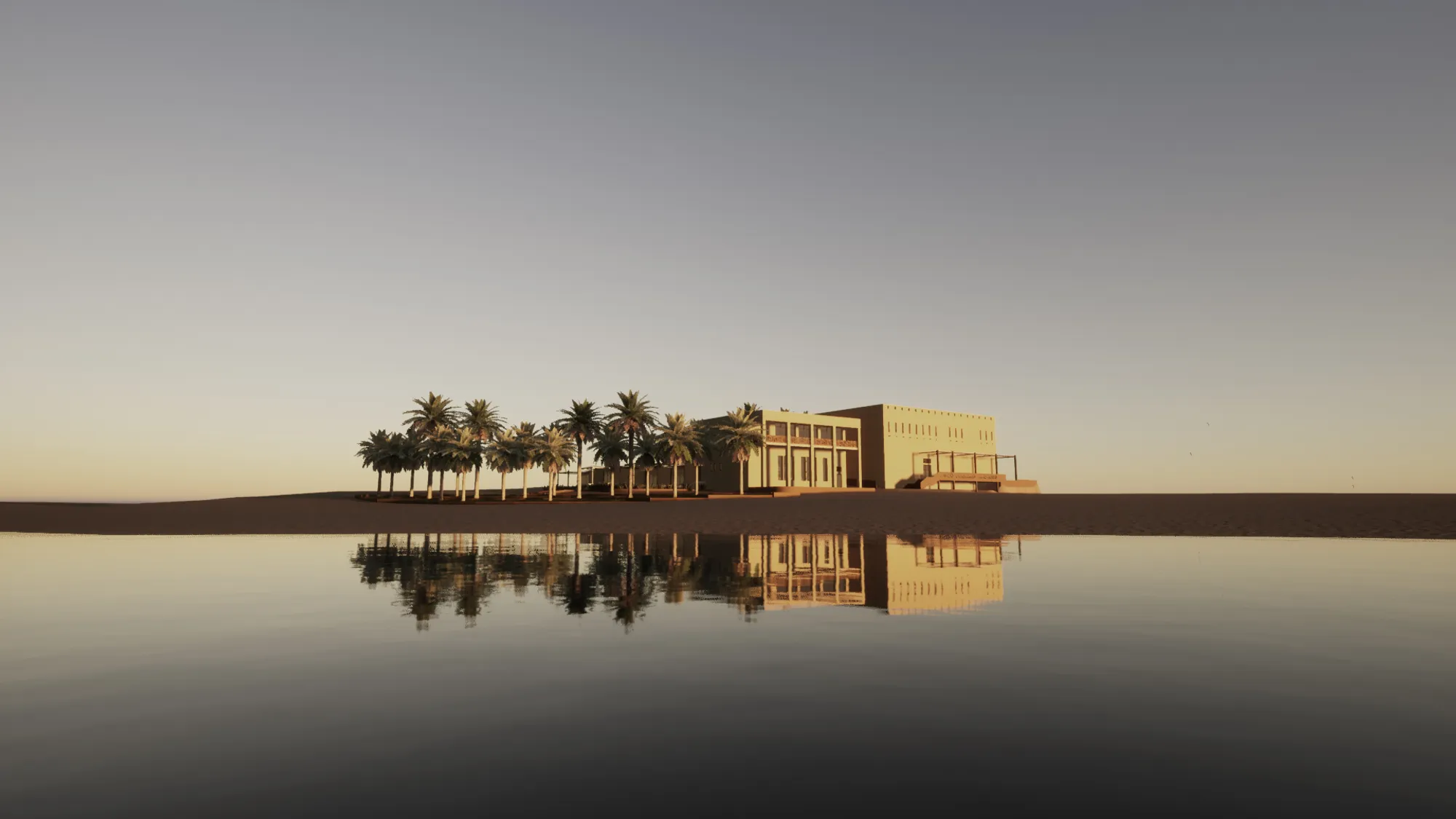
Al Souq Cultural Center
Introduction

The main objective of the competition is to design a cultural center near Marrakech in Morocco. The site is located at the shore of a water lake Lalla Takerkoust, around 40 km away from the city. It is an important area for tourism as well as entertainment for locals. At the same time, the lake provides resources, irrigation for agriculture, and energy. The main question asked during the design process of the building complex was “how can we experience the culture more than just observe it”.
These days globalization is a well-known process occurring almost anywhere in the world. We mostly consider it as a positive change, but we need to remember the consequences that it brings along. For example, we are facing challenges with slowly disappearing national or cultural identity. On the other hand, there is ongoing migration around the world, movement of people, families that also shifts their legacy as well as culture. As result, there are different fusions around the world that we can notice in art, cuisine, etc. which of course is not a negative phenomenon, but it changes our way of thinking. Of course, globalization is not a new occurrence. It has been happening for many years now, starting with colonialism or religious crusades, bringing goods, ideas, and knowledge around the world. Today, as representatives of cultures, we are facing another danger, which is a very fast-phased lifestyle defined by access to the internet. We see global trends, especially in architecture. Some of them are great, such as sustainable, ecological architecture, but at the same time a building itself often lacks connection to national identity, and just by looking at it we are unable to recognize its location. Summing up there is nothing wrong with unifying styles around the globe, we just need to ask ourselves if it is something that we want to see in the future.
Other challenges that architects and urban planners around the world are facing nowadays are climate change and social shifts (such as rapid urban migration) and our task is to respond to them responsibly and deliberately. Trying to look for the right approach designers could not only look for the newest technological innovations but also take a step back and learn from the tradition. It is important to notice that people lived in certain climates and areas for long centuries, and they developed great mechanisms and structures for protection without using too many resources.
The Oasis Cultural Center competition sets similar challenges. How can we design a contemporary building that will represent Moroccan culture and tradition and at the same time respond to sustainability goals? As mentioned before the main question asked during the conceptual design process was “how can we experience the culture more than just observe it”? This is how the main idea was created; whenever we travel or visit a new place, but as locals, we tend to go and explore markets. Traditional markets are those locations that bond people together as it is one of the main places to supply items. Those places are usually loud, full of people, food, art, and… tradition. Markets are platforms for social gatherings as well as just brief meetings. The design of Al Souq Cultural Center was inspired by the traditional form of the market from Islamic cultures. The building complex itself and its’ composition are pushing people to explore and experience rather than just observe. There is a lot of different spaces for people to gather - stop, narrow corridors between walls – to move. This forces a specific interaction depending on the area that a person is present at. The arrangement of buildings is inspired by the urban scale and adapted to a small area so that behind every corner a new surprise waits for the visitor. The form consists of 14 buildings – 4 of them are rather large, two store structures, and 10 – inspired by Souq – smaller, simple objects in a form close to a kiosk. Most of the Buildings are separated and created openings towards the outside area of the plot that allows for observation of the water body from different points. The southeastern side of the plot is covered by a small date plantation on terraces that are naturally irrigated with gravitation force and the traditional form of Falaj. The amount of grass on the plot is rather for representative purposes because grass itself is difficult and expensive to maintain and has a low biological value. But there are different species of trees on the plot including date palms, olive, and fig trees. To protect users from the sun there are shading structures made from fabric and based on wooden frames located in most areas of gathering and movement. The construction of the buildings consists of wooden structures and filling from compressed earth blocks which both consist of low embodied energy and are biodegradable and reusable. The outer walls of bigger buildings are 50 cm thick which allows for good insulation and protection from heat. Windows that are facing South are narrow and deeply embedded, which allows a very limited amount of direct sunlight inside the building. Otherwise, they are protected by removable shading elements.
The cooling system is provided by ground pomp, but due to good insulation and thick walls, additional cooling can be avoided most times. There is also a water tank located underneath the main square surface to reuse rainwater in the object. The decision not to use solar panels is because they consume a lot of energy and resources to be produced and are not so effective due to the high amount of dust/sand in the air.
In terms of usage, there are 4 different buildings and Souq area. In the main building A, there is a hall, reception, mediatheque, workshop rooms, music conservatory, administration, and small prayer rooms for male and female users – to respect Islamic laws and tradition.
The main function of building B is a gallery – it consists of open space on two levels that can be arranged depending on the exhibition. Building C – it’s a theater building that can allow around 250 visitors at once to enjoy a spectacle. The magazine is located at the back, behind the main scene. There are acoustic panels installed on the ceiling that allows manipulating the sound quality, time, and intensity. The main function of building D is gastronomy – with the ground floor functioning more like a cafeteria and the second floor as a restaurant with the possibility to rent. The area of Souq is focused mostly on retail, ideally of the products that are crafted or collected in the center to create income and make the complex more resilient and self-sufficient.
With time there could be an expansion of the agricultural area of the site to include more variety of good – add other fruits and vegetables. Additionally, to start the cooperation with local farmers and producers who grow and craft organically and traditionally.




Popular Articles
Popular articles from the community


Riyadh For All: Intergenerational Urban Design for Active Aging in Rabat
Riyadh For All reimagines urban design in Rabat with intergenerational co-living, adaptive courtyards, and Moroccan cultural exchange today.

The Musturak Paradise: Senior Living Architecture for a Connected Future in Temara, Morocco
The Musturak Paradise reimagines senior living architecture in Temara via private homes, social spaces, culture, community, and shared care.

Co-Life: Senior Housing Design That Reconnects Older Adults With the City
Co-Life reimagines senior housing design through healing gardens, shared streets, workshops, and a sustainable community across generations.

Conexión: Biophilic Design Reimagines High-Rise Living in Hong Kong
Conexión reimagines high-rise living in Hong Kong through biophilic design, green facades, shared spaces, daylight, water and nature within.

Similar Reads
You might also enjoy these articles

The Rhythm of Seasons
A Farmers' Market Connecting Nature and the City

More Than a Building-Designing a Living System
More Than a Building-Designing a Living System
Base Beyond
DESERT COMPOUND ARID: TOURISM OF ABSENCE AND ABUNDANCE
Explore Desert Architecture Competitions
Discover active competitions in this discipline




Challenge to reimagine the Iron Throne


Photograph architecture without architects


Illustrate the lost glory of Angkor Wat - Render Challenge

Bring back Drive In's
Comments (0)
Please login or sign up to add comments
No comments yet. Be the first to comment!