
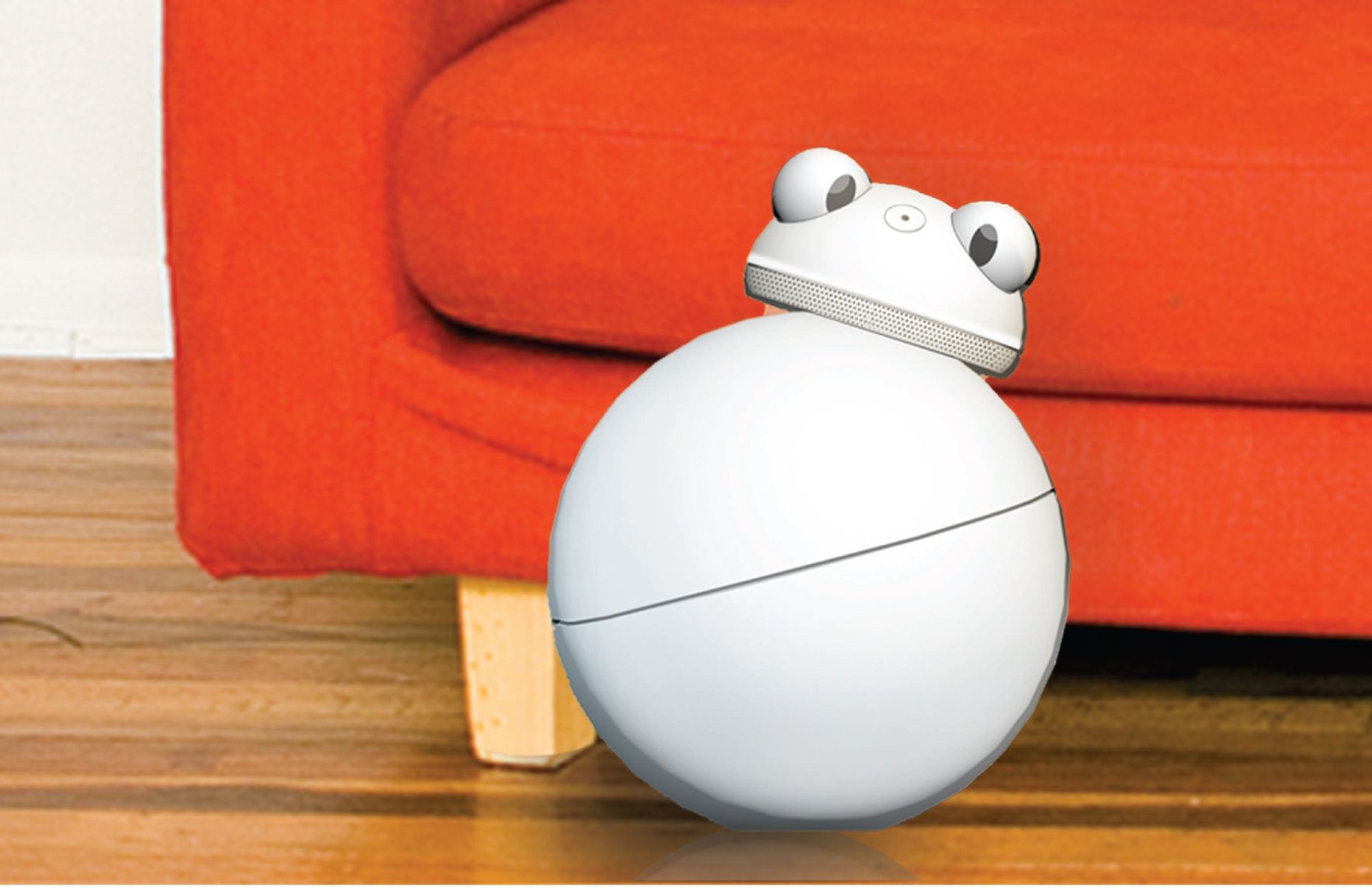
Ami: A Holonomic AI Companion Rethinking Elderly Well-Being Through Design
Megan Kozaruk's shortlisted product design concept uses scent, sound, and movement to combat the loneliness epidemic among aging populations.

Chronic loneliness increases the risk of early death by 45% and dementia by 64%. For elderly people living alone, the last eight hours of each day often pass without meaningful engagement, filled instead by passive television watching or aimless internet browsing. Ami proposes a different kind of intervention: a holonomic AI companion that moves independently through the home, emitting scents, sounds, and gentle prompts designed to stimulate memory, encourage movement, and reconnect seniors with distant family members.
Designed by Megan Kozaruk, Ami was shortlisted at the International Product Design Awards 2019. The project targets elderly individuals between 75 and 100 years old, many of whom live alone due to widowhood or divorce, physically distanced from the people who care about them most. Rather than treating loneliness as a byproduct of aging, Kozaruk treats it as a design problem, one that sits at the intersection of product design, architecture, and caregiving.
Anatomy of a Companion: Sensors, Scents, and a Charging Dock
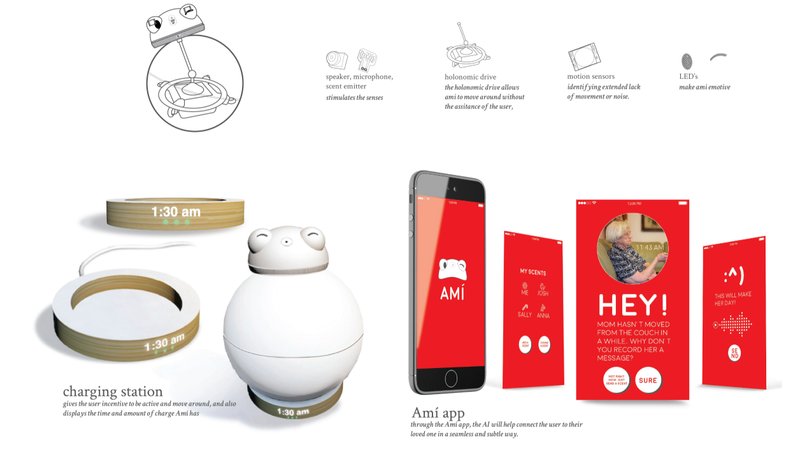
The exploded diagram above reveals the hardware logic driving Ami. A holonomic drive system allows the device to move freely across the home without the user needing to carry or reposition it, a critical accessibility consideration for the target demographic. Motion sensors detect extended periods of inactivity, triggering gentle interventions. A scent emitter and speaker provide multi-sensory stimulation aimed at activating memory and mood, while an LED expression system gives Ami an emotive face, transforming it from a gadget into something closer to a presence. The charging station doubles as a purposeful dock that encourages the user to stand, walk, and interact with Ami's physical location in the home.
What makes the component breakdown compelling is how each element serves a psychological function, not just a technical one. The scent emitter is not ambient fragrance; it is a memory trigger. The LED expressions are not decoration; they create the illusion of companionship. Every feature maps directly to a specific dimension of cognitive or emotional decline associated with isolation.
Daily Rhythms: Designing Interaction Around the User's Routine

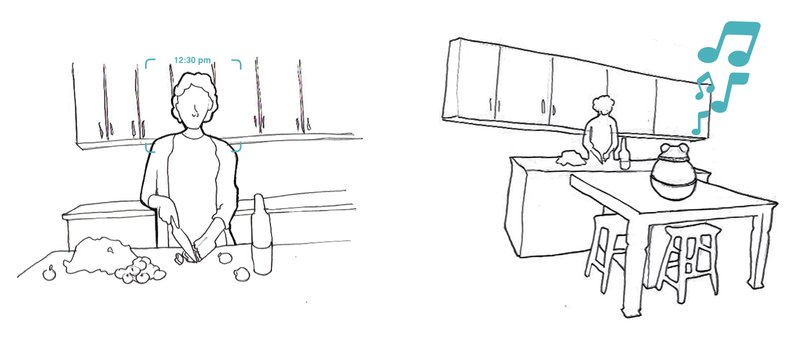
Kozaruk's sketches trace how Ami weaves itself into the fabric of a senior's day. The interaction sequence shows a smartphone interface prompting connectivity throughout different daily scenarios, from morning wake-up to evening wind-down. Interior scenes depict figures performing routine activities in bedroom and kitchen spaces, with Ami present as a quiet participant rather than a demanding device. The design resists the urge to over-engineer; nudges arrive as subtle reminders to move, connect, or recall a memory through scent or sound.
The user research behind these sequences is grounded in a clear demographic reality. Most people in the 75 to 100 age range spend the majority of their day at home, and their activities provide minimal cognitive stimulation. Ami does not attempt to replace human contact. Instead, it punctuates the hours with micro-interactions that accumulate into something meaningful: a sense of being noticed, of being part of a rhythm larger than one's own silence.
Bridging Distance: The Ami App and Family Integration

The concept sketch above illustrates the other half of Ami's ecosystem: a smartphone app that connects seniors to their children, grandchildren, and caregivers. Family members can send personalized uplifting notes and messages that Ami delivers through its speaker or displays on the paired device. The sequence of figures responding to motivational messages throughout the day shows how these small digital gestures translate into genuine emotional nourishment. The app reframes the family's role from occasional visitor to daily participant in the senior's well-being.
This family integration layer is where Ami moves beyond a standalone product and becomes something closer to a care infrastructure. It distributes the emotional labor of elder care across a network, reducing the burden on any single caregiver while keeping the senior at the center. The architecture of the home remains unchanged, but the experience of living in it shifts substantially.
Why This Project Matters
Traditional elderly care architecture focuses heavily on safety rails, accessible thresholds, and non-slip surfaces. These are necessary, but they address only the physical dimension of aging. Ami represents a growing recognition that the architecture of care must be holistic, extending beyond walls and floor plans to include the digital, sensory, and social layers that determine whether a person feels like they are living or merely surviving. Kozaruk's work treats loneliness not as an inevitable consequence of growing old, but as a solvable design problem.
For a shortlisted entry in an international product design competition, Ami demonstrates remarkable restraint. It does not propose a robot that replaces human interaction; it proposes a small, wheeled companion that gently insists the world has not forgotten you. That distinction matters. As designers increasingly turn their attention to aging populations, projects like Ami set a useful precedent: the most powerful interventions are often the quietest ones, layered into routine so seamlessly that they feel less like technology and more like care.
View the Full Project
About the Designers
Designer: Megan Kozaruk’s
Enter a Design Competition on uni.xyz
uni.xyz runs architecture and design competitions year-round that reward proposals with spatial conviction and real site intelligence.
Project credits: Ami by Megan Kozaruk’s International Product Design Awards 2019 (uni.xyz).




Popular Articles
Popular articles from the community

YOAP Architects Round a Corner in Yeongcheon with a Cylindrical Community Hub
A 197-square-meter brick and ribbed-clad tower turns a forgotten alley corner in South Korea into a public garden with a low threshold.

Fausto Terán and Toro Fuse Japanese Craft with Mexican Tradition in a Lakeside Retreat
Nakamura House pairs Shou-Sugi-Ban charred pine with handmade clay tile at the foot of Atlangatepec Lagoon in Mexico.
3dor Concepts Wraps a Kerala Home in Mirrored Concrete Arcs Around a Courtyard Tree
In the Western Ghats foothills of Thamarassery, a 270 m² single-story house uses two curved volumes to frame nature as its center.


20 Most Popular Office Building Projects of 2025
From biophilic workspaces in India to net-positive energy offices in New Delhi, 20 office building projects that defined architecture in 2025.


Similar Reads
You might also enjoy these articles

Mechanism of Memories: Adaptive Architecture Reimagines Offshore Structures as Living Cultural Machines
Floating adaptive architecture transforms abandoned offshore structures into cultural spaces that preserve memory, habitation, and human connection.
Wildlife Rehabilitation Architecture in Australia: A Regenerative Sanctuary for Koalas by Philip Skein and Keegan Mayber
A regenerative wildlife sanctuary in Queensland redefines sustainable architecture through habitat restoration, healing, and ecological awareness.

The Interfusion: Mobile Performance Architecture Reconnecting Art and Public Space
A mobile performance architecture project transforming Madrid’s streets into inclusive cultural spaces through adaptive urban design.
Biophilic Architecture and Regenerative Stadium Design: Biophilia Lagos by Rachel George
A regenerative stadium in Lagos transforms landfill into a living ecosystem through biophilic architecture, waste reuse, and environmental healing.


Explore Product Design Competitions
Discover active competitions in this discipline




The Global Benchmark for Architecture Dissertation Awards

Design challenge to equip cities with modern furniture


Design challenge to reuse E-waste


Packaging challenge - Design meets sustainability
Comments (0)
Please login or sign up to add comments
No comments yet. Be the first to comment!