
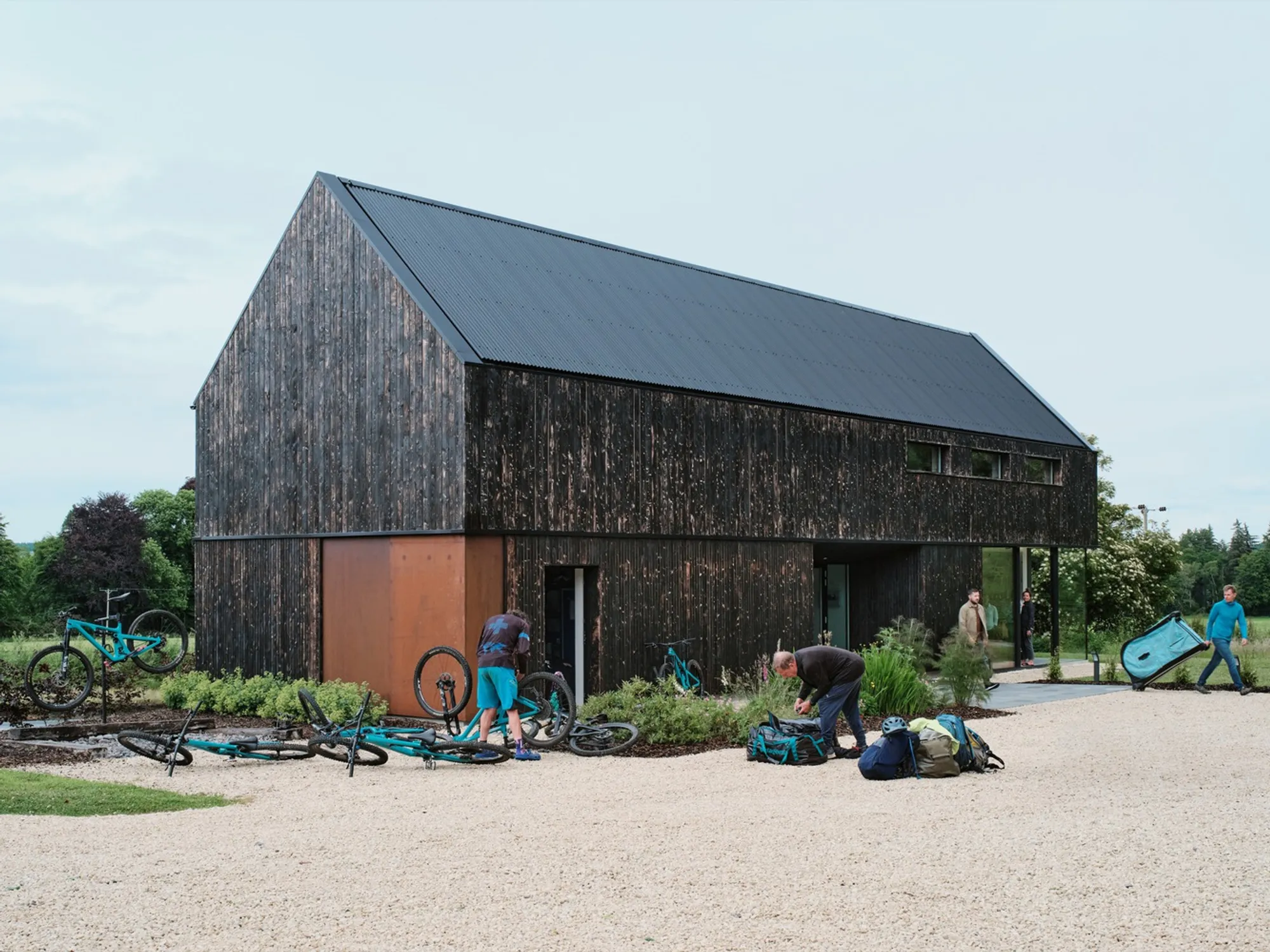
Loader Monteith Turns a Forgotten Brownfield Strip Outside Inverness into an Office and Two Houses
Charred Scottish larch, a Z-shaped plan, and a coherent masterplan bring new life to a roadside site overlooking the Beauly Firth.


A slim, forgotten parcel of roadside land on the western fringes of Inverness is not the obvious place to stage a manifesto for rural regeneration. But that is exactly what Loader Monteith has done with An Office and Two Houses, a compact mixed-use development for H&I Adventures, an international mountain bike tour operator. The project threads three buildings across a 5,600 square metre brownfield plot next to a busy commuter road and a railway line, proving that overlooked sites can anchor both commerce and domestic life if the masterplan is tight enough.
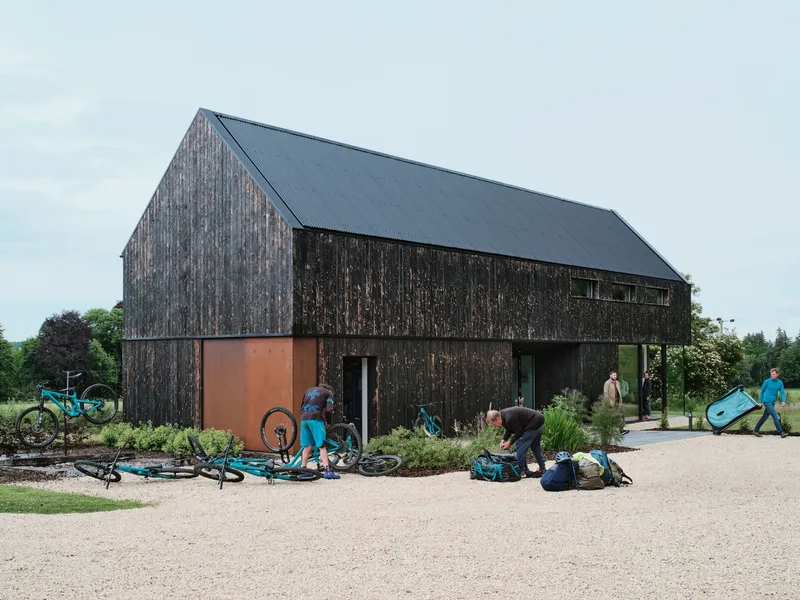
What makes the project genuinely interesting is not one gesture but the discipline of the whole: a two-storey office, a completed house, and a second house to follow, all held together by a shared material language of hand-charred Scottish larch, corten corners, and triple glazing. The buildings present a robust, almost fortified edge to the road and open up on their southern faces to capture views over the Beauly Firth. It is a simple move repeated with conviction, and it gives the entire site a legibility that most small developments lack entirely.
Charred Larch and Corten: A Material Strategy That Earns Its Keep
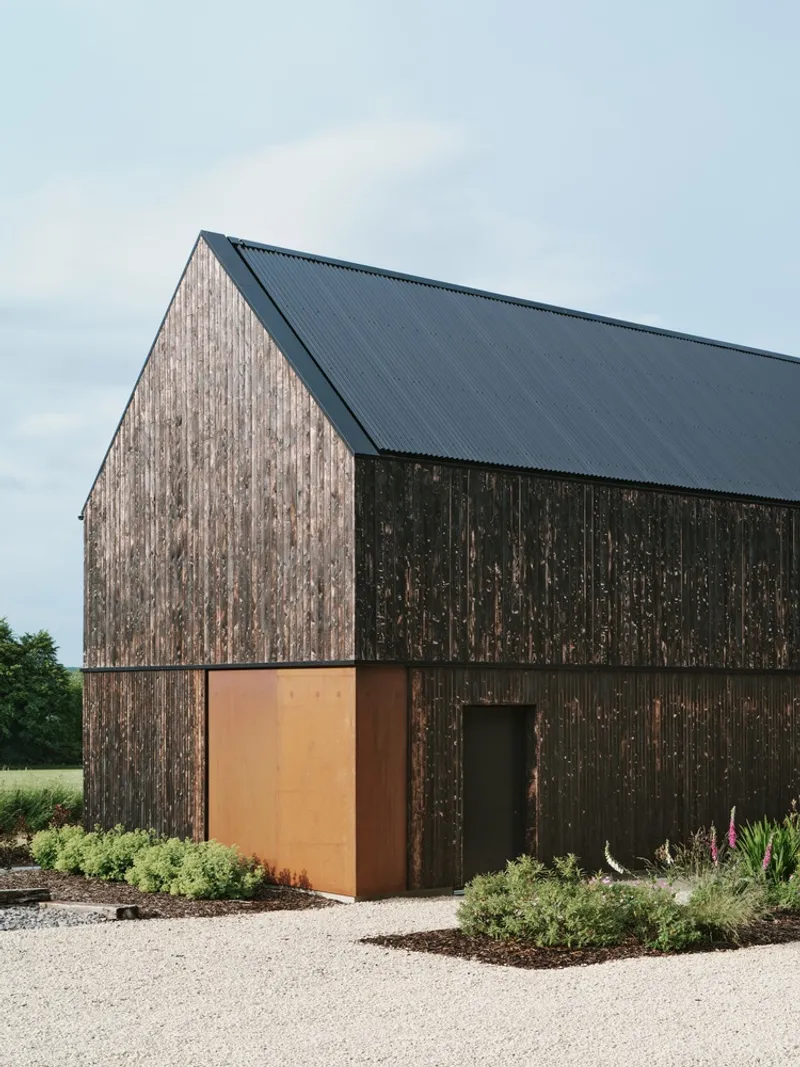
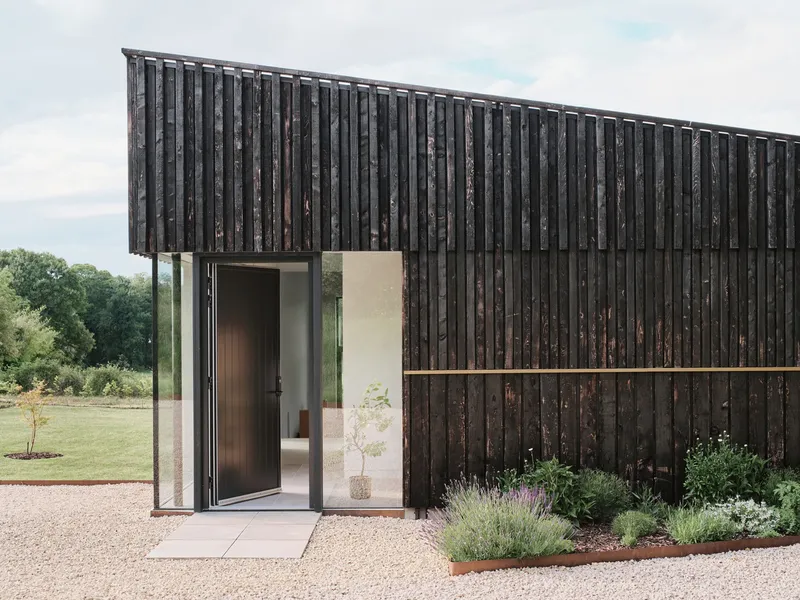
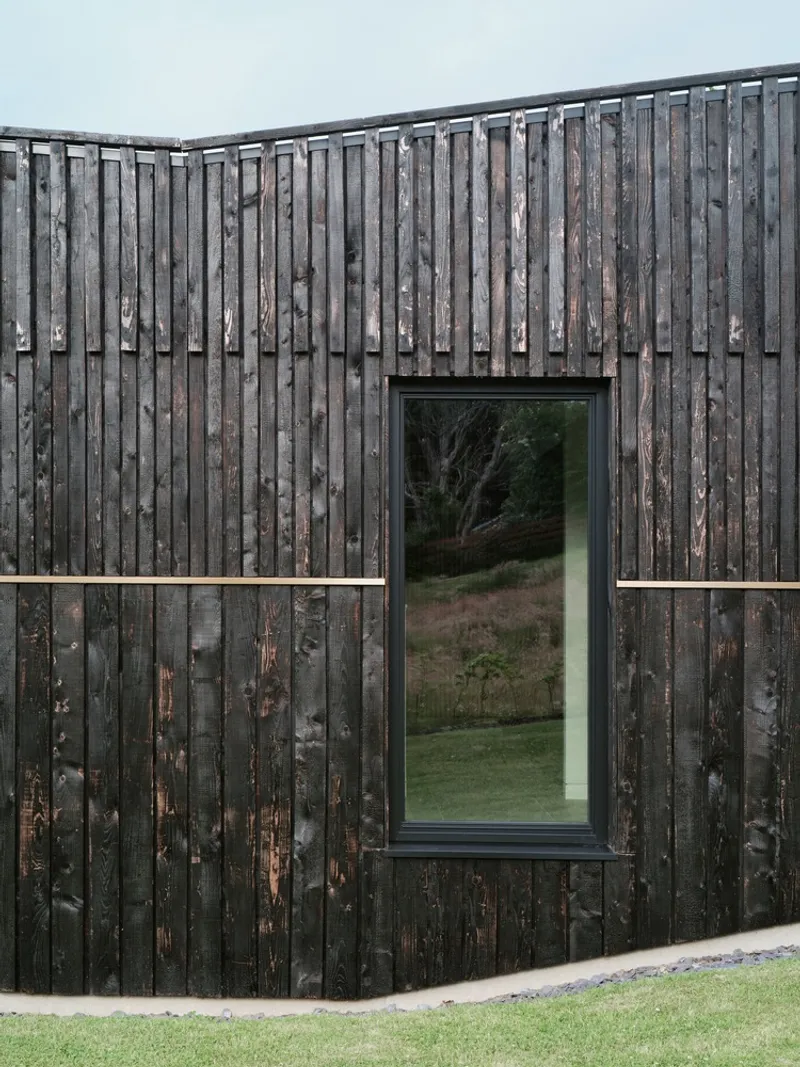
The charred larch cladding was seared on site by hand, not factory-finished, and it shows. Multi-layered timber battens of varying widths create a facade that is not flat but subtly ridged, with gaps and dips that catch shadow differently through the day. Where the timber meets a corner or a threshold, corten steel detailing takes over. The combination is now almost a signature of contemporary Scottish architecture, but Loader Monteith earns it here through specificity: the larch is FSC-certified and sourced from Highland forests, not shipped across the continent.
At dusk, the tall windows set into the charred walls become lanterns, reflecting lawn and sky. The recessed glazing is deliberate. Keller sliding systems were chosen for their slender profiles, while Nordan windows handle the performance demands of a Highland winter. Triple glazing is used throughout, and steel was minimized in the structural frame to keep embodied carbon low. The visual austerity of the exterior is not decorative restraint; it is the direct expression of a carbon-conscious construction budget.
The Office: A Coworking Hub Disguised as a Bike Workshop
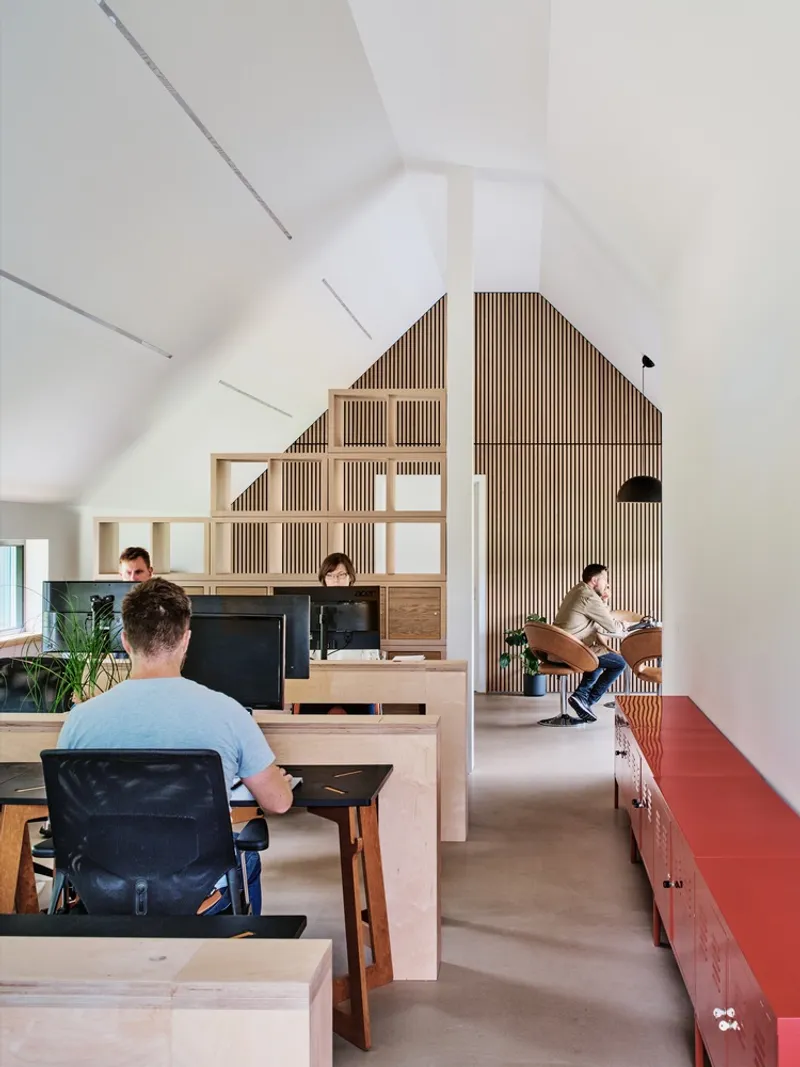
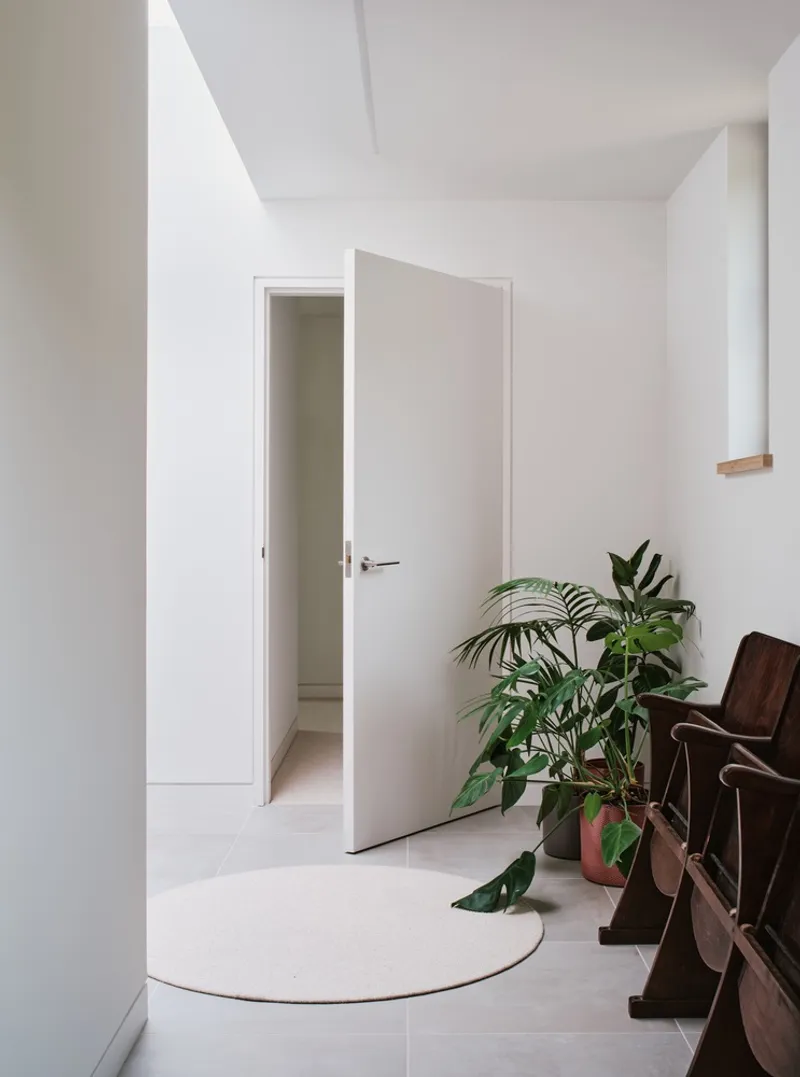
H&I Adventures needed a headquarters that could greet international clients, store and service mountain bikes, and seat a team of ten. The 145 square metre office stacks these functions vertically: workshop, showers, changing rooms, and a kitchen breakout on the ground floor; desks and a meeting space above. Long black tables on the first floor run perpendicular to the southern elevation, giving every seat a view of the Firth. It is a workspace designed to be occupied by people who spend most of their day outside.
The interior palette is restrained. Birch veneer plywood lines the ceiling and furnishings, red storage units punch through the neutral scheme, and a timber-slatted partition separates zones without closing them off. The vaulted ceiling on the upper floor adds volume without adding height, and the courtyard below doubles as a staging ground for pre-tour briefings. At £2,205 per square metre, the office is not cheap, but the construction cost reflects genuine performance rather than embellishment.
The Z-Shaped House: Living with the Slope
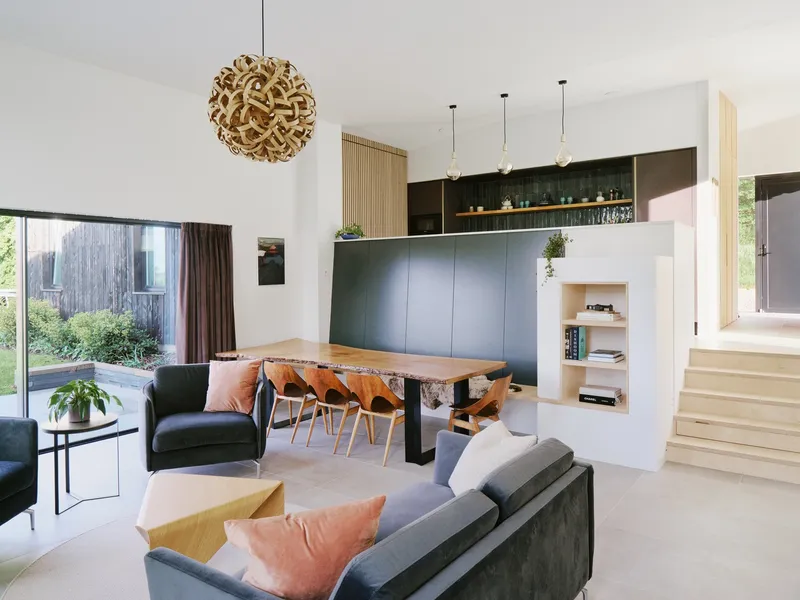
The first residence, completed in October 2022, sits at the highest point of the site to claim the best views. Its Z-shaped plan is a direct response to the topography: the entrance lands in the middle of the building, giving immediate access to public areas, while the open-plan kitchen overlooks a generous living space that steps down with the slope. Two bedrooms and a main suite bookend the plan, and an external carport closes the sequence.
At 130 square metres and £1,770 per square metre (excluding the kitchen, joinery, and some renewables), the house is lean. But lean here means carefully proportioned, not underfinished. A live-edge dining table, built-in cabinetry beneath the stairs, and pendant lighting give the interior a warmth that the charred exterior only hints at. The butterfly roof, visible in the gable profile, is more than an aesthetic choice: it channels rainwater and defines the section in a way that a conventional pitch would not.
Interior Craft: Timber Screens, Green Tile, and Built-In Furniture
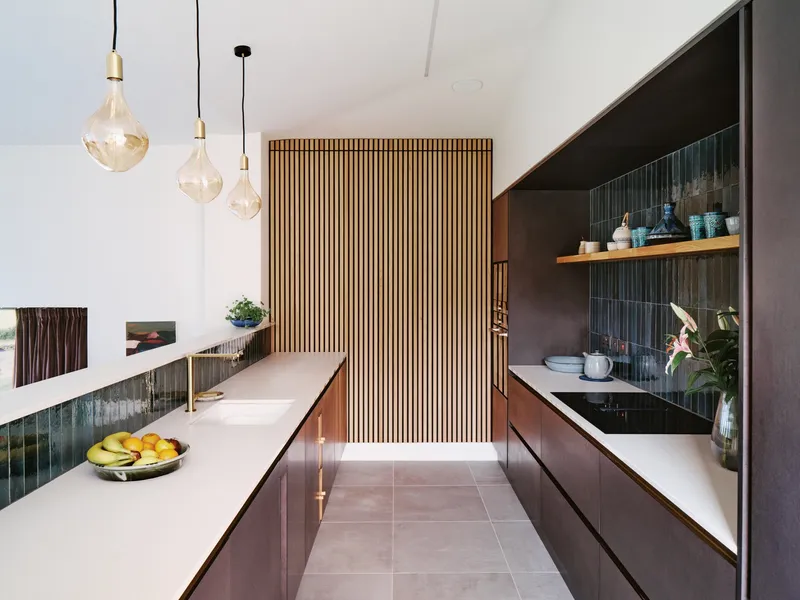
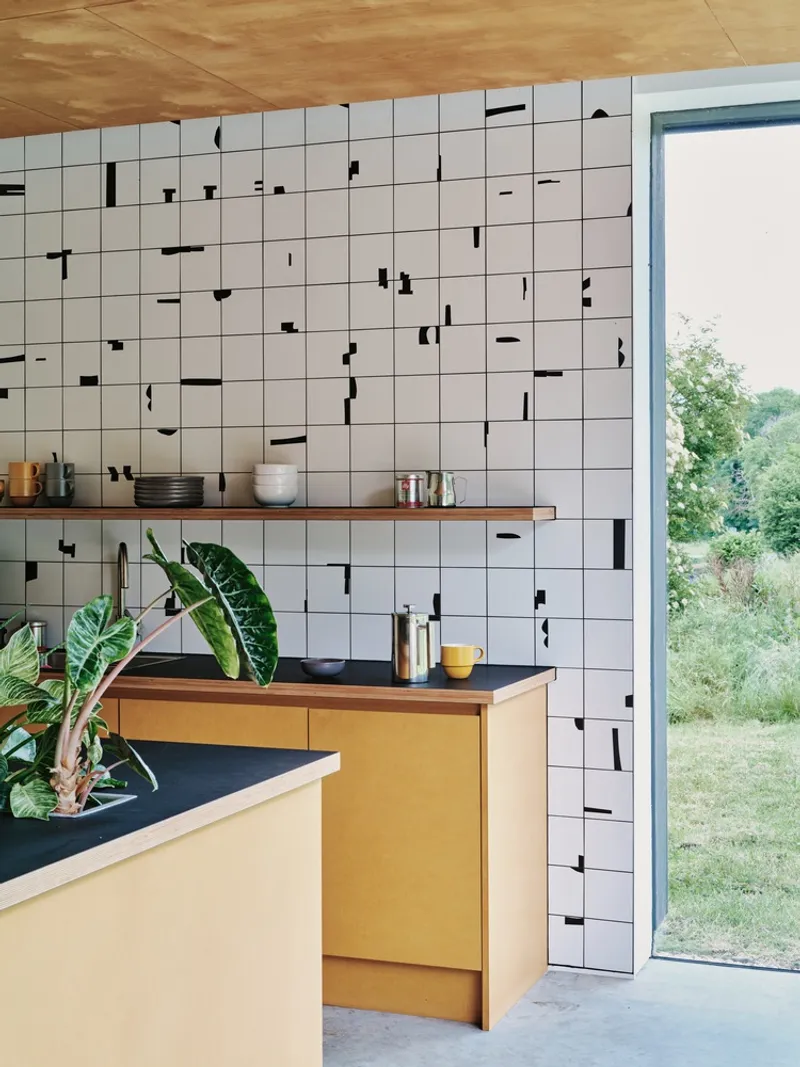
Inside the house, a vertical timber slat screen divides the kitchen from the living area without severing the spatial connection. Green backsplash tiles add the only strong colour in the room, set against the warm grain of the timber and the clean white walls. Elsewhere, a white tile wall with scattered black accent tiles creates a quiet rhythm behind open shelving, framing a garden view. These details are not afterthoughts; they are built into the architecture from the start.
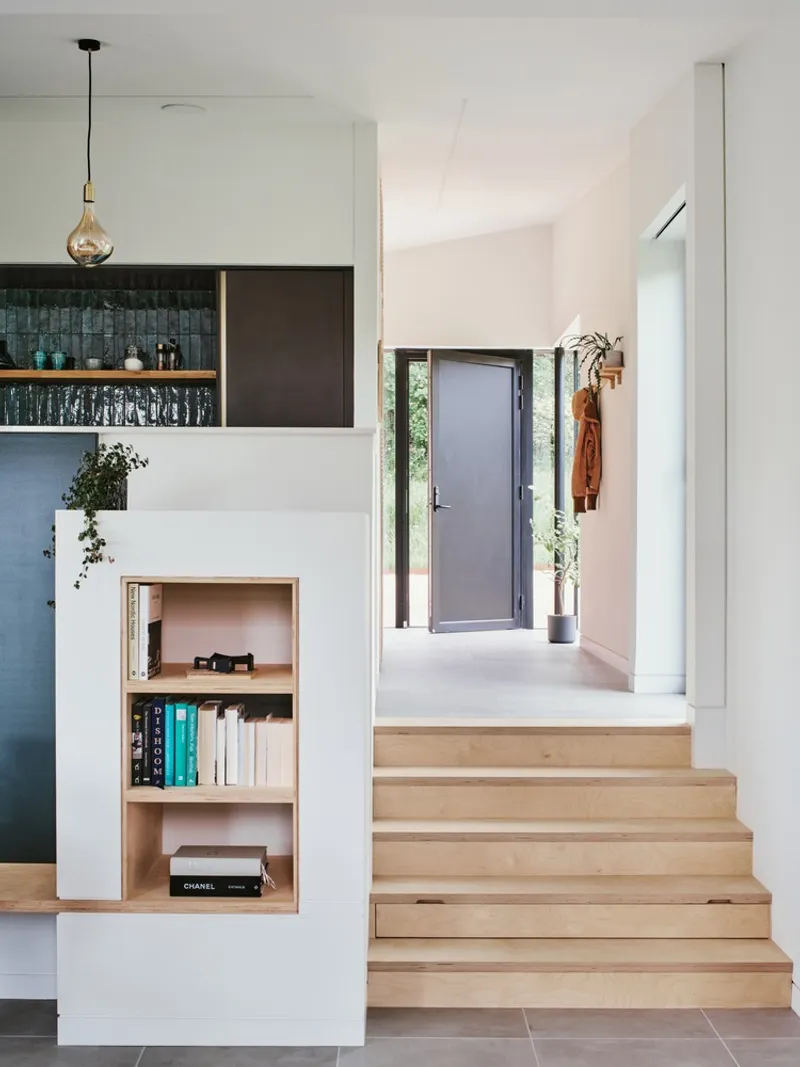
The staircase descends from entry level to a hall lined with built-in shelving, light birch treads catching daylight from above. Custom joinery runs through the house: dining seating, storage, cabinetry. When a project this small works, it is almost always because the furniture and the walls were designed by the same hand. That integration is evident in every room.
Energy and Climate: Passive Strategy with Active Backup
The orientation of every building on the site follows a single rule: closed to the road, open to the south. Southern glazing captures passive solar gain and enables cross-ventilation in summer, while the robust northern walls minimize heat loss. Air source heat pumps, solar panels, and a battery storage system handle the active load. The result is a pair of low-energy residences that do not rely on fuel-powered generators, a meaningful distinction in a Highland context where grid reliability is not always guaranteed.
Timber frame construction by Scotframe, with C16/44 and glulam structural members, keeps the embodied carbon of the superstructure low. The minimal use of steel is a conscious decision, not a cost-saving shortcut. Frameless corner glazing, developed in collaboration with the structural engineer, eliminates the need for steel at precisely the points where most builders would default to it. That kind of detail separates a building that talks about sustainability from one that actually delivers it.
Why This Project Matters
Scotland's rural fringes are dotted with forgotten strips of land: too narrow, too noisy, too close to a road or a rail line for conventional development. Loader Monteith's project demonstrates that these sites are not problems to be avoided but opportunities to be planned. A coherent masterplan, a shared material vocabulary, and a clear separation between commercial and residential functions turn a brownfield sliver into a small community. The second house, planned for 2024, will complete the vision.
More broadly, the project offers a model for what rural-remote coworking and living can look like when it is designed with the same rigour applied to urban mixed-use developments. The construction costs are transparent, the materials are local and certifiable, and the energy strategy is measurable. If Scotland wants to revitalise its rural communities through architecture rather than subsidy alone, this is the kind of precedent that should be studied and repeated.
An Office and Two Houses by Loader Monteith, Inverness, Scotland. Office: 145 m²; House: 130 m². Completed 2022. Photographs by Henry Woide.
About the Studio
Share Your Own Work on uni.xyz
If projects like this are the kind of work you want to make, uni.xyz is a place to publish your own, find collaborators, and enter design competitions.



Popular Articles
Popular articles from the community


Co-life: Sustainable Architecture for Age-Friendly Community Living
Co-life reimagines sustainable architecture for seniors through courtyards, rammed earth, shared gardens, and spaces designed for belonging.

Play: Fragments of Their World
Familiar architecture becomes modular playground design, creating safe spaces where displaced children can learn, connect, imagine and play.

The Ocean Hive: Sustainable Architecture for a Self-Sufficient Civilization at Sea
The Ocean Hive imagines sustainable architecture at sea, where modular habitats, algae, wave power and ocean waste sustain a growing colony.

The Earth Pod: 3D Printed Homes for Resilient Refugee Communities
The Earth Pod reimagines refugee housing through 3D printed homes made from clay, combining resilience, self-sufficiency, and rapid shelter.


Similar Reads
You might also enjoy these articles


Hodi-Mandai Geram
Project Function: Preservation and revitalization of the Intangible heritage and socio-spatial identity of the Hodi by Housing, Cultural Memory Center, Sacred Grove, landscape, local tourism economy


Olio Towers: A Mid-Rise for Performers That Fuses Housing, Rehearsal, and Stage
Located blocks from Houston's Theater District, this modular tower stacks living units around a central performance atrium.

Oasis: Modular Green Housing Carved into Dhaka's Urban Fabric
A shortlisted Plugin Housing entry reclaims unauthorized settlements in Dhaka with stepped concrete volumes, green roofs, and ventilation-driven design.

Black Hole: A Floating Megastructure for the Post-Physical Era
Emiliano Mazzarotto envisions a spherical, self-scaling arena where e-sports, digital hotels, and holographic stadiums replace traditional public space.


Explore Housing Competitions
Discover active competitions in this discipline



Challenge to reimagine the Iron Throne


Photograph architecture without architects


Illustrate the lost glory of Angkor Wat - Render Challenge


Design challenge to reuse E-waste
Comments (0)
Please login or sign up to add comments
No comments yet. Be the first to comment!