
Anagram Architects Carves a Playful Gabled Home Diagonally Across a Gurugram Plot
Chromatic House splits a rectangular urban site into equal halves for living and landscape, all within a 300-mile material radius.


Most residential architecture in Gurugram defaults to the box: flat roofs, symmetrical setbacks, sealed facades that shut out the dense suburban fabric and rely on mechanical cooling to survive the semi-arid summers. Chromatic House, designed by Anagram Architects for a young family of five, rejects that template entirely. The house is sliced diagonally across a 9,203 square-foot rectangular plot, yielding two roughly equal triangles: one for the home, one for a generous lawn and vegetable garden. The result is a figure-ground relationship that reads less like a building on a site and more like two interlocking geometric fields, each defined by the other.
What makes Chromatic House genuinely interesting is the way it synthesizes child-like playfulness with rigorous environmental performance. The clients, parents of three children, wanted a home that prioritized family togetherness over guest entertainment. Anagram responded with a tapered A-frame volume capped by a pitched roof that references rural Indian vernacular rather than the urban glass-and-granite idiom of Gurugram's newer developments. Inside, a slide tucked under the stairs connects the attic study to lower floors, bedrooms spill onto a mezzanine lounge, and circular porthole cutouts turn plywood storage walls into climbing surfaces. But beneath the whimsy sits a serious climate strategy: under-floor radiant heating and cooling (the first residential installation of its kind in the region), photovoltaics feeding energy back to the grid, and every building material sourced within a 300-mile radius.
A Red Shell in a Dense Neighborhood
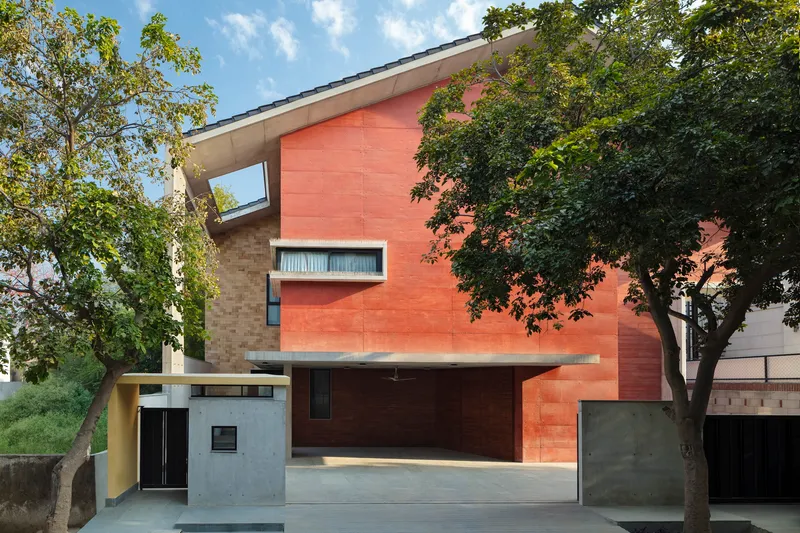
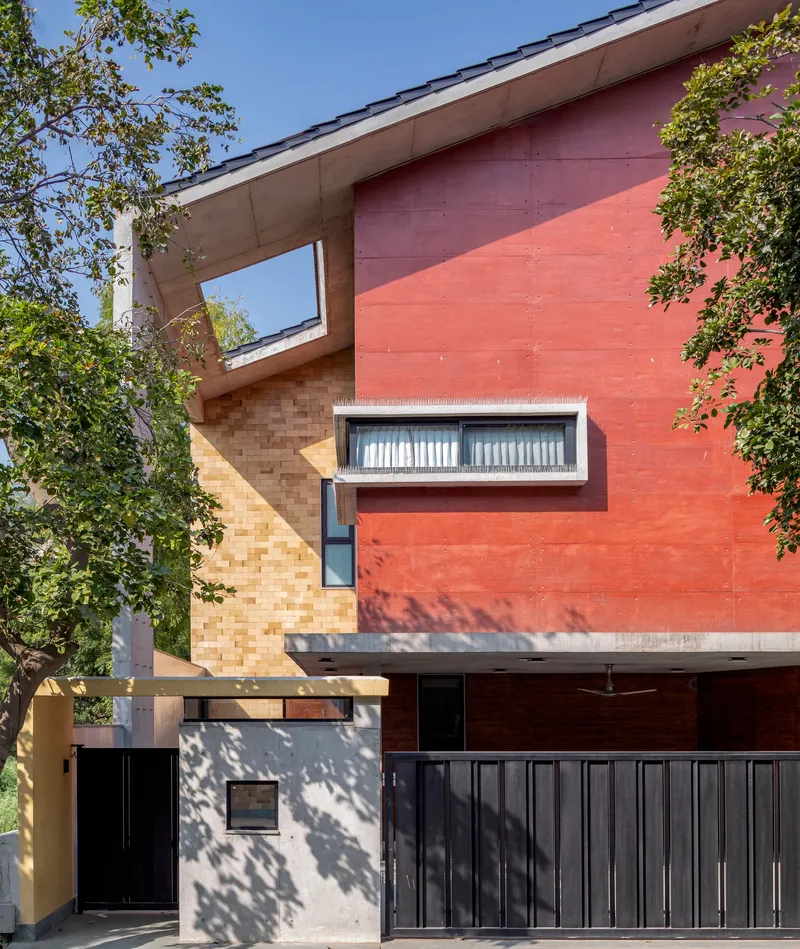
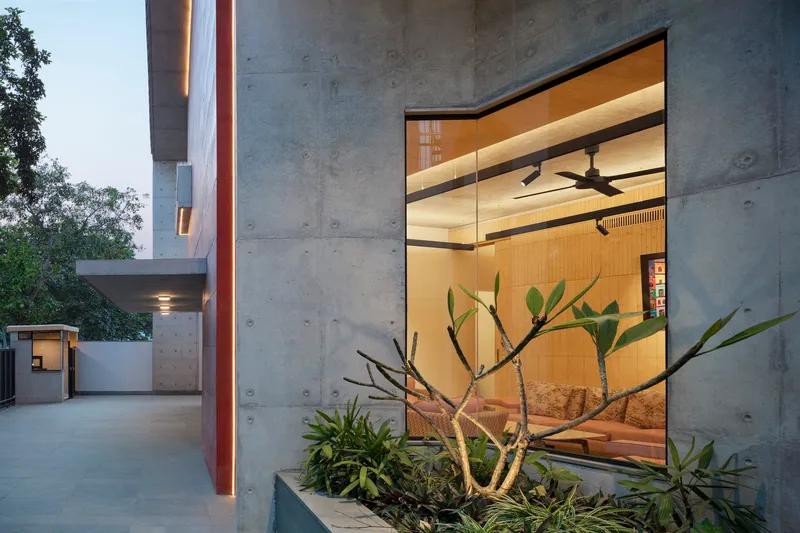
From the street, the house announces itself through its materiality: red-tinted concrete cast in expressed formwork, paired with diagonally patterned ochre brick that wraps the gabled volume. The color palette is warm and earthy without being decorative. It reads as geological, almost like a sandstone outcrop that has been precisely cut and inhabited. Narrow window bands are punched through the red walls to control solar heat gain while still pulling in daylighting. Mature trees on both sides of the plot soften the scale and filter views from the street.
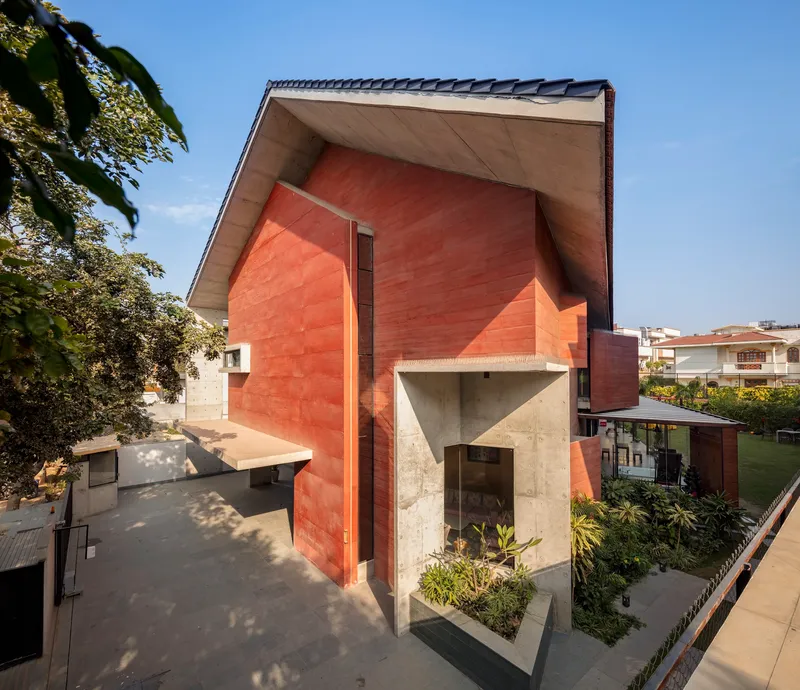
The entry sequence is handled with restraint. A concrete portal frames the approach, leading past planted beds into the interior. The facade strategy is fundamentally about blocking extraneous views of the surrounding dense neighborhood while opening expansively toward the private lawn on the other side. The diagonal orientation of the building makes this possible: the house turns its back on its neighbors and its face toward its own landscape.
The Diagonal Cut
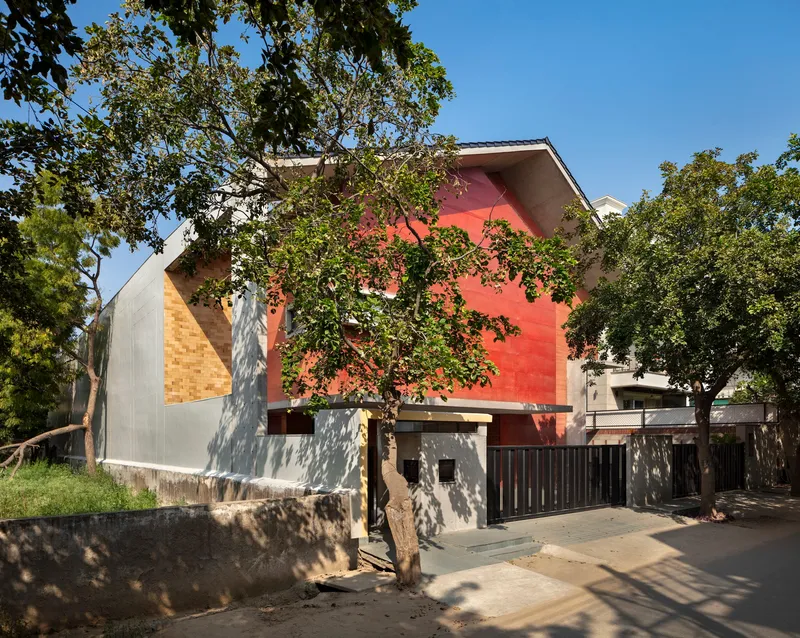
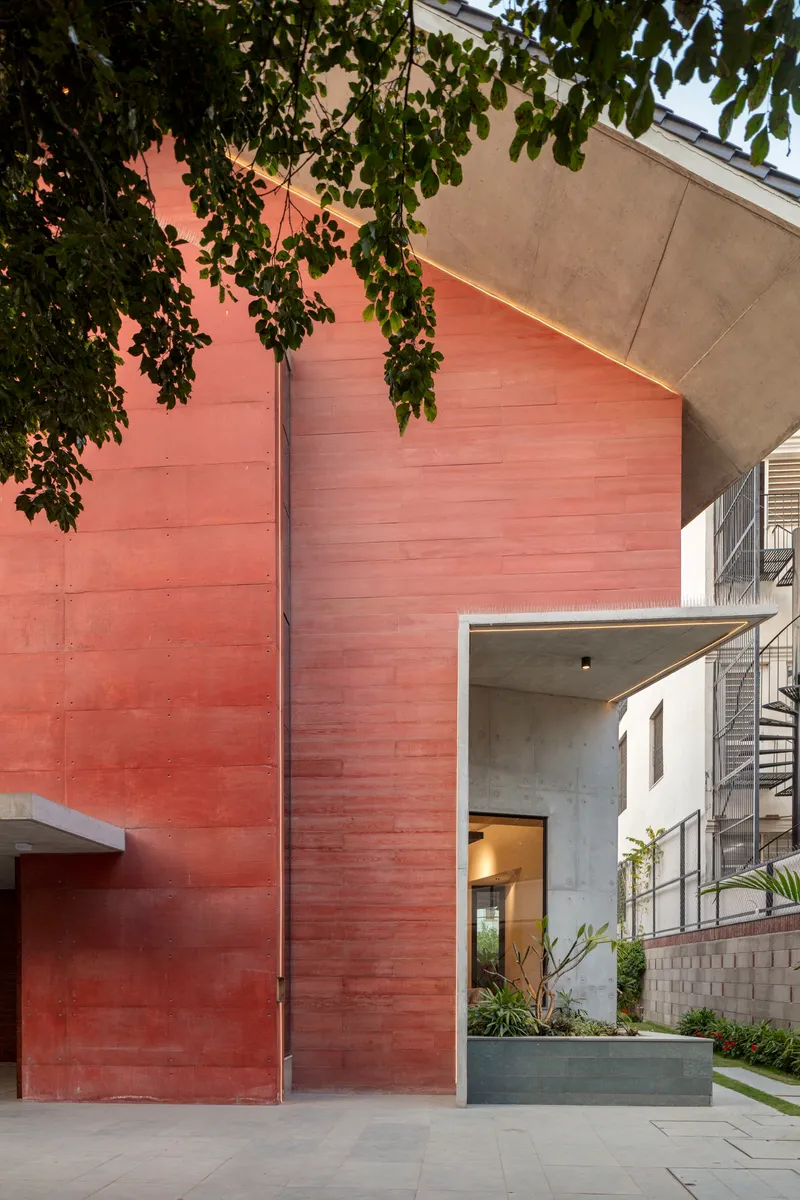
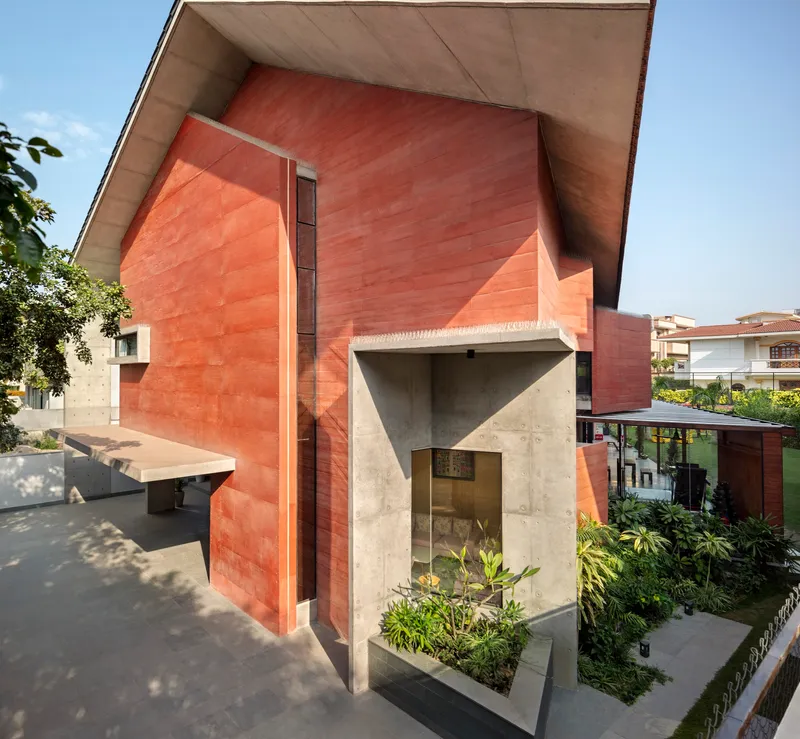
The decision to carve the house diagonally across the plot is the project's strongest conceptual move. It liberates the lawn from being a leftover setback and instead makes it a co-equal partner to the built volume. The long verandah, shaded by a timber pergola, mediates between the two zones, functioning as an outdoor room that belongs simultaneously to the house and to the garden. From the gabled end, the building's triangular profile is fully legible, and the diagonal brick cladding reinforces the angular geometry.
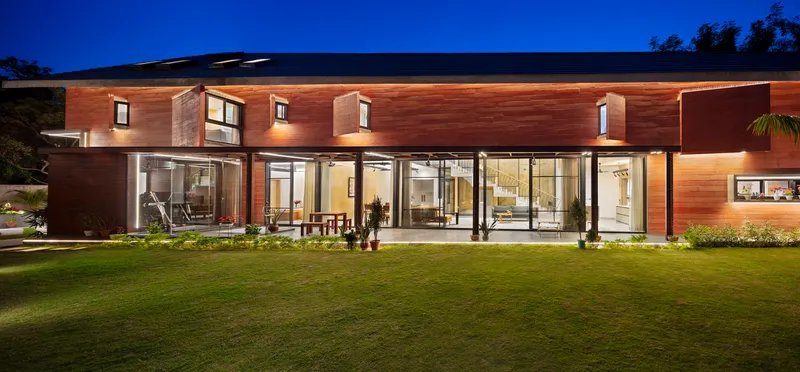
At dusk, the red stone walls darken to a deeper ochre, and the concrete entry volume catches the last horizontal light. The massing reads differently depending on the angle: from the side, it is a long, low bar; from the front, a steep gable that rises like a tent. That variability keeps the street presence dynamic rather than monolithic.
Living Under the A-Frame
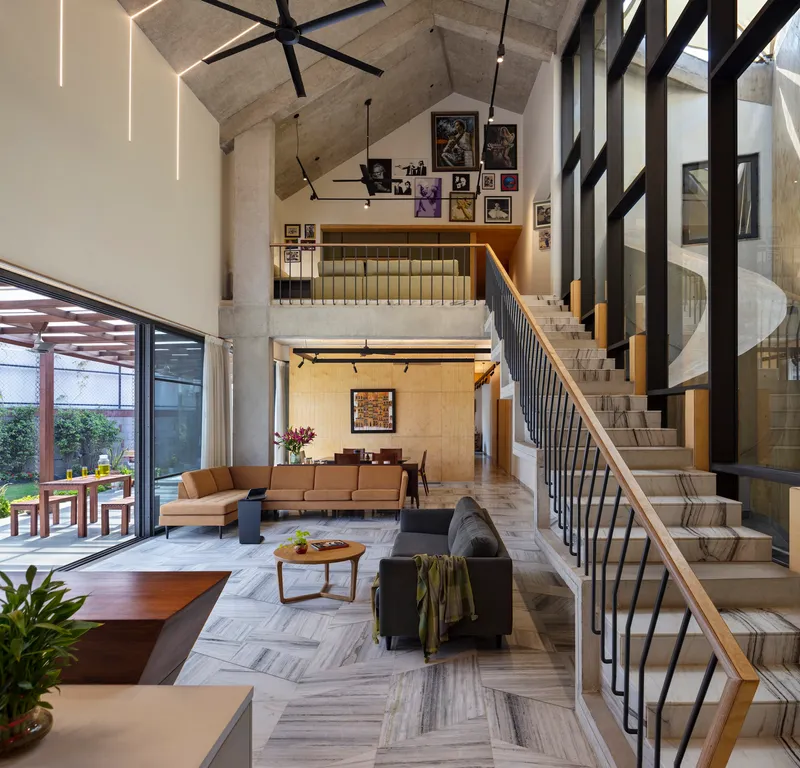
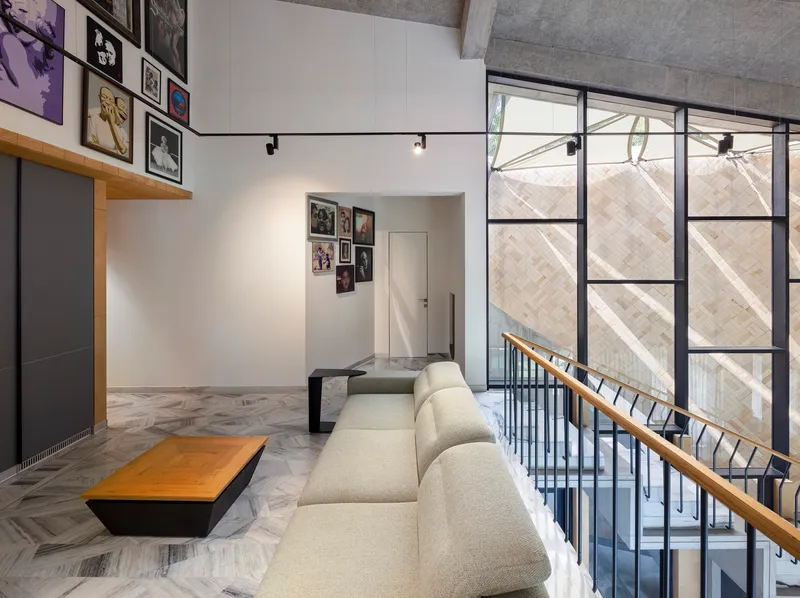
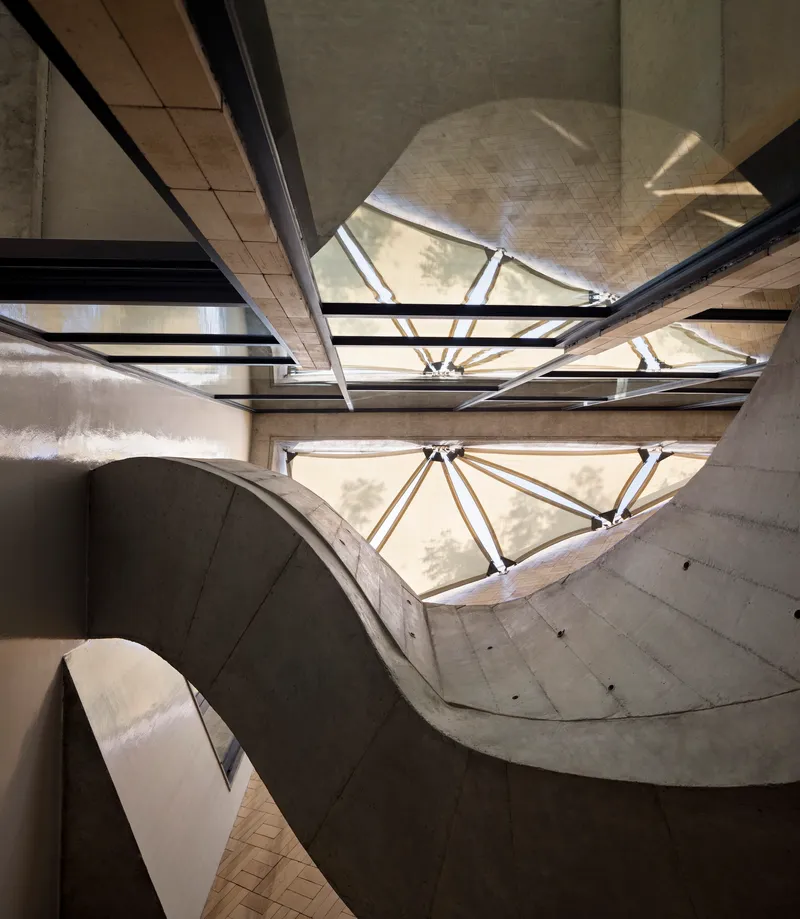
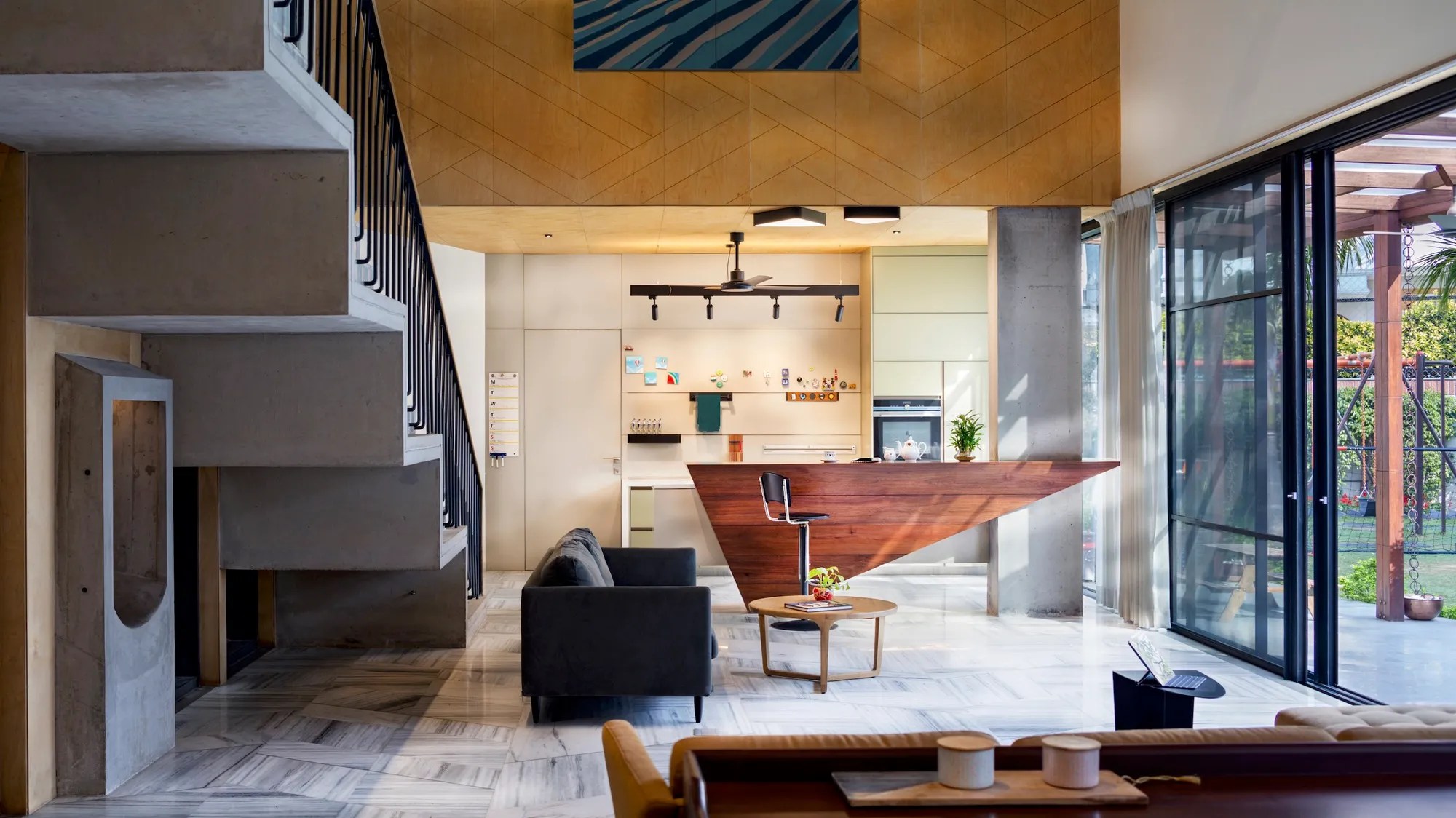
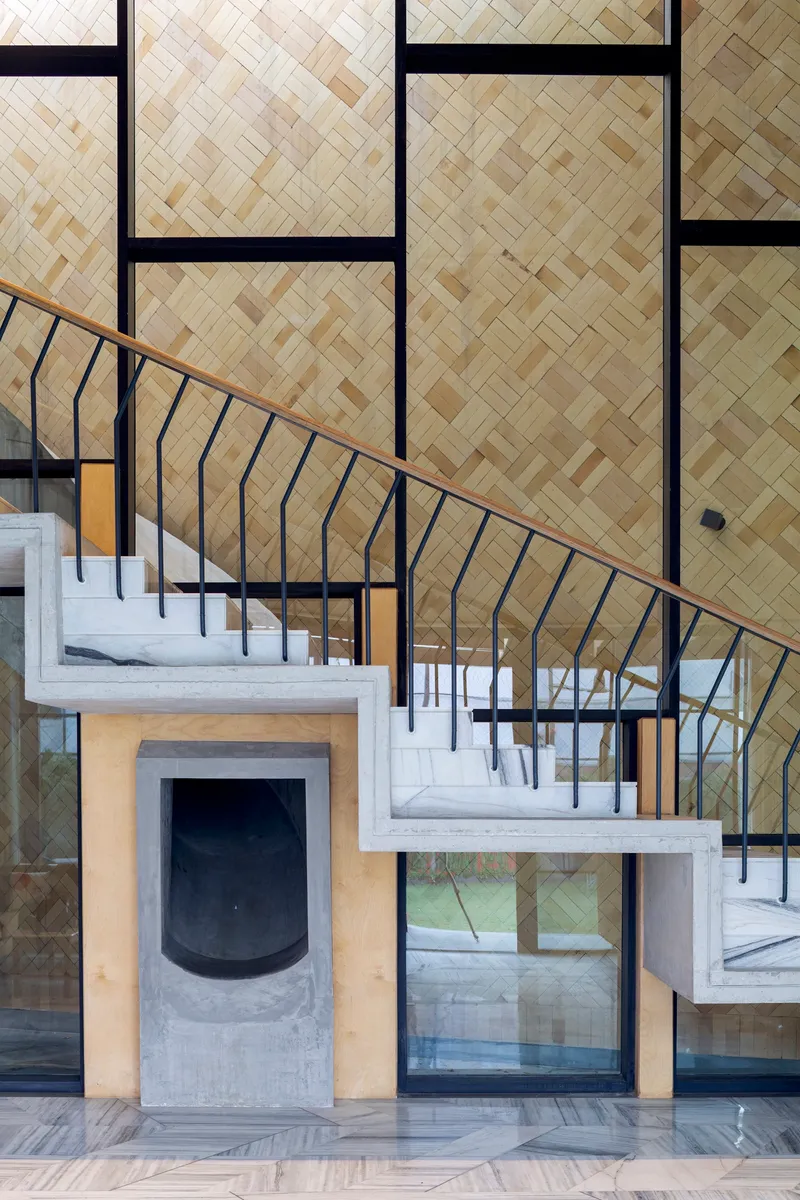
The interior is organized around a large, tapered A-frame volume that houses the open-plan living, dining, and kitchen zone. First-floor bedrooms spill onto a mezzanine lounge that overlooks this double-height space, collapsing the domestic hierarchy into a single, interconnected section. Pitched skylights send shafts of light down through the concrete ceiling, animating the herringbone timber finish above. The cantilevered concrete staircase and steel bracing overhead lend an industrial edge that counterbalances the warmth of the birch joinery.
Looking up through the stairwell, triangular skylights and crossed steel members create a geometry that feels structural and ornamental at the same time. There is no false ceiling, no attempt to hide the bones of the building. The exposed concrete transitions from the red-tinted exterior formwork to a smooth grey finish inside, marking the threshold between public and private with a shift in texture rather than a change in material.
Rooms for Play and Refuge
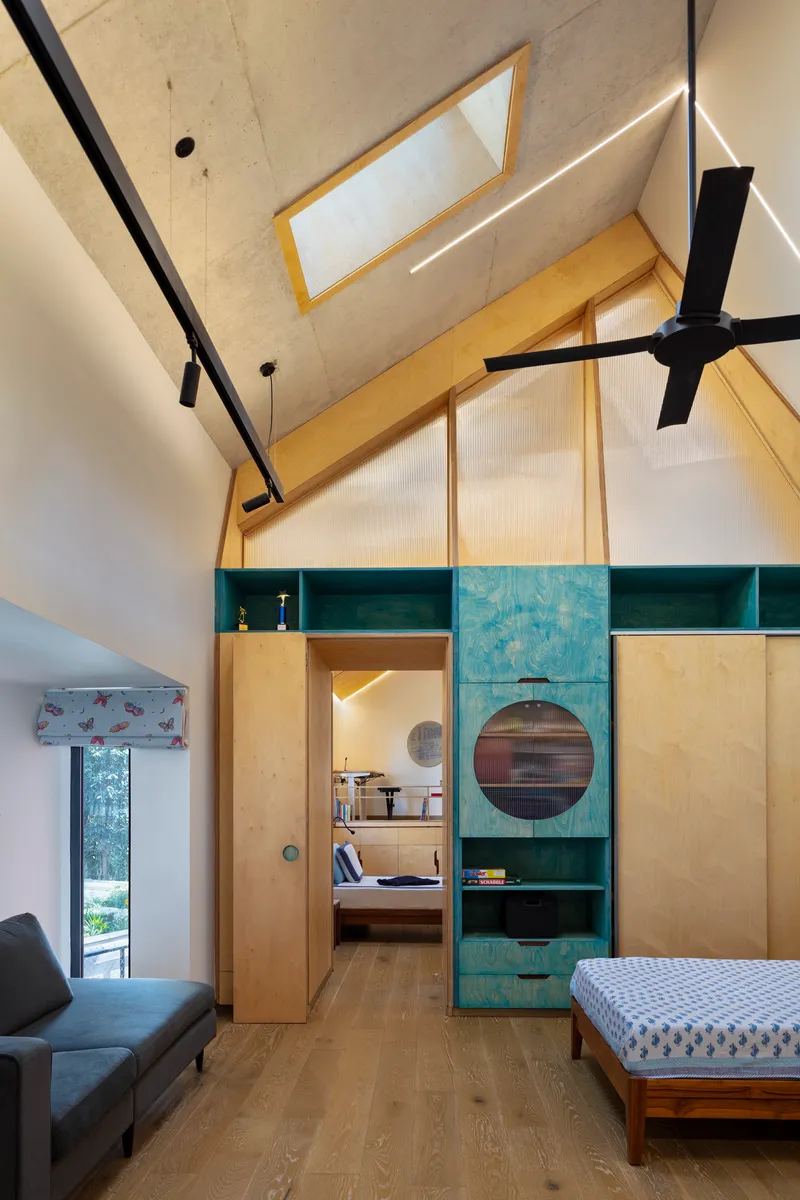
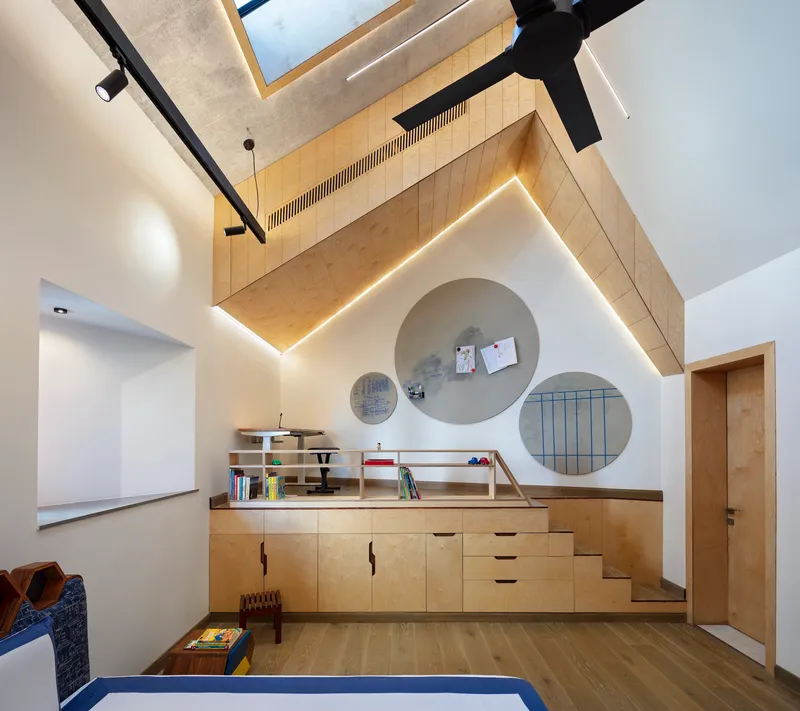
The children's bedrooms are where the playfulness of the brief becomes most tangible. Vaulted plywood storage units feature circular porthole openings that double as climbing niches, and green shelving inserts add unexpected color to the warm wood tones. A loft platform with built-in cabinets sits under the sloping ceiling, creating a fort-like sleeping zone that any child would immediately claim as their own. The slide connecting the attic study to the lower floors is not merely a gimmick; it is a genuine circulation element that collapses the distance between work and play.
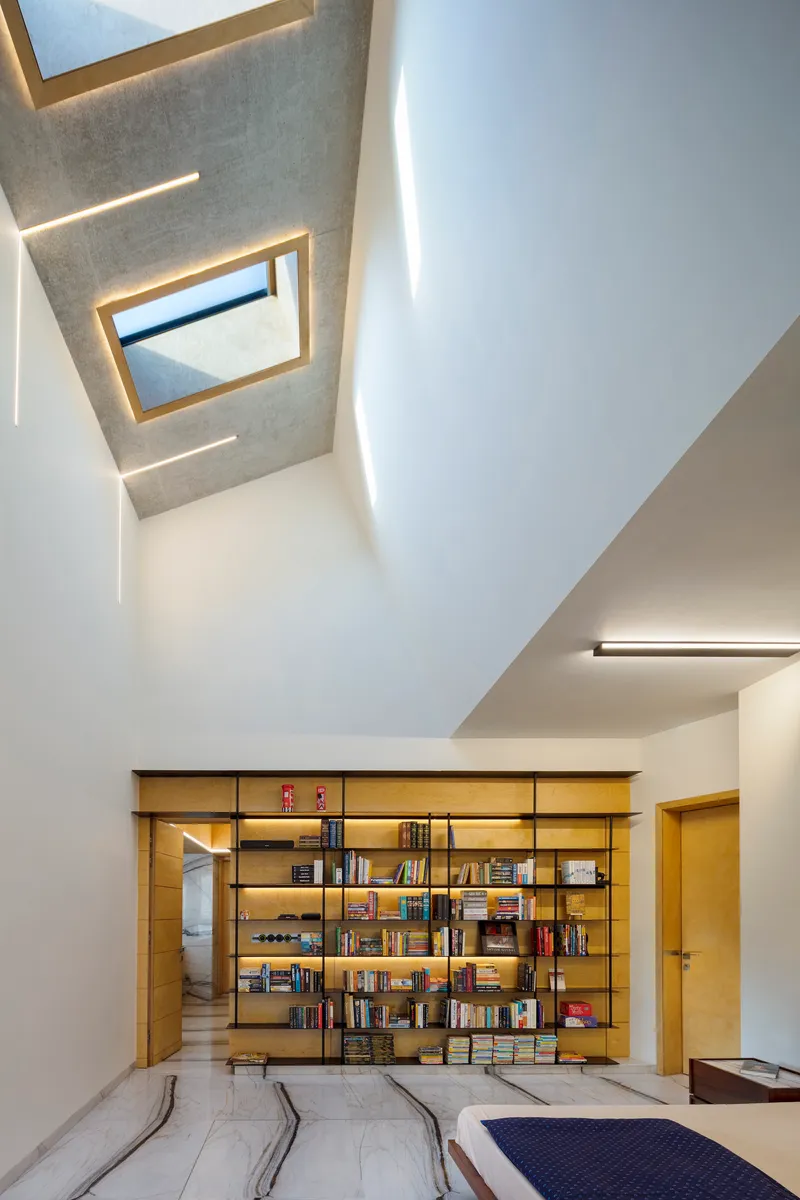
The double-height library, lined with timber bookshelves and washed with skylight, operates as the adults' counterpart to these playful bedrooms. Recessed cove lighting along white walls creates a calm, even illumination that makes the room feel taller than it is. It is a space for concentration, set apart from the open communal zones below.
The Verandah and Landscape
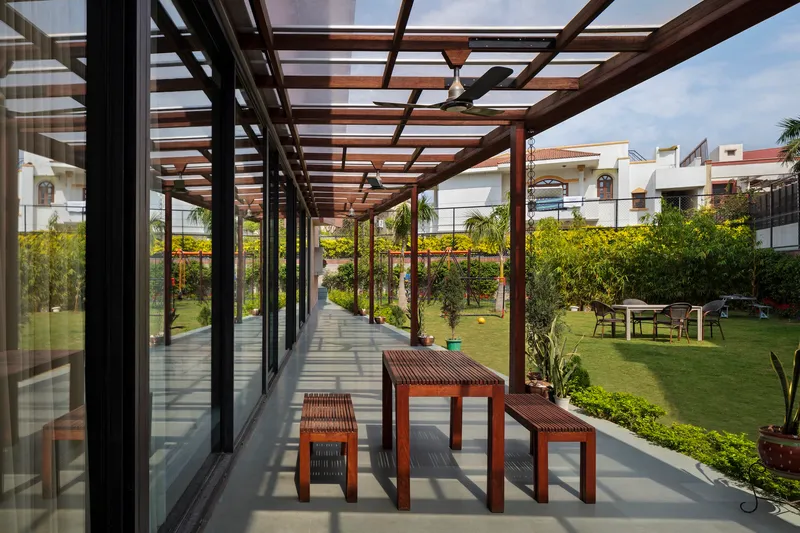
The long verandah, shaded by timber pergola beams, is the hinge of the plan. It mediates between the controlled interior and the open lawn, providing a semi-outdoor dining and living zone that functions for much of the year in Gurugram's climate. Slatted furniture reinforces the linear rhythm of the beams above, and the view through the pergola frames the planted lawn as a composed green field rather than a leftover yard.
At the rear, the house presents a very different face: horizontal timber cladding and continuous glazed openings dissolve the heavy masonry character of the street facade. At twilight, the interior light fills these openings and turns the rear elevation into a lantern above the lawn. The courtyard, visible through floor-to-ceiling glazing, brings a young tree and planted bed into the center of the plan, ensuring that even the most interior rooms maintain a connection to landscape.
Climate and Energy
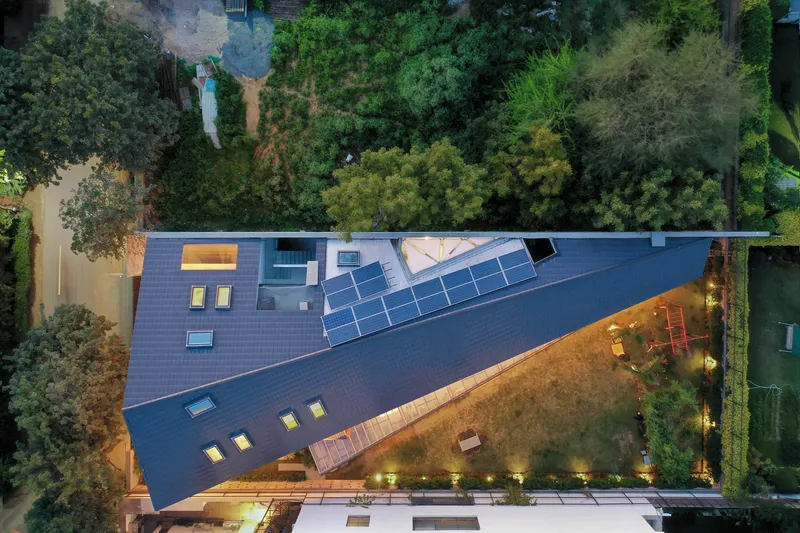
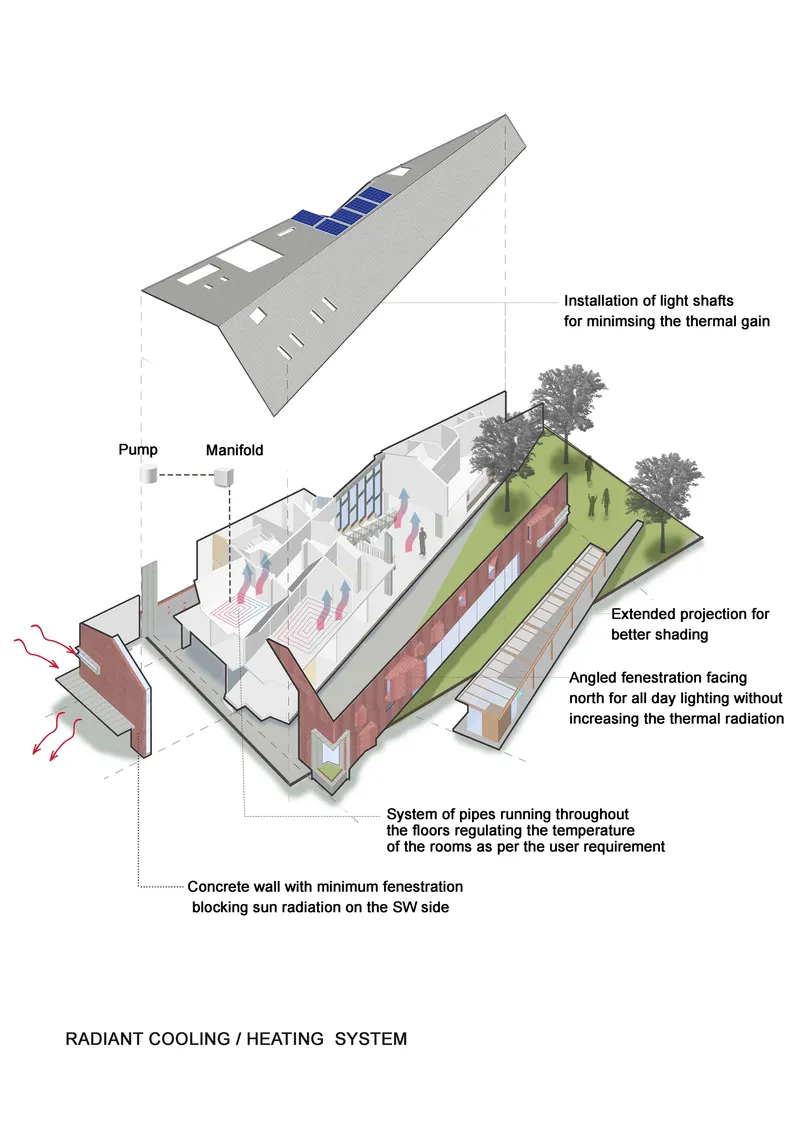
The aerial view at dusk reveals the photovoltaic array marching across the sloped roof, feeding energy back to the grid and offsetting the house's consumption. Skylights are positioned to bring natural light deep into the A-frame section without admitting the brutal solar thermal load that characterizes Gurugram's summers. The tapering linear form and careful window placement minimize western exposure while maximizing the north-south orientation toward the lawn.
Beneath the finished floors, an under-floor radiant heating and cooling system handles the semi-arid, semi-humid subtropical climate with significantly lower energy consumption than conventional forced-air systems. Anagram notes that this was the first installation of the technology in a residence in the region. Combined with the 300-mile material sourcing radius, which prioritizes North Indian marbles over imported stones and uses locally available terracotta and brick, the project demonstrates that environmental ambition and a modest construction budget are not mutually exclusive.
Plans and Drawings
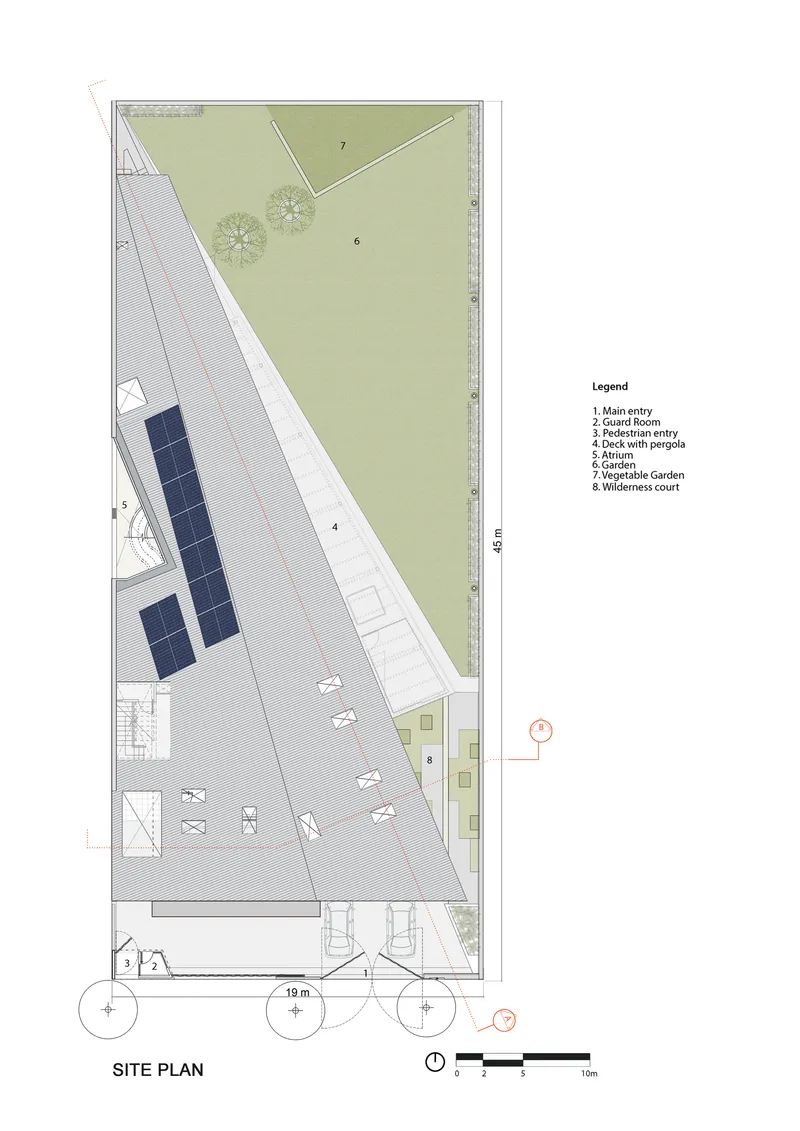
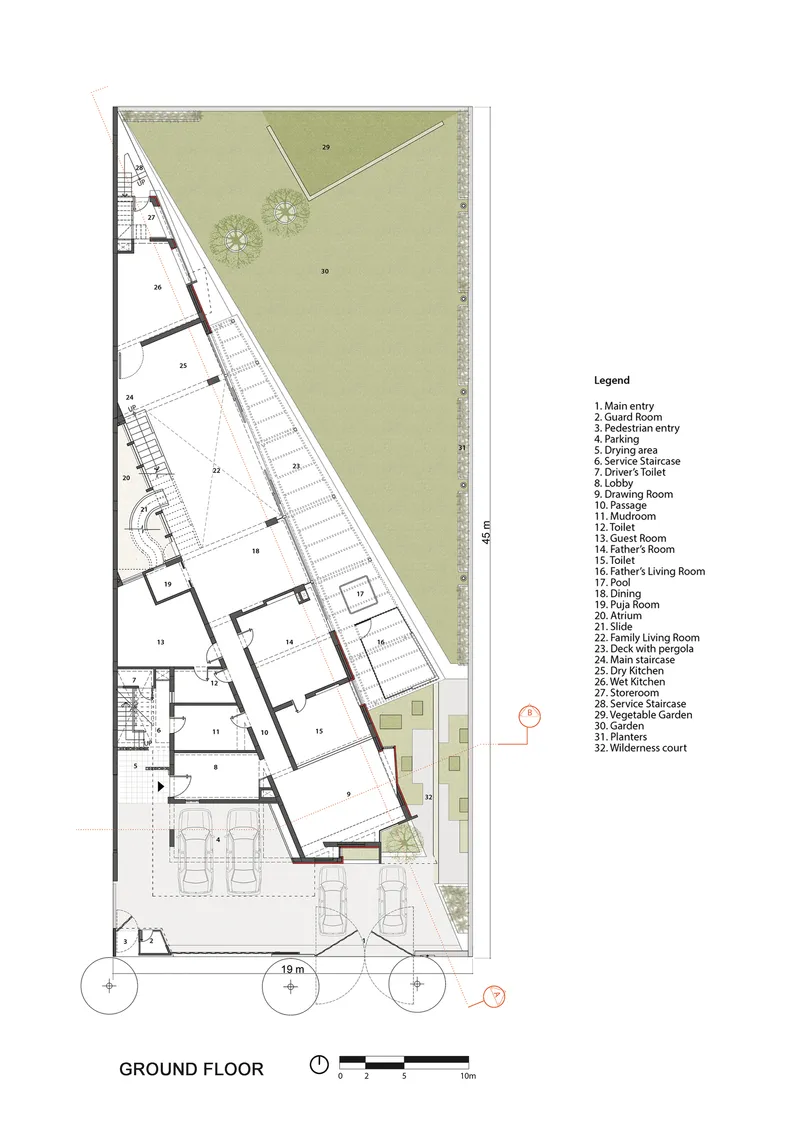
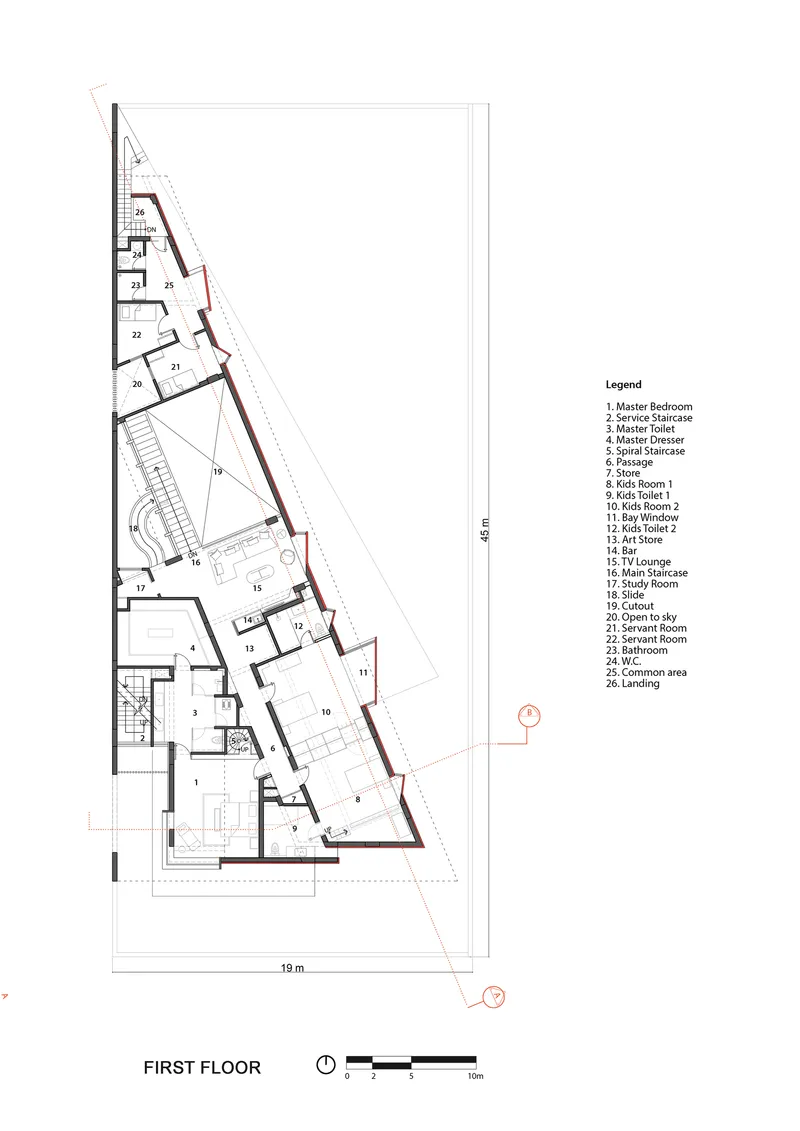
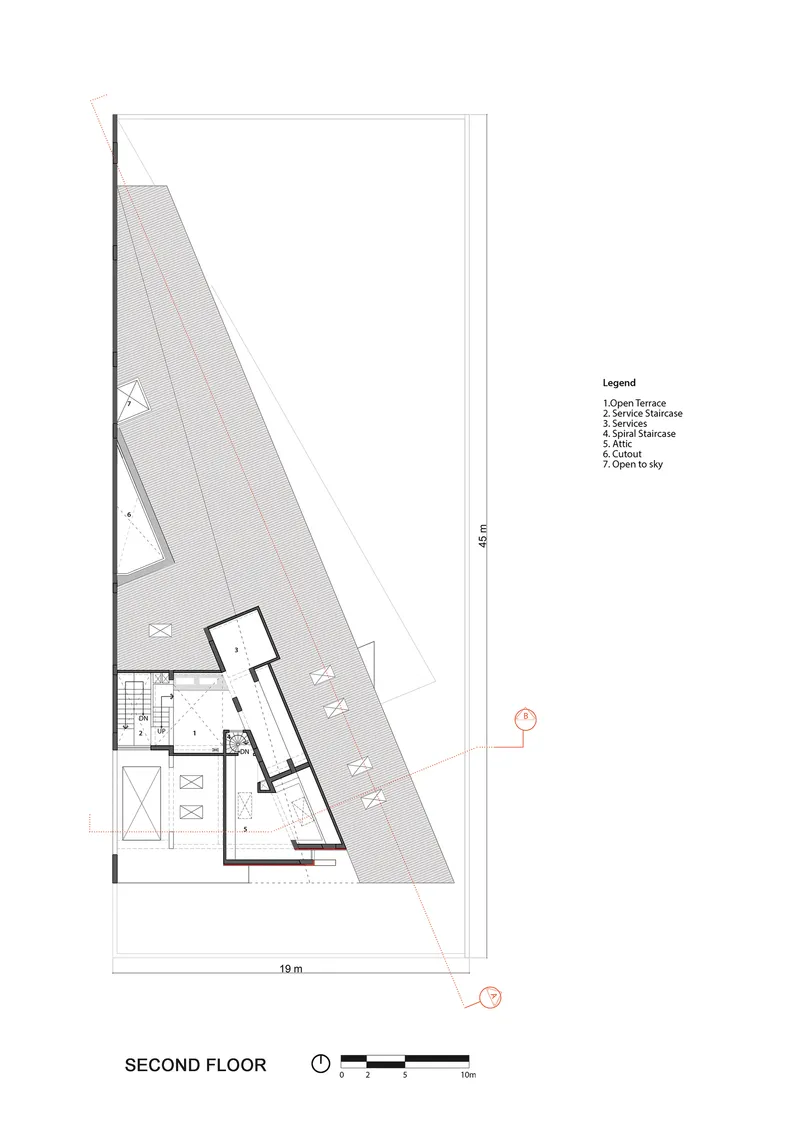
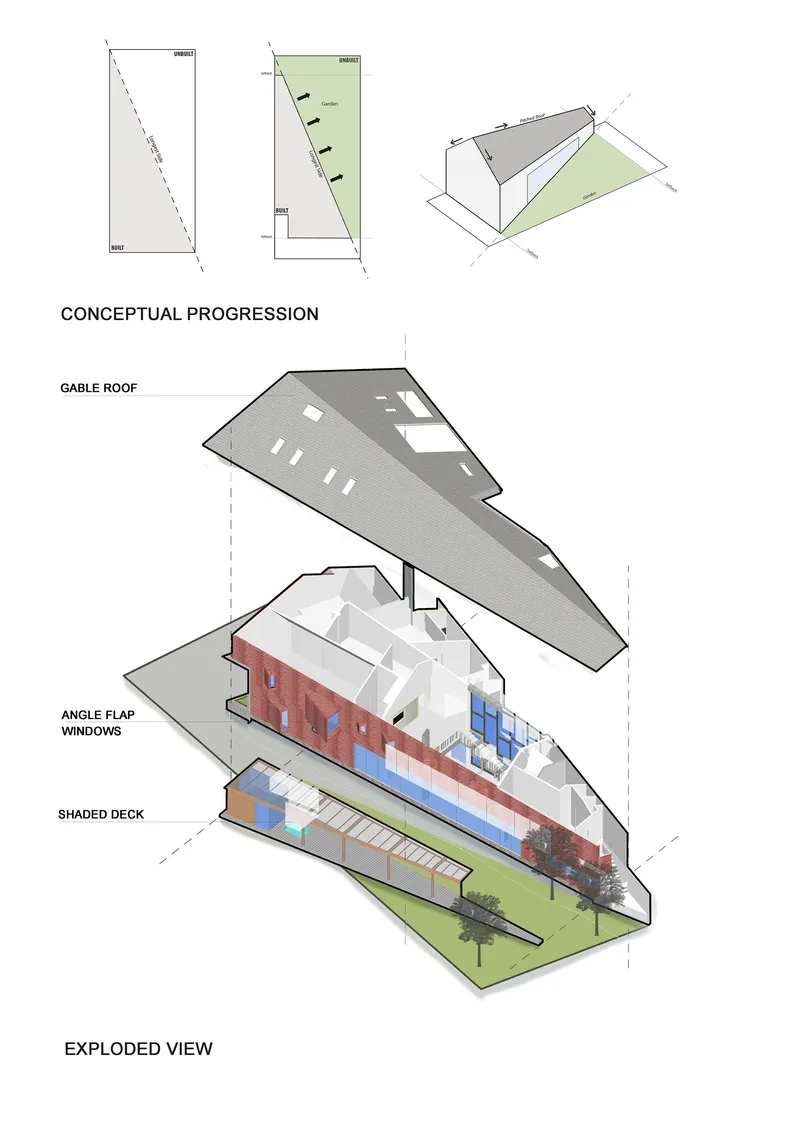
The site plan makes the diagonal strategy immediately legible: the triangular building footprint and the triangular lawn are mirror figures carved from a single rectangle. The ground floor plan shows how the angled geometry generates a long entry sequence and pushes the living areas toward the garden edge, while the first floor plan reveals how bedrooms and study spaces line the angled perimeter with circulation concentrated along the interior wall. The second floor is mostly open terrace, punctuated by skylights that feed light to the double-height spaces below.
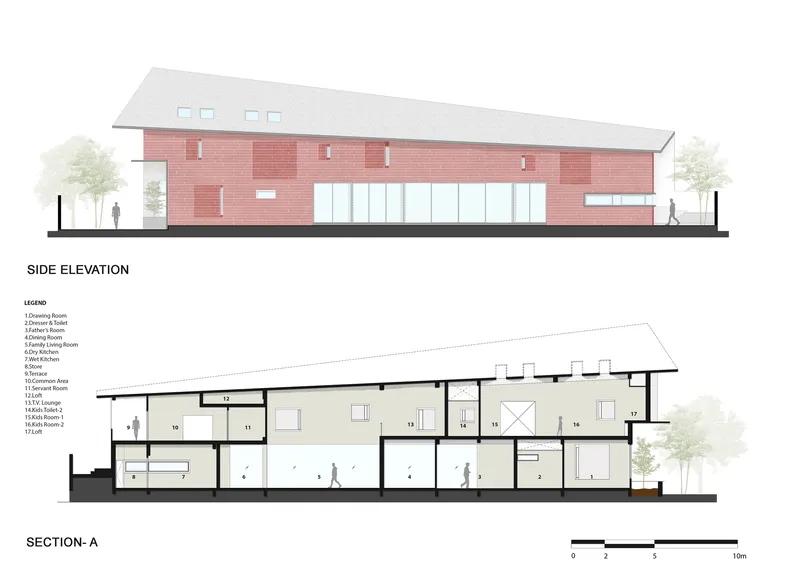
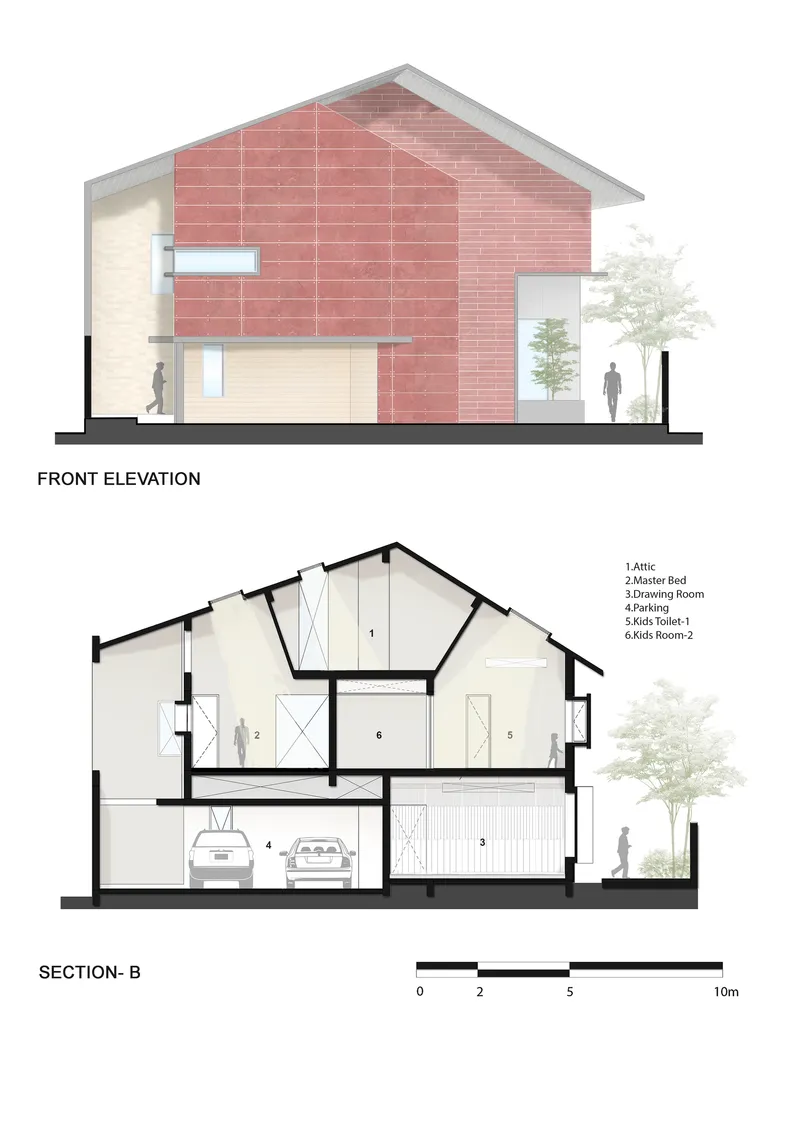
The sectional drawings are perhaps the most revealing. The gabled form rises steeply from a relatively compact footprint, and the relationship between the skylit attic, the mezzanine lounge, and the double-height living room becomes clear in section. The exploded axonometric shows the layered assembly: landscape base, shaded deck, angled window walls, and the gable roof as a distinct structural cap. The radiant system diagram illustrates how embedded floor piping, roof openings, and light shafts work together as an integrated environmental section rather than separate mechanical and architectural systems.
Why This Project Matters
Chromatic House matters because it refuses the false choice between domesticity and ambition. In a city where residential architecture often defaults to gated boxes optimized for resale value, Anagram Architects produced a home that is specific to its family, its climate, and its material context. The diagonal site strategy, the A-frame section, and the under-floor radiant system are all strong individual ideas, but what elevates the project is the way they reinforce one another. The diagonal cut creates the lawn; the lawn justifies the open south facade; the open facade demands the passive solar strategy; and the passive strategy is completed by the radiant floor and the photovoltaic roof. Each decision cascades logically into the next.
For families considering how to build in dense Indian suburbs, and for architects navigating similar constraints, Chromatic House offers a clear lesson: the most generous thing you can do on a tight urban plot is give half of it away to landscape. The house gains more from its lawn than it loses in built area, and the children gain a home that treats play not as a program to be contained in one room but as a principle that shapes the entire section. That is worth more than a fourth bedroom.
Chromatic House by Anagram Architects. Located in Gurugram, India. Built-up area: 6,800 sq. ft. on a 9,203 sq. ft. plot. Completed in 2021. Photography by Andre J Fanthome.
About the Studio
Share Your Own Work on uni.xyz
If projects like this are the kind of work you want to make, uni.xyz is a place to publish your own, find collaborators, and enter design competitions.




Popular Articles
Popular articles from the community


Lunar Spiral: Space Architecture Shaped by the Mathematics of the Universe
Lunar Spiral reimagines space architecture through Fibonacci geometry, lunar regolith, levitating habitats, and self-sustaining Moon living.

Co-Life: Senior Housing Design That Reconnects Older Adults With the City
Co-Life reimagines senior housing design through healing gardens, shared streets, workshops, and a sustainable community across generations.

Conexión: Biophilic Design Reimagines High-Rise Living in Hong Kong
Conexión reimagines high-rise living in Hong Kong through biophilic design, green facades, shared spaces, daylight, water and nature within.

Hill & Cross Opera: Sculptural Opera House Architecture Shaped by Tallinn’s Landscape and Identity
Hill & Cross Opera reimagines opera house architecture in Tallinn through its sculptural hill, civic plaza, glass wave and a luminous cross.


Similar Reads
You might also enjoy these articles

Bao Huynh Watercolor Atelier: A Serene Art Retreat in Hội An
Bao Huynh Watercolor Atelier in Hội An blends multifunctional art spaces, sustainable design, local materials, and family-friendly living in a serene environment.

Atelier Macri Concept Store Interior Design by CASE-REAL
Atelier Macri store features a "ko" counter, walnut wood details, cork displays, blending retail, gallery, and seamless customer experiences.

Manuel Vargas Izquierdo Stadium and High-Performance Sports Center: Architectural Excellence in Jalpa de Méndez
The Manuel Vargas Izquierdo Stadium blends sustainable design, inclusive sports facilities, and cultural-inspired architecture, revitalizing Jalpa de Méndez’s public spaces.
KAKR Buluh Awar Hall: Revitalizing Community and Ecology Through Bamboo Architecture
Community built bamboo hall revitalizes Buluh Awar village, empowering youth, restoring ecology, celebrating vernacular craftsmanship through sustainable architecture and culture.



Comments (0)
Please login or sign up to add comments
No comments yet. Be the first to comment!