
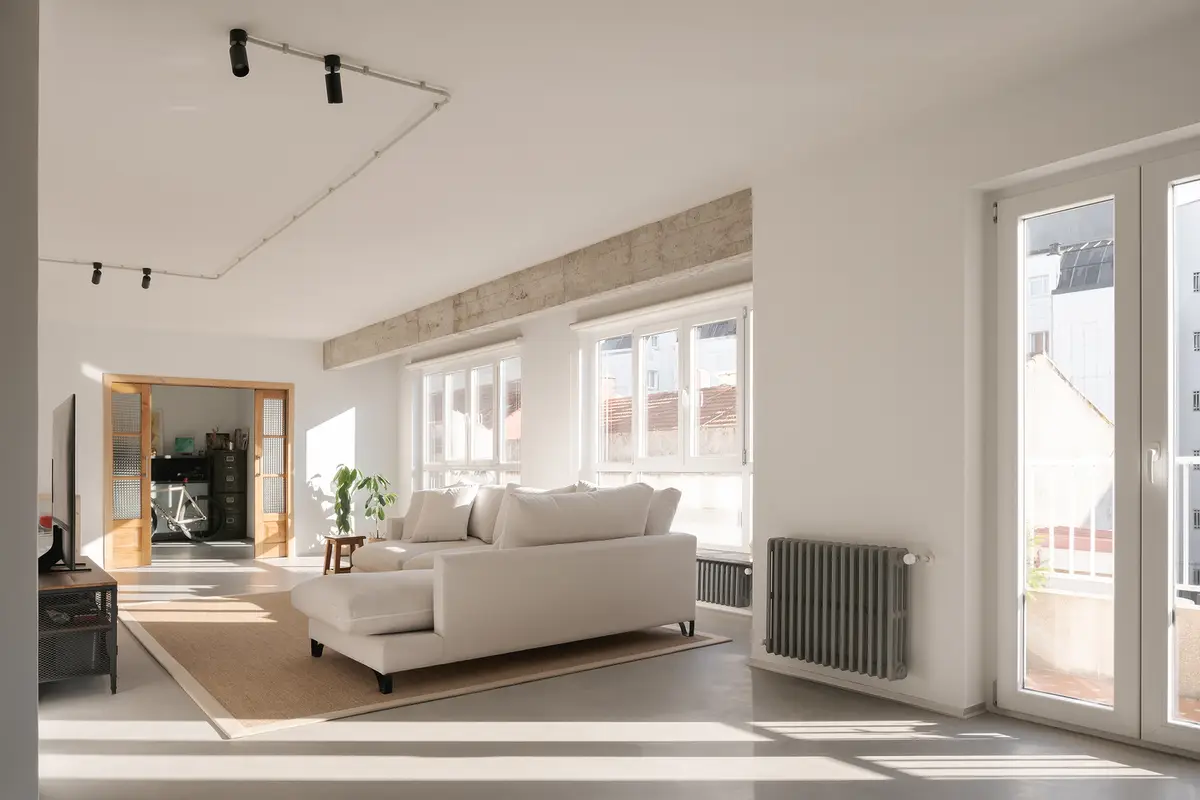
NAN Arquitectos Reveals Hidden Concrete Bones in a Pontevedra Apartment for a Young Family
A 205-square-meter renovation in Pontevedra, Spain strips back decades of finishes to reunite old structure with new domestic life.


Renovation projects in historic city centers tend to fall into two camps: the full gut job that erases every trace of the past, or the precious restoration that treats the existing fabric like a museum exhibit. NAN Arquitectos sidesteps both traps in their rework of a 205-square-meter apartment on Rúa Andrés Muruais in Pontevedra, Spain. Completed in 2022 for a couple, their baby, and two dogs, the project strips away accumulated layers of plaster and paneling to expose a rough concrete framework that had been buried for years, then threads new curved timber partitions and a restrained palette of white and gray through the space to make the old bones feel like a deliberate design choice rather than a leftover.
What makes the project genuinely interesting is its refusal to treat the exposed concrete as mere texture. The uncovered beams and lintels become the primary spatial markers: they define thresholds, anchor lighting runs, and give each of the apartment's three longitudinal zones its own distinct ceiling character. Meanwhile, the new insertions, particularly the curving timber and glass screens, never touch or mimic the concrete. The contrast is frank and legible. You always know what is old and what is new, and the tension between them is what gives the apartment its charge.
Framing the Threshold
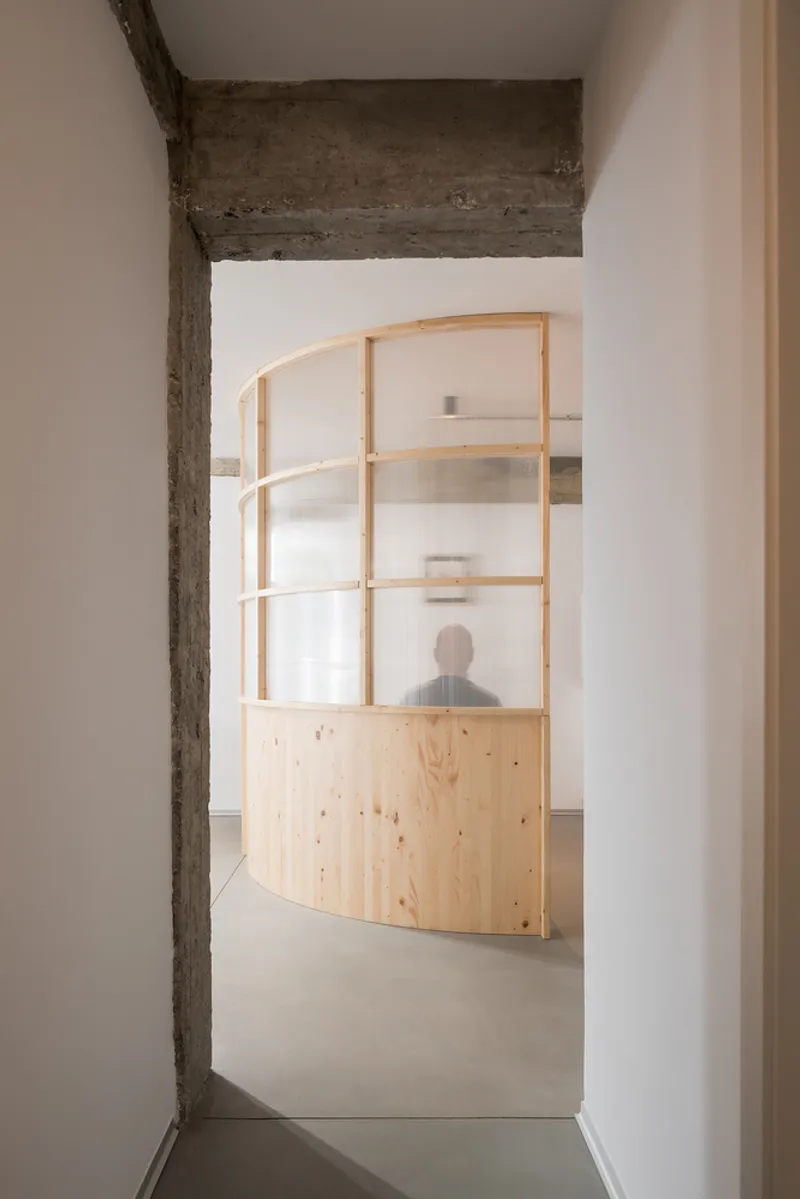
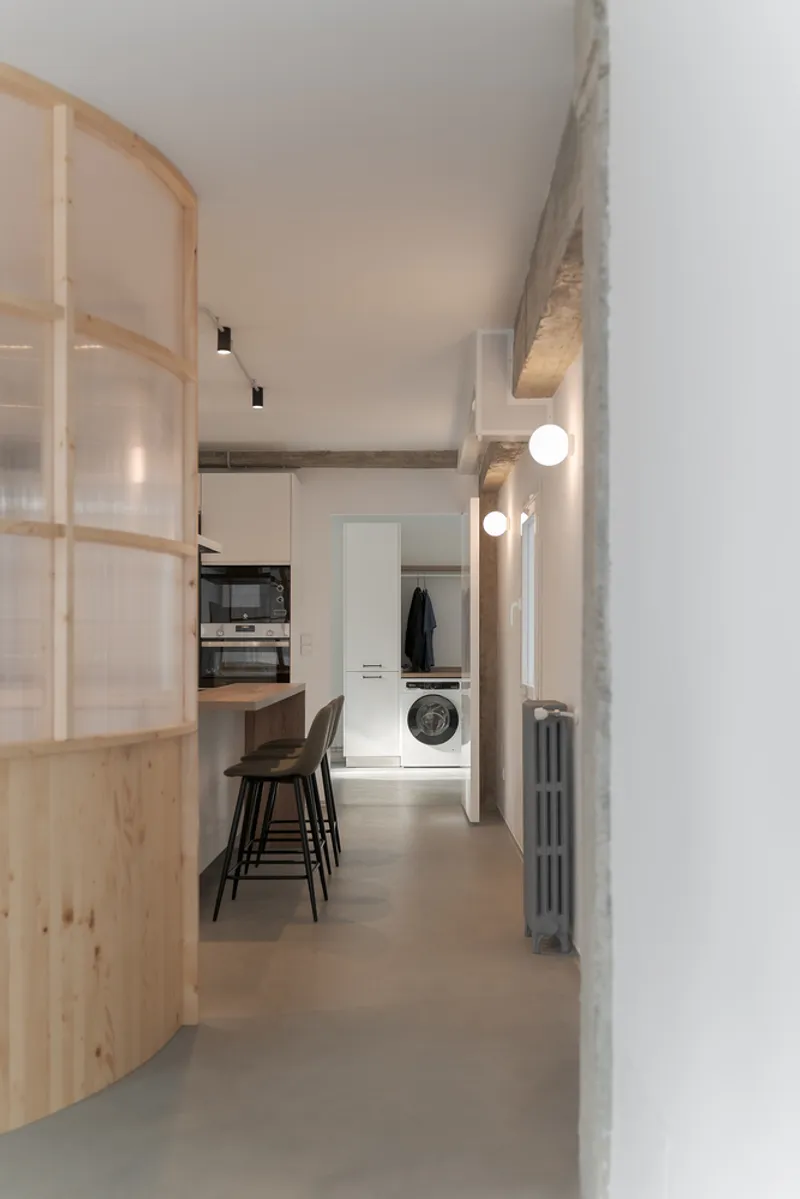
The raw concrete doorway captured in these views does heavy architectural work. By leaving the original frame exposed, complete with the rough formwork imprint on its surface, NAN Arquitectos turns a simple passage into a moment of deliberate transition. The curved timber and glass partition visible beyond sits in sharp material opposition: warm, light, finely milled wood against cold, porous concrete. A silhouetted figure moving through the space reinforces the scale and makes clear that these are not decorative gestures but full-height spatial elements designed to organize circulation.
The corridor that extends from this threshold reveals how the architects manage depth in a long, narrow plan. Rather than relying on a straight axis, the curved screen introduces a gentle lateral deflection that pulls the eye sideways and slows the pace of movement. The kitchen and laundry areas visible at the far end are glimpsed rather than announced, creating a sequence that unfolds gradually as you walk through.
The Curved Screen as Spatial Device
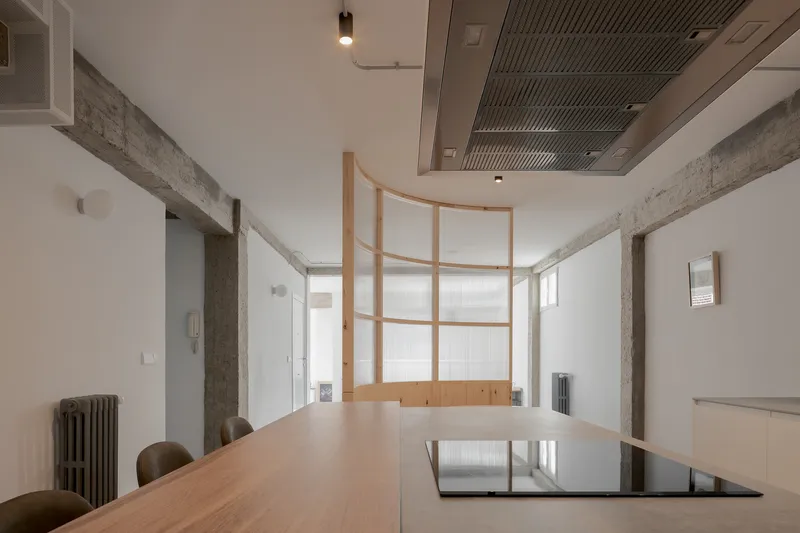
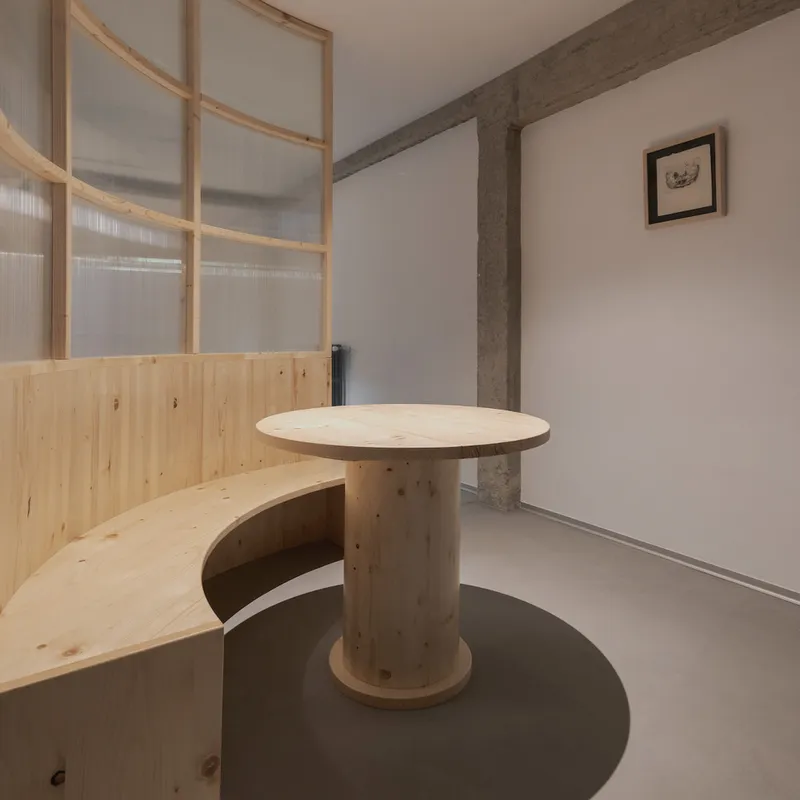
The translucent curved partition is the single most assertive new element in the apartment, and it earns its prominence. Constructed from timber slats with inset glass panels, the screen separates the living and dining zones without severing visual connection. Light passes through it in both directions, softened and diffused, so that adjacent rooms register as present but private. It is a partition that behaves more like a piece of furniture than a wall.
A cylindrical timber table and a built-in curved bench tuck into the corner beside the screen, creating an intimate work or dining nook beneath the exposed concrete beam. The inset black panel on the conference table suggests a considered integration of services, possibly for power or data, that keeps the surface clean while acknowledging the practical demands of a home that doubles as a workspace. The material continuity between the table, bench, and screen gives this corner a sense of completeness: every piece belongs to the same family of insertions.
Designing for Dogs and Laundry
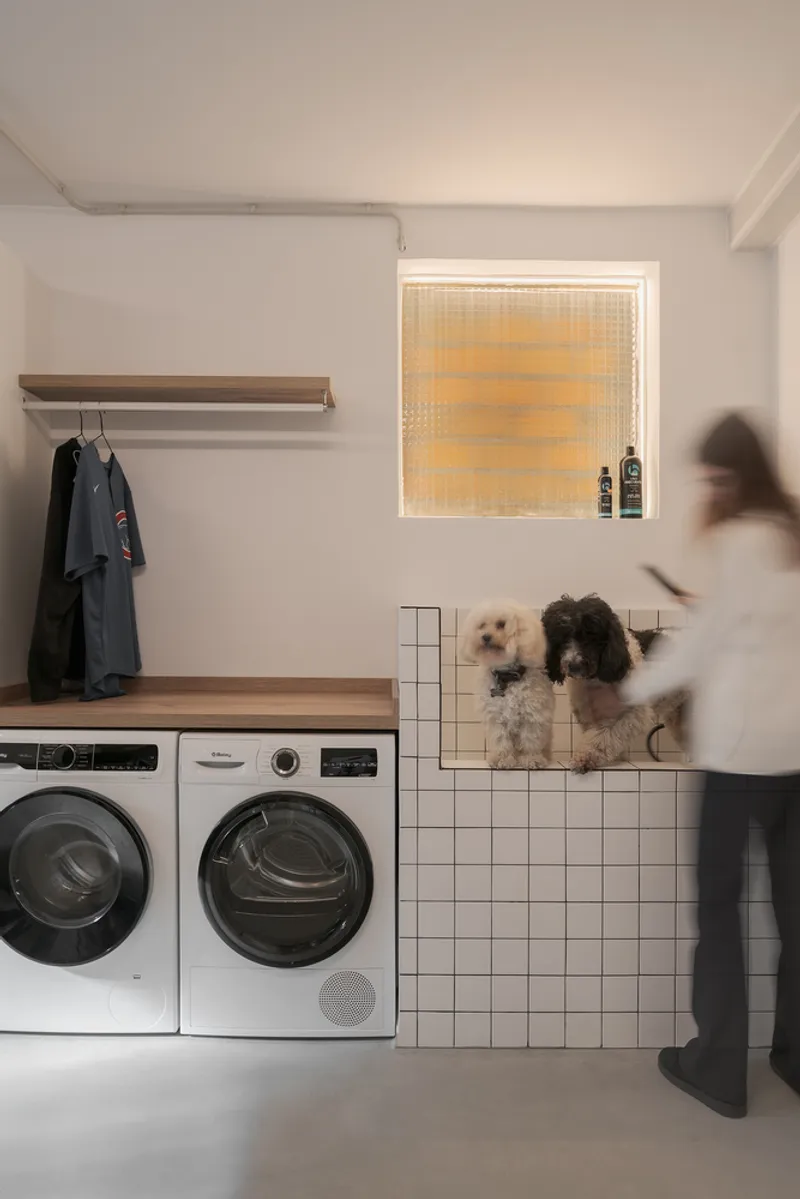
Too many residential renovations treat utility spaces as afterthoughts, buried behind the most forgettable door in the apartment. NAN Arquitectos does something more honest here. The laundry room, which includes a tiled dog-washing station, receives the same level of spatial attention as the public rooms. A backlit glass block window fills the room with an even, milky glow that makes the white tile surfaces feel luminous rather than clinical. The proportions are generous enough that the space reads as a proper room, not a closet.
Accommodating two dogs in a city-center apartment is a real programmatic challenge, and the dedicated wash station is a practical solution that most architects would not bother to design so carefully. The fact that a figure can be caught passing through the frame in motion suggests the room sits on a primary circulation path, integrated into daily routine rather than sequestered at the plan's dead end.
Light, Concrete, and the Living Room
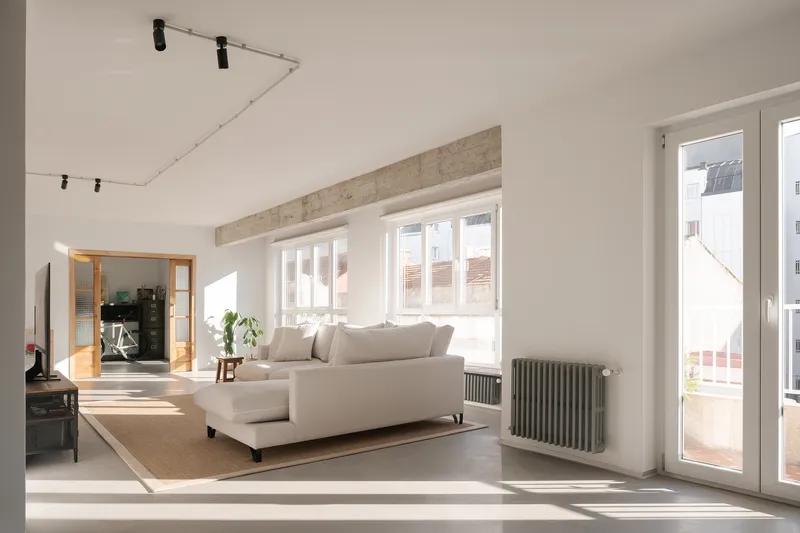
The living room is where the renovation's strategy comes together most clearly. Daylight floods in through multiple windows and rakes across the polished concrete floor, turning the surface into a reflective plane that amplifies the brightness deep into the plan. The exposed concrete beam overhead, running the full width of the room, provides a strong horizontal datum that anchors the composition and keeps the generous ceiling height from feeling formless.
NAN Arquitectos' lighting approach is deliberately understated: a visible track system traces along the concrete structure, projecting focused beams onto surfaces and objects rather than washing the room in ambient light. The result is an interior where natural and artificial light play distinct roles. During the day, the windows dominate. At night, the track fixtures take over, sculpting the same concrete surfaces with controlled pools of illumination. It is a simple technique, but it demands precise placement, and it rewards the effort.
Why This Project Matters
The Andrés Muruais House is a useful case study in how to renovate without sentimentality. NAN Arquitectos does not fetishize the original apartment or pretend it was more beautiful than it was. They strip it back, assess what has structural and spatial value, and then build a new domestic landscape around those elements. The exposed concrete is not nostalgic; it is simply honest. The new timber screens and continuous flooring are not apologetic; they are confident enough to stand next to rough formwork without flinching. The chromatic restraint of white and gray keeps the conversation between old and new legible throughout.
For a 205-square-meter apartment serving a young family with real, messy needs (a baby, two dogs, laundry, work from home), the project also demonstrates that spatial clarity and domestic function are not mutually exclusive. The U-shaped plan cleanly separates day and night zones, the utility areas are designed with the same care as the living room, and the curved partitions allow privacy without sacrificing the openness that makes a compact apartment feel livable. It is not a radical project. It is a disciplined one, and discipline is harder to pull off.
Andrés Muruais House by NAN Arquitectos, Pontevedra, Spain. 205 m². Completed 2022. Photography by Iván Casal Nieto.
About the Studio
Share Your Own Work on uni.xyz
If projects like this are the kind of work you want to make, uni.xyz is a place to publish your own, find collaborators, and enter design competitions.


Popular Articles
Popular articles from the community


The Ocean Hive: Sustainable Architecture for a Self-Sufficient Civilization at Sea
The Ocean Hive imagines sustainable architecture at sea, where modular habitats, algae, wave power and ocean waste sustain a growing colony.

Hill & Cross Opera: Sculptural Opera House Architecture Shaped by Tallinn’s Landscape and Identity
Hill & Cross Opera reimagines opera house architecture in Tallinn through its sculptural hill, civic plaza, glass wave and a luminous cross.

Co-life: Sustainable Architecture for Age-Friendly Community Living
Co-life reimagines sustainable architecture for seniors through courtyards, rammed earth, shared gardens, and spaces designed for belonging.

Lunar Spiral: Space Architecture Shaped by the Mathematics of the Universe
Lunar Spiral reimagines space architecture through Fibonacci geometry, lunar regolith, levitating habitats, and self-sustaining Moon living.

Similar Reads
You might also enjoy these articles


Hodi-Mandai Geram
Project Function: Preservation and revitalization of the Intangible heritage and socio-spatial identity of the Hodi by Housing, Cultural Memory Center, Sacred Grove, landscape, local tourism economy


Olio Towers: A Mid-Rise for Performers That Fuses Housing, Rehearsal, and Stage
Located blocks from Houston's Theater District, this modular tower stacks living units around a central performance atrium.

Oasis: Modular Green Housing Carved into Dhaka's Urban Fabric
A shortlisted Plugin Housing entry reclaims unauthorized settlements in Dhaka with stepped concrete volumes, green roofs, and ventilation-driven design.

Black Hole: A Floating Megastructure for the Post-Physical Era
Emiliano Mazzarotto envisions a spherical, self-scaling arena where e-sports, digital hotels, and holographic stadiums replace traditional public space.

Explore Architecture Competitions
Discover active competitions in this discipline

Challenge to reimagine the Iron Throne

Photograph architecture without architects

Illustrate the lost glory of Angkor Wat - Render Challenge

Design challenge to reuse E-waste
Comments (0)
Please login or sign up to add comments
No comments yet. Be the first to comment!