
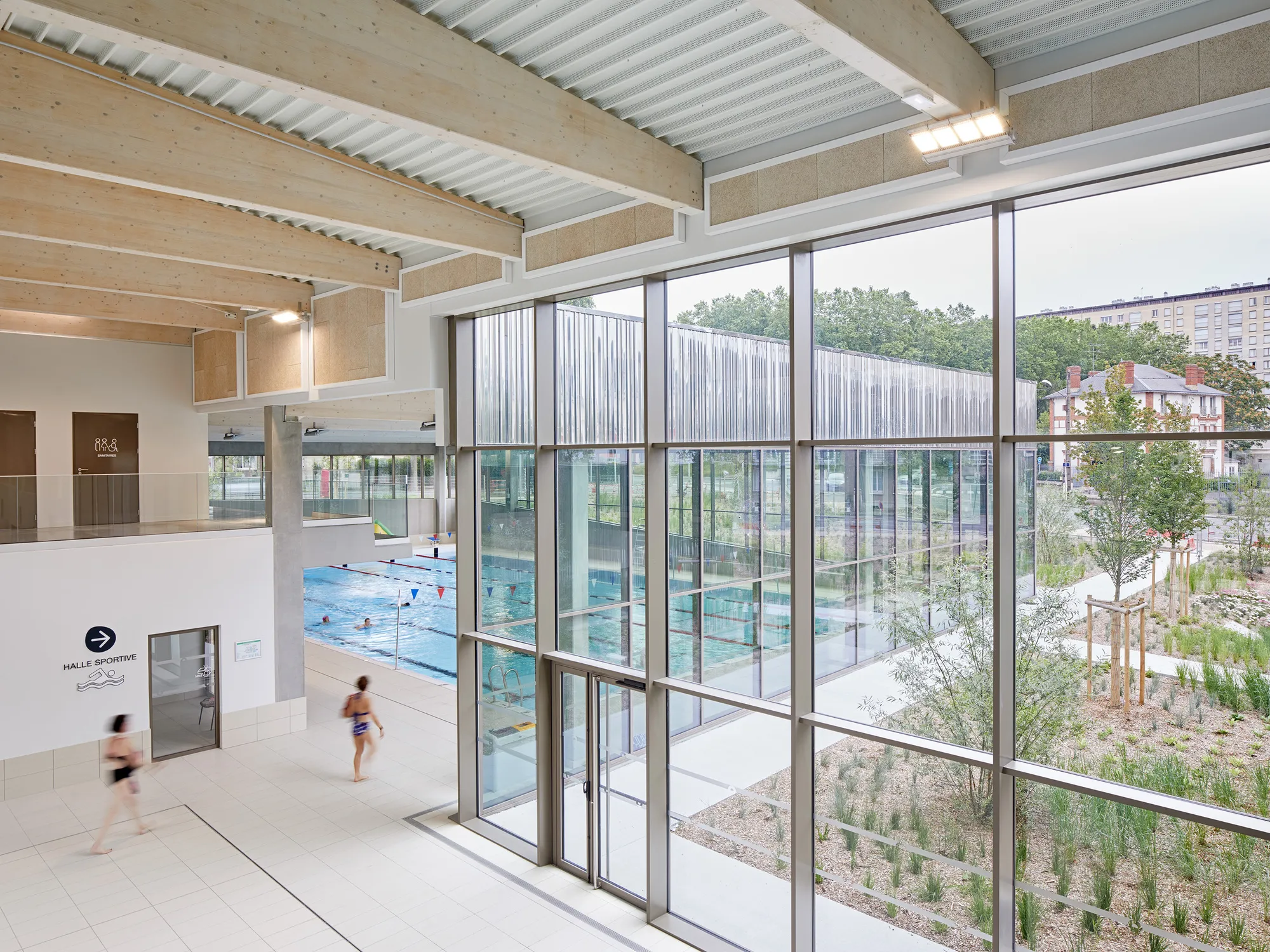
ANMA Converts the Site of a Former Orléans Jail into a Timber-Framed Aquatic Center
A low-slung aqualudic complex wrapped in timber and wild grasses replaces a decommissioned prison near the heart of Orléans, France.


A ten-minute walk from Orléans train station, on the former grounds of the city's decommissioned jail, ANMA has planted a 6,300 square meter aquatic center that reads less like a civic sports facility and more like a pavilion dissolving into its landscape. The Aqualudic Center L'O, completed in 2021, replaces the hard perimeter of incarceration with continuous glazing, timber cladding, and planted roofs that blur the line between building and park. It is a pointed act of urban repair, swapping one of the city's most closed institutions for one of its most permeable.
What makes L'O genuinely interesting is the refusal to treat an aquatic center as a sealed, climate-controlled box. The building is organized as a cluster of low rectangular volumes around courtyards and planted gaps, keeping the interior spaces in constant visual dialogue with the outdoors. Swimmers look through floor-to-ceiling glass to meadows of wild grasses; visitors on the green roof walk among perennials at the same level as the treetops. The architecture insists that water, daylight, and vegetation are not separate programs but a single continuous experience.
A Low Horizon Behind the Trees
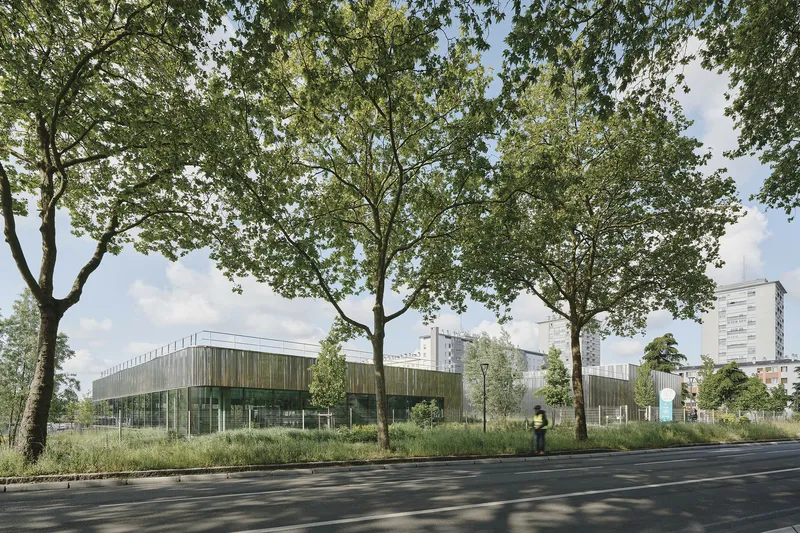
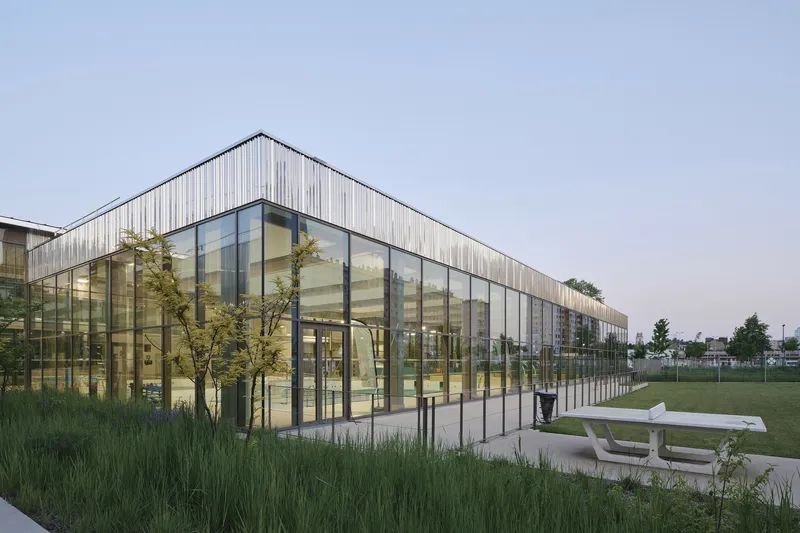
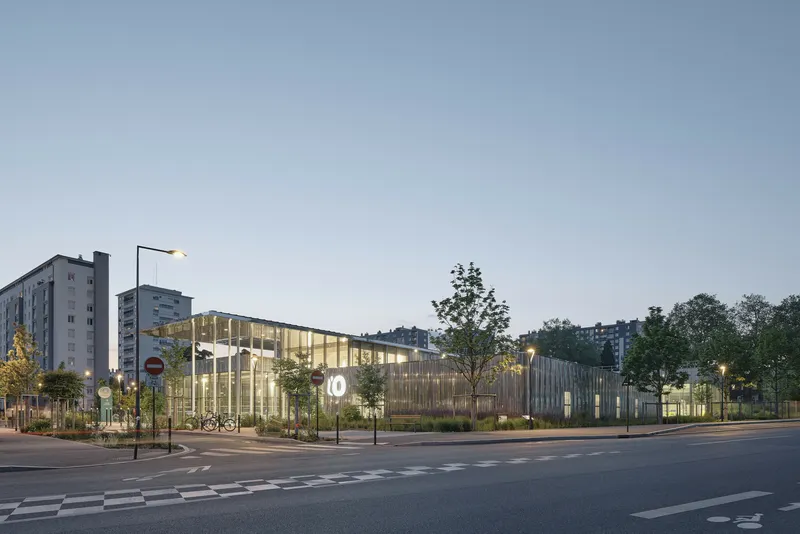
From the street, L'O barely announces itself. Mature plane trees screen the facade, and the building's deliberately low horizontal profile tucks under the canopy line rather than competing with it. At dusk the glazed walls glow warmly through vertical timber screens, giving the complex a lantern-like quality that is inviting without being monumental. The restraint is deliberate: in a neighborhood still adjusting to the absence of a prison wall, ANMA chose a building that defers to its context rather than demanding attention.
The timber cladding wraps continuously around corners, unifying volumes that vary in height and program. Combined with the corrugated metal roof soffit visible at the entrance canopy, the material palette reads as warm, industrial, and precise. There is nothing recreational or cartoonish about the exterior, which is a welcome change from the inflatable aesthetics that plague so many European leisure pools.
Landscape as Infrastructure
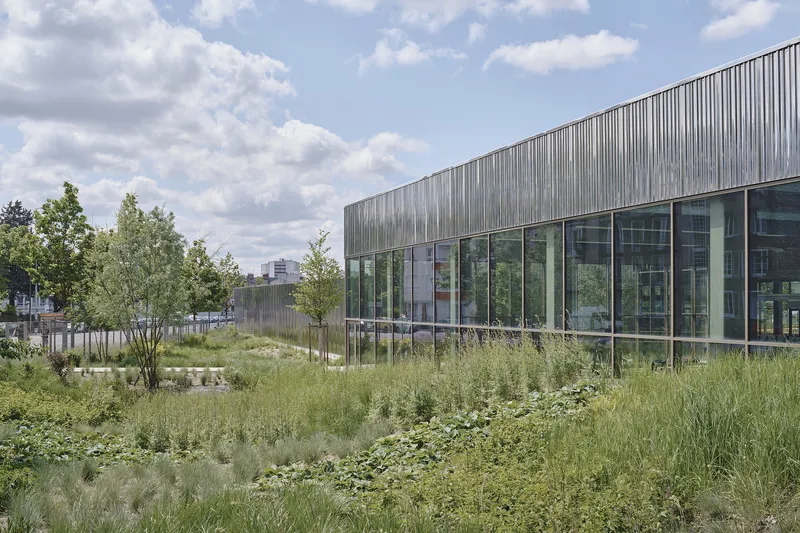
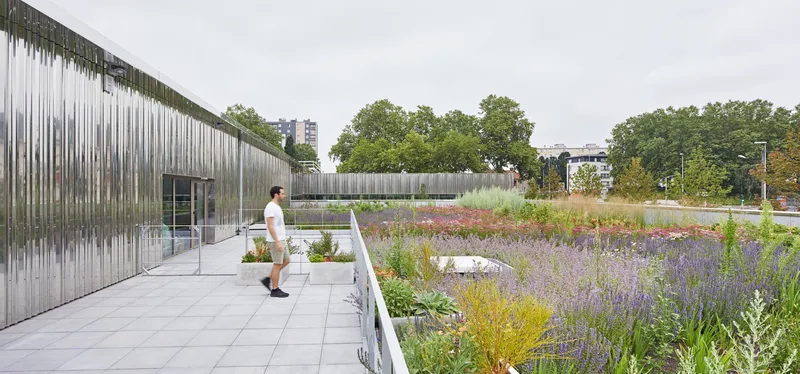
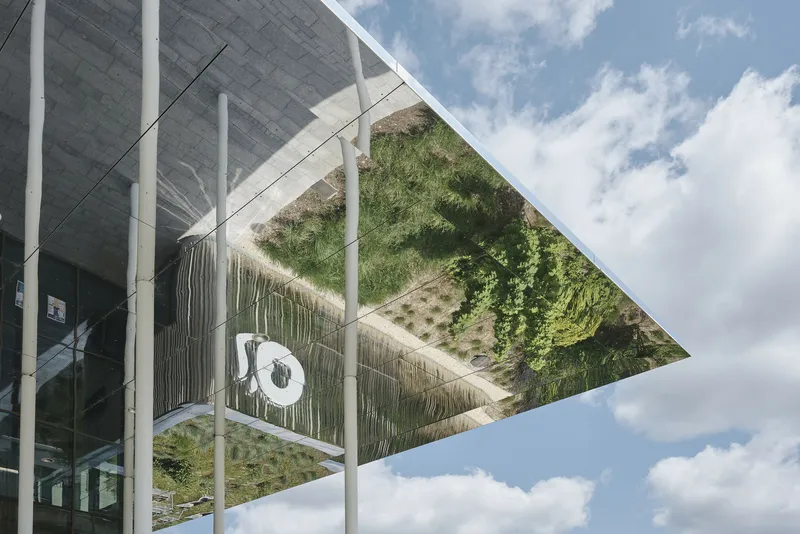
The meadow of wild grasses that fronts the building is not ornamental filler. Together with the planted green roof and the courtyards threaded between the volumes, it forms a continuous ecological surface that manages stormwater, reduces the urban heat island effect, and provides habitat. Looking up from beneath the white structural columns at the roof edge, the planting reads as thick and deliberate, not as a token sedum tray.
Walking along the roof terrace, you encounter perennials and grasses at arm's length beside the timber facade. The effect is that the building appears to grow out of its site rather than sitting on top of it. For a program that consumes enormous amounts of water and energy, this landscape strategy is both an ethical statement and a practical one, softening the environmental footprint of a facility that, by nature, is resource intensive.
Timber Structure and the Quality of Interior Light
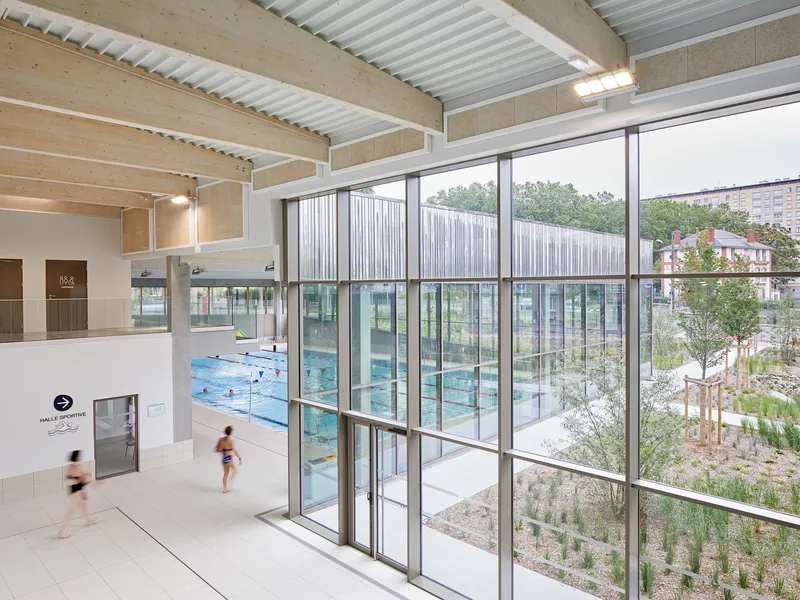
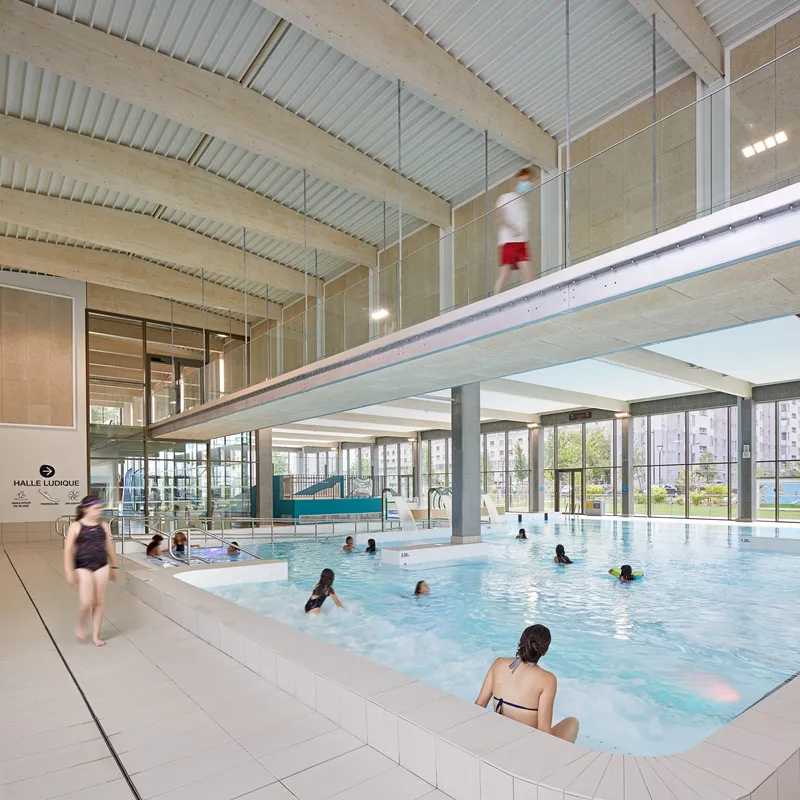
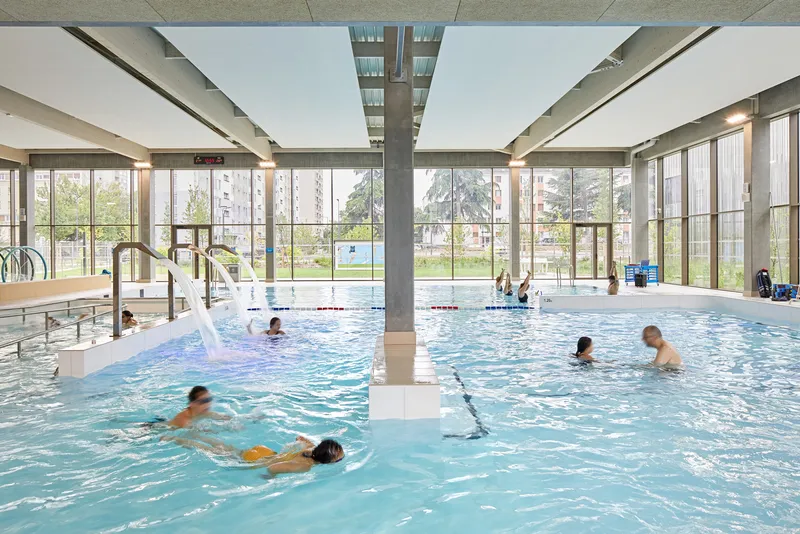
Inside, exposed timber beams span the pool halls and reception areas, giving the interiors a warmth and acoustic softness that concrete or steel structures rarely achieve in aquatic buildings. The corrugated metal ceiling panels bounce indirect light downward, while the floor-to-ceiling glazing on the pool's long side floods the water surface with natural light and frames views of the sunlit park beyond. It is hard to overstate how much this changes the experience of swimming: instead of staring at tiled walls, you are floating toward a landscape.
The mezzanine overlooking the main pool, bounded by a glass balustrade, adds a spectator dimension without enclosing the volume. Parents, trainers, and casual visitors occupy a social perch that keeps the pool hall feeling active and watched over. The structural logic is honest throughout: beams, columns, and connections are expressed, not concealed, lending the space a workshop clarity that pairs well with the physicality of sport.
Arrival and the Timber Lobby
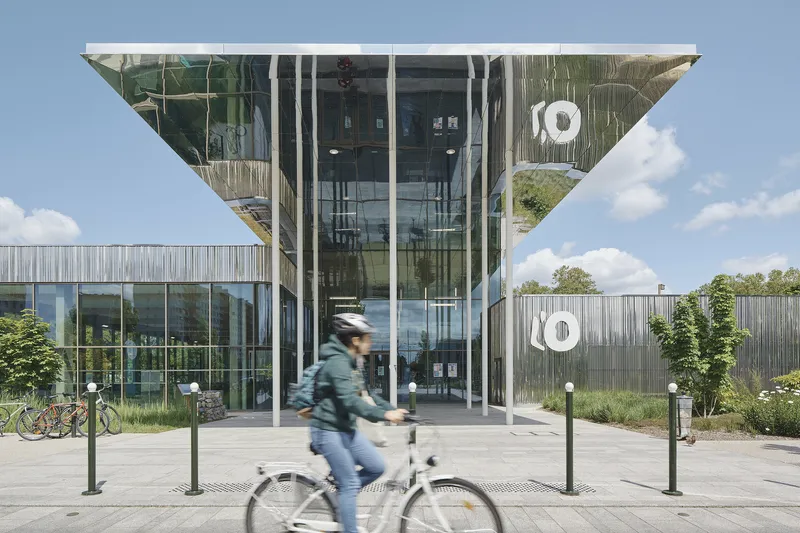
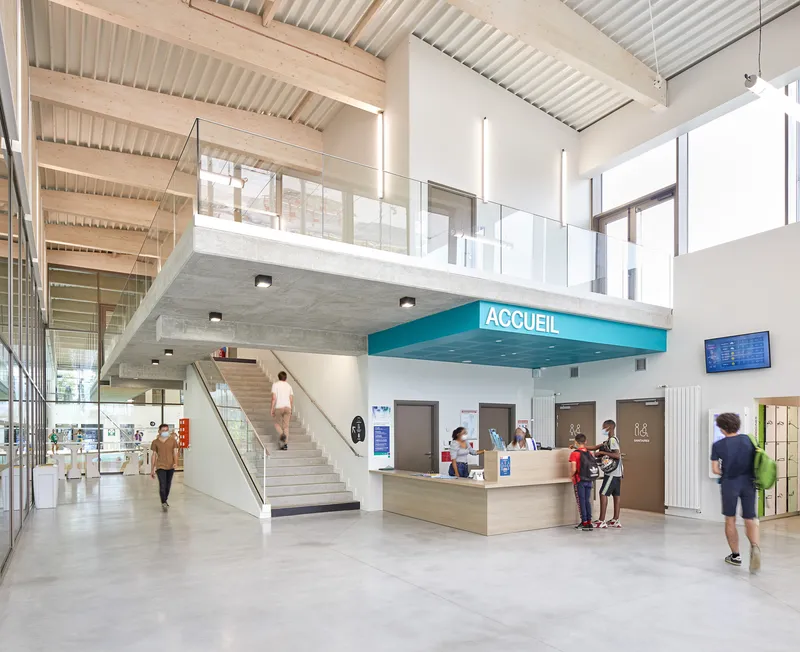
The entrance sequence is compact and legible. A cantilevered soffit marks the threshold from the paved public plaza, and within a few steps you are in a double-height reception lobby defined by a timber-slatted ceiling that filters overhead light into warm bands. A mezzanine walkway crosses above, connecting upper-level programs and giving the lobby a sense of activity and vertical depth that prevents it from reading as a mere corridor.
The reception desk itself is clad in wood, consistent with the material vocabulary. ANMA has clearly thought about the moment a swimmer arrives, wet-haired and slightly disoriented, and designed a space that orients through materiality and light rather than signage. It is a small detail, but it signals a facility that was designed from the user's body outward, not from a site plan downward.
The Spa as Threshold
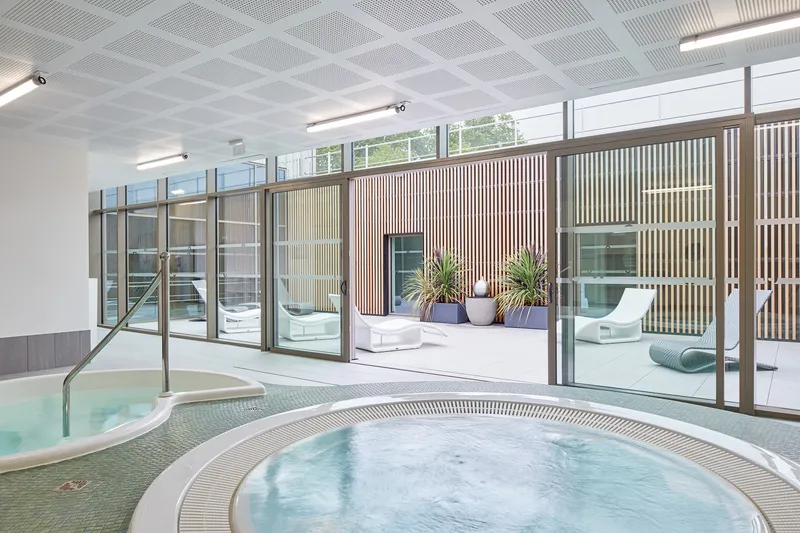
The circular spa pool, screened by timber slats and opening through glass doors onto an outdoor terrace, is one of the most quietly accomplished spaces in the building. It occupies a transitional zone between the interior pool program and the landscape, functioning as a decompression chamber for visitors moving between wet and dry, warm and cool, inside and out. The slatted screen controls privacy and light simultaneously, creating a filtered atmosphere that feels genuinely restorative rather than performatively luxurious.
Plans and Drawings
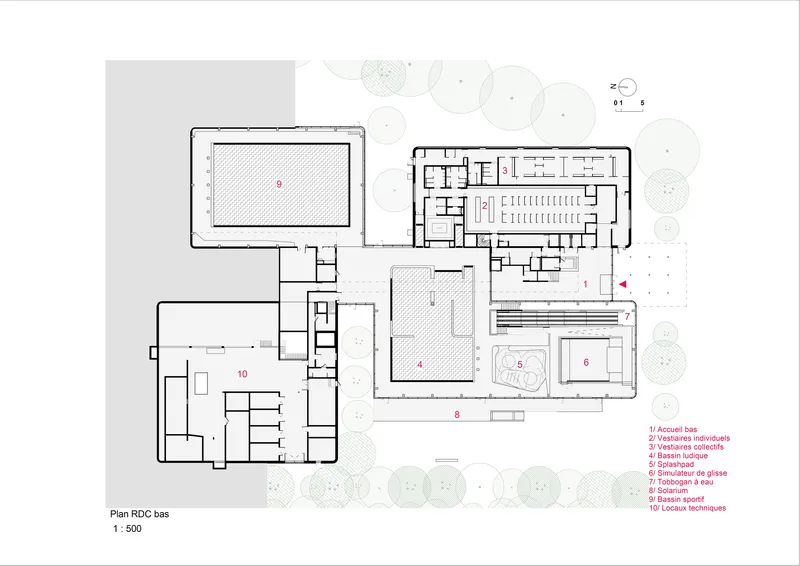
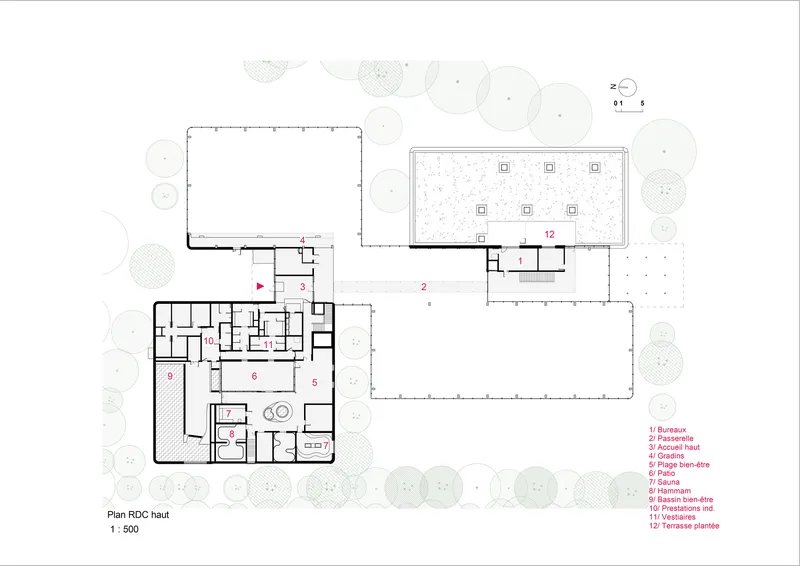
The ground floor plan reveals the organizational logic: a cluster of rectangular volumes, no single dominant mass, arranged around courtyards and tree plantings that push landscape deep into the building's footprint. Pools, changing rooms, and technical spaces each occupy discrete volumes, connected at their edges but independently legible. The upper level plan shows a lighter occupation, with the mezzanine walkways and spectator areas reading as bridges between the main program blocks.
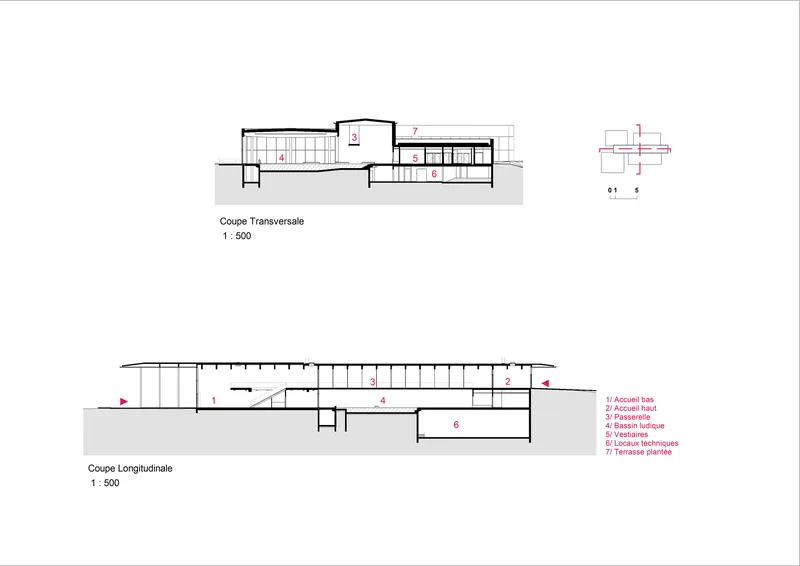
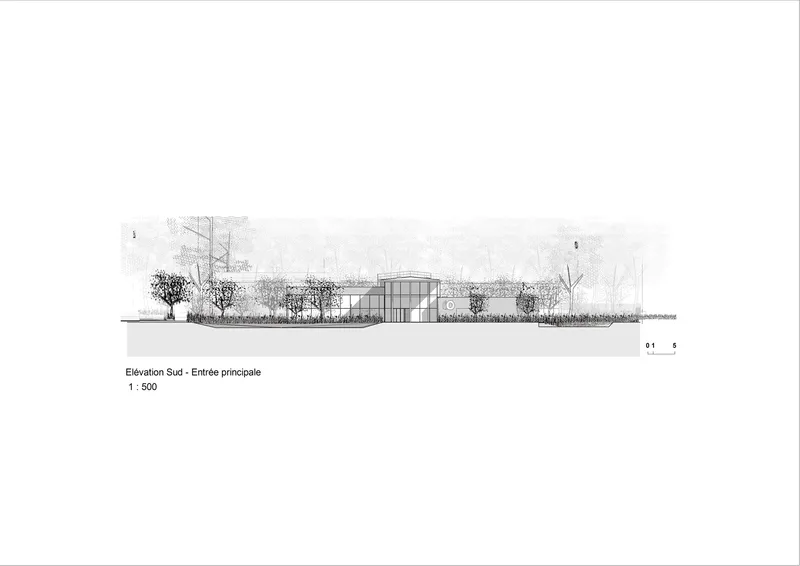
The section drawings are particularly revealing. Grade changes across the site are absorbed by the building, creating a subtle topography that differentiates pool depths, terrace levels, and roof gardens without resorting to ramps or dramatic level shifts. The south elevation confirms what is apparent from the photographs: the building is genuinely low, a single horizontal stroke behind a row of trimmed trees, modest in profile but generous in its interior volumes.
Why This Project Matters
Aquatic centers are among the most technically demanding civic buildings to design well. They are loud, humid, chemically intense, and notoriously expensive to operate. Most architects solve the engineering problems and call it a day. ANMA has done something rarer here: they have made a building that resolves all those technical demands while also functioning as a piece of urban landscape, a timber pavilion in a meadow that happens to contain 25-meter pools and a spa. The decision to break the program into clustered volumes rather than packing everything under one roof is the key move. It allows light, air, and planted courtyards to penetrate the facility, transforming what could have been a hermetic box into a building that breathes.
The site's history adds another layer. Replacing a prison with an aquatic center is a symbolic gesture that architecture rarely gets to make so explicitly. ANMA does not overplay it; there is no memorial wall or interpretive signage visible in the photographs. The gesture is spatial: where there was enclosure, there is now openness; where there were walls, there is glass; where there was a yard, there is a meadow. L'O is proof that civic architecture still has the capacity to rewrite urban narratives, one swimming pool at a time.
Aqualudic Center L'O by ANMA. Orléans, France. 6,300 m². Completed 2021. Photography by Epaillard + Machado and Marwan Harmouche.
About the Studio
Share Your Own Work on uni.xyz
If projects like this are the kind of work you want to make, uni.xyz is a place to publish your own, find collaborators, and enter design competitions.




Popular Articles
Popular articles from the community


Hill & Cross Opera: Sculptural Opera House Architecture Shaped by Tallinn’s Landscape and Identity
Hill & Cross Opera reimagines opera house architecture in Tallinn through its sculptural hill, civic plaza, glass wave and a luminous cross.

The Ocean Hive: Sustainable Architecture for a Self-Sufficient Civilization at Sea
The Ocean Hive imagines sustainable architecture at sea, where modular habitats, algae, wave power and ocean waste sustain a growing colony.

The Musturak Paradise: Senior Living Architecture for a Connected Future in Temara, Morocco
The Musturak Paradise reimagines senior living architecture in Temara via private homes, social spaces, culture, community, and shared care.

Riyadh For All: Intergenerational Urban Design for Active Aging in Rabat
Riyadh For All reimagines urban design in Rabat with intergenerational co-living, adaptive courtyards, and Moroccan cultural exchange today.


Similar Reads
You might also enjoy these articles

Bao Huynh Watercolor Atelier: A Serene Art Retreat in Hội An
Bao Huynh Watercolor Atelier in Hội An blends multifunctional art spaces, sustainable design, local materials, and family-friendly living in a serene environment.

Atelier Macri Concept Store Interior Design by CASE-REAL
Atelier Macri store features a "ko" counter, walnut wood details, cork displays, blending retail, gallery, and seamless customer experiences.

Manuel Vargas Izquierdo Stadium and High-Performance Sports Center: Architectural Excellence in Jalpa de Méndez
The Manuel Vargas Izquierdo Stadium blends sustainable design, inclusive sports facilities, and cultural-inspired architecture, revitalizing Jalpa de Méndez’s public spaces.

KAKR Buluh Awar Hall: Revitalizing Community and Ecology Through Bamboo Architecture
Community built bamboo hall revitalizes Buluh Awar village, empowering youth, restoring ecology, celebrating vernacular craftsmanship through sustainable architecture and culture.


Explore Aqua Center Competitions
Discover active competitions in this discipline



Challenge to design a barrier free sports center


Challenge to design an outdoor ice-rink and park

Challenge to design a portable theatre

Challenge to design a portable music platform
Comments (0)
Please login or sign up to add comments
No comments yet. Be the first to comment!