
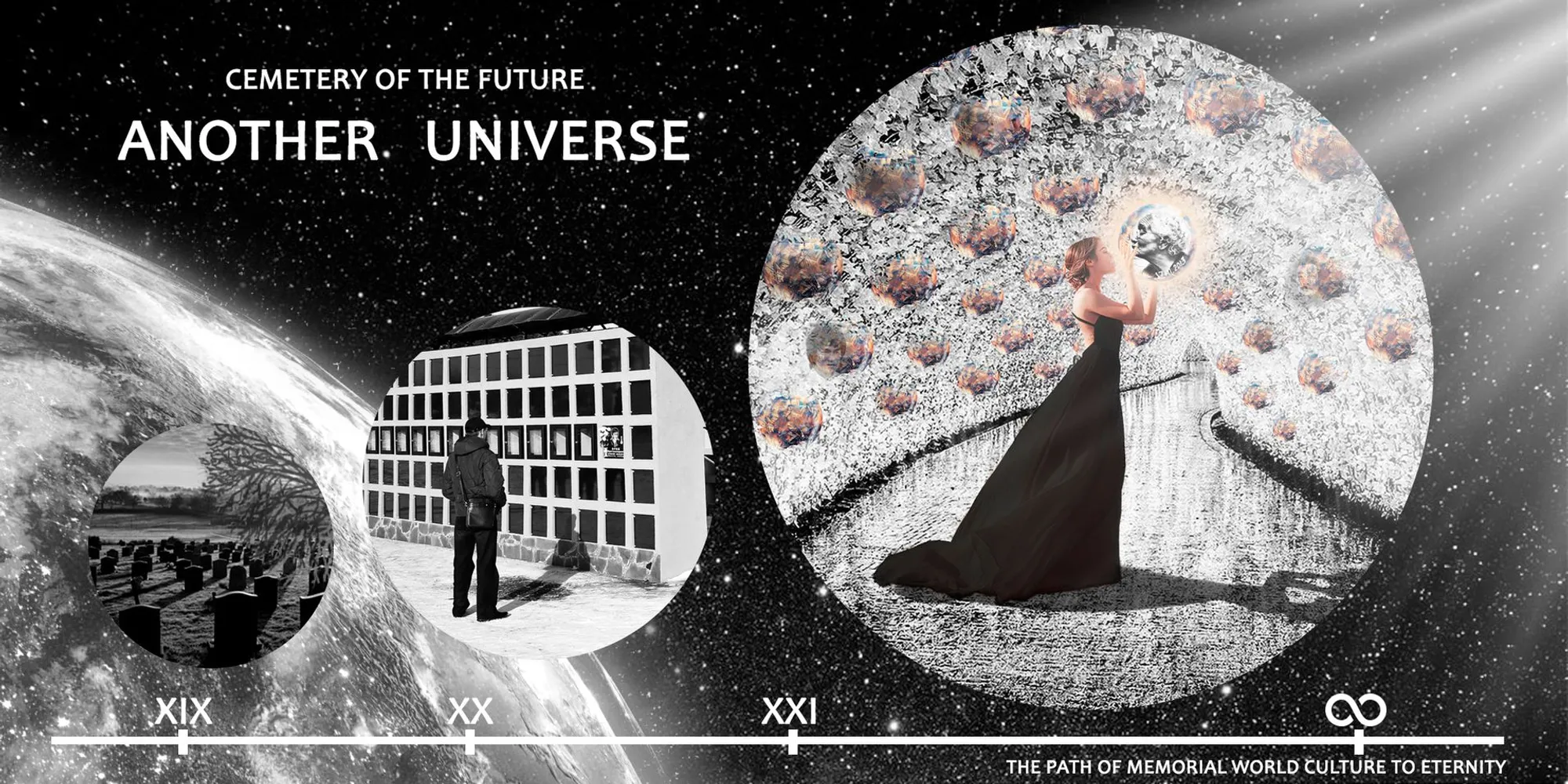
Another Universe: A Memorial Complex That Grows Into the City Over Time
Helen Sporsheva reimagines the cemetery as a living urban park, layering remembrance beneath an evolving green roofscape that symbolizes eternity.


What if a cemetery didn't withdraw from the city but grew into it? Another Universe proposes a memorial complex that refuses to be static. Its green roof thickens and matures over decades, gradually absorbing the building into the urban landscape until what remains visible is not a monument to death but a living park. The architecture operates on geological time: closed memorial chambers below, open sky above, and a columbarium held in the liminal space between.
Designed by Helen Sporsheva, the project rethinks how cities accommodate remembrance by embedding it within biophilic, time-responsive architecture. Sited along a curved waterfront, the complex layers three spatial conditions (closed, semi-open, and open) into a single structure that doubles as public infrastructure. A restaurant sits alongside memorial spaces; a columbarium opens to the air; and a terraced green roof invites the neighborhood to walk, sit, and inhabit a landscape that is quietly rooted in loss.
A Grass-Covered Roof That Feels Like a Hill

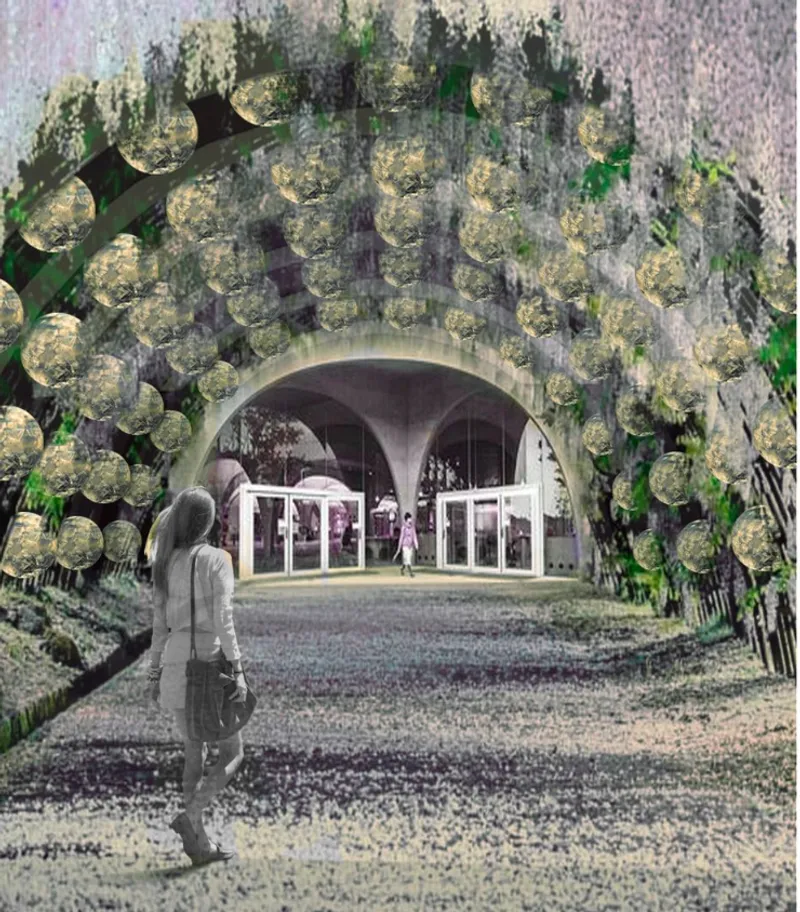
The night rendering reveals the project's public face: a gently undulating grass-covered roof punctuated by arched pavilions that glow softly, drawing visitors across the park surface. People wander, gather, linger. There is nothing funereal about the scene. The section drawing below it tells the other story. Beneath the planted surface lie underground memorial chambers, spherical columbarium structures, and skylights that pull natural light deep into the interior. The roof is not decoration; it is the building's primary strategy for dissolving the boundary between infrastructure and landscape.
Light Filtered Through Stone: The Interior as Sacred Space
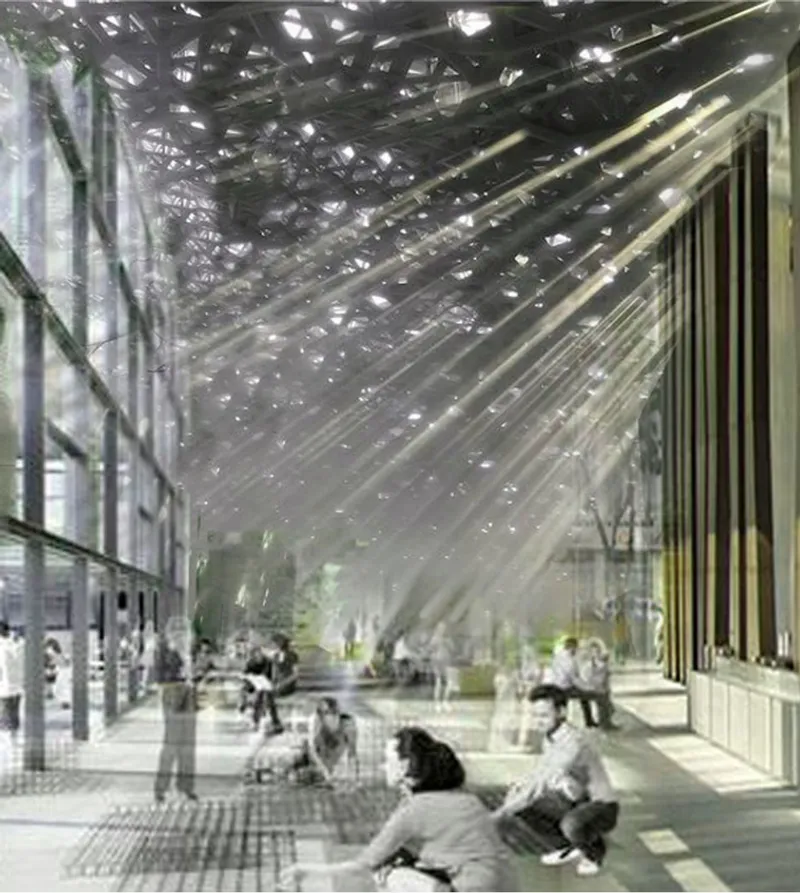
Inside, the memorial spaces achieve something remarkable with light. Vaulted ceilings are perforated to allow dappled sunlight to fall across seated visitors, creating an atmosphere closer to a forest floor than a mausoleum. The quality of light shifts throughout the day, ensuring the interior experience is never fixed. It is a space designed for sustained reflection rather than brief ceremony.
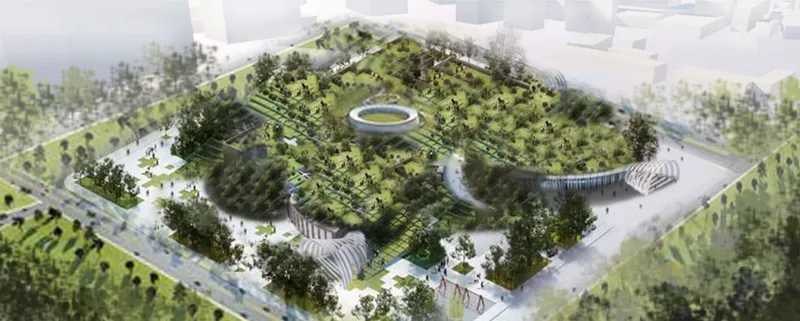
The aerial view confirms how the terraced green roof rises above the surrounding urban context, its planted surface thick with trees that will only grow denser with time. The complex reads as topography, not building. From above, the distinction between architecture and park is already dissolving, and the design is calibrated so that this dissolution accelerates as the vegetation matures.
Spiraling Ramps and a Cloverleaf Core

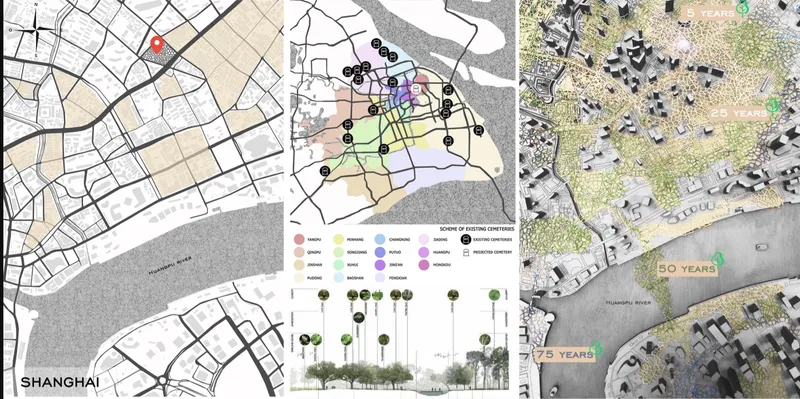

The axonometric rendering exposes the circulatory logic: spiraling ramps wrap around planted terraces beneath arched roof structures, guiding visitors through a continuous promenade that moves between memorial and park. There is no abrupt threshold between mourning and daily life. The transition is spatial, gradual, and deliberate. The site plan drawing reinforces this reading, presenting zoning diagrams alongside a growth timeline that maps how the complex will evolve along its curved waterfront site.
A second axonometric breaks the building into three stacked floor levels of a cloverleaf-shaped plan organized around a central circular core. Each lobe accommodates a different program (memorial, columbarium, restaurant) while the core provides vertical circulation and structural continuity. The cloverleaf geometry is efficient without being mechanical, lending each wing a sense of enclosure while maintaining openness at the intersections.
Why This Project Matters
Cemeteries consume land and repel development. They are, by convention, designed to remain unchanged. Another Universe inverts that logic entirely: the memorial complex is conceived as a catalyst for urban green space, a structure that becomes more public and more ecological as it ages. The integration of a restaurant and park programming ensures the site draws daily visitors, not just mourners, weaving remembrance into the ordinary rhythms of city life.
Helen Sporsheva's project is ultimately an argument about time. Most buildings fight entropy; this one collaborates with it. The planted roof thickens, the trees mature, the perforated ceilings cast shifting patterns across the interior as seasons turn. Memory here is not frozen in marble but embedded in a living system that changes as the city changes. That is a more honest model for how we actually remember: not in stasis, but through accumulation, growth, and slow transformation.
View the Full Project
About the Designers
Designer: Helen Sporsheva
Enter a Design Competition on uni.xyz
uni.xyz runs architecture and design competitions year-round that reward proposals with spatial conviction and real site intelligence.
Project credits: Another Universe by Helen Sporsheva.




Popular Articles
Popular articles from the community


The Earth Pod: 3D Printed Homes for Resilient Refugee Communities
The Earth Pod reimagines refugee housing through 3D printed homes made from clay, combining resilience, self-sufficiency, and rapid shelter.

Hill & Cross Opera: Sculptural Opera House Architecture Shaped by Tallinn’s Landscape and Identity
Hill & Cross Opera reimagines opera house architecture in Tallinn through its sculptural hill, civic plaza, glass wave and a luminous cross.

AL-JANNAH: Sustainable Architecture and Permaculture for Afghan Widows
AL-JANNAH uses sustainable architecture and permaculture to create resilient oasis of housing, learning, work and renewal for Afghan widows.

The Musturak Paradise: Senior Living Architecture for a Connected Future in Temara, Morocco
The Musturak Paradise reimagines senior living architecture in Temara via private homes, social spaces, culture, community, and shared care.

Similar Reads
You might also enjoy these articles

Day and Night Park: A Time-Based Urban Newsstand in Beijing
A temporary urban newsstand in Beijing blending travel, light, and reading through poetic colors, compact form, and community-focused design.

Modernist Patio Renovation in El Masnou, Barcelona by Oliver Segura Arquitectura + Cebrià Arquitectura
Modernist patio renovation blending tradition and innovation with a movable pool, leveled floors, and Catalan materials in El Masnou.

Alto Residencial Coop: Cooperative Housing Development in Santiago de Compostela by Carbajo Barrios Arquitectos
A linear cooperative housing complex blending white volumes and perforated metal façades, enhancing community living, natural light, privacy, and urban integration.

Vil Genis School by BPA ARCHITECTURE – Massy, France
Vil Genis School in Massy, France, features sustainable design, south-facing classrooms, community integration, accessible spaces, and modern educational architecture.


Comments (0)
Please login or sign up to add comments
No comments yet. Be the first to comment!