
Anti-Ghetto Library: Modular Cubes Stacked into a Civic Landmark for Warsaw
A pyramidal structure of interlocking volumes turns adaptive reuse into a spatial dialogue between historical memory and collective learning.


Stack enough contradictions on top of each other and you might just build something coherent. The Anti-Ghetto Library takes modular cubes, each representing a fragment of program and meaning, and assembles them into a jagged pyramidal form that confronts Warsaw's layered history head-on. It is not a quiet monument. It is a vertical urban street: loud at its base, contemplative at its peak, and deliberately porous throughout. The project asks what happens when a library refuses to be an institution and instead becomes a threshold between oppression and openness, city and forest, past trauma and future learning.
Designed by Sıddıka Kulu and Beyza Çapal, the Anti-Ghetto Library received an Honorable Mention in Libgen 2019. Rooted in Warsaw, Poland, the proposal confronts the historical weight of ghettos and partitions not through erasure but through architectural synthesis. Adaptive reuse principles drive the design, treating the library as an equilibrium center where contrasts coexist rather than cancel each other out.
A Stepped Section That Maps Solitude Against Spectacle
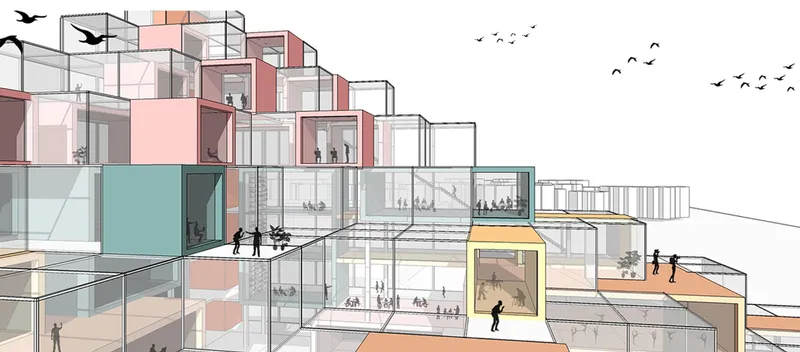
The section drawing reveals the project's core spatial logic. Colored volumes step upward in a terraced formation, each level corresponding to a different intensity of communal interaction. At the urban base, open platforms and auditoriums host public gatherings, exhibitions, and collaborative events. As users ascend, the program shifts toward quiet reading lounges, private alcoves, and individual study spaces. The lower levels house a museum and conference areas, while mid to upper tiers accommodate gaming rooms, workshops, and contemplative zones. It is a vertical spectrum that physically separates noise from silence without walls between them.
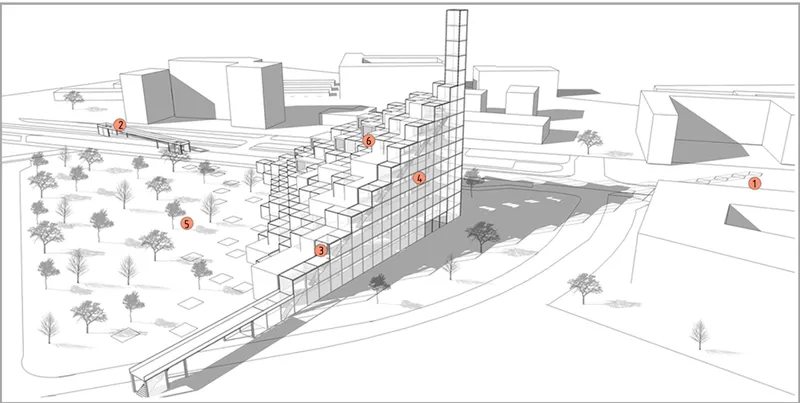
The axonometric view places the pyramidal tower in its Warsaw context, surrounded by low-rise buildings, trees, and pathways. The gridded structure rises decisively above its neighbors, establishing itself as a civic landmark without overwhelming the streetscape. Orientation axes connect the building to residential zones, the broader cityscape, and nearby forest trails, ensuring accessibility from multiple directions and reinforcing the duality the designers pursue: one face addresses the urban condition, the other softens toward nature.
Interior Atria and the Architecture of Constant Discovery
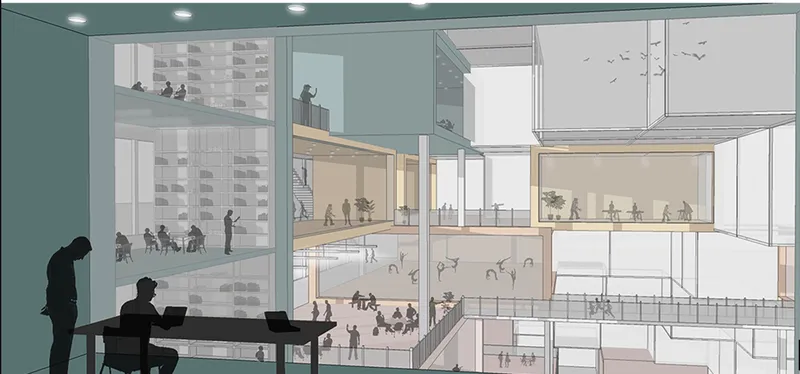
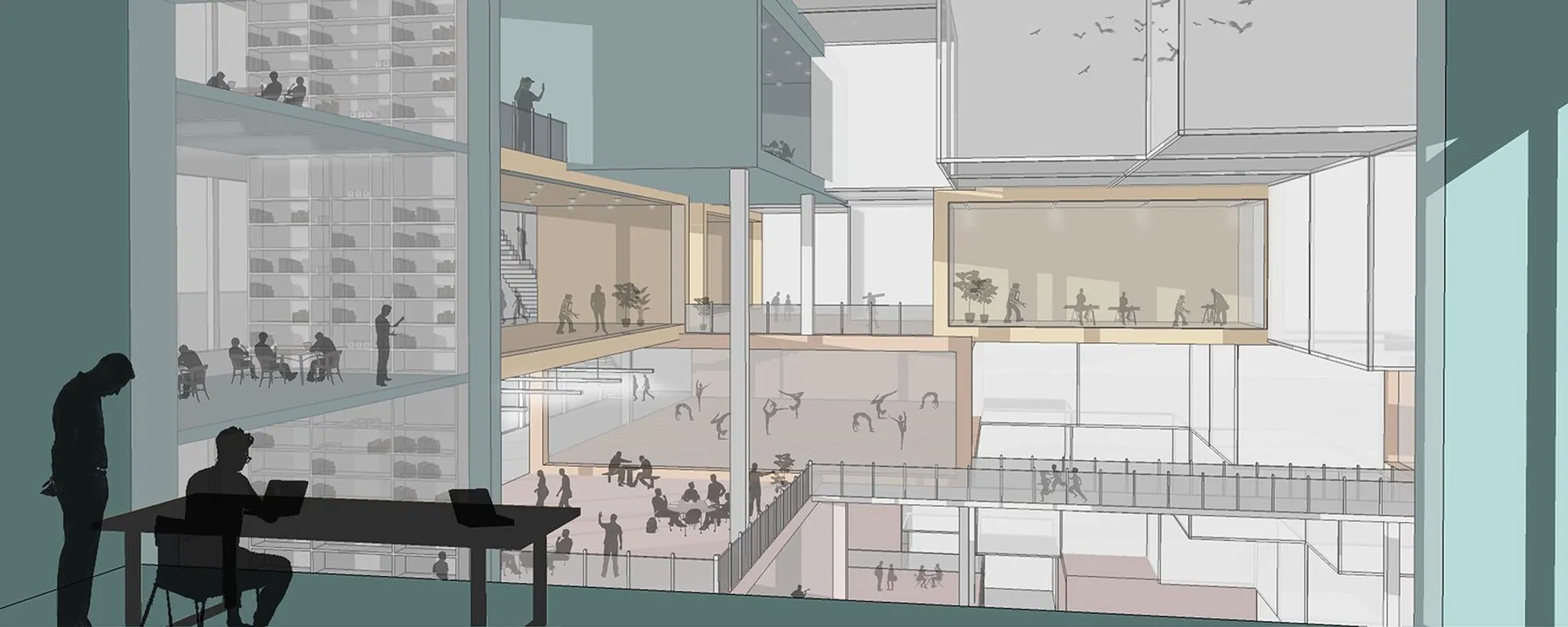
The section perspective cuts through multilevel interior spaces to expose the building's circulatory ambition. Figures sit at desks overlooking a central atrium, a spatial device that ties every floor together visually and environmentally. Wide stairways, elevated walkways, and transparent boundaries ensure that movement through the library is never hidden. Users experience spatial discovery at every turn, catching sight of activities on distant floors and orienting themselves through the building's open sectional logic rather than signage.
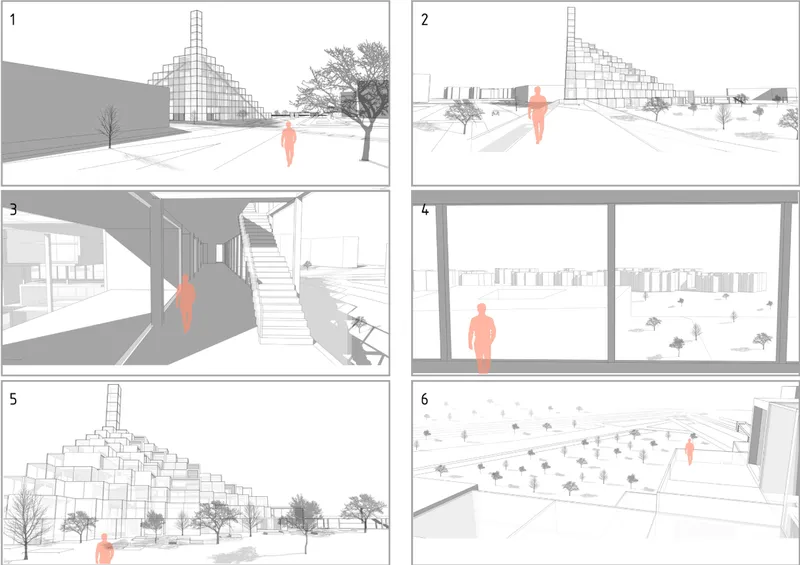
Six perspective vignettes, rendered with scale figures in orange, rotate around the pyramidal form to show it from exterior and interior viewpoints. These views confirm that the semi-porous façade is not decorative: it performs. The building's internal life reads outward to the city, demonstrating activity and invitation. From the forest side, the structure softens, becoming a meditative counterweight to its bold urban front. The vignettes collectively argue that the library's identity changes depending on where you stand, which is exactly the point.
Programmatic Zones Stacked Inside a Glass Envelope
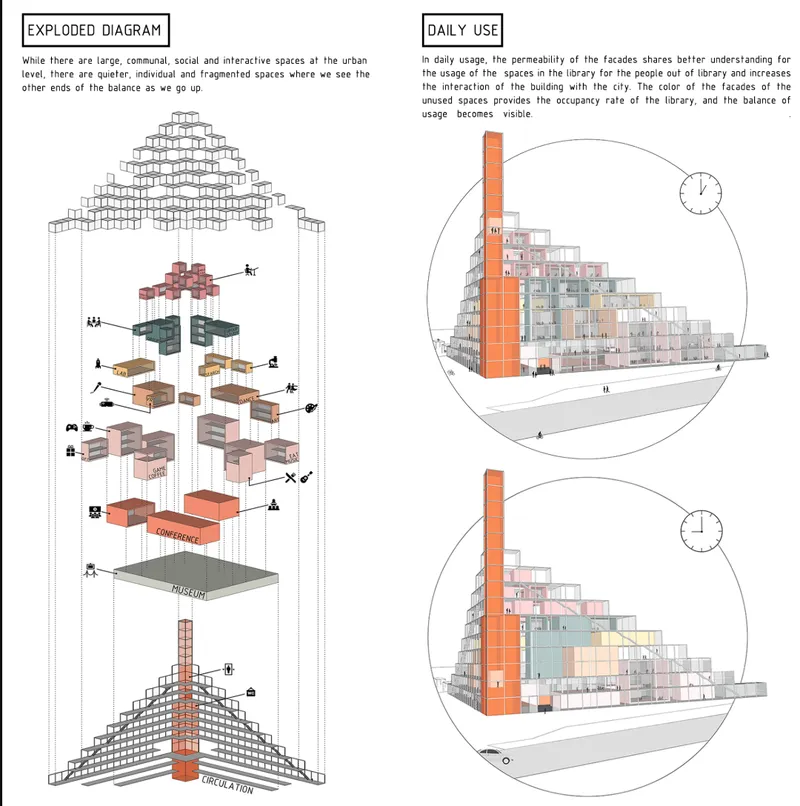
The exploded axonometric peels the building apart to reveal its programmatic stacking strategy. Each modular cube contains a distinct function, and the diagram makes legible how these units aggregate into the pyramidal whole. Accompanying daily use diagrams illustrate how different spaces activate throughout the day: some zones light up in the morning, others come alive in the evening, ensuring the library functions as a living civic hub rather than a building with fixed operating hours. The glass envelope that wraps the entire assembly enhances visual connectivity and allows occupancy patterns to be read from the outside.
Stepped Seating as Public Infrastructure
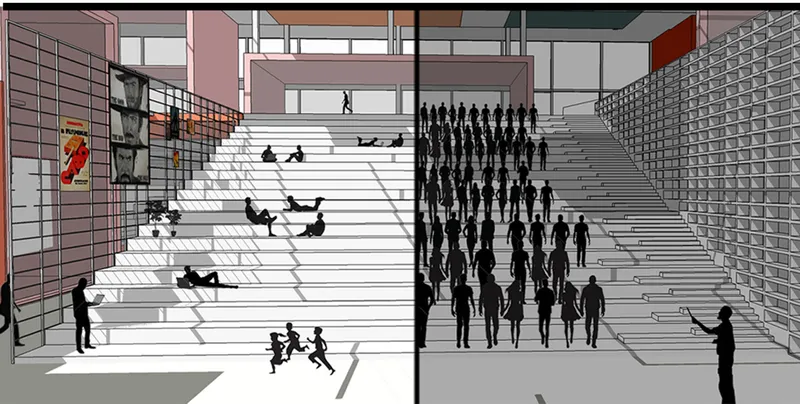
The interior perspective of the wide stepped seating area captures the building at its most generous. People lounge on broad terraces, crowds gather between glass block walls, and the boundary between reading, socializing, and simply occupying space dissolves entirely. This is the library functioning as urban street: approachable, informal, and open to appropriation. The permeable façade behind these spaces brings daylight deep into the section, optimizing both atmosphere and energy performance while reinforcing the visual connection between interior activity and the surrounding city.
Why This Project Matters
The Anti-Ghetto Library succeeds because it refuses to treat history as something to memorialize from a distance. By siting a radically open, modular civic structure in Warsaw and naming it directly after the partition systems it opposes, Kulu and Çapal make the architecture itself an act of reconciliation. The building's dual orientation, toward city and forest, and its vertical gradient from public spectacle to private study, demonstrate that equilibrium is not the absence of tension but its careful spatial management.
More practically, the project offers a compelling model for how libraries can remain relevant as civic infrastructure. Its time-based activation strategy, flexible volumes, and programmatic diversity ensure that the building serves communities across hours, seasons, and generations. The Anti-Ghetto Library does not ask people to be quiet. It asks them to be present, to move through layers of memory and innovation, and to find their own balance within a structure that holds all the contradictions at once.
View the Full Project
About the Designers
Designers: Sıddıka Kulu, Beyza Çapal
Enter a Design Competition on uni.xyz
uni.xyz runs architecture and design competitions year-round that reward proposals with spatial conviction and real site intelligence.
Project credits: Anti-Ghetto Library by Sıddıka Kulu, Beyza Çapal Libgen 2019 (uni.xyz).




Popular Articles
Popular articles from the community

EW PARK: Sustainable Architecture Reimagines the Future of Urban Parking
EW PARK reimagines city parking as a modular wooden tower combining automation, solar energy, electric mobility, and adaptable urban design.

Co-life: Sustainable Architecture for Age-Friendly Community Living
Co-life reimagines sustainable architecture for seniors through courtyards, rammed earth, shared gardens, and spaces designed for belonging.

The Ocean Hive: Sustainable Architecture for a Self-Sufficient Civilization at Sea
The Ocean Hive imagines sustainable architecture at sea, where modular habitats, algae, wave power and ocean waste sustain a growing colony.

Conexión: Biophilic Design Reimagines High-Rise Living in Hong Kong
Conexión reimagines high-rise living in Hong Kong through biophilic design, green facades, shared spaces, daylight, water and nature within.
Similar Reads
You might also enjoy these articles

The Musturak Paradise: Senior Living Architecture for a Connected Future in Temara, Morocco
The Musturak Paradise reimagines senior living architecture in Temara via private homes, social spaces, culture, community, and shared care.

The Leaf Center: Cultural Center Architecture for Social Integration in Amsterdam
Cultural center architecture becomes a bridge at The Leaf Center, connecting international students with Amsterdam through art and exchange.
Conexión: Biophilic Design Reimagines High-Rise Living in Hong Kong
Conexión reimagines high-rise living in Hong Kong through biophilic design, green facades, shared spaces, daylight, water and nature within.

Wander to Wonder: Modular Playground Design for Children in Kutupalong Refugee Camp
Wander to Wonder uses modular playground design to create flexible, imaginative play spaces for children in Kutupalong refugee camp.




Comments (0)
Please login or sign up to add comments
No comments yet. Be the first to comment!