
23 Degrees Design Shift Floats a Multigenerational Retreat on a Moat Near Hyderabad
Antriya House uses three sandstone walls and a moat-like water body to ground a five-acre family retreat in Muchintal, India.


Weekend homes on the outskirts of Indian cities tend toward two poles: nostalgic pastiche or glossy resort mimicry. Antriya House, designed by Hyderabad-based 23 Degrees Design Shift, sidesteps both. Sitting on a five-acre plot in Muchintal, south of Hyderabad, the 14,500 square-foot dwelling is organized by three massive Khammam brown sandstone walls that anchor the house to the land while a continuous water channel lifts it off the ground. The name itself, ANTRIYA, translates roughly as a space to self-reflect and become one with, and the architecture delivers on that ambition without resorting to sentimental gestures.
Commissioned by brothers Sachin and Nitin Agarwal as a transgenerational retreat for their parents, their families, and their children, the brief demanded something more nuanced than a luxury farmhouse. It had to serve three generations with equal dignity, accommodate daily use rather than occasional visits, and respond to Hyderabad's relentless heat. The result is a house that reads as a long, low landscape intervention: cantilevered concrete slabs shading every facade, a moat teeming with fish and water plants, and grape vines tracing a driveway inspired by the brothers' childhood memories of a family vineyard. The architecture is specific to its people, its climate, and its region in ways that deserve close reading.
Three Walls, One Ordering Logic
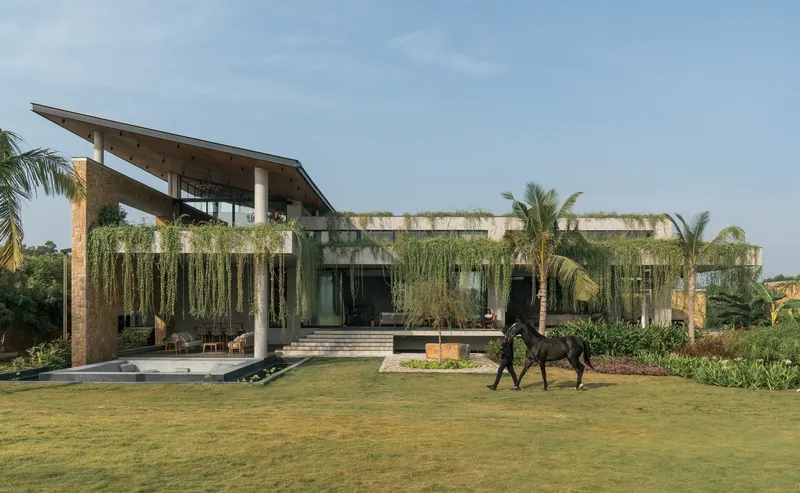
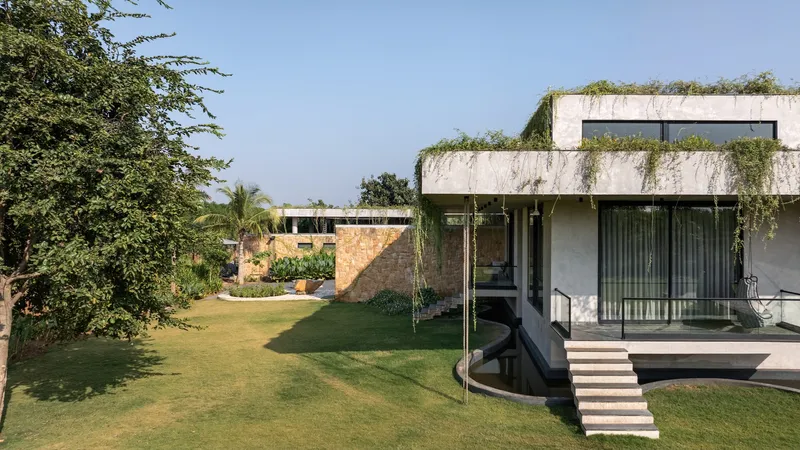
The entire composition hinges on three linear stone walls built from locally sourced Khammam brown sandstone, a material quarried in the Telugu states with a rough, porous surface that invites creepers to grab hold and colonize over time. The first wall runs along the north edge, forming a floating pathway that guides visitors toward a semi-open veranda and screens the pool from view. The second bisects the plan, cleanly separating communal rooms (living, dining, verandas, kitchen) from private bedrooms. The third extends outward to form the primary structure of the adjacent pool house and anchors the entry approach.
What makes this strategy effective is its simultaneous role as structure, spatial divider, and thermal mass. The sandstone absorbs heat during the day and releases it slowly, moderating internal temperatures. The walls also introduce a strong directionality to the plan, channeling breezes and framing views without requiring elaborate partition systems. It is regional modernism in the most literal sense: contemporary spatial logic executed through vernacular materials.
Floating on Water
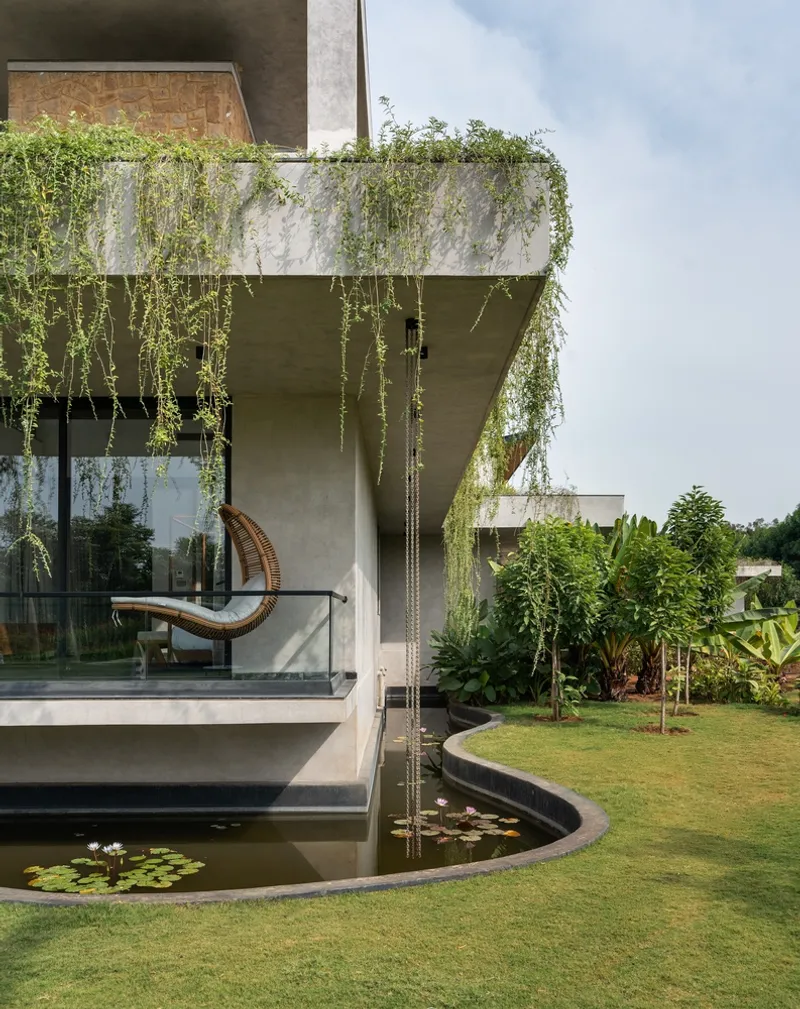
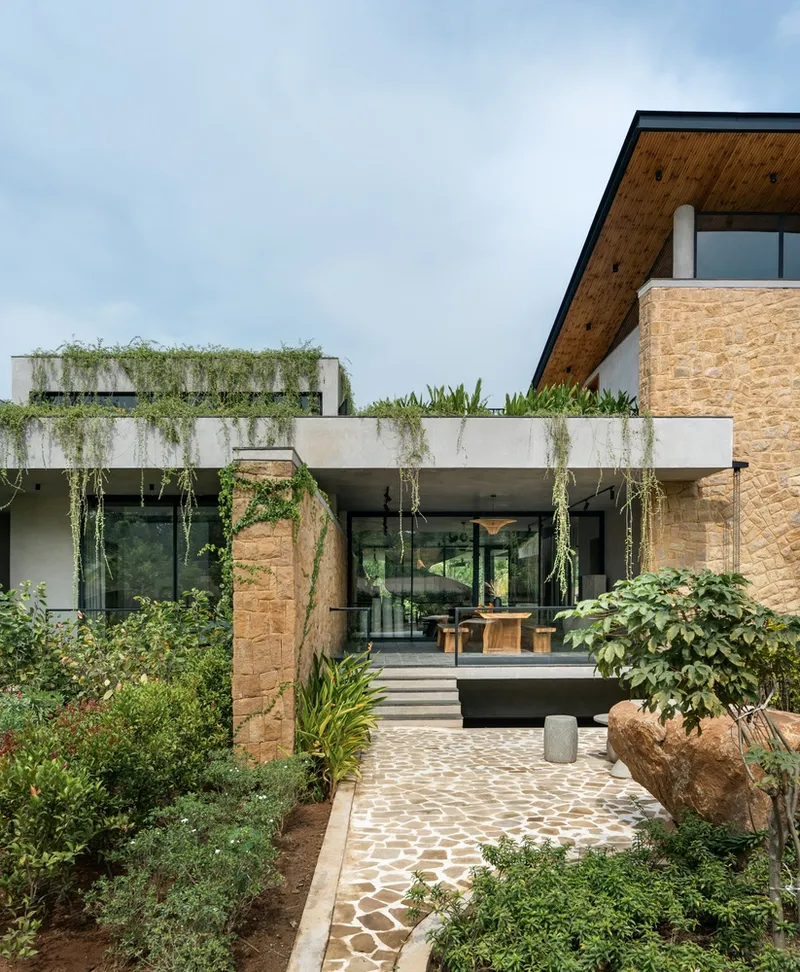
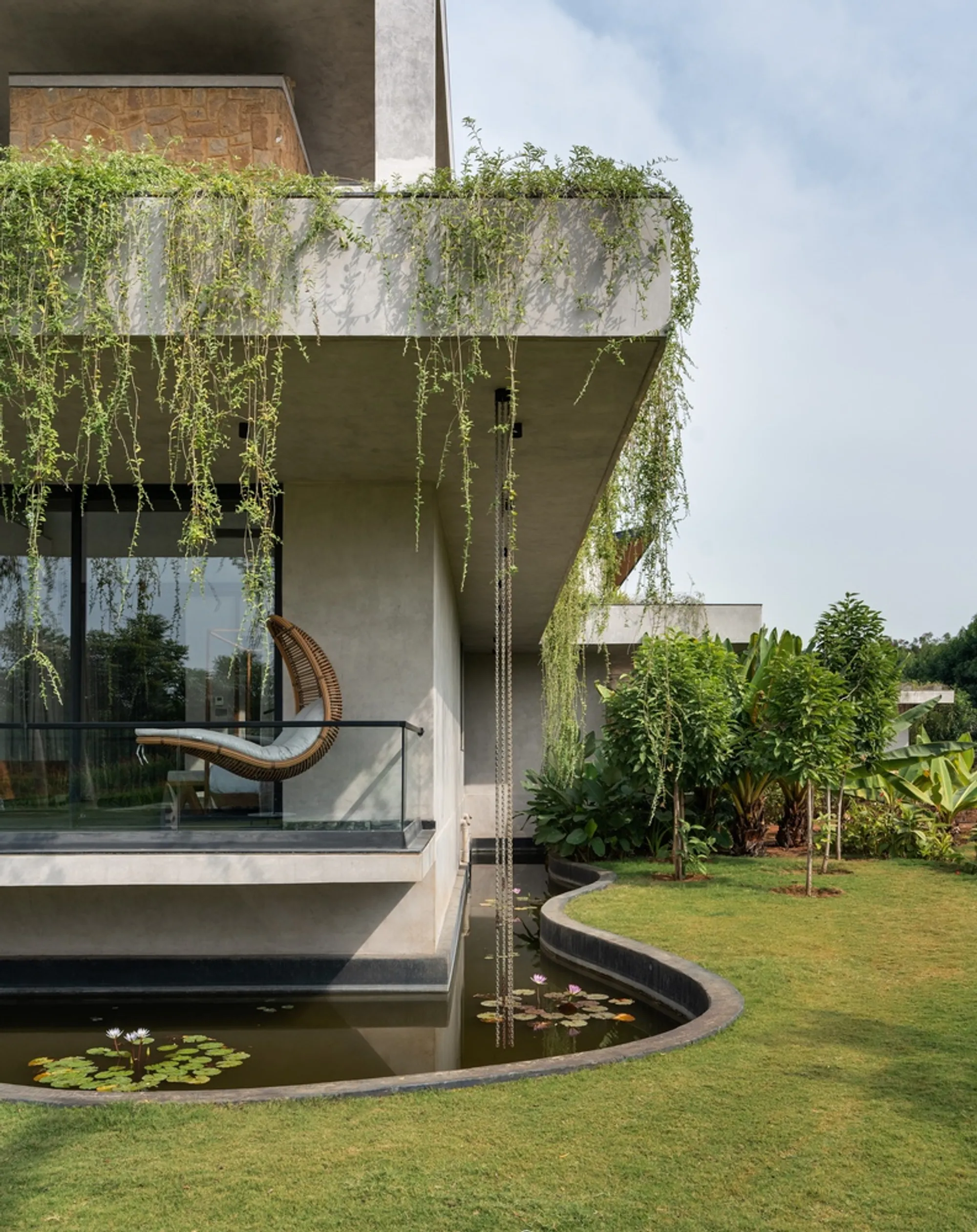
The house appears to hover above a continuous moat that encircles the plinth, a cantilevered concrete platform supporting the entire structure. Populated with fish and aquatic plants, the water body is more than scenic: it cools air as breezes cross its surface, moderating the microclimate around the house in a city where summer temperatures regularly exceed 40 degrees Celsius. The moat also acts as a practical barrier against snakes and crawling creatures, a genuine concern on a semi-rural site.
A raised pathway approaching the entrance telegraphs the idea of elevation and separation from the ground. Arriving at Antriya means literally crossing water, a threshold gesture that shifts your posture from the everyday into something more deliberate. The curved lily pond beneath cantilevered terraces extends this language further, creating moments where the boundary between building and landscape dissolves into reflected sky and trailing plants.
Deep Overhangs and Layered Light
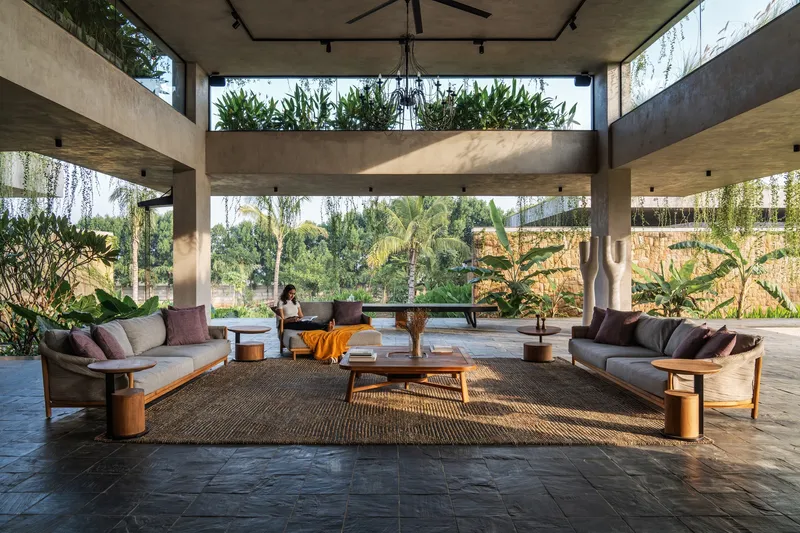
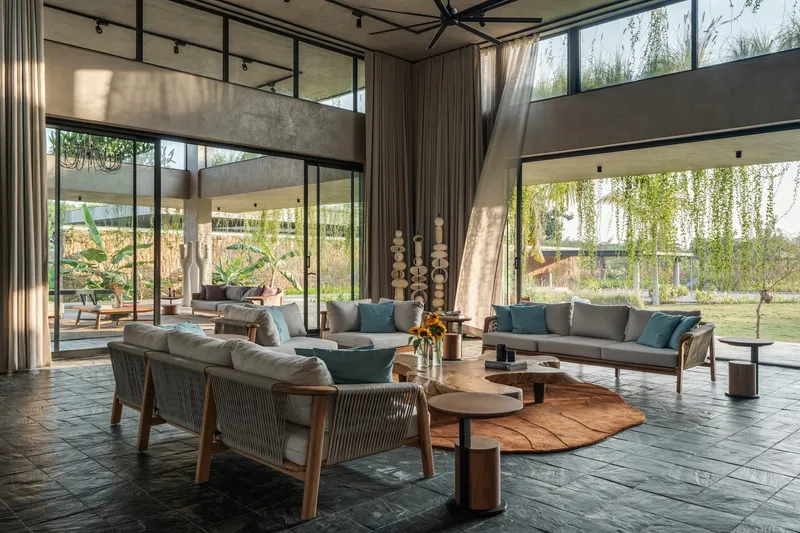
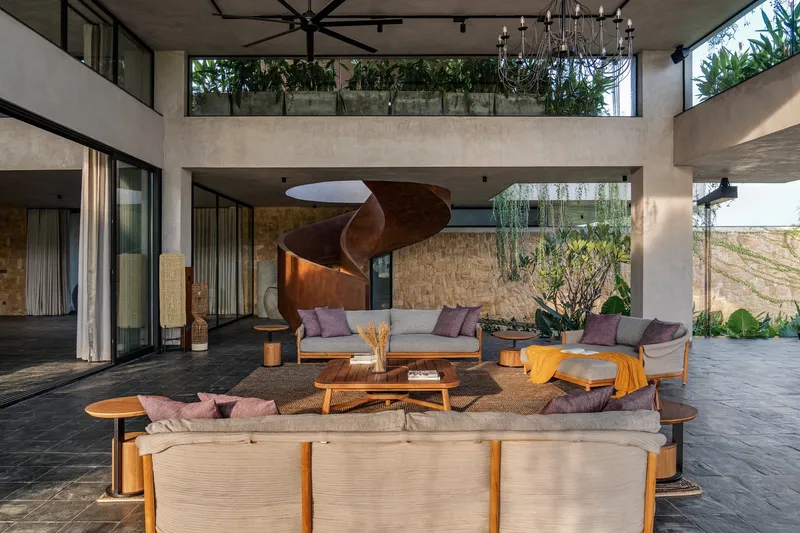
Every facade is shaded by cantilevered slabs projecting eight to ten feet, deep enough to keep direct sun off the full-height glazing throughout the day. The external walls are divided cleverly: nine feet of glass below the overhang line and a 2'6" clerestory band above it. Seasonal creepers and planted trays on top of the overhang slabs filter light through the clerestory, projecting shifting green shadows into the interiors. It is one of the house's most compelling details, a living layer that changes with the seasons.
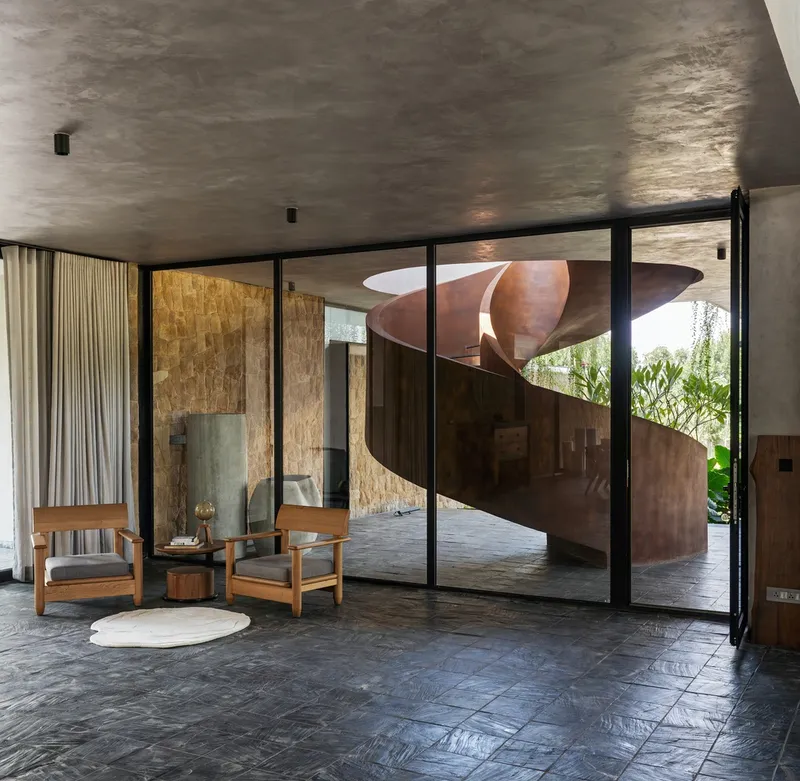
The double-height living area reveals this strategy most dramatically. Fifteen-foot ceilings with an intermediate slab at ten feet create a proportional system that feels expansive without being cavernous. A helical copper stair rises beneath a concrete bridge linking upper-level planted terraces, turning vertical circulation into a sculptural event. Floor-to-ceiling curtains soften the concrete and stone palette, while stacked concrete beams overhead introduce rhythmic shadow lines that animate the room as the sun moves.
Material Honesty, Barefoot Comfort
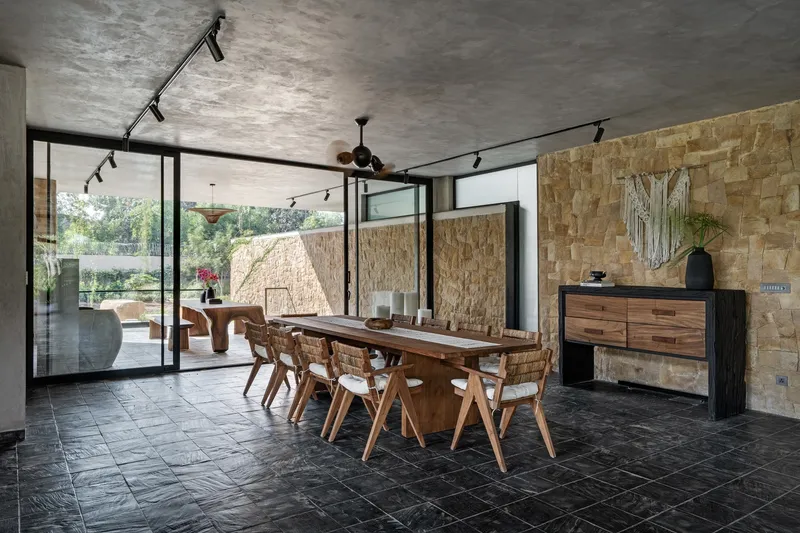
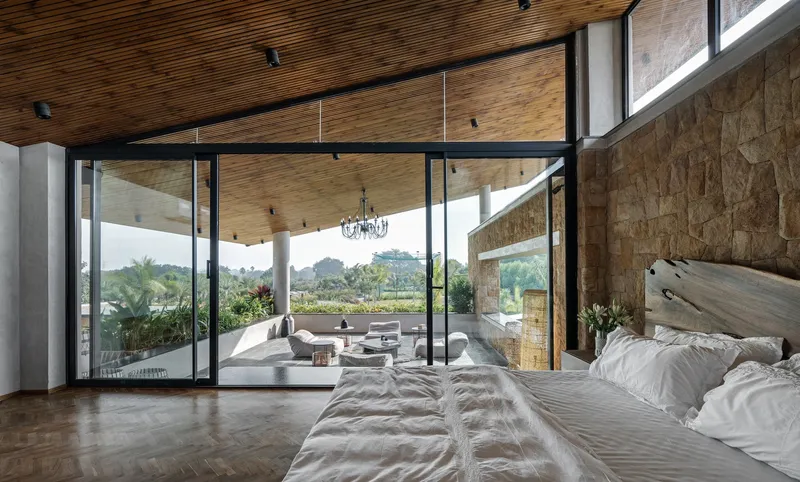
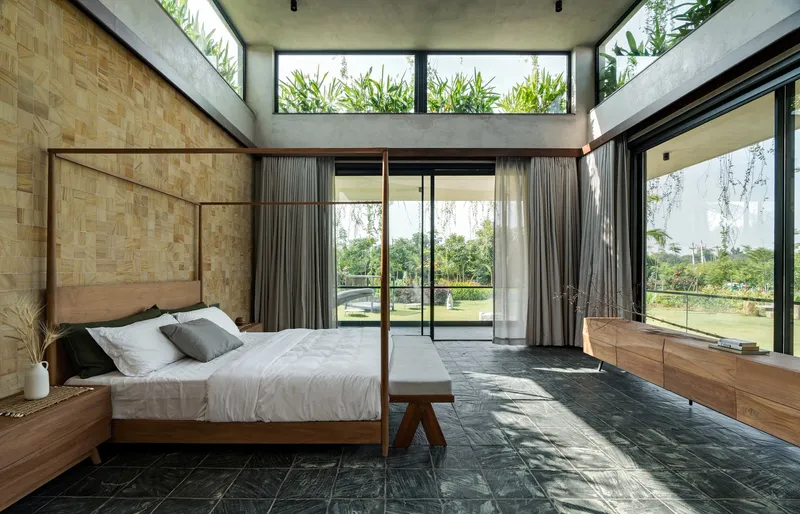
The material palette is deliberately restrained: Khammam sandstone, Markapuram slate flooring, reclaimed teak, grey lime plaster, black metal frames, and jute furnishings. Both the sandstone and slate are sourced within the Telugu states, keeping the supply chain short and the building's identity rooted in its geography. Lime-based plaster on walls and ceilings breathes, absorbing and releasing moisture in a way cement plaster cannot, contributing to indoor air quality in a subtropical climate.
Markapuram slate, with its smooth yet undulating surface, was chosen specifically to encourage barefoot walking, a detail that reveals the architects' attention to embodied experience rather than visual polish alone. In the bedrooms, slatted timber ceilings and woven wood headboard walls add warmth against the stone and concrete backdrop, while full-height glazing dissolves the wall between sleeping quarters and the surrounding lawn. The dining room, with its exposed sandstone block wall and steel-framed courtyard doors, demonstrates that honest construction can be its own decoration.
The Landscape as Program
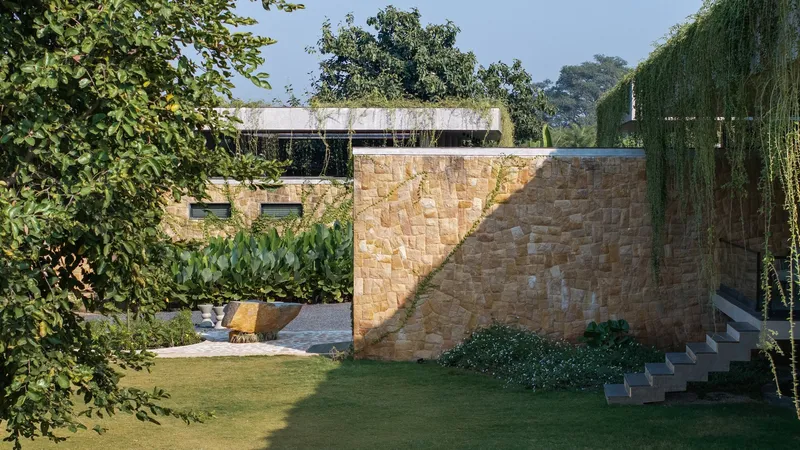
Before construction, the five-acre site held little beyond a solitary peepal tree to the west. That tree now anchors the entry zone, a decision that structured the entire site plan. A curving driveway navigates around existing boulders and sheet rock outcroppings, treating obstacles as features rather than problems. Kiasma Studio handled the landscape design, layering open lawns, coconut groves, dense peripheral tree planting, and the grape vineyard that traces the brothers' childhood memories.
The program extends well beyond the house footprint. A cricket practice area and ATV mud track serve the youngest generation, while a rock garden with Mediterranean planting, vine-covered stone walls, and dispersed guest parking transform the approach into a sequence of curated experiences. Twenty car parking spaces acknowledge the reality of large family gatherings without allowing automobiles to dominate the landscape. Dense taller trees along the site edges create a green perimeter that will only thicken over time, gradually enclosing the retreat from its suburban context.
A Corten Courtyard and Vertical Circulation
A corten steel spiral staircase set within a planted courtyard is one of the house's most visually striking moments. Visible through glazed doors from the interior, it connects the ground-floor bedrooms to the single first-floor bedroom positioned in the southeast corner. The courtyard functions as a light well, pulling natural light deep into the plan and providing cross-ventilation pathways that supplement the breeze corridors created by the sandstone walls.
The decision to place four bedrooms at ground level and only one above reflects a pragmatic reading of the family's demographics: elderly parents and young children benefit from grade-level access, while the upper floor offers a quieter retreat for whoever needs it. Upper-level planted terraces, linked by the concrete bridge visible in the living room, extend the green roof strategy and provide private outdoor space tied to the bedroom above.
Why This Project Matters
Antriya House matters because it demonstrates that regional modernism in India can be rigorous without being austere and personal without being indulgent. The three-wall strategy gives the entire project a structural and spatial clarity that many contemporary houses lack, while the moat, the deep overhangs, the clerestory planting, and the cross-ventilation pathways form an integrated passive design system that responds to Hyderabad's climate with precision rather than gadgetry. Every material is locally sourced, every dimension is justified by environmental performance or lived experience, and the landscape is treated as architecture, not afterthought.
More broadly, the project offers a convincing model for the multigenerational Indian family home: a building type that the real estate market has largely abandoned in favor of nuclear-family apartments. By organizing the plan around a clear public-private gradient and giving each generation its own spatial register (lawns and ATV tracks for children, verandas and water gardens for elders, bedrooms that open directly onto nature for everyone), 23 Degrees Design Shift proves that the joint family home can be a vehicle for serious architecture. It is a weekend retreat, yes, but one designed with the ambition and discipline of a primary residence.
Antriya House by 23 Degrees Design Shift. Located in Muchintal, Hyderabad, India. Built-up area: 10,000 sq ft on a five-acre site. Completed 2025. Landscape design by Kiasma Studio. Photography by Shamanth Patil.
About the Studio
Share Your Own Work on uni.xyz
If projects like this are the kind of work you want to make, uni.xyz is a place to publish your own, find collaborators, and enter design competitions.




Popular Articles
Popular articles from the community


Play: Fragments of Their World
Familiar architecture becomes modular playground design, creating safe spaces where displaced children can learn, connect, imagine and play.

Lunar Spiral: Space Architecture Shaped by the Mathematics of the Universe
Lunar Spiral reimagines space architecture through Fibonacci geometry, lunar regolith, levitating habitats, and self-sustaining Moon living.

Co-Life: Senior Housing Design That Reconnects Older Adults With the City
Co-Life reimagines senior housing design through healing gardens, shared streets, workshops, and a sustainable community across generations.

Riyadh For All: Intergenerational Urban Design for Active Aging in Rabat
Riyadh For All reimagines urban design in Rabat with intergenerational co-living, adaptive courtyards, and Moroccan cultural exchange today.


Similar Reads
You might also enjoy these articles


Hodi-Mandai Geram
Project Function: Preservation and revitalization of the Intangible heritage and socio-spatial identity of the Hodi by Housing, Cultural Memory Center, Sacred Grove, landscape, local tourism economy


Olio Towers: A Mid-Rise for Performers That Fuses Housing, Rehearsal, and Stage
Located blocks from Houston's Theater District, this modular tower stacks living units around a central performance atrium.

Oasis: Modular Green Housing Carved into Dhaka's Urban Fabric
A shortlisted Plugin Housing entry reclaims unauthorized settlements in Dhaka with stepped concrete volumes, green roofs, and ventilation-driven design.

Black Hole: A Floating Megastructure for the Post-Physical Era
Emiliano Mazzarotto envisions a spherical, self-scaling arena where e-sports, digital hotels, and holographic stadiums replace traditional public space.


Explore Architecture Competitions
Discover active competitions in this discipline



Challenge to reimagine the Iron Throne


Photograph architecture without architects


Illustrate the lost glory of Angkor Wat - Render Challenge


Design challenge to reuse E-waste
Comments (0)
Please login or sign up to add comments
No comments yet. Be the first to comment!