

Venna Architects Builds a Brick House in Bangladesh Around Solitude and Ancestral Memory
In Alamdar Para, courtyards and perforated screens turn a 496 square meter home into a space for reflection and gathering.


A house that begins with a poem is already operating on a different register. Anukrom House, completed in 2021 in Alamdar Para, Bangladesh, takes its conceptual cue from Emily Dickinson's meditation on solitude: "There is a solitude of space." Venna Architects, led by Asif Mohammed Ahsanul Haq, translated that idea into a 496 square meter residence for client Ibrahim Chowdhury. The result is not merely a house with courtyards. It is an argument that domestic architecture can hold grief, nostalgia, and community within the same set of walls.
What makes the project genuinely interesting is how it refuses to separate the private from the communal, the spiritual from the everyday. Two courtyards divide the rectangular plan into distinct social zones: one public, one intimate. A kachari ghar (guest house) faces the street, while a private yard shelters family gatherings and, crucially, maintains a visual connection to a family grave. Prayer, memory, and daily life occupy the same spatial sequence. The perforated brick screens that recur throughout the house are not decorative filler; they calibrate exactly how much light, wind, and visibility each room receives.
Thresholds That Slow You Down
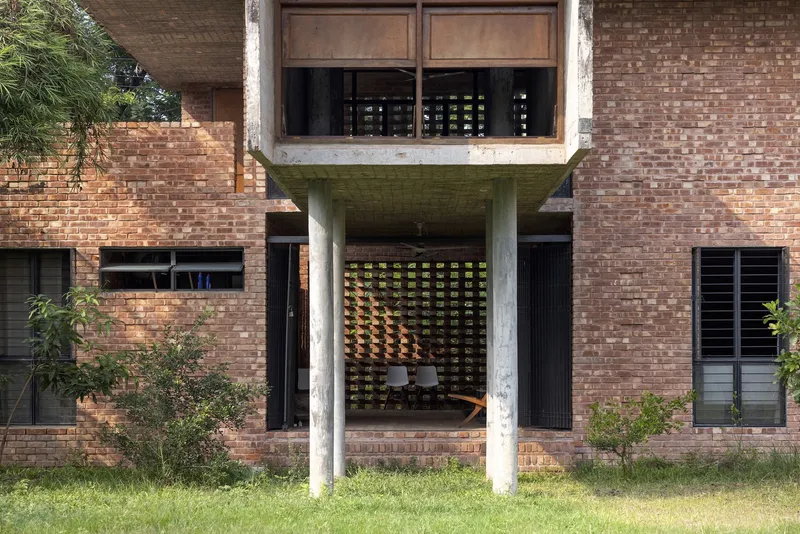
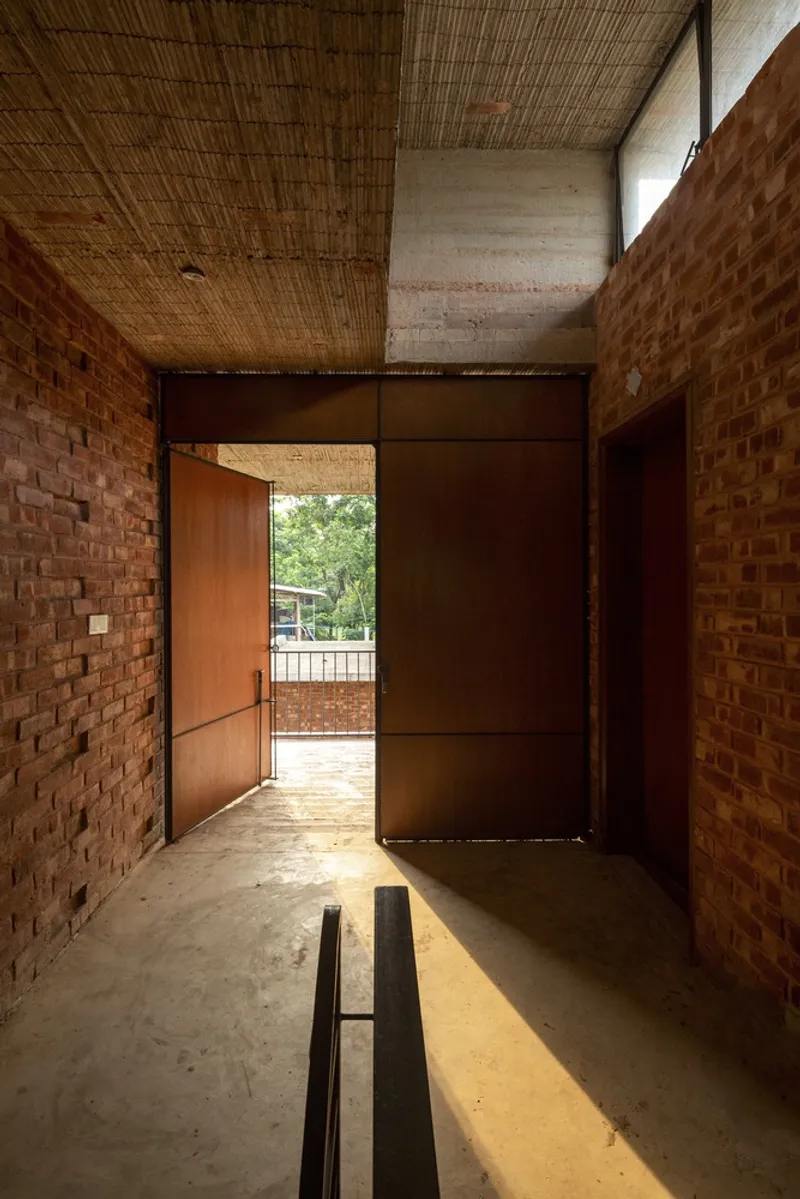
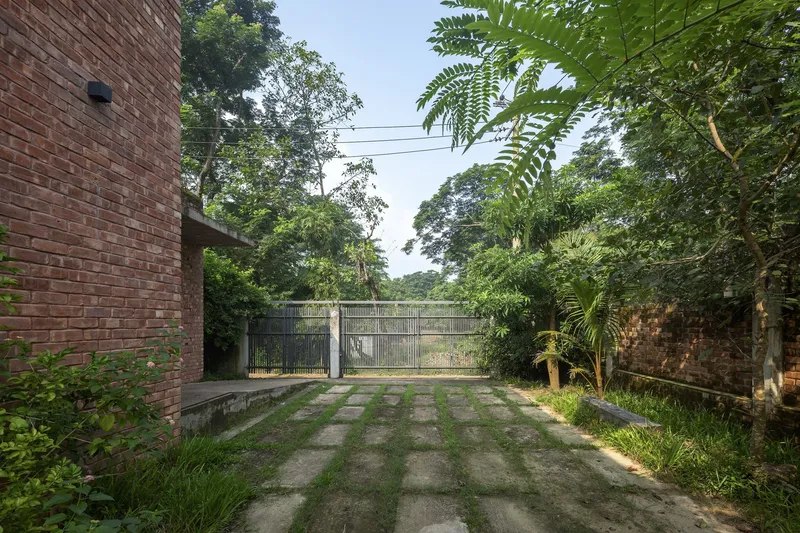
Arriving at Anukrom House is a measured experience. A green lawn separates the street from a recessed entrance framed by cast concrete columns and a perforated brick screen. The approach is deliberately elongated: a grid of concrete pavers with grass growing between them leads to a metal gate, then a pivoting timber door opens into a sunlit corridor before the courtyard reveals itself. Each threshold adds a beat of decompression, filtering out the chaos of the road before you enter the domestic world.
The entry sequence is a lesson in restraint. Rather than broadcasting the interior through floor-to-ceiling glazing, the architects let the perforated brickwork do the talking. Light arrives in fragments, dappled and warm, and the courtyard beyond is glimpsed rather than displayed. It sets the tone for the entire house: nothing is given away all at once.
The Double Height Volume as Connective Spine
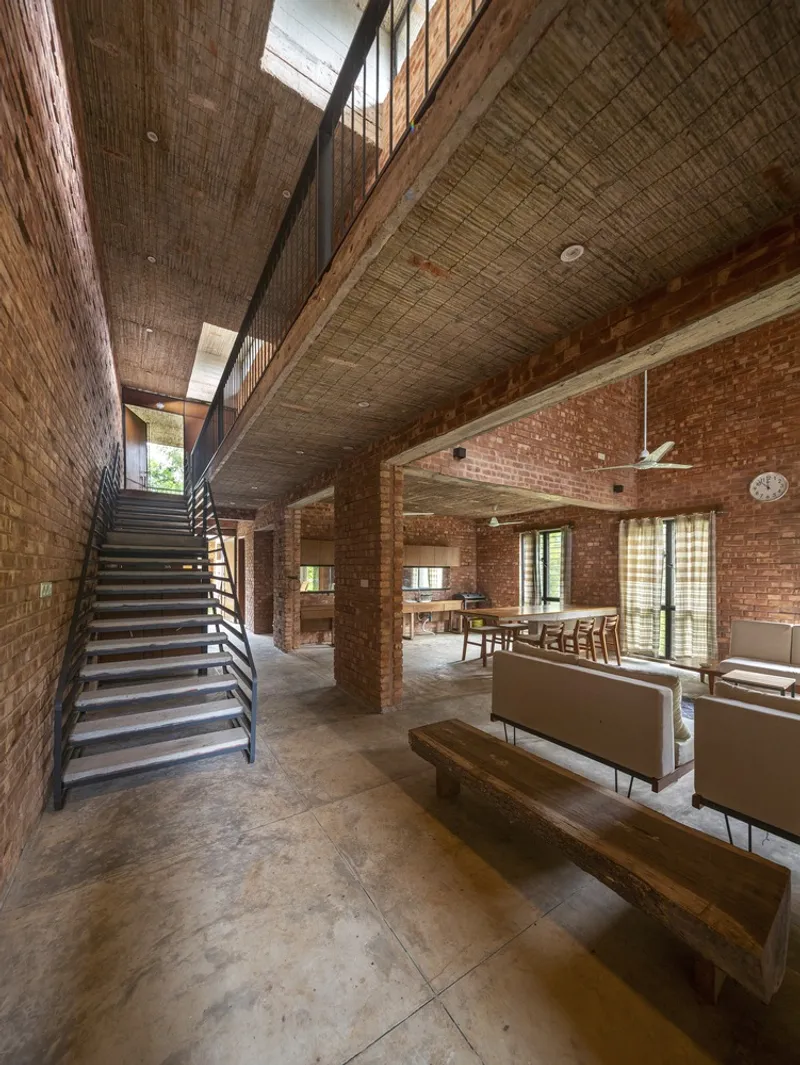
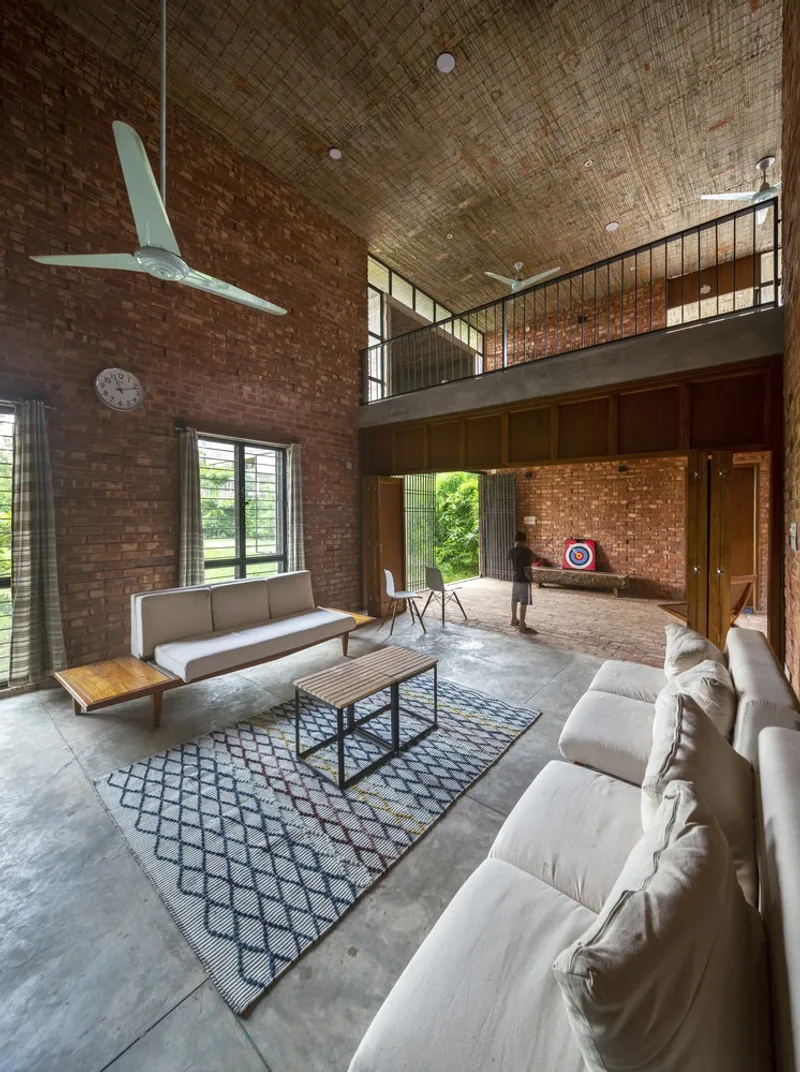
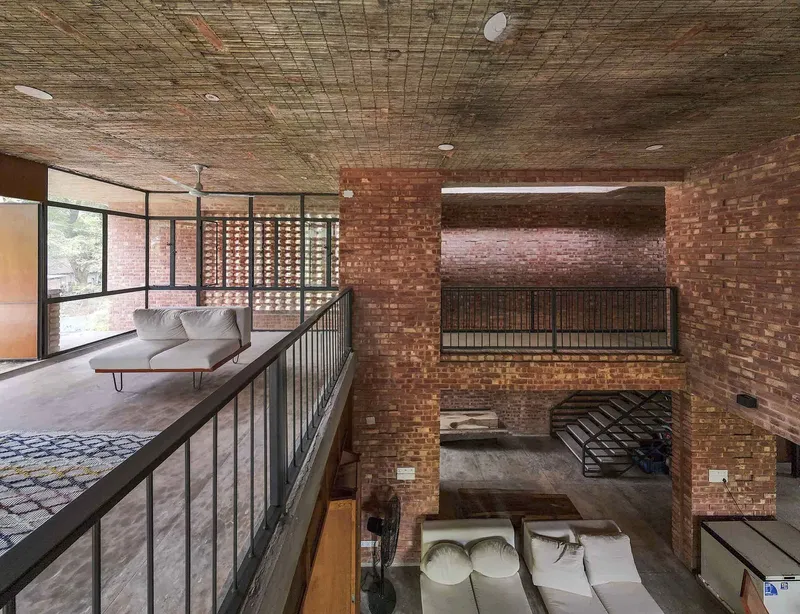
The heart of the house is a double-height living space that stitches every level together. Exposed brick walls rise uninterrupted to clerestory windows, while a woven bamboo ceiling introduces a warm, textured counterpoint to the masonry. A steel staircase and mezzanine bridge connect split levels without chopping the volume into isolated rooms. From below, you read the house as a single vertical room; from the mezzanine, you look down through layers of activity. It is the spatial equivalent of an open conversation.
The perforated brick screen at the far wall opens the living room to greenery beyond, collapsing the boundary between interior and landscape. Natural ventilation enters through the roof apertures along the circulation spine, drawn down through the volume and out through the courtyard openings. In a Bangladeshi climate, this cross-ventilation strategy is not a luxury but a necessity, and the sectional design makes it legible. The rectangular plan is oriented to maximize prevailing winds and minimize direct sun exposure, a passive cooling approach that avoids reliance on mechanical systems.
Brick Screens as Climate Mediators
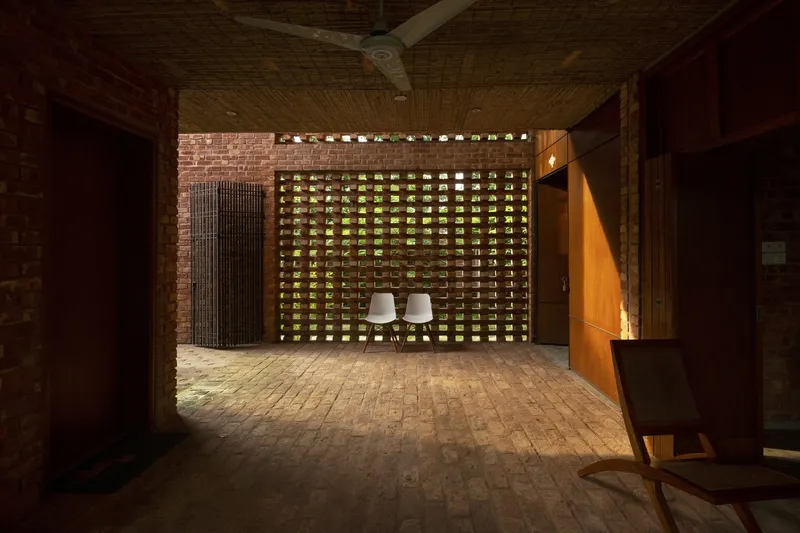
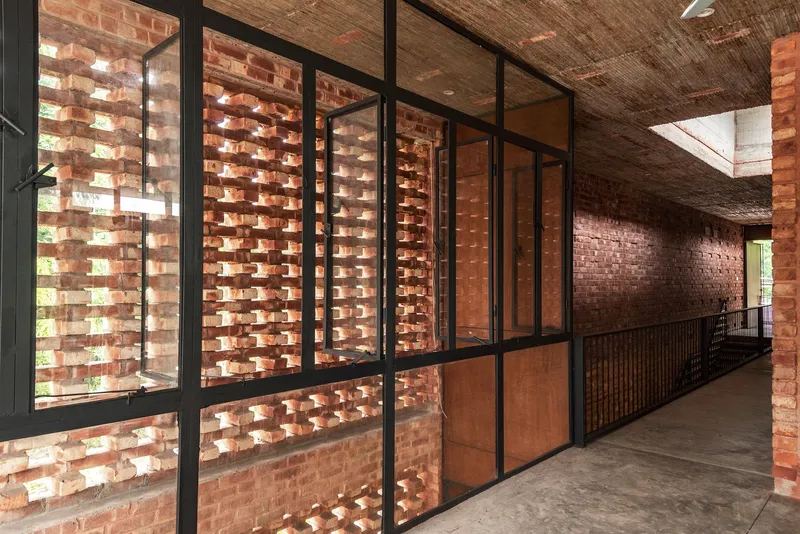
Perforated brick screens appear in nearly every image of the house, and for good reason. They do triple duty: filtering direct sunlight into soft patterns, allowing air to pass through the building envelope, and providing visual privacy without the claustrophobia of a solid wall. On the terrace, a brick screen wall transforms evening light into a grid of warm spots across the seating area. In the interior corridor, a similar screen sits adjacent to steel-framed glazing, creating a layered condition where daylight is modulated twice before reaching the occupant.
The screens also anchor the project in Bangladeshi material culture. Brick construction is indigenous to this region, and Venna Architects treat it with respect rather than irony. The perforations are not a trendy gesture imported from Pinterest; they belong to a long tradition of jali-like openwork in South Asian architecture. What the architects add is a precise control of aperture size and density tailored to each room's orientation and program.
Upper Levels and the Bamboo Ceiling
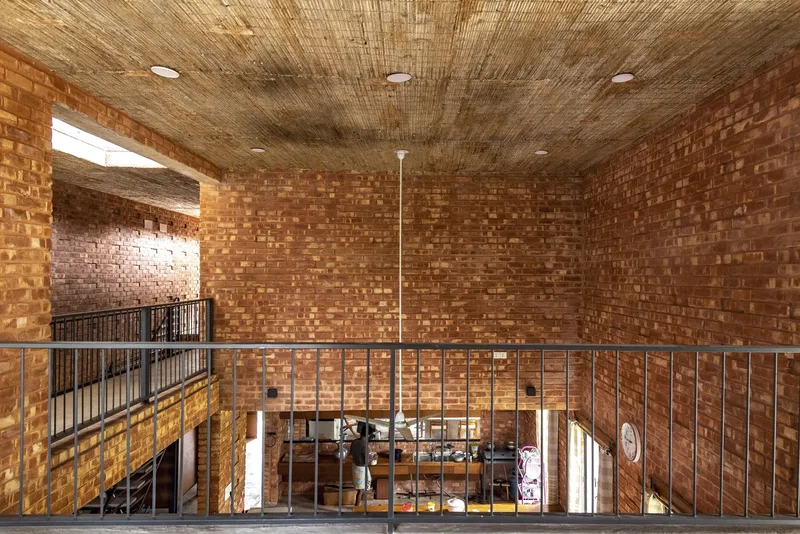
The upper floor houses an open kitchen and the bridge that connects family living and dining areas. Steel railings keep sightlines open between the mezzanine and the double-height volume below. The woven bamboo ceiling, visible from every level, unifies the interior under a single material gesture. It is warm, acoustically forgiving, and ages gracefully, qualities that concrete alone cannot provide.
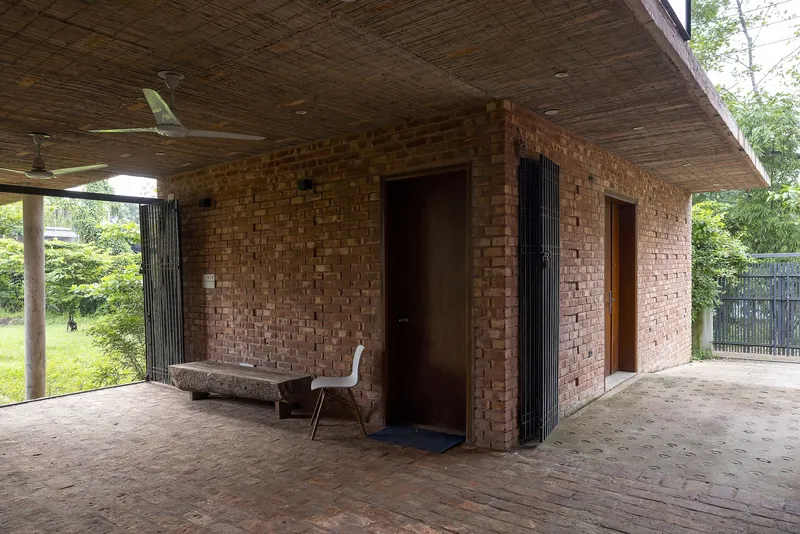
A covered terrace with exposed brick walls and a timber ceiling extends the living space outdoors. A single chair placed beside an open doorway captures the project's ethos more clearly than any diagram: solitude is not isolation but a deliberate moment of quiet within a house designed for gathering. The terrace bridges indoor and outdoor family activities, and the greenery of the southern compound is never far from view.
Why This Project Matters
Anukrom House matters because it demonstrates that a modest residential program in a small Bangladeshi town can sustain real architectural ambition. Venna Architects did not import a global style and paste it onto a local context. They started with a specific emotional brief, rooted in nostalgia and spiritual continuity, and resolved it through climate-responsive form, local materials, and a spatial sequence that privileges gathering and reflection in equal measure. The kachari ghar, the courtyard oriented toward an ancestral grave, the prayer space with its deliberate sightline: these are not generic moves. They are precise responses to one family's life.
At a moment when residential architecture in South Asia increasingly defaults to developer-driven generics, projects like Anukrom House remind us what a house can hold. It can hold wind, light, memory, and silence. It can hold a poem. And it can do all of this with brick, concrete, bamboo, and steel, materials available on any construction site within a few kilometers. That is the real lesson here: ambition does not require exotic resources. It requires attention.
Anukrom House by Venna Architects. Alamdar Para, Bangladesh. 496 m². Completed 2021. Lead Architect: Asif Mohammed Ahsanul Haq. Design Team: Arifa Akhter, Faria Nur Munia, Arafin Haque Romon, Aftabun Nahar. Photography by Asif Salman and Shakil Hai.
About the Studio
Share Your Own Work on uni.xyz
If projects like this are the kind of work you want to make, uni.xyz is a place to publish your own, find collaborators, and enter design competitions.


Popular Articles
Popular articles from the community


Aquadapt: An Underwater Habitat That Rewrites Its Rooms by the Hour
Curved modules ring the seabed while one shell shifts from breakfast room to cinema, farm and football pitch as residents' needs change.


graciastudio Turns a Viewless Tijuana Lot Inward Around a Courtyard of Concrete, Timber and Trees
In Tijuana, Jorge Gracia's GA2 House stacks a timber-clad private floor over exposed concrete and replaces a missing view with a planted interior patio.

Cube Design Draws an Ecological Corridor Between Two Shenzhen Hills with the Nankai Building
Beside Shenzhen's container docks, the Nankai Building pairs stacked balconies with a climbing green screen to connect two hillsides across its height.

Manzana Morphosis: Stretching Barcelona's Grid into a Living Landscape for 2050
A radical reworking of the Eixample manzana turns density into a tool for generous public space, vertical ecology, and environmental performance.

Similar Reads
You might also enjoy these articles


Hodi-Mandai Geram
Project Function: Preservation and revitalization of the Intangible heritage and socio-spatial identity of the Hodi by Housing, Cultural Memory Center, Sacred Grove, landscape, local tourism economy


Olio Towers: A Mid-Rise for Performers That Fuses Housing, Rehearsal, and Stage
Located blocks from Houston's Theater District, this modular tower stacks living units around a central performance atrium.

Oasis: Modular Green Housing Carved into Dhaka's Urban Fabric
A shortlisted Plugin Housing entry reclaims unauthorized settlements in Dhaka with stepped concrete volumes, green roofs, and ventilation-driven design.

Black Hole: A Floating Megastructure for the Post-Physical Era
Emiliano Mazzarotto envisions a spherical, self-scaling arena where e-sports, digital hotels, and holographic stadiums replace traditional public space.

Explore Architecture Competitions
Discover active competitions in this discipline

Challenge to reimagine the Iron Throne

Photograph architecture without architects

Illustrate the lost glory of Angkor Wat - Render Challenge

Design challenge to reuse E-waste
Comments (0)
Please login or sign up to add comments
No comments yet. Be the first to comment!