

Apartment Renovation in Honancho by Takehiko Suzuki
Apartment Renovation in Honancho transforms a 40-year-old Tokyo apartment into a flexible, light-filled home blending tradition and modernity.


Located in Tokyo, Japan, the Apartment Renovation in Honancho by Takehiko Suzuki transforms a 40-year-old corner apartment into a flexible, light-filled, and thoughtfully organized home. With a total area of 68 m², this renovation reimagines a compact urban dwelling as a multifunctional living and working environment, accommodating a couple, their child, and a home office. The project emphasizes spatial fluidity, sustainable reuse, and the subtle integration of traditional Japanese architectural elements for contemporary living.


Maximizing Light and Space in a Compact Apartment
Situated on the top floor of a five-story apartment building, the unit benefits from windows on three sides. The architects stripped the interiors to their skeleton to allow complete reconfiguration. Private and utility spaces such as the office, bathroom, and storage were positioned along the north side of the reinforced concrete bearing wall. In contrast, the living areas — including the kitchen, dining, and lounge — were arranged to the south, creating a clear spatial flow and maximizing access to natural light and ventilation.
The bedroom sits at the heart of the apartment, encircled by functional zones such as the kitchen, closet, and work area. This circulation pattern promotes both movement and a gentle sense of separation between spaces, while encouraging light and air to flow freely through the home. Above the bedroom, a loft serves as both a playful hideout for the child and a practical storage solution.


Adaptive “Fittings” and Material Innovation
A central design concept in this renovation is the use of adjustable boundary surfaces, or “fittings,” which allow residents to fine-tune their environment according to daily needs. These surfaces control light, air, sound, and visibility — enabling a high degree of spatial flexibility and user interaction.
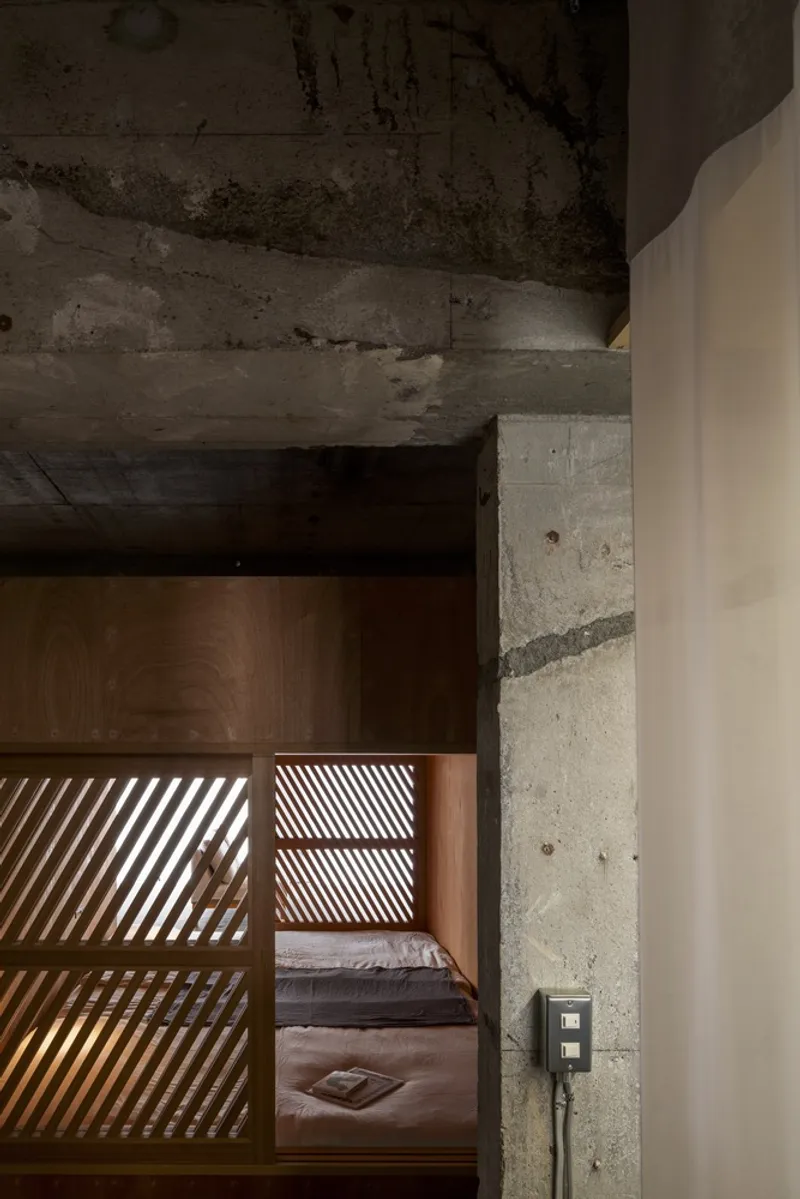
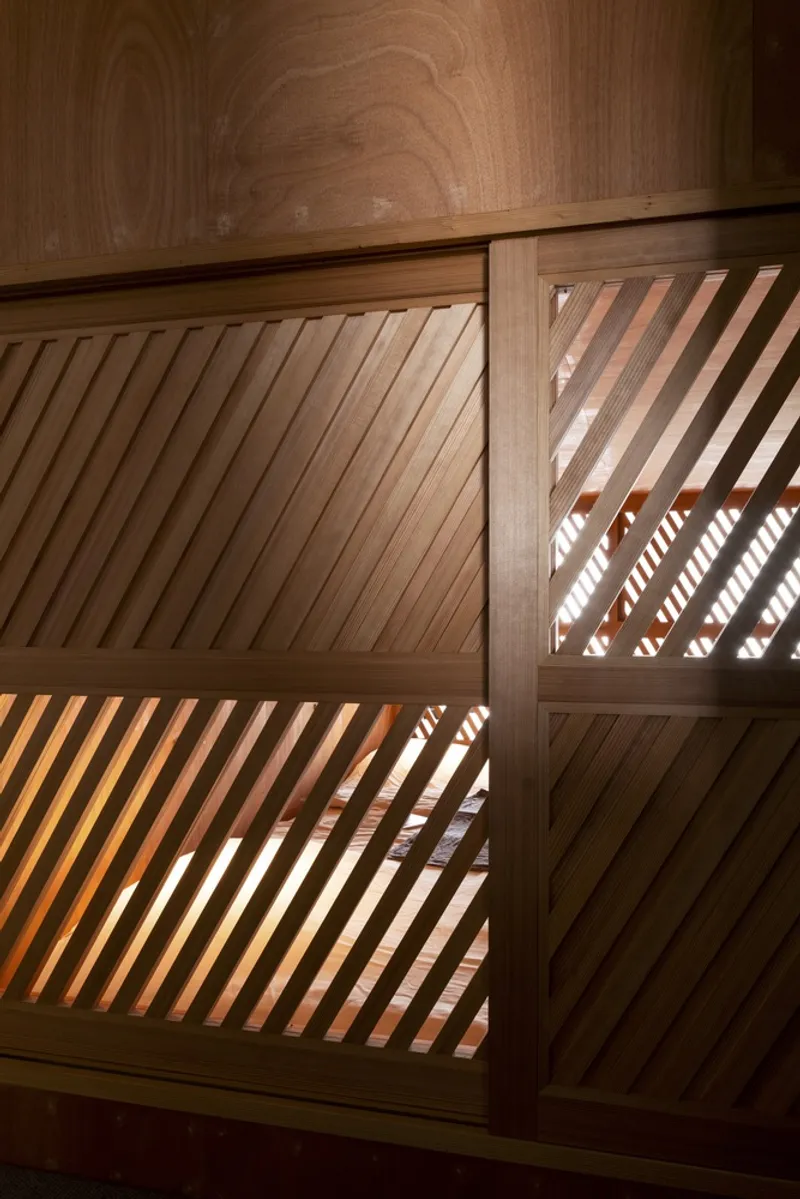
One standout element is the diagonal Muso-mado fitting, inspired by traditional Japanese double-lattice screens. Unlike the typical vertical slats, this modern version uses diagonal lattices to manage both visual privacy and airflow. Its adjustable design allows residents to tailor lighting and openness — perfect for moments when one might want to “block the view but let the breeze in” or maintain presence between family members across spaces.
Another notable invention is the skeleton flush door, crafted with a core of paper honeycomb and faced with translucent Shoji paper. This lightweight yet strong door allows soft light diffusion while maintaining visual privacy — especially useful between the dressing room and the office. The honeycomb’s structure also casts unique shadows, adding visual depth and warmth to the minimalist interiors.


Sustainable, Efficient, and Sensory-Centered
The renovation not only recycles the apartment’s shell but also embraces environmentally friendly materials and lightweight construction methods. The blend of traditional Japanese design elements with modern materials results in a serene, tactile interior that is both aesthetically calming and functionally versatile.
Rather than rigid compartmentalization, the design promotes a gradation of space — where activities, moods, and atmospheres coexist through adjustable layers of partition and transparency. The environment subtly expands and contracts with the rhythms of daily life.
This project exemplifies how small-scale renovations can offer big design lessons: by focusing on adaptability, sensory experience, and cultural continuity, it redefines the potential of aging urban apartments.


All the Photographs are works of Masao Nishikawa



Popular Articles
Popular articles from the community


Co-Life: Senior Housing Design That Reconnects Older Adults With the City
Co-Life reimagines senior housing design through healing gardens, shared streets, workshops, and a sustainable community across generations.
EW PARK: Sustainable Architecture Reimagines the Future of Urban Parking
EW PARK reimagines city parking as a modular wooden tower combining automation, solar energy, electric mobility, and adaptable urban design.

The Earth Pod: 3D Printed Homes for Resilient Refugee Communities
The Earth Pod reimagines refugee housing through 3D printed homes made from clay, combining resilience, self-sufficiency, and rapid shelter.

The Ocean Hive: Sustainable Architecture for a Self-Sufficient Civilization at Sea
The Ocean Hive imagines sustainable architecture at sea, where modular habitats, algae, wave power and ocean waste sustain a growing colony.
Similar Reads
You might also enjoy these articles


Hodi-Mandai Geram
Project Function: Preservation and revitalization of the Intangible heritage and socio-spatial identity of the Hodi by Housing, Cultural Memory Center, Sacred Grove, landscape, local tourism economy


Olio Towers: A Mid-Rise for Performers That Fuses Housing, Rehearsal, and Stage
Located blocks from Houston's Theater District, this modular tower stacks living units around a central performance atrium.

Oasis: Modular Green Housing Carved into Dhaka's Urban Fabric
A shortlisted Plugin Housing entry reclaims unauthorized settlements in Dhaka with stepped concrete volumes, green roofs, and ventilation-driven design.

Black Hole: A Floating Megastructure for the Post-Physical Era
Emiliano Mazzarotto envisions a spherical, self-scaling arena where e-sports, digital hotels, and holographic stadiums replace traditional public space.


Explore Renovation Competitions
Discover active competitions in this discipline


Challenge to design mud housing for contemporary communities


Challenge to reimagine the Iron Throne


Photograph architecture without architects


Illustrate the lost glory of Angkor Wat - Render Challenge
Comments (0)
Please login or sign up to add comments
No comments yet. Be the first to comment!