
AQUASIS: A Pavilion of Water Rejuvenation
A visionary sustainable architecture pavilion in Egypt that harvests water from air, turning desert desiccation into a living oasis.


In an era defined by climate instability and escalating water scarcity, sustainable architecture is no longer an option, it is an urgent necessity. Aquasis: A Pavilion of Water Rejuvenation, designed by Wunghee Lee, Do Yeun Kim, and Matthew Bong, proposes a transformative architectural response to environmental degradation in Egypt’s arid landscape.
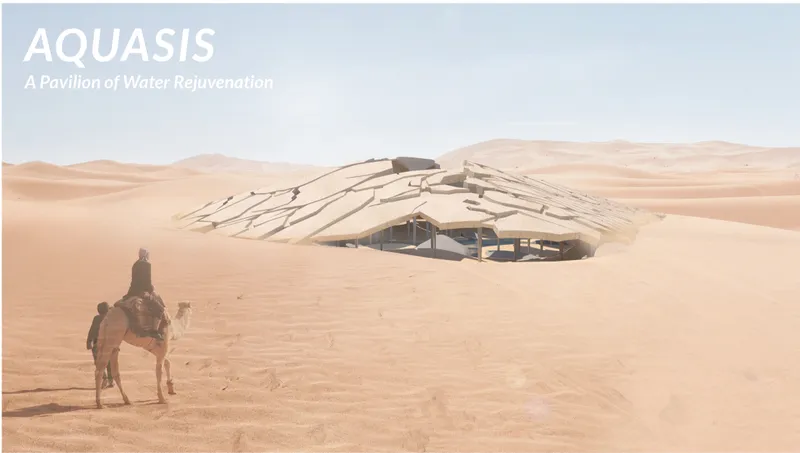
Located near the Pyramids of Giza and the Grand Egyptian Museum, Aquasis positions itself at the intersection of history, climate crisis, and technological innovation. The project challenges conventional architectural typologies by merging monumentality with environmental performance, transforming a barren desert into a regenerative oasis.
Architecture as Environmental Intervention
Egypt’s subtropical desert climate is marked by extreme heat, minimal precipitation, and growing water contamination issues. Aquasis addresses this ecological vulnerability through an integrated sustainable architecture strategy that extracts water directly from the air while utilizing locally abundant materials.
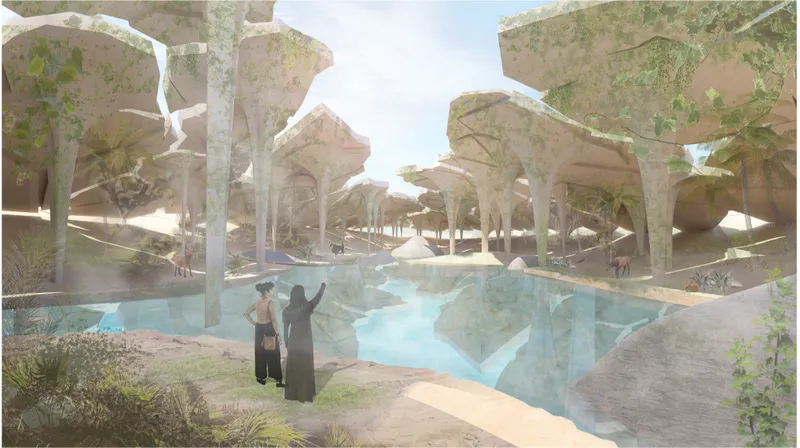
Rather than imposing an alien structure onto the desert, the pavilion emerges from it. Its cracked, carapace-like roof mimics the desiccated earth, a powerful metaphor for environmental neglect. Yet beneath this fractured surface lies a thriving micro-ecosystem of water, vegetation, and human interaction.
This duality, harsh exterior, life-giving interior, encapsulates the project’s central thesis: within degradation lies the potential for regeneration.
Water Harvesting Architecture: Metal-Organic Frameworks (MOF)
At the core of Aquasis is an advanced atmospheric water harvesting system embedded within the roof canopy. The design integrates Metal-Organic Frameworks (MOF), sponge-like materials with extensive internal surface areas capable of capturing moisture from desert air.
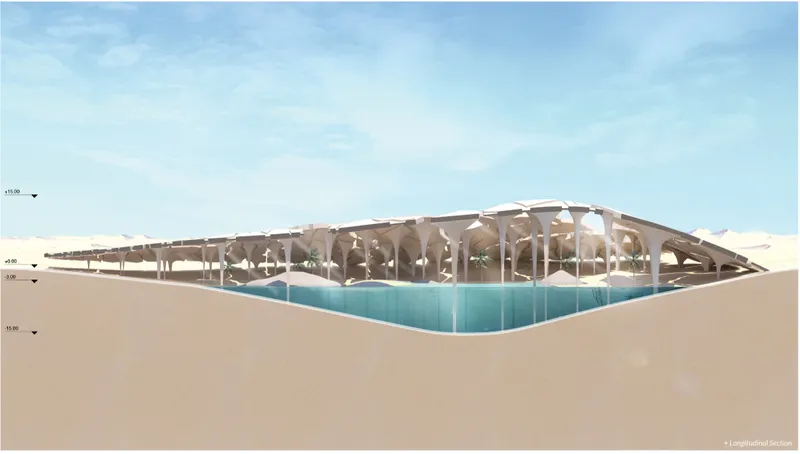
During cooler nighttime conditions, moisture is absorbed into the MOF layer. As temperatures rise during the day, condensation occurs, and collected water flows downward through funnel-like channels integrated into the structural columns. These columns contain natural filtration layers, ensuring clean and potable water output.
This system transforms architecture into infrastructure, where the building envelope itself becomes a living machine for survival.
Solar Sintering: Building with the Desert
Sustainable architecture also demands responsible material sourcing. Aquasis adopts solar sintering, an innovative construction process that uses concentrated solar heat to fuse desert sand into structural components.
By melting silica particles directly on-site, the process creates glass-like forms and structural elements without conventional manufacturing or heavy transportation. This significantly reduces carbon footprint, material waste, and energy consumption.
In this way, the pavilion is not imported into the desert, it is grown from it.
Spatial Experience: From Desiccation to Oasis
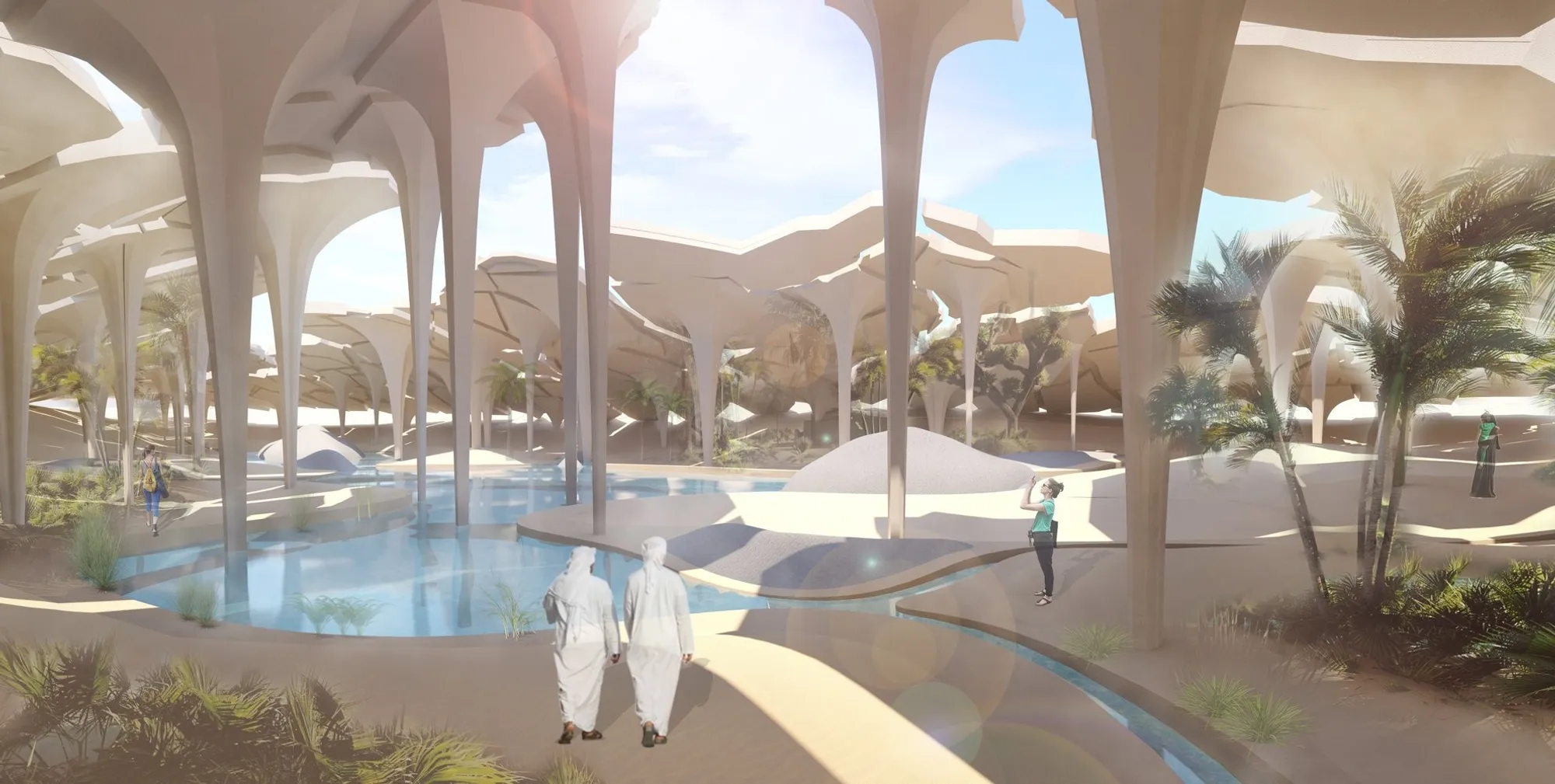
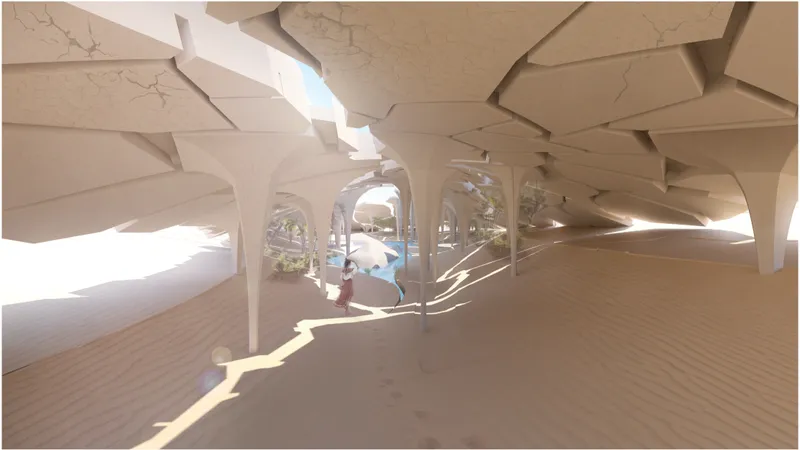
The architectural narrative unfolds as a journey of transformation. Rendered sequences illustrate cracked terrain gradually hydrating into lush vegetation. Visitors descend beneath the fractured canopy into a shaded sanctuary defined by slender solar-sintered columns and reflective water basins.
Pools of harvested water nourish planted ecosystems, creating microclimates that cool the environment naturally. Palm trees, desert flora, and shaded walkways invite human interaction, contemplation, and communal gathering.
Aquasis functions simultaneously as:
- A memorial to ecological loss
- A research-driven sustainable architecture prototype
- A public oasis for education and reflection
- A scalable water infrastructure model
Monumentality Reinterpreted
Monumentality in contemporary architecture is often associated with scale and permanence. Aquasis redefines monumentality through ecological responsibility. Its vast canopy recalls geological formations, evoking a sense of ancient terrain. However, unlike static monuments of the past, this pavilion performs, regenerates, and adapts.
The fractured roof symbolizes environmental damage, while the flourishing interior embodies hope. This contrast reinforces the emotional power of sustainable architecture, design that not only shelters but also heals.
A Model for Climate-Responsive Architecture
Beyond Egypt, Aquasis proposes a replicable model for regions facing water stress. By combining atmospheric water harvesting, passive cooling strategies, local material fabrication, and ecosystem integration, the project demonstrates how architecture can become climate infrastructure.
Rather than relying solely on centralized utilities, Aquasis decentralizes water production, empowering local environments to regenerate themselves.
Epilogue: Cultivating Resurgence
Aquasis extends beyond a singular pavilion, it is a manifesto for sustainable architecture in the age of climate urgency. It reframes water not as a diminishing resource, but as an opportunity for innovation. Through technological integration and symbolic spatial storytelling, the project restores dignity to the desert landscape.
In transforming cracked earth into oasis, Aquasis reminds us that architecture can move beyond form-making into life-making.
It is not merely a pavilion. It is a living system of resurgence.




Popular Articles
Popular articles from the community


Co-life: Sustainable Architecture for Age-Friendly Community Living
Co-life reimagines sustainable architecture for seniors through courtyards, rammed earth, shared gardens, and spaces designed for belonging.

The Musturak Paradise: Senior Living Architecture for a Connected Future in Temara, Morocco
The Musturak Paradise reimagines senior living architecture in Temara via private homes, social spaces, culture, community, and shared care.

The Ocean Hive: Sustainable Architecture for a Self-Sufficient Civilization at Sea
The Ocean Hive imagines sustainable architecture at sea, where modular habitats, algae, wave power and ocean waste sustain a growing colony.

Conexión: Biophilic Design Reimagines High-Rise Living in Hong Kong
Conexión reimagines high-rise living in Hong Kong through biophilic design, green facades, shared spaces, daylight, water and nature within.


Similar Reads
You might also enjoy these articles

Eco Chapel: A Green Architecture Pavilion Designed in Symbiosis with the Forest
Eco Chapel uses green architecture to weave prayer, learning and reuse into a forest pavilion shaped by modular hexagonal canopies for life.
Kaffeebühnen: Coffee Shop Architecture Designed as a Civic Stage Between Vienna’s City and Park
Kaffeebühnen turns coffee shop architecture into a civic stage, linking Vienna’s park edge, urban life, warm timber yards, and coffee craft.
Healing Façade: Sustainable Architecture for Reforestation, Community, and Sacred Ecology in Ethiopia
Healing Façade reimagines sustainable architecture as a living wall that restores soil, catches water and renews Ethiopia's forest churches.


Urban Forest: A Vertical Ecosystem for 5,000 Workers in Singapore's Changi Business Park
Radially stacked pods and layered green decks turn a 7-acre plot into 47 acres of ecological workspace projected for 2040.


Explore Architecture Competitions
Discover active competitions in this discipline



Challenge to reimagine the Iron Throne


Photograph architecture without architects


Illustrate the lost glory of Angkor Wat - Render Challenge


Design challenge to reuse E-waste
Comments (0)
Please login or sign up to add comments
No comments yet. Be the first to comment!