
SALT Architects Turns Cape Town's Water Crisis into Architecture at the Cape Flats Aquifer Recharge Plant
A gravity-fed filtration facility in the False Bay Nature Reserve gives dignified form to the infrastructure of water resilience.


Cape Town nearly ran out of water. In 2018, the city counted down to "Day Zero," a projected date when municipal taps would be shut off entirely. The crisis receded, but the vulnerability it exposed did not. The Cape Flats Managed Aquifer Recharge Plant, completed in 2024 by SALT Architects, is a direct material response to that vulnerability: a R341 million facility that purifies treated effluent to potable standards and pumps it back into the underground aquifer beneath the city. It is infrastructure in the fullest sense, a civic survival mechanism. But it is also a building, and SALT has treated it as one.
What makes the project worth studying is the refusal to let function dictate ugliness. Sited within the False Bay Nature Reserve at Pelican Park, roughly 23 kilometers from Cape Town's center, the plant sits on a flat sandy expanse battered by southeasterly winds and salt air. Every material choice, every orientation decision, every facade detail answers both an environmental engineering problem and an architectural one. The gravity-fed filtration sequence, which moves water downhill through four parallel buildings arranged along an artificial slope, is simultaneously the structural diagram and the design concept. The architecture does not illustrate the process; it is the process.
Gravity as Organizing Principle
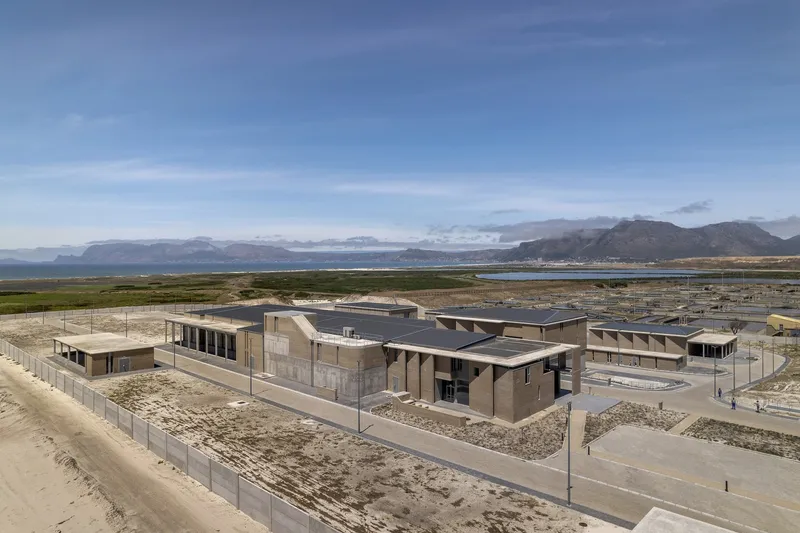
The site strategy is straightforward and compelling. Four linear filtration buildings step down an artificial slope so that water moves through the treatment sequence under its own weight: media filtration at the top, ozone and biological activated carbon treatment at the second level, UV disinfection at the third, then pumping to the aquifer. The aerial view reveals the compound's logic clearly, a series of long metal-roofed volumes running parallel amid coastal wetlands, their arrangement dictated not by compositional preference but by hydraulic gradient.
The landscaping reinforces the site's ecological context. Indigenous species like Carpobrotus edulis and Metalasia muricata have been planted to stabilize the sandy terrain, while dune sand excavated during construction was reused as backfill. Terraforce retaining wall blocks with a round-faced finish create staircase access between the three building platform levels, an honest solution that reads as landscape rather than engineering.
Brick Fins and Controlled Light
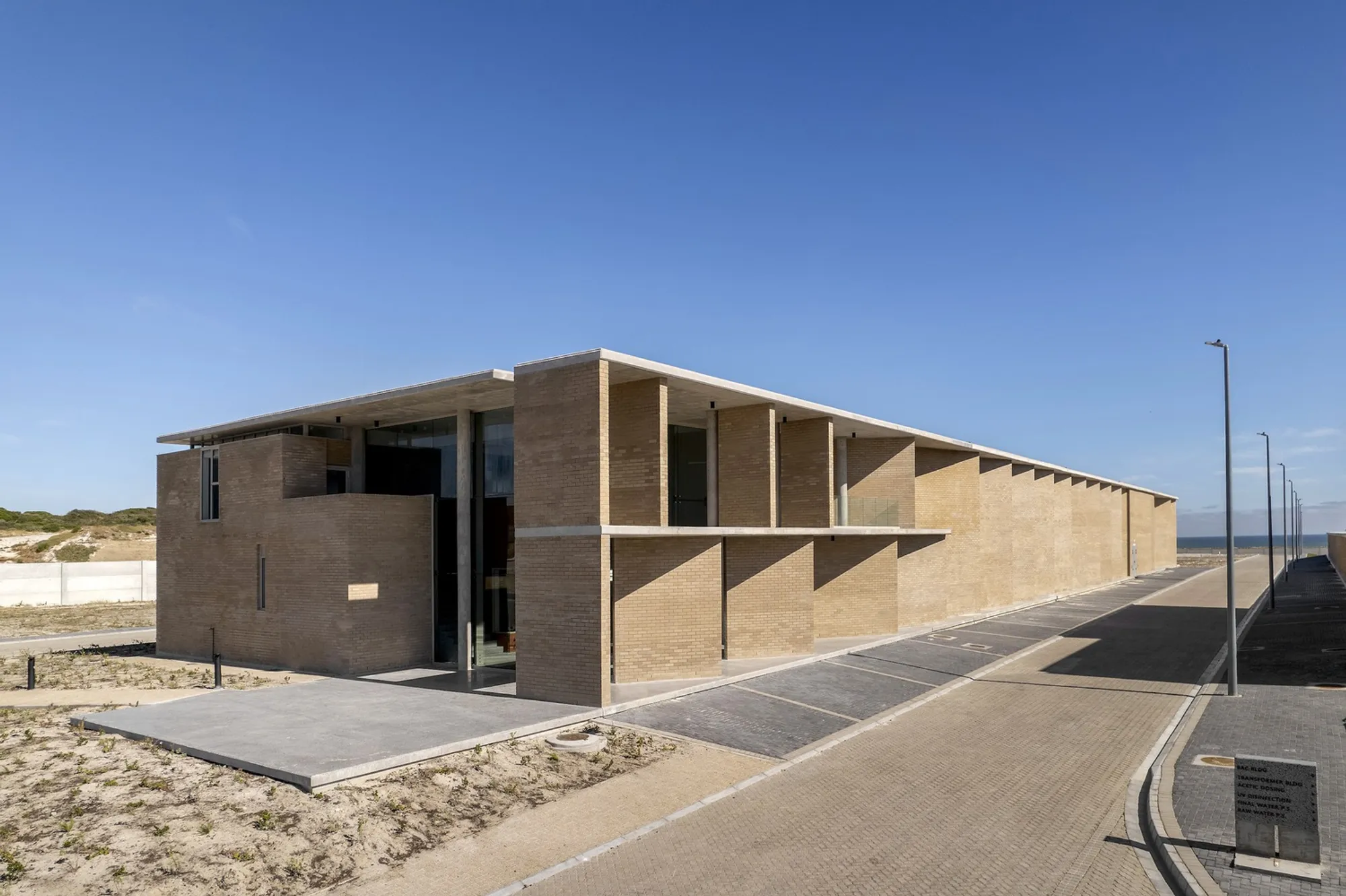
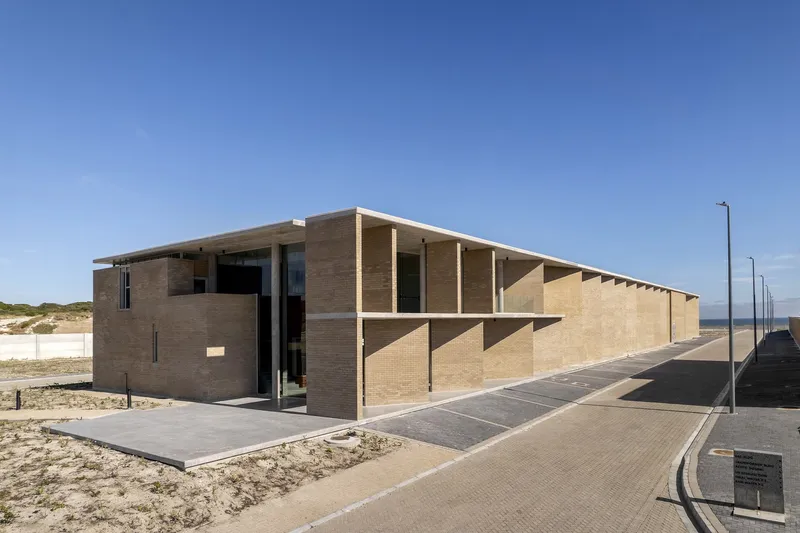
The filtration buildings' east-west facades are defined by angled brick fins, deep enough to shade the interiors from coastal glare and narrow enough to restrict the light that enters to a controlled sliver. The reasoning is not purely aesthetic: uncontrolled sunlight would promote algae growth in the filtration media, degrading performance. So the facade functions as a membrane, regulating light and ventilation much as the filters inside regulate water. SALT chose face brick for its warmth, its low maintenance demands in a corrosive environment, and its tonal harmony with the sandy surroundings.
The result is what might be called a "gilled" expression, rows of deep vertical fins producing rhythmic shadow lines that shift throughout the day. Against the buff-toned brick, the narrow south-facing windows appear almost as slots, just enough to ventilate and illuminate without inviting the problems that come with generous glazing in this climate. It is a practical solution that also happens to give the buildings a strong civic presence, dignified rather than defensive.
The Weight of Water
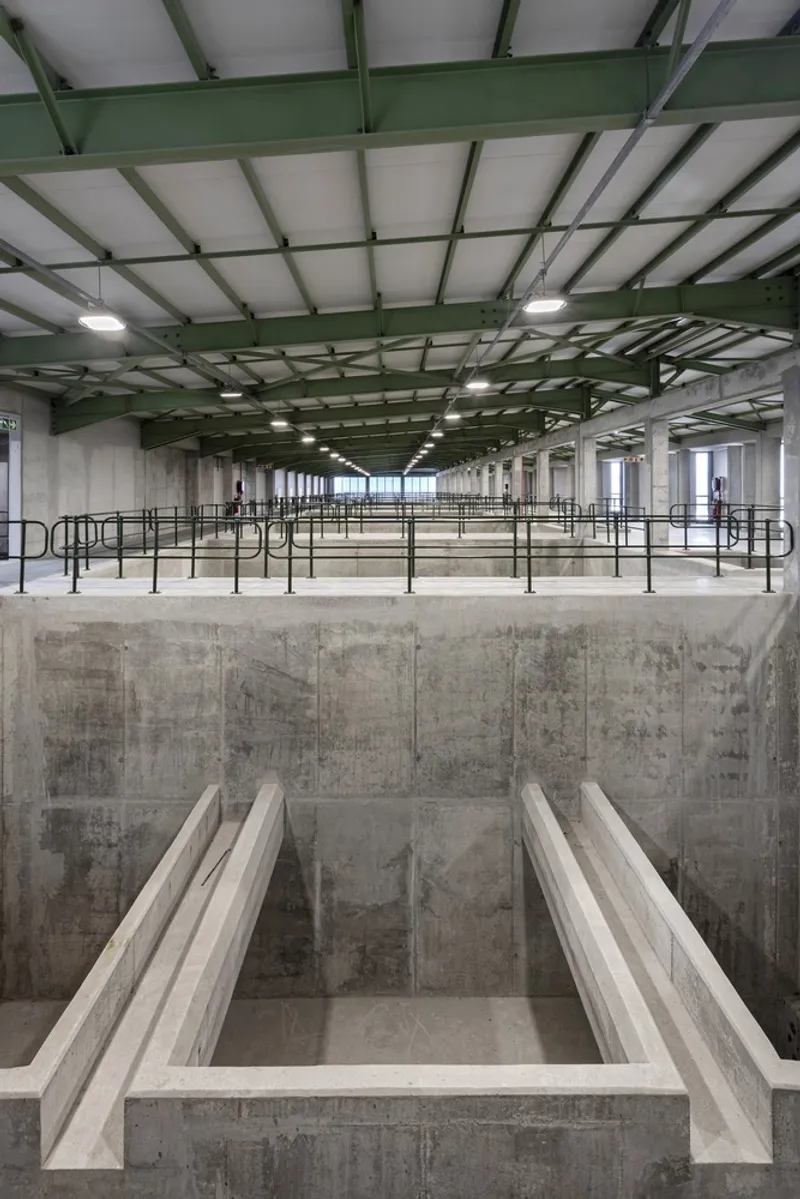
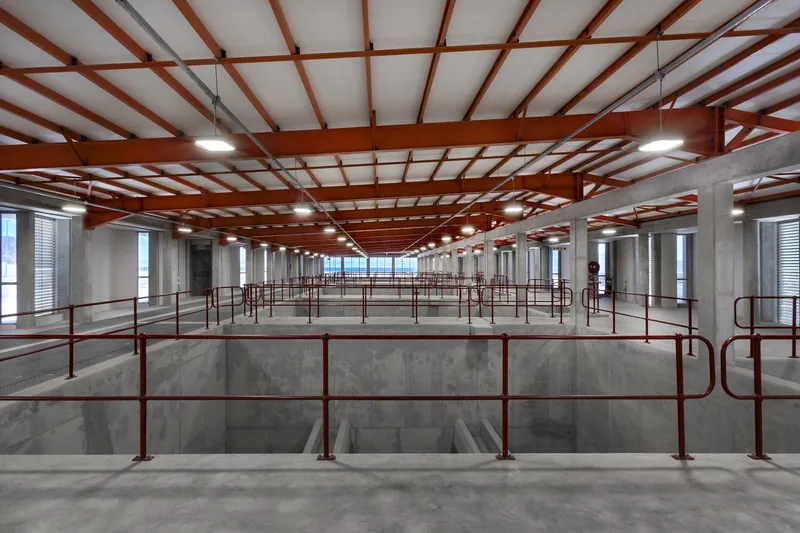
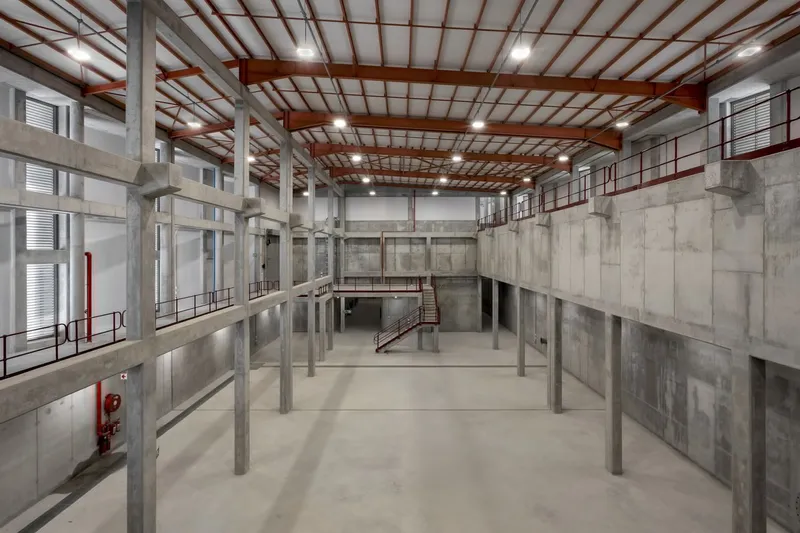
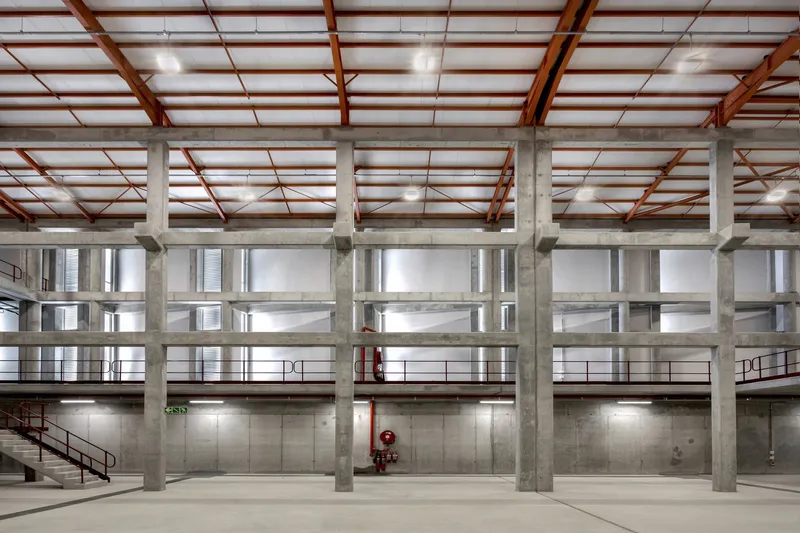
Inside the filtration halls, the architecture reveals its mass. Concrete walls and floors up to 600 millimeters thick contain the water retention structures, and the sheer density of the construction is palpable. Red and green painted steel roof structures span over concrete basins and channels, their industrial palette reading as functional coding rather than decoration. These are working interiors, designed for durability and access rather than comfort, yet the spaces have a monumental quality that comes from the honest expression of heavy infrastructure.
The concrete is largely board-formed, its texture a byproduct of the formwork rather than a surface treatment. Metal railings, mezzanine levels, and exposed columns establish a clear spatial hierarchy: the water moves below, operators circulate above. SALT has embedded significant energy in these structures, with 600mm-thick concrete representing a serious commitment to longevity. The implicit argument is that buildings this durable deserve to be well-designed, because they will stand for a very long time.
An Administrative Building That Earns Its Place
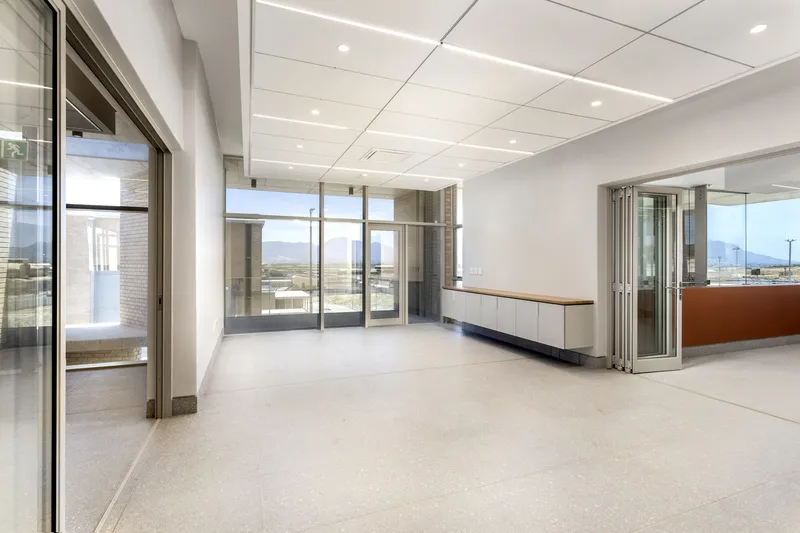
Positioned at the site's highest point and integrated with the first filtration building, the administrative building serves as the control center and the facility's human face. Its ground floor accommodates operational spaces for plant staff; the first floor houses offices, meeting rooms, and the plant control room, with views out to distant mountain ranges through restrained glazing. The interior is calm and well-proportioned, with white suspended ceilings, glass partitions, and built-in casework establishing a civic quality that is uncommon in utility infrastructure.
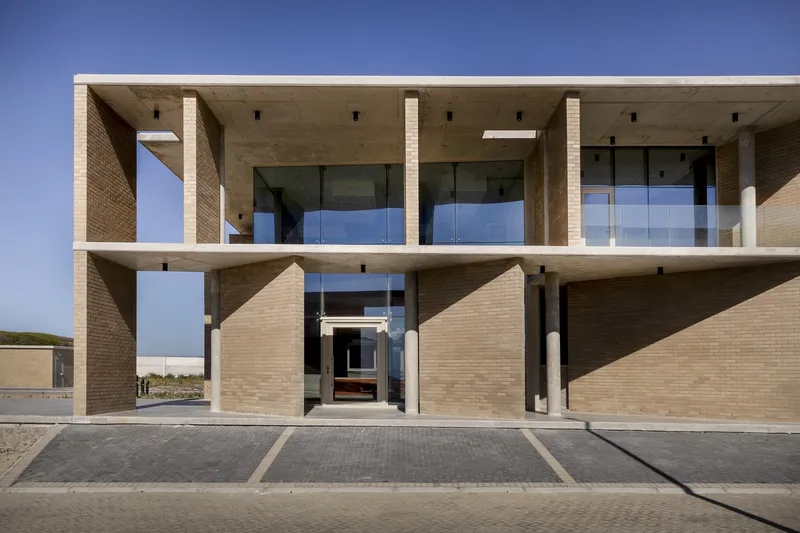
A double-height glazed atrium at the entrance creates a naturally lit threshold between the administrative and industrial zones. The exposed concrete columns and red steel roof structure visible in the interior hall give the building an institutional solidity, but the generous daylighting and careful material palette prevent it from feeling oppressive. The brise-soleil on the admin building's facade mirrors the gilled language of the filtration buildings but opens up slightly, offering a semi-permeable screen appropriate for occupied spaces. SALT has understood that the people who operate this plant every day deserve an environment that conveys purpose, not just function.
Dignity in the Details
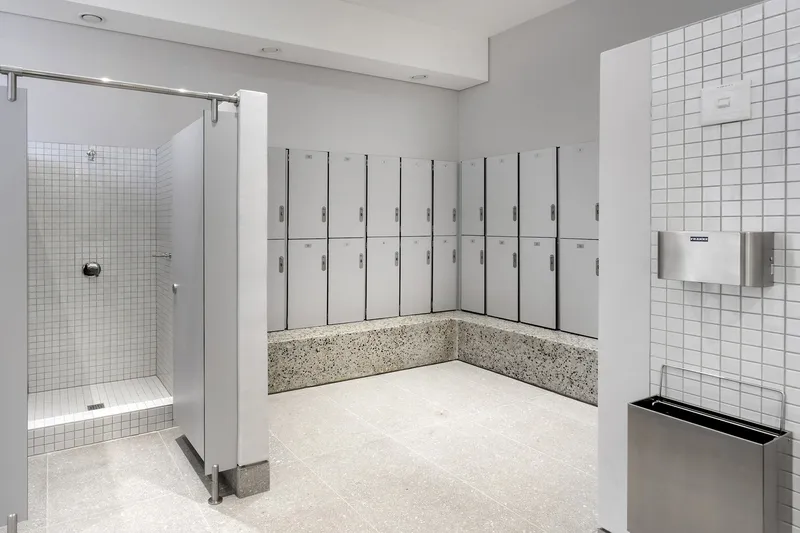
A locker room with white tile walls, a terrazzo base, and a glass-partitioned shower stall is not the kind of space that typically receives design attention in infrastructure projects. Its inclusion in the photographic record is telling. SALT has extended the same care to the back-of-house spaces as to the public-facing ones, a gesture that communicates respect for the operators who maintain this critical facility. Low-flow sanitary fittings and waterless urinals are installed throughout, a fitting detail for a building whose entire purpose is water conservation.
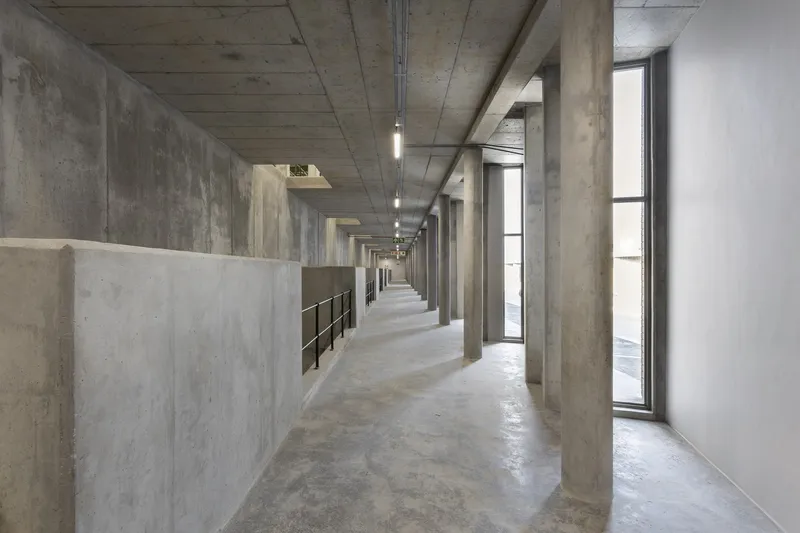
The board-formed concrete corridors with their tall narrow windows are among the most spatially compelling moments in the project. Light enters in controlled vertical strips, casting hard shadows across the textured concrete surfaces. These are circulation spaces, but they possess a quiet intensity that elevates the experience of moving through the building. Infrastructure does not have to feel industrial simply because it is.
Why This Project Matters
The Cape Flats Aquifer Recharge Plant matters because it demonstrates that climate resilience infrastructure can be architecturally serious without being architecturally indulgent. SALT Architects have designed a building where every facade decision has a performance justification, where the spatial sequence mirrors the water treatment sequence, and where durable materials are selected not for their visual appeal alone but for their capacity to endure decades of corrosive coastal conditions. The gravity-fed arrangement is the design concept. The brick fins are the shading strategy. Nothing here is applied.
More broadly, the project offers a model for how cities facing water scarcity can invest in infrastructure that serves as civic architecture rather than hidden utility. Access to the facility is restricted, but its presence within the False Bay Nature Reserve, its indigenous landscape strategy, and its educational program signal that this is public investment meant to be seen and understood. In a world where water crises will only become more frequent, the argument that such buildings deserve thoughtful design is not sentimental. It is strategic.
Cape Flats Managed Aquifer Recharge Plant by SALT Architects. Pelican Park, False Bay Nature Reserve, Cape Town, South Africa. Completed 2024. Photographs by Karl Rogers.
About the Studio
Share Your Own Work on uni.xyz
If projects like this are the kind of work you want to make, uni.xyz is a place to publish your own, find collaborators, and enter design competitions.




Popular Articles
Popular articles from the community


Co-life: Sustainable Architecture for Age-Friendly Community Living
Co-life reimagines sustainable architecture for seniors through courtyards, rammed earth, shared gardens, and spaces designed for belonging.

The Ocean Hive: Sustainable Architecture for a Self-Sufficient Civilization at Sea
The Ocean Hive imagines sustainable architecture at sea, where modular habitats, algae, wave power and ocean waste sustain a growing colony.

The Earth Pod: 3D Printed Homes for Resilient Refugee Communities
The Earth Pod reimagines refugee housing through 3D printed homes made from clay, combining resilience, self-sufficiency, and rapid shelter.

The Musturak Paradise: Senior Living Architecture for a Connected Future in Temara, Morocco
The Musturak Paradise reimagines senior living architecture in Temara via private homes, social spaces, culture, community, and shared care.

Similar Reads
You might also enjoy these articles


Hodi-Mandai Geram
Project Function: Preservation and revitalization of the Intangible heritage and socio-spatial identity of the Hodi by Housing, Cultural Memory Center, Sacred Grove, landscape, local tourism economy


Olio Towers: A Mid-Rise for Performers That Fuses Housing, Rehearsal, and Stage
Located blocks from Houston's Theater District, this modular tower stacks living units around a central performance atrium.

Oasis: Modular Green Housing Carved into Dhaka's Urban Fabric
A shortlisted Plugin Housing entry reclaims unauthorized settlements in Dhaka with stepped concrete volumes, green roofs, and ventilation-driven design.

Black Hole: A Floating Megastructure for the Post-Physical Era
Emiliano Mazzarotto envisions a spherical, self-scaling arena where e-sports, digital hotels, and holographic stadiums replace traditional public space.

Explore Aqua Energy Competitions
Discover active competitions in this discipline



Challenge to reimagine the Iron Throne


Photograph architecture without architects


Illustrate the lost glory of Angkor Wat - Render Challenge


Design challenge to reuse E-waste
Comments (0)
Please login or sign up to add comments
No comments yet. Be the first to comment!