
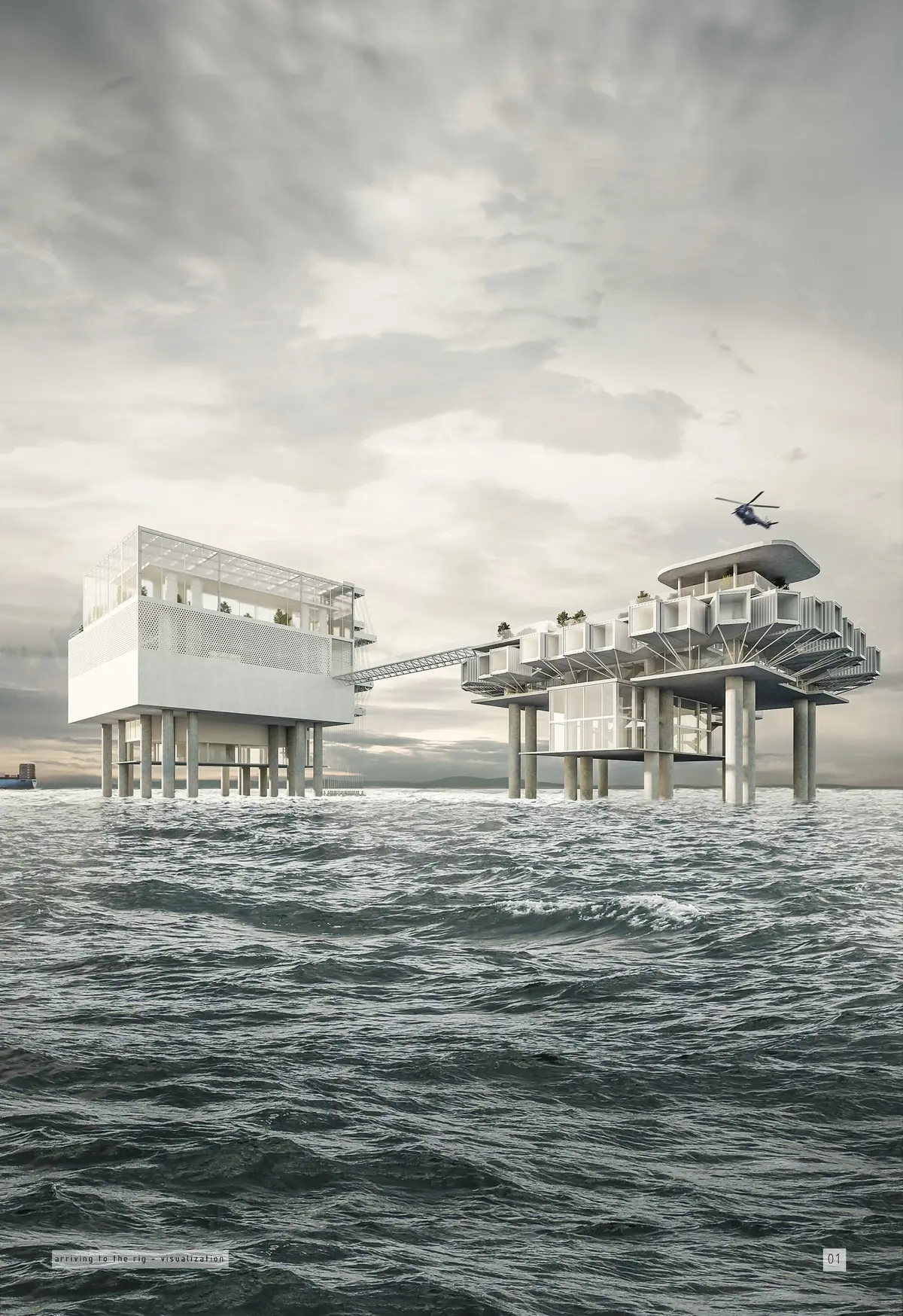
ArchiPelago: Turning a Decommissioned Adriatic Oil Rig into a Sea Satellite for Research and Living
A winning Proximity Island 2019 entry that stacks container homes, labs and wave-powered facades on an oil rig, leading visitors from depth to open sky.


Most decommissioned oil rigs face one of two fates: slow corrosion at sea or a costly tow to the scrapyard. ArchiPelago: The Sea Satellite proposes a third option. It keeps the structural frame standing and treats it as the foundation for an artificial island where people study the sea, gather around it and live on it for a while. The central argument is simple and persuasive. An industrial relic in open water already solves the hardest problem in seasteading, which is getting a stable platform out there. The design question becomes what to build on top, and how that building can teach its occupants to pay attention to the water beneath them.
The proposal was designed by Jákob Czinger, Diana Konovalova, Anna Orbanic and Sara Orbanić, and it was named a winning entry of Proximity Island 2019. The team placed it in the Adriatic Sea and borrowed the idea of a satellite: a distant body that stays connected, gathers information and sends it back. Researchers, scientists, residents and visitors share the rig, and its programme combines exhibitions, laboratories, workshops and temporary housing. The rig is not a sealed retreat. It is a working station that faces outward to the sea.
A Vertical Journey from Enclosed Depth to Open Horizon
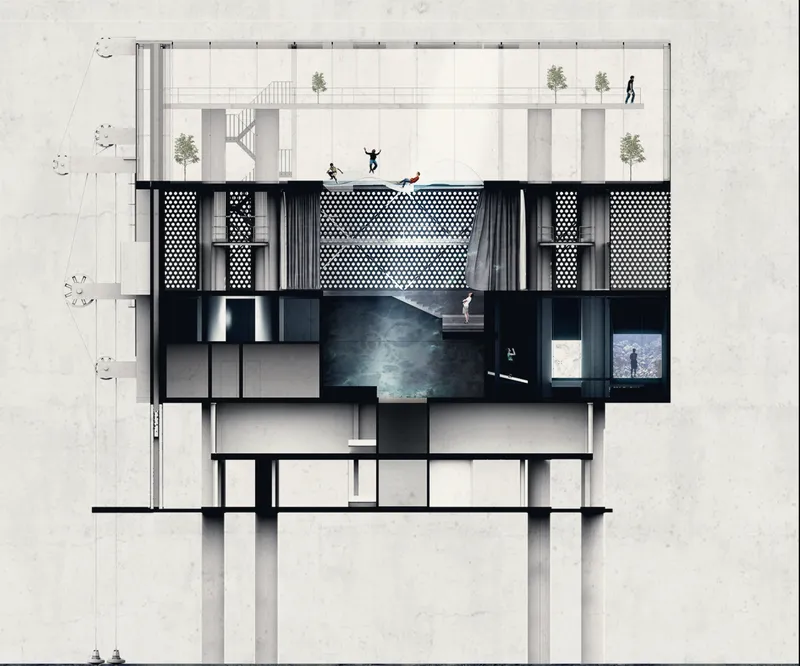
The section shows the building's main idea most clearly. A stilted block rises above the water, a central pool sits at its heart, perforated screens filter the edges and a rooftop garden crowns the stack. Figures leap above the water in the drawing, which signals early that this is a place for bodily contact with the sea, not a viewing deck kept at a safe distance. The team describes the sequence as a gradual transition from enclosed, underwater-inspired atmospheres to open panoramic spaces above the surface. Read from bottom to top, the section works like a decompression chamber played in reverse: you begin in the dense, dim conditions of depth and climb out into light.
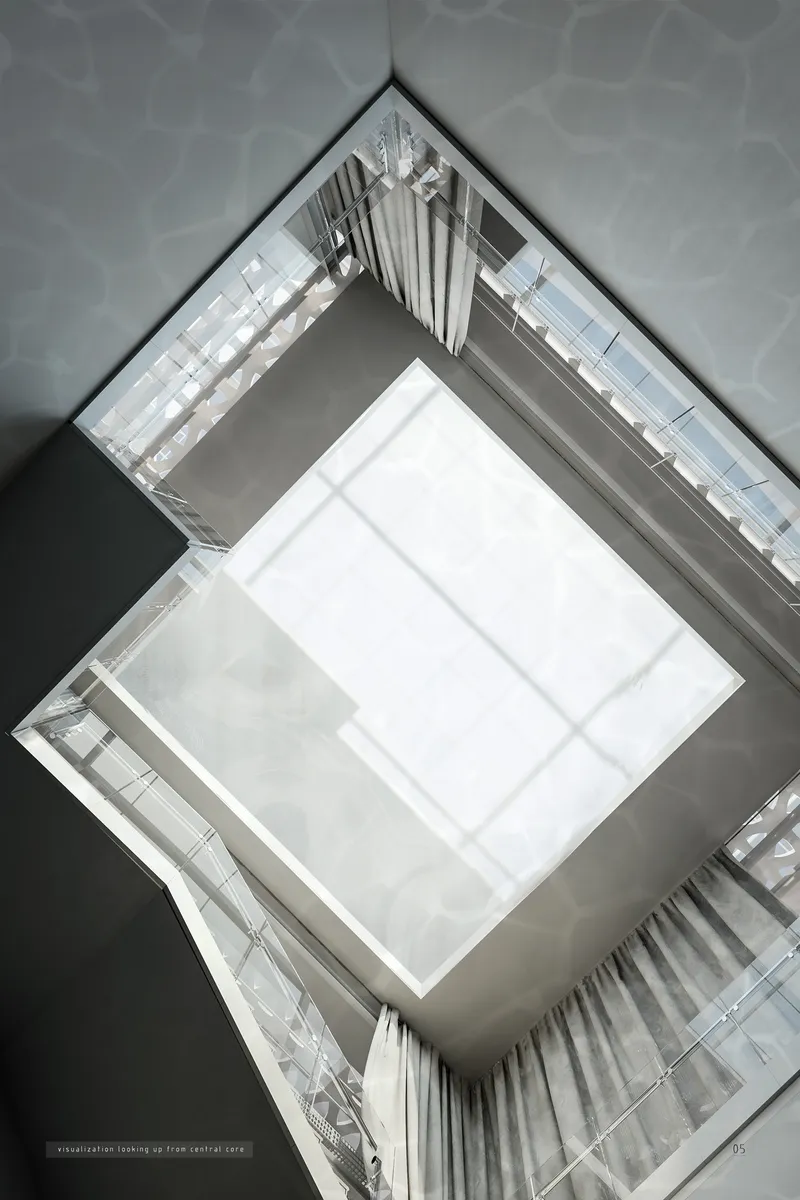
The view up through the square central core shows what that sequence feels like at eye level. Hanging curtains soften the shaft, railings trace the floors above, and light reflected off the water ripples across the walls. This is the project's most effective spatial move. The sea does not stay framed as scenery out a window. It is projected into the interior as moving light, so the building's atmosphere changes with the state of the water. That matches the team's claim that sea conditions should shape lighting, circulation and social life, and here the claim shows up as an experience rather than a slogan.
Shipping Containers Plugged into an Industrial Frame
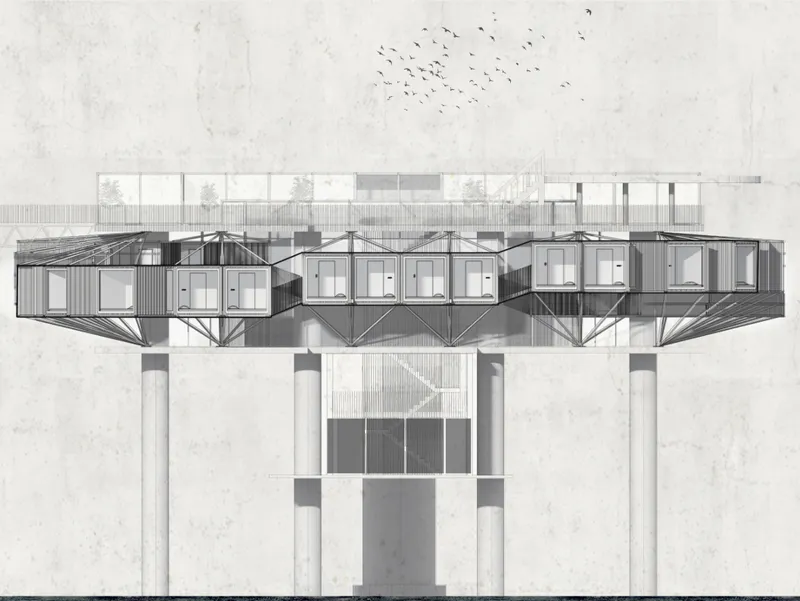
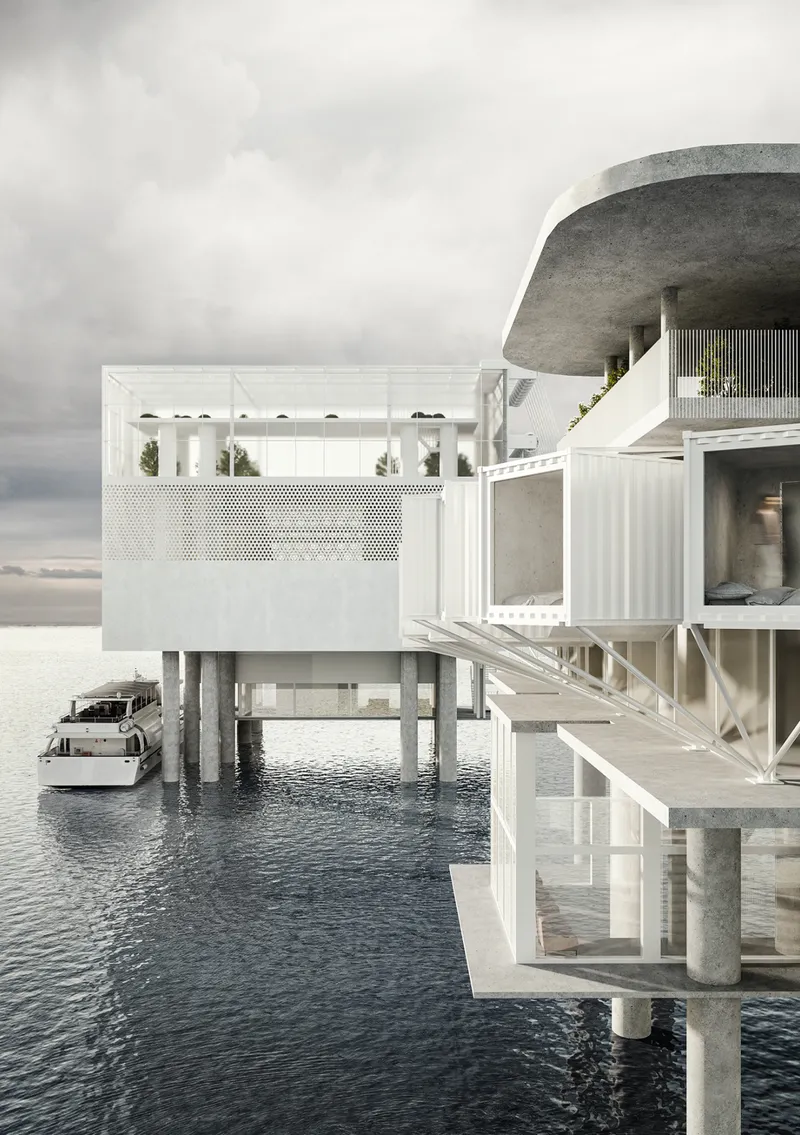
The elevation shows the construction logic plainly: container modules stacked on concrete columns, with a flock of birds overhead as a reminder of how exposed the site is. Because the rig sits far from any urban supply chain, the team relies on modular construction and recyclable materials that can be assembled on site. Shipping containers become residential capsules. Lightweight structures hold laboratories and communal rooms. Wave-energy systems built into the facade generate power from the surrounding sea. The approach is pragmatic. Containers are the native unit of maritime logistics, so using them on an oil rig feels less like a borrowed aesthetic and more like using parts the sea already knows how to deliver.
The perspective puts this logic into weather. Container bedrooms and a cantilevered concrete canopy sit on piles above dark water, a boat is moored below and heavy grey cloud presses down from above. The image refuses to romanticise the site, and that honesty strengthens the scheme. The heavy concrete of the inherited structure and the light, swappable modules read as two distinct layers: one permanent and one adaptable. That separation is what makes adaptive reuse believable here. The industrial history stays visible instead of being cleaned away, and new occupation can grow or shrink around it.
Plans for Collective Life, and a Room for Solitude
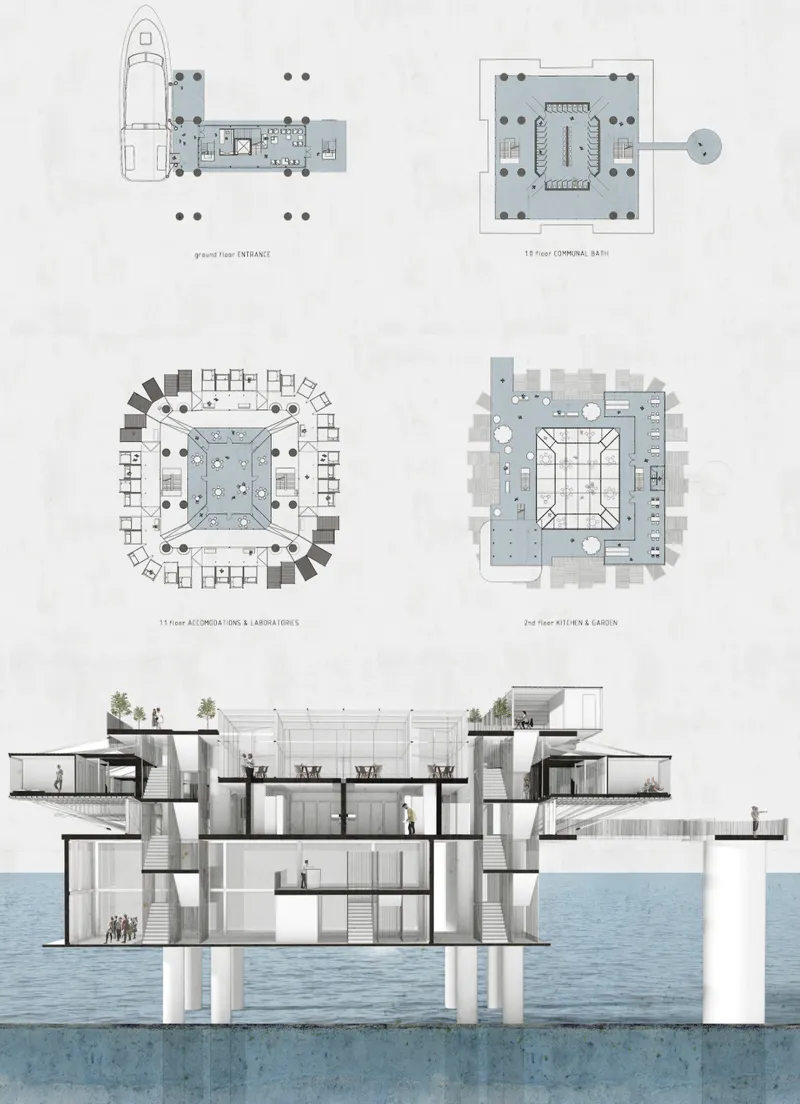
The presentation board places four floor plans above a cross-section of the building rising from open water, which shows how the programme stacks across levels. Research, exhibition, workshop and living spaces need to coexist on a limited footprint far from shore, and the plans show the team managing that density vertically around the shared core. This organisation supports the project's social ambition. Visitors are invited to stay, take part in workshops and contribute to environmental research, not just pass through an exhibit. The rig works as a collaborative platform as much as a building.
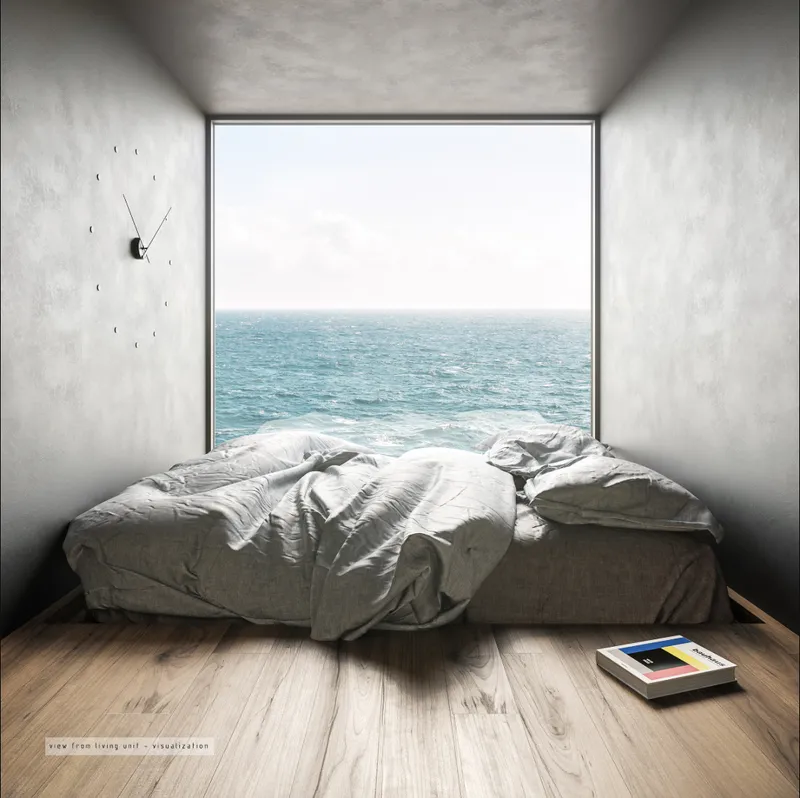
The final interior provides the counterweight. An unmade bed sits against a full-width window filled with open sea, with a wall clock above and a book on the timber floor. After the communal intensity of the core, this is a room of isolation, one of the metaphors the team names alongside water, depth and light. The clock is a quiet touch: out here, time is measured against an unchanging horizon. The image suggests that living on a sea satellite is partly about research and partly about the slower, more introspective awareness that comes from waking up surrounded by water.
Why This Project Matters
Offshore infrastructure will keep reaching the end of its working life, and debates about what to do with it usually stay within engineering and cost. ArchiPelago brings that discussion into architecture. It argues that an obsolete rig is a ready-made foothold in open water, worth reprogramming instead of erasing. Its mix of container modules, on-site assembly from recyclable materials and wave energy built into the facade amounts to a believable kit of parts for a self-sustaining offshore settlement, even at a conceptual stage.
What lifts the scheme above a technical exercise is its focus on perception. The ripple-lit core, the climb from depth to horizon and the solitary bedroom facing the sea all aim to change how people relate to the water, treating it as an active participant in daily life rather than a backdrop. In a competition about islands and proximity, the team's answer is that the most useful thing a remote structure can do is bring people closer to the environment around it, and ArchiPelago designs that closeness room by room.
View the Full Project
About the Designers
Designers: Jákob Czinger, Diana Konovalova, Anna Orbanic, Sara Orbanić
Enter a Design Competition on uni.xyz
uni.xyz runs architecture and design competitions year-round that reward proposals with spatial conviction and real site intelligence.
Project credits: ArchiPelago – The Sea Satellite by Jákob Czinger, Diana Konovalova, Anna Orbanic, Sara Orbanić Proximity Island 2019 (uni.xyz).


Popular Articles
Popular articles from the community


U.GA Architects Wraps an Oval Rooftop Pool in Curved Board-Formed Concrete on Busan's Jeollidan-gil
In Busan's Jeonpo-dong, a 454 m² mixed-use block stacks a neighborhood facility, guest rooms and an oval rooftop pool inside spiraling concrete walls.

Jaramillo Van Sluys Arquitectura and Urbanismo Turn a Demolished Registry Lot in Quito into an Orchard Plaza
In Quito's Centro Histórico, a 2,800 m² plaza exposes the San Agustín convent wall and redraws its lost Augustinian orchard in volcanic stone.

David Ortega Stacks a Two-Story Mexico City Penthouse Around a Steel Stair and a Pergola-Shaded Roof Terrace
In Colonia Roma, a 300 m² penthouse uses oak joinery, a planted steel stair and a slatted roof pergola to make a new-build apartment feel like a house.

Architekt Andreas Gruber Scatters 23 Dark Timber Chalets Across a South Tyrolean Forest Edge
In Molini di Tures, Amonti Chalets breaks a resort into a hamlet of gabled timber houses, with parking, storage and services pushed into the slope.

Similar Reads
You might also enjoy these articles
Healing Façade: A Modular Chapel System That Restores Ethiopia's Sacred Forests
Winner of the Eco-Chapel competition, this circular timber façade collects water from air to rebuild soil and reforest degraded Ethiopian landscapes.
Kaffeebühnen: Where Coffee Shop Architecture Becomes a Civic Stage in Vienna
A linear sequence of timber boxes, transparent shells, and open yards turns the Viennese café tradition into a public performance space.
Eco Chapel: A Modular Forest Pavilion That Grows Like the Landscape It Protects
Hexagonal timber modules weave through existing trees, turning a chapel into a living system for prayer, education, and reforestation.


Urban Forest: A Vertical Ecosystem for 5,000 Workers in Singapore's Changi Business Park
Radially stacked pods and layered green decks turn a 7-acre plot into 47 acres of ecological workspace projected for 2040.

Explore Architecture Competitions
Discover active competitions in this discipline

Challenge to reimagine the Iron Throne

Photograph architecture without architects

Illustrate the lost glory of Angkor Wat - Render Challenge

Design challenge to reuse E-waste
Comments (0)
Please login or sign up to add comments
No comments yet. Be the first to comment!