

Archipoetry Studio Lets a Hangzhou Factory's Decay Become the Design at Flop Art Space
An 807-square-meter gallery in Binjiang District transforms industrial ruin into a photography and art venue that wears its history openly.


Renovation projects tend to follow one of two scripts: scrub the old building clean and wrap it in something polished, or fetishize every crack and stain as if age alone guarantees meaning. Archipoetry Studio's Flop Art Space, completed in 2021 on Jugong Road in Hangzhou's Binjiang District, does neither. It accepts the factory's material reality on the factory's terms. When damp plaster walls collapsed during construction, revealing layers of brick and render underneath, the team simply left the result standing. The peeling became the finish.
That instinct, treating accident as intention, runs through the entire 807-square-meter conversion. The project inserts two mezzanines into the old double-height volume, lines the facade in corrugated aluminum alloy that echoes the shed's industrial DNA, and pours daylight through frameless glass walls and rooftop solar-panel skylights. The outcome is a space built for photography and exhibition that refuses to be precious about itself. It is rough where roughness makes sense and precise where precision counts.
A Facade That Remembers
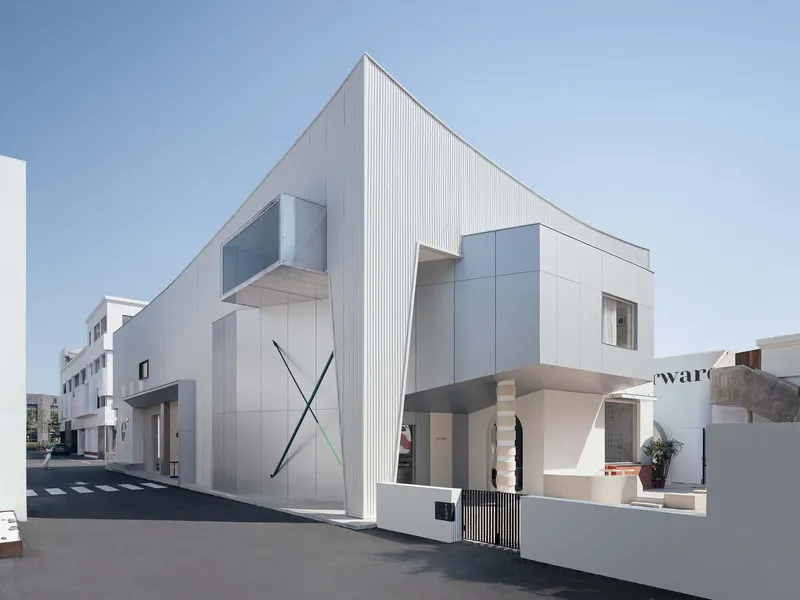


The street-facing elevation plays a careful game of correspondence. Vertical ribbed aluminum cladding, white and rhythmic, replaces the original corrugated metal but retains its proportions and cadence. A cantilevered upper volume punches out over a stacked stone entry portal, giving the building a sculptural presence without abandoning its warehouse parentage. The palette is restrained: white metal, grey concrete, glass.
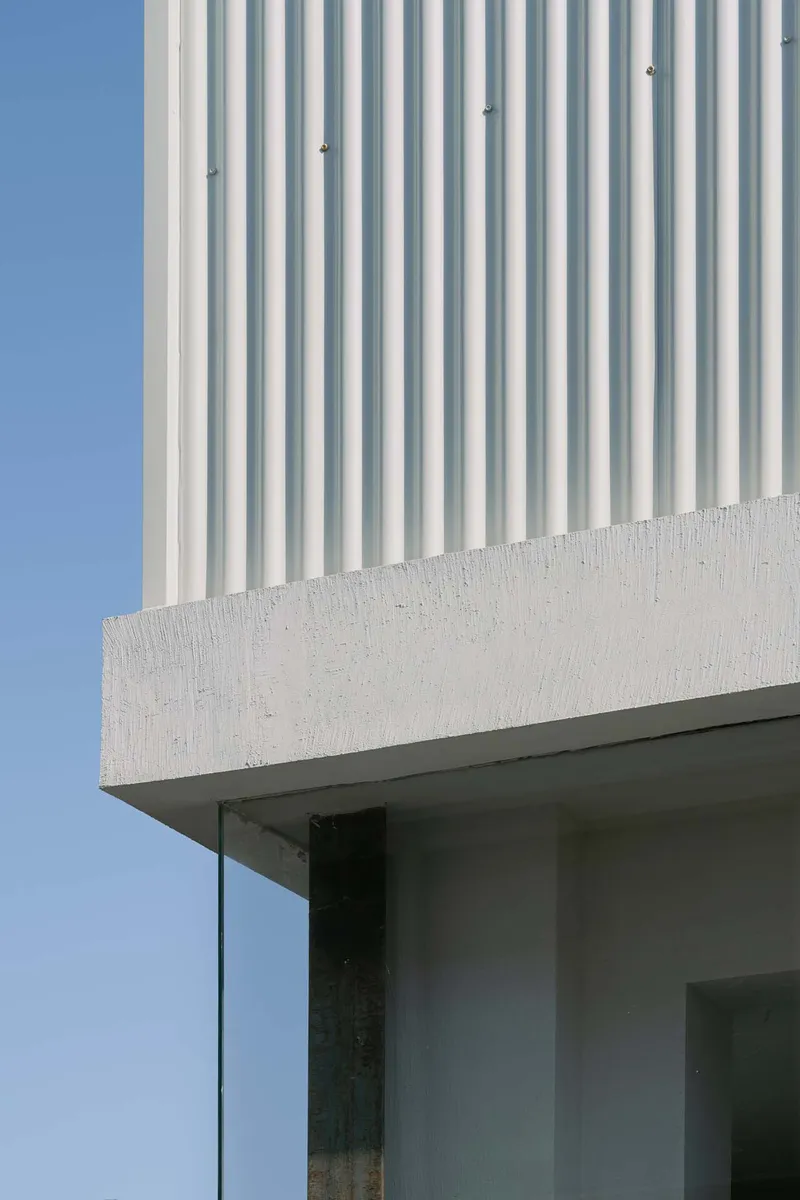
Step back and you notice the layering. Where the new cladding meets the original masonry, Archipoetry Studio does not try to blend the two. The joint is frank. A cast concrete edge sits above a recessed glass opening, marking the exact point where intervention begins. The facade reads as a timeline rather than a mask.
Before and After, Side by Side
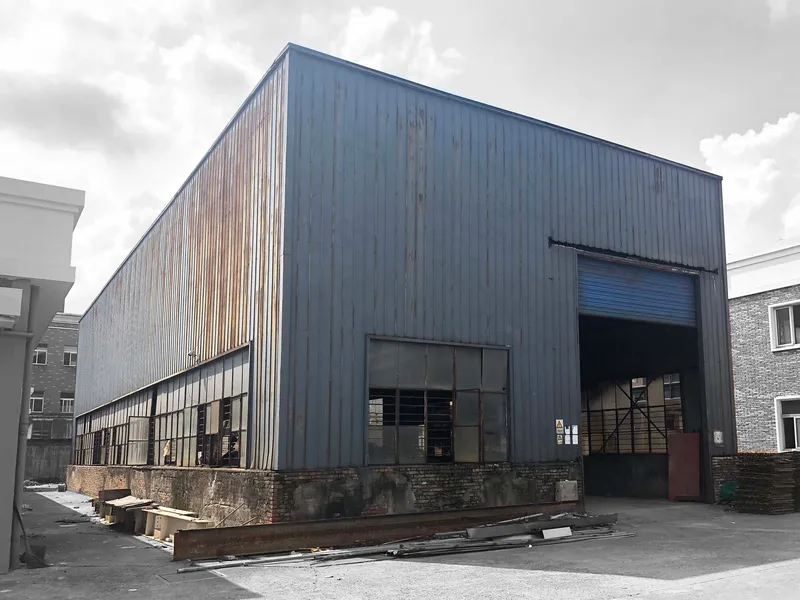

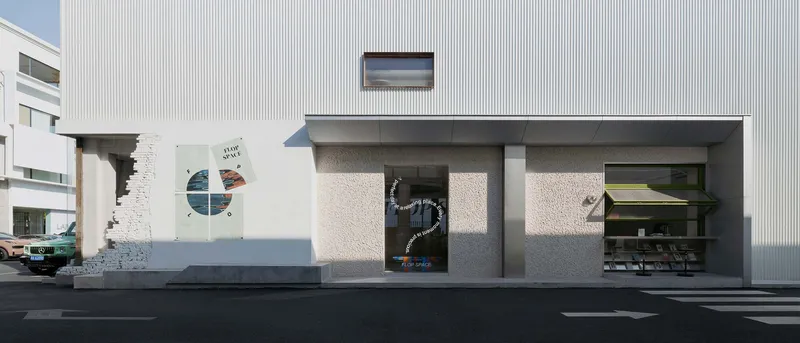
The old building was a weathered corrugated metal warehouse with oversized glazed openings and a roll-up door, the kind of structure that fills every transitional industrial zone in coastal China. Inside, exposed steel trusses and gridded windows gave the hall a generous but raw character. Understanding what the architects started with is essential to reading the finished project: they did not impose a concept on a blank canvas but negotiated with a stubborn existing body.
At ground level, fragments of exposed brick survive alongside grey stucco panels, a patchwork that Archipoetry Studio chose to preserve rather than reconcile. The result is honest about the building's mixed material history and avoids the trap of faking a uniform patina.
The Interior as Stage


Inside, the double-height gallery is the heart of the project. Skylights wash the concrete staircase and mezzanine platforms in even, diffused light, a non-negotiable requirement for a space designed to host diverse photo shoots. The column-and-beam structure is left fully exposed. Steel, concrete, and distressed plaster share the frame without hierarchy.
On the first floor, vast open areas handle human circulation and provide flexible exhibition ground. Arched openings punch through walls of weathered plaster, framing views through the building's depth. The white epoxy floor and curved railing around the stair void are the only gestures of refinement, clean enough to anchor tripods and soft-boxes without competing with whatever artwork or model occupies the room.
The second floor introduces a movable partition device that lets users reconfigure the photography space to suit different functional needs. It is a pragmatic insert inside a poetic shell, exactly the kind of unsexy decision that makes a creative venue actually work.
Thresholds and Transitions


The external staircase with its open timber treads ascending along the curved corrugated facade is one of the project's strongest moments. It is simultaneously structure, circulation, and ornament. A visitor walking beneath it sees the sky through the gaps between treads, while the stair's diagonal line animates the otherwise monolithic side elevation.
From the courtyard, the layered facade reveals its depth: new cladding, original wall, glazing, tree branches all stack into a composition that shifts as you move. A visitor photographing the entrance in one of the images is a fitting detail. The building was made for the act of looking, and it rewards that act at every threshold.
Plans and Drawings

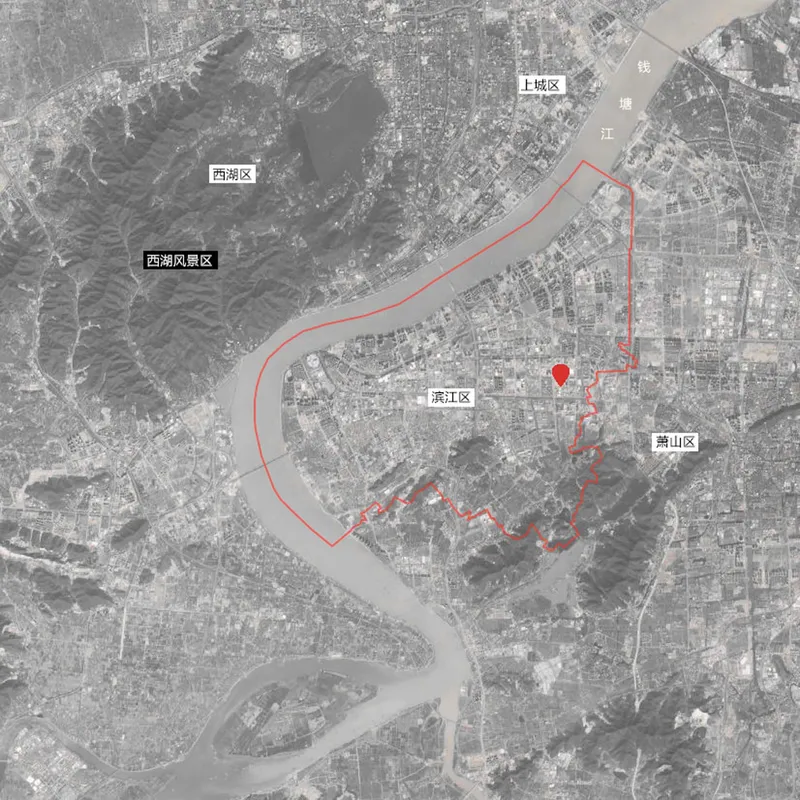
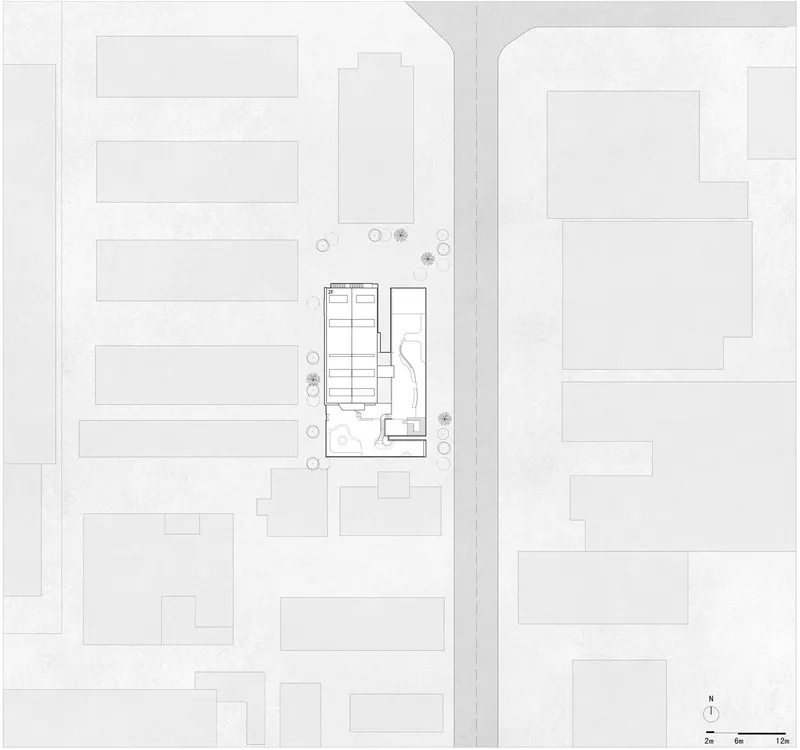
The site plans and aerial maps locate Flop Art Space within a dense industrial district along a river bend in Binjiang. The building sits among neighboring urban blocks, flanked by street trees and adjacent to a courtyard that anchors the ground floor plan. The context is transitional: remaining factories share the block with a growing high-tech park and creative pioneer center.


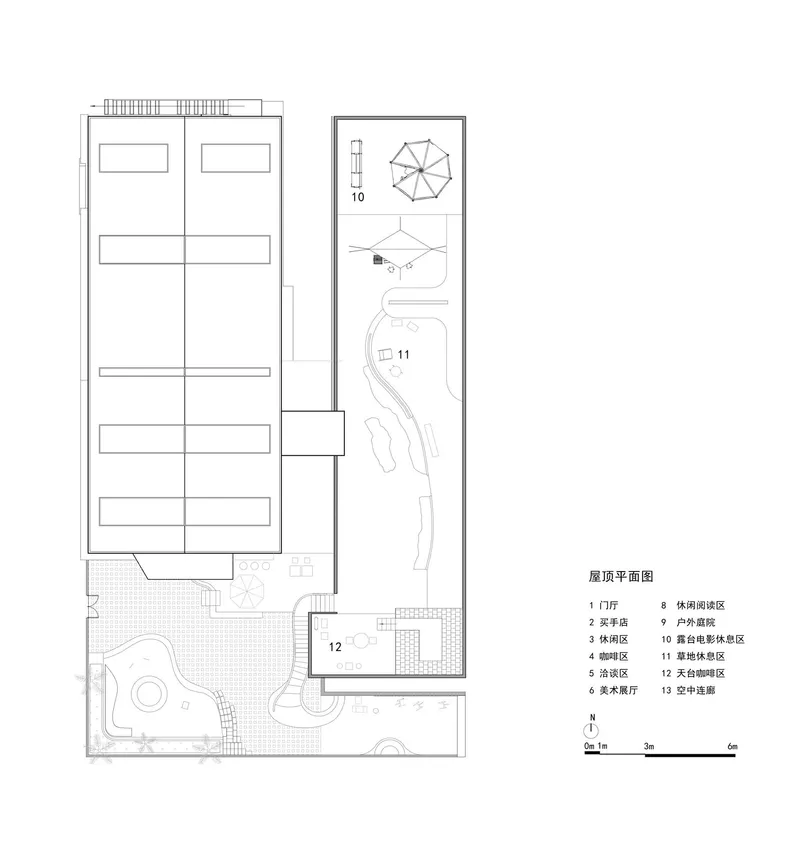
The floor plans trace the project's logic floor by floor. The ground level is largely open, with numbered rooms lining one edge and a landscaped courtyard providing light and breathing room. The second floor tightens the plan, creating more defined interior zones for photography use. The roof plan reveals a rectangular footprint with an octagonal pavilion tucked into the courtyard, a small formal surprise.

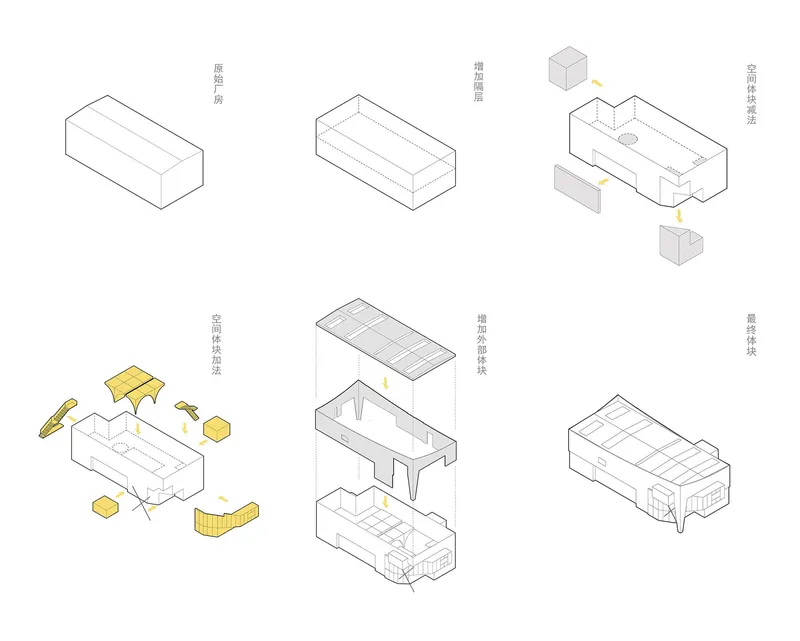
The axonometric and isometric diagrams are perhaps the most revealing drawings in the set. The axonometric breaks the steel structural frame into color-coded components, showing exactly how the mezzanines slot into the existing volume. The isometric diagram walks through six sequential steps of spatial assembly and massing transformation, from the original shell to the finished configuration. Together they make the architects' strategy legible: preserve the envelope, restructure the interior.


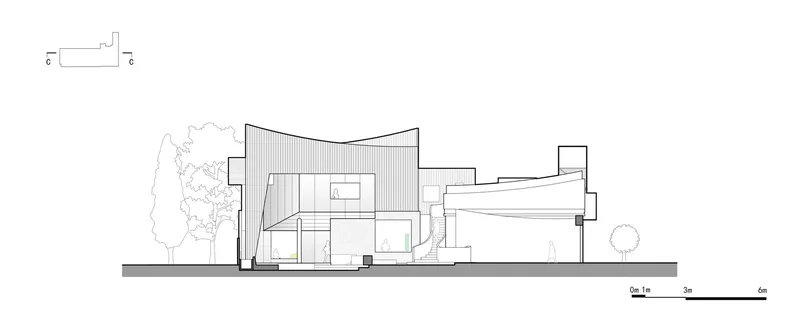

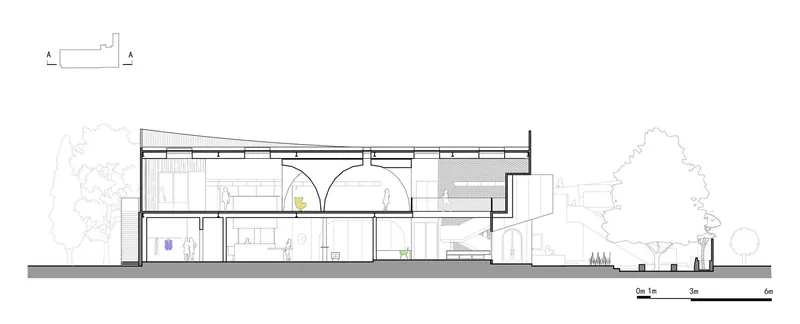
The sections and elevations confirm the spatial generosity of the original factory. A curved roof caps the main volume, and the drawings show how the two inserted mezzanines subdivide the height without choking it. Flanking vegetation softens the elevations in drawing, though on site the industrial neighbors make no such concession. The cross-section of the adjacent linear building, with its arched openings, suggests that Archipoetry Studio read the entire compound rather than treating Flop as an isolated object.
Why This Project Matters
Hangzhou's Binjiang District is rewriting itself at speed, swapping factories for tech campuses and creative hubs. In that context, Flop Art Space is a small but pointed argument for renovation over demolition, and for letting a building's material biography remain legible. The decision to keep the collapsed plaster walls, the exposed trusses, and the corrugated cladding language is not nostalgia. It is a practical stance: these surfaces photograph well, they give artists and brands a textured backdrop, and they cost less to maintain than a polished white box.
More broadly, the project demonstrates that a gallery does not need to suppress its host building to function. The best creative spaces hold tension between control and accident, and Flop manages that balance with quiet confidence. Archipoetry Studio has delivered a venue that works for its users precisely because it refuses to erase the building that was already there.
Flop Art Space by Archipoetry Studio, Jugong Road, Binjiang District, Hangzhou, China. 807 m², completed 2021. Photography by Jianbo Ke.
About the Studio
Share Your Own Work on uni.xyz
If projects like this are the kind of work you want to make, uni.xyz is a place to publish your own, find collaborators, and enter design competitions.


Popular Articles
Popular articles from the community


Opera on the Sea: Driftwood Logic Shapes a Timber Opera House on Estonia's Coast
Trevor Orgill's opera house translates the entangled drift of floating timber into a civic building where wood, water, and music converge.


FCC Arquitectura Expands a Portuguese Granite House with a Board-Marked Concrete Wing
In Portugal, JV House pairs a cleaned-up whitewashed and granite dwelling with a timber-shuttered concrete extension, courtyards and a garden pool.

Manzana Morphosis: Stretching Barcelona's Grid into a Living Landscape for 2050
A radical reworking of the Eixample manzana turns density into a tool for generous public space, vertical ecology, and environmental performance.

Cube Design Draws an Ecological Corridor Between Two Shenzhen Hills with the Nankai Building
Beside Shenzhen's container docks, the Nankai Building pairs stacked balconies with a climbing green screen to connect two hillsides across its height.

Similar Reads
You might also enjoy these articles

LAVA Architecten Gives Vocational Education a Sawtooth-Roofed Face on a Mechelen School Campus
In Mechelen, Belgium, a 2,053 m² STEM school on a 6×6 m grid turns workshops and classrooms into rooms that can be rearranged as teaching changes.

KEMA Studio Turns a Derelict Marvila Attic into a 60 m² Lighthouse Apartment Above Lisbon
In Lisbon's Marvila district, a rebuilt roof, four skylights and two plywood volumes turn an unlivable attic into a bright home facing the Tagus.

Pixel Gardens: One Repeated Module Stacked Into a Terraced Social Housing Tower for Famagusta
Salem Bader's shortlisted housing tower builds a vertical neighbourhood from one repeated module, offsetting units to carve terraces, light and air.

Bao Huynh Watercolor Atelier: A Serene Art Retreat in Hội An
Bao Huynh Watercolor Atelier in Hội An blends multifunctional art spaces, sustainable design, local materials, and family-friendly living in a serene environment.

Explore Flowing Space Competitions
Discover active competitions in this discipline

Challenge to reimagine the Iron Throne

Photograph architecture without architects

Illustrate the lost glory of Angkor Wat - Render Challenge

Bring back Drive In's
Comments (0)
Please login or sign up to add comments
No comments yet. Be the first to comment!