
Architects 49 Builds a University Campus in Thailand Around Passive Design and Forest Thinking
An 80,000-square-meter campus in Sattahip treats landscape, climate, and raw materials as the starting point for higher education architecture.

University campuses in Southeast Asia face a basic contradiction: they need large, flexible buildings for thousands of students, but the tropical climate punishes every square meter of glass and concrete with relentless heat gain. The Panyapiwat Institute of Management EEC Campus in Sattahip, Thailand, designed by Architects 49, takes this constraint as its organizing idea. Spread across roughly 99 rai of land in Chonburi Province's Eastern Special Development Zone, the 80,000-square-meter campus was designed to accommodate up to 5,000 students while treating passive cooling, rainwater reuse, and native planting not as sustainability add-ons but as the architectural logic itself.
What makes the project worth studying is the consistency with which the passive design concept operates at every scale, from the master plan's orientation and green spacing down to the vertical timber fins on individual facades. The guiding idea, summarized by the architects as "Back to Basics | Learning with Nature | Knowledge Is Everywhere," could easily read as a platitude. Here it reads as a set of building instructions. Buildings are oriented to minimize solar heat gain. Green roofs reduce the heat island effect. Large trees are grown from seedlings rather than transplanted. The result is a campus that looks calm and low-key but is technically exacting.
A Campus Shaped by Climate
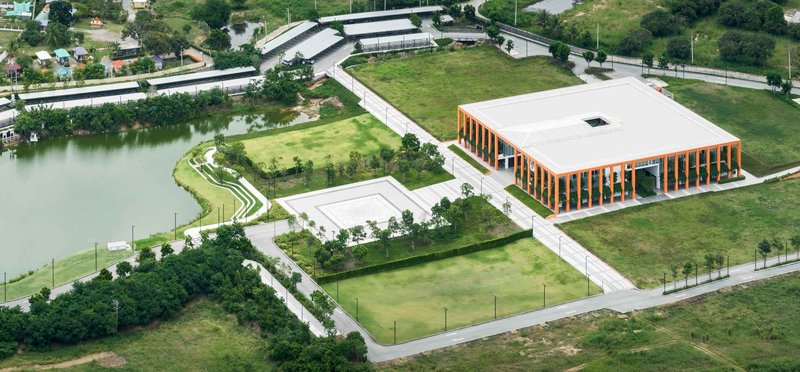
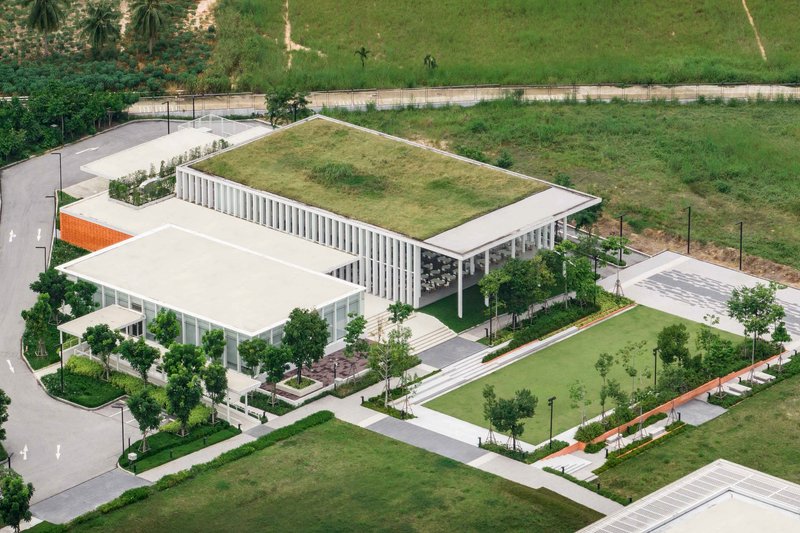
From the air, the campus reads as a series of rectangular volumes arranged around central courtyards and generous green corridors. The master plan places open space between every building, allowing wind to pass through and reducing the trapped heat that plagues compact institutional campuses in the region. Green roofs are visible on nearly every structure, functioning as thermal buffers while also managing stormwater. The adjacent pond is not merely ornamental; it participates in a broader system of rainwater retention and gray water reuse.
The landscape strategy borrows from Dr. Akira Miyawaki's natural forest planting method, using native species grown from seedlings rather than importing mature trees. This produces a landscape that is initially modest but becomes more robust over time, with lower maintenance requirements and deeper root systems. The decision to plant rather than transplant signals a campus that understands its timeline: it is building for decades, not for an opening-day photo.
Timber Fins and Deep Overhangs
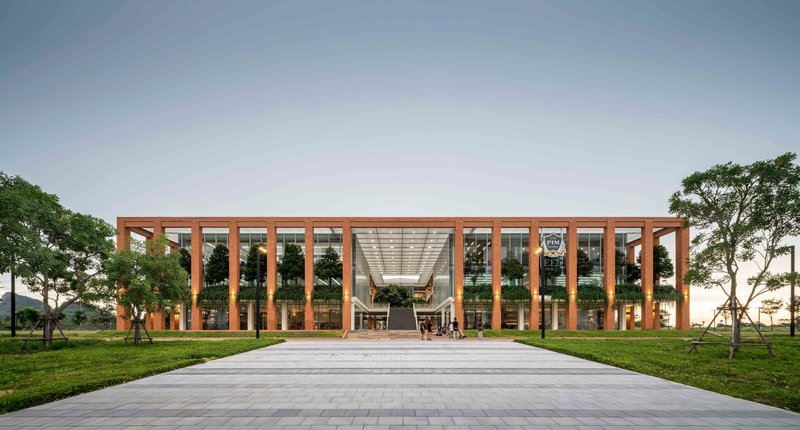
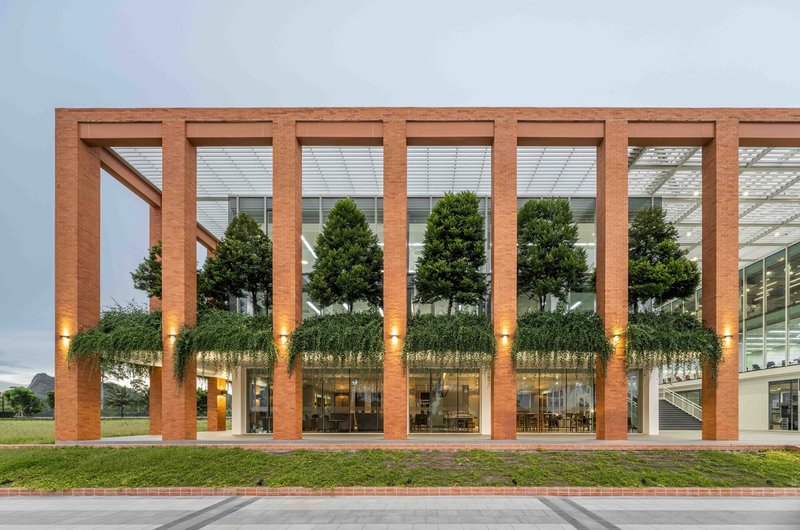
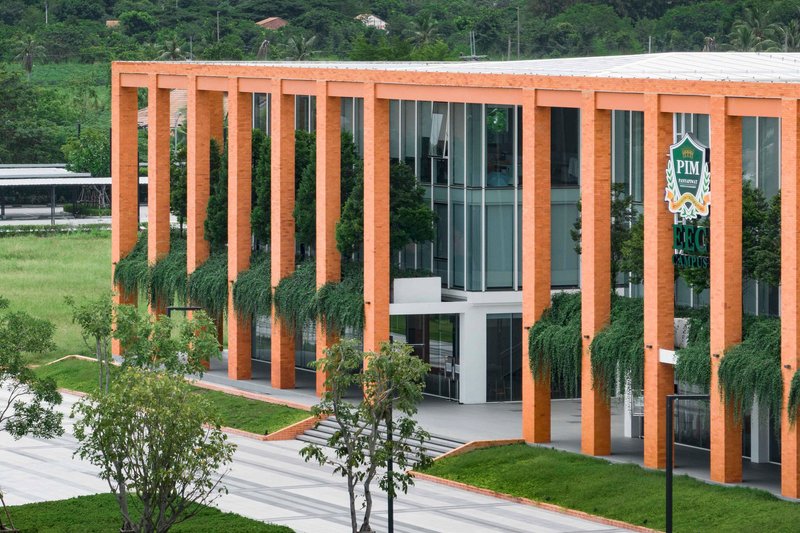
The most immediately recognizable element of the campus is the vertical timber fin system that wraps the glass curtain walls. These fins do serious work: they filter direct sunlight while allowing diffused daylight to penetrate interiors, reducing the cooling load on air-conditioned spaces. At the same time, the timber gives the buildings a warm, textured character that avoids the clinical feel of many institutional projects. The fins are complemented by deep horizontal overhangs and planted terraces, creating layered shading systems that reduce reliance on mechanical cooling.
Trailing vines at ground level and green terraces at upper levels soften the facades further. The choice of natural raw materials with minimal chemical treatments, including the omission of external paint in many areas, simplifies maintenance and reduces off-gassing. The construction process itself was simplified by these material choices, a practical benefit that is often overlooked when natural materials are discussed primarily through an aesthetic lens.
Thresholds and Entry Sequences
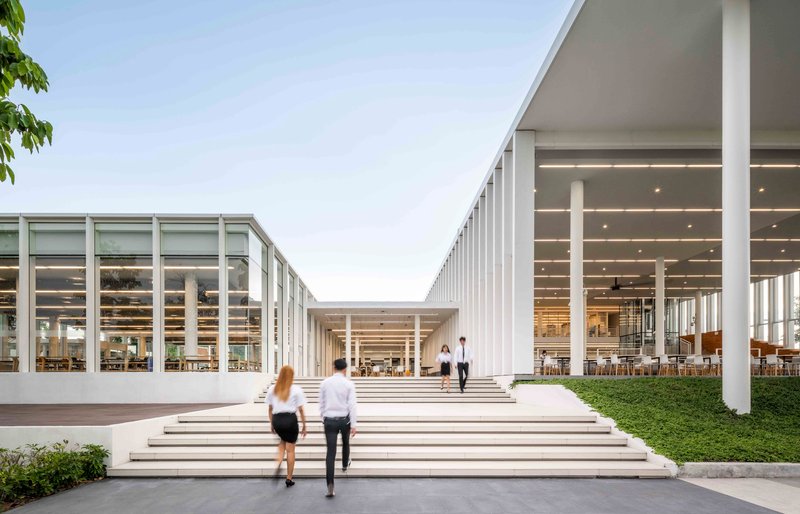
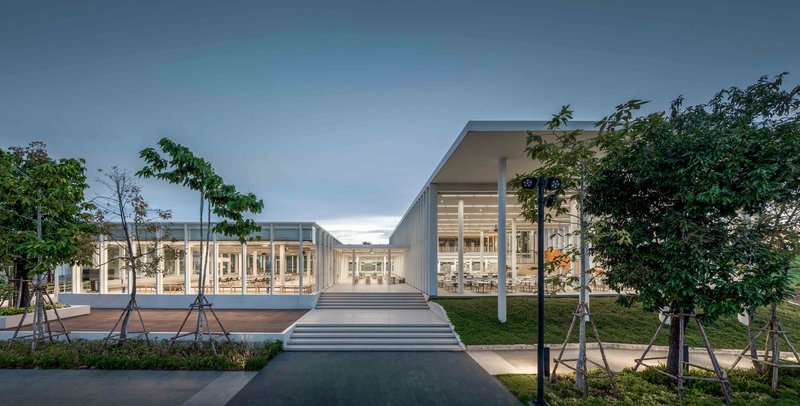
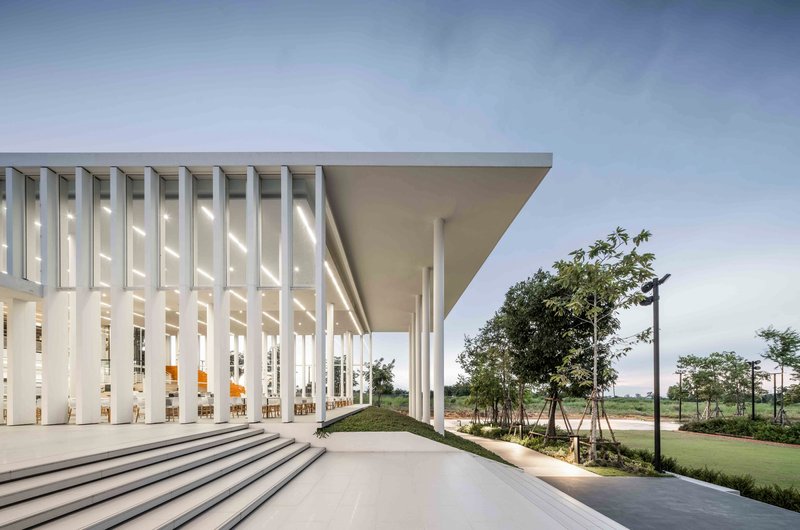
The campus makes much of its entry sequences. Wide stepped plazas draw students upward toward recessed glazed volumes, creating a sense of approach and arrival that many sprawling campuses lack. Covered colonnades with white vertical louvers provide shaded transition zones between the outdoor heat and conditioned interiors. These thresholds are not decorative gestures; they are functional climate buffers, allowing the body to adjust gradually between temperature zones.
The slender columns supporting the deep overhangs keep the ground plane visually open, and the young trees lining the approach will eventually form a canopy that further shades the circulation paths. The scale of these entry spaces is generous without being monumental, which sets an appropriate tone for an educational institution that emphasizes collaborative and experiential learning.
Dining and Gathering Spaces
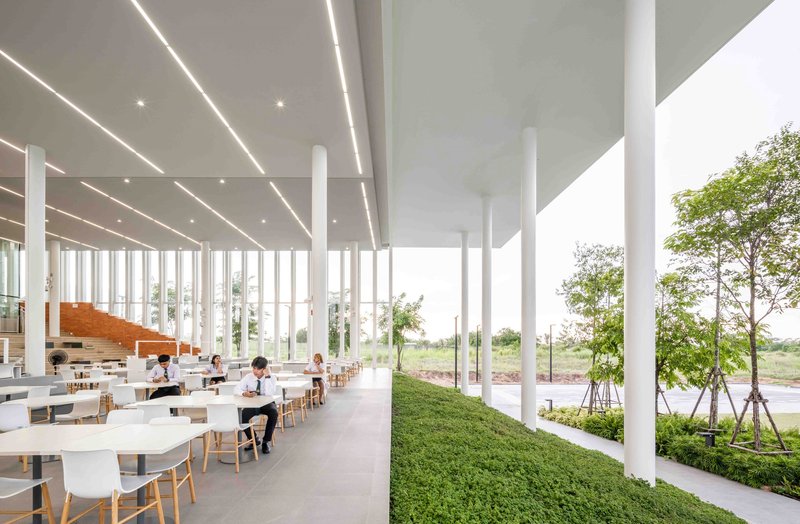
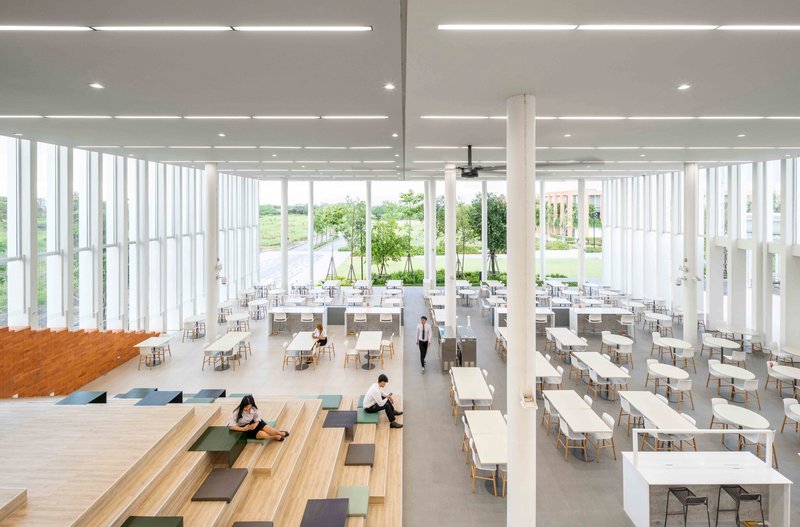
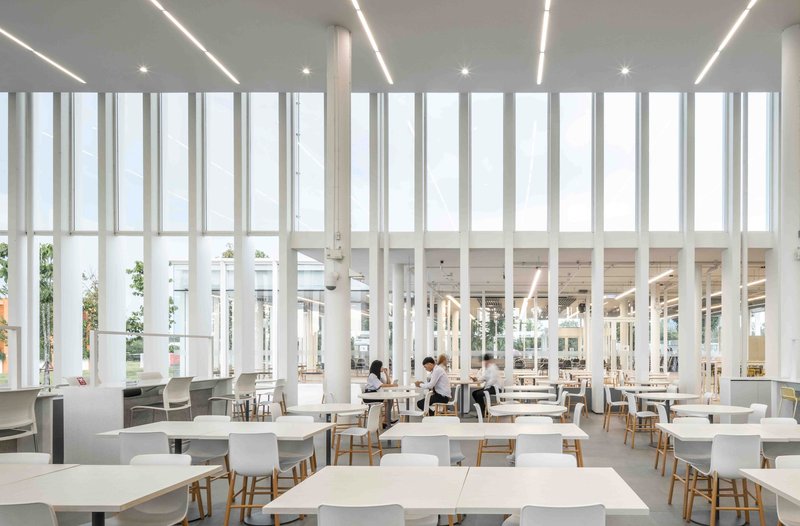
The dining halls are among the most successful interiors on the campus. The canteen opens directly to the landscaped perimeter through large glazed walls, blurring the line between indoor and outdoor eating. White columns and linear ceiling lights give the space a clean rhythm without austerity. The tiered timber seating in one dining hall introduces a casual amphitheater quality, encouraging students to linger and socialize rather than eat and leave.
Vertical fin curtain walls filter daylight into these spaces with a softness that fluorescent panels cannot replicate. The architectural intent is clear: these are not cafeterias in the institutional sense but social hubs where learning can continue informally. For a campus designed around the idea that "knowledge is everywhere," the dining spaces are as important as the lecture halls.
Interior Circulation and Daylight
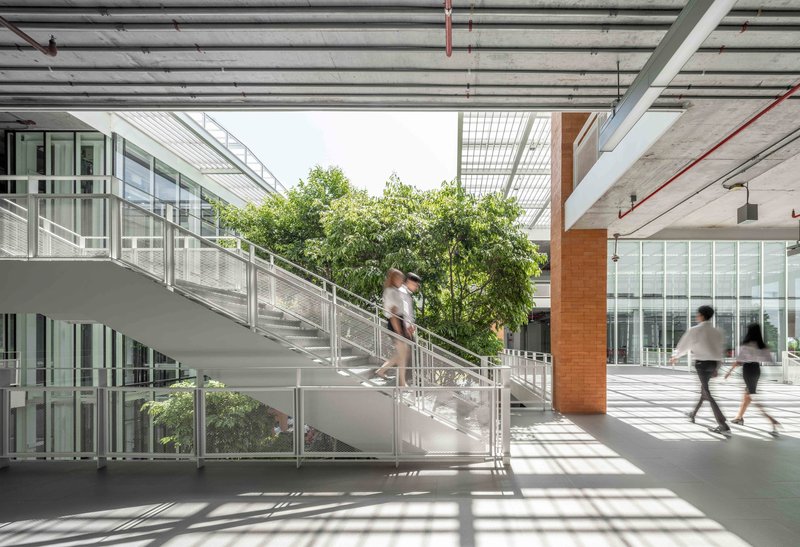
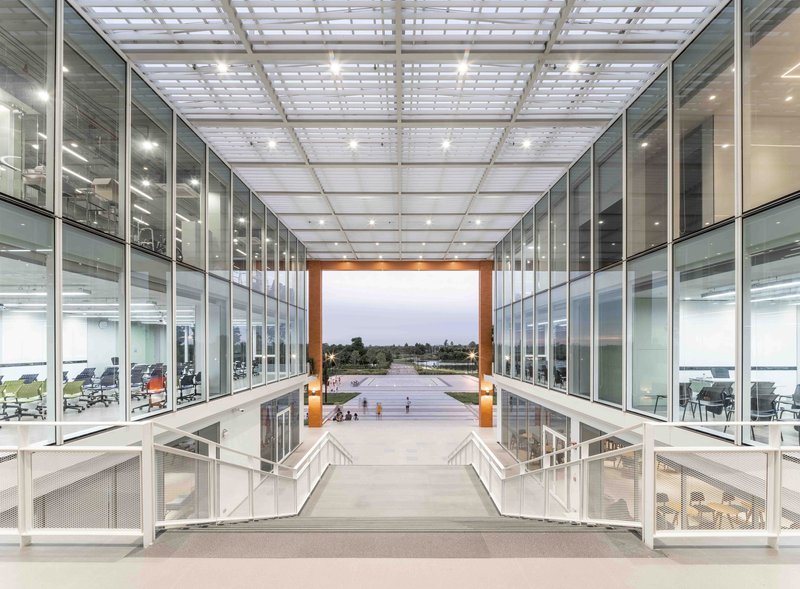
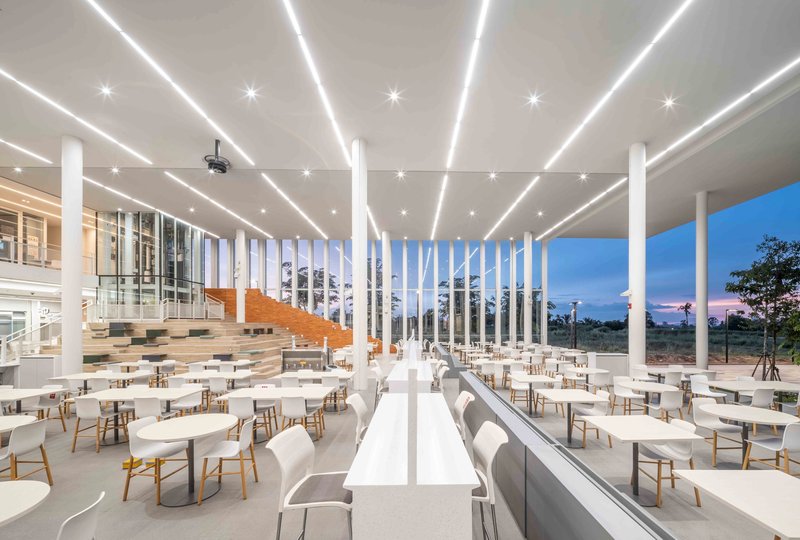
Circulation through the buildings is treated as another opportunity for daylight and spatial variety. Staircases with exposed concrete ceilings are punctuated by skylights, drawing natural light deep into the core of the buildings. A glass-walled atrium bridge with a gridded translucent ceiling overlooks an outdoor courtyard, turning a simple corridor connection into a moment of orientation and pause. Students moving between spaces are never fully cut off from the exterior environment.
The flexible interior layouts, with open floor plates and strategically placed service cores, allow for adaptation over time. As the campus grows toward its 5,000-student capacity, rooms can be reconfigured without structural intervention. The diagonal circulation paths visible in the plans add variety to what could otherwise become repetitive linear corridors, giving students multiple routes through the buildings and encouraging chance encounters.
Dusk and the Reflecting Pond
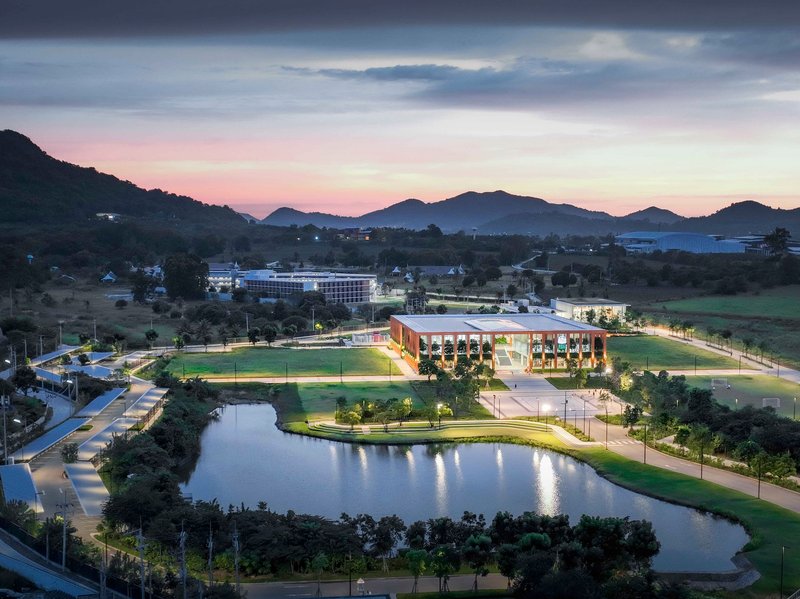
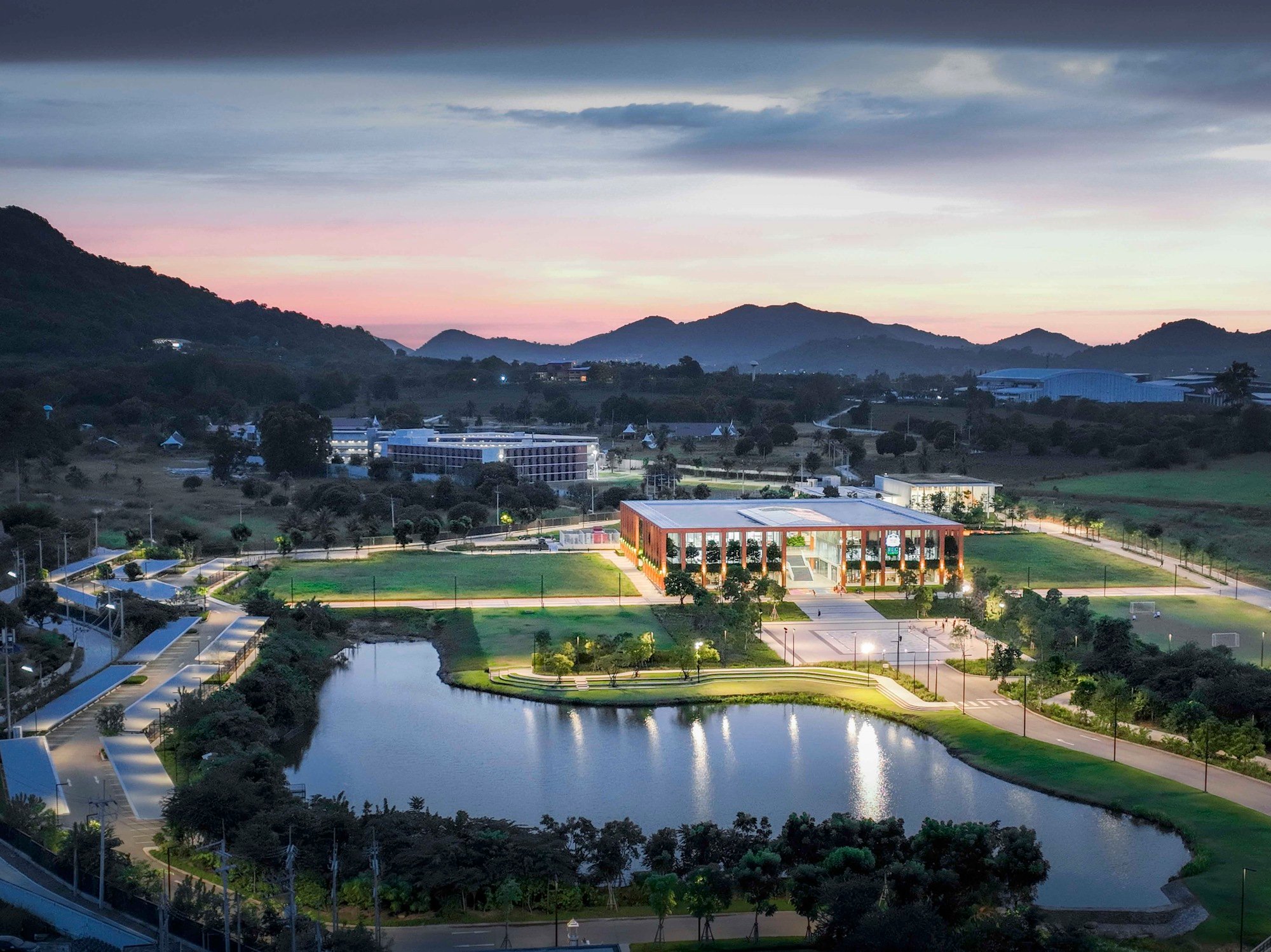
The campus takes on a different character at dusk, when the warm interior lighting glows through the vertical fins and reflects off the pond. The mountain silhouettes beyond reinforce the sense of the campus as a piece of landscape rather than an imposition on it. The reflecting pond serves double duty: it stores rainwater for reuse while creating a microclimate that cools the air around adjacent buildings. It is a satisfying example of infrastructure and aesthetics serving the same goal.
Plans and Drawings
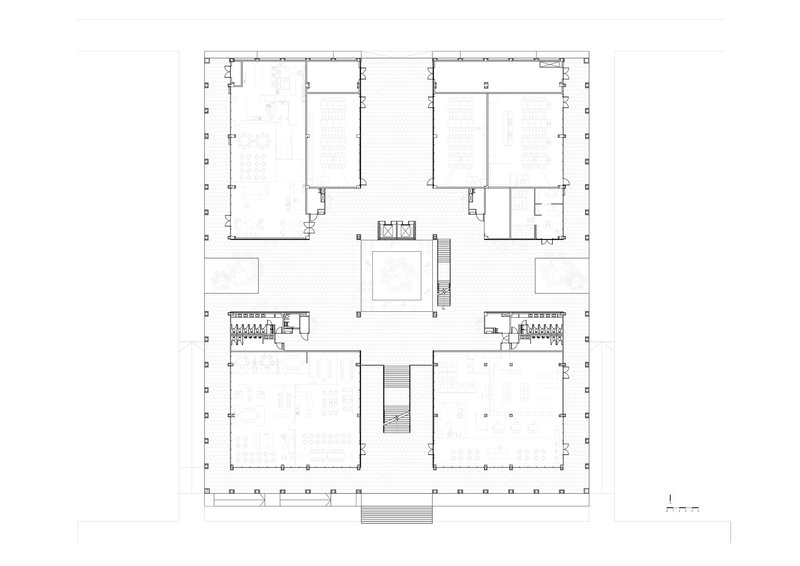
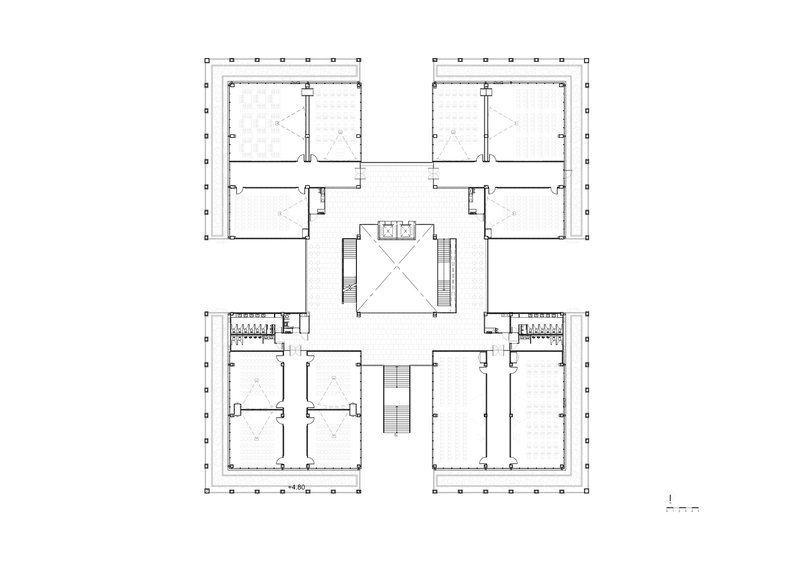
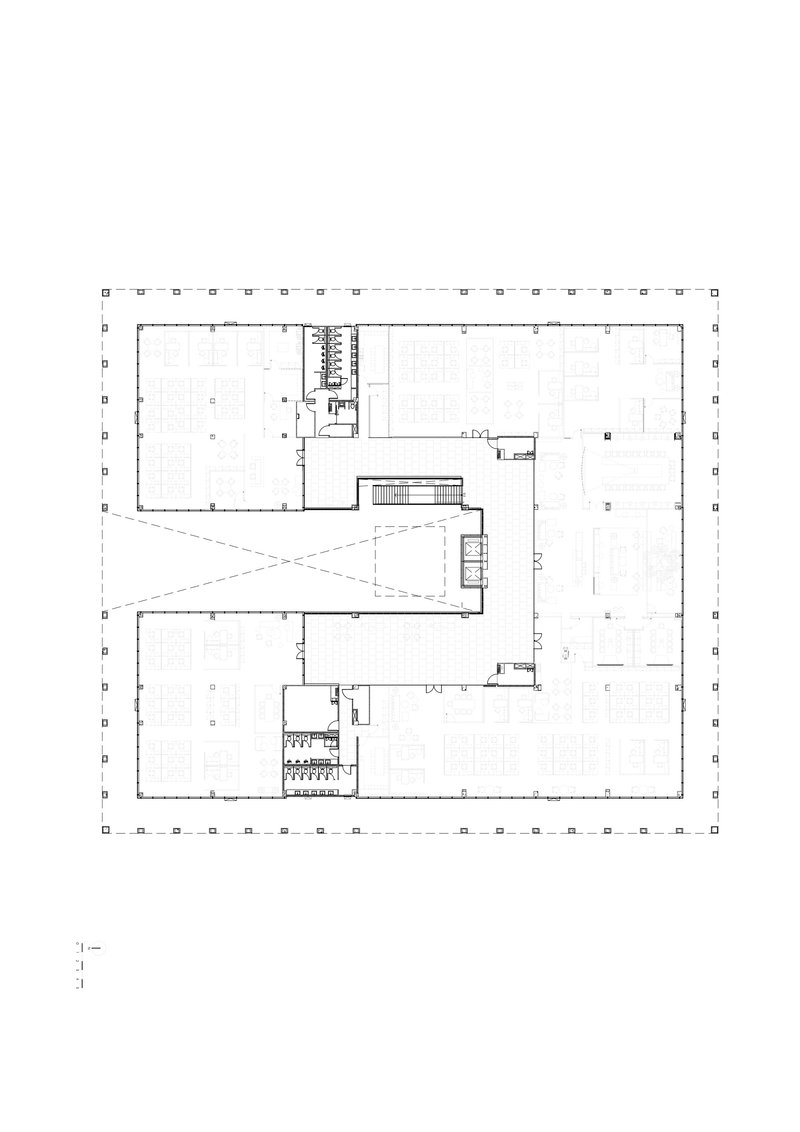
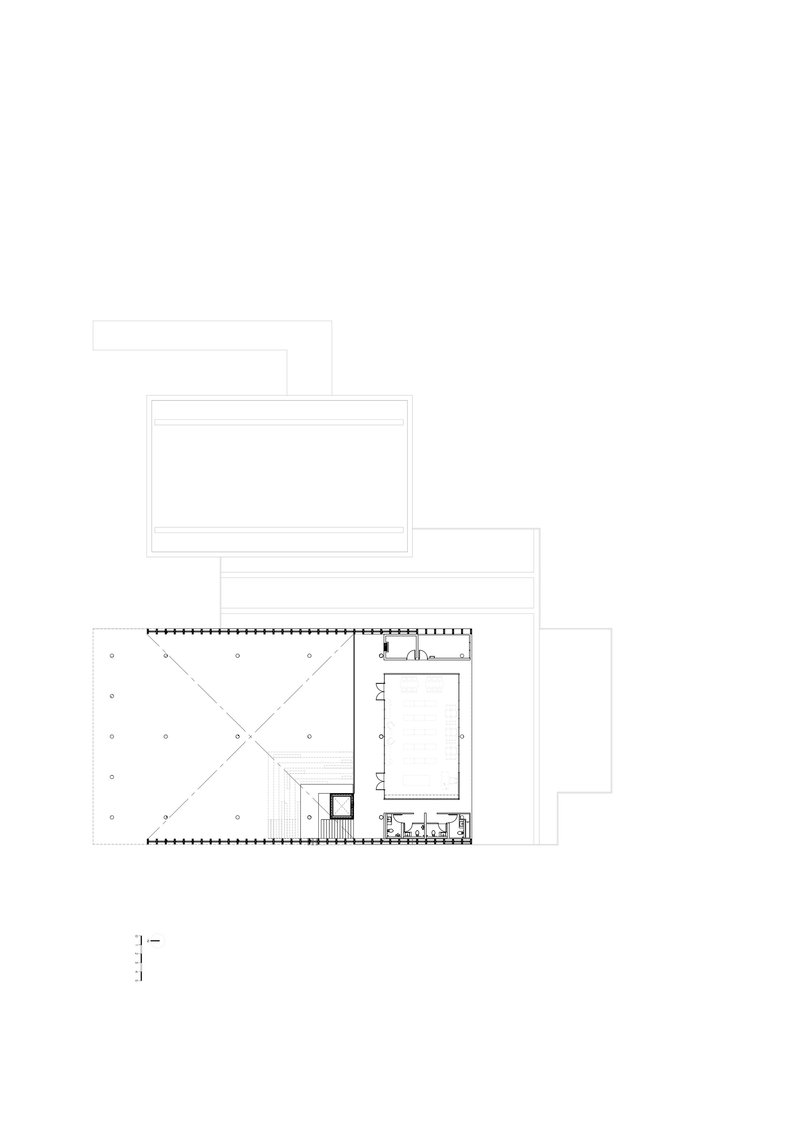
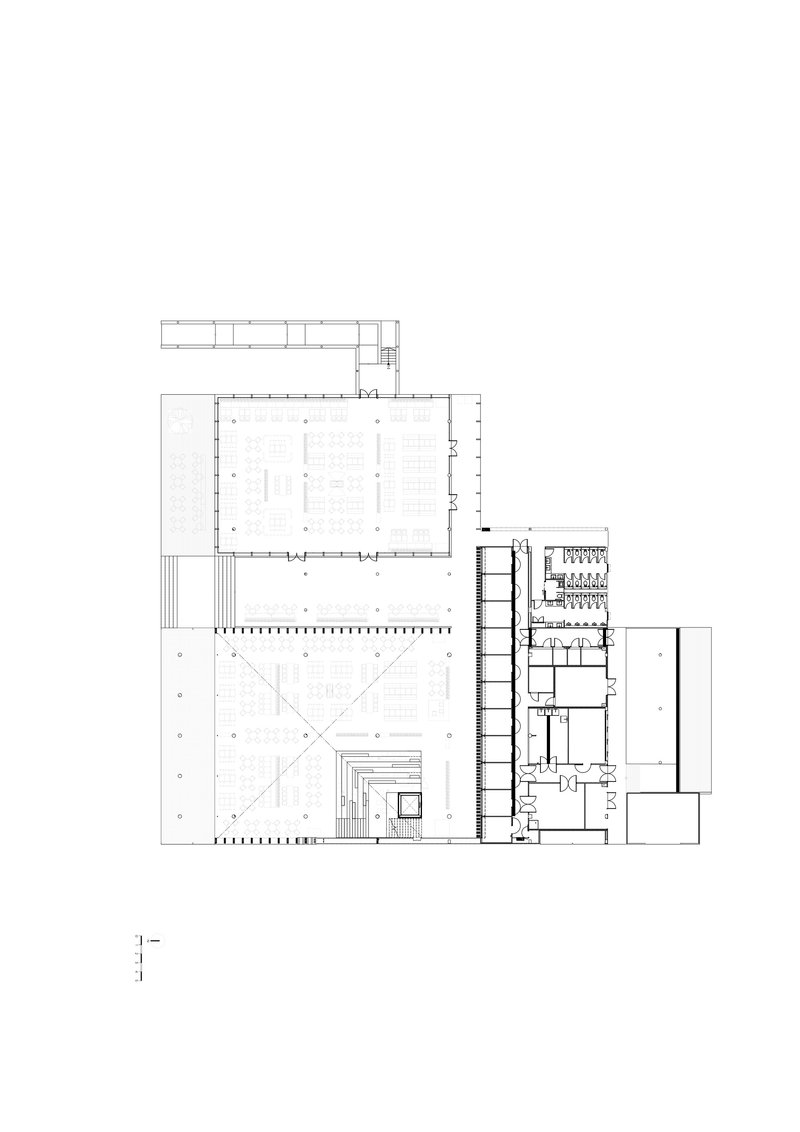
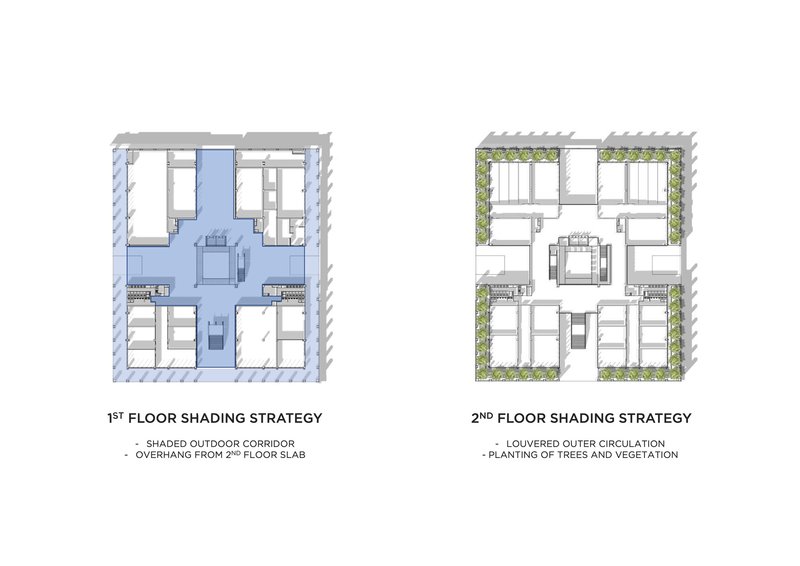
The floor plans reveal the organizational clarity underlying the campus. Four rectangular volumes are arranged around a central courtyard at the ground floor, with upper levels connected by bridges and shared circulation cores. Diagonal paths cut through the grid, creating informal shortcuts and visual connections between wings. The shading diagrams are particularly instructive: they compare first and second floor strategies, showing how outdoor corridors and planted terraces provide different levels of solar protection at different heights.
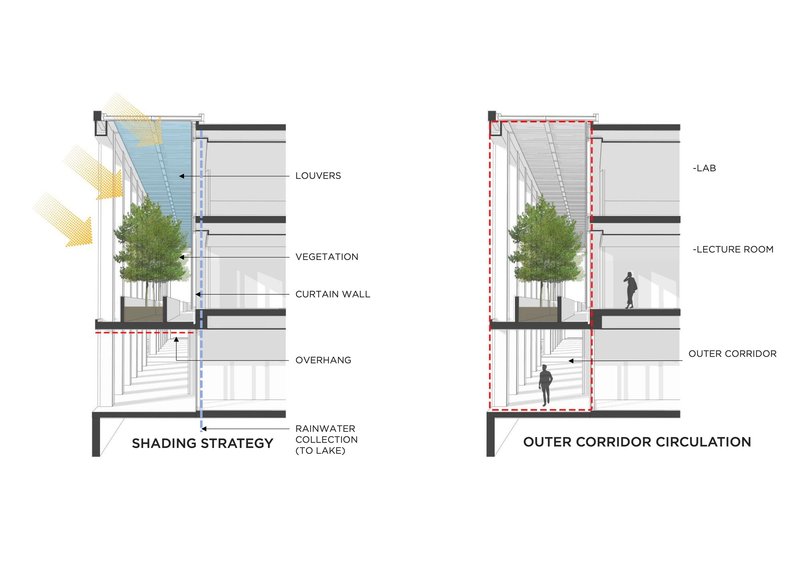
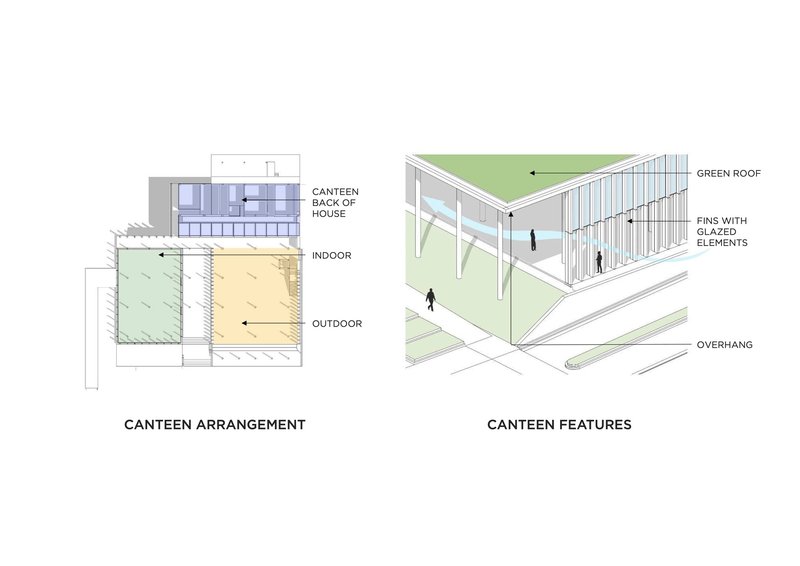
The building sections illustrate how the multilevel corridors stack vertically, with planted trees integrated into intermediate levels and louvers controlling light at each floor. The axonometric breakdown of the canteen shows the relationship between the green roof, the glazed facade, and the vertical fin system as three interdependent layers rather than separate decorative elements. These drawings make a persuasive case that the campus's visual coherence stems from structural and environmental logic, not stylistic preference.
Why This Project Matters
The Panyapiwat Institute of Management EEC Campus matters because it demonstrates that passive design in the tropics does not have to look austere or experimental. The campus is straightforward, even conventional in its building typologies: dining halls, lecture wings, connected corridors. What distinguishes it is the discipline with which every decision, from master plan orientation to facade fin spacing to seedling planting, serves the same environmental logic. That consistency is harder to achieve than any single green technology.
For institutions planning campuses in hot, humid climates, this project offers a useful model. It does not rely on expensive proprietary systems or dramatic formal gestures. It uses natural materials, native plants, and intelligent orientation. It plans for growth without requiring demolition. And it treats the spaces between buildings, the shaded thresholds, the courtyards, the reflecting ponds, as equally important to the spaces within them. In a region where air conditioning often substitutes for design, Architects 49 shows what happens when you refuse that shortcut.
Panyapiwat Institute of Management EEC Campus, designed by Architects 49. Located in Sattahip, Chonburi Province, Thailand. 80,000 m². Completed in 2022. Photography by DOF Sky|Ground.
About the Studio
Share Your Own Work on uni.xyz
If projects like this are the kind of work you want to make, uni.xyz is a place to publish your own, find collaborators, and enter design competitions.




Popular Articles
Popular articles from the community

Constanti Architects Builds a Fortress of Privacy in Nicosia with House 345
A concrete and timber residence in Cyprus reinterprets the traditional introverted courtyard house for a new urban landscape.


Cyber Oyster: A Visionary Adaptive Reuse Architecture Project Transforming Abandoned Oil Rigs Through Oyster Bionics
An adaptive reuse architecture concept transforming abandoned offshore oil platforms into self-healing marine ecosystems inspired by oyster bionics.
Twobytwo Architecture Studio Towers a Blackened Ski Cabin Above the Trees in Golden, BC
A compact three-storey lookout in the Kootenay mountains trades square footage for 14-foot ceilings and Columbia River Valley views.
Ippolito Fleitz Group Identity Architects Turn Eight Floors in Shanghai into a Vertical Creative City
Publicis Groupe's new headquarters in Xintiandi reimagines the office as a courtyard-driven urban landscape stacked across eight floors.


Similar Reads
You might also enjoy these articles
127af Flips a Tiny Bagnolet Rowhouse Upside Down with a Handcrafted Roof Extension
A 55-square-meter terraced house on the edge of Paris gains a luminous upper living floor through lightweight timber and steel.
1.61 Design Workshop Wraps a 600-Square-Meter Café in Vietnam in Sculptural Burgundy Drama
Reden Café & Bistro pairs a helical staircase, mosaic floors, and deep red interiors to rethink Vietnamese hospitality space.

The Unbound Brain: A School Shaped by Cognitive Architecture
Cylindrical learning pods radiate like neurons from a central cortex, turning the floor plan into a spatial model of human thought.
Revival Vernacular Architecture: Rammed Earth Settlements for the Sahara
A modular desert community in Mauritania that fuses passive cooling techniques with earthen construction and local craftsmanship.


Explore Educational Building Competitions
Discover active competitions in this discipline




The Global Benchmark for Architecture Dissertation Awards


Challenge to design public laboratory
Comments (0)
Please login or sign up to add comments
No comments yet. Be the first to comment!