
What can we learn from the progression of healthcare architecture?
Architecture and Health
Back in the year 2012, during a study abroad in Montreal, Canada, I had the opportunity to visit an exhibition at the Canadian Centre for Architecture (CCA) that changed the course of my academic life. At the time, I was still an architecture and urbanism bachelor’s student. The exhibition “Imperfect Health: The Medicalization of Architecture”[1] contained several galleries with publications, arts, models, and architectural drawings illustrating the complexity of the relationship between human health and architecture over time.
I was so astonished by the exhibition that from that moment on, I decided to focus my academic life to explore an architecture that, above all, could contribute in some way to the health of our society. A topic that until then was not widely academically explored. Currently, especially after the covid-19 outbreak, it is a topic under the spotlight.
Now as an architect, graduated with a master and a specialization in healthcare design and as a doctorate candidate in the same topic, I am sharing in this article some interesting information about the progress of the healthcare architecture and what we can learn from it.
"The environment in which we live, and work have a profound influence on our physical and psychological well-being" (Waller & Masterson, 2015).
It is well-known that architecture plays an important role in our everyday lives. One of the causes is that it directly impacts our health and well-being. For this reason, special attention should be given to the design of healthcare environments in which architecture should be seen and used as a therapeutic tool. Architecture has the power to contribute to the recovery process of patients and in the working conditions of healthcare professionals. Part of this knowledge started to be revealed during the 18th century.
The “hospital” - space for the reception of sick people -, has existed since the Middle Ages, but the lack of knowledge at the time made the environment conducive to the multiplication of diseases and the worsening of the state of health. For many years, hospital buildings were a place of separation and exclusion in which the sick and mostly poor people, were crowded together.
From the 18th century onwards, together with the industrial revolution, a new vision of man and nature began to prevail. These movements greatly expanded the knowledge of the time, contributing to improving sanitary conditions that were intensified throughout the 19th century. As Foucault (1989) mentioned, social medicine, which began at the end of the 18th century, emerged with the discovery of pathological anatomy. Therefore, the functional and spatial conditions of the hospital gain importance.
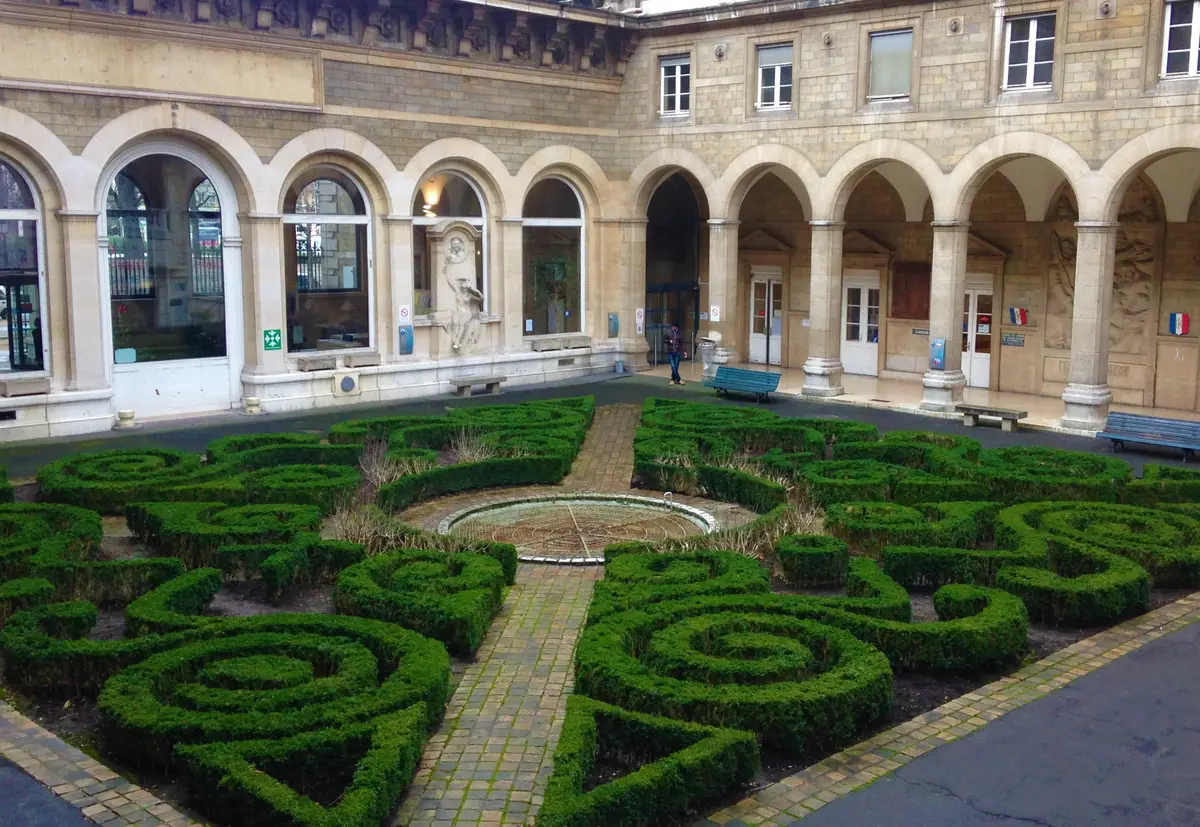
The precursor to several discussions about health architecture was the fire at the Hôtel-Dieu at the end of the 18th century. Hôtel-Dieu was the largest and oldest hospital in Paris. Its building was the target of several systematic fires for many years, due to its poor hygiene conditions, overcrowding, and neglect. Just after a devastating fire in 1772, debates took place regarding its precarious conditions. Since it was an establishment of great importance in the European scene at the time, committees developed several revolutionary proposals for the reconstruction of the building. However, none of them was adopted and the hospital was rebuilt following the old models. Regardless, this moment was considered a milestone for hospital architecture, and from that moment on, as mentioned by Foucault (1989) the hospital started to be seen as a “healing machine”.
The contemporary hospital with the current purpose of healing has its origins in this period. The fire at the Hôtel-Dieu concluded that the horizontal pavilion organization system of the space would be the ideal way to solve the unsanitary problems. Until a certain period, the stagnation of air and humidity in indoor environments were considered the biggest causes of unsanitary conditions in hospitals. The spatial organization of the hospital starts to value the contact with the outside and the circulation axes define the typology that became predominant in this period of history.
Studies related to the internal quality of the environment arise, highlighting the works of the architect Bernard Poyet (1742-1824), the physician Jacques Tenon (1724-1816) and, a few years later, the nurse Florence Nightingale (1820-1910).
Florence Nightingale had an important role in healthcare design. She developed a ward model in which the quality of the indoor environment was the main concern. She developed studies involving the patient and the physical space of hospitalization. In her books Notes on nursing (1858) and Notes on Hospitals (1859) she highlighted the importance of attributes such as adequate ventilation, sanitation, noise control, and lightening. According to her, the hospital should not cause any harm to its patients.
The “Nightingale ward” model emerges with a new concept of physical space, combining natural and adequate ventilation and lighting with the quality of the patients' healing process. The patients were grouped in wards with an average of 20 beds and windows participated in the distribution of spaces. The pavilion-nightingale model was considered a reference for architecture and health. In the 19th century, the main characteristic of hospital architecture was the concern about the hygiene and healthfulness of buildings.
During the 20th century, the number of hospital buildings in the world grew substantially, due to the evolution of treatment processes and technological advances, such as the use of X-rays. The population begins to have greater confidence in healthcare facilities and the hospital, which used to concentrate the less affluent classes, starts to be used by the richest classes of society. Gradually, the design of the pavilion model that demanded long distances is replaced by a more compact model. With the advancement in structures and the emergence of elevators, buildings became predominantly vertical, creating a new hospital model, the vertical block, characteristic of North American hospitals since 1877.
During the ‘50s and ‘70s, with technological development, there is a loss of architectural quality. Artificial means begin to perform the work previously performed by the architecture itself. In this context, natural ventilation loses its importance in the healthcare building and sophisticated heating, ventilation, and air conditioning systems start to be used on a large scale in indoor environments. The hospital aesthetic become more institutional. Medical advances considerably reduced the length of stay of hospitalized patients. The hospital environment became more hostile, adapting to the modernist style of the time.
Therefore, the 20th century was marked by the rise and fall of the technology-centred model. Modern architecture came to be widely criticized for its standardized and repetitive appearance. Criticisms were intensified after the oil crisis in the ‘70s when the energy voracity of buildings came to be questioned. During this period, opposition movements to modernism emerged, such as bio-climatic architecture, passive architecture, and sustainable architecture, all with very similar ideas. Schmid (2005) mentioned that in the last three decades of the 20th century, following the environmental movement, new trends in architecture aimed to rescue the natural thermal conditioning of the built environment.
Until then, an inhuman architecture prevailed, influenced by the medical practices adopted in that period, where the patient was not seen as a human being, but rather as a collection of possible diseases. It is important to emphasize that until the 20th century, health was considered only as of the absence of disease. Health, in current terms, has a broader meaning closely related to the premises of quality of life. In 1946, the World Health Organization (WHO) defined health as a state of complete physical, mental, and social well-being and not merely the absence of disease or infirmity[2]. The concept of health influenced the design and structure of healthcare buildings over time.
Nowadays, there is scientific evidence that the environment directly influences well-being and that its elements provoke sensory stimuli on people, evoking responses that are generally reflected in their behaviour and attitudes. In this context, the humanization of hospital environments arises, that is, a qualification of the built space with the main objective of promoting physical and psychological comfort to the user to carry out their activities, through attributes that provoke a feeling of well-being.
In recent years, hospital architecture has undergone a process of transformation as a result of this emerging concern for the well-being of patients. In this new phase, the emphasis is on the quality of the hospital environment and the concern to remove the hostile aspect that still predominates this type of building. The architectural ambience starts to be valued again, especially attributes of humanization that add personal value to the physical space.
There is no prescription for the creation of humanized spaces, however, there are certain essential aspects that must be considered, such as the relationship between interior and exterior, presence of natural elements, inviting furniture, environment control, privacy, colours, decoration, among others. Humanized healthcare design takes these and other aspects into account and approaches to a welcoming and familiar characteristic.
The current outbreak of the covid-19 puts us on the edge of an era that may transform, once again, the future of hospital design. It is interesting to note that the concept of internal quality of the environment has existed since the long 18th century. Even though in this period the main concern was the control of contamination among individuals, as the wards sheltered several beds with individuals with different symptoms. The same topic is still discussed nowadays, although artificial solutions are easier to adapt, especially to existing buildings. It is necessary to emphasize the great importance and influence of humanization in hospital environments for users in general, especially for the healing process of the main protagonist of the hospital: the patient.
REFERENCES
Foucault, M. (1989). Microfísica do Poder. 8. ed. Rio de Janeiro: Graal.
Kobus, R. L., Skaggs, R. L.; Bobrow, M.; Thomas, J.; Payette, T. M.; Kliment, S. A. (2000). Building Type Basics for Healthcare Facilities. 2 edição. New York: John Wiley & Sons.
Malkin, J. (2008). A Visual Reference for Evidence-Based Design. Concord: The Center for Health Design.
Schmid, A. L. (2005). A ideia de Conforto: Reflexões sobre o ambiente construído. Curitiba: Pacto Ambiental.
Waller, S., & Masterson, A. (2015). HOSPITAL INFRASTRUCTURE Designing dementia friendly hospital environments. Future Hospital Journal, 2(1), 63–71.
[1] https://www.cca.qc.ca/en/events/3178/imperfect-health-the-medicalization-of-architecture
[2] https://www.who.int/about/governance/constitution

Popular Articles
Popular articles from the community


Singing Woman: An Opera House That Performs Before the Curtain Rises
Ovidiu Cristian Pavel's conceptual opera house translates Estonia's choral identity into a sculpted waterfront landmark facing the Baltic Sea.

The Amber Palace Opera: A Geological Fiction Surfaces on Tallinn's Baltic Waterfront
Pierre Brillard reimagines a Baltic legend as a public landscape, opera house, and waterfront promenade rooted in Tallinn's coastal identity.


graciastudio Turns a Viewless Tijuana Lot Inward Around a Courtyard of Concrete, Timber and Trees
In Tijuana, Jorge Gracia's GA2 House stacks a timber-clad private floor over exposed concrete and replaces a missing view with a planted interior patio.

LT2A and OPEN Architectes Thread a Brick and Glass High School Through a Wooded Belgian Campus
In Braine-l'Alleud, a 3,000 m² wing for Collège Cardinal Mercier pairs pale brick with a glazed colonnade, deferring to a small chapel and a dense wood.

Similar Reads
You might also enjoy these articles

Vereda Arquitetos Renovates a 40-Square-Meter Apartment Inside Niemeyer's Copan Building
A compact unit in São Paulo's most iconic residential tower gets a material overhaul that pairs exposed concrete with bold blue Formica.

Shakur's House: Exposed Brick as an Interior Organiser in a 168 m² Mashhad Residence
Brick moves indoors in this Mashhad residence, where masonry walls, glass partitions and teal planes sequence a compact home without closing it off.

Day and Night Park: A Time-Based Urban Newsstand in Beijing
A temporary urban newsstand in Beijing blending travel, light, and reading through poetic colors, compact form, and community-focused design.

Modernist Patio Renovation in El Masnou, Barcelona by Oliver Segura Arquitectura + Cebrià Arquitectura
Modernist patio renovation blending tradition and innovation with a movable pool, leveled floors, and Catalan materials in El Masnou.

Comments (0)
Please login or sign up to add comments
No comments yet. Be the first to comment!