
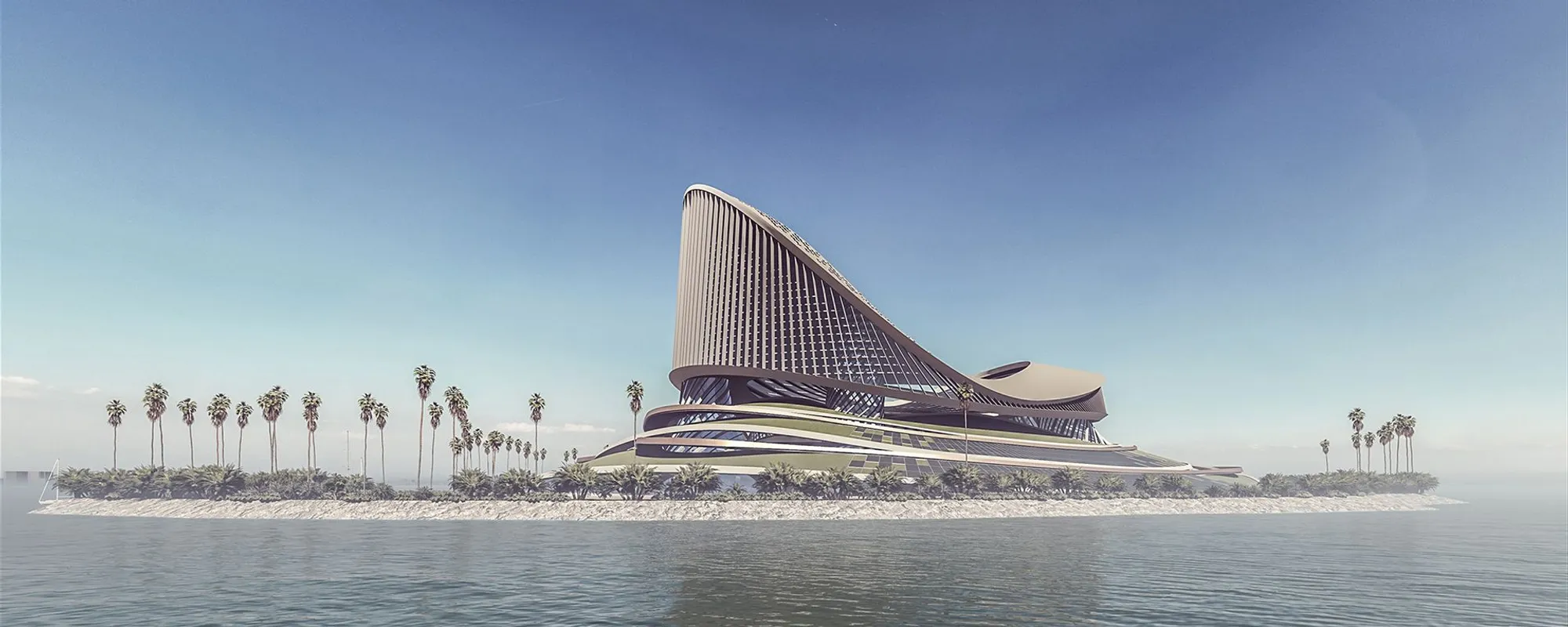
Arena of Independence: A Masterpiece of Futuristic Architecture
Innovative, sustainable, and iconic—the Arena of Independence redefines futuristic architecture, blending technology, nature, and design.


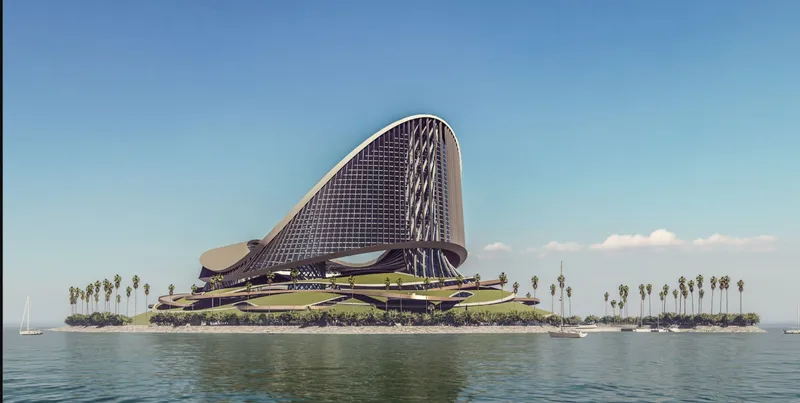
Build an island. Put a stadium on it. Then grow a hotel out of the stadium's back like a sail. Arena of Independence, designed by Aleksei Shestakov, places a multipurpose sports and esports arena on an artificial island off the coast of Los Angeles, with a sail-shaped hotel tower rising from one end and a spiralling landscape of ramps, lawns, and promenades wrapping the whole thing from shore to summit.
Shortlisted in the Di: Generic Cities competition on uni.xyz, the project answers the Los Angeles brief with the most Californian gesture imaginable: a building that is half yacht, half stadium, half landform, set in the Pacific and visible from the entire coastline. The competition asked entrants to challenge the generic in city architecture. This entry does so by making the building an island, which is the opposite of generic: it is singular, unrepeatable, and anchored to one specific point in the ocean.
The Island: A Landform in the Pacific
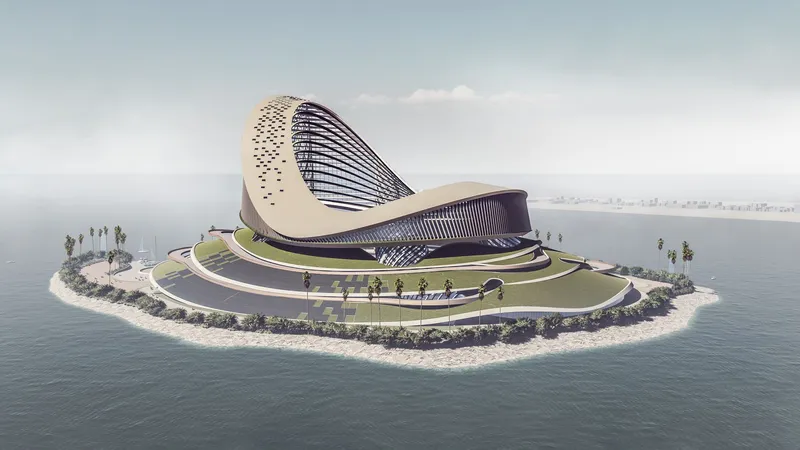
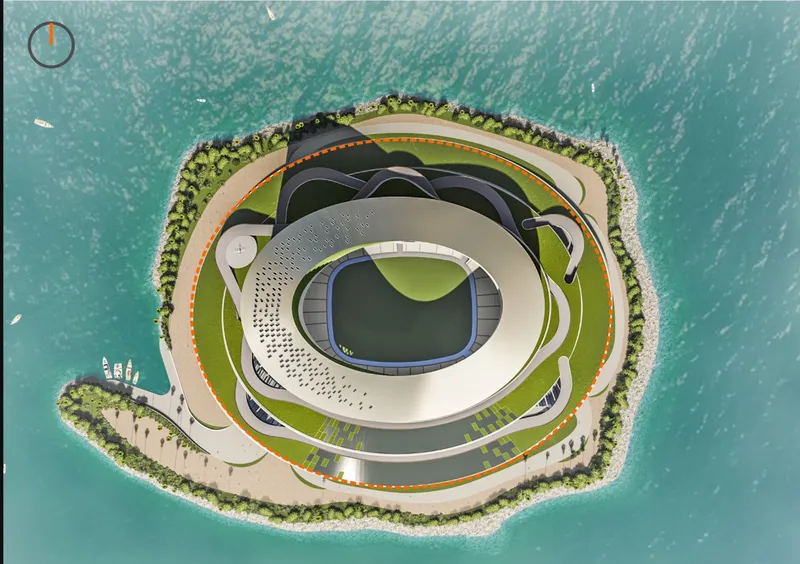
The aerial views establish the proposition. An artificial island sits offshore, shaped like a rough oval with a sandy perimeter. At one end, the sail-shaped hotel tower rises. At the other, an open-roof stadium bowl sinks into the ground. Between the two, a spiralling landscape of terraced ramps, green lawns, and paved paths connects every level from the waterline to the upper decks. The LA skyline is visible on the horizon.
The plan view from above confirms the reading. The stadium is an oval carved into the island. The tower is a vertical extrusion at one end. The landscape spirals around both, creating a continuous pedestrian route from the marina at sea level to the upper terraces. No elevators needed for the outdoor experience: you walk up the island the way you walk up a hill, except the hill is artificial and the views are of the Pacific.
The Tower: A Sail That Holds a Hotel
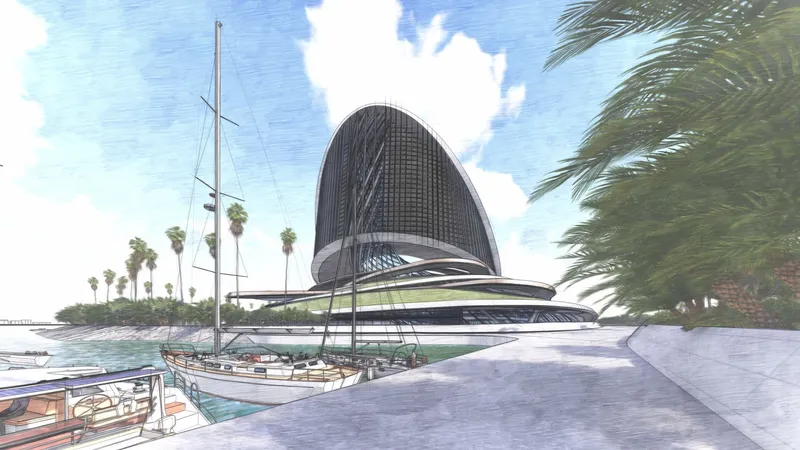
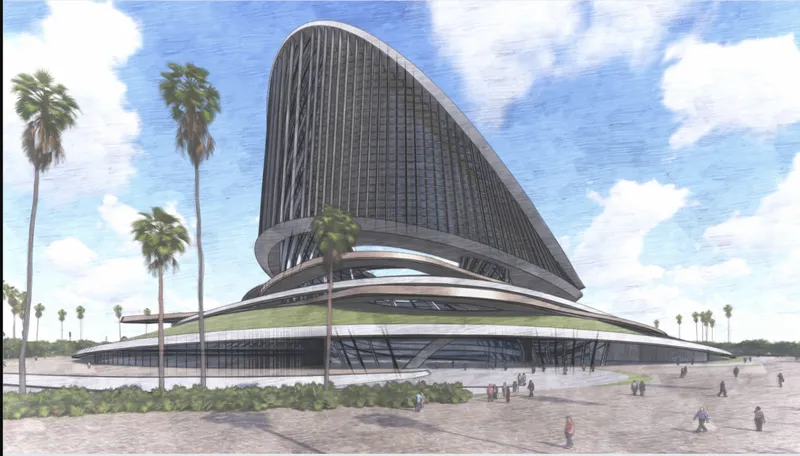
The marina-level render is the project's signature image. The sail-shaped tower rises behind moored yachts, its dark glazed facade curving upward from the low sweeping base. The silhouette reads as a single curved fin, closer to a spinnaker than a skyscraper. From the beach promenade, the same tower appears above palm trees and a low recreational base, with pedestrians walking toward it along the waterfront.
The tower houses a luxury hotel directly above the arena. This stacking is the project's cleverest spatial move: tournament participants and spectators stay in the building they came to visit. The hotel does not compete with the stadium for ground area because it occupies the vertical space above it. The sail shape is not arbitrary either. The southern face, which catches the most sun, is equipped with integrated solar panels. The curve maximises the panel area while giving the building its distinctive profile.
The Arena: Open Roof, Undulating Canopy
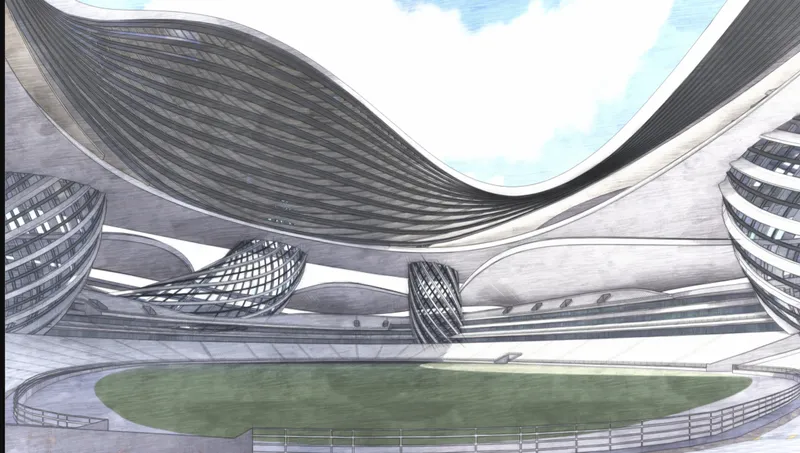
The interior render shows the stadium from inside. An open-roof bowl with tiered seating surrounds a football pitch. An undulating structural canopy shades the upper tiers without enclosing them. The tower is visible rising behind the open end of the bowl, confirming that the arena and the hotel share a single structural system. The open roof lets the Pacific breeze through, which in Los Angeles is not a compromise but a feature.
The arena is designed for both live sports and esports tournaments. That dual programme is what makes the project a co-living and entertainment hybrid rather than a pure stadium. The lower volume of the complex houses the recreational zone: walking paths, green terraces, and nature-oriented spaces designed to counterbalance the screen time of competitive gaming. The building offers both the spectacle and the antidote.
The Landscape: Spiralling from Shore to Sky
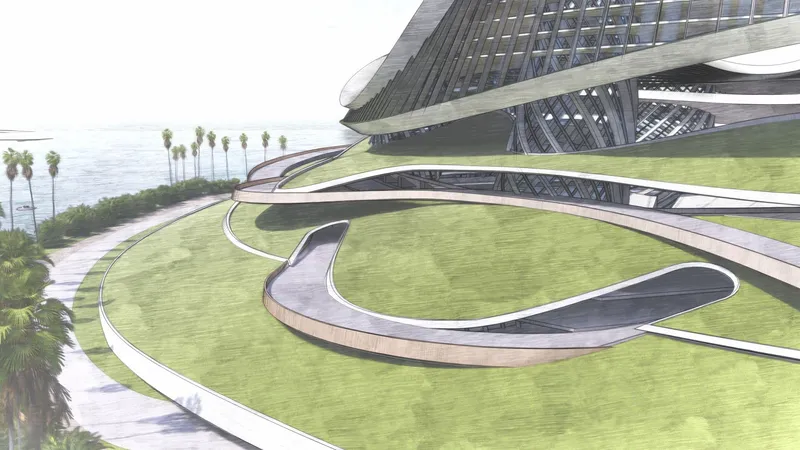
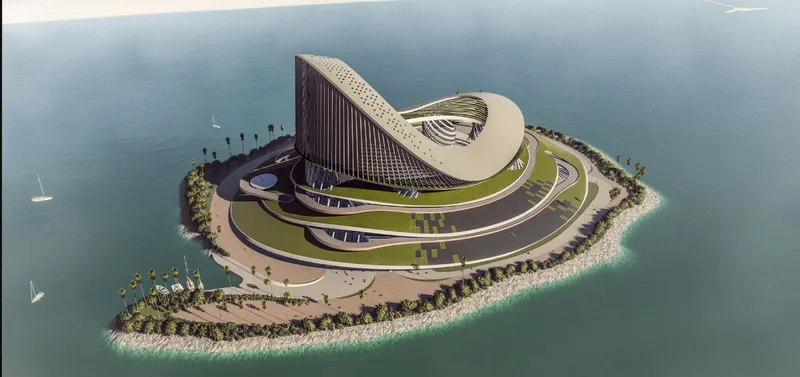
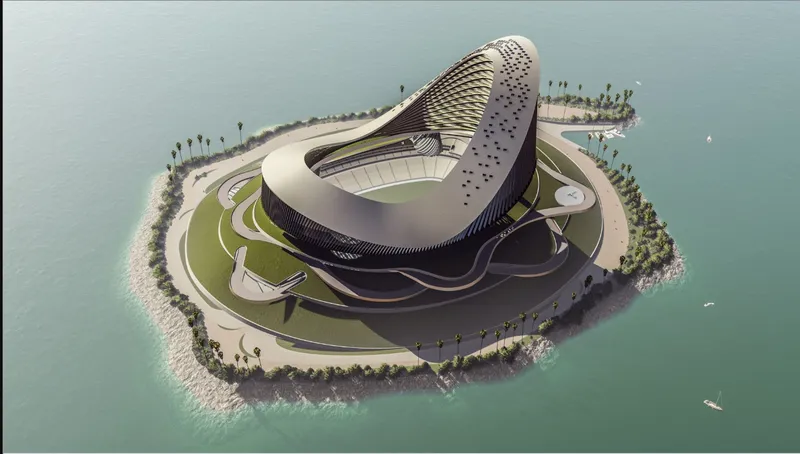
The ground-level landscape render shows how the base of the building meets the earth. Swooping green lawns and paved ramps curve around the tower's footprint, with palm-lined paths leading toward the ocean edge. The two aerial three-quarter views confirm that this spiralling landscape wraps the entire island, creating multiple levels of outdoor terrace connected by a continuous ascending path.
This landscape strategy is what transforms the project from a stadium-on-an-island into a public park-on-an-island. The ramps are not just circulation. They are the public realm: places to sit, walk, jog, and watch the ocean while the tournament plays out inside the bowl below. The island is simultaneously a venue and a park, and the spiral is the device that makes both programmes legible from every angle.
Why This Project Matters
The Di: Generic Cities competition asked entrants to resist the generic. Arena of Independence resists it by leaving the city entirely. The building is not on a street. It is not between other buildings. It is in the ocean, on its own island, with its own landscape, its own marina, and its own skyline. That isolation is the architectural argument: when you cannot differentiate a building by its context, you differentiate it by removing the context altogether.
For anyone studying island architecture, stadium typologies, or the intersection of sports and hospitality design, this project is a useful reference. It demonstrates that a competition entry can be simultaneously outlandish and programmatically coherent. The sail is a hotel. The bowl is an arena. The spiral is a park. The island is the site. Every formal gesture has a function, and every function has a form. That discipline, inside a project this ambitious, is what earned it a place on the shortlist.
View the Full Project
About the Designer
Designer: Aleksei Shestakov
Enter a Design Competition on uni.xyz
If speculative urbanism, stadium architecture, or island-scale design is the kind of work you want to explore, uni.xyz runs competitions year-round that reward proposals with spatial ambition and programmatic conviction.
Project credits: Arena of Independence by Aleksei Shestakov. Shortlisted, Di: Generic Cities: Los Angeles (uni.xyz).




Popular Articles
Popular articles from the community


Riyadh For All: Intergenerational Urban Design for Active Aging in Rabat
Riyadh For All reimagines urban design in Rabat with intergenerational co-living, adaptive courtyards, and Moroccan cultural exchange today.

Hill & Cross Opera: Sculptural Opera House Architecture Shaped by Tallinn’s Landscape and Identity
Hill & Cross Opera reimagines opera house architecture in Tallinn through its sculptural hill, civic plaza, glass wave and a luminous cross.

Conexión: Biophilic Design Reimagines High-Rise Living in Hong Kong
Conexión reimagines high-rise living in Hong Kong through biophilic design, green facades, shared spaces, daylight, water and nature within.

Co-Life: Senior Housing Design That Reconnects Older Adults With the City
Co-Life reimagines senior housing design through healing gardens, shared streets, workshops, and a sustainable community across generations.


Similar Reads
You might also enjoy these articles

Day and Night Park: A Time-Based Urban Newsstand in Beijing
A temporary urban newsstand in Beijing blending travel, light, and reading through poetic colors, compact form, and community-focused design.

Modernist Patio Renovation in El Masnou, Barcelona by Oliver Segura Arquitectura + Cebrià Arquitectura
Modernist patio renovation blending tradition and innovation with a movable pool, leveled floors, and Catalan materials in El Masnou.

Alto Residencial Coop: Cooperative Housing Development in Santiago de Compostela by Carbajo Barrios Arquitectos
A linear cooperative housing complex blending white volumes and perforated metal façades, enhancing community living, natural light, privacy, and urban integration.

Vil Genis School by BPA ARCHITECTURE – Massy, France
Vil Genis School in Massy, France, features sustainable design, south-facing classrooms, community integration, accessible spaces, and modern educational architecture.

Explore Iconic Building Competitions
Discover active competitions in this discipline



Challenge to design a barrier free sports center


Challenge to design an outdoor ice-rink and park
Comments (0)
Please login or sign up to add comments
No comments yet. Be the first to comment!