
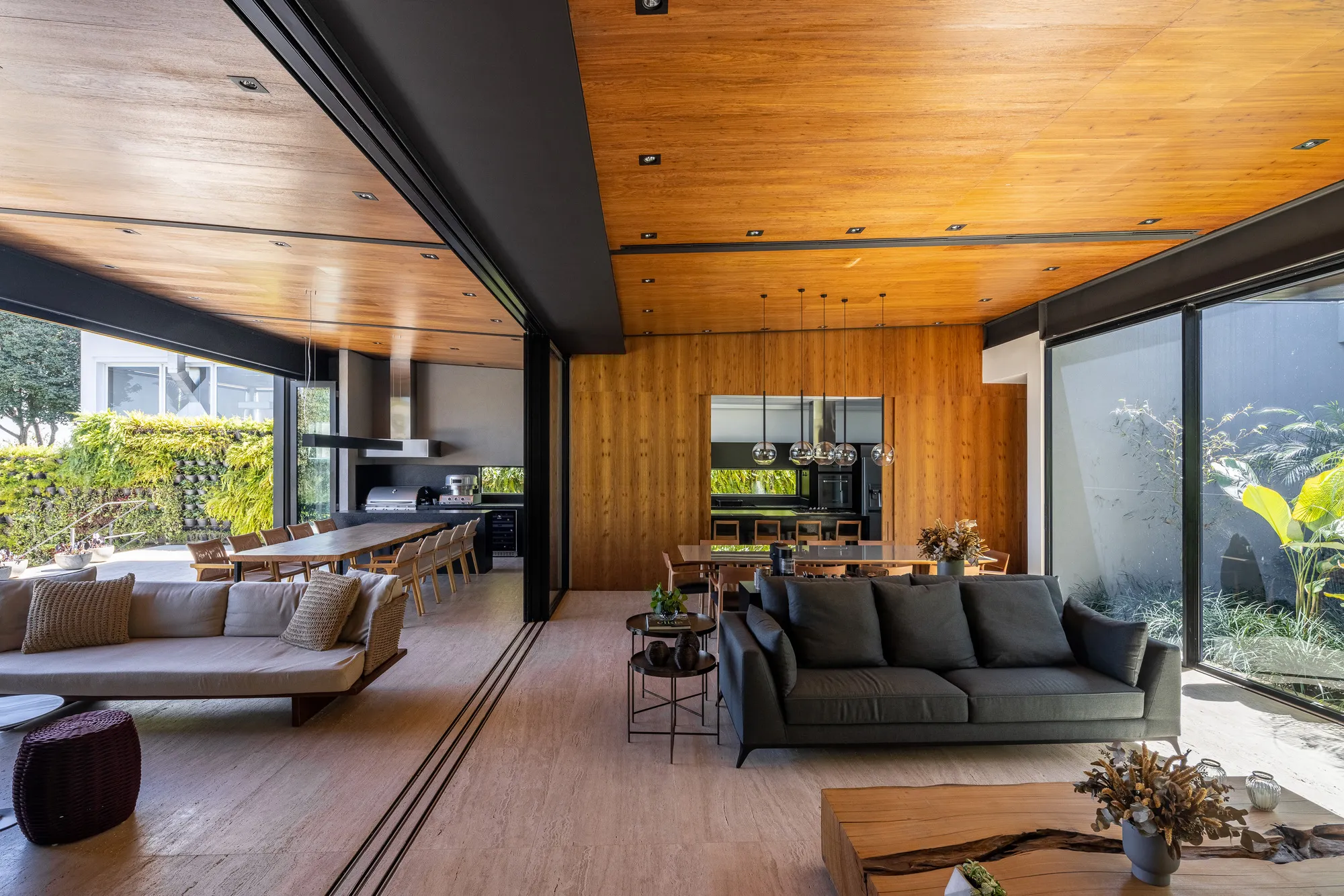
Arquitetos Associados Strips a São Paulo House Back to Its Bones and Rebuilds It in Timber
A renovation in São Paulo replaces heavy concrete tiles with a floating metallic roof, opening the house to its sloped garden and city beyond.


Renovation projects rarely get to reinvent a building's silhouette. LE House, led by Paula Zasnicoff of Arquitetos Associados, does exactly that. By swapping out the original concrete tile roof for a metallic one carried on steel beams and wrapped in a warm timber soffit, the architects gave this São Paulo residence a new identity: lower, longer, lighter. The house no longer hunches over its hillside lot. It stretches across it, reaching toward the garden with deep eaves that blur every boundary between inside and out.
What makes the project compelling is its discipline. Rather than adding volume, the team subtracted it. An old deposit in the center of the plan was demolished to create a central patio. The former dining room was gutted to merge living and dining into a single generous space. Excessive angulations in the original layout were straightened into orthogonal rooms. The result is a house that feels twice its age in rootedness but half its age in energy, a building that finally acknowledges the terrain it sits on.
Before and After: Reading the Transformation
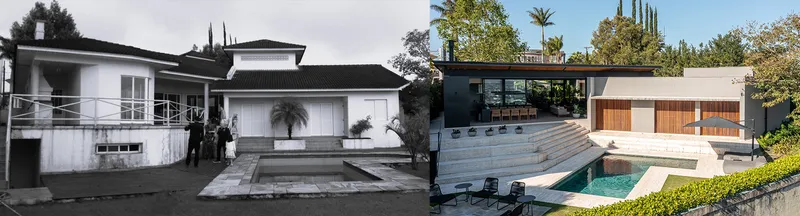

The comparison images tell the story more bluntly than any description. Where the original house presented a blocky, inward-looking facade with pitched concrete tile roofs and a cluttered poolside, the renovation introduces a continuous horizontal datum. Guardrails vanish. The pool terrace, once walled off from the slope below, now cascades down in board-formed concrete steps that double as bleacher seating. A garage door becomes a rhythmic screen of vertical timber slats. Every edit serves the same agenda: remove visual weight, invite the landscape in.
A Roof That Floats

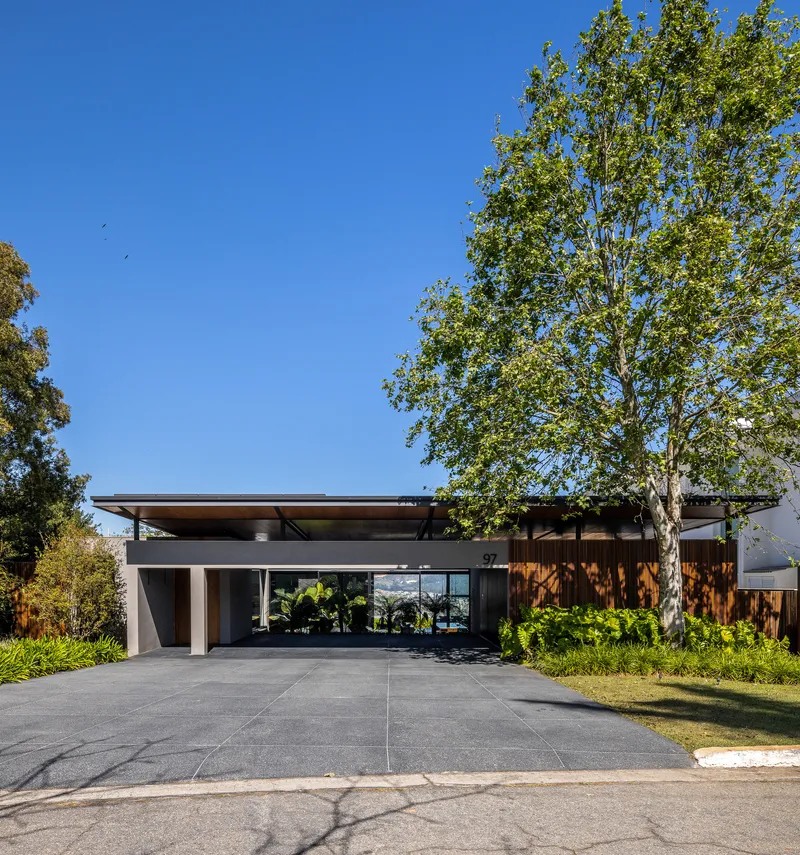
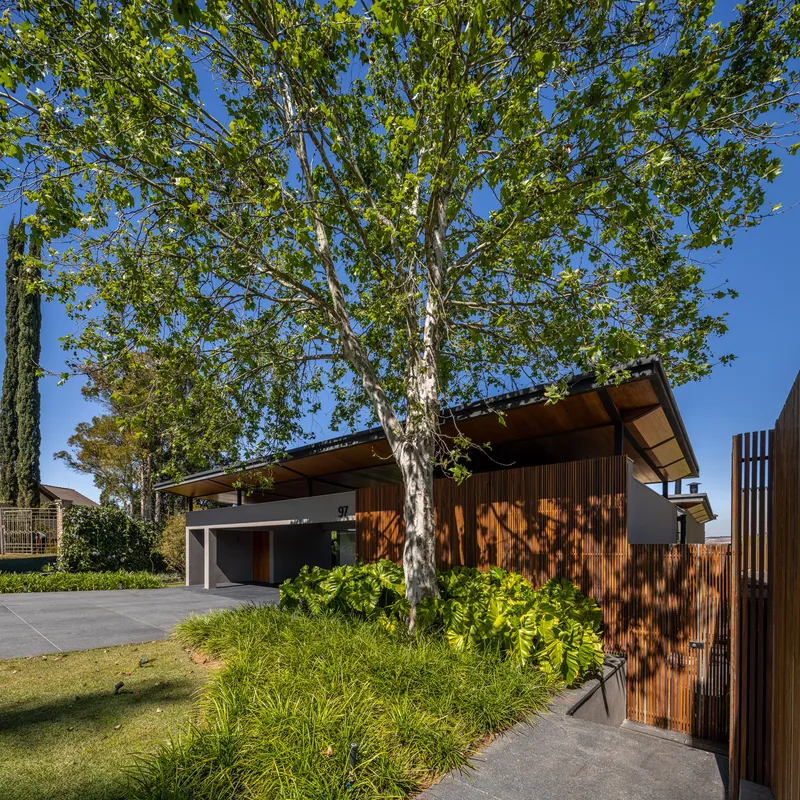
The metallic roof is the single most consequential move in the project. From the street, it reads as a thin, dark line hovering above a forecourt that sits comfortably under a large sycamore tree. The cantilevered eaves extend far beyond the walls, creating shade without enclosure. Underneath, the timber soffit provides a rich, tactile warmth that contrasts with the steel fascia at the roof's edge. The roof's lightness is not decorative. It is structural honesty: steel beams span wider, allowing the removal of interior partitions that the old concrete-tile system demanded.
Zasnicoff and her team understood that horizontality is the key to making a house feel grounded on a slope. A steep lot naturally wants to push a building upward. LE House resists that impulse. Its roofline stays low and even, letting the terrain do the vertical work beneath it.
Street Facade: Timber, Steel, and Shade
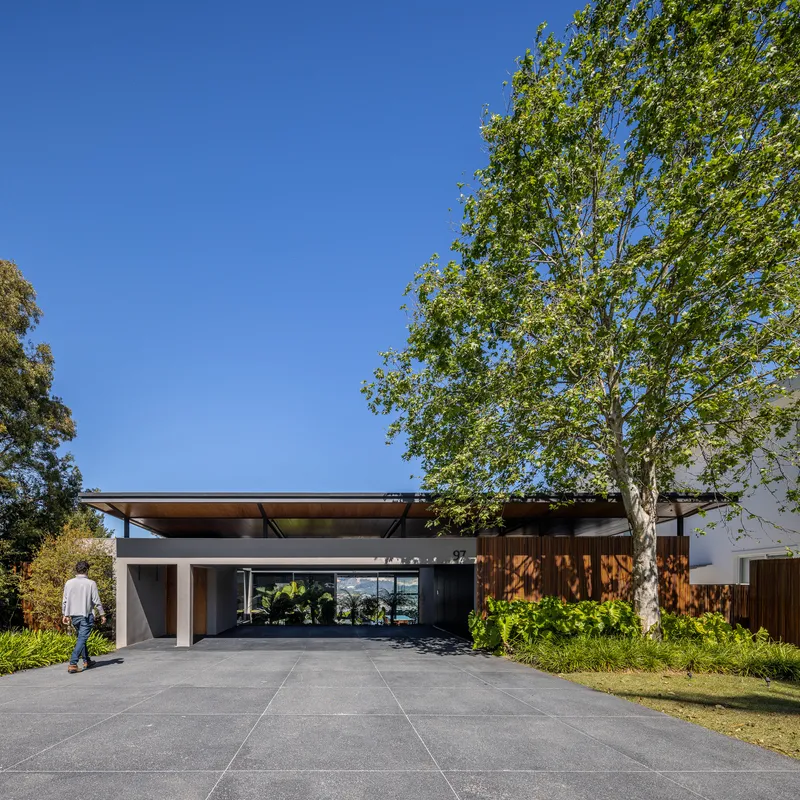

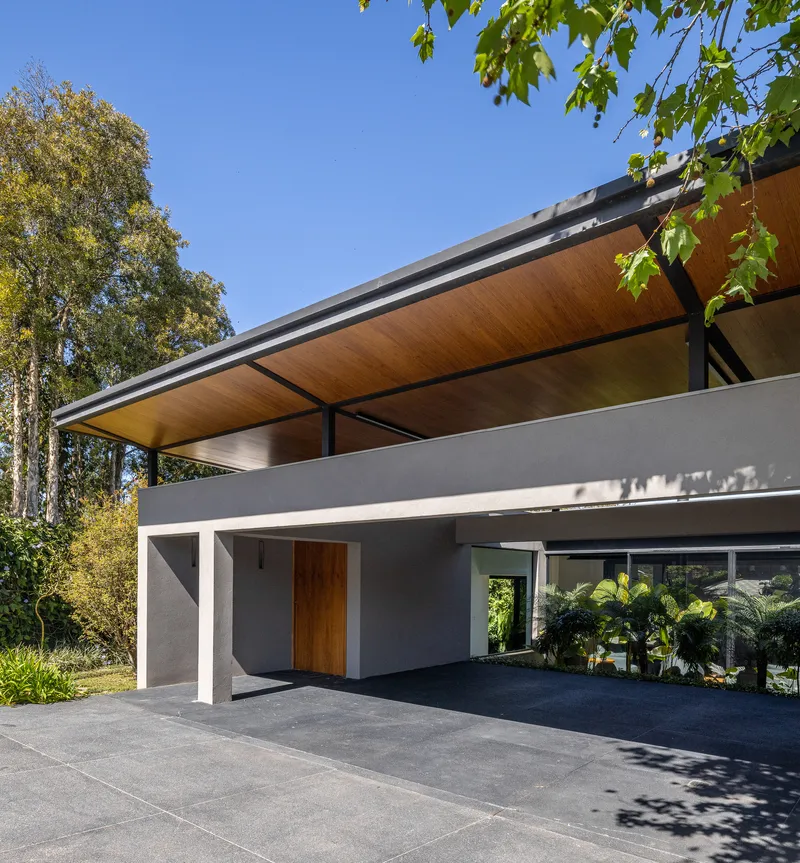
From the public side, the house presents a layered composition. Vertical timber cladding wraps the main volume, its grain catching different qualities of light throughout the day. A sycamore tree stands as a co-author of the facade, its trunk and canopy framed deliberately by the cantilevered roof and the slat screen wall. The architects did not fight the tree; they designed around it, letting dappled shade animate surfaces that might otherwise read as flat.
The entry canopy reveals the material logic up close: exposed timber soffit, steel beams, and concrete walls at the perimeter. There is no attempt to hide the renovation's structural DNA. Steel meets wood with bolted connections left visible, an honest joint that tells you this house was rebuilt, not merely refreshed.
The Entry Sequence and Carport


Arrival at LE House is choreographed through a covered carport that doubles as a threshold. Concrete walls anchor the space at its edges while a planted bed and clerestory windows soften the transition from street to interior. The stepped travertine terrace leading to the timber-slat garage doors establishes the material palette that runs through the entire house: pale stone, warm wood, raw concrete. It is a compressed preview of the spatial generosity that unfolds once you pass through.
Living Space as Landscape Room


The demolition of the old dining room partition created what the house always needed: a single living volume that runs from courtyard to courtyard. Floor-to-ceiling glazing on both sides makes the room feel less like an interior and more like a covered garden. A suspended fireplace anchors the seating area without dividing the plan, hovering as a sculptural object rather than a wall. Above, the timber ceiling with its exposed beams establishes a consistent rhythm that carries the eye from indoors to the covered terraces beyond.
The steel beams are not hidden above the timber; they sit at the same level, proud and visible. This structural frankness gives the ceiling a layered depth. Light enters from multiple directions, from the planted courtyards on either side, from clerestories, and from the generous openings that the new roof structure made possible.
The Outdoor Rooms: Terrace, Pool, and Slope
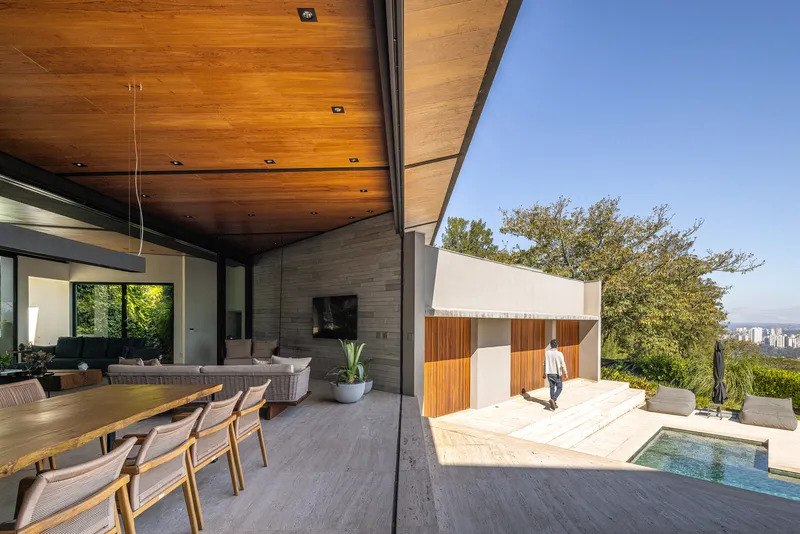


Landscape architect Gilberto Elkis redesigned the outdoor spaces to work with the slope rather than against it. The covered dining terrace opens directly to the pool courtyard, its long table positioned to catch afternoon light filtered through the timber ceiling. A grey brick fireplace wall gives the terrace a sense of enclosure without blocking views. Further out, the hillside view unfolds beyond the lawn and pool, framed by the cantilevered roof edge like a picture window turned inside out.
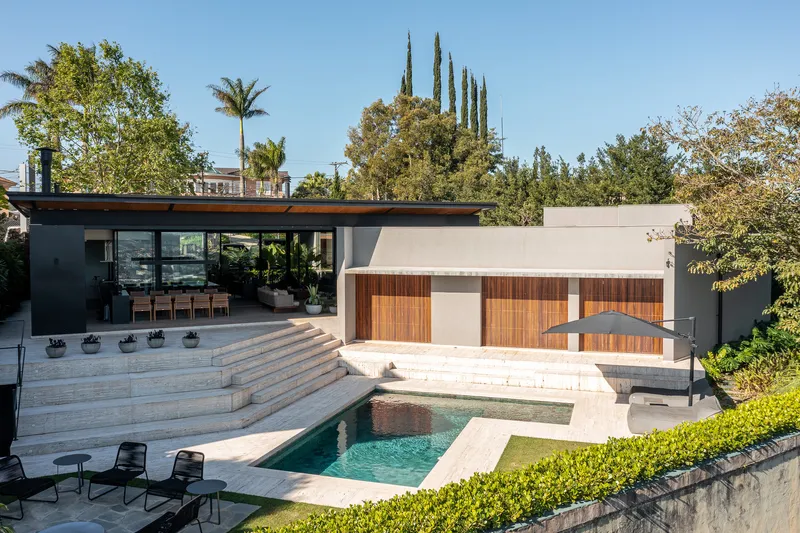
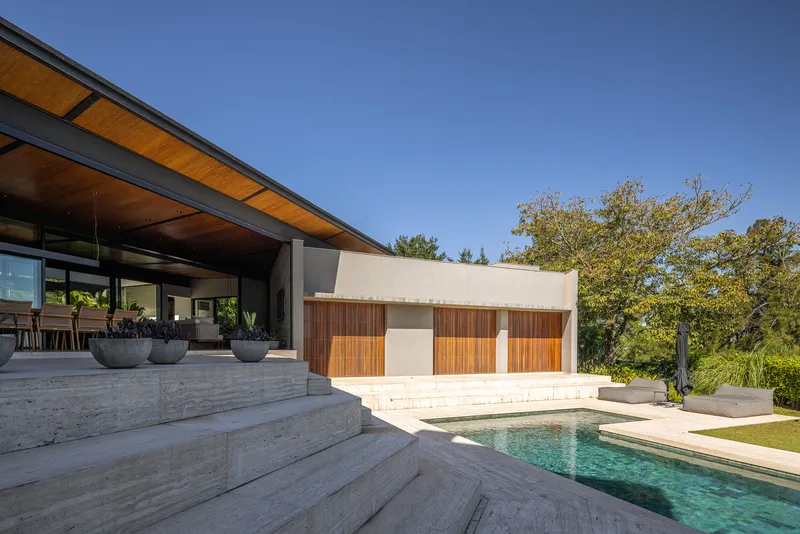

The pool terrace is where the project's topographic ambition is most legible. Board-formed concrete steps replace the old guardrails, turning what was once a retaining wall into usable space. The bleacher-like stairs negotiate the grade change in a way that feels generous rather than defensive. From above, the aerial view reveals the courtyard's geometry: pool, lawn, and deck arranged as a series of outdoor rooms that step down the slope in parallel with the interior split levels.
Plans and Drawings


The site plan reveals an angular, sloped lot that is anything but simple. The ground floor plan shows how the architects organized the program around a central courtyard, positioning the pool and main living spaces to face the garden while keeping service areas closer to the street. The demolition plan is particularly instructive: it maps every wall removed, making visible the degree to which the original house was compartmentalized. The triangular site geometry, which could have been a constraint, becomes a generator of oblique views and unexpected spatial connections.
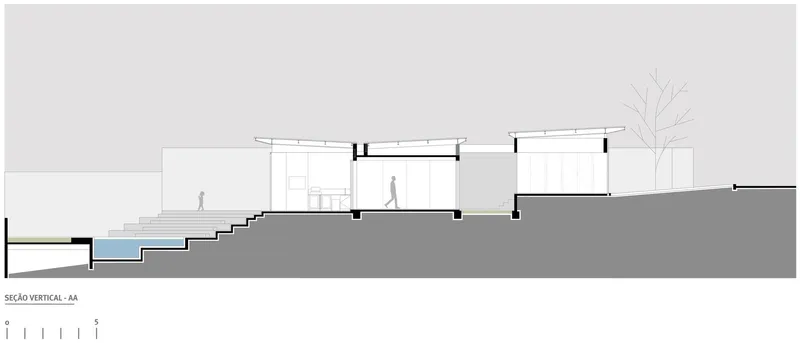
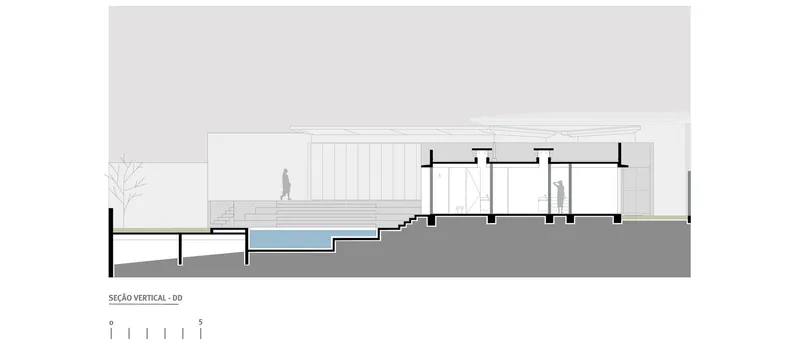

Three section drawings show the house stepping down the slope in a cascade of half-levels. The relationship between the pool deck, the main living floor, and the sunken garden level is clear: each terrace gains ceiling height as the terrain drops away. The central courtyard, created by demolishing the old deposit, appears in section as a vertical void that pulls light and air deep into the plan. These drawings make a strong case that the project's intelligence lives in its section more than its plan.
Why This Project Matters
LE House is a renovation that argues for subtraction as a design strategy. In a city where São Paulo's residential renovations often mean adding volume, adding floors, adding complexity, Zasnicoff and her team took the opposite approach. They demolished walls, removed an entire outbuilding, eliminated guardrails, and replaced a heavy roof with a lighter one. Every intervention opened something: a view, a breeze path, a connection between rooms that the original plan kept separate. The result is a house that gained space by losing mass.
The project also demonstrates how a single material decision, in this case the shift from concrete tiles to a metallic roof on steel beams, can cascade through an entire design. That change unlocked wider spans, which allowed partitions to come down, which created the open living volume, which demanded full-height glazing, which connected the interior to the garden, which required the landscape to be redesigned. One move generated all the others. That kind of chain reaction is the mark of a renovation that understands its building structurally, not just aesthetically.
LE House by Arquitetos Associados, led by Paula Zasnicoff. São Paulo, Brazil. 547 m². Completed 2020. Landscape design by Gilberto Elkis. Lighting design by Gilza Carvalho. Structural engineering by Meirelles Carvalho Engenharia. Photography by Manuel Sá.
About the Studio
Share Your Own Work on uni.xyz
If projects like this are the kind of work you want to make, uni.xyz is a place to publish your own, find collaborators, and enter design competitions.




Popular Articles
Popular articles from the community


Conexión: Biophilic Design Reimagines High-Rise Living in Hong Kong
Conexión reimagines high-rise living in Hong Kong through biophilic design, green facades, shared spaces, daylight, water and nature within.

Co-Life: Senior Housing Design That Reconnects Older Adults With the City
Co-Life reimagines senior housing design through healing gardens, shared streets, workshops, and a sustainable community across generations.

AL-JANNAH: Sustainable Architecture and Permaculture for Afghan Widows
AL-JANNAH uses sustainable architecture and permaculture to create resilient oasis of housing, learning, work and renewal for Afghan widows.

Riyadh For All: Intergenerational Urban Design for Active Aging in Rabat
Riyadh For All reimagines urban design in Rabat with intergenerational co-living, adaptive courtyards, and Moroccan cultural exchange today.
Similar Reads
You might also enjoy these articles

Bao Huynh Watercolor Atelier: A Serene Art Retreat in Hội An
Bao Huynh Watercolor Atelier in Hội An blends multifunctional art spaces, sustainable design, local materials, and family-friendly living in a serene environment.

Atelier Macri Concept Store Interior Design by CASE-REAL
Atelier Macri store features a "ko" counter, walnut wood details, cork displays, blending retail, gallery, and seamless customer experiences.

Manuel Vargas Izquierdo Stadium and High-Performance Sports Center: Architectural Excellence in Jalpa de Méndez
The Manuel Vargas Izquierdo Stadium blends sustainable design, inclusive sports facilities, and cultural-inspired architecture, revitalizing Jalpa de Méndez’s public spaces.

KAKR Buluh Awar Hall: Revitalizing Community and Ecology Through Bamboo Architecture
Community built bamboo hall revitalizes Buluh Awar village, empowering youth, restoring ecology, celebrating vernacular craftsmanship through sustainable architecture and culture.


Explore Power Generation Competitions
Discover active competitions in this discipline


Challenge to design mud housing for contemporary communities


Challenge to design luxury tourism on rails


VR headsets Storefront design competition


Designing a staircase for a client
Comments (0)
Please login or sign up to add comments
No comments yet. Be the first to comment!