
Arquitika Plants a Stone Research Center at the Foot of an Atacama Sand Dune for the Colla Community
A 148-square-meter courtyard building in Copiapó, Chile, draws on Colla construction traditions of raw earth, stone, and timber.


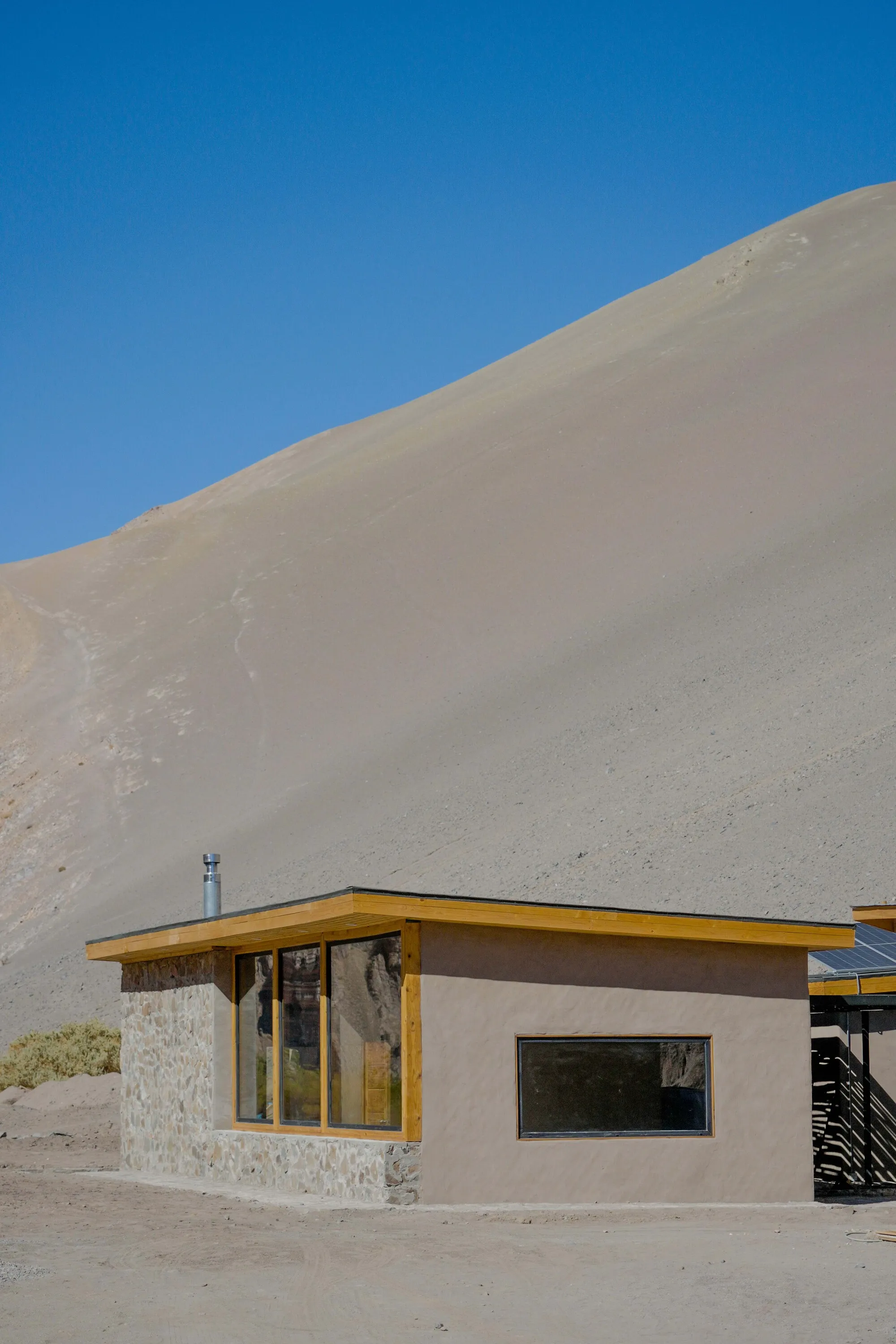
There is a particular kind of confidence required to place a building at the base of a towering sand dune and expect it to hold its own. Arquitika, the Atacama-based practice led by David Cortez Godoy and Natalia Jorquera Silva, achieves that here not through formal bravado but through material kinship. The Research Center of the Colla Indigenous Community reads as an extension of the ground it sits on: stone walls, timber frames, and a restrained profile that refuses to compete with the landscape. At 148 square meters, this is a small building with an outsized sense of place.
What makes the project genuinely interesting is how it operationalizes a participatory design ethic without reducing it to a style. Arquitika has a long-running engagement with the Colla people, whose traditional territory spans the Atacama Desert and the Andean foothills of the Copiapó and Chañaral provinces. The Colla building culture, rooted in adobe, quincha, plant fibers, and stonework, is not quoted decoratively here. It is the structural logic of the building. The result is a research center that embodies the very knowledge it is meant to house.
A Building That Belongs to Its Terrain


From any distance, the building barely registers as separate from its context. Dry-stacked and mortared stone walls rise from the desert floor in tones that mirror the surrounding earth and rock. A flat roof keeps the profile low and horizontal, reinforcing a sense of embeddedness rather than imposition. Yellow-framed ribbon windows are the clearest signal that this is architecture, not geology, punching precise apertures through the mass of the walls.
The staircase carved into the slope on the approach side treats the building as part of the topography itself, a threshold between the road and the dune. At twilight, the structure dissolves further into the hillside, its stone absorbing the last light in a way that poured concrete or stucco never could.
The Courtyard as Organizing Principle

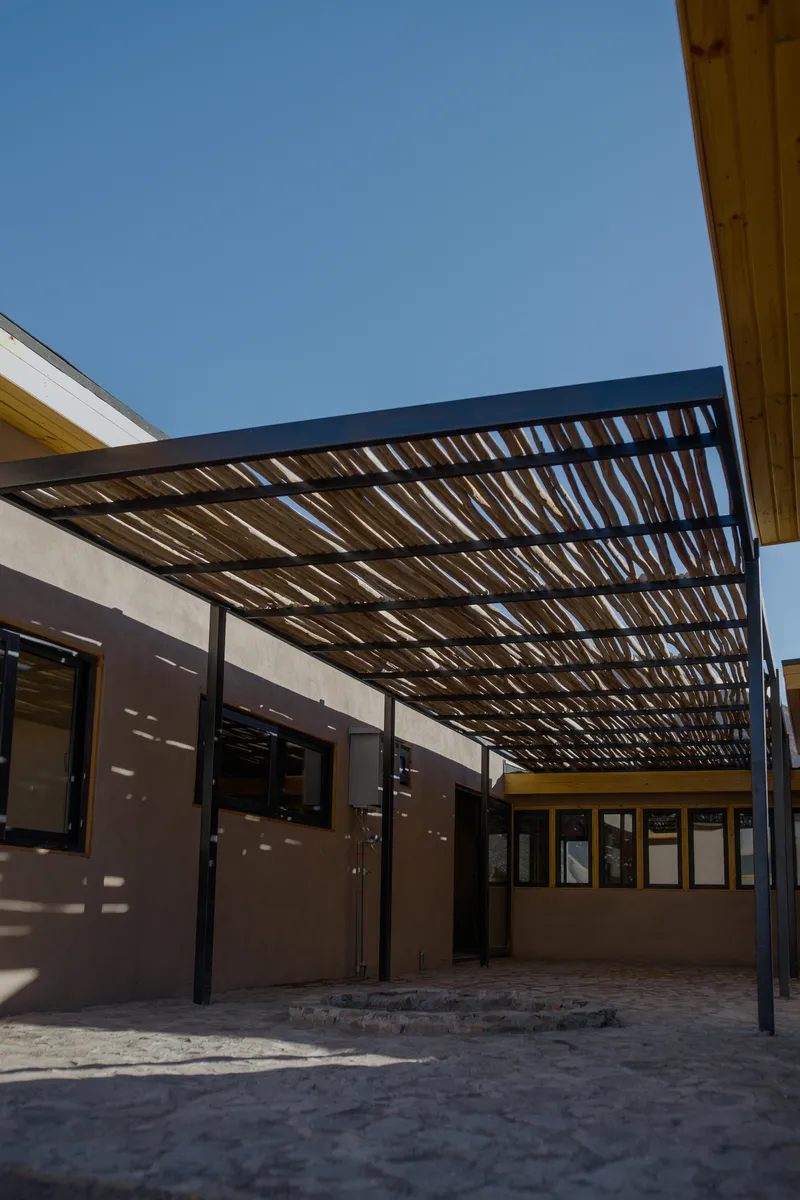

The floor plan wraps its program around a central courtyard, a strategy with deep roots in arid-climate architecture. Here the courtyard is not simply an open void but a layered sequence of filtered light and sheltered ground. A slatted timber and steel pergola hovers overhead, casting rhythmic shadow patterns across stone pavers and plastered walls. At night, a fire pit at the center of the court becomes the gravitational focus, an explicit reference to communal gathering traditions that predates the building by centuries.
The sliding glass doors lining the courtyard perimeter allow interior rooms to open fully onto this protected outdoor space. In a climate defined by extreme solar radiation and wide diurnal temperature swings, the courtyard serves as a thermal buffer zone, cooler than the open desert during the day, warmer than the surrounding air at night thanks to the thermal mass of the surrounding stone walls.
Stone, Timber, and the Pergola Overhead
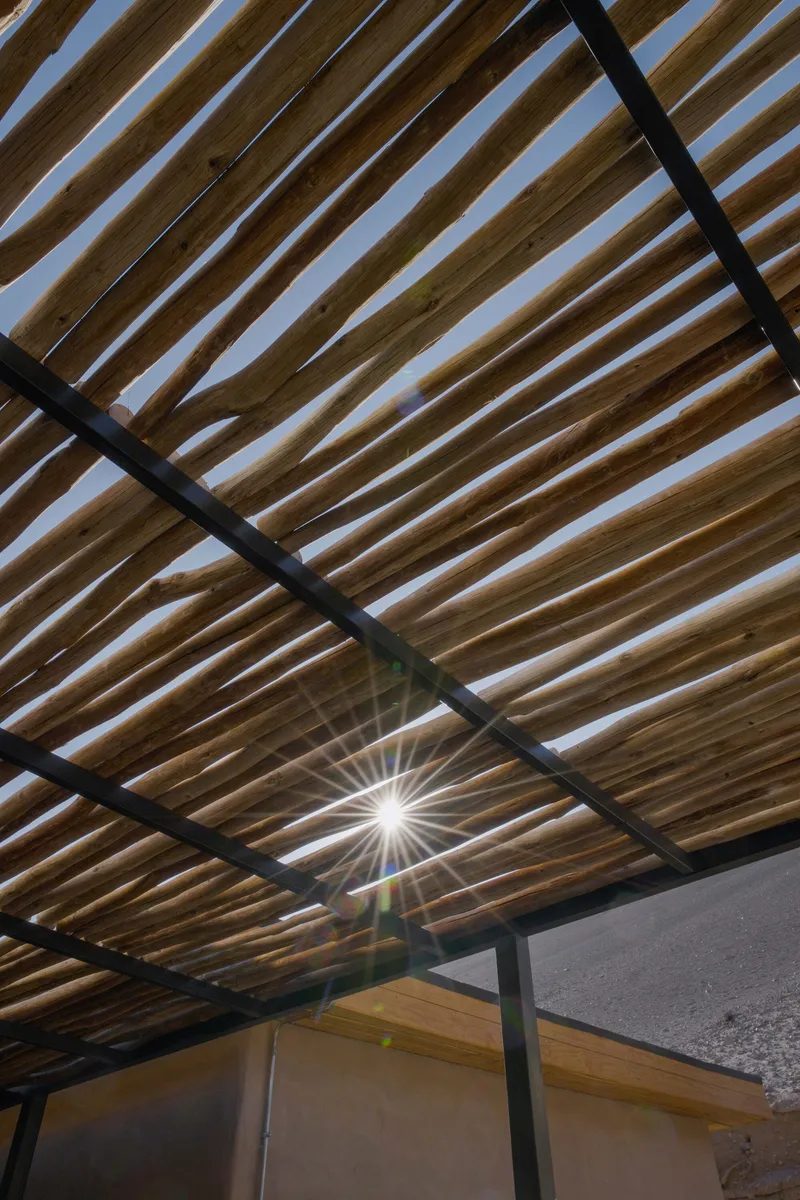
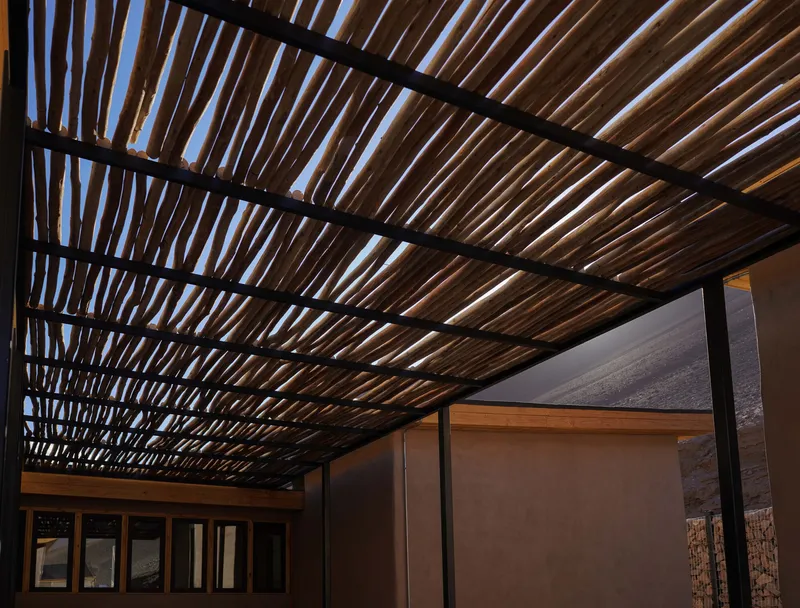
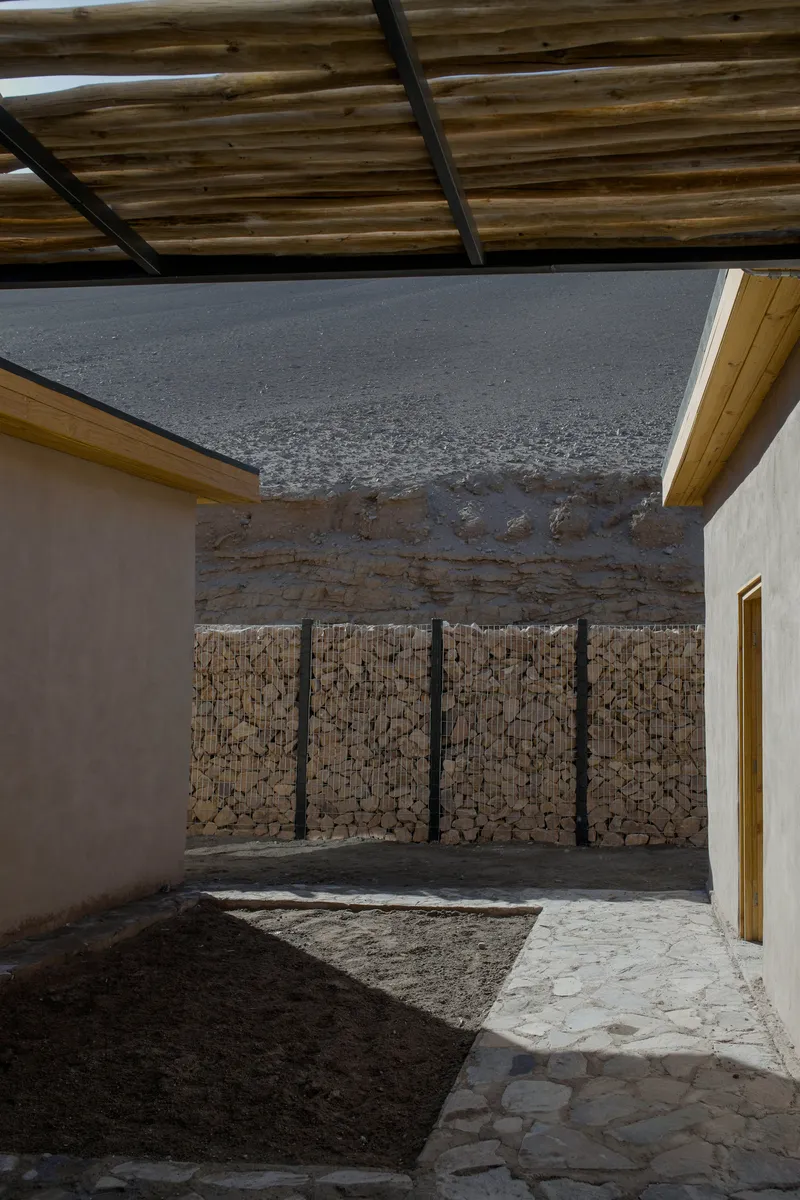
Arquitika's material palette is deliberately narrow. Local stone carries the structural and thermal loads. Timber, sourced through Arauco, handles the roof framing, interior partitions, and the extensive pergola system. Black steel beams support the slatted canopy, providing the necessary spans without competing visually with the natural materials. The gabion wall filled with loose stone and backed by an earth mound inside the courtyard is a smart detail: it introduces thermal mass and a textured surface that reads as landscape rather than wall.
The pergola deserves particular attention. It is not decorative screening. The slatted timber overhead modulates solar gain with the precision of a climate device, filtering midday sun into tolerable bands of light. In a region where shade is the most valuable architectural commodity, this element does the most important work in the building.
Interior Texture and Controlled Light


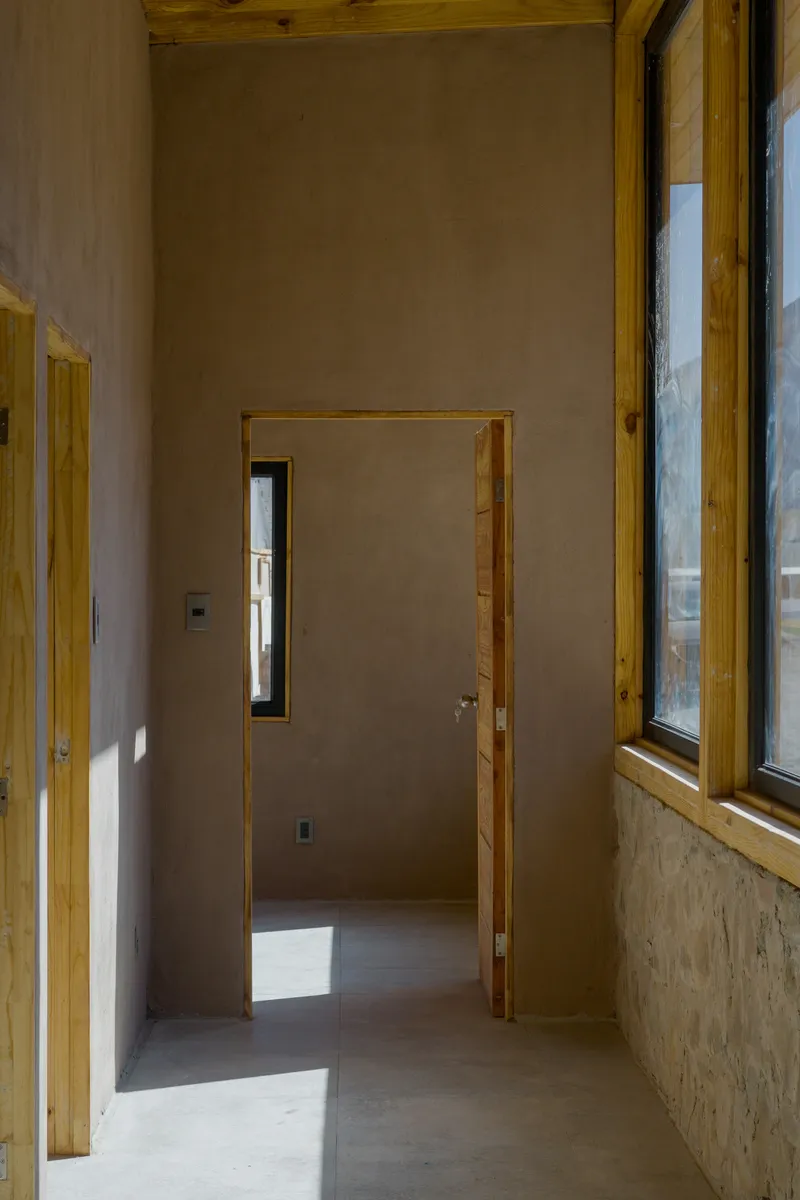
Inside, the building maintains the same material honesty. Exposed timber ceiling beams run in parallel across every room, giving the corridors a rhythmic cadence. Stone accent walls appear at key junctures, anchoring the interior spatially while connecting it to the exterior expression. Timber slat partition walls divide spaces without sealing them off, allowing air and light to pass through in controlled measure.
The hallway junctions are particularly well handled. Narrow vertical windows cast sharp blades of sunlight across plastered walls, marking the passage of time through the building in a way that feels intentional rather than incidental. The corridor with its ribbon of windows along the stone wall creates one of the strongest interior moments: a long view compressed between heavy masonry and warm timber above.
Framing the Desert

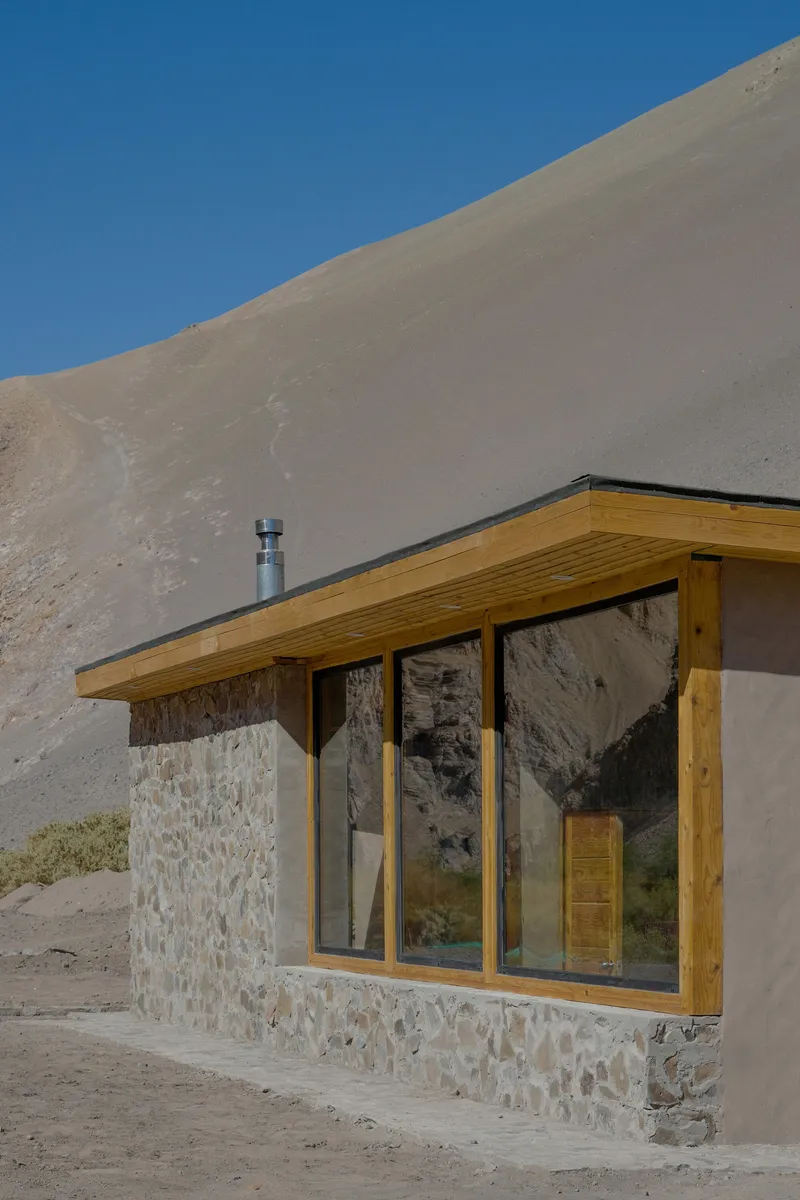
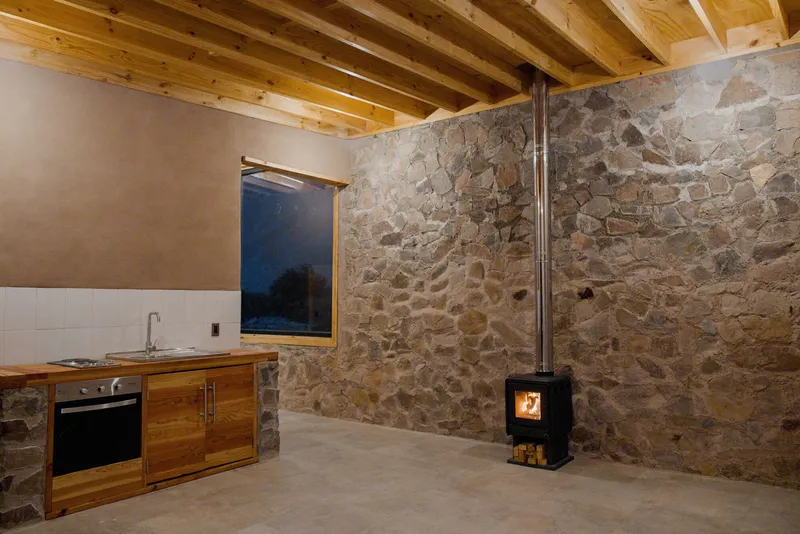
Every window in this building is a deliberate frame. The square opening that captures the desert hillside beyond, bracketed by exposed timber joists overhead, operates like a landscape painting that shifts with the light. The corner glazing at the junction of two stone walls opens the building to the slope with an almost aggressive directness, pulling the dune into the room.
The kitchen and living spaces introduce a more domestic register. A freestanding wood stove sits against a stone wall flanked by timber cabinetry, suggesting that the building is designed for extended occupation, not just daytime research visits. At dusk, these interiors glow with a warmth that contrasts sharply with the stark terrain outside. The building becomes a refuge in the most literal sense.
Threshold and Entry

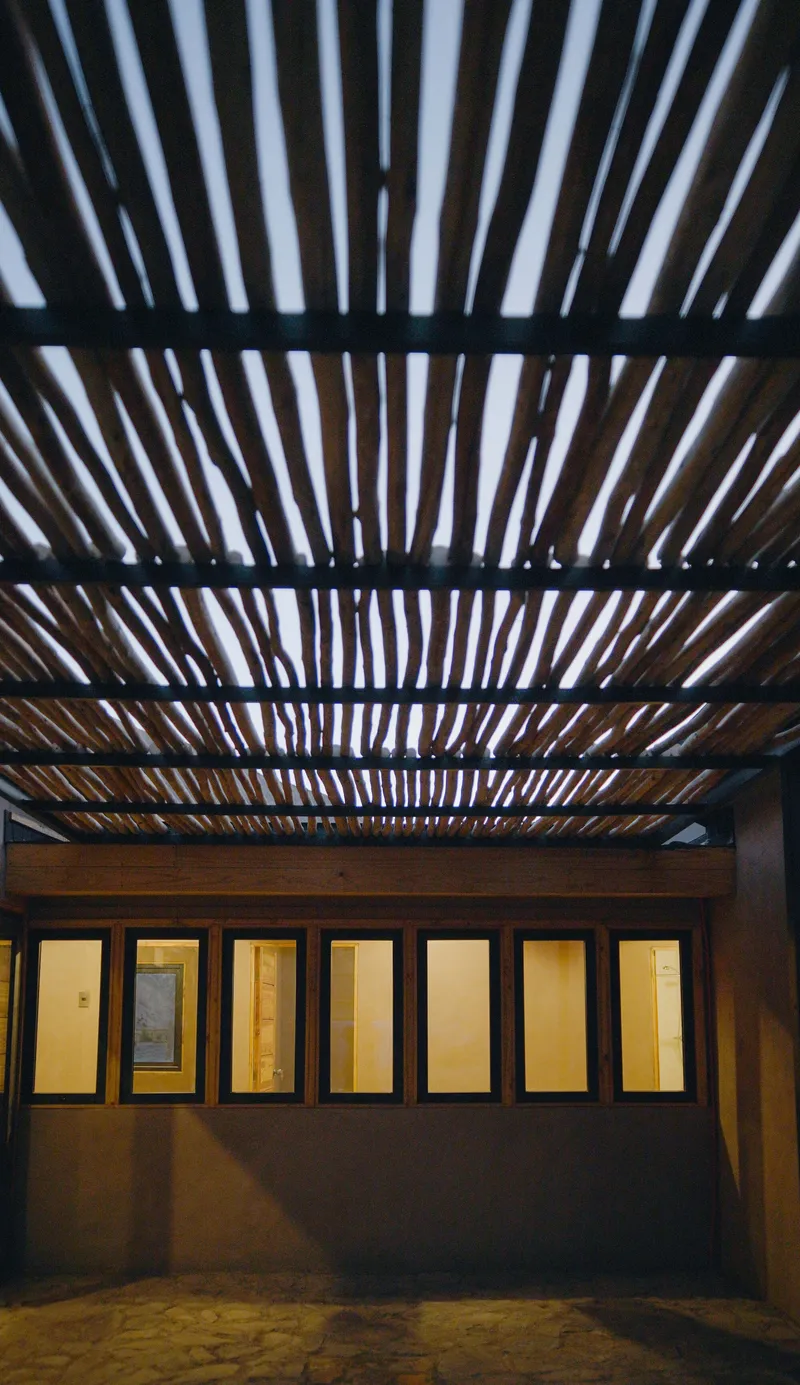
The entry sequence is modest but deliberate. A timber door set into a stone wall, sheltered by a metal lattice pergola, offers no grand gesture. The scale is domestic, almost understatement. In the evening view, the illuminated glazed doors beneath the timber canopy reveal the courtyard as the true entry point: you pass through the wall into a sheltered world before entering any enclosed room. It is a sequence that privileges transition over arrival, which feels appropriate for a community research center meant to support slow, sustained engagement with place.
Plans and Drawings
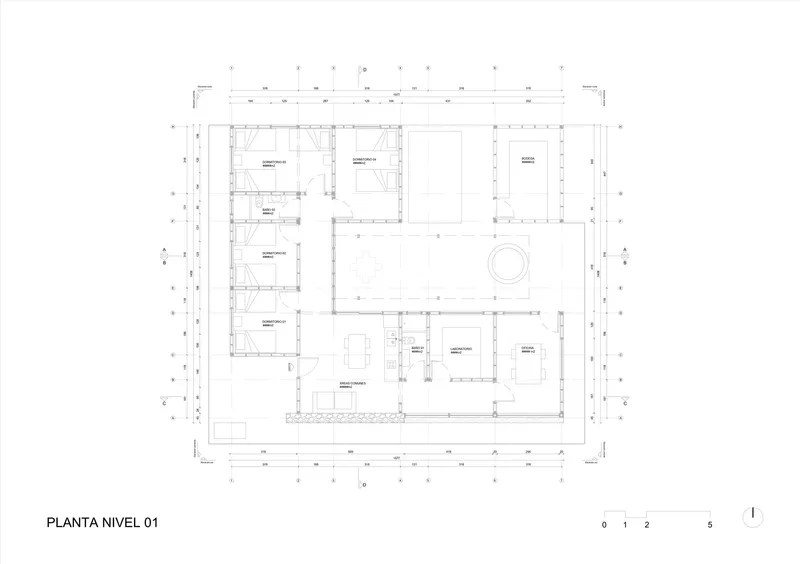

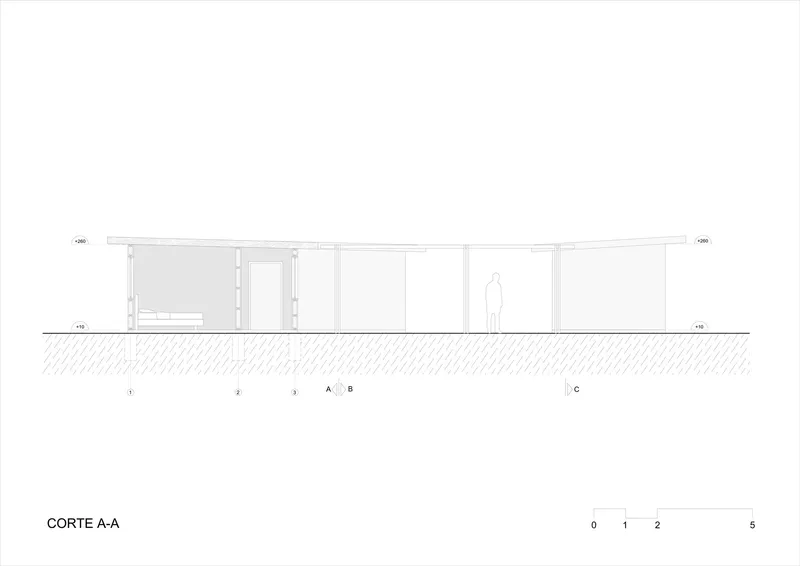
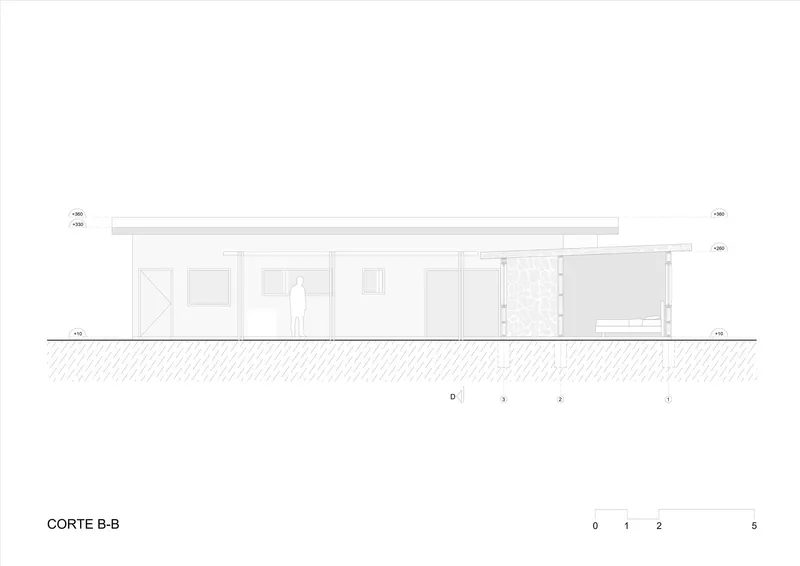

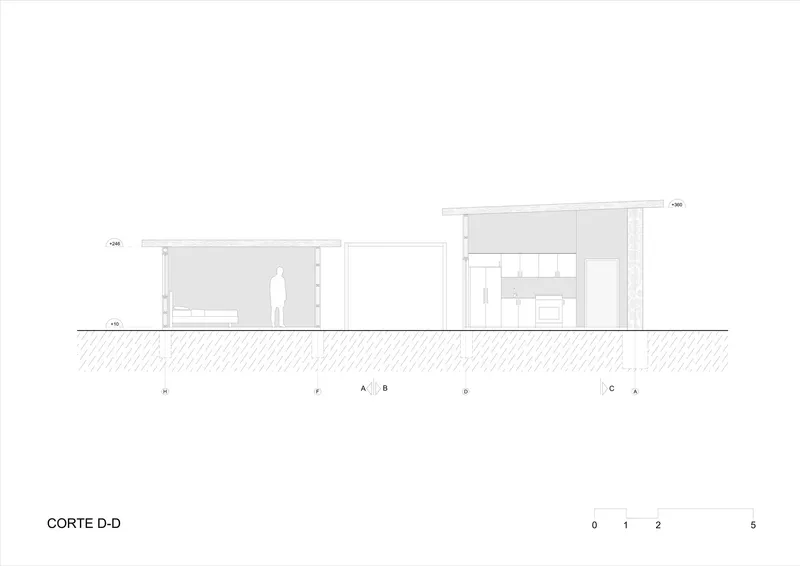


The floor plan confirms the courtyard-centric organization, with rooms arranged in an L or U configuration around the circular fire pit. The exploded isometric reveals how the roof planes are not a single slab but a series of interconnected volumes at slightly different heights, creating clerestory opportunities and differentiating program zones without relying on conventional walls. The four section drawings demonstrate the surprising internal complexity of what appears from outside to be a simple single-story structure: split levels, perforated screen walls, and varied ceiling heights introduce spatial richness within a compact footprint.
The elevation drawings are equally informative. The north elevation shows layered roof planes stepping back from a recessed central entrance. The east and west facades reveal the vertical slatted screen element that mediates between interior and exterior. The south elevation makes clear how the building's massing plays with offset roof volumes to break down what could be a monolithic form into a composition of interlocking parts, each scaled to the human figure drawn for reference.
Why This Project Matters
Small buildings for indigenous communities rarely get the attention they deserve in architectural media, partly because they lack the spectacle that drives clicks and partly because they operate within value systems that the profession still struggles to articulate. The Colla Research Center is important precisely because it takes those value systems seriously at the level of construction. The stone is not a veneer. The timber is not a finish. The courtyard is not a gesture toward tradition. These are working elements of a building designed to function in one of the driest environments on Earth, using knowledge that the Colla have refined over generations.
Arquitika's contribution is in translating that knowledge into contemporary architectural form without domesticating it. The building does not perform indigeneity for an outside audience. It performs shelter, gathering, research, and habitation for the community it serves. At 148 square meters, it is a reminder that the most consequential architecture is often the smallest, the most site-specific, and the least interested in being noticed from far away.
Research Center of the Colla Indigenous Community of the Municipality of Copiapó by Arquitika (David Cortez Godoy and Natalia Jorquera Silva). Copiapó, Atacama Region, Chile. 148 m². Completed 2026. Photography by Sebastián Maluenda Torres.
About the Studio
Share Your Own Work on uni.xyz
If projects like this are the kind of work you want to make, uni.xyz is a place to publish your own, find collaborators, and enter design competitions.




Popular Articles
Popular articles from the community


The Ocean Hive: Sustainable Architecture for a Self-Sufficient Civilization at Sea
The Ocean Hive imagines sustainable architecture at sea, where modular habitats, algae, wave power and ocean waste sustain a growing colony.

AL-JANNAH: Sustainable Architecture and Permaculture for Afghan Widows
AL-JANNAH uses sustainable architecture and permaculture to create resilient oasis of housing, learning, work and renewal for Afghan widows.

The Earth Pod: 3D Printed Homes for Resilient Refugee Communities
The Earth Pod reimagines refugee housing through 3D printed homes made from clay, combining resilience, self-sufficiency, and rapid shelter.

Hill & Cross Opera: Sculptural Opera House Architecture Shaped by Tallinn’s Landscape and Identity
Hill & Cross Opera reimagines opera house architecture in Tallinn through its sculptural hill, civic plaza, glass wave and a luminous cross.


Similar Reads
You might also enjoy these articles

Bao Huynh Watercolor Atelier: A Serene Art Retreat in Hội An
Bao Huynh Watercolor Atelier in Hội An blends multifunctional art spaces, sustainable design, local materials, and family-friendly living in a serene environment.

Atelier Macri Concept Store Interior Design by CASE-REAL
Atelier Macri store features a "ko" counter, walnut wood details, cork displays, blending retail, gallery, and seamless customer experiences.

Manuel Vargas Izquierdo Stadium and High-Performance Sports Center: Architectural Excellence in Jalpa de Méndez
The Manuel Vargas Izquierdo Stadium blends sustainable design, inclusive sports facilities, and cultural-inspired architecture, revitalizing Jalpa de Méndez’s public spaces.

KAKR Buluh Awar Hall: Revitalizing Community and Ecology Through Bamboo Architecture
Community built bamboo hall revitalizes Buluh Awar village, empowering youth, restoring ecology, celebrating vernacular craftsmanship through sustainable architecture and culture.


Explore Residential Building Competitions
Discover active competitions in this discipline



Challenge to design public laboratory


Challenge to design mud housing for contemporary communities
Comments (0)
Please login or sign up to add comments
No comments yet. Be the first to comment!