
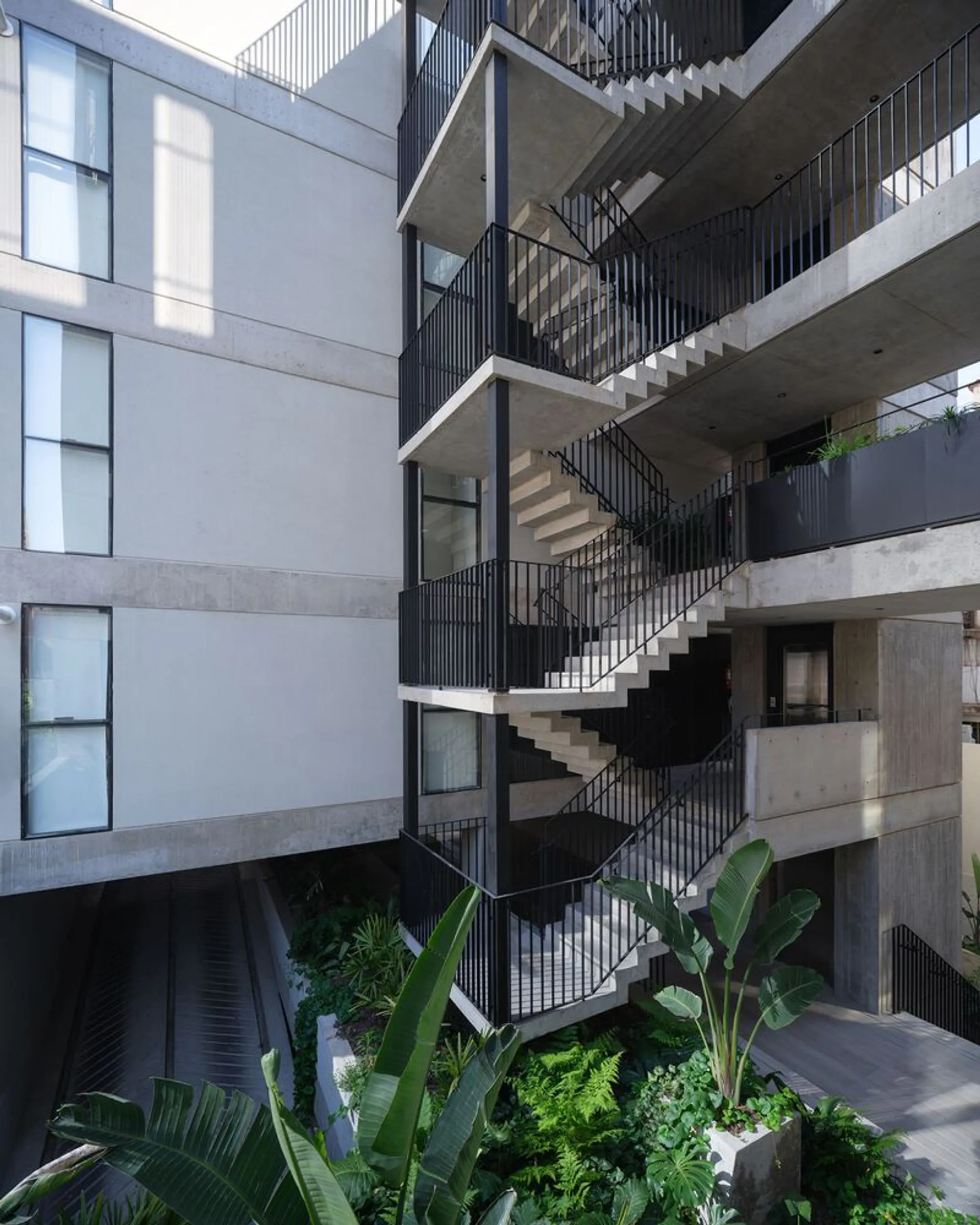
Israel & Teper Stack Jungle Courtyards Through a Buenos Aires Apartment Building
In the Nuñez neighborhood, a mid-rise residential block treats tropical planting and raw concrete as equals in a vertical domestic landscape.


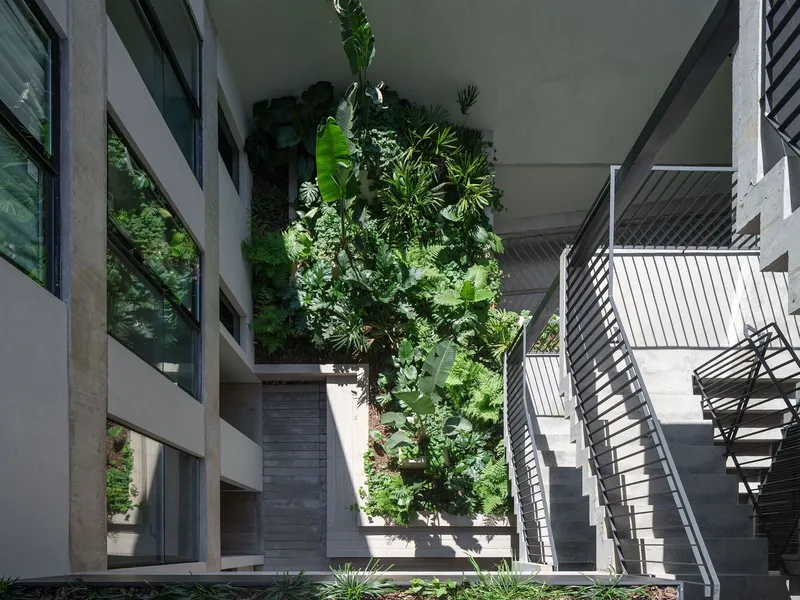
Most apartment buildings in Buenos Aires treat landscaping as an afterthought: a potted fern in the lobby, a strip of grass nobody uses. Israel & Teper Arquitectos reject that convention entirely with Arrive Nuñez, a residential project in the city's northern Nuñez neighborhood where the courtyard is not a gap between buildings but the building's organizing spine. Banana palms, ferns, and tropical ground cover climb vertically through a central void, threaded by zigzagging concrete stairs and steel railings that turn circulation into a kind of botanical promenade.
What makes the project genuinely interesting is its refusal to separate the planted world from the built one. Concrete planter boxes are cast as integral structural elements. Terraces read as extensions of garden beds rather than the other way around. The result is a building where you cannot walk from your front door to the street without brushing past living green, and where every unit is oriented toward something growing rather than toward a neighbor's kitchen window.
A Facade That Frames Rather Than Decorates
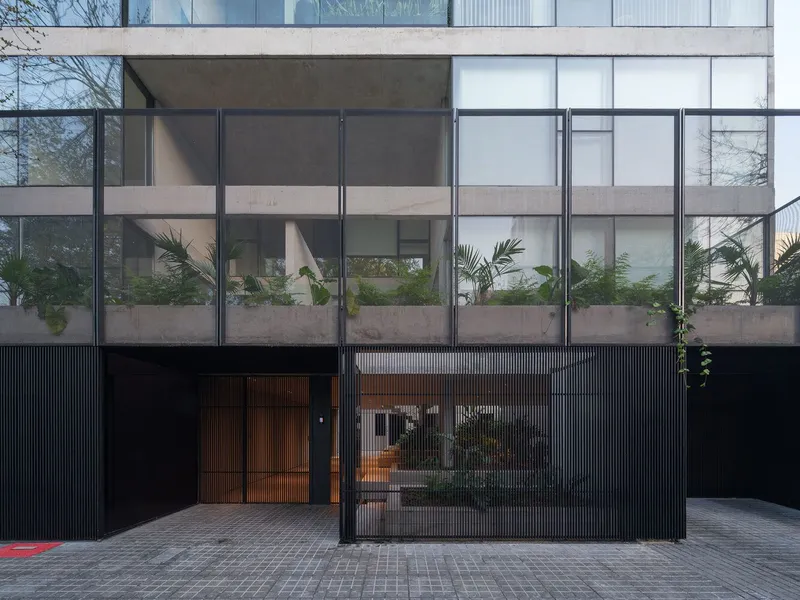
From the street, the building presents itself in black vertical metal cladding, a taut, industrial wrapper that acts more like a screen than a wall. Glass balustrades and planted balconies sit behind the steel frames, giving the facade depth without relying on decorative gestures. The dark palette lets the greenery do the talking: banana palms and cascading planting push forward visually, making the building feel more alive than its neighbors.
Viewed from the courtyard side, the logic flips. Concrete balconies and vertical metal screens layer outward, and the planting reads as a shared interior garden rather than a series of private balcony pots. The architects clearly designed the envelope from both directions simultaneously, treating the public and private faces as two aspects of one argument about how vegetation and structure can share the same frame.
The Courtyard as Vertical Ecosystem
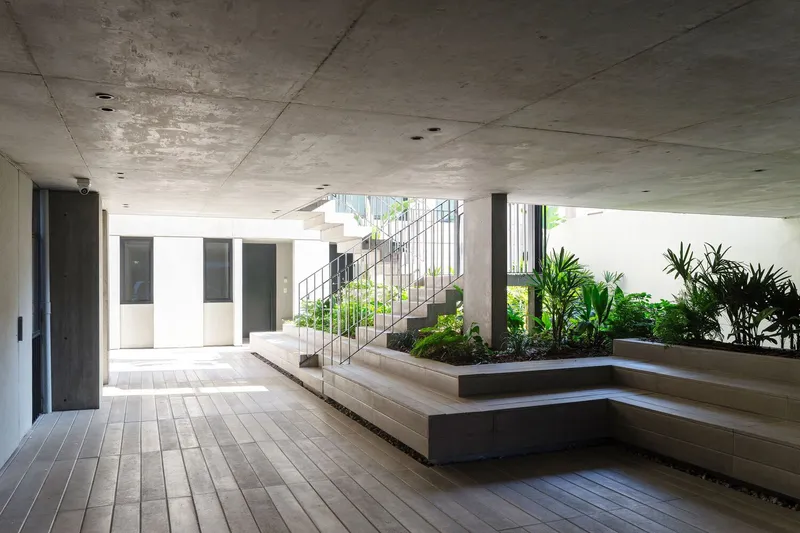
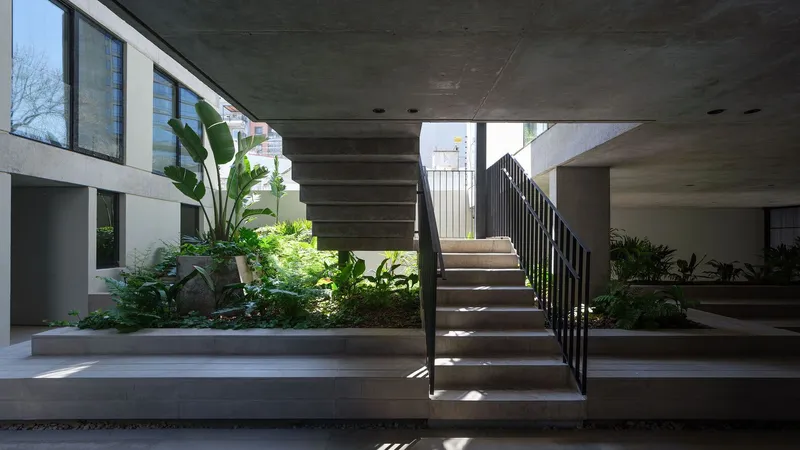
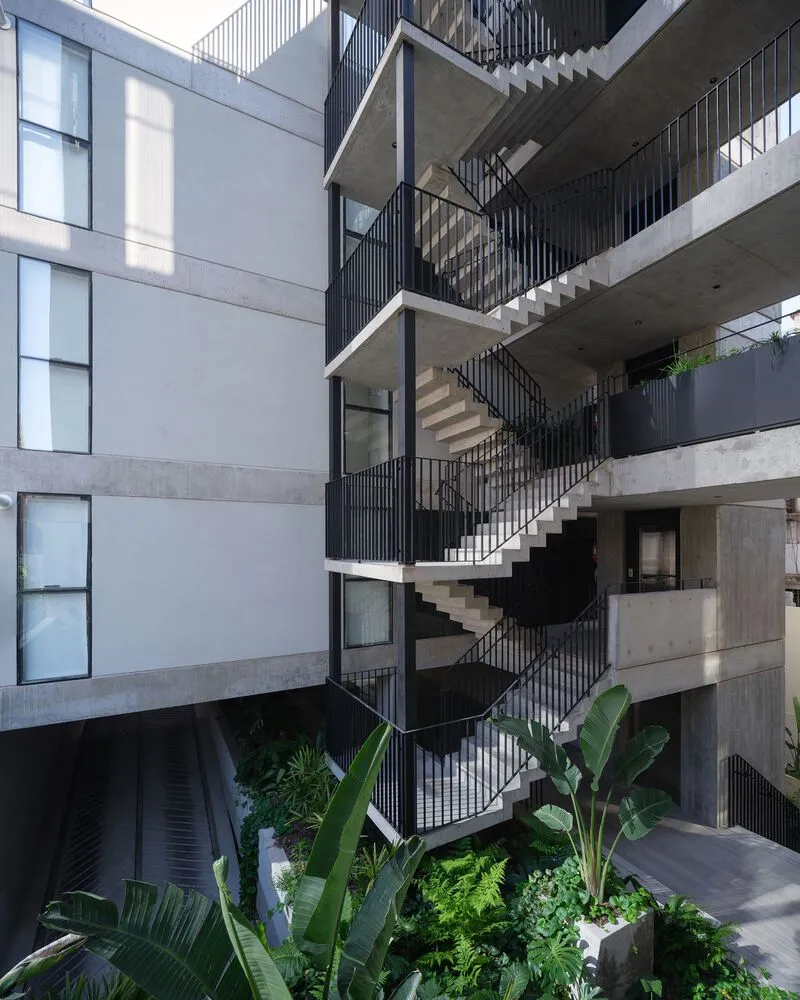
The central courtyard is the heart of the project, and it functions on multiple registers at once. At ground level, stepped timber flooring meets planted beds dense with tropical species, creating a threshold between the street and the private units that feels genuinely generous. Above, the same void is traced by the zigzagging concrete staircase, its black metal railings drawing clean diagonals against the exposed soffits. Light drops through the void at different angles throughout the day, keeping the vegetation healthy and making the stair landings surprisingly pleasant places to pause.
Israel & Teper have avoided the common trap of treating a courtyard as a light well with ambitions. The planting here is serious: large-scale banana palms and layered tropical species that require real soil depth and irrigation infrastructure. That commitment means the concrete planter boxes had to be designed as structure, not applied after the fact. The architecture and the landscape are genuinely co-dependent.
Circulation as Experience
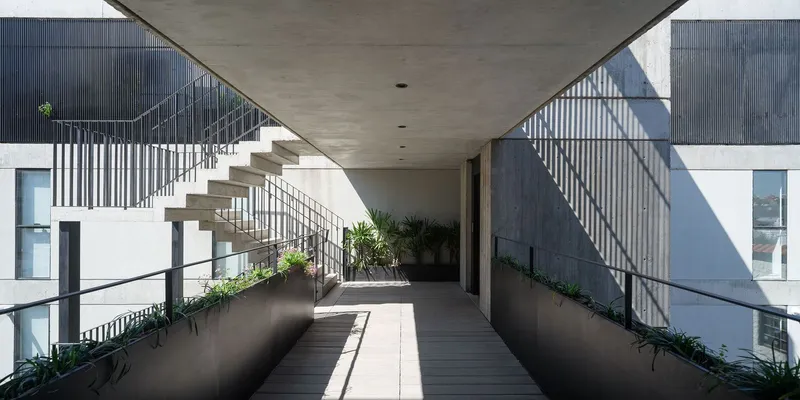
The corridors and stairways in Arrive Nuñez are too carefully considered to be called "service" spaces. Upper-level corridors feature concrete planter boxes built into the balustrade, so residents walk alongside greenery rather than past blank walls. Vertical steel railings cast sharp shadow patterns that shift with the sun, adding a graphic quality to otherwise utilitarian passages.
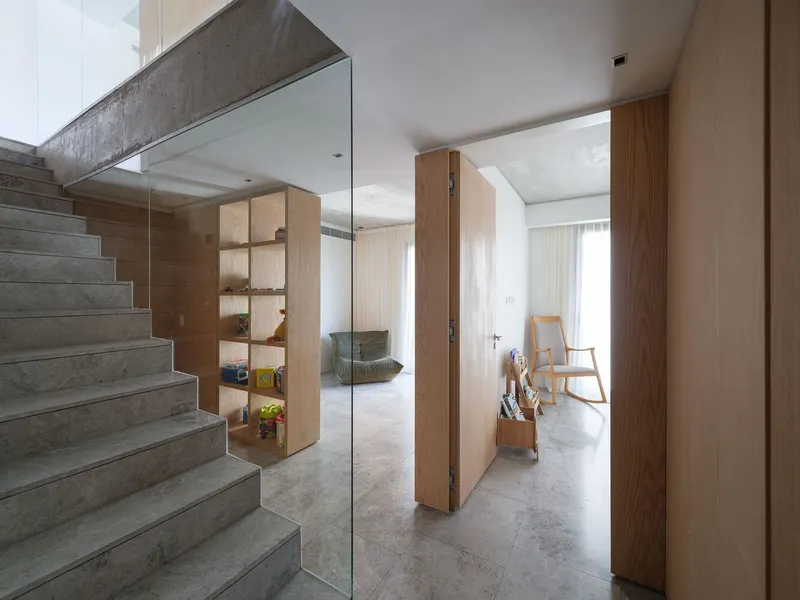
A concrete staircase flanked by a full-height timber display shelf turns a transitional moment into something closer to a gallery. The glass balustrade keeps the stair visually open to the courtyard below, reinforcing the sense that you are always moving through a garden, not adjacent to one. These are small moves, but they accumulate into a fundamentally different experience of getting home.
Interiors Built on Honest Materials
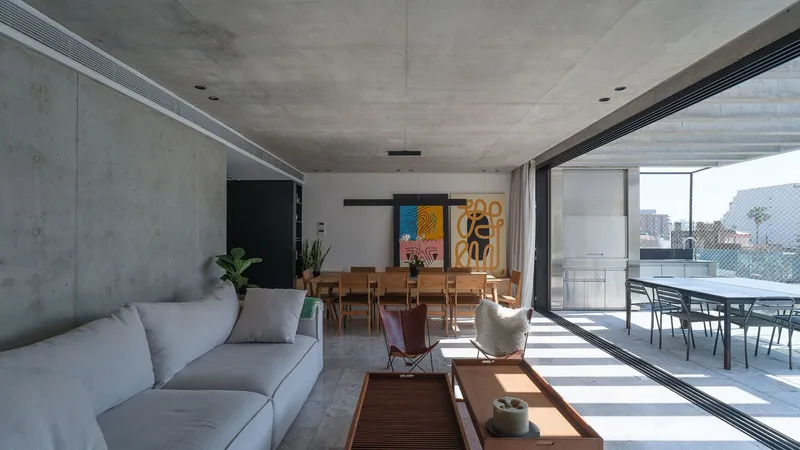
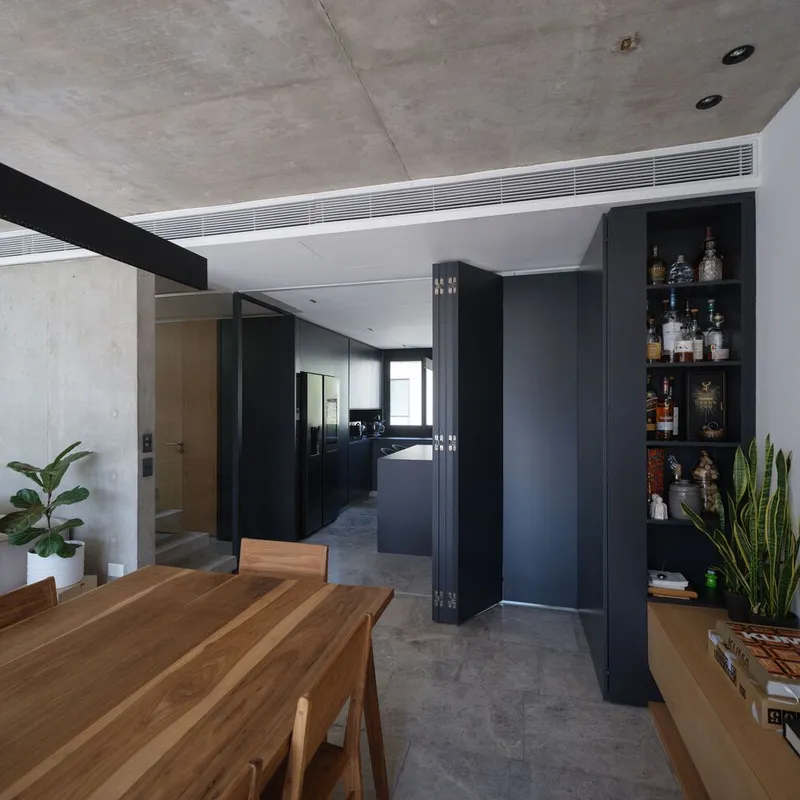
Inside the units, the material palette stays tight: exposed concrete ceilings, warm timber paneling, and full-height glass. The living spaces open through sliding doors to terraces and garden views, collapsing the boundary between inside and out. A dining area with black folding storage panels and recessed bottle shelving shows the kind of bespoke detailing that lifts the project above developer-grade finishes.
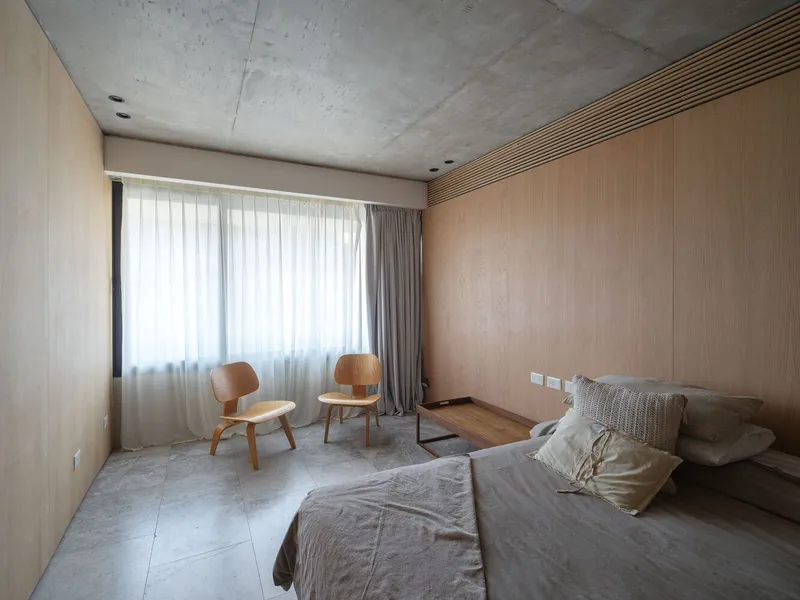
Bedrooms are quieter in character, with pale timber wall panels and sheer curtains filtering daylight into soft, diffused washes. The concrete ceiling remains visible overhead, connecting even the most private rooms to the building's structural logic. Nothing is concealed for the sake of comfort, but nothing is left raw for the sake of fashion either. It is a careful balance.
Thresholds of Light and Shadow
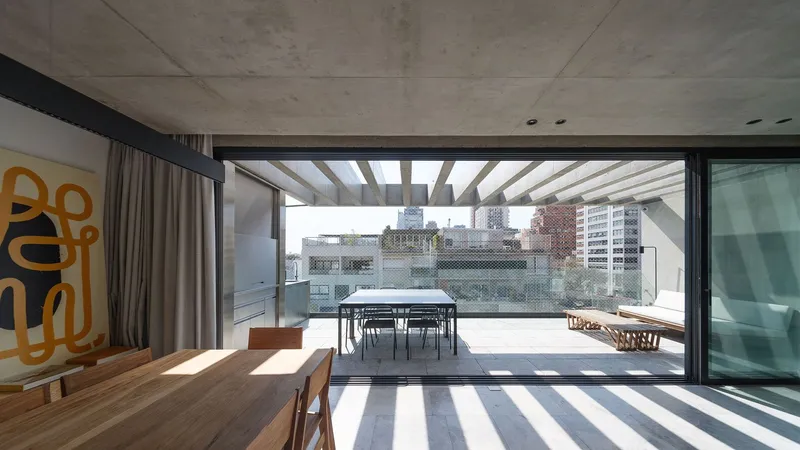
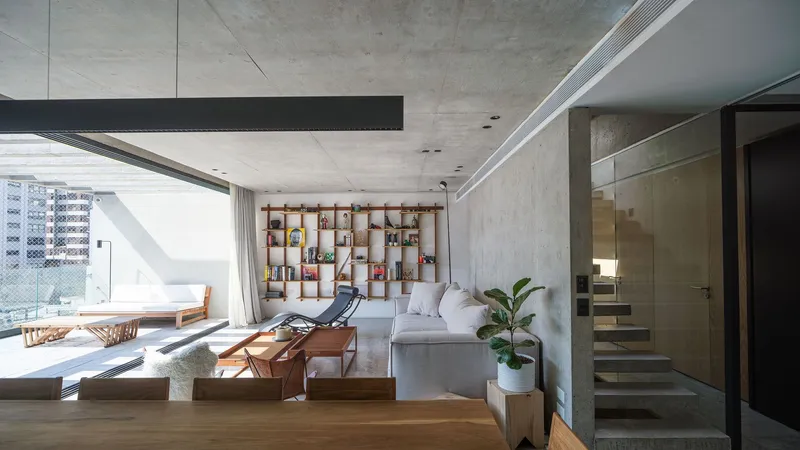
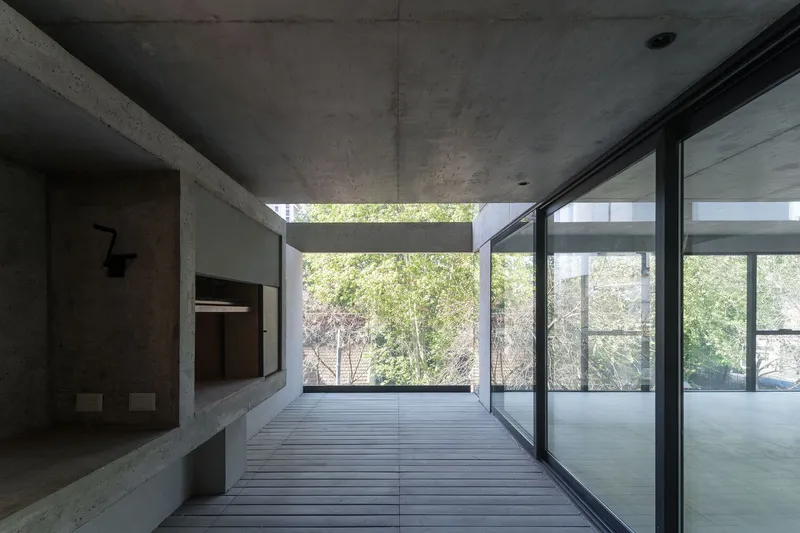
Some of the strongest moments in the project happen at the edges between inside and outside. Timber pergola beams cast striped shadows across interior floors through open terrace thresholds, turning sunlight into a material in its own right. Living rooms with bookshelf walls and daybeds on adjacent terraces blur the line between domestic space and outdoor room. These thresholds are not just doors that open; they are spatial gradients that shift the atmosphere as you move through them.
The architects seem to understand that in Buenos Aires, where the climate is mild enough to keep terraces usable for much of the year, the real luxury is not square meters but the quality of the transition between enclosed and open air. The glass walls framing garden vegetation from the interior decks make that point clearly: the view of something growing is part of the room.
A Rooftop That Earns Its View
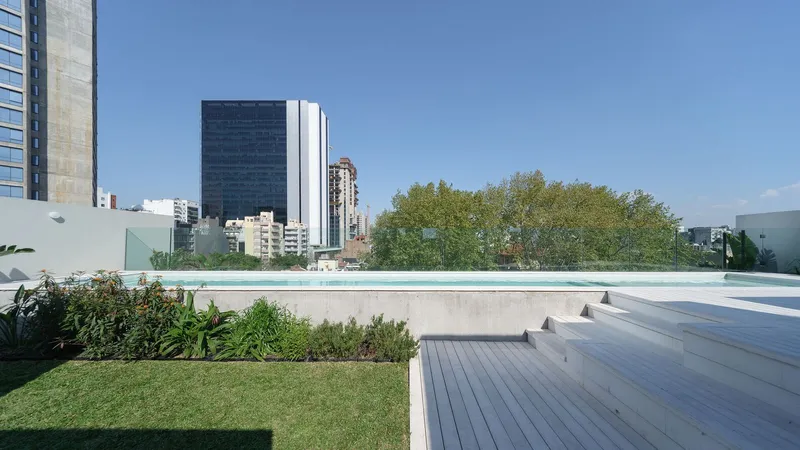
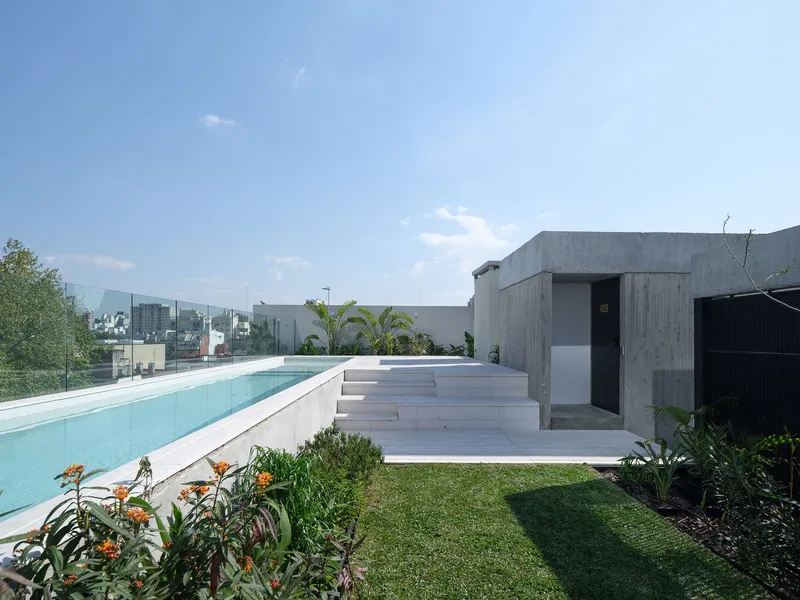
The rooftop terrace completes the building's vertical garden logic with a lap pool, concrete stepped seating, planted beds, and a lawn that overlooks the Buenos Aires skyline. A concrete service volume anchors one end, keeping mechanical systems out of sight without resorting to a screen wall. The stepped seating doubles as a social amphitheater, oriented toward the pool and the horizon.
It is a generous communal space, but what makes it work is its continuity with everything below. The planting, the concrete, the timber detailing: all of it reads as the same building, not a rooftop bar grafted on top. Israel & Teper have clearly thought about the roof as the final layer of a section, not as an amenity bolted to its lid.
Plans and Drawings
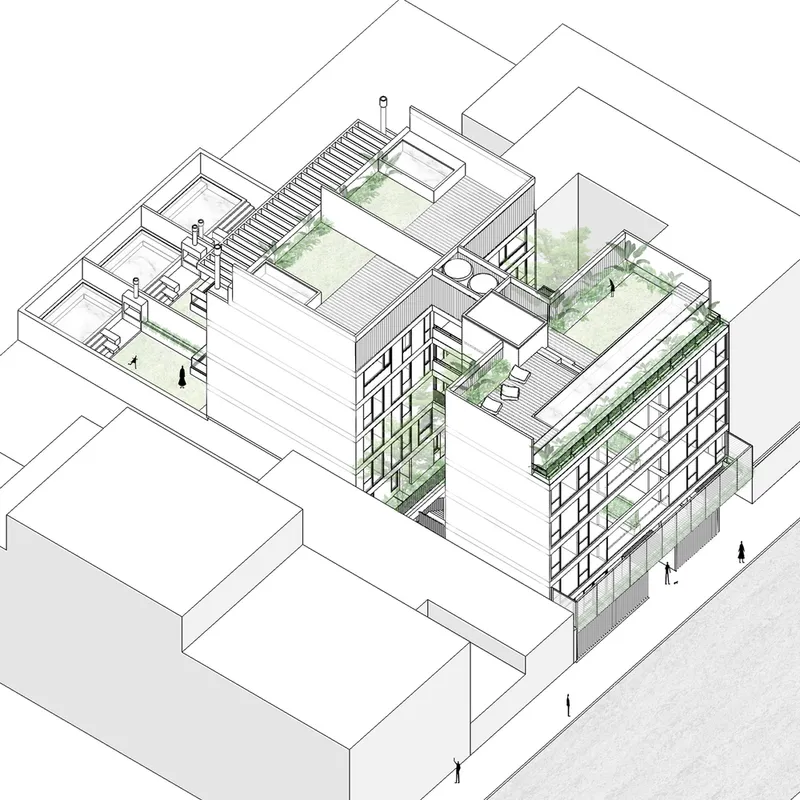
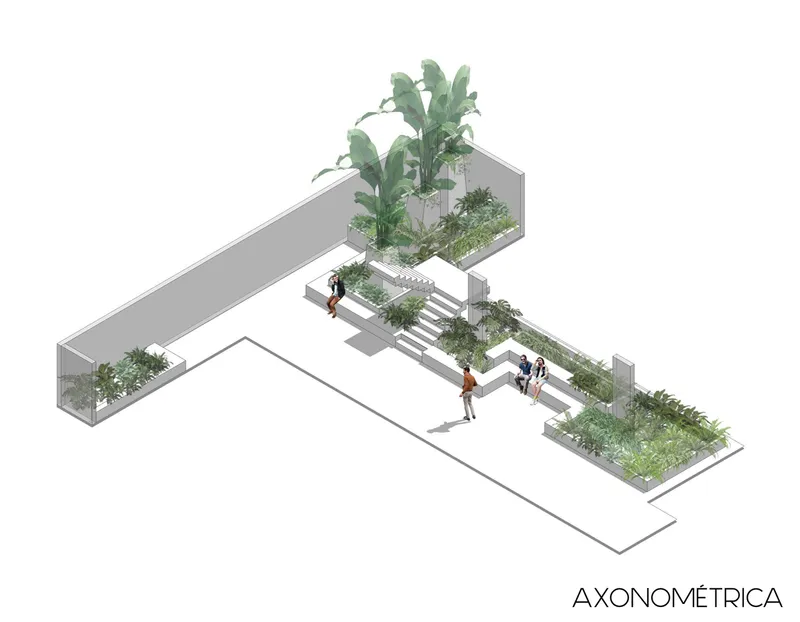
Two axonometric drawings reveal the organizational logic that photography alone cannot communicate. The first shows the full multi-story volume, with planted rooftop terraces and courtyard voids punched through the mass. The second zooms into the terraced courtyard itself, depicting the stepped levels, planted beds, and human figures moving through what is essentially a three-dimensional garden threaded into the building's bones. Together, they confirm that the greenery is not ornamental. It is foundational to the section, the structure, and the spatial sequence from street to sky.
Why This Project Matters
Residential architecture in dense Latin American cities faces a recurring problem: how to deliver privacy, light, and contact with nature on tight urban lots without retreating into gated introversion. Arrive Nuñez offers a persuasive answer by making the planted courtyard the organizing principle rather than the leftover space. Every decision, from the structural planter boxes to the zigzagging stair to the pergola shadows, follows from that commitment. The building does not just contain greenery; it is built around it.
Israel & Teper demonstrate that taking landscape seriously in a multi-unit project does not require a suburban footprint or an unlimited budget. It requires integrating planting into structure from day one, designing circulation as experience rather than corridor, and treating the threshold between inside and outside as the most important room in the building. For a city that could use more of all three, the project sets a standard worth studying.
Arrive Nuñez Apartments by Israel & Teper Arquitectos, Buenos Aires, Argentina. Photography by Javier Agustín Rojas.
About the Studio
Share Your Own Work on uni.xyz
If projects like this are the kind of work you want to make, uni.xyz is a place to publish your own, find collaborators, and enter design competitions.



Popular Articles
Popular articles from the community


Conexión: Biophilic Design Reimagines High-Rise Living in Hong Kong
Conexión reimagines high-rise living in Hong Kong through biophilic design, green facades, shared spaces, daylight, water and nature within.

Lunar Spiral: Space Architecture Shaped by the Mathematics of the Universe
Lunar Spiral reimagines space architecture through Fibonacci geometry, lunar regolith, levitating habitats, and self-sustaining Moon living.

The Musturak Paradise: Senior Living Architecture for a Connected Future in Temara, Morocco
The Musturak Paradise reimagines senior living architecture in Temara via private homes, social spaces, culture, community, and shared care.

Co-life: Sustainable Architecture for Age-Friendly Community Living
Co-life reimagines sustainable architecture for seniors through courtyards, rammed earth, shared gardens, and spaces designed for belonging.


Similar Reads
You might also enjoy these articles


Hodi-Mandai Geram
Project Function: Preservation and revitalization of the Intangible heritage and socio-spatial identity of the Hodi by Housing, Cultural Memory Center, Sacred Grove, landscape, local tourism economy


Olio Towers: A Mid-Rise for Performers That Fuses Housing, Rehearsal, and Stage
Located blocks from Houston's Theater District, this modular tower stacks living units around a central performance atrium.

Oasis: Modular Green Housing Carved into Dhaka's Urban Fabric
A shortlisted Plugin Housing entry reclaims unauthorized settlements in Dhaka with stepped concrete volumes, green roofs, and ventilation-driven design.

Black Hole: A Floating Megastructure for the Post-Physical Era
Emiliano Mazzarotto envisions a spherical, self-scaling arena where e-sports, digital hotels, and holographic stadiums replace traditional public space.


Explore Architecture Competitions
Discover active competitions in this discipline



Challenge to reimagine the Iron Throne


Photograph architecture without architects


Illustrate the lost glory of Angkor Wat - Render Challenge


Design challenge to reuse E-waste
Comments (0)
Please login or sign up to add comments
No comments yet. Be the first to comment!