
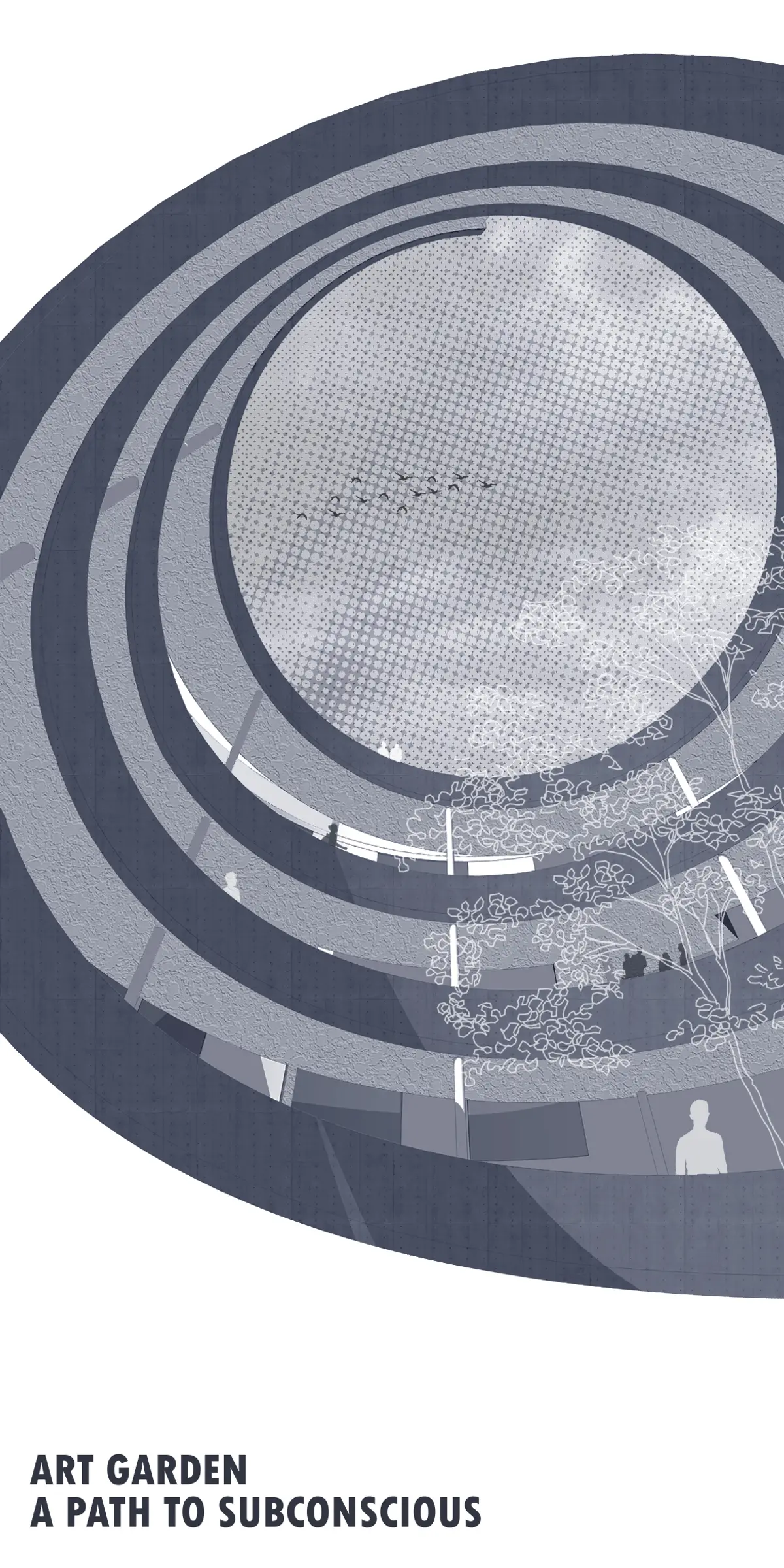
A path to subconscious
subconscious_"concerning the part of the mind of which one is not fully aware but which influences one's actions and feelings". An art institute designed to stimulate subconscious thoughts and emotions.

The conceptualization of the project followed the research of the topic of the competition and the characteristics of the subject area. The city of Chicago is known for its rich culture and tradition. I orientated the creative process through the design objectives.
My understandings of the five pillars of the art institute are:
Purpose - the human body exists in the physical domain and experiences it through its five senses - sight, hearing, taste, smell and touch. If one of these senses took precedence over the other, we would be shown a distorted or partially distorted perception of the world. The newly designed art institute should strive to stimulate as many senses as possible in order to better provoke users.
Multifunctionality - the house is both unique and complex, made up of memories and experiences. Its different parts evoke different sensations, but still bring an intimate experience of living. Therefore, the premises inside the art institute should be multifunctional and free for anyone to use. Multifunctional rooms should promote user interactivity in order to create different memories and experiences.
Balance / harmony (two principles integrated into one) - human nature tends to interpret an object as an analogue of the human body or vice versa. The balance between architecture and man should be established through a harmonious organization of content and space.
Context - the connection between the observer and the artist. Contextualization of the project occurs after recognizing the immediate environment of the subject area, analyzing and striving to create something striking.
The Art Institute is designed to be a synthesis of the above principles.
The starting point in the design process of the institute was burying the object in the ground. I believe that this procedure stimulates as many different senses as possible and creates identification in the project. Also, the buried art institute would contrast with the panorama of the city of Chicago, which is specific for tall skyscrapers. So, instead of the newly designed art institute being a classic multi-storey building, the main creative stamp will be sinking below ground level.
The ground floor solution is organized around the main opening in the country within which the spiral ramp is positioned. Based on the concentric circles described around the main opening, a disposition of lanterns was created, which will provide zenithal lighting to the lower levels. Green areas are organized around lanterns. Artificial hills are connected to lanterns and integrated into greenery. All elements are thoughtfully positioned to create an art garden together. The ground floor solution is an interactive common space within which people can move freely and create their own perception of the environment.
The first level below ground level is a space for exhibiting students' artwork. It is designed in the same manner as the previous level. It is permeated by partition walls of amorphous forms that provide various possibilities for exhibiting works of art.
The second level below ground level is the workspace for students. It is intended only for the work of students, thus creating a sense of privacy. It is purposefully multifunctional and intended for use by all students and the various arts they practice.
The last level contains an amphitheater with accompanying facilities. The entire floor is cascaded vertically to meet the requirements of the amphitheater. It stretches from -12.00 to -15.00 meters below ground level. In the first segment, there are offices and a conference hall that should serve the administration of the institute. In the second segment there is an amphitheater. Behind the art stage, there are technical rooms intended for the needs of students who deal with performance arts and theatrics.
The whole building is lit by a combination of natural and artificial light. Natural light is established through lanterns and gallery space that is provided on all three levels. Inside the gallery is positioned a fast vertical communication that would also serve as a fire exit. The emphasis of the project is placed on the spiral ramp which is the main entrance to the building. The spiral represents the connection between all three levels. The constant decline forces users to move, thus stimulating the senses and creating their own perception of space. Careful organization of the content within the institute fulfills all the conditions of the area program.
The goal of the design is to create a unique and exciting journey through the institute for artists, audiences and visitors. The project is specific to common social spaces that are designed to support interaction between students and the general public.

Popular Articles
Popular articles from the community

Extended Shell: Retrofitting Kolkata's Balconies as Living Urban Thresholds
A modular retrofit system recovers the social and environmental intelligence of Kolkata's historic verandas for contemporary Park Street residents.

Manzana Morphosis: Stretching Barcelona's Grid into a Living Landscape for 2050
A radical reworking of the Eixample manzana turns density into a tool for generous public space, vertical ecology, and environmental performance.

Temporary Home for Dogs: A Reversed Zoo Rethinks Animal Shelter Architecture
In Bucharest, a sinuous corridor and freed landscape flip the logic of containment, designing a shelter that works to make itself unnecessary.

The Amber Palace Opera: A Geological Fiction Surfaces on Tallinn's Baltic Waterfront
Pierre Brillard reimagines a Baltic legend as a public landscape, opera house, and waterfront promenade rooted in Tallinn's coastal identity.

Similar Reads
You might also enjoy these articles

Day and Night Park: A Time-Based Urban Newsstand in Beijing
A temporary urban newsstand in Beijing blending travel, light, and reading through poetic colors, compact form, and community-focused design.

Modernist Patio Renovation in El Masnou, Barcelona by Oliver Segura Arquitectura + Cebrià Arquitectura
Modernist patio renovation blending tradition and innovation with a movable pool, leveled floors, and Catalan materials in El Masnou.

Alto Residencial Coop: Cooperative Housing Development in Santiago de Compostela by Carbajo Barrios Arquitectos
A linear cooperative housing complex blending white volumes and perforated metal façades, enhancing community living, natural light, privacy, and urban integration.
Vil Genis School by BPA ARCHITECTURE – Massy, France
Vil Genis School in Massy, France, features sustainable design, south-facing classrooms, community integration, accessible spaces, and modern educational architecture.

Explore Urban Planning Competitions
Discover active competitions in this discipline


Challenge to reimagine the Iron Throne

Photograph architecture without architects

Illustrate the lost glory of Angkor Wat - Render Challenge

Design challenge to reuse E-waste
Comments (0)
Please login or sign up to add comments
No comments yet. Be the first to comment!