
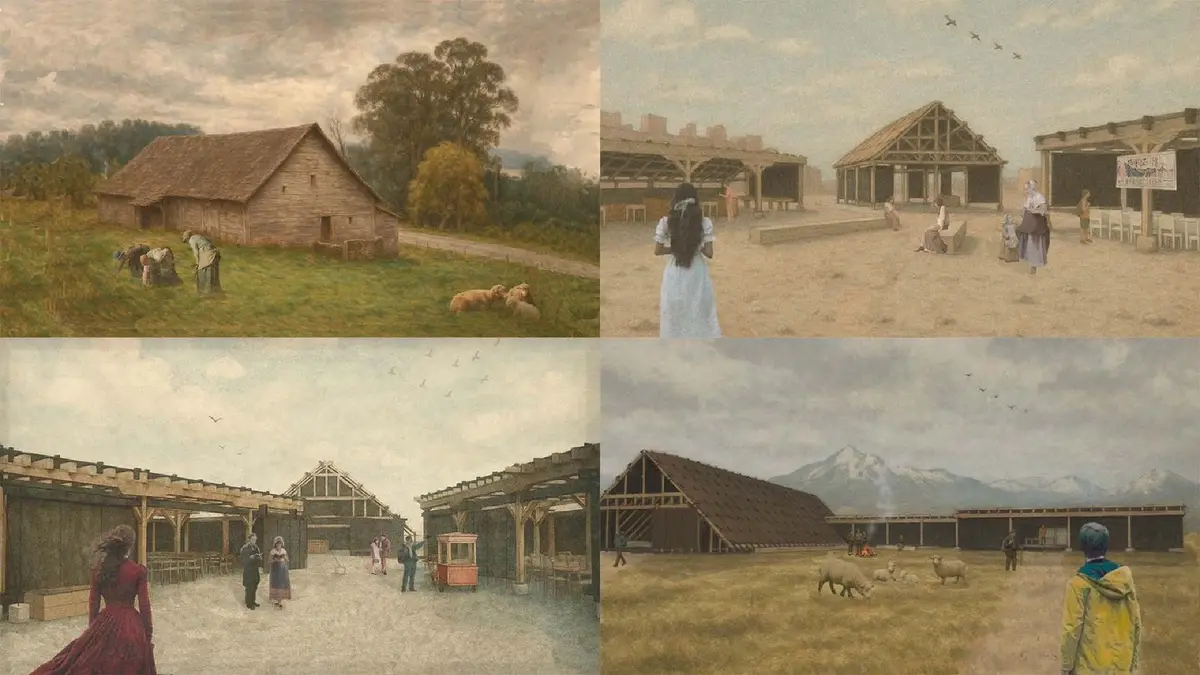
Assembling the Ruin: Toward a Recyclable Architecture
Thoughts and methodologies

Why produce new architecture when vast amounts of it already exist—abandoned, dismantled, or awaiting obsolescence? This project begins not with form, but with a question of process: what if architecture were understood not as a finished object, but as a reversible system of parts?
The research unfolds through three intertwined operations—disassembling, ordering, and assembling—understood not only as construction techniques but as cognitive tools. To disassemble is to understand. Like the photographic work of Todd McLellan or the anatomical drawings of Vesalius, taking things apart reveals an embedded intelligence: a logic of relations, sequences, and dependencies. In architecture, this act exposes a crucial shift—form is no longer fixed, but contingent on how parts come together.
This thinking resonates with authors such as Tim Ingold and John Frazer, who describe making not as imposing form onto matter, but as a process of correspondence and evolution. Similarly, generative design reframes architecture as a system of rules rather than a singular outcome. From this perspective, dismantling is not an end, but an opening: a moment where form becomes available for reconfiguration.
The project situates itself in the south of Chile, focusing on 19th-century timber barns around Lake Llanquihue. Built by German settlers using sophisticated joinery systems without nails, these structures once played a central role in agricultural life. Today, they stand as rural ruins—disused, deteriorating, yet materially intact. Rather than preserving them as static heritage, the project proposes a shift: to understand them as repositories of parts.
Here, the notion of ruin is reconsidered. Following ideas by Sou Fujimoto and Rem Koolhaas, the ruin is not simply decay, but a threshold between past and future. It holds narrative, memory, and latent potential. Instead of restoring these barns to their original state, the project disassembles them—physically and conceptually—transforming their components into a new architectural vocabulary.
Through processes of cataloguing, measuring, and coding each element, the barn becomes a dataset. Pieces are no longer tied to a single configuration but gain agency within a broader system. This echoes the open-source logic of Enzo Mari’s furniture or the participatory frameworks of WikiHouse, where design is not a closed object but a shared, adaptable protocol.
The result is a series of cultural artefacts—temporary, transportable structures assembled from reclaimed timber components. These artefacts are not designed as fixed buildings, but as devices: systems capable of adapting to different contexts and programs. Their deployment across Chilean “cultural capitals” (Antofagasta, Valparaíso, Puerto Natales) tests their capacity to engage with diverse landscapes and identities—mining, academia, gastronomy.
In each case, the architecture does not impose itself but negotiates with its surroundings. It “embraces rather than intervenes,” allowing existing contexts to remain legible while introducing new spatial possibilities. The project thus operates between preservation and transformation, avoiding both nostalgic conservation and total erasure.
Ultimately, this work proposes a shift in how we understand architectural value. Heritage is no longer located in the intact object, but in the intelligence of its parts—their capacity to be reused, reassembled, and reinterpreted over time. Architecture becomes less about permanence and more about continuity: a living system that evolves through cycles of disassembly and reconstruction.
In this sense, the project does not seek to design a final form, but to establish a method—one that enables architecture to persist not by resisting change, but by embracing it.

Popular Articles
Popular articles from the community


Aquadapt: An Underwater Habitat That Rewrites Its Rooms by the Hour
Curved modules ring the seabed while one shell shifts from breakfast room to cinema, farm and football pitch as residents' needs change.


graciastudio Turns a Viewless Tijuana Lot Inward Around a Courtyard of Concrete, Timber and Trees
In Tijuana, Jorge Gracia's GA2 House stacks a timber-clad private floor over exposed concrete and replaces a missing view with a planted interior patio.

Singing Woman: An Opera House That Performs Before the Curtain Rises
Ovidiu Cristian Pavel's conceptual opera house translates Estonia's choral identity into a sculpted waterfront landmark facing the Baltic Sea.

Opera on the Sea: Driftwood Logic Shapes a Timber Opera House on Estonia's Coast
Trevor Orgill's opera house translates the entangled drift of floating timber into a civic building where wood, water, and music converge.

Similar Reads
You might also enjoy these articles

Vereda Arquitetos Renovates a 40-Square-Meter Apartment Inside Niemeyer's Copan Building
A compact unit in São Paulo's most iconic residential tower gets a material overhaul that pairs exposed concrete with bold blue Formica.

Shakur's House: Exposed Brick as an Interior Organiser in a 168 m² Mashhad Residence
Brick moves indoors in this Mashhad residence, where masonry walls, glass partitions and teal planes sequence a compact home without closing it off.

Day and Night Park: A Time-Based Urban Newsstand in Beijing
A temporary urban newsstand in Beijing blending travel, light, and reading through poetic colors, compact form, and community-focused design.

Modernist Patio Renovation in El Masnou, Barcelona by Oliver Segura Arquitectura + Cebrià Arquitectura
Modernist patio renovation blending tradition and innovation with a movable pool, leveled floors, and Catalan materials in El Masnou.

Explore Architectural Assemblage Competitions
Discover active competitions in this discipline


Challenge to reimagine the Iron Throne

Photograph architecture without architects

Illustrate the lost glory of Angkor Wat - Render Challenge

Design challenge to reuse E-waste
Comments (0)
Please login or sign up to add comments
No comments yet. Be the first to comment!