
Atelier A Converts a 29-Square-Meter Shanghai Electrical Room into a Cult Burger Joint
At the crossroads of Yanqing Road and Changshu Road, a derelict utility building becomes one of Shanghai's most talked-about takeaway spots.

There is a particular courage in doing almost nothing. In a city where restaurant interiors compete for attention through ever more elaborate scenography, Atelier A walked into a battered former electrical room at the corner of Yanqing Road and Changshu Road in Shanghai and decided, essentially, to leave it alone. Cheers Burger, the takeaway-only burger spot that emerged from this decision, occupies less than 30 square meters. It has no indoor seating. It barely has a sign. And yet it became one of the most talked-about food destinations in the city.
What makes this project worth studying is not its program, which is functionally simple, but its posture toward the existing building. Lead architect Yanwen Zhu treated the weathered concrete walls, the old door frames, and the battered facade as assets rather than liabilities. The design strategy is one of surgical repair and selective revelation: patch the damaged wall with raked concrete, strip away later additions to expose original tile, reopen a blocked window. The result feels less like a renovation and more like an excavation, a building allowed to show its own history without apology.
Before and During: Reading the Ruin
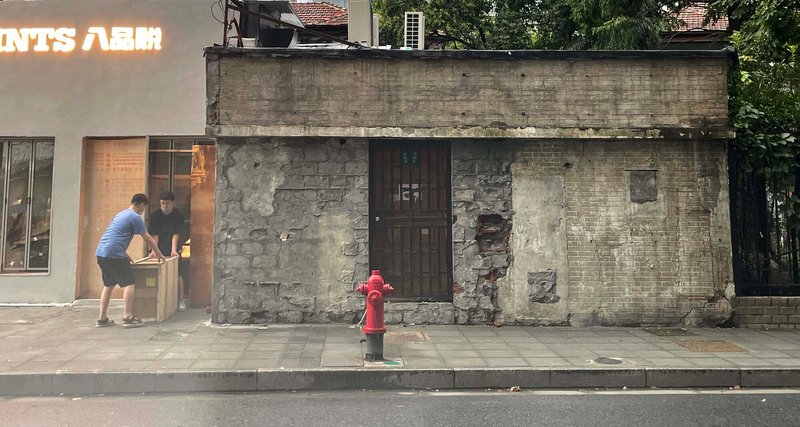
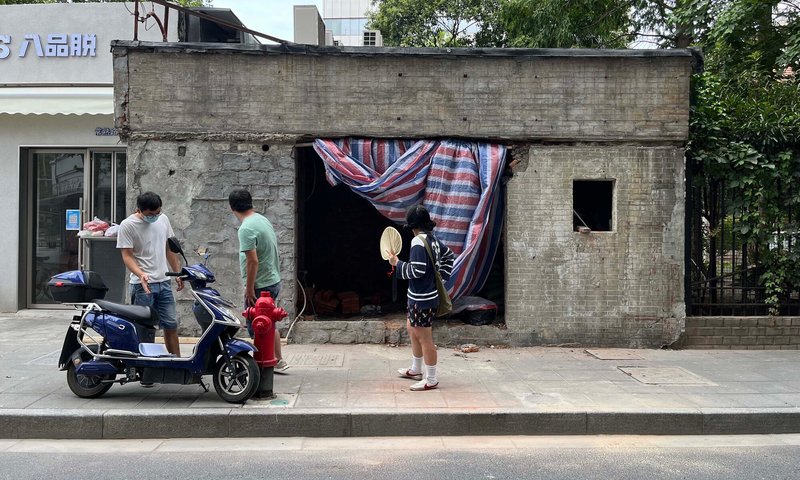
The before photographs tell a familiar story of urban dereliction in Shanghai's older neighborhoods. A squat concrete structure with boarded-up windows, a striped curtain covering the only opening, pedestrians drifting past without a second glance. During the pandemic, many independent restaurants and boutiques in this area had closed, and this corner building, possibly a former electrical room, had been left to accumulate grime and indifference.
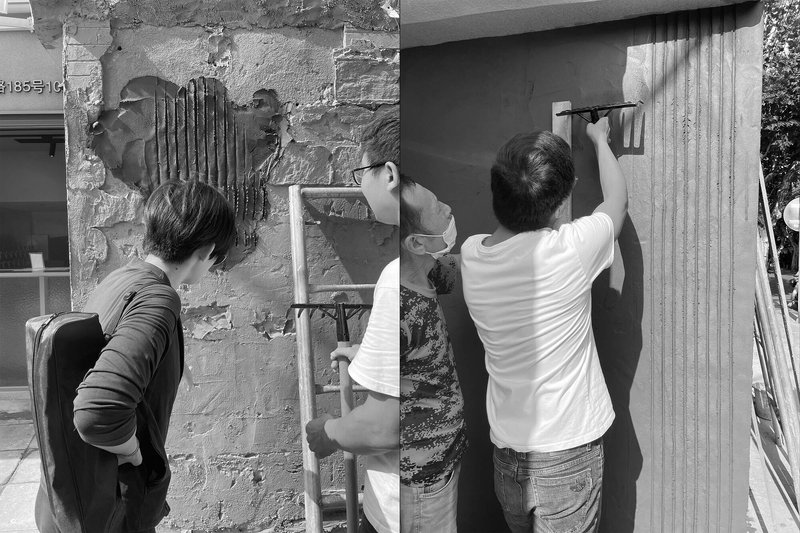
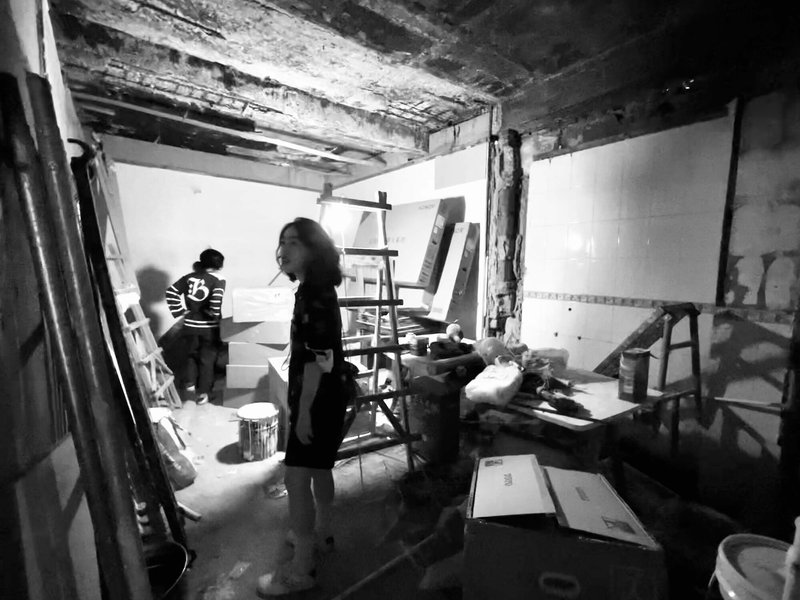
The construction images reveal the careful forensic work that preceded any design decisions. Workers repair exposed brick, install corrugated metal panels where structural reinforcement is needed, and strip interior surfaces back to timber ceiling beams. The renovation reinforced the existing door rather than replacing it. Every move reads as a negotiation with the building's actual condition rather than an imposition of a predetermined aesthetic.
The Facade as Found Object
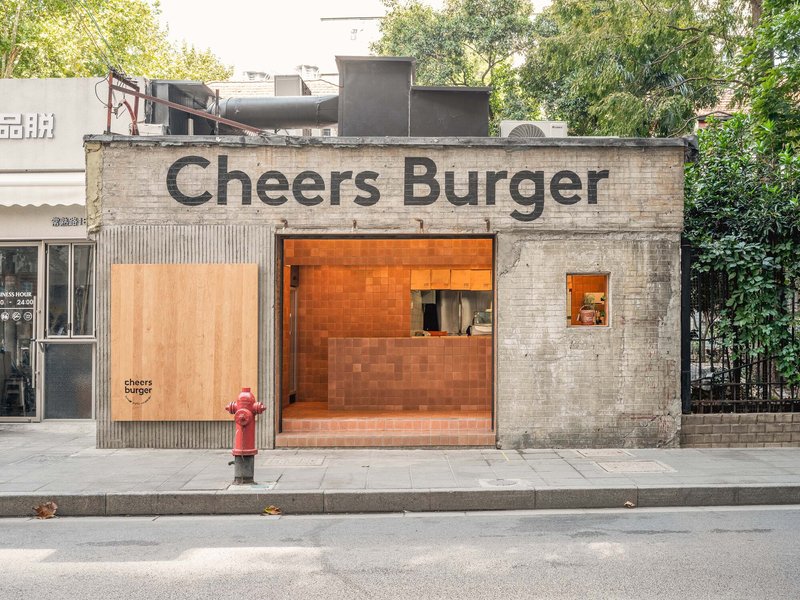
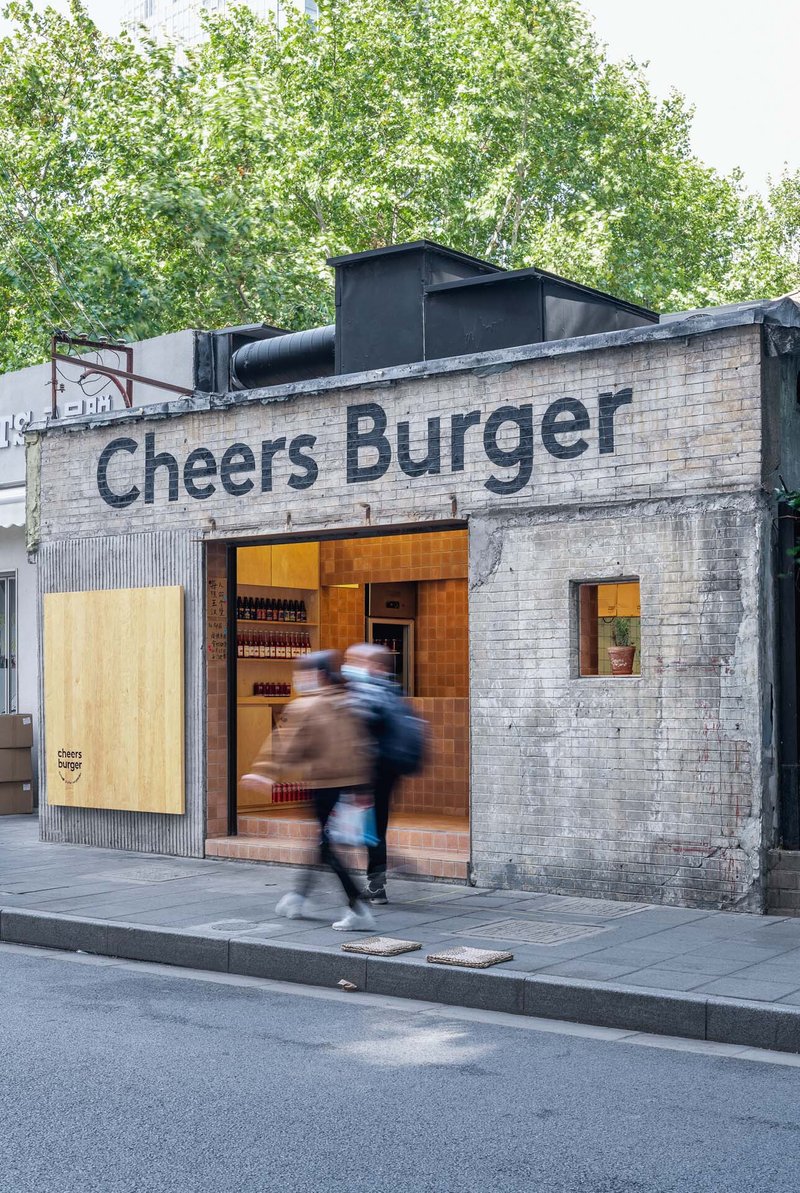
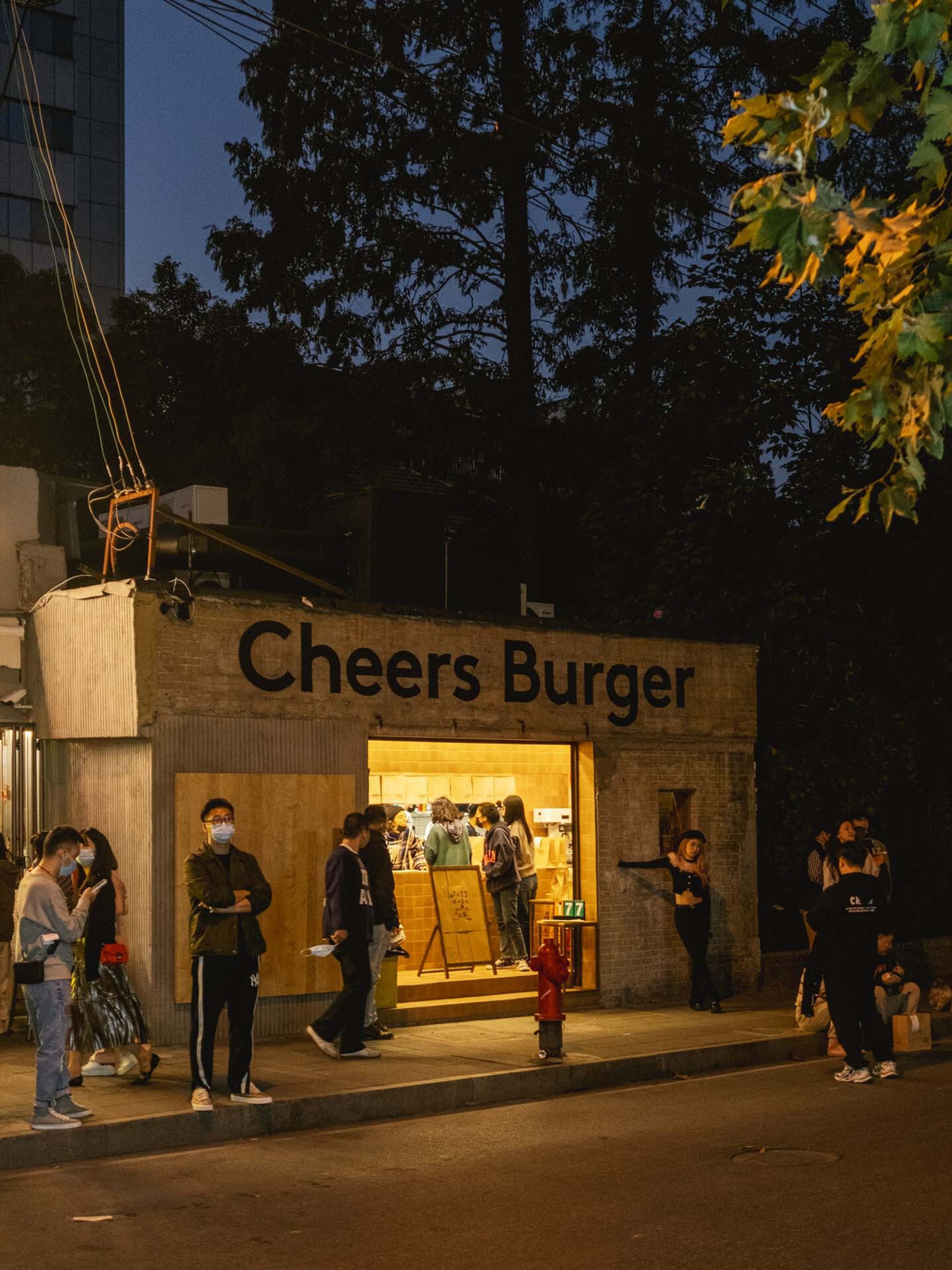
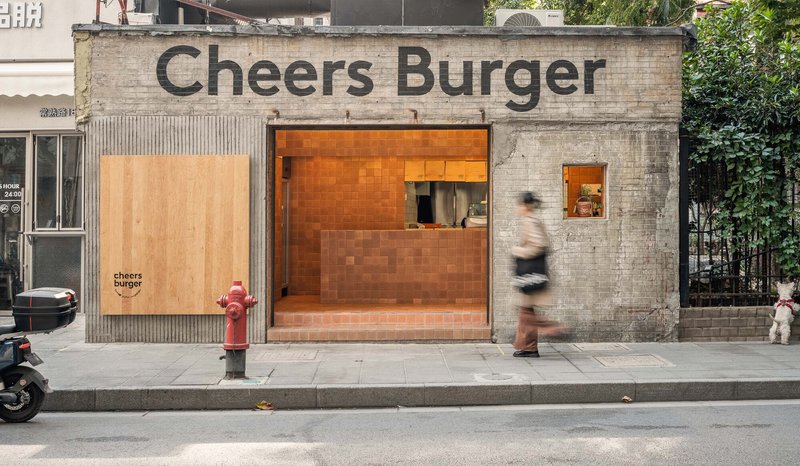
The street-facing elevation is the project's strongest statement, and it is a statement about restraint. The damaged left wall was repaired with concrete scored with vertical rake lines, creating a textured surface that reads as deliberately raw without pretending to be original. Next to it, the terracotta-tiled entrance provides a warm threshold, and a plywood panel serves as an unadorned menu board. A red fire hydrant anchors the composition with an almost comic punctuation.
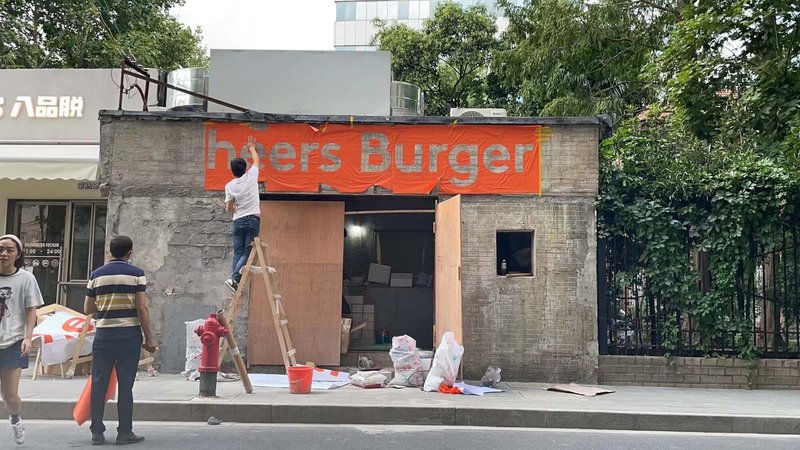
When workers installed the orange signage, they used a ladder propped against the concrete blocks. The image of that installation captures the spirit of the whole project: modest means, direct action, no scaffolding of pretense. Underneath the green tiles that had been applied in a previous life, the team discovered original beige tiles, a small archaeological reward that reinforced Atelier A's instinct to subtract rather than add.
Terracotta and Fluorescent Light
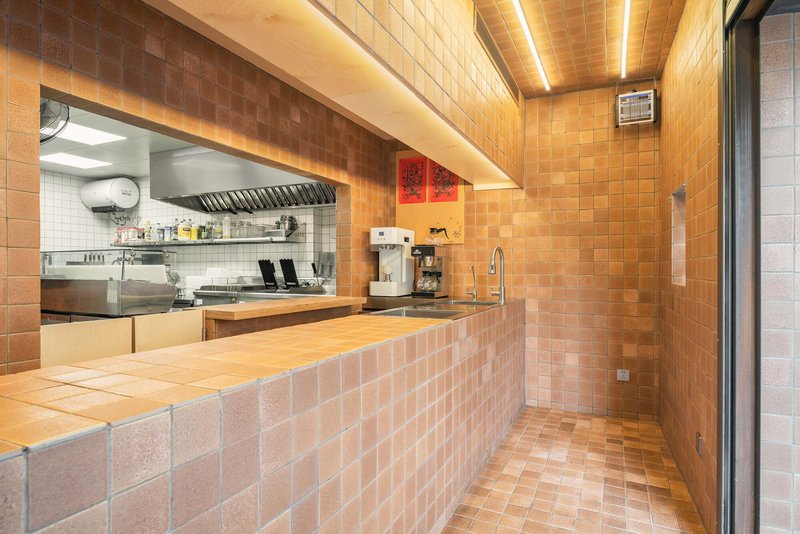
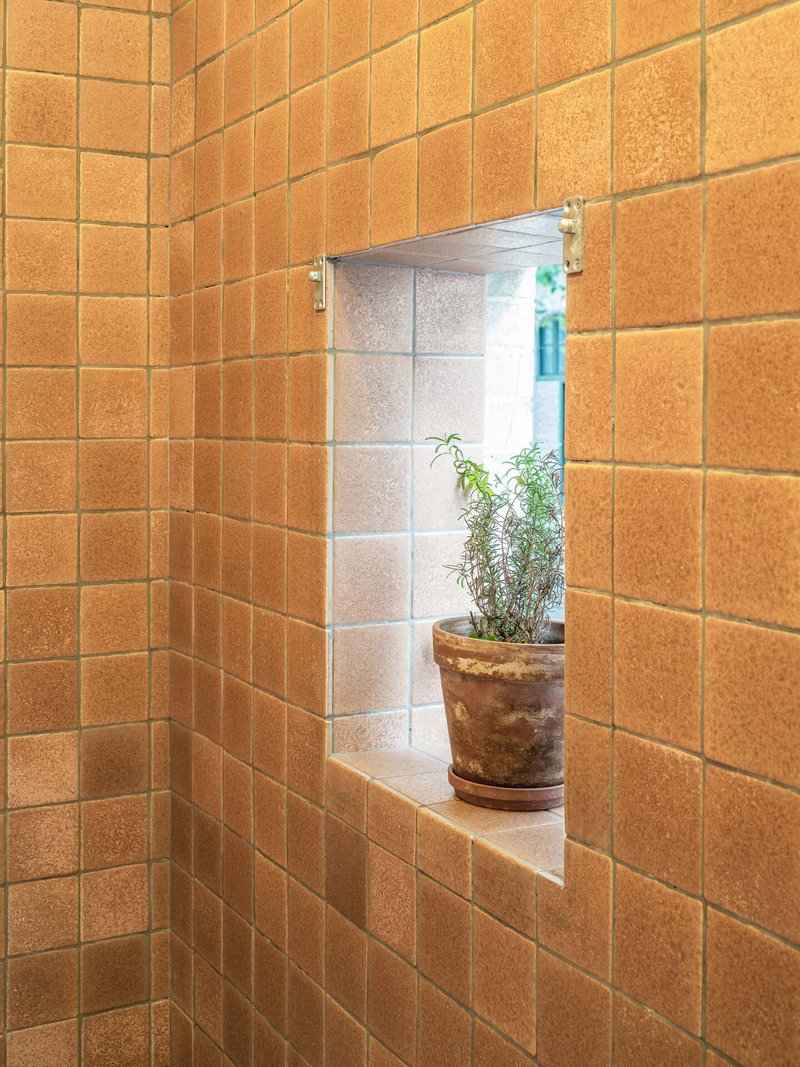
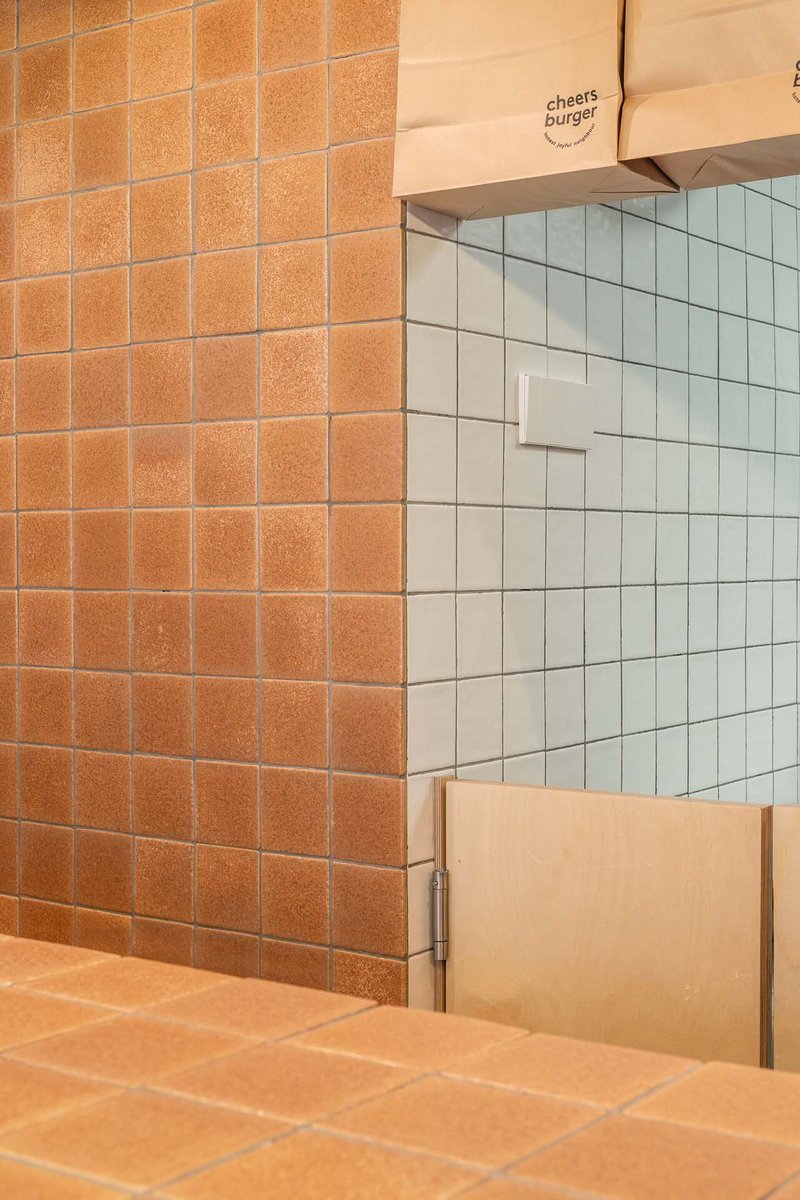
Inside, the material palette narrows to a conversation between two elements: handmade auburn tiles and fluorescent tube lighting. The tiles wrap the service counter, climb the walls, and frame small niches where a potted plant or a paper towel dispenser sits with equal composure. The glazed surface catches the cool white light of the fluorescent tubes overhead, creating a warm glow that, at dusk, spills out onto the sidewalk and draws people in.
The junction of orange and pale green tiled walls is a detail worth pausing on. It reveals that the interior surfaces were not uniformly refinished. Existing finishes were kept where they survived, and the new auburn tiles were introduced where function demanded them, around the counter, behind the sinks. The effect is a patchwork that feels honest rather than designed, each surface testifying to a different moment in the building's life.
A Kitchen Behind Glass
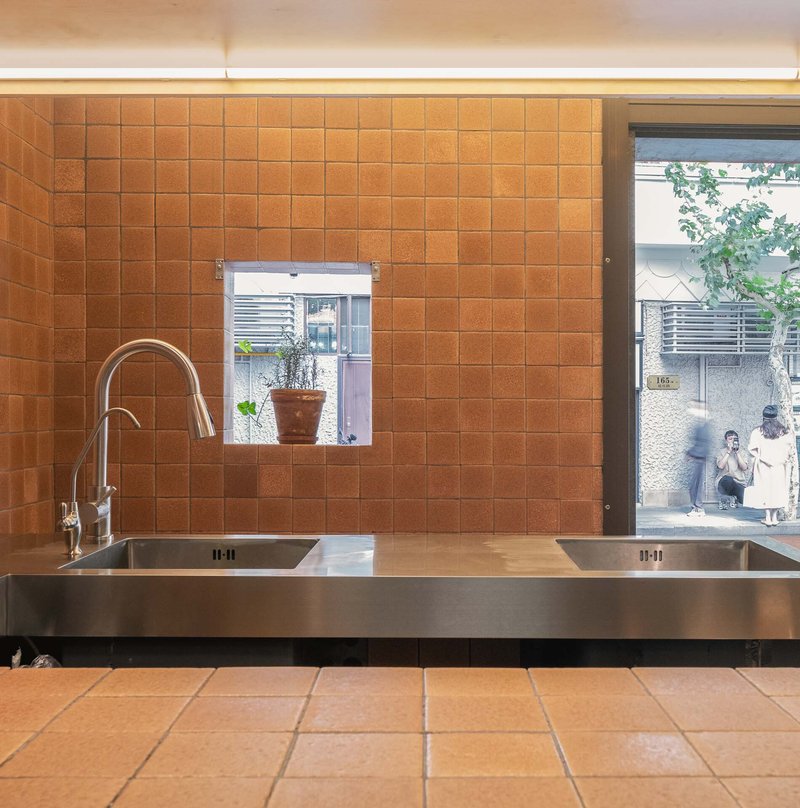
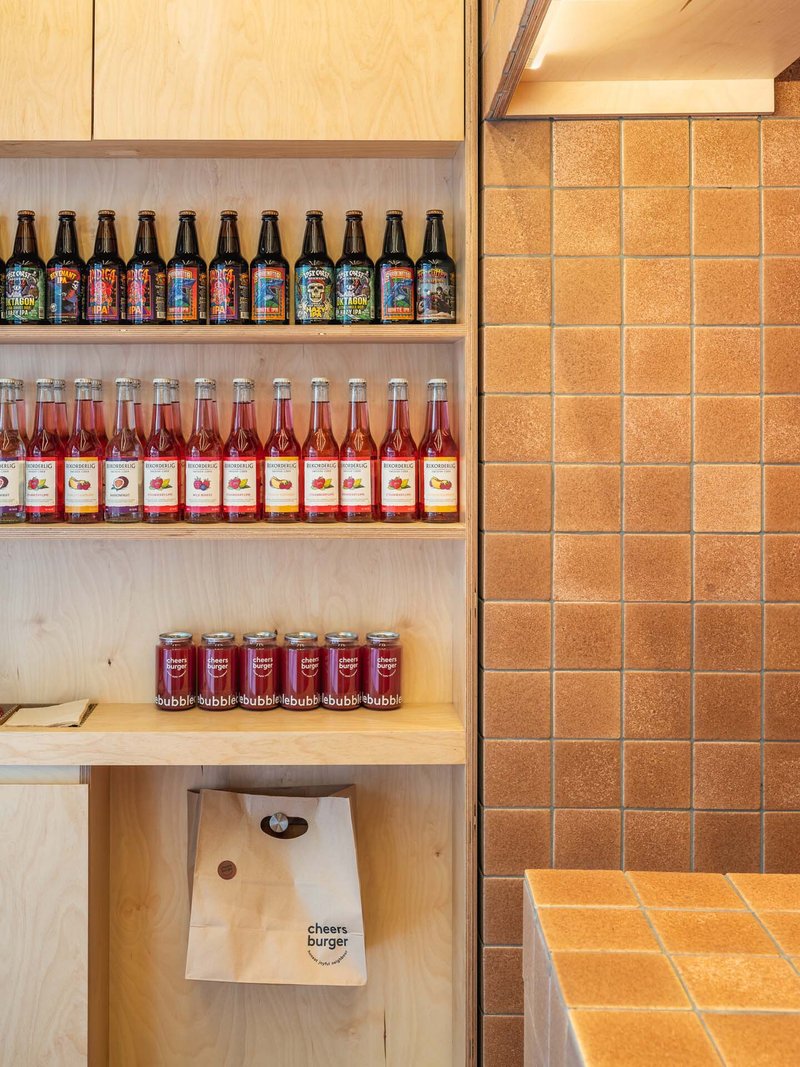
With no space for seating, the entire interior functions as a production line visible through the storefront opening. The stainless steel counter with dual sinks, the open plywood shelving stacked with bottled drinks and takeaway bags, the kitchen beyond: all of it is on display. The previously blocked window was reopened during renovation, and it now serves a dual purpose, bringing daylight into a space that would otherwise feel like a cave and offering passersby a lateral glimpse into the operation.
Plywood cupboards provide storage without ceremony. The material is left unfinished, its grain and edge layers exposed, establishing a visual kinship with the raked concrete outside. There is no attempt to conceal the mechanics of a burger operation. What you see through the glass is exactly what happens: orders taken, burgers assembled, bags handed across the counter.
The Corner and the Vine
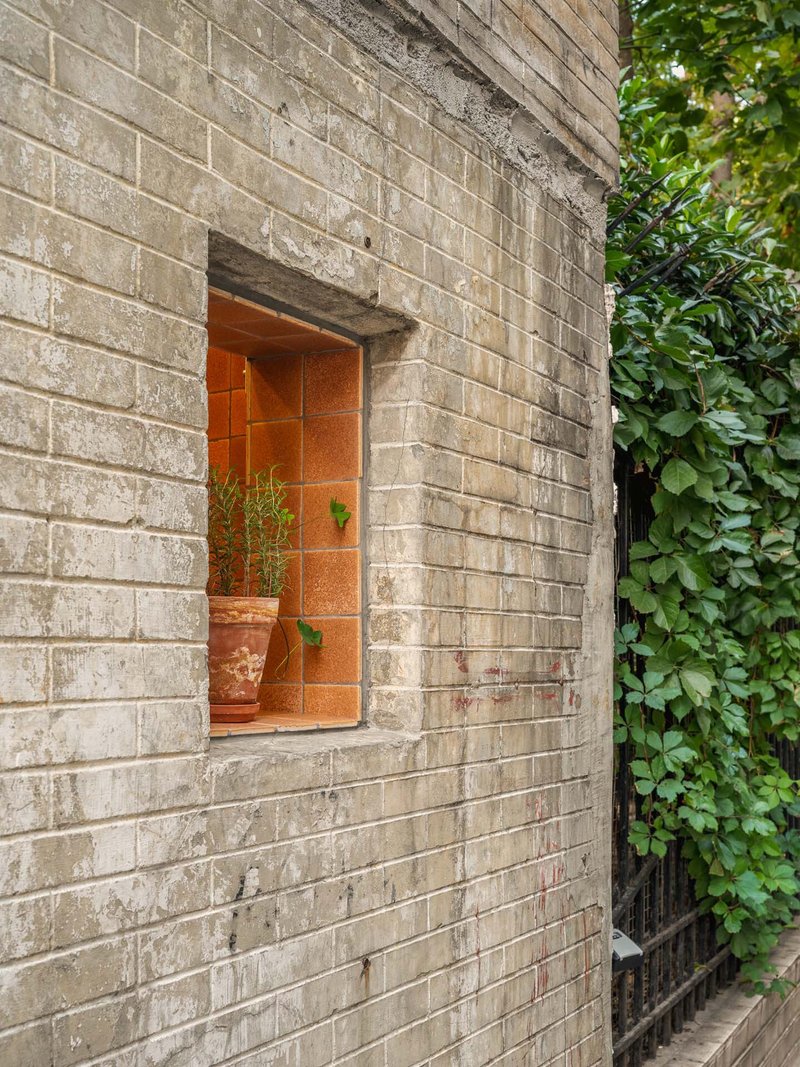
A small window opening, framed in weathered concrete block, holds a potted plant while climbing vines begin to colonize the edges of the facade. It is a detail that speaks to the passage of time Atelier A is comfortable with. The building is not preserved in amber. It is a living surface that will continue to age, that will be marked by weather and use, and that gains character from that process rather than losing it.
The interior renovation photograph, with its exposed timber ceiling beams and scattered construction materials, is a useful counterpoint. It reminds us that the rough charm of the finished project is not accidental. Considerable labor went into achieving this precise degree of imperfection, reinforcing doors, repairing brickwork, selectively stripping surfaces. The line between preservation and neglect is thin, and walking it requires a confidence that Yanwen Zhu clearly possesses.
Plans and Drawings
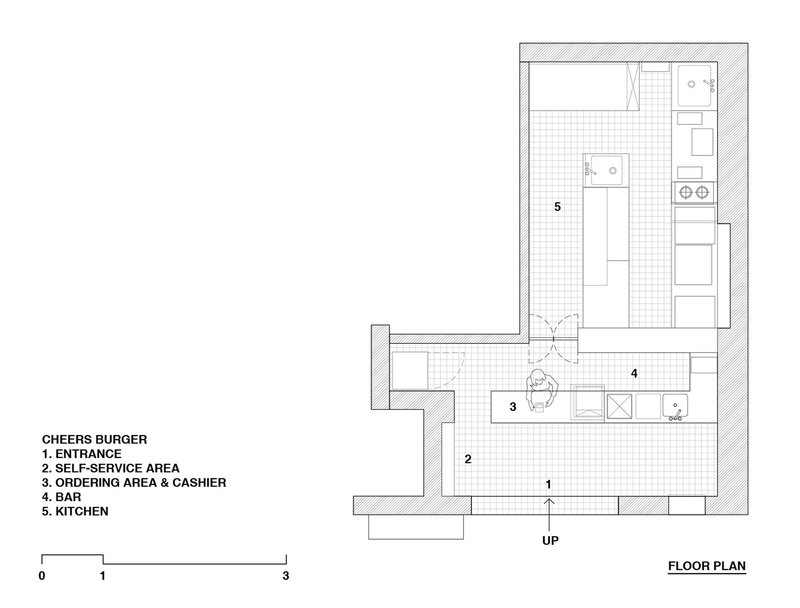

The floor plan confirms just how constrained the footprint is. The entrance leads directly into the service and ordering area, which feeds into a compact bar zone and, at the rear, the kitchen. There is no circulation to speak of; the customer stands at the threshold and the staff works within arm's reach of every surface. The elevation drawing reveals the proportional logic of the facade: a central glass window flanked by the textured concrete panel on one side and the tiled entry on the other, balanced asymmetrically in a way that feels inevitable rather than composed.
Why This Project Matters
Cheers Burger matters because it demonstrates that the most compelling design interventions in dense urban contexts are often the quietest. In a city saturated with Instagram-ready interiors, Atelier A produced a space whose appeal comes not from novelty but from legibility. You understand this building immediately: its age, its materials, its purpose. Nothing is hidden, nothing is performed. The architecture is in service of a transaction that takes about three minutes, and it does not overstay its welcome.
More broadly, the project is a case study in what preservation can mean for small commercial buildings that fall outside any heritage register. These are the structures that cities lose by the thousands, not because they are demolished but because they are renovated beyond recognition. Atelier A's approach, repair what is broken, reveal what is buried, add only what the program demands, offers a replicable ethic for working with the unremarkable buildings that give neighborhoods their grain. At 29 square meters, Cheers Burger is tiny. Its implications are not.
Cheers Burger by Atelier A, lead architect Yanwen Zhu. Located at the crossroads of Yanqing Road and Changshu Road, Shanghai, China. 29 m², completed 2022. Photography by Studio FF.
About the Studio
Share Your Own Work on uni.xyz
If projects like this are the kind of work you want to make, uni.xyz is a place to publish your own, find collaborators, and enter design competitions.




Popular Articles
Popular articles from the community

Reincarnation Weaves a Three-Story Retreat into the Green Landscape of Rural Bangladesh
Ara Manor in Narsingdi dissolves the line between domestic architecture and its lush surroundings through screens, courtyards, and planted rooftops.
Inside a Timeless Mumbai Residence by Aether Studio
Aether Studio's 2,250 sq ft apartment in Malad, Mumbai uses marble, brass, boucle, and disciplined restraint to build a quiet retreat from the city.
Kaffeebühnen: Coffee Shop Architecture Designed as a Civic Stage Between Vienna’s City and Park
Kaffeebühnen turns coffee shop architecture into a civic stage, linking Vienna’s park edge, urban life, warm timber yards, and coffee craft.

IKC de Geluksvogel: Sustainable School Architecture Designed for Free Movement and Digital Learning
IKC de Geluksvogel turns sustainable school architecture into a flexible Maastricht campus for digital learning, nature, and free movement.


Similar Reads
You might also enjoy these articles
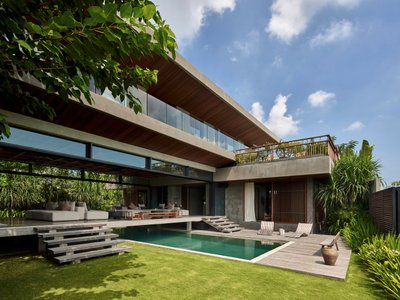
Freebird Residence by Alexis Dornier: A Tropical Modernist Sanctuary in Bali
Floating living pavilion above pool anchors H-shaped tropical villa, blending Japanese minimalism, sustainable strategies, lush landscape, and sculptural interiors.
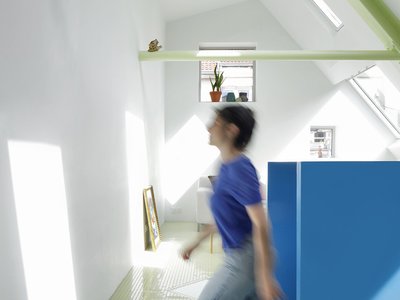
127af Flips a Tiny Bagnolet Rowhouse Upside Down with a Handcrafted Roof Extension
A 55-square-meter terraced house on the edge of Paris gains a luminous upper living floor through lightweight timber and steel.
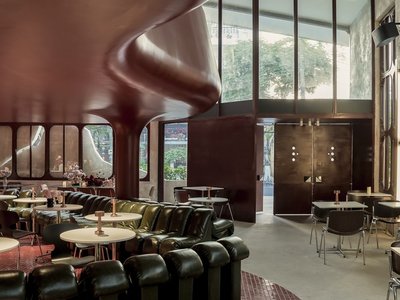
1.61 Design Workshop Wraps a 600-Square-Meter Café in Vietnam in Sculptural Burgundy Drama
Reden Café & Bistro pairs a helical staircase, mosaic floors, and deep red interiors to rethink Vietnamese hospitality space.

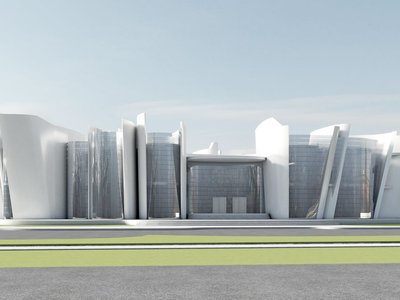
The Unbound Brain: A School Shaped by Cognitive Architecture
Cylindrical learning pods radiate like neurons from a central cortex, turning the floor plan into a spatial model of human thought.


Explore Architecture Competitions
Discover active competitions in this discipline




The International Standard for Design Portfolios


The Global Benchmark for Architecture Dissertation Awards


The Global Benchmark for Graduation Excellence


Challenge to reimagine the Iron Throne
Comments (0)
Please login or sign up to add comments
No comments yet. Be the first to comment!