
Atelier cnS Plugs Arched Micro-Worlds into a Foshan Primary School to Blur Campus and Park
At the foot of Jinping Mountain, lightweight canopies and colored portals transform a renovated campus into a landscape that teaches through play.


At the base of Jinping Mountain in Foshan's Longjiang Town, a former middle school campus has been reworked into something closer to a public park than a conventional primary school. Atelier cnS, led by Guanqiu Zhong, Zhiyuan Zhu, and Gang Song, avoided the impulse to demolish and rebuild. Instead, they treated the existing site as a host organism, inserting a family of lightweight functional modules, arched canopies, corridors, and bridges, into the gaps between buildings and green spaces. The result is a 6,110 square meter renovation that accommodates 20 classes of first and second graders while preserving mature trees, a historic stone road, and the character of a campus that had already been freshly renovated just two years earlier.
What makes the project worth studying is not any single formal gesture but the strategy itself: a plug-in approach that turns leftover space into the most memorable parts of the school. A seven-meter grade change between the sports grounds and the main building becomes an opportunity for hiking trails and sky bridges. A stairwell becomes a "Library Castle." The entrance forecourt, squeezed between two residential buildings, becomes a sequence of colored arched portals. Each intervention is small, specific, and structurally independent, yet together they dissolve the hard boundary between institution and landscape.
Super Arches and the Entrance Sequence
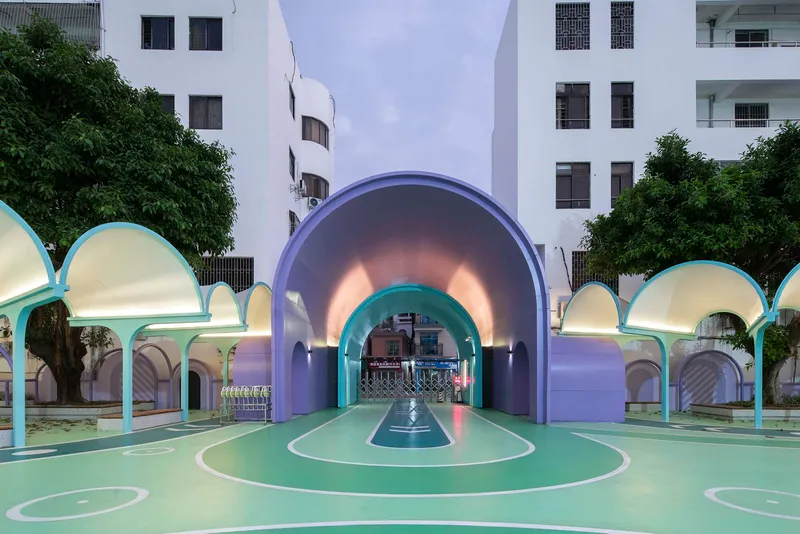

The school's street frontage sits in a dense, older neighborhood where the transition space is blocked by flanking residential buildings. Atelier cnS responded by stacking a series of arched portals in graduated purple tones, creating what they call "Super Arches." At dusk these glow like a theater proscenium, signaling the campus entrance from the narrow street. The arch profile is playful without being cartoonish; it borrows its logic from the vault language used elsewhere on the campus, giving the whole project a legible formal family.
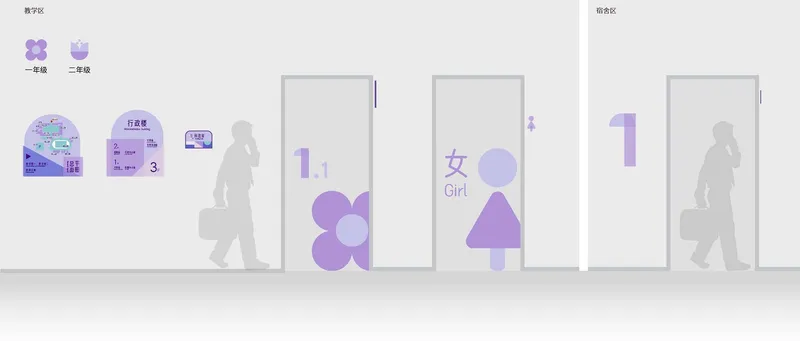
Inside the entry sequence, wayfinding graphics adopt the same palette. Restroom signage rendered in purple silhouettes on white walls continues the color coding. It is a small detail, but it shows that the architects were thinking about experience at every scale, not just the headline moves.
Cloud Corridor and the Vaulted Courtyard
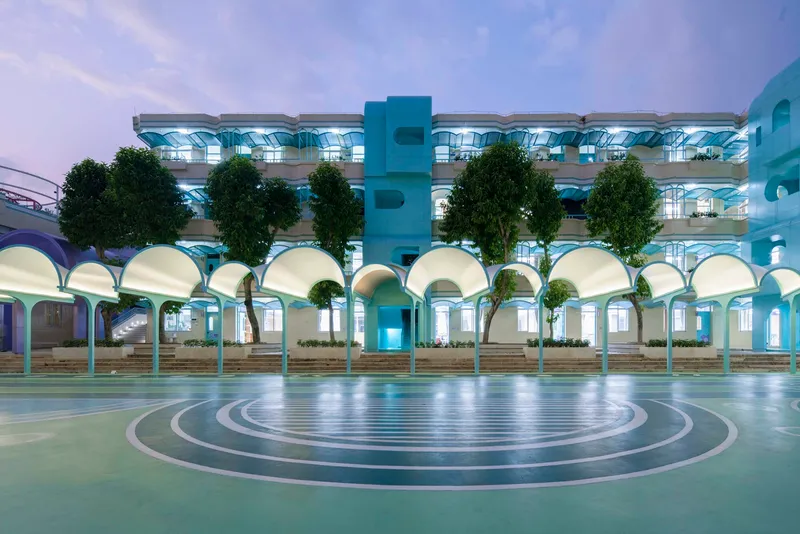
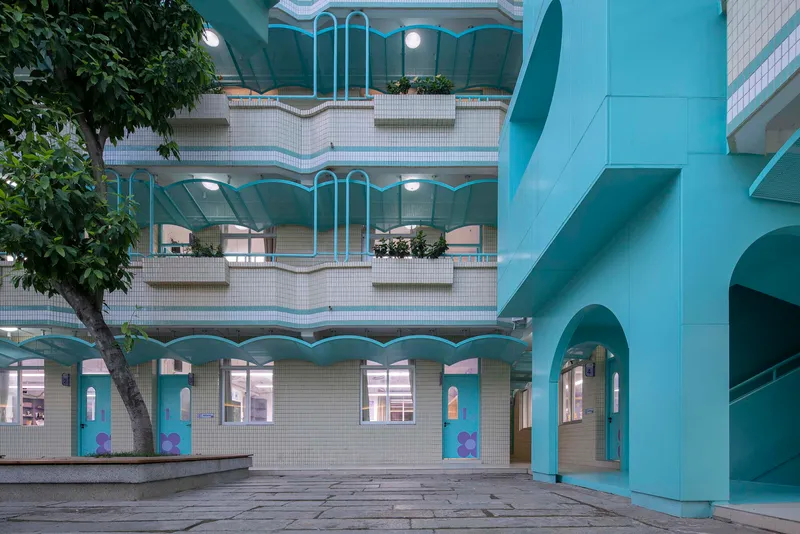
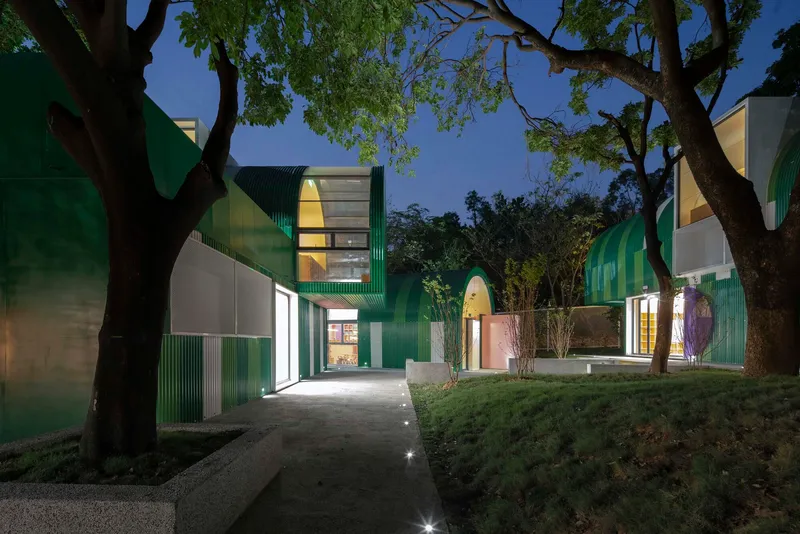
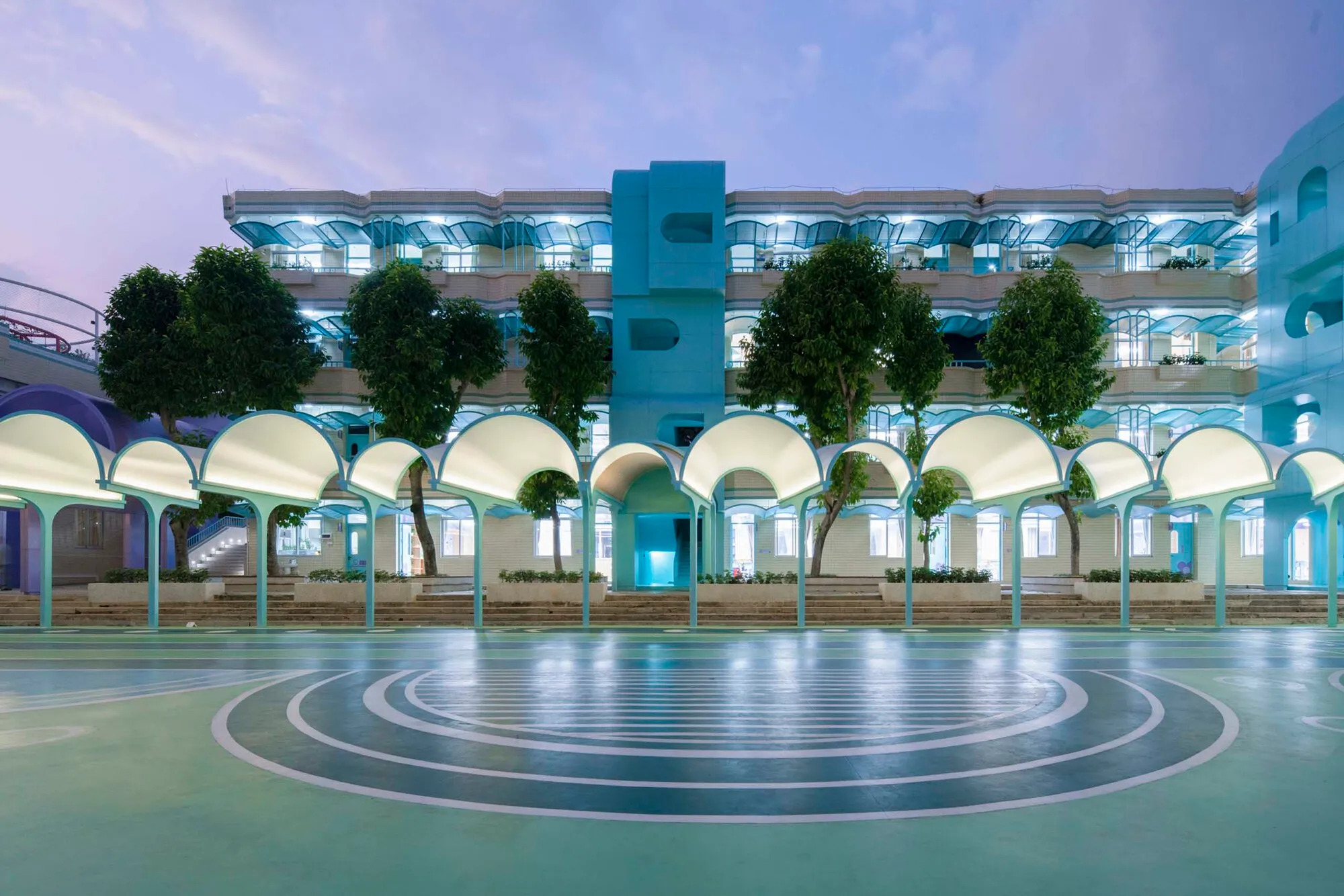
The courtyard is the heart of the campus, and Atelier cnS treated it accordingly. A multi-story arcade of vaulted arches wraps the space, its concentric circular paving pulling students into the center. Under dusk light the corridors read almost as a cloister, but the wavy white railings and potted trees on the tiered balconies pull the mood toward something more open and informal. The effect is an enclosed outdoor room where children can gather without being confined.
Flanking the courtyard, a glass corridor offers subtle gradations of light and shade, its transparent walls making adjacent planted zones visible from inside. At twilight, illuminated pathways between green-paneled volumes and mature trees show how carefully the lighting strategy reinforces the park-like ambition. The "Cloud Corridor" shelters outdoor activities from rain while keeping the air open on both sides, a passive climate move that avoids mechanical intervention.
Canopy Taxonomy on the Playing Fields


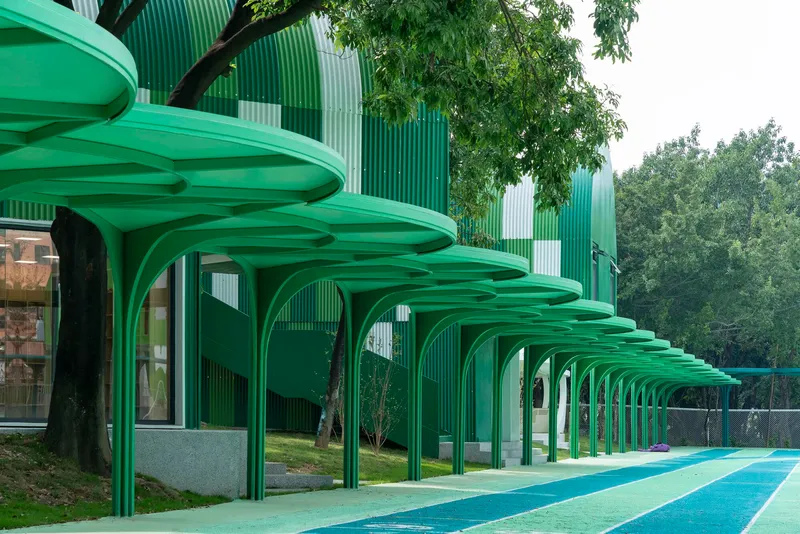
Where the campus meets its sports grounds, a catalog of shell-like canopies appears. Some are pastel blue and purple, others green with ribbed undersides. Each variation responds to a different edge condition: planted borders, playground surfaces, or circulation paths. Children occupy the space beneath them as naturally as they would a grove of trees, which is precisely the point. The canopies are not decorative; they provide shade and rain shelter for outdoor play in Foshan's subtropical climate.
The formal variety is deliberate. Rather than repeating a single module, Atelier cnS developed a family of arch and vault profiles, each dimensioned to its structural span and programmatic purpose. The PTFE membrane and steel-frame construction keeps each canopy lightweight, allowing it to sit lightly among the preserved large trees that ring the expanded sports grounds.
Terraced Landscape and the Seven-Meter Drop
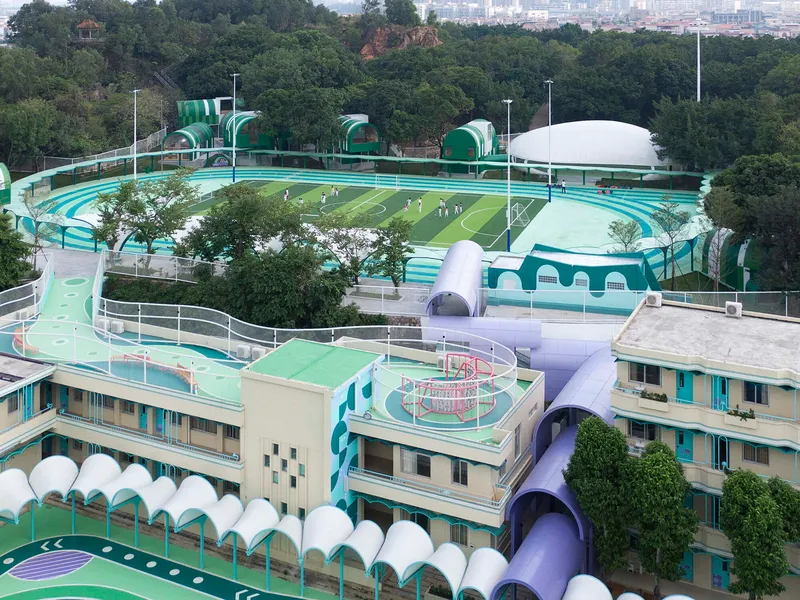
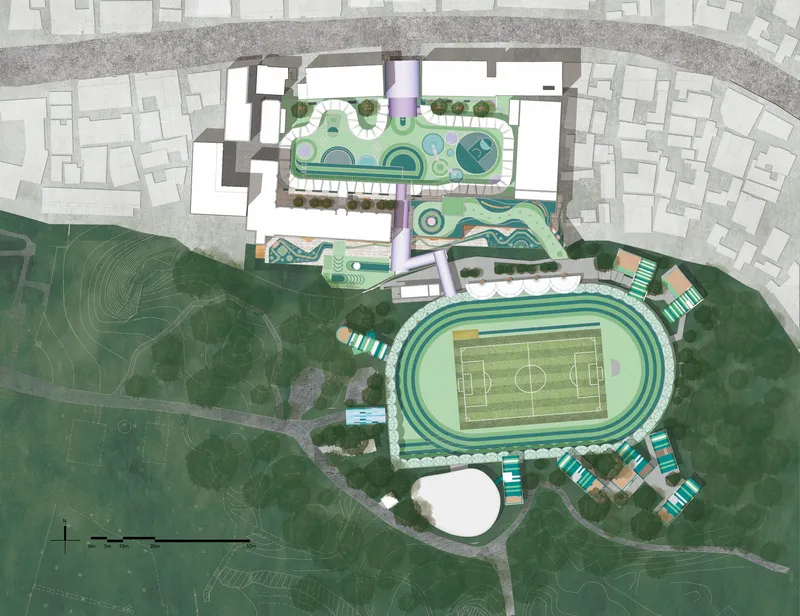
An aerial view reveals the campus's real topographic challenge: a roughly seven-meter elevation change between the main school building and the sports grounds below. The architects turned this into an asset by terracing the landscape and threading a hiking trail and sky bridge through the grade change, giving students direct access to the lower playing fields while folding the natural parkland environment of Liyugang Park into daily school life.
The site plan confirms the ambition. Building wings, courtyard gardens, a curved running track, and surrounding green landscape merge into a single continuous surface. You cannot easily locate where the campus ends and the park begins, which is the entire design thesis: a campus in the park, or a park in the campus.
Structural Logic: Steel, Membrane, and Modular Assembly
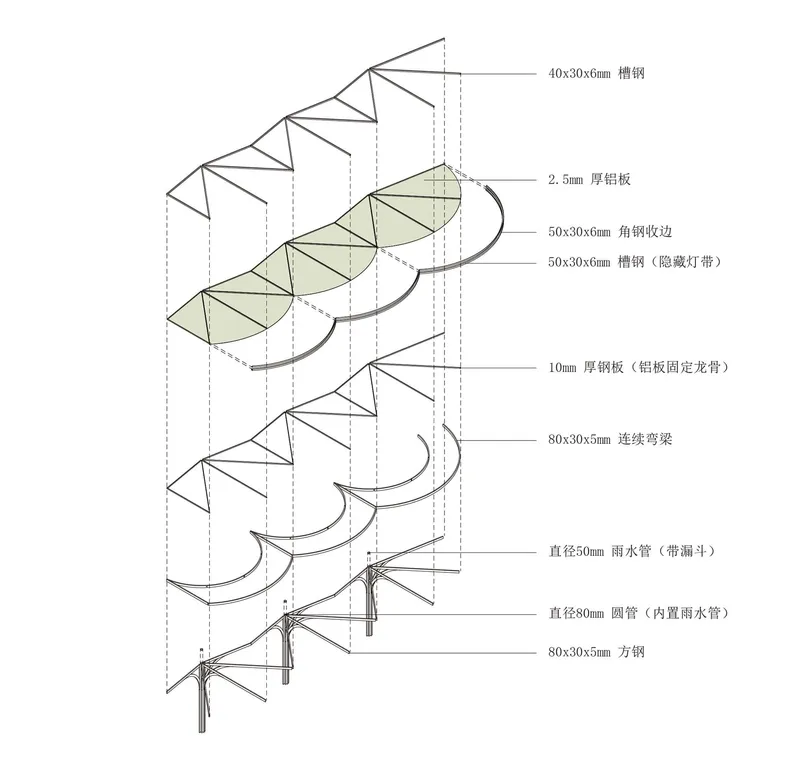

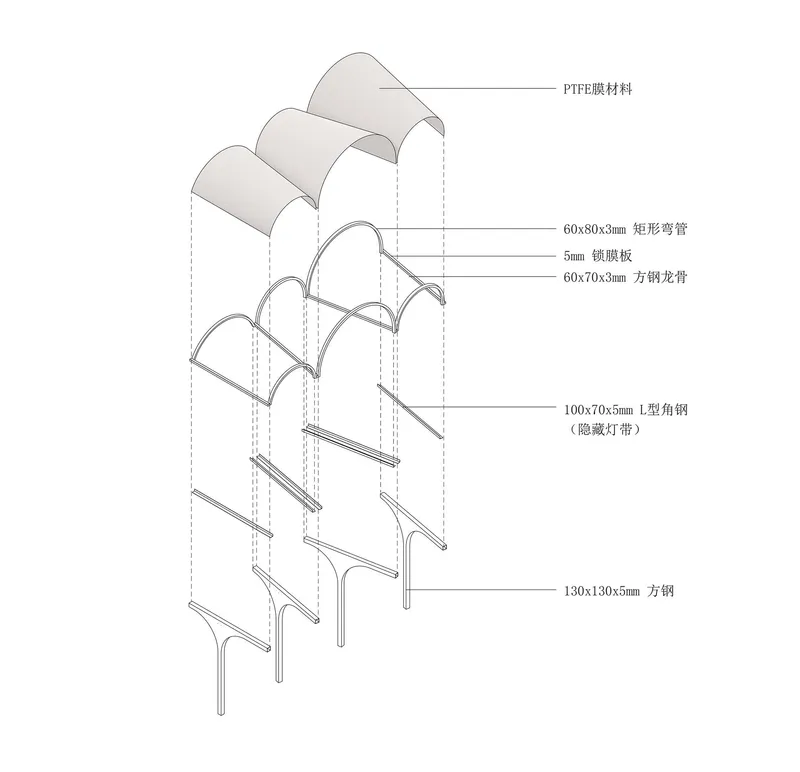
The drawings tell the construction story clearly. Each canopy is an assembly of curved steel columns, a structural frame, and layered roof panels, often finished in PTFE membrane. The axonometric details show how plant bases anchor columns to grade, reinforcing the garden-like character of the structural supports. Everything is bolted, not cast in place, which aligns with the plug-in philosophy: these elements could theoretically be removed or relocated without damaging the host buildings.
The undulating canopy supported by slender steel columns reads as a contemporary reinterpretation of the pergola, but one engineered to span real distances and resist real wind loads. It is a satisfying marriage of formal softness and structural rigor.
Plans and Drawings
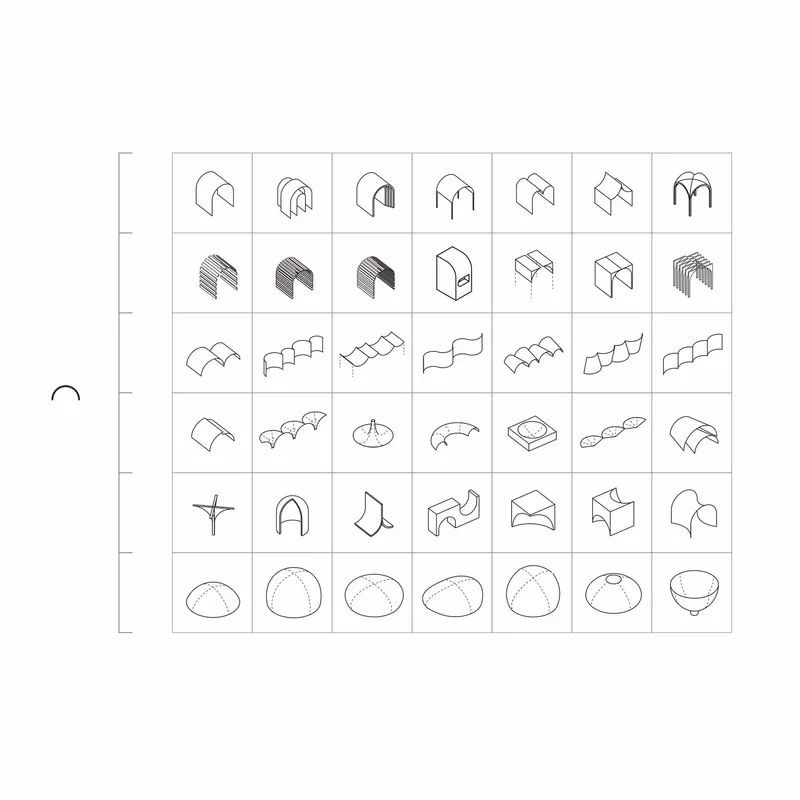
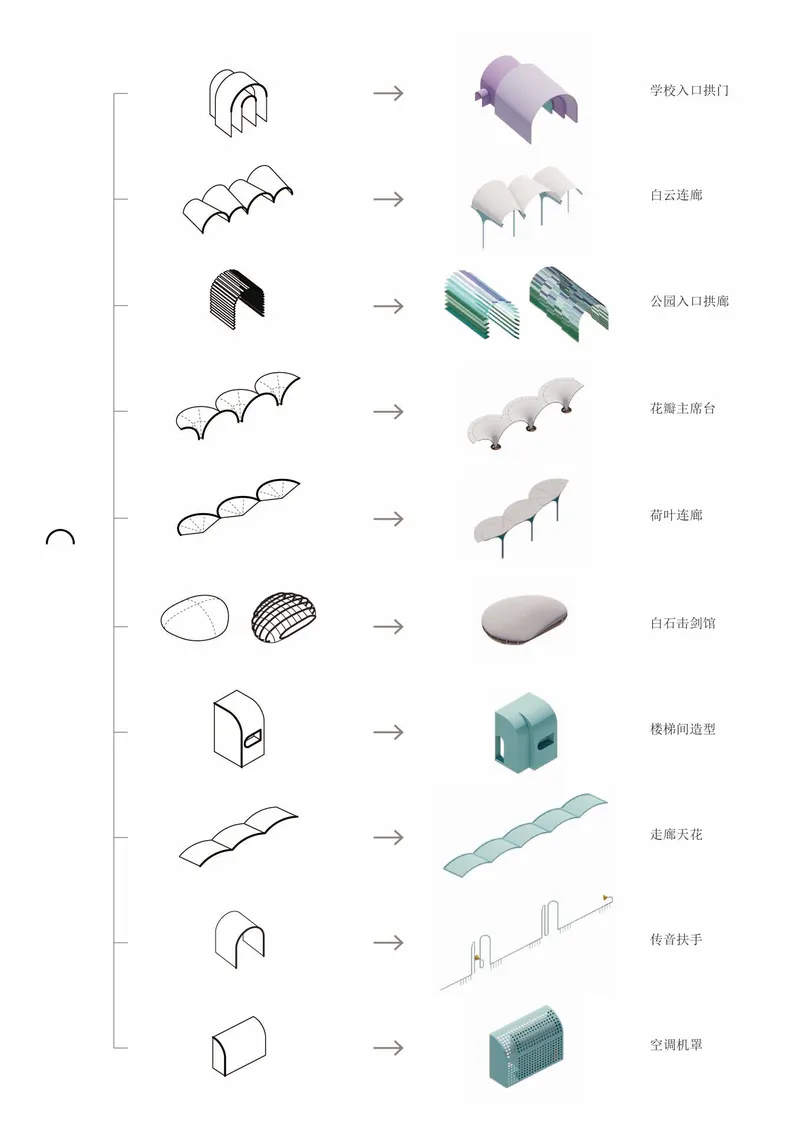
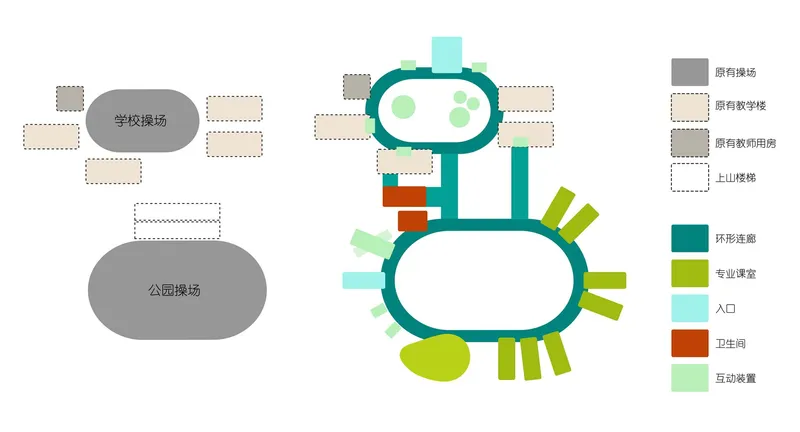
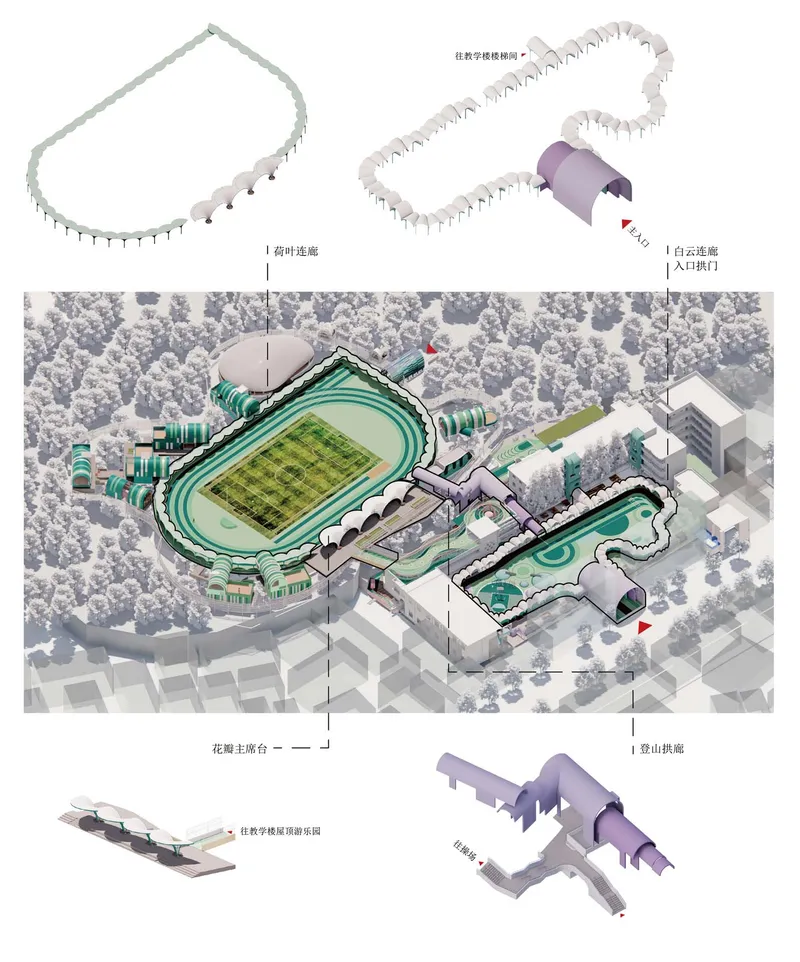
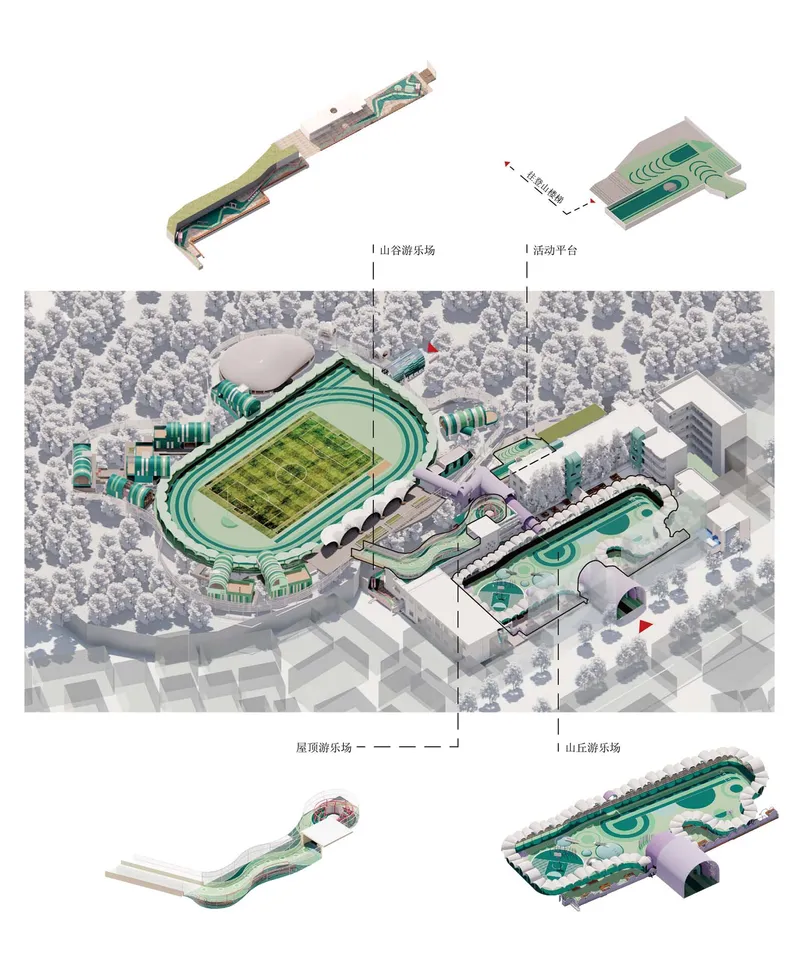


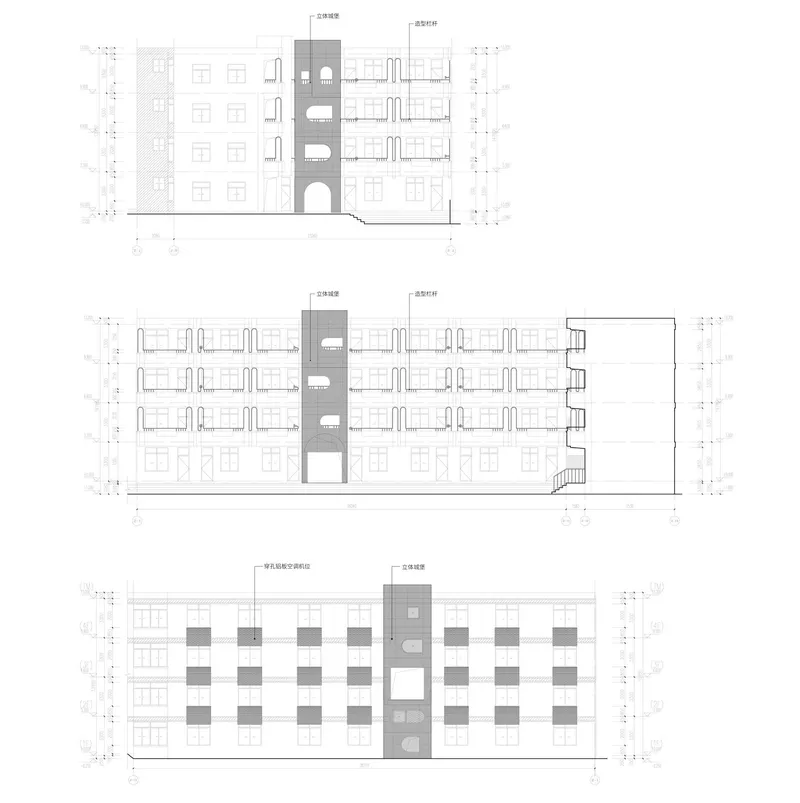
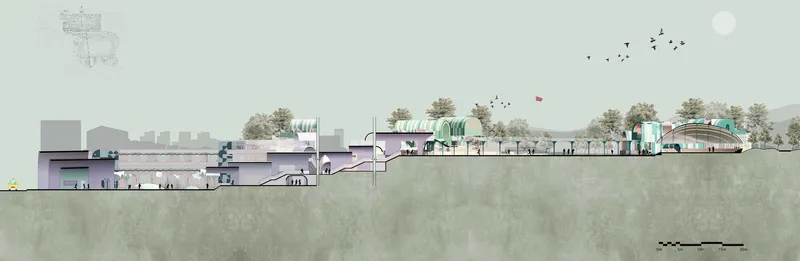
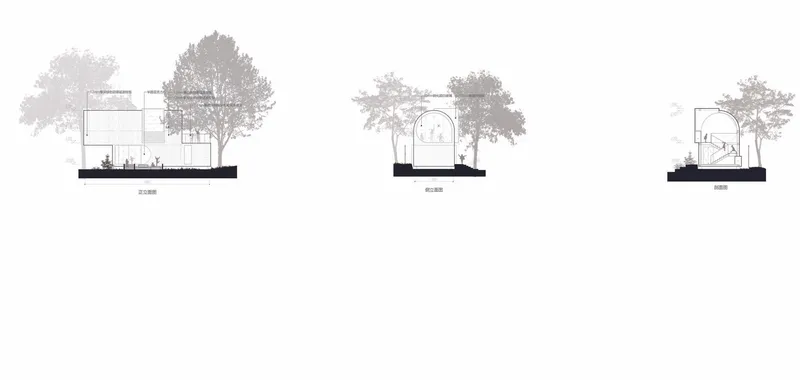

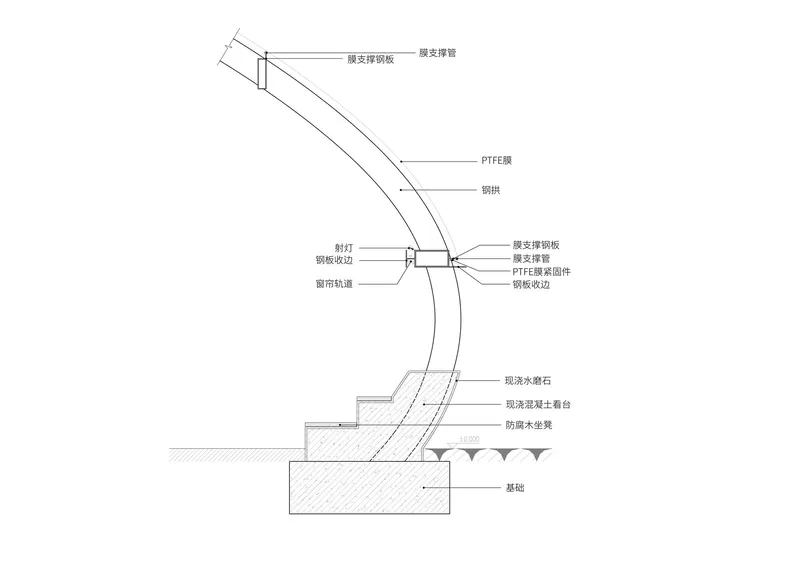
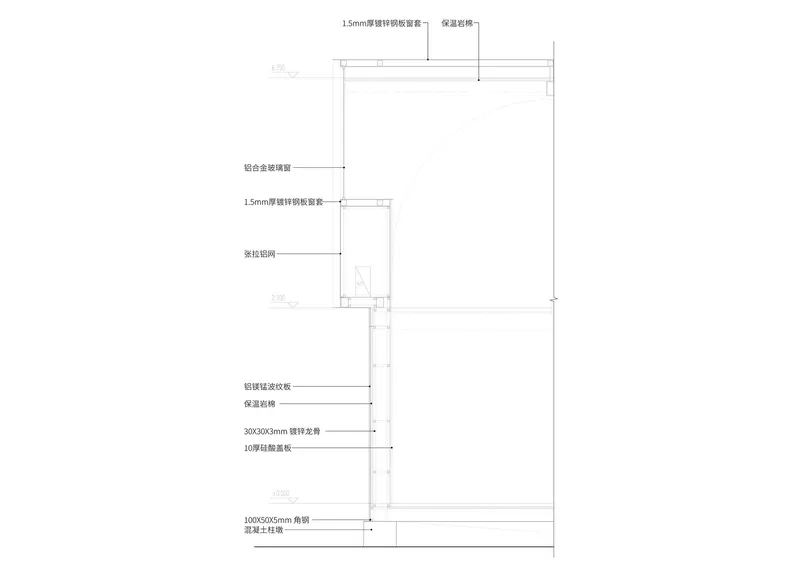
The drawing set is unusually rich for a renovation project. An isometric grid catalogs every roof and vault variation, demonstrating that the formal diversity on site was not improvised but systematically generated. Schematic plans color-code functional zones, making the relationship between school and park facilities legible at a glance. Sections reveal how the arched cores connect flanking classroom wings, stepping down the hillside with turquoise roof forms.
Exploded axonometrics of the sports facilities show roof structure, seating, and underground service levels as separable layers, reinforcing the plug-in logic. Construction details at the wall section level document the junction between curved roof assemblies and foundations, as well as the layered glazing, insulation, and cladding systems. These drawings are a manual for how to intervene surgically on an existing campus without losing what was already there.
Why This Project Matters
School renovations in China's fast-growing cities tend to favor total demolition and reconstruction, treating the existing campus as an inconvenience to be erased. Atelier cnS offers a counter-model. By retaining the recently renovated building, the historic stone road, the mature trees, and the existing site memory, they demonstrate that a light touch can produce a richer, more layered environment than any blank-slate approach. The plug-in modules, arched canopies, library castle, cloud corridor, are parasitic in the best sense: they feed off the host campus while giving back shade, shelter, and delight.
For first and second graders transitioning from kindergarten, the blurred boundary between campus and park is not just a design concept but a developmental one. These are children who still need to learn through movement and sensory exploration. By making the seven-meter climb to the sports field a hiking trail instead of a staircase, and by scattering a taxonomy of colorful canopies across the playing fields instead of erecting a single monolithic shade structure, the architects embed variety and discovery into the daily school experience. That is a serious commitment to the idea that architecture can shape how children engage with the world.
Renovation of the Jinping Lower Primary School, designed by Atelier cnS (lead architects: Guanqiu Zhong, Zhiyuan Zhu, Gang Song). Fo Shan, China. 6,110 m². Completed 2022. Photography by Siming Wu.
About the Studio
Share Your Own Work on uni.xyz
If projects like this are the kind of work you want to make, uni.xyz is a place to publish your own, find collaborators, and enter design competitions.




Popular Articles
Popular articles from the community


Hill & Cross Opera: Sculptural Opera House Architecture Shaped by Tallinn’s Landscape and Identity
Hill & Cross Opera reimagines opera house architecture in Tallinn through its sculptural hill, civic plaza, glass wave and a luminous cross.

The Ocean Hive: Sustainable Architecture for a Self-Sufficient Civilization at Sea
The Ocean Hive imagines sustainable architecture at sea, where modular habitats, algae, wave power and ocean waste sustain a growing colony.

AL-JANNAH: Sustainable Architecture and Permaculture for Afghan Widows
AL-JANNAH uses sustainable architecture and permaculture to create resilient oasis of housing, learning, work and renewal for Afghan widows.

Riyadh For All: Intergenerational Urban Design for Active Aging in Rabat
Riyadh For All reimagines urban design in Rabat with intergenerational co-living, adaptive courtyards, and Moroccan cultural exchange today.


Similar Reads
You might also enjoy these articles

Bao Huynh Watercolor Atelier: A Serene Art Retreat in Hội An
Bao Huynh Watercolor Atelier in Hội An blends multifunctional art spaces, sustainable design, local materials, and family-friendly living in a serene environment.

Atelier Macri Concept Store Interior Design by CASE-REAL
Atelier Macri store features a "ko" counter, walnut wood details, cork displays, blending retail, gallery, and seamless customer experiences.

Manuel Vargas Izquierdo Stadium and High-Performance Sports Center: Architectural Excellence in Jalpa de Méndez
The Manuel Vargas Izquierdo Stadium blends sustainable design, inclusive sports facilities, and cultural-inspired architecture, revitalizing Jalpa de Méndez’s public spaces.

KAKR Buluh Awar Hall: Revitalizing Community and Ecology Through Bamboo Architecture
Community built bamboo hall revitalizes Buluh Awar village, empowering youth, restoring ecology, celebrating vernacular craftsmanship through sustainable architecture and culture.


Explore Renovation Competitions
Discover active competitions in this discipline



Challenge to design public laboratory


Challenge to design luxury tourism on rails


VR headsets Storefront design competition

Designing a staircase for a client
Comments (0)
Please login or sign up to add comments
No comments yet. Be the first to comment!