

Atelier Deshaus Converts an Abandoned Water Intake Station into a Lakeside Bookstore in Shaoxing
Six disused industrial structures on a small island in Jianhu Lake find new life as a bookstore, café, and cultural venue.


There is a particular category of adaptive reuse that operates not on grand industrial monuments but on forgotten municipal infrastructure: the pump houses, substations, and dormitories that quietly served a city and then quietly stopped. Atelier Deshaus found exactly this condition on a small island in Jianhu Lake, in Shaoxing's Keqiao district. Built in 1992 as a water intake facility for the local waterworks, the six structures on the island lost their purpose when a larger regional plant came online in 2001. Two decades of abandonment followed, the buildings slowly vanishing under tree canopy, until a rural revitalization initiative in 2022 presented a question worth asking: what do you do with a piece of civic infrastructure that a lake has already begun to reclaim?
The answer, completed in 2024 at 830 square meters, is a branch of Librairie Avant-Garde, the celebrated independent bookstore chain. The pump house became a bookshop. The substation became a café. The administrative building and staff dormitory became exhibition space and a viewing pavilion. A cargo hoisting dock became a public boat dock. None of the six original buildings were demolished. Instead, Atelier Deshaus threaded them together with a new corridor system of slender steel columns and flat roofs, creating a legible public sequence out of what had been a collection of utilitarian structures scattered through the trees. The result is less a single building than a small campus, one that invites you to wander between reading, looking, and sitting at the water's edge.
An Island Rediscovered
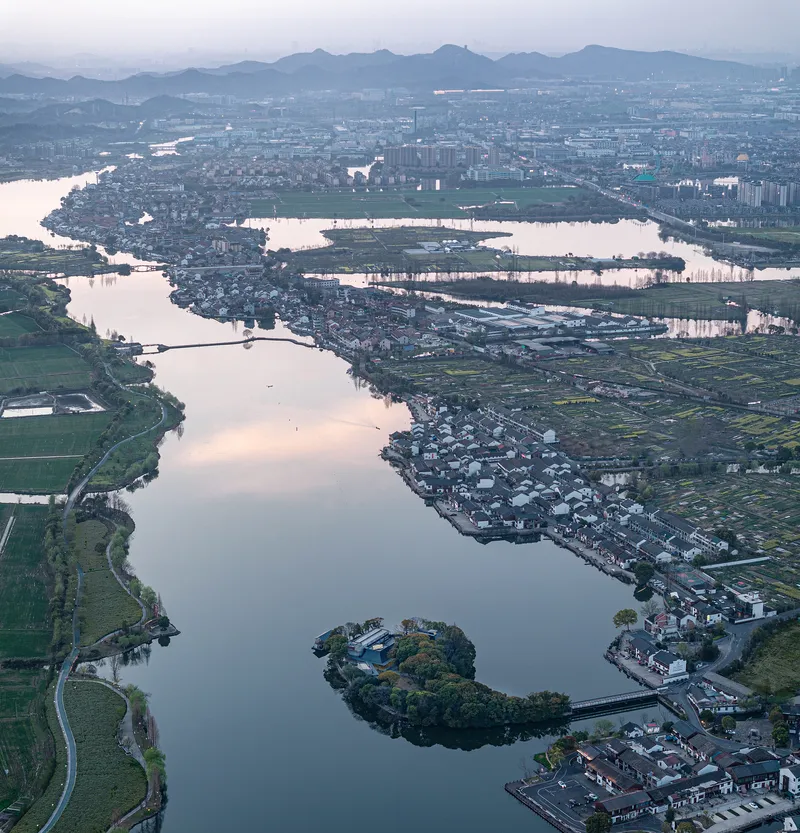
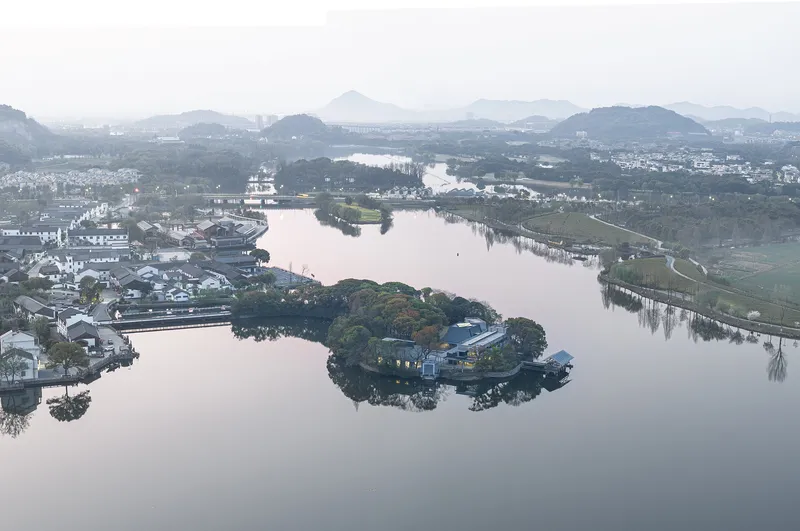
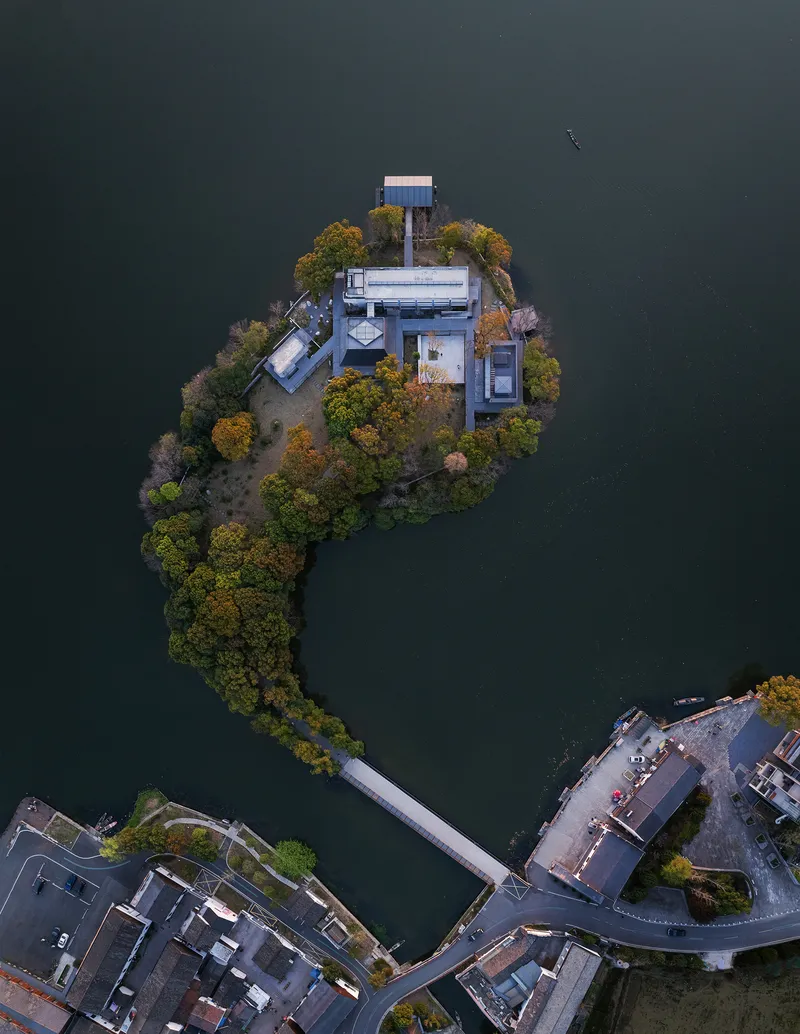
Seen from above, the island reads as a green smudge in the middle of Jianhu Lake, tethered to the mainland by a single footbridge. The surrounding landscape is the low-rise residential grain and agricultural patchwork typical of the Yangtze Delta. Morning mist softens the boundary between water and land, and the buildings are barely visible beneath the canopy. That near-invisibility is the point. Atelier Deshaus did not attempt to make the island into a landmark visible from a distance. They chose instead to make it a place you arrive at, slowly, on foot.
The aerial views reveal a planning logic that is gentle rather than assertive. The new interventions hug the existing building footprints and respect the positions of mature trees. No clearing was done to open dramatic sightlines. The architecture defers to the island's ecology, which has had twenty years to grow wild. Arriving by bridge, visitors enter a landscape where the buildings feel incidental to the trees, which is a reversal of the usual hierarchy in cultural architecture.
The Corridor as Connective Tissue
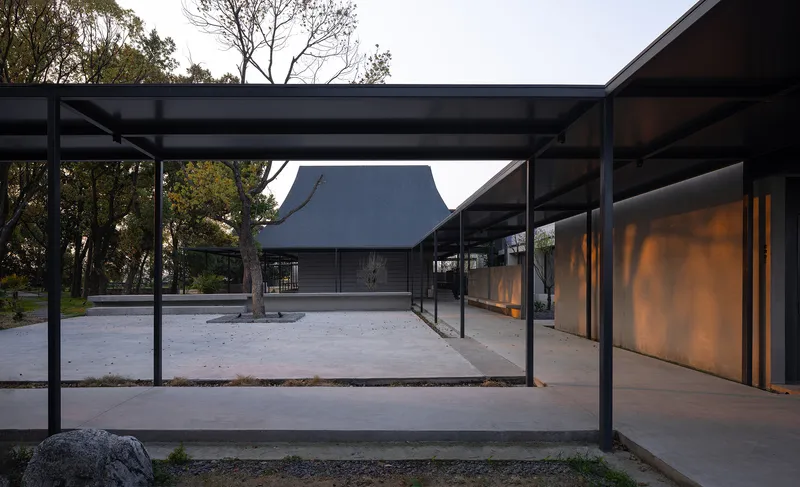
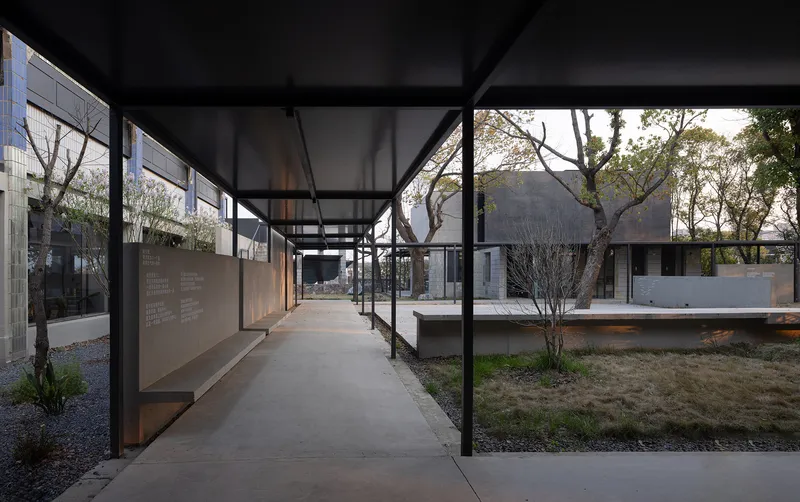
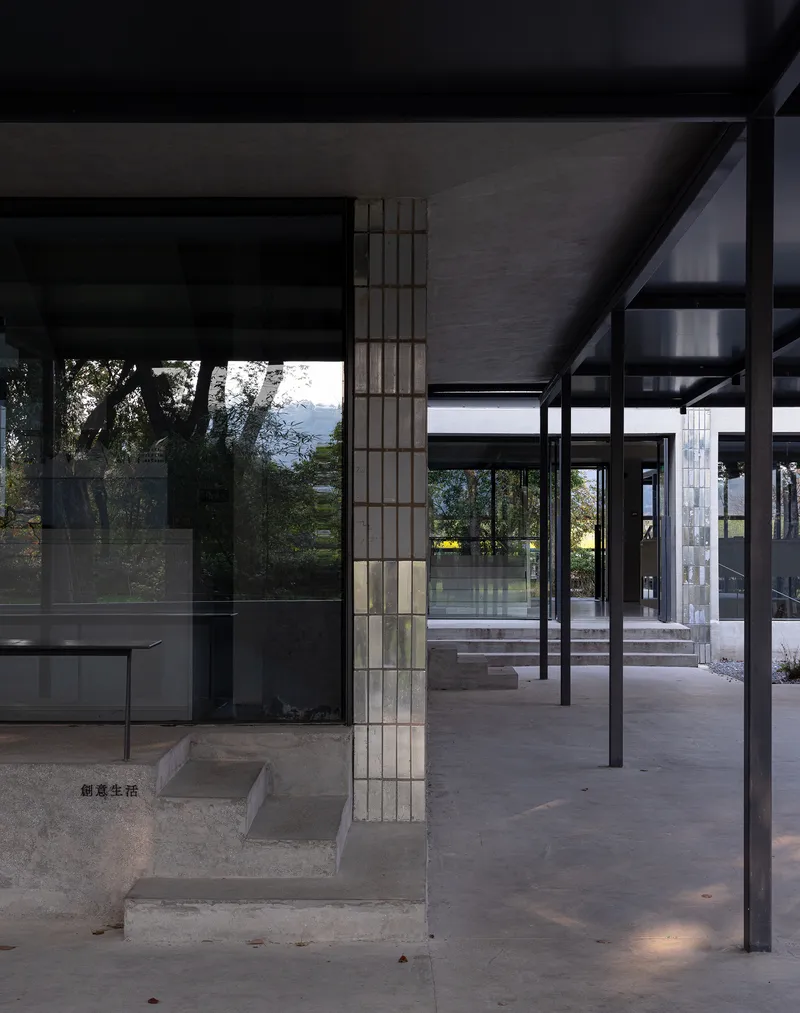
The most consequential design move is the corridor system. A network of flat-roofed walkways supported by slender steel columns links the six repurposed structures into a single itinerary. The corridors are generous enough to feel like inhabitable spaces in their own right, not merely passages between destinations. Translucent roof panels admit diffused light while providing shelter from rain, and the open sides keep visitors in constant visual contact with the surrounding landscape.
These corridors do something subtle but important: they establish a new organizational logic for a site that never had one. The original water intake facility was a collection of functional buildings placed according to operational need, not spatial experience. By introducing a connective tissue that is architecturally distinct from the original concrete and brick structures, Atelier Deshaus makes legible the difference between what was found and what was added. Steel columns and flat roofs against pitched roofs and concrete walls: the conversation between old and new is clear without being didactic.
Courtyards and Thresholds
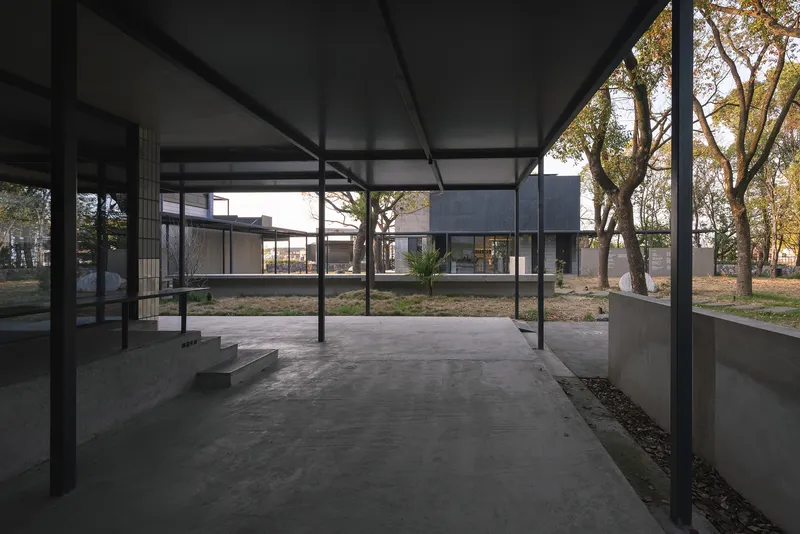
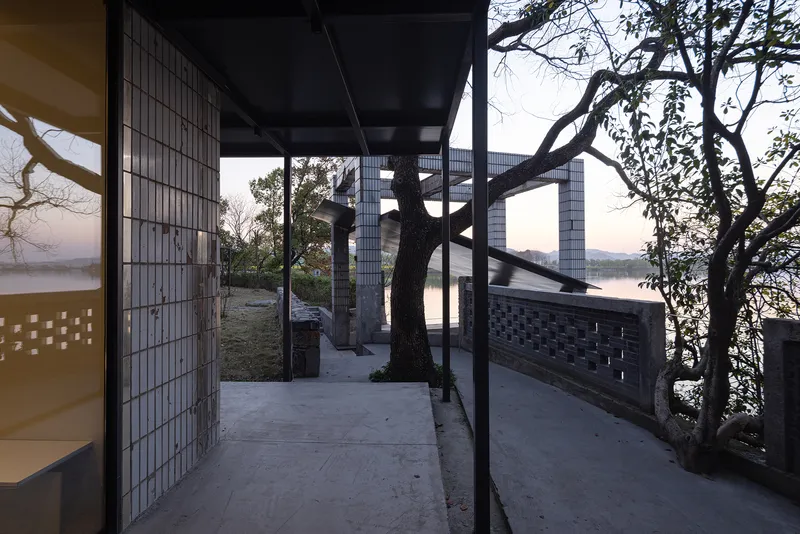
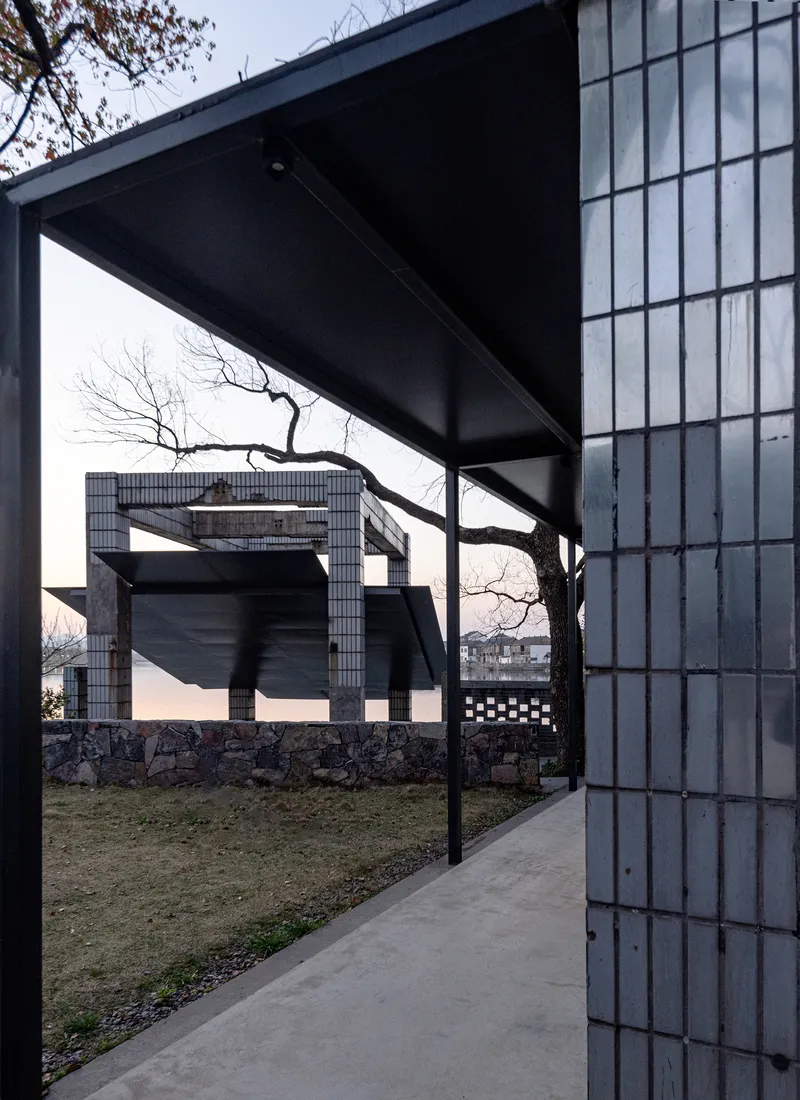
Between the buildings and beneath the corridors, Atelier Deshaus has carved out a series of courtyards planted with gravel and scattered trees. These interstitial spaces serve as decompression zones between programmatic functions, moments where you pause between the bookstore and the café, or between the exhibition space and the lake view. Glass block walls filter light and define edges without creating hard boundaries, and existing trees have been retained as structural elements of the spatial composition.
The treatment of thresholds is particularly well handled. Covered walkways frame views of the lake and the trees with a cinematic precision, using steel canopies and deep overhangs to control the visual field. At dusk, when the glass block walls glow and the steel frames silhouette against the sky, the architecture takes on a quality that is almost theatrical. These are not accidental effects; they are the result of careful attention to the way light, material, and sightline interact across the hours of the day.
The Bookstore Interior
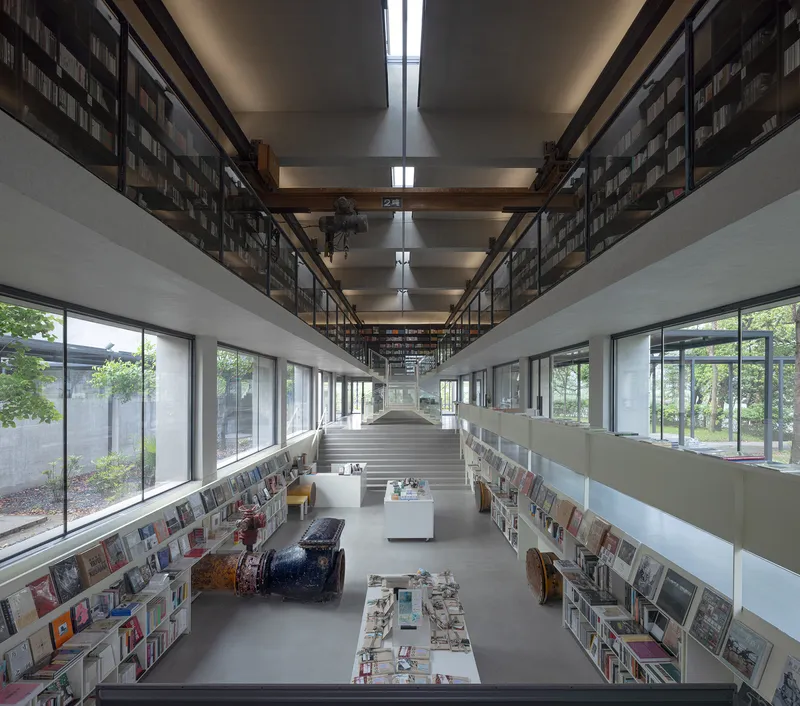
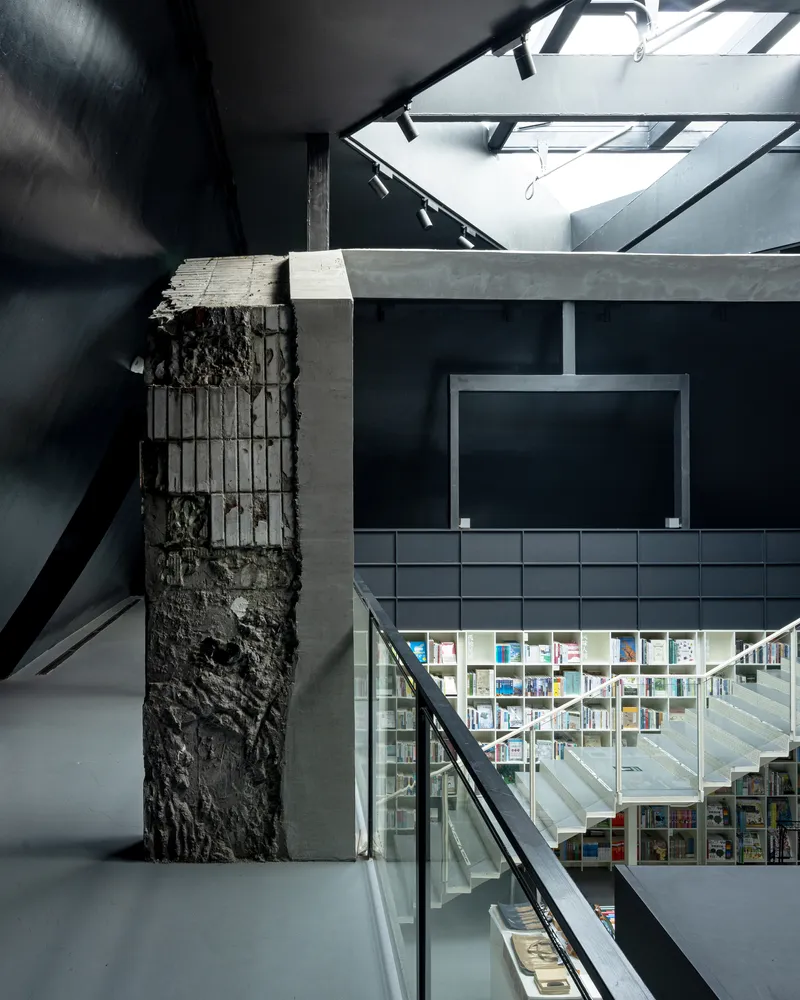
The heart of the project is the double-height library interior housed in the converted pump house. A central staircase rises between walls of bookshelves, with courtyard windows on both sides admitting natural light. The space is tall enough to feel generous but compact enough to feel intimate, a balance that many purpose-built bookstores struggle to achieve. Skylights supplement the courtyard glazing, and the overall atmosphere is one of quiet enclosure within a larger landscape of openness.
Structural remnants of the original building are left visible. Exposed concrete columns with rebar detail stand alongside new glass-walled stairwells, creating a layered material record of the building's two lives. Atelier Deshaus has resisted the temptation to polish these surfaces into aesthetic objects. The rebar is not decorative; it is documentary. This is adaptive reuse that respects the original building's plainness rather than romanticizing it.
Meeting the Water
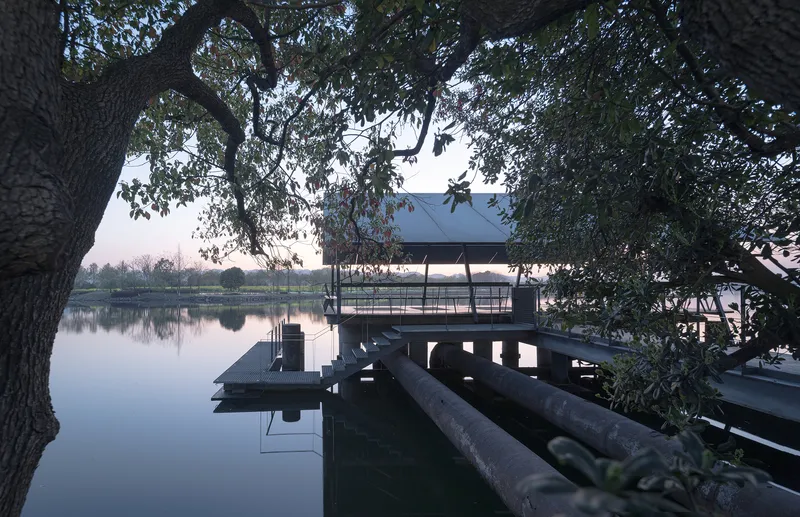
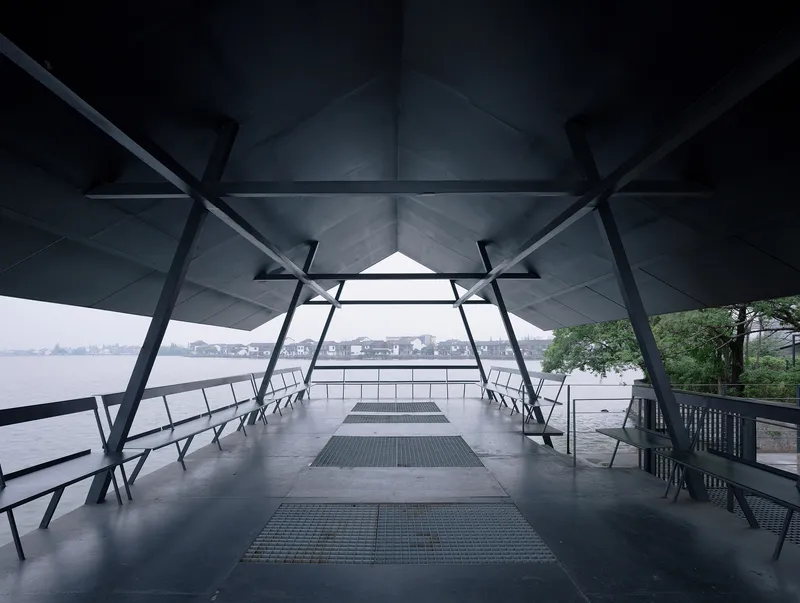
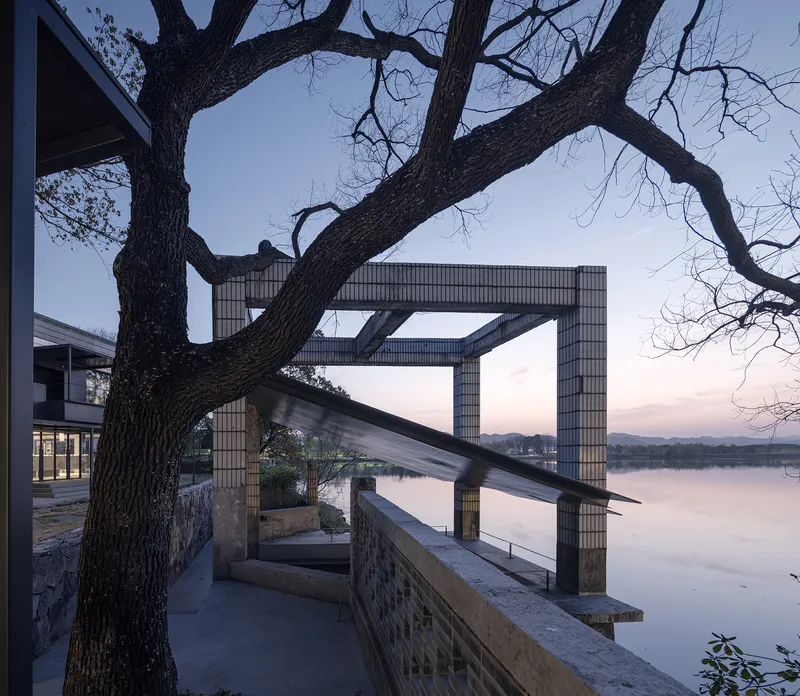
The island's edges are where the project is at its most poetic. An elevated pavilion with a metal roof and timber deck extends over the still water, framed by overhanging tree branches. A covered platform with diagonal steel bracing and folded ceiling panels opens a panoramic view of the lake. A brick portal structure, a remnant of the original cargo dock, stands silhouetted against the twilight sky. Each of these moments offers a different relationship to the water: intimate, expansive, and symbolic.
The decision to preserve the cargo dock as a public boat dock is quietly brilliant. It maintains the island's original connection to the lake not as heritage display but as active infrastructure. Visitors can arrive by water, which transforms the experience of the site entirely. An island bookstore you reach by boat is a fundamentally different proposition than one you reach by road, and Atelier Deshaus understood that preserving that mode of arrival was as important as any architectural gesture.
Existing Fabric and New Insertions
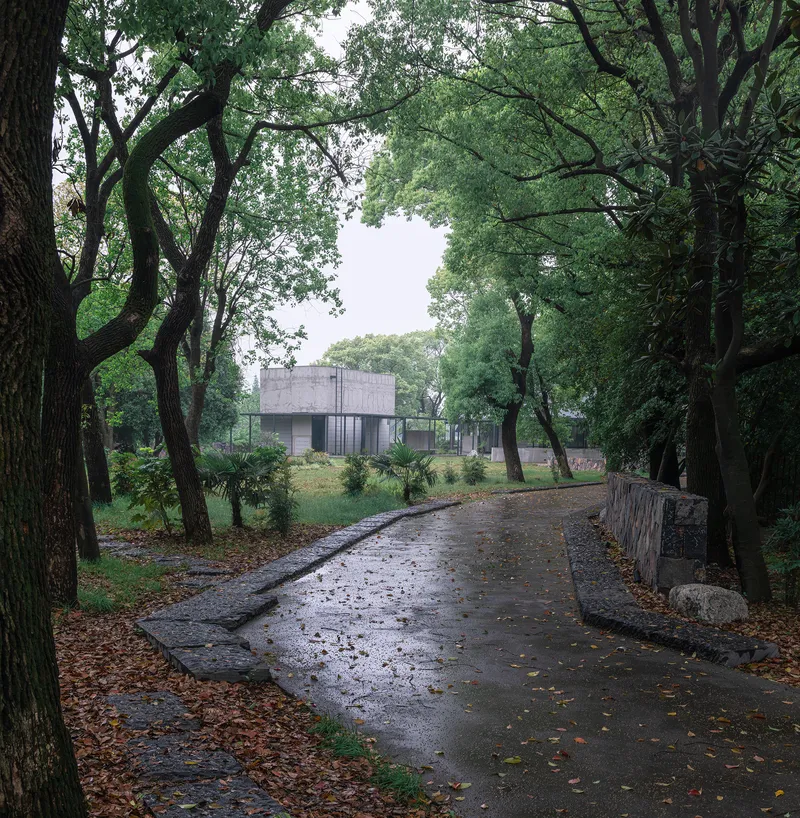
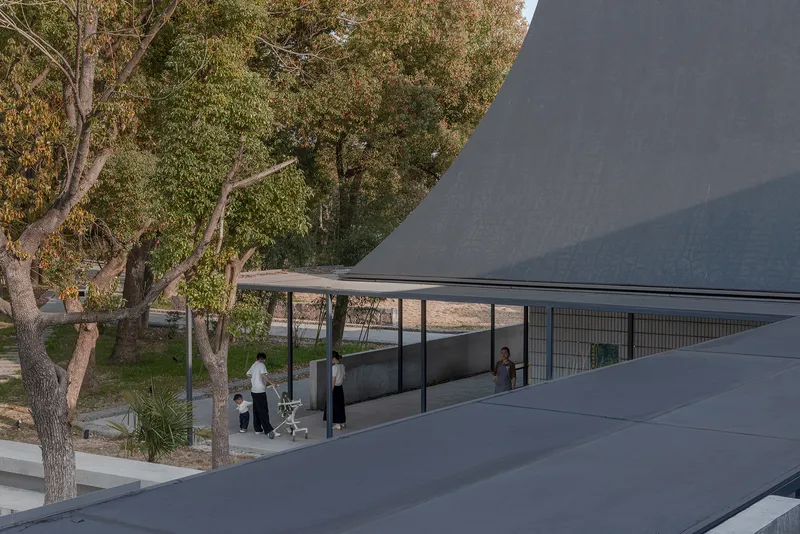
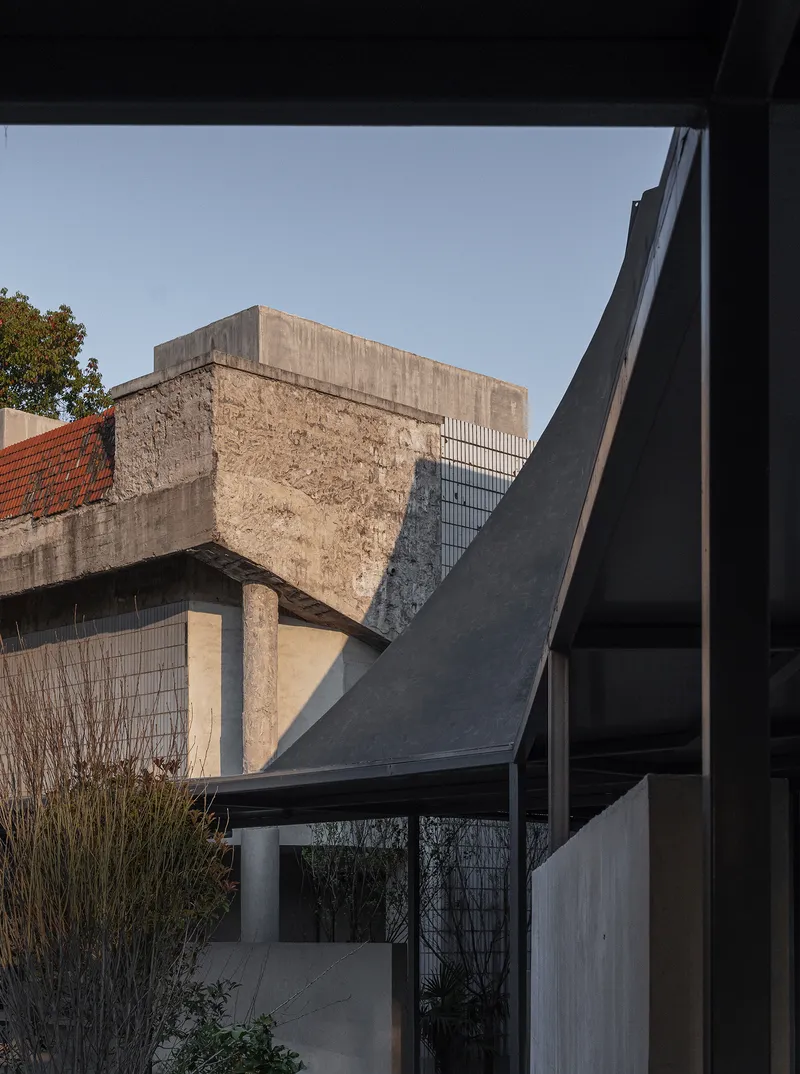
Throughout the site, the dialogue between retained and inserted elements gives the project its distinctive texture. Concrete volumes sit elevated among dense trees, their mass softened by wet pathways and autumn leaves. Curved gray roofscapes frame glass pavilions sheltered beneath mature canopy. Exposed concrete bridge remnants and angular new roof forms coexist in single views. The palette is deliberately restrained: concrete, steel, glass block, timber, and brick. No flashy cladding, no parametric curves, no attention-seeking gestures.
What Atelier Deshaus achieves here is a kind of architectural humility that is rarer than it should be in Chinese cultural projects. The existing buildings are not spectacular, and the new interventions do not try to compensate for that. Instead, the project finds its richness in the accumulation of modest moves: a well-placed column, a precisely framed view, a retained tree that forces a corridor to bend. It is architecture that earns its quality through care rather than ambition.
Paths Through the Landscape
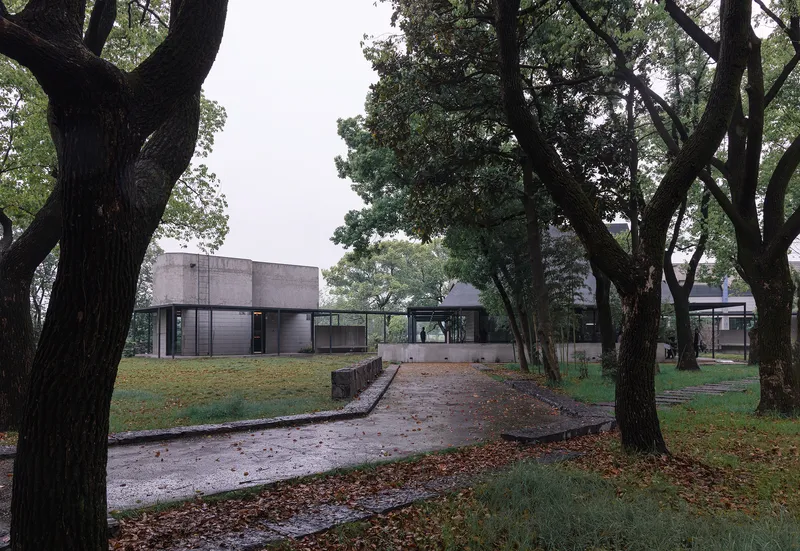
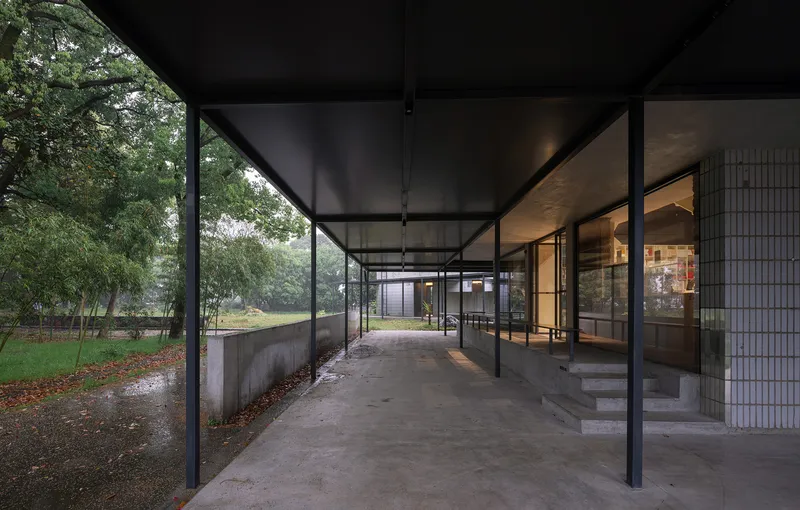
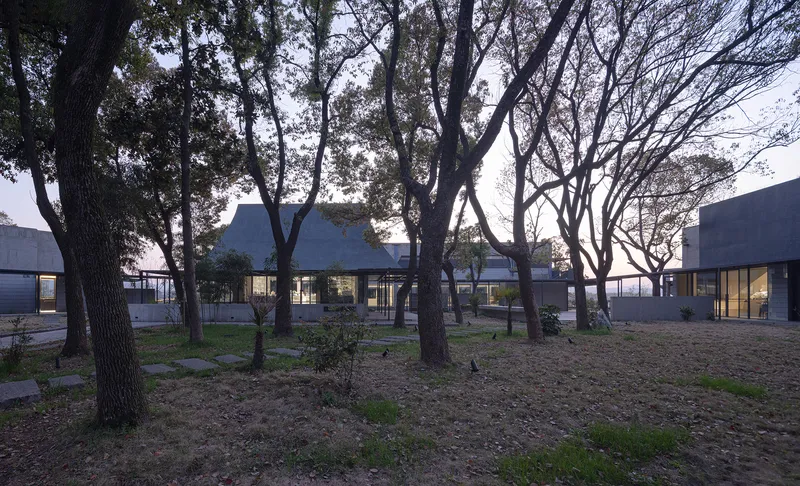
The ground plane is handled with the same deliberation as the buildings. Paved paths wind through mature trees, leading between concrete volumes and glass-walled pavilions. In wet weather, the covered entry walkways with their full-height glazing become observation galleries overlooking the park. At dusk, the illuminated glass walls of the pavilions glow through bare tree trunks, transforming the island into a lantern visible across the lake.
The landscape strategy reinforces the project's core idea: that this is a place of discovery, not display. You do not see the whole site at once. You move through it, encountering buildings and views sequentially, each framed by the next threshold or corridor. It is a spatial choreography borrowed from the Chinese garden tradition, adapted here for a very different program and material language.
Plans and Drawings
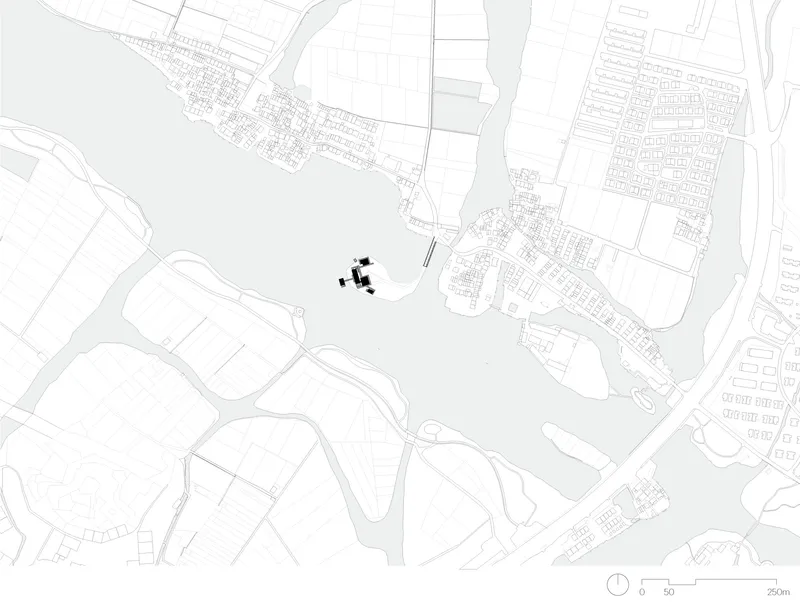
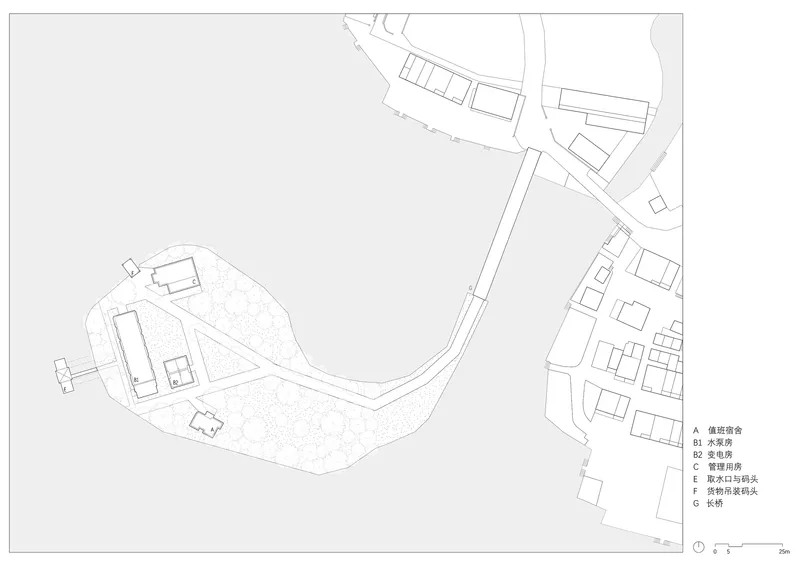
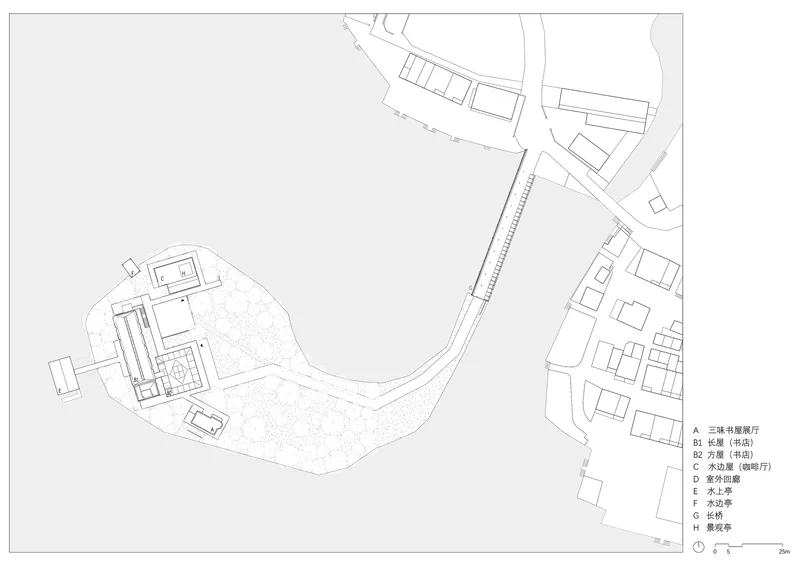
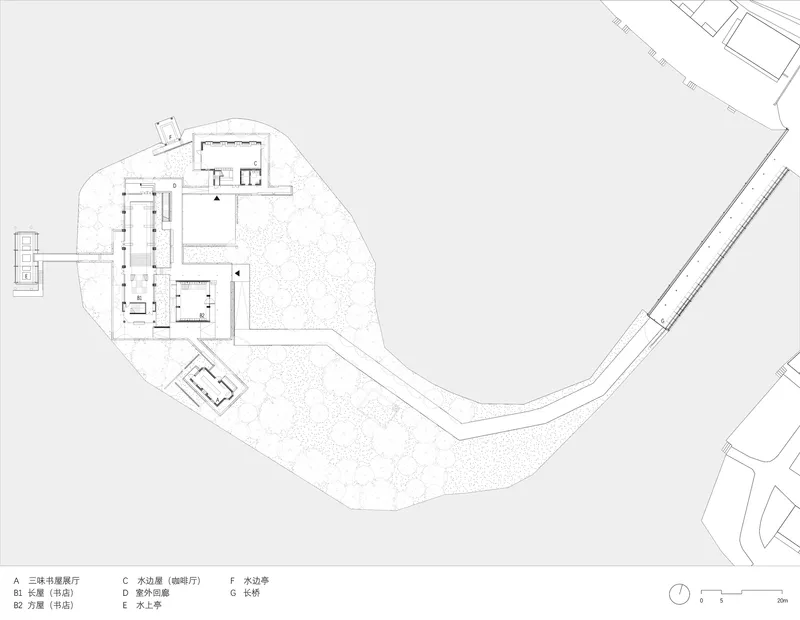
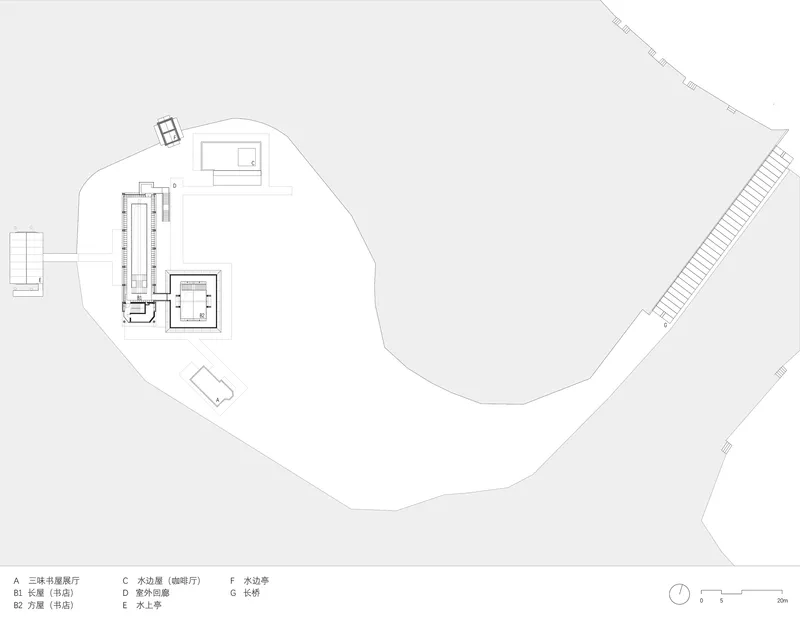
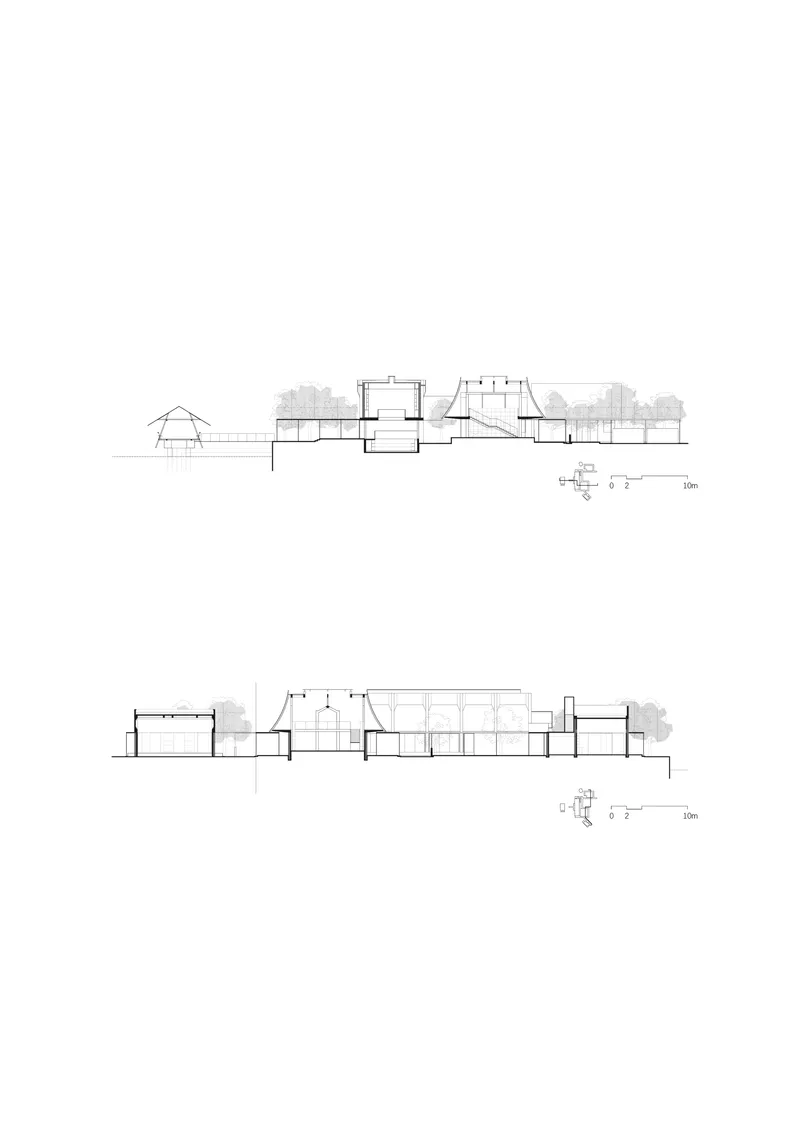
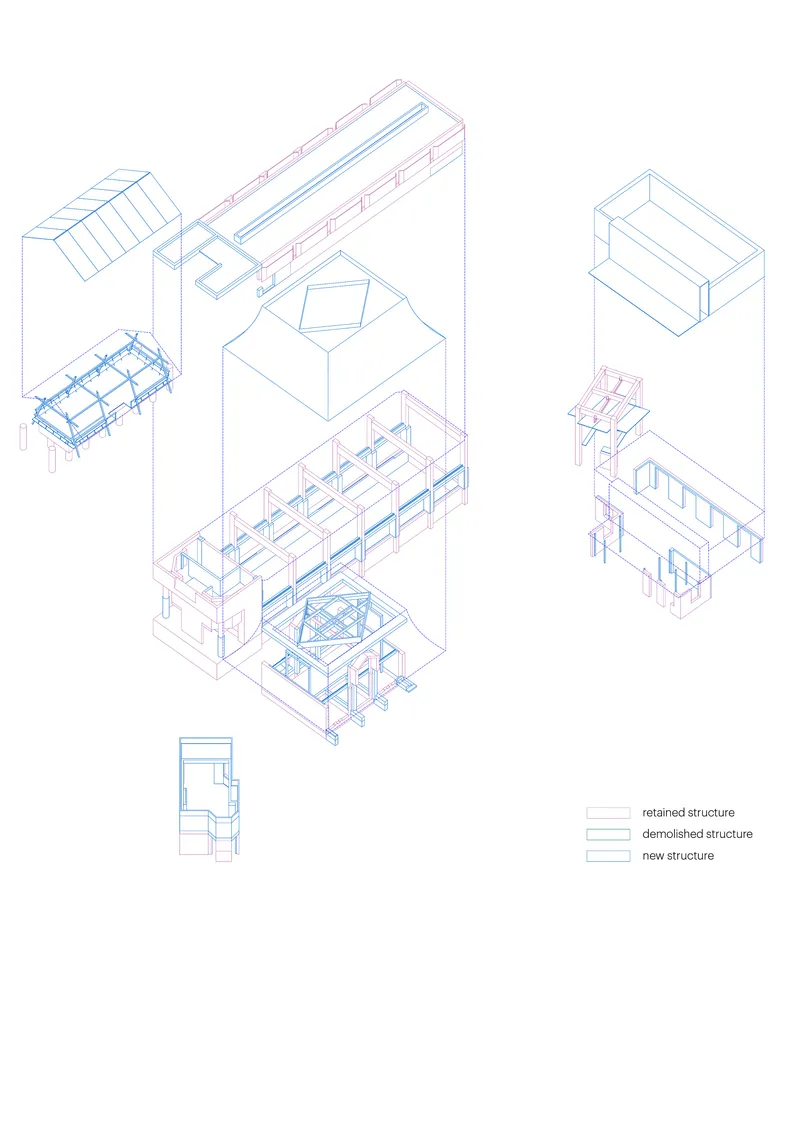
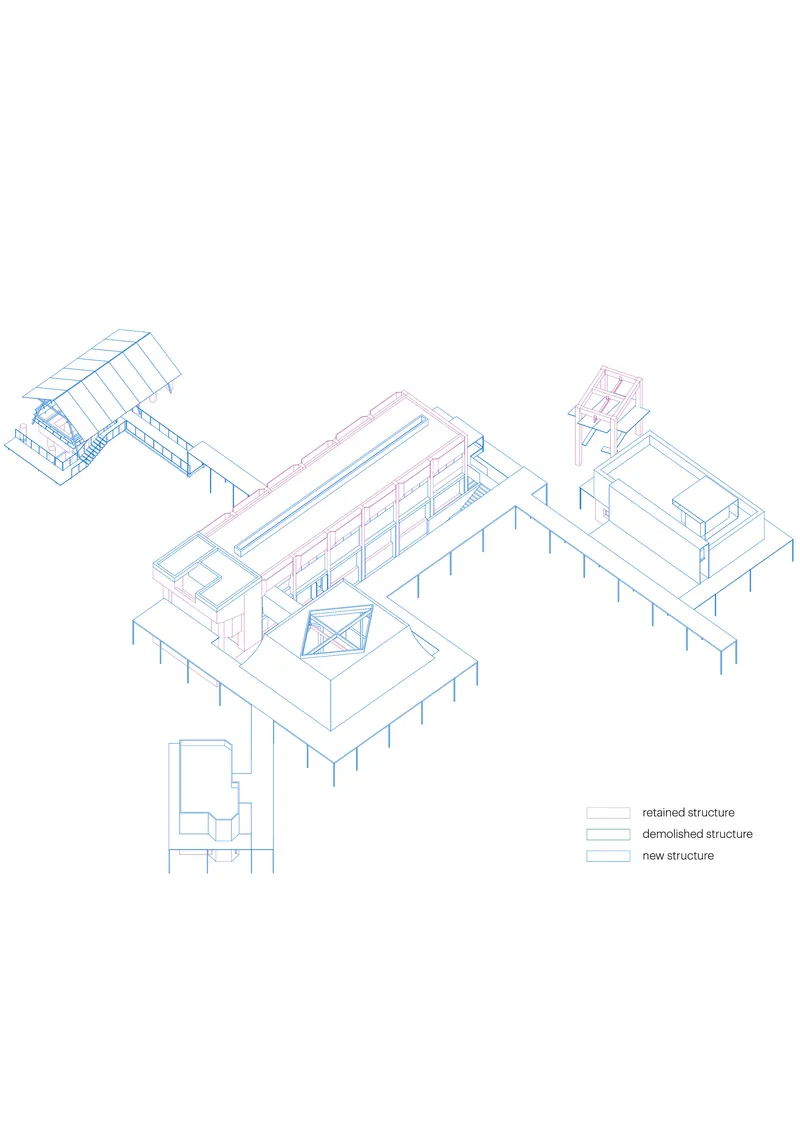
The site plan sequence reveals how the project evolved through careful phases of analysis and intervention. The curved island parcel, bounded by the lake on all sides and connected to an access road, contains rectilinear volumes organized around courtyards. The section drawings show multi-level structures with exposed framing nestled into the landscape, confirming that the new corridor system operates as a lightweight layer above and between the heavier existing masses.
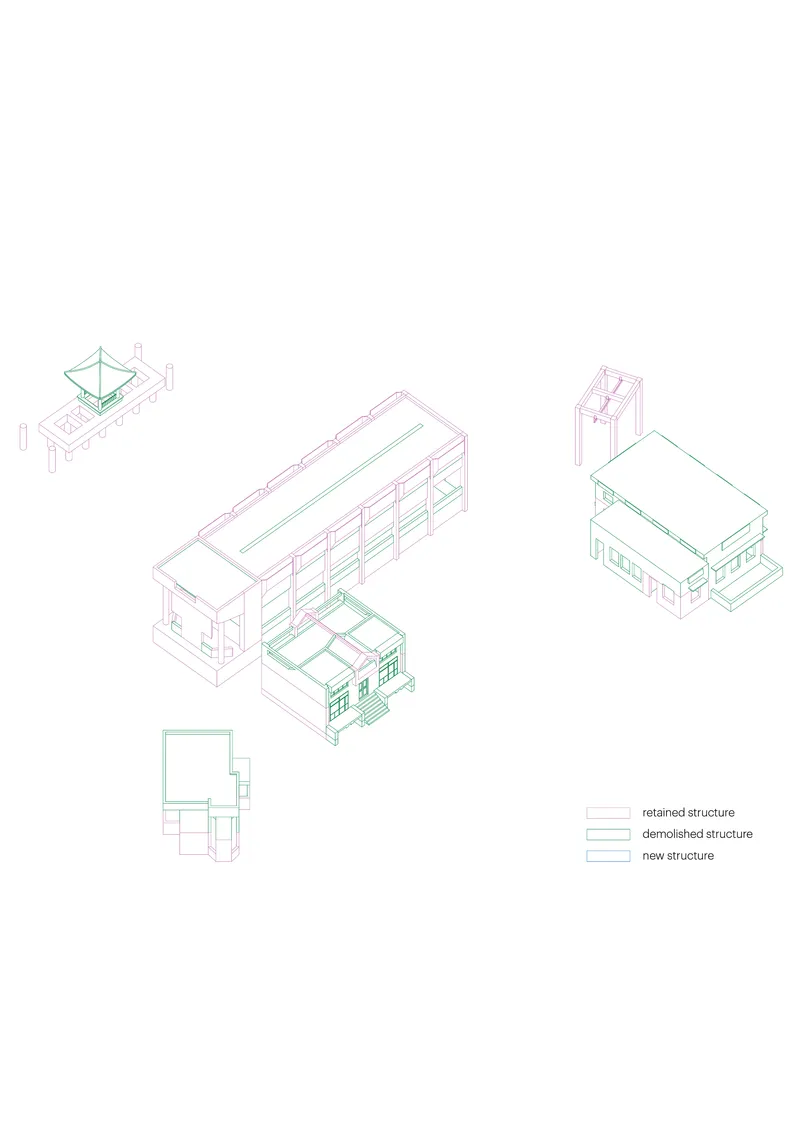
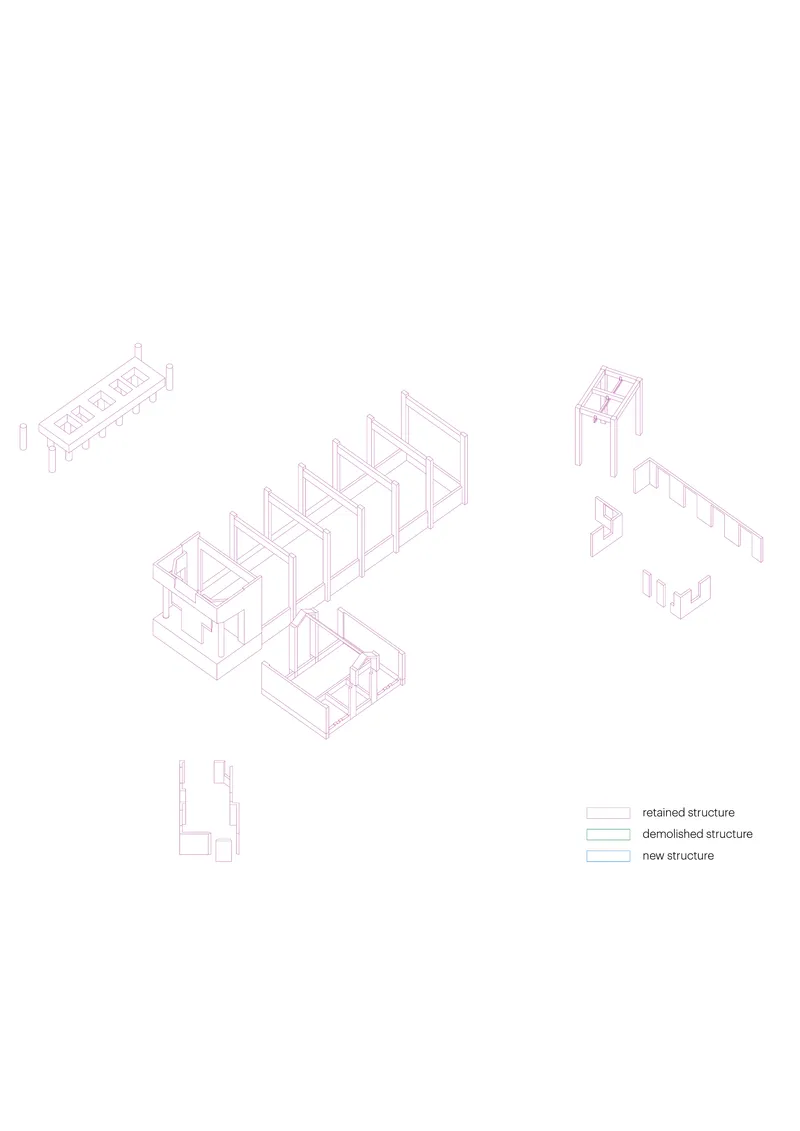
The axonometric drawings are especially instructive. A color-coded exploded view distinguishes retained structures from new insertions, while a companion drawing in purple linework maps the demolished elements, making visible what was removed as well as what was kept. The exploded axonometric displaying layered floor plates and roof structures reveals the project's tectonic strategy: existing floor slabs and walls carry the program, while new steel roofs and corridors provide shelter, connection, and identity. It is a legible system, precisely the kind of analytical clarity you want from a reuse project of this complexity.
Why This Project Matters
China's rural revitalization campaigns have produced a wide spectrum of cultural projects, from spectacular museum insertions to modest village libraries. The best of them resist the temptation to overpower their sites with architectural spectacle. Librairie Avant-Garde at Jianhu belongs firmly in this camp. Atelier Deshaus has treated a forgotten piece of water infrastructure not as a blank canvas but as a found condition to be carefully read, selectively edited, and generously opened to the public. The six original buildings are still recognizable as what they were, even as they now serve entirely different purposes.
The project also offers a persuasive model for how to make adaptive reuse legible without making it heavy-handed. The steel corridor system is clearly new, but it does not compete with the existing concrete and brick. The retained trees are not ornamental; they structure the spatial experience. And the decision to keep the boat dock functional, rather than converting it into yet another viewing platform, shows an understanding that program matters as much as form. This is a project where every decision serves the experience of being on an island, surrounded by water, holding a book. That sounds simple. Getting it right is not.
Librairie Avant-Garde at Jianhu, designed by Atelier Deshaus, Shaoxing, China. 830 m², completed 2024. Photography by Shengliang Su.
About the Studio
Share Your Own Work on uni.xyz
If projects like this are the kind of work you want to make, uni.xyz is a place to publish your own, find collaborators, and enter design competitions.


Popular Articles
Popular articles from the community


ETEH Reworks the Shared Spaces of São Domingos School in Brazil Around Timber, Color and Hanging Plants
At São Domingos School in Brazil, 436 m² of hall, refectory and library are recast with timber joinery, a yellow and blue code and trailing greenery.


Aquadapt: An Underwater Habitat That Rewrites Its Rooms by the Hour
Curved modules ring the seabed while one shell shifts from breakfast room to cinema, farm and football pitch as residents' needs change.

Cube Design Draws an Ecological Corridor Between Two Shenzhen Hills with the Nankai Building
Beside Shenzhen's container docks, the Nankai Building pairs stacked balconies with a climbing green screen to connect two hillsides across its height.

David Ortega Stacks a Two-Story Mexico City Penthouse Around a Steel Stair and a Pergola-Shaded Roof Terrace
In Colonia Roma, a 300 m² penthouse uses oak joinery, a planted steel stair and a slatted roof pergola to make a new-build apartment feel like a house.

Similar Reads
You might also enjoy these articles

LAVA Architecten Gives Vocational Education a Sawtooth-Roofed Face on a Mechelen School Campus
In Mechelen, Belgium, a 2,053 m² STEM school on a 6×6 m grid turns workshops and classrooms into rooms that can be rearranged as teaching changes.

KEMA Studio Turns a Derelict Marvila Attic into a 60 m² Lighthouse Apartment Above Lisbon
In Lisbon's Marvila district, a rebuilt roof, four skylights and two plywood volumes turn an unlivable attic into a bright home facing the Tagus.

Pixel Gardens: One Repeated Module Stacked Into a Terraced Social Housing Tower for Famagusta
Salem Bader's shortlisted housing tower builds a vertical neighbourhood from one repeated module, offsetting units to carve terraces, light and air.

Bao Huynh Watercolor Atelier: A Serene Art Retreat in Hội An
Bao Huynh Watercolor Atelier in Hội An blends multifunctional art spaces, sustainable design, local materials, and family-friendly living in a serene environment.

Explore Architecture Magazine Competitions
Discover active competitions in this discipline

Challenge to design public laboratory

Bring back Drive In's
Comments (0)
Please login or sign up to add comments
No comments yet. Be the first to comment!