

Atelier DRK Grafts a Cantilevered Timber Volume onto Stone Ruins in Serra da Estrela
Two pre-existing buildings in Videmonte, Portugal become a mountain retreat where granite walls meet pale timber cantilevers.


Serra da Estrela Natural Park is not the kind of place that tolerates architectural posturing. Its granite terraces, wild meadows, and shifting light have a way of humbling anything too conspicuous. So when Atelier DRK, led by Diogo Aguiar Almeida, took on the task of transforming two pre-existing buildings in Videmonte into the TerraSense Mountain Charm Retreat, the primary challenge was legibility: how to add new volume and new purpose without betraying the material logic that already saturated the site.
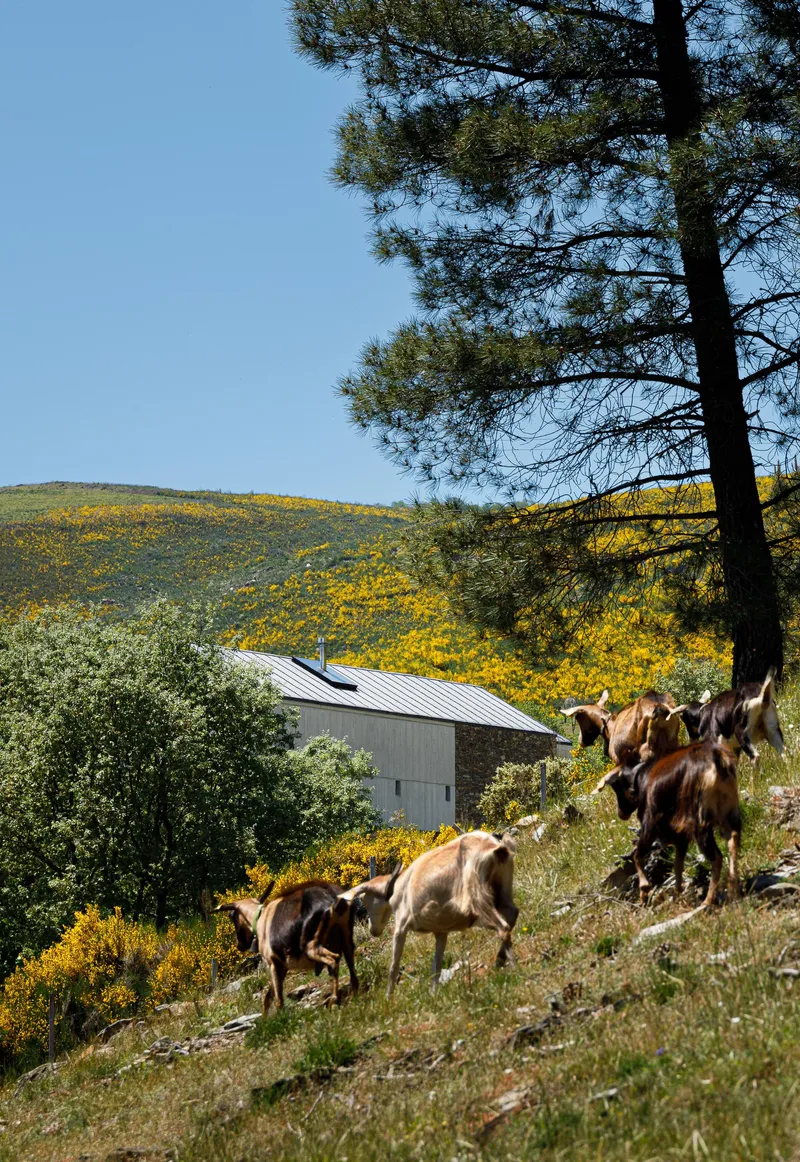
What makes this project genuinely interesting is the directness of the confrontation between old and new. There is no gradual blending, no camouflage. Stacked fieldstone walls rise from the terraced hillside as they have for generations, and then, right on top, pale timber-clad volumes cantilever out over the meadow with an almost defiant confidence. The two registers read clearly as separate moments in time, yet they lock together structurally and spatially through concrete plinths, skylights, and carefully punched openings that draw the landscape into every room.
Stone Below, Timber Above
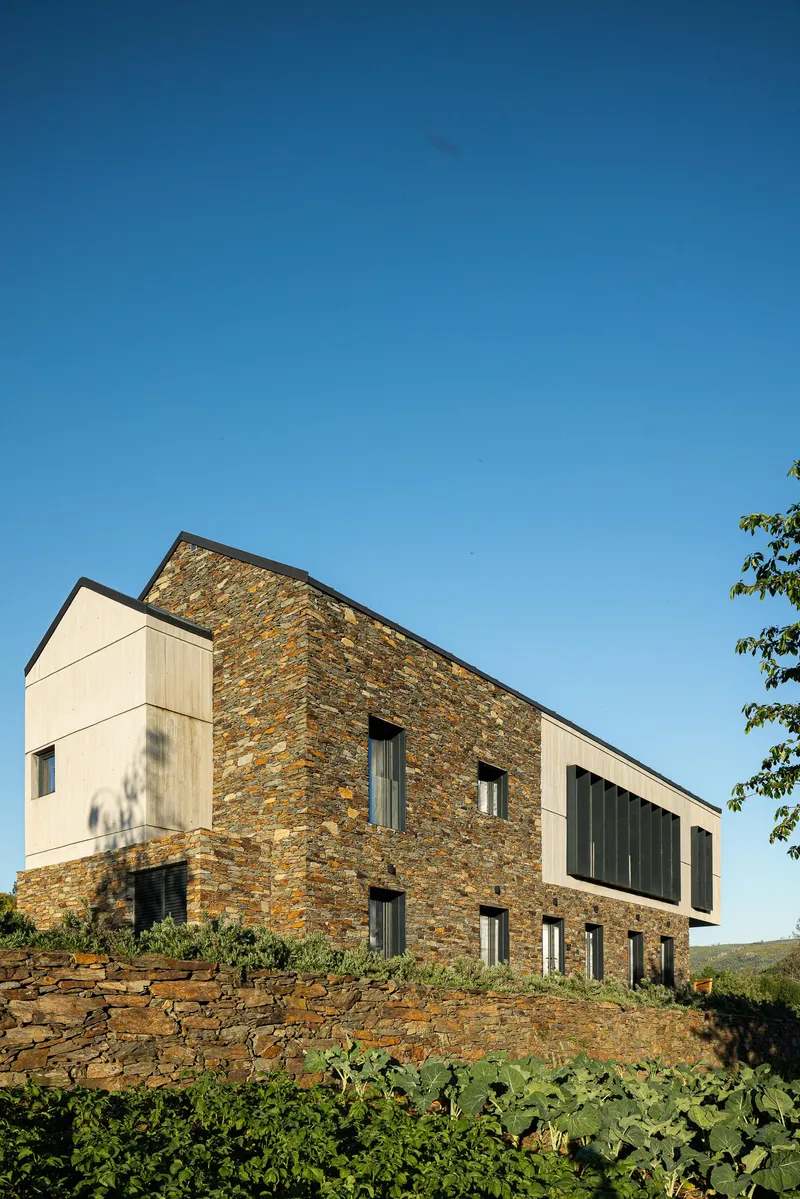
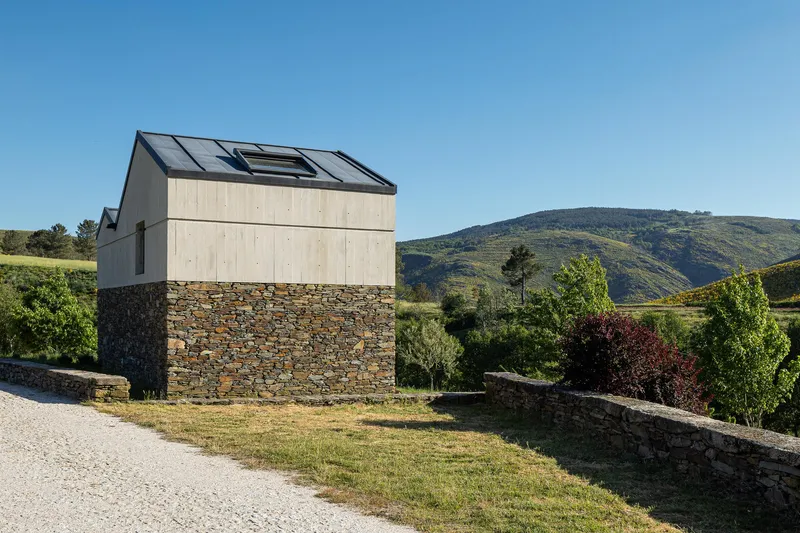
The compositional strategy is almost diagrammatic. Heavy, rough-cut granite anchors the buildings to the slope. Above, the new volumes are clad in vertical timber panels finished to a warm, pale tone that catches the mountain light differently at every hour. The gabled profile echoes the vernacular silhouette of Serra da Estrela farm buildings without mimicking their proportions. It is taller, sharper, and deliberately lighter in mass, which lets the eye distinguish the intervention at a glance.
Standing seam metal roofs reinforce the contemporary reading. They fold tightly over the timber volumes, creating a continuous skin that sheds rain and snow cleanly. The result is a layered section: stone, concrete, timber, metal, each material performing a specific structural and expressive role.
The Cantilever as Threshold
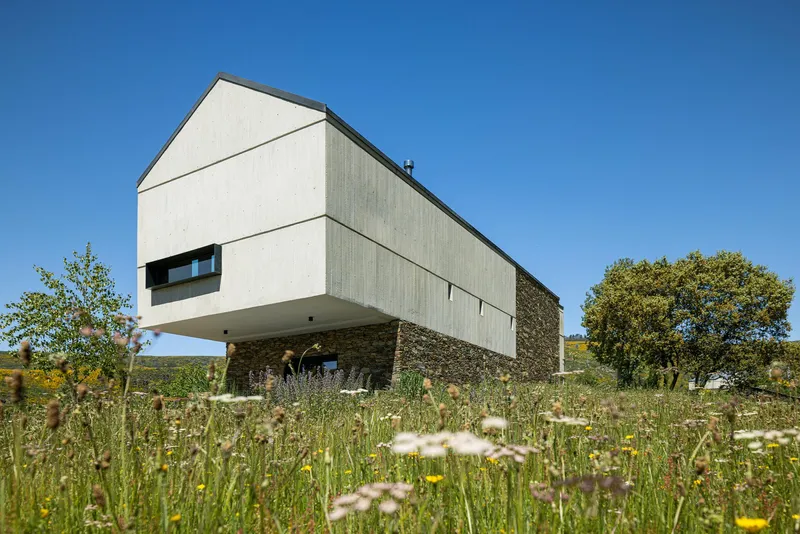
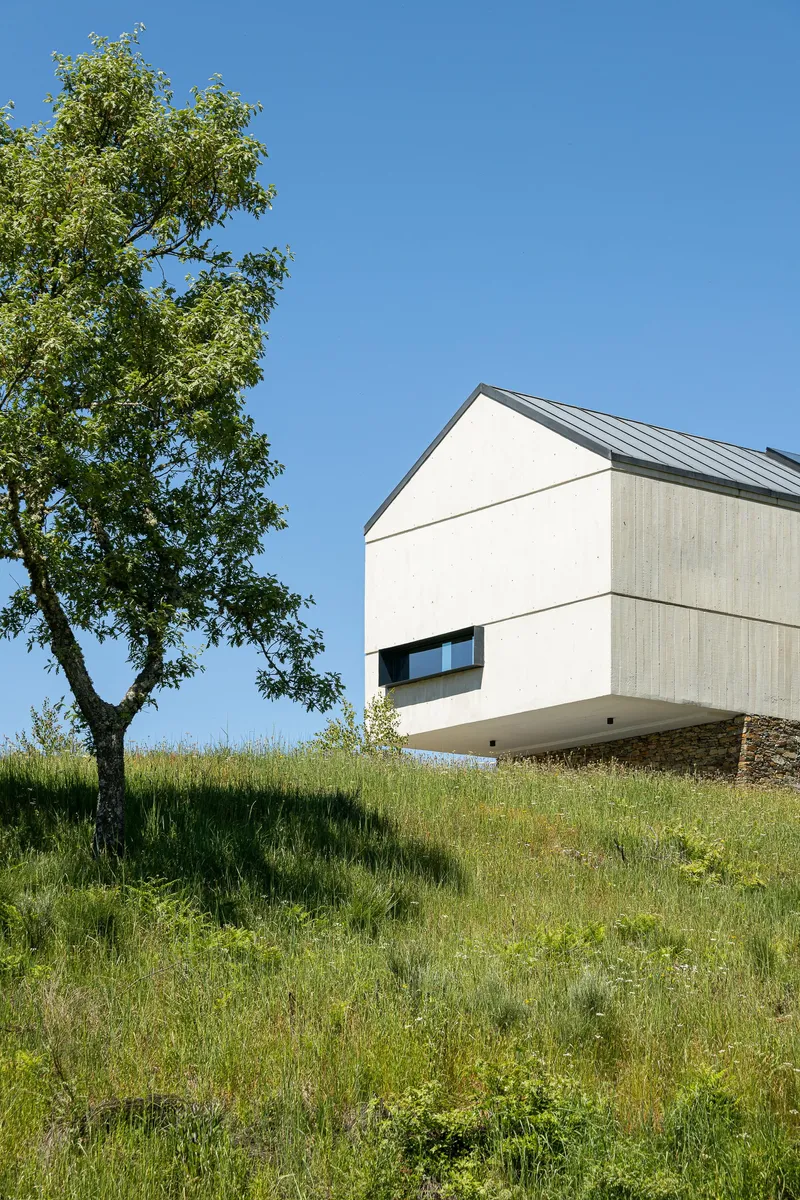
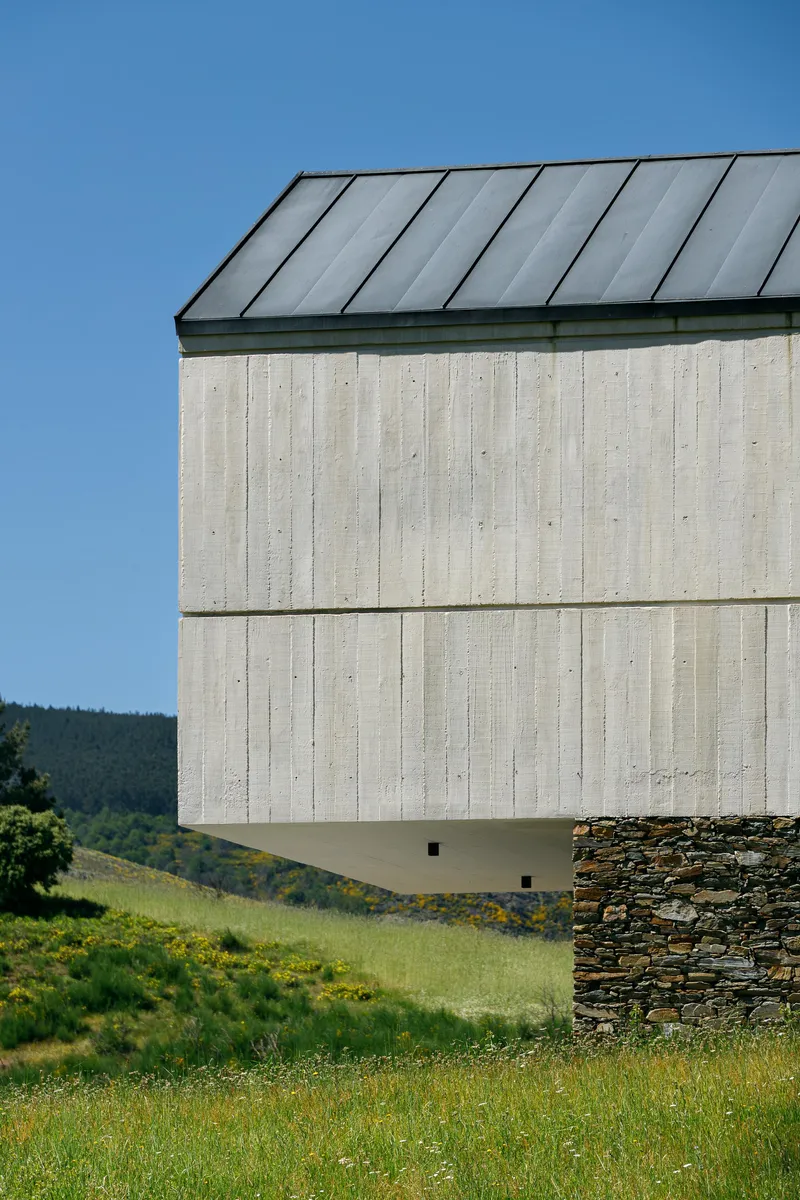
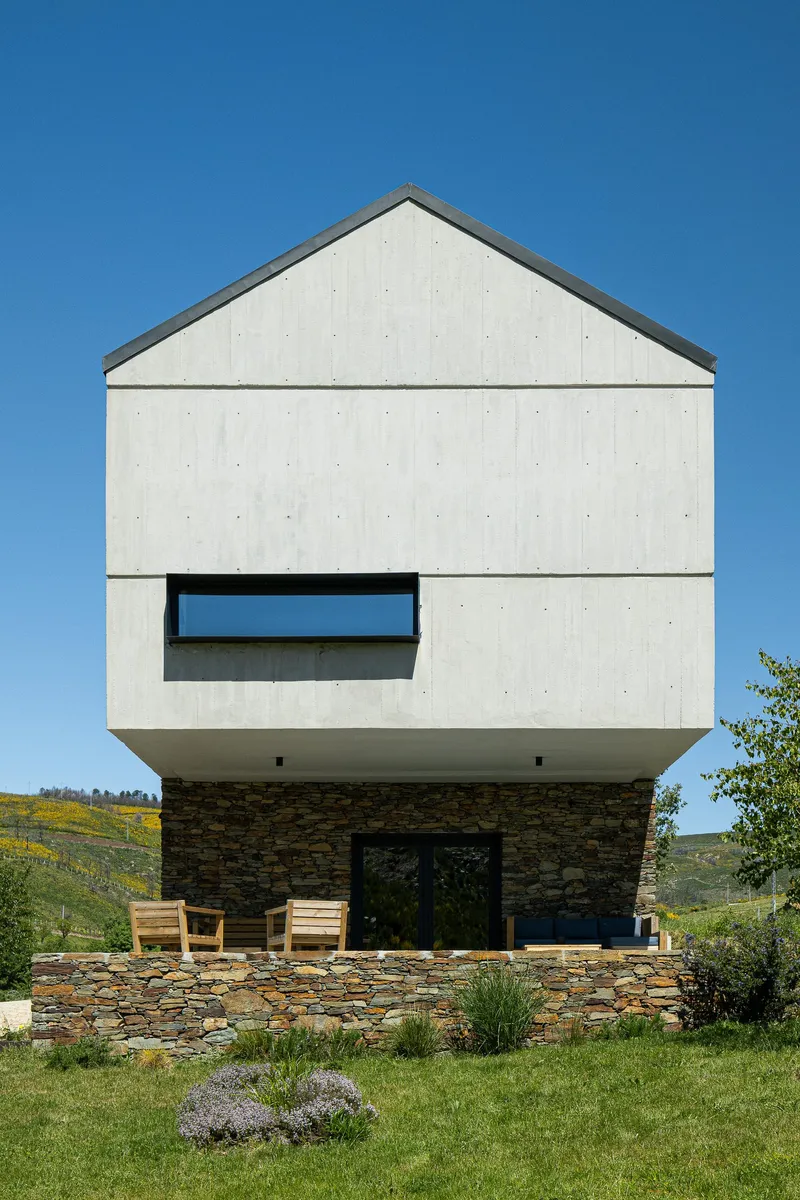
Several moments in the project push the upper volume beyond the footprint of the stone base, creating cantilevered overhangs that shelter sunken courtyards, entrance paths, and terraces below. These are not decorative gestures. They produce a shaded zone of transition between the raw landscape and the interior, a compressed space where you register the weight of the building above before stepping inside.
The cantilever also frames the meadow. From below, the underside of the concrete slab is visible, board-formed and honest. From above, ribbon windows offer panoramic views that feel earned precisely because the structure has reached out to claim them. It is a simple move, but it does a lot of work: defining entry, creating shelter, directing views, and expressing the relationship between old foundation and new ambition.
Landscape Integration
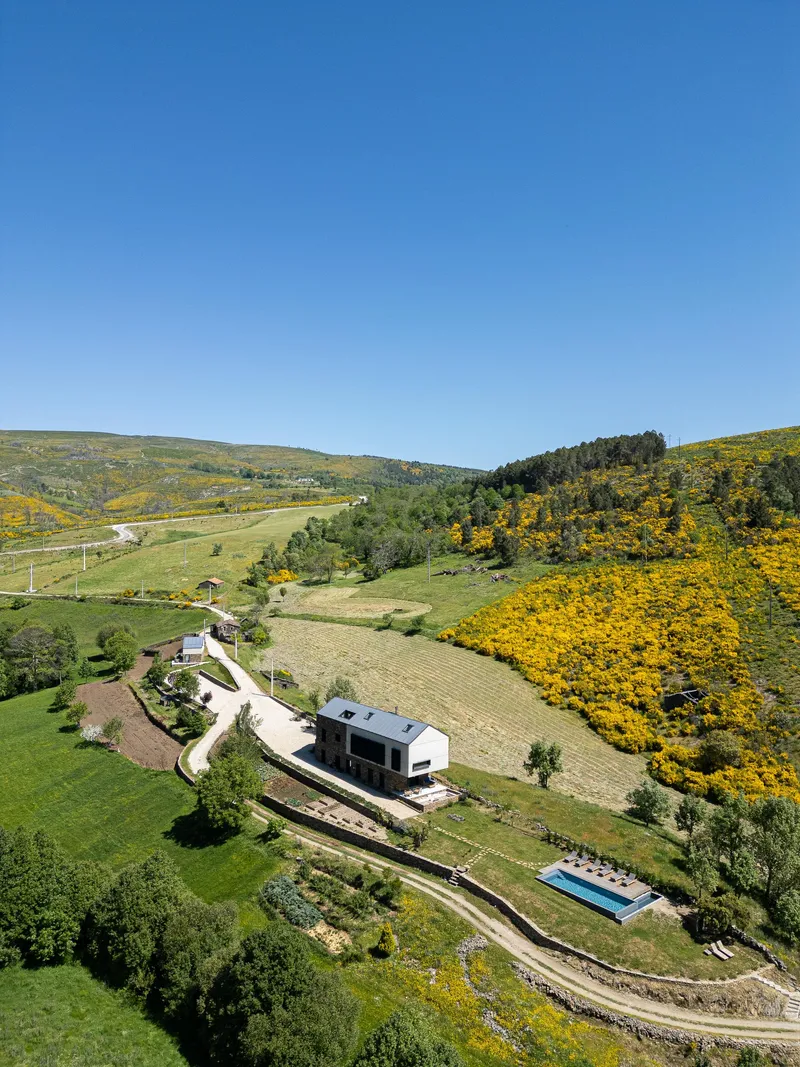
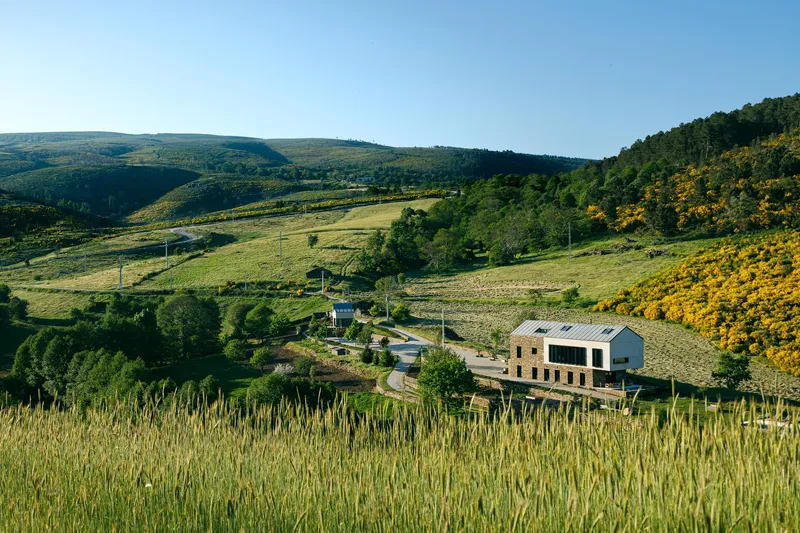
Seen from the air, the retreat reveals its true scale and context. The building sits within a lattice of terraced stone walls, vineyards, and wheat fields that cascade down the hillside. A swimming pool occupies one of the lower terraces, its geometry aligned with the cobblestone paths and retaining walls that have organized this landscape for centuries. Wildflowers and yellow flowering shrubs blur the boundary between garden and agricultural land.
Atelier DRK resisted the temptation to over-landscape the immediate surroundings. Grasses grow right up to the stone base. Goats graze on adjacent slopes. The building participates in the productive landscape rather than separating itself from it, an approach that feels both ecologically honest and programmatically appropriate for a rural retreat.
Material Choreography Inside
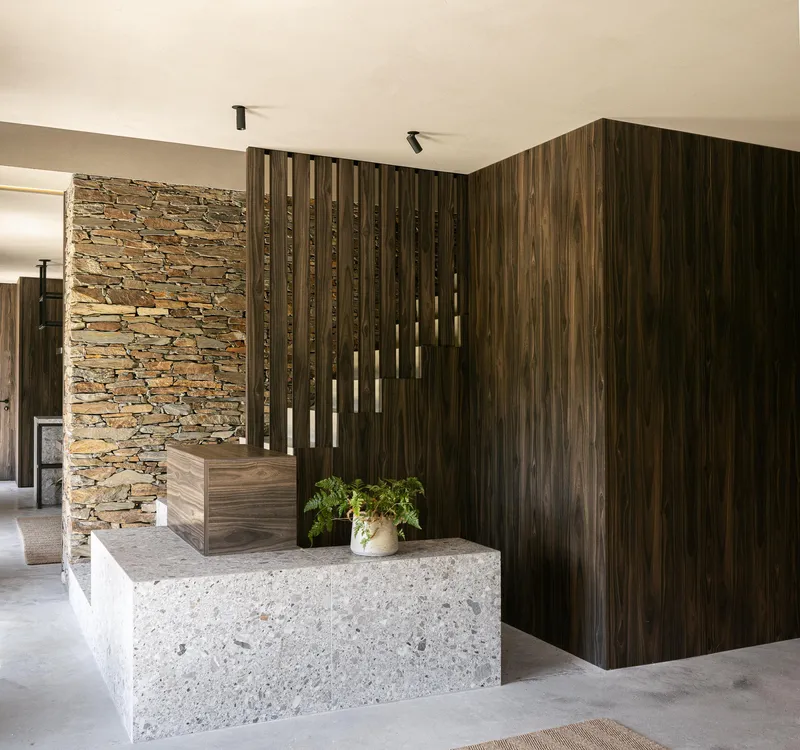
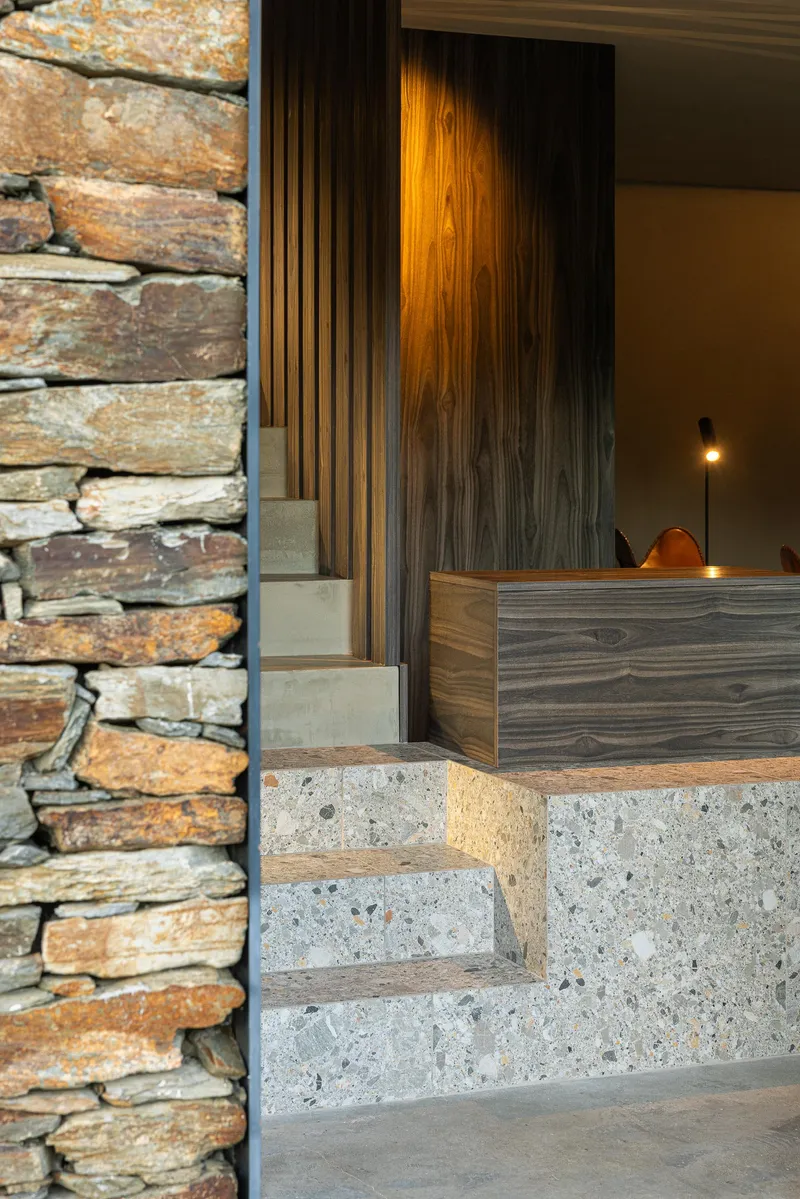
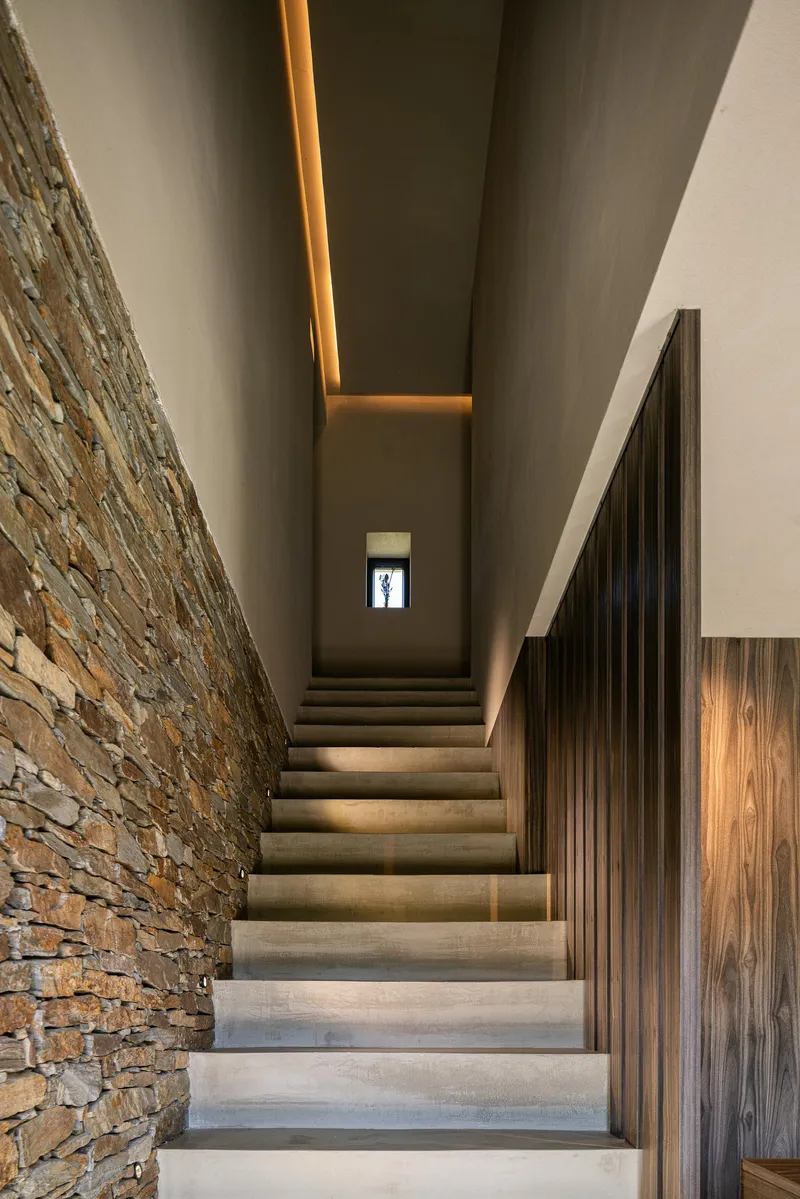
The interior entry sequence sets the tone: a stacked stone wall meets a vertical timber slat screen beside a terrazzo reception counter, each material touching the next without concealment. Polished concrete steps lead deeper into the building, lit from above by recessed ceiling slots. The material palette is restrained, three or four surfaces doing the heavy lifting, but the quality of the junctions is where the design really shows its hand.
Board-formed concrete, wood-grain paneling, and rough granite walls coexist without hierarchy. The staircase is a particularly precise moment: a concrete volume inserted between the existing stone wall and the new timber lining, the joint between them expressed as a narrow shadow gap that reads as a seam between eras.
Living Spaces and Light
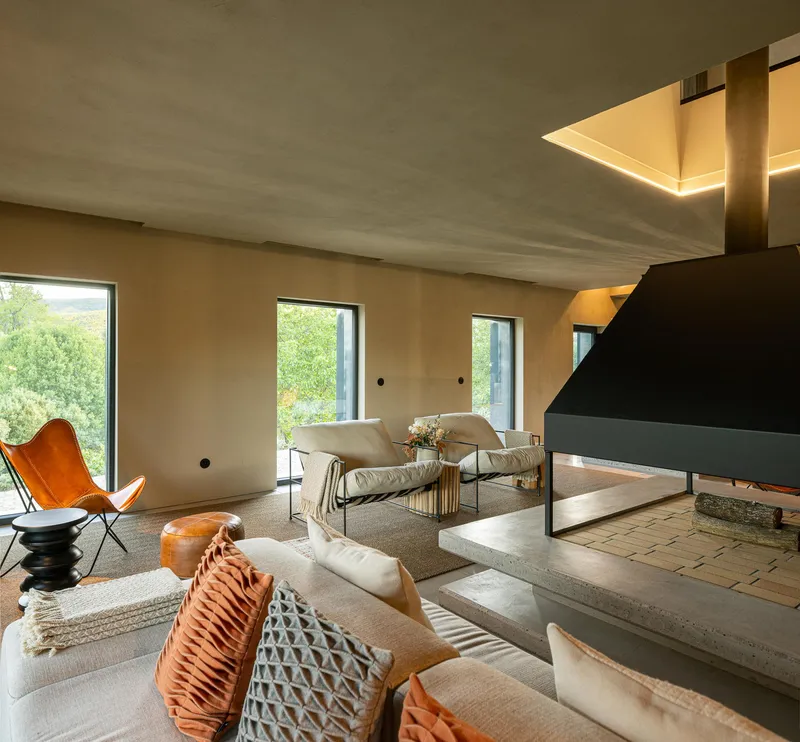
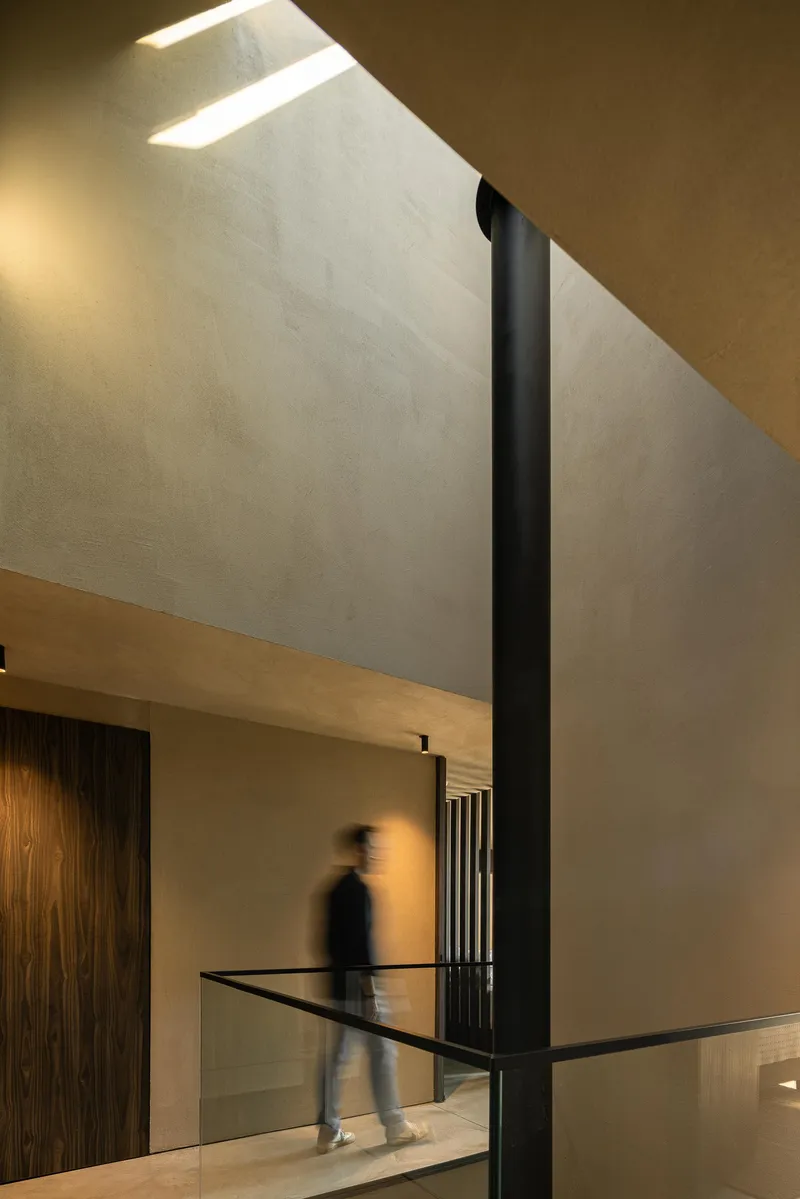
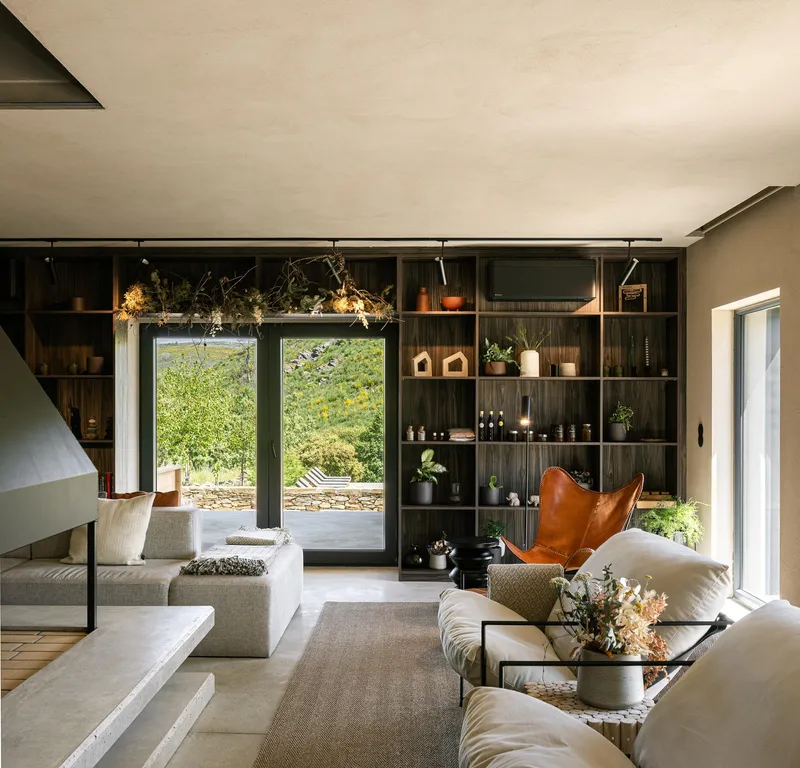
Common areas are organized around sources of natural light that punctuate the section. A fireplace sits beneath a skylight, so the hearth glows even in daylight. A double-height hallway is carved through the upper volume, its angled skylight throwing a blade of light across plaster walls while a glass balcony allows glimpses across levels. These vertical connections keep the interior from feeling compartmentalized despite the building's compact footprint.
Dark timber shelving walls in the living spaces serve a dual purpose: they provide storage and display while acting as thickened partitions that frame glazed openings to the landscape. The effect is cinematic. Views are never accidental; they are cropped and composed by the depth of the wall assembly.
Guest Rooms and Private Spaces
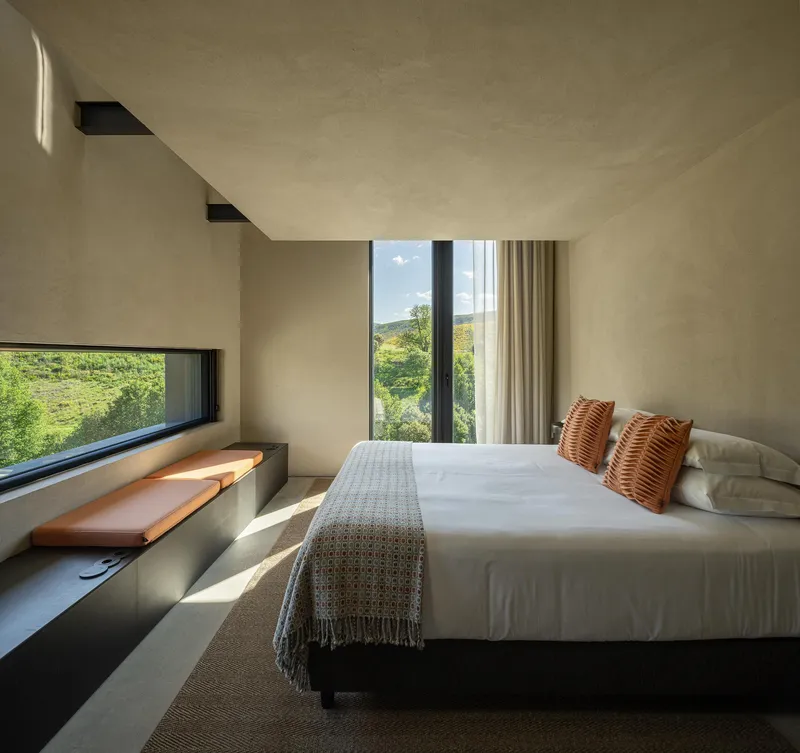
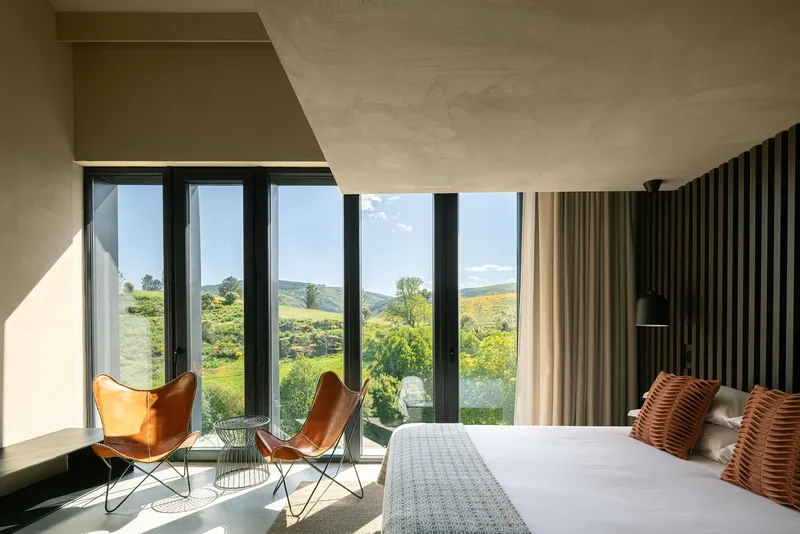
Bedrooms are generously glazed, with floor-to-ceiling windows that place the green hillside directly in the field of vision from the bed. Concrete window seats encourage lingering, turning the threshold between inside and outside into a habitable zone. Vertical slat headboards and wood-grain paneled sliding doors maintain the material continuity of the public areas but at a softer, more intimate register.
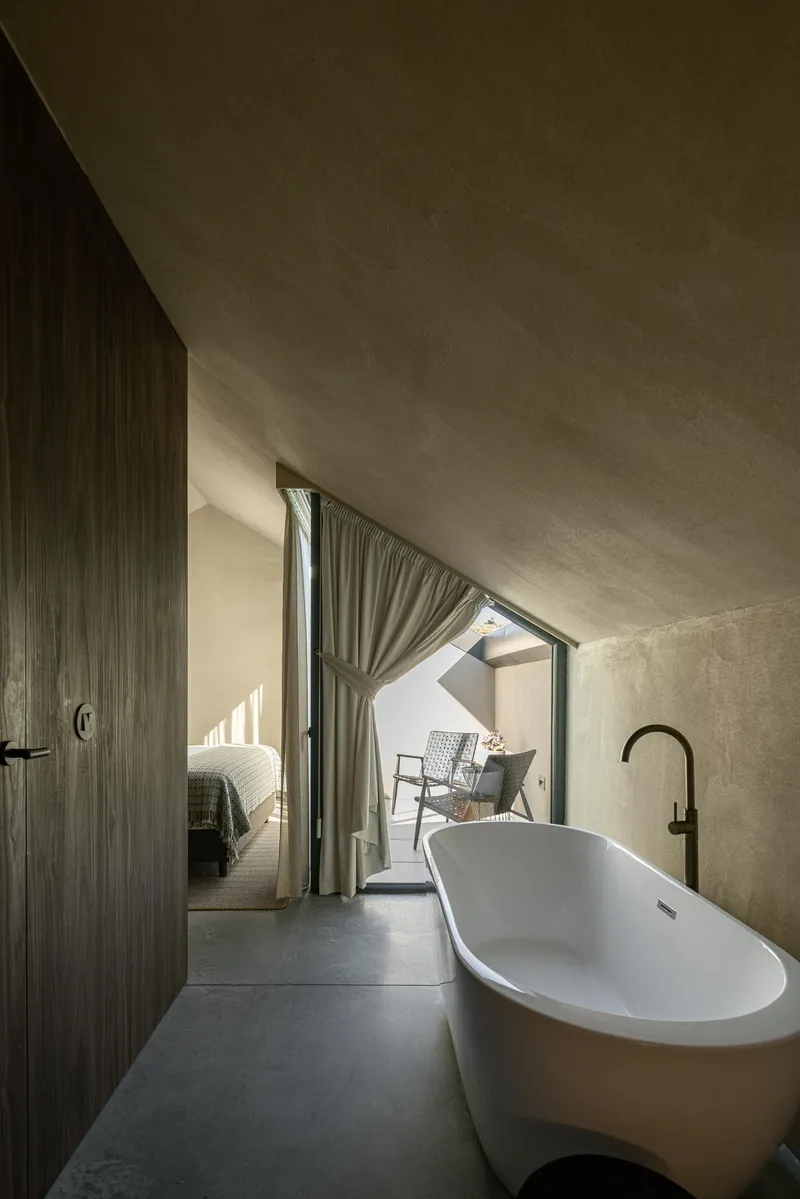
The bathrooms deserve particular mention. A freestanding white bathtub beneath a curved plaster ceiling opens through sheer curtains to a terrace flooded with sunlight. It is a luxurious gesture, but grounded by the restraint of the surrounding materials. No marble, no excess. Just light, plaster, and the landscape.
Outdoor Rooms
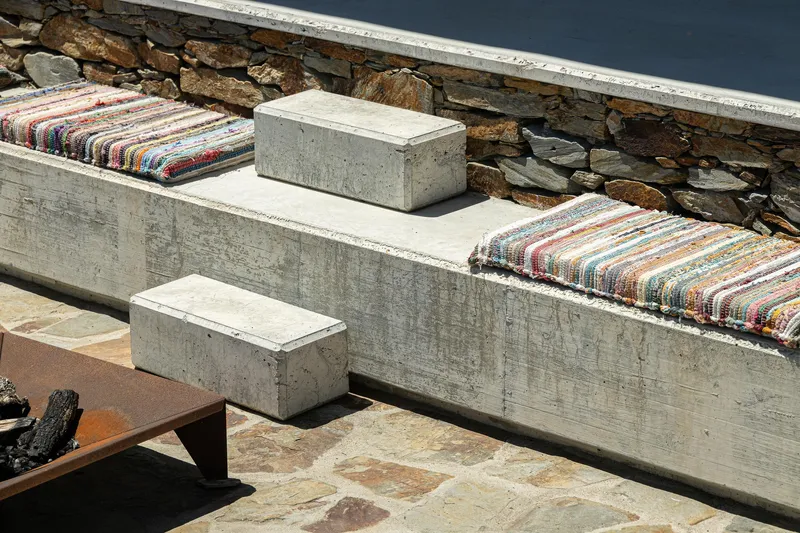

The terraces function as genuine outdoor rooms rather than leftover spaces. Board-formed concrete benches with striped cushions and stone side tables sit against a sunlit stone wall, creating a scene that feels both designed and completely natural. The pool terrace, with its timber deck and loungers, occupies a lower level that connects to the agricultural terracing of the hillside, so the act of swimming becomes a way of inhabiting the landscape at a different altitude.
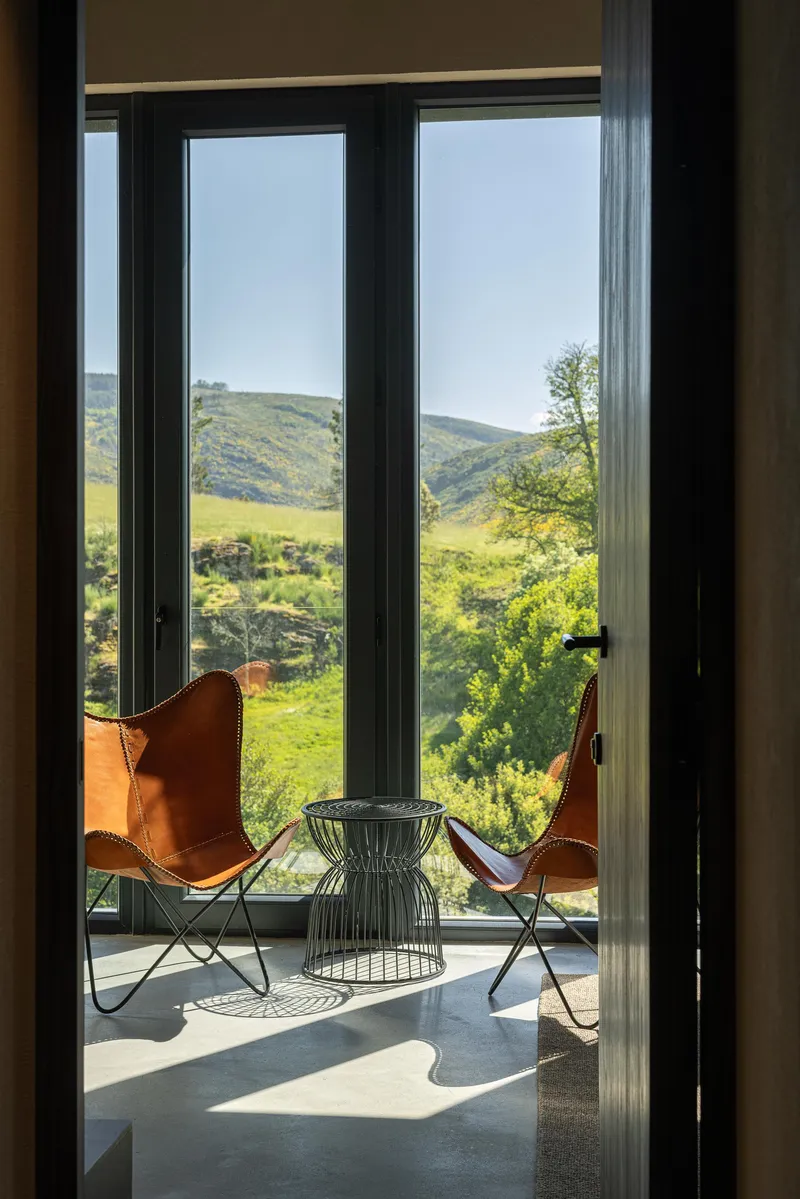
Glass doors throughout the building open onto balconies and terraces that frame specific views: the green valley, the scattered pines, the cobbled path winding uphill. Leather butterfly chairs and metal cafe furniture populate these thresholds, suggesting a casual inhabitation that the architecture encourages without prescribing.
Dusk Readings
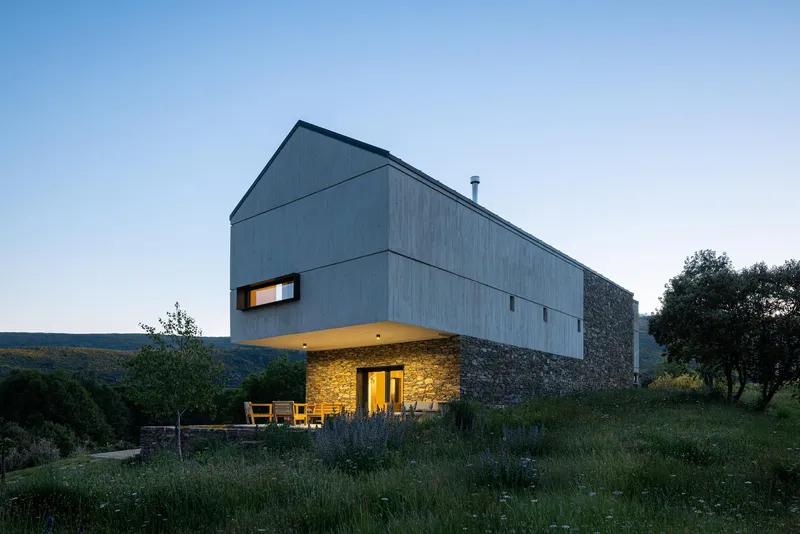
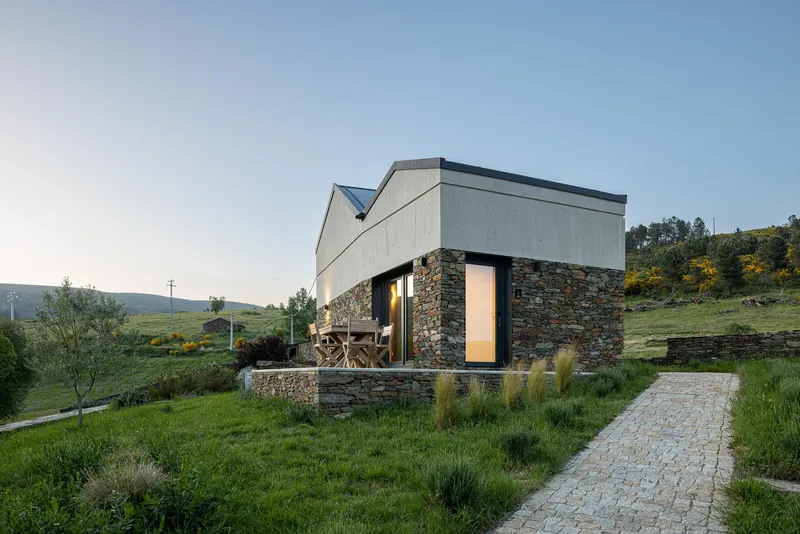
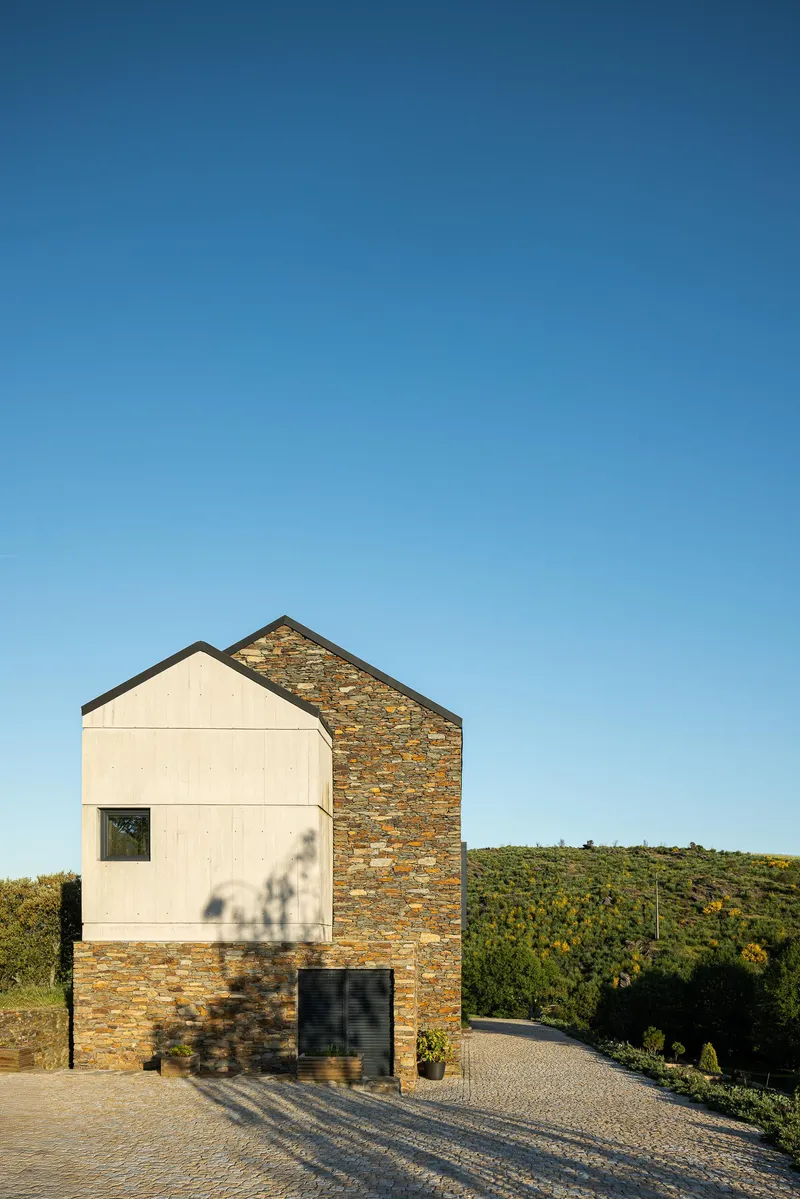
At twilight, the retreat reveals a second character. The illuminated entrance beneath the cantilevered timber volume glows warmly against the darkening stone base. The contrast between pale-paneled and stone-clad gable walls sharpens as shadows deepen. Window openings become lanterns, broadcasting interior life outward across the hillside. It is at this hour that the building's dual nature, ancient and contemporary, registers most powerfully.
Plans and Drawings
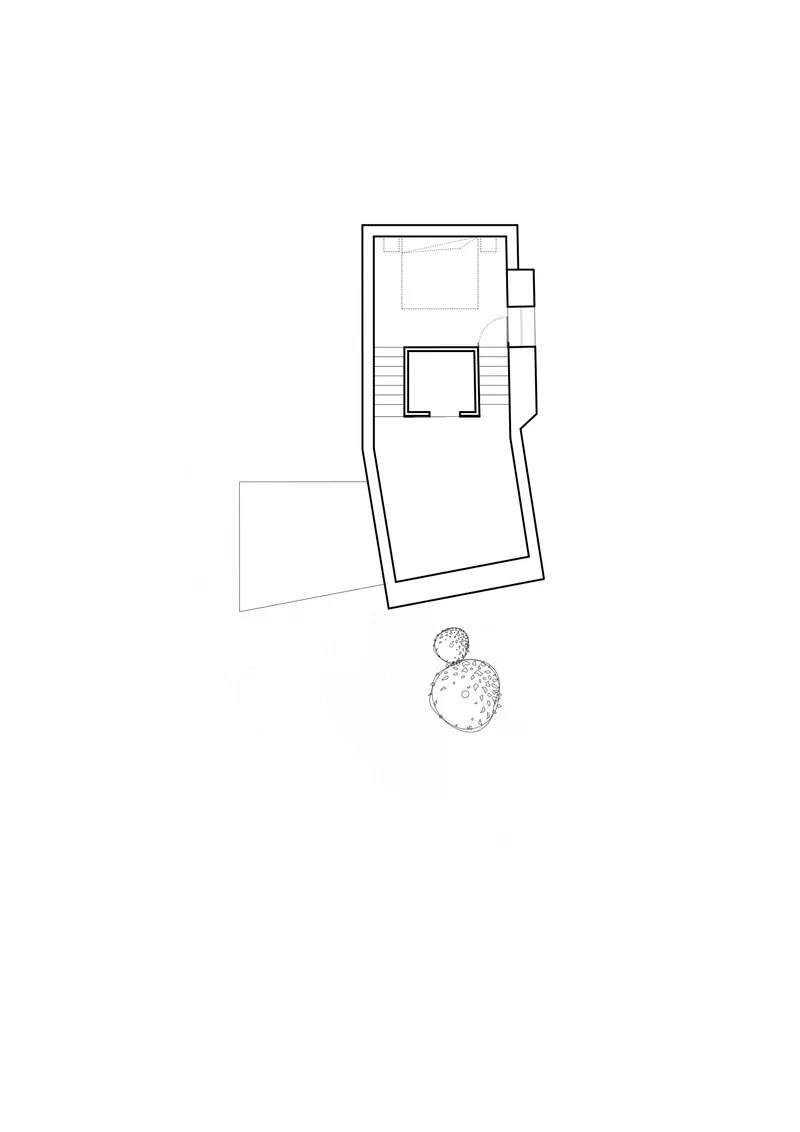

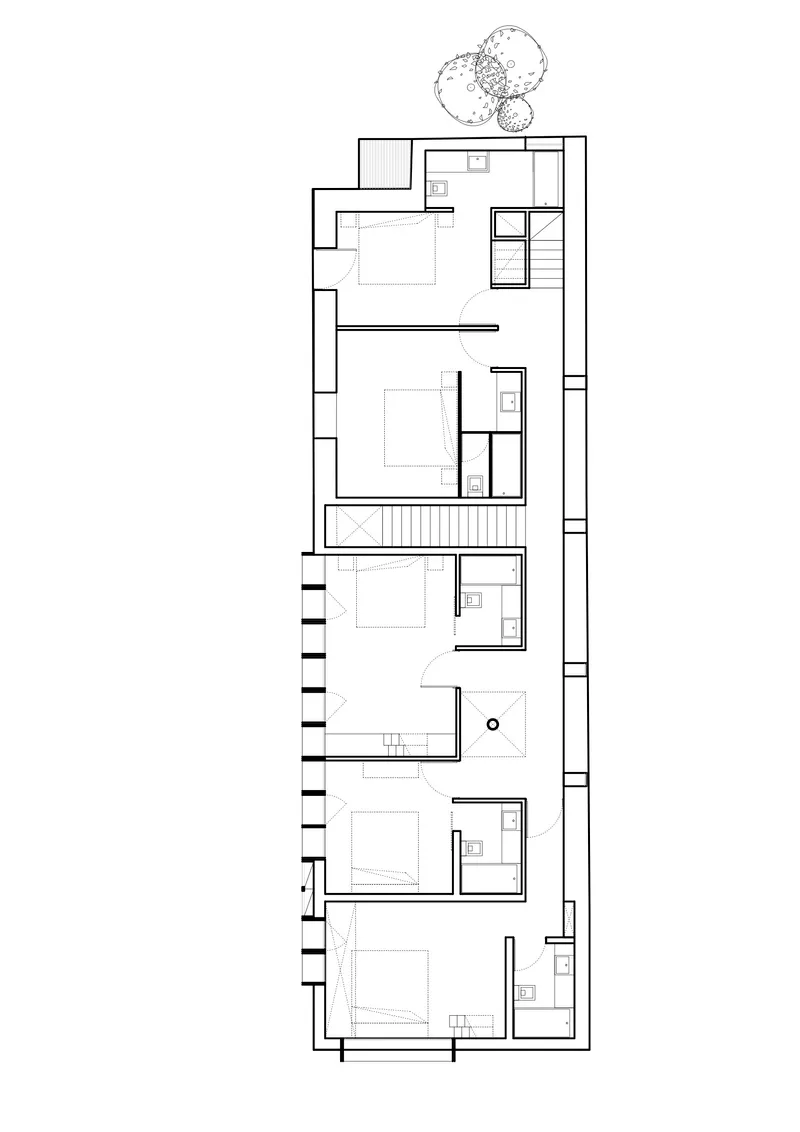
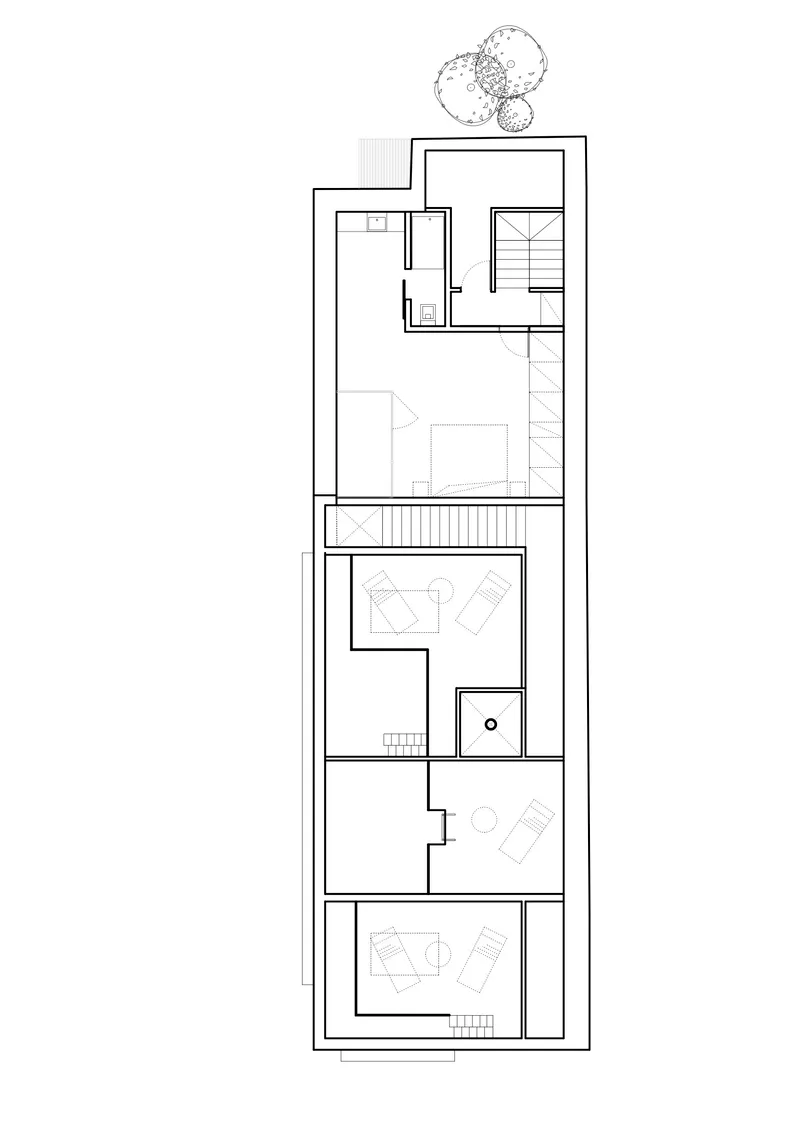
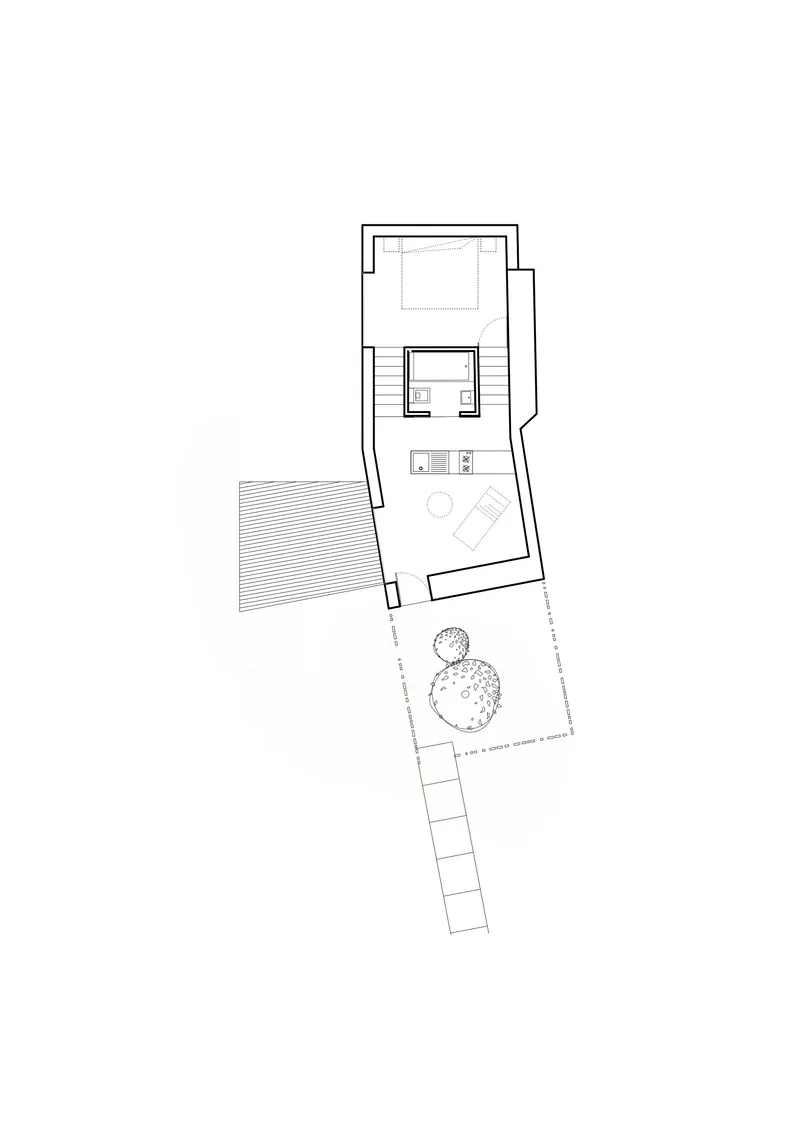
The plan drawings confirm what the photographs suggest: rooms are organized around a central staircase that mediates between levels carved into the hillside. The ground floor houses the kitchen, dining area, and reception, while bedrooms stack on the first floor with private bathrooms arranged along the perimeter. Upper levels open into living spaces that extend across multiple split levels, with skylights positioned at the highest points. The site plan shows the building footprint embedded within a grove of trees, its angled geometry rotated slightly off the slope contours to capture specific views.
Why This Project Matters
Rural adaptive reuse in Portugal is not new territory, but it has become an increasingly contested one. Too many projects in the countryside treat vernacular buildings as scenography, gutting their spatial logic and wrapping the remains in minimalist interiors for Instagram. Atelier DRK's approach is more honest. The existing stone structures are not dressed up or smoothed over; they are allowed to remain rough, structural, and present. The new volumes are clearly new, confidently different in material and profile, yet calibrated to the scale and rhythm of the terraced landscape.
TerraSense succeeds because it understands that the tension between old and new is the project. Rather than resolving that tension into a seamless whole, the design holds it open, letting guests experience the weight of granite and the lightness of timber as complementary conditions. It is a retreat that teaches you something about its place, not by lecturing, but by framing every window, every threshold, and every material joint as an invitation to look more carefully.
TerraSense Mountain Charm Retreat, Videmonte, Portugal. Architect: Atelier DRK, led by Diogo Aguiar Almeida. Completed 2023. Photography by Ivo Tavares Studio.
About the Studio
Share Your Own Work on uni.xyz
If projects like this are the kind of work you want to make, uni.xyz is a place to publish your own, find collaborators, and enter design competitions.


Popular Articles
Popular articles from the community


GROUP A Strips a 1969 Rotterdam Harbor Headquarters to Its Frame and Wraps It in Timber Louvers
In Rotterdam's M4H harbor district, Ferro Offices reuses a 1969 frame, adds one timber storey and reaches BREEAM-NL Outstanding.

longwave studio Reorganizes a 112 m² Tainan Apartment Around the Daily Routines of a Family and Two Cats
In Tainan, Taiwan, birch plywood, rust-red furniture and a freestanding plaster wall link arrival, storage, work and family life in one apartment.

Cube Design Draws an Ecological Corridor Between Two Shenzhen Hills with the Nankai Building
Beside Shenzhen's container docks, the Nankai Building pairs stacked balconies with a climbing green screen to connect two hillsides across its height.

Architekt Andreas Gruber Scatters 23 Dark Timber Chalets Across a South Tyrolean Forest Edge
In Molini di Tures, Amonti Chalets breaks a resort into a hamlet of gabled timber houses, with parking, storage and services pushed into the slope.

Similar Reads
You might also enjoy these articles


LAVA Architecten Gives Vocational Education a Sawtooth-Roofed Face on a Mechelen School Campus
In Mechelen, Belgium, a 2,053 m² STEM school on a 6×6 m grid turns workshops and classrooms into rooms that can be rearranged as teaching changes.

KEMA Studio Turns a Derelict Marvila Attic into a 60 m² Lighthouse Apartment Above Lisbon
In Lisbon's Marvila district, a rebuilt roof, four skylights and two plywood volumes turn an unlivable attic into a bright home facing the Tagus.

Pixel Gardens: One Repeated Module Stacked Into a Terraced Social Housing Tower for Famagusta
Salem Bader's shortlisted housing tower builds a vertical neighbourhood from one repeated module, offsetting units to carve terraces, light and air.

Bao Huynh Watercolor Atelier: A Serene Art Retreat in Hội An
Bao Huynh Watercolor Atelier in Hội An blends multifunctional art spaces, sustainable design, local materials, and family-friendly living in a serene environment.

Explore Landscape Design Competitions
Discover active competitions in this discipline

Comments (0)
Please login or sign up to add comments
No comments yet. Be the first to comment!