
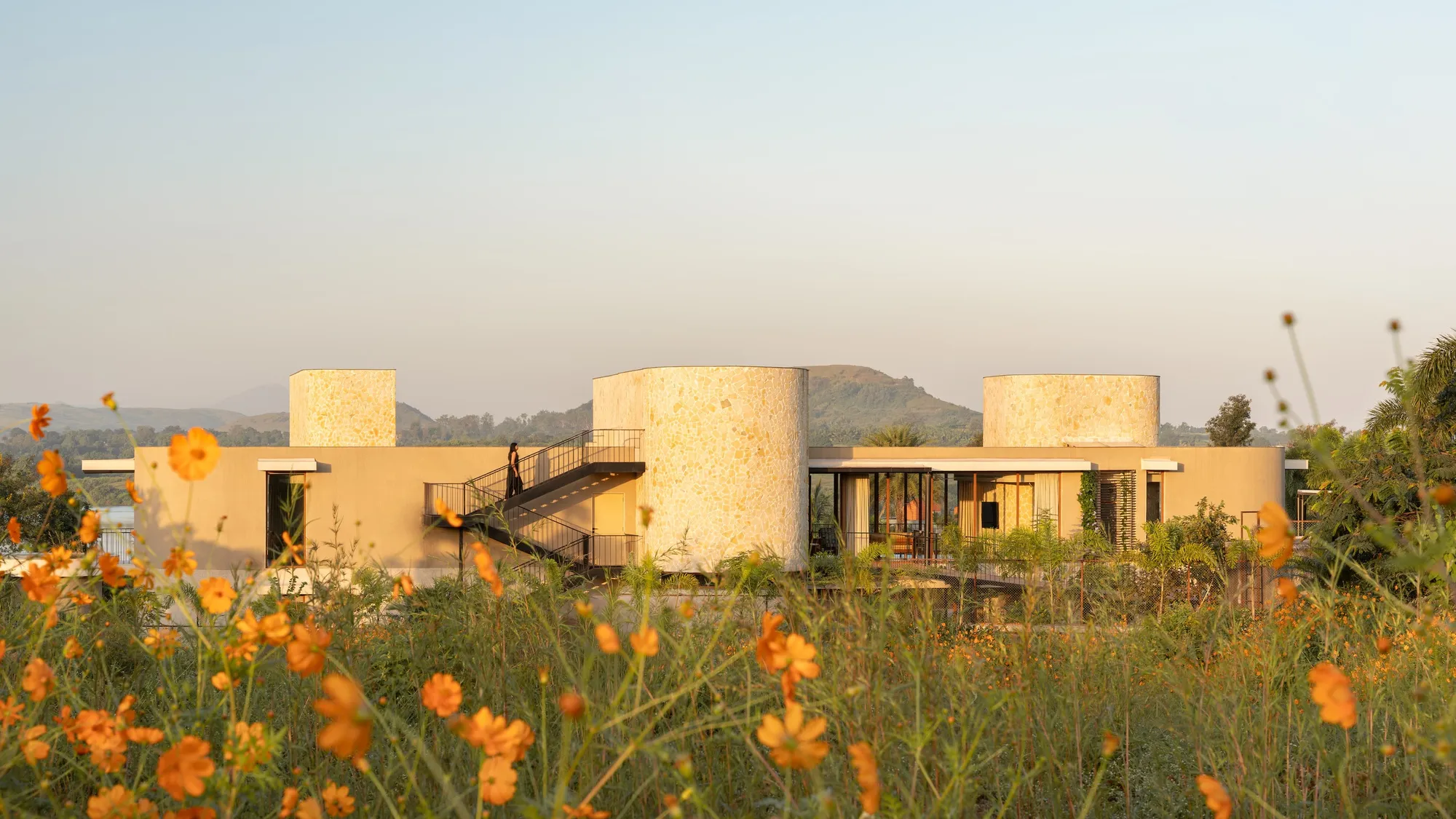
Atelier Landschaft Wraps a Lakeside Micro-Resort in Stone Cylinders at the Edge of an Indian Dam
Amoha Villas clusters bedrooms inside sculpted towers overlooking the Gautami Godavari reservoir in Beze, India.


Most boutique resorts in rural India default to one of two postures: either a polite regionalism that mimics local craft or a glossy minimalism that ignores context entirely. Amoha Villas, designed by Atelier Landschaft on the fringe of the Gautami Godavari dam in Beze, India, does neither. Instead, the practice organizes a six-bedroom villa and three cottages around a family of cylindrical stone towers, forms that read simultaneously as ancient grain silos and contemporary sculptural objects. Completed in 2025, the project is a micro-resort whose plan and massing treat each bedroom as an autonomous volume rather than a cell in a corridor.
What makes the project genuinely interesting is the disciplined interplay between the heavy, opaque cylinders and the thin, transparent glazed bands that stitch them together. The towers anchor the composition to the sloping site while the glass walls dissolve at exactly the moments you want to see the reservoir and the distant hills. It is a building that knows when to frame and when to open, and it does so without sentimentality.
Cylinders and Curtain Walls
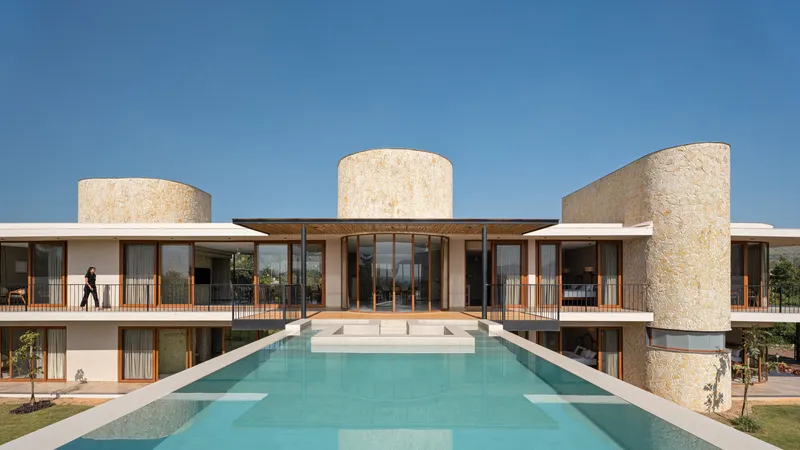
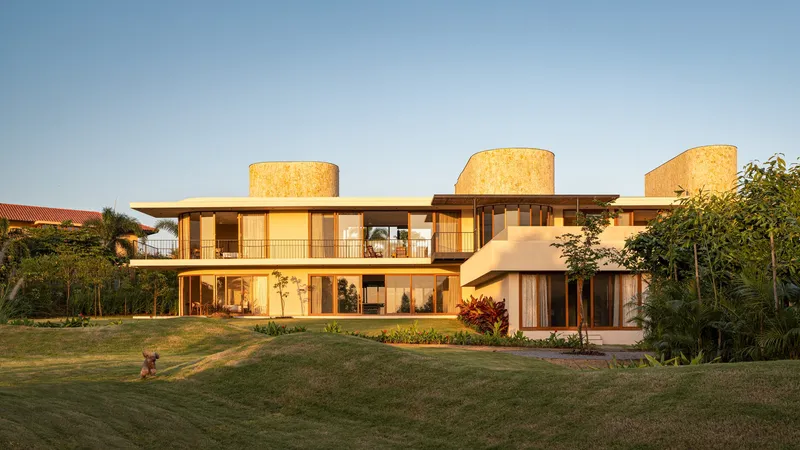
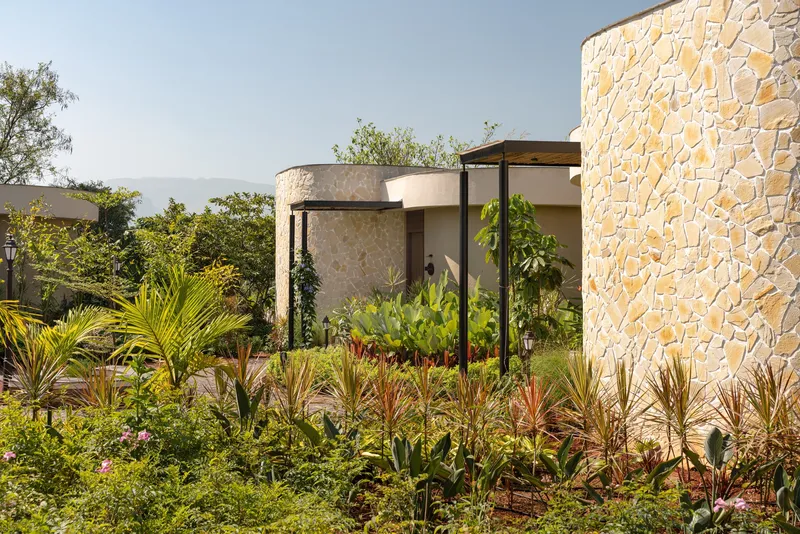
The signature move is the trio of cylindrical stone-clad towers that punctuate both the villa and cottage elevations. From the rear, they read as massive, grounded elements flanking a glazed living volume that floats above a reflecting pool. At sunset, the cork-toned cladding catches warm light and the horizontal glazing bands recede into shadow, exaggerating the towers' mass. The cylinders are not ornamental. They house bedrooms, each with its own orientation and degree of enclosure, turning what could have been a repetitive plan into a sequence of distinct spatial experiences.
Between towers, floor-to-ceiling timber-framed glass walls handle the social program: living, dining, and terrace spaces that borrow the panoramic landscape. The result is a rhythmic facade of solid, void, solid, void, legible from every approach but never monotonous.
The Landscape as Infrastructure
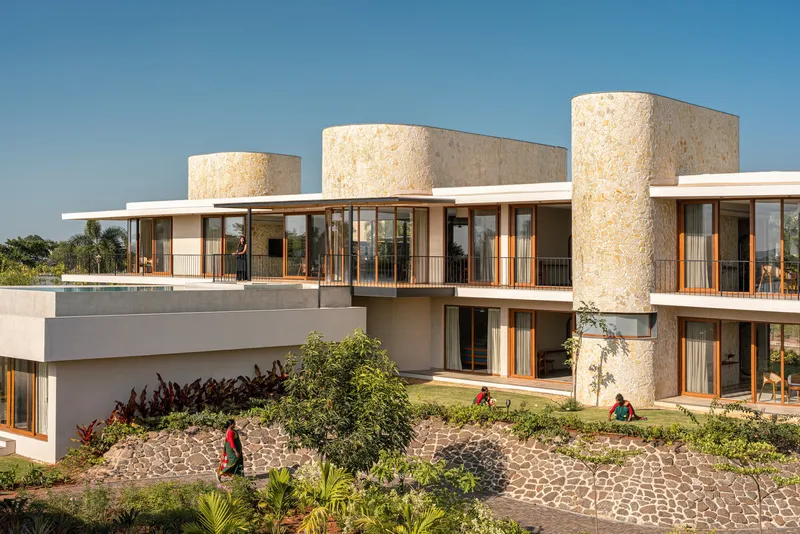
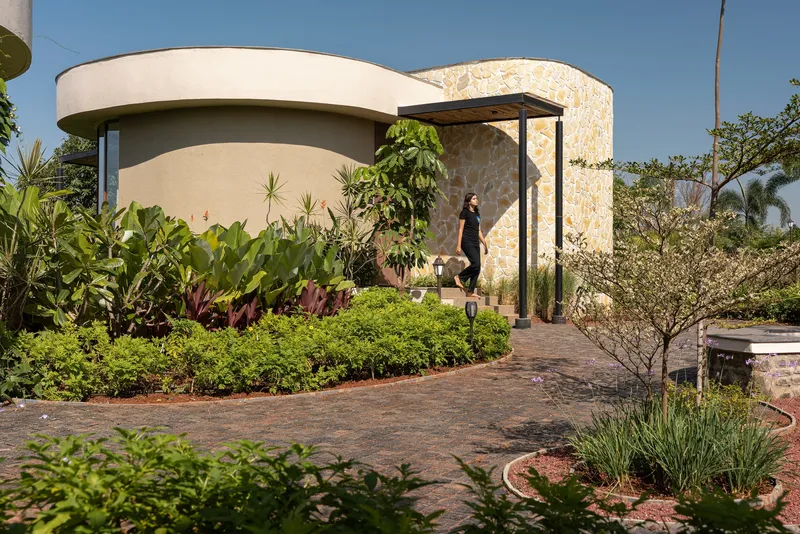
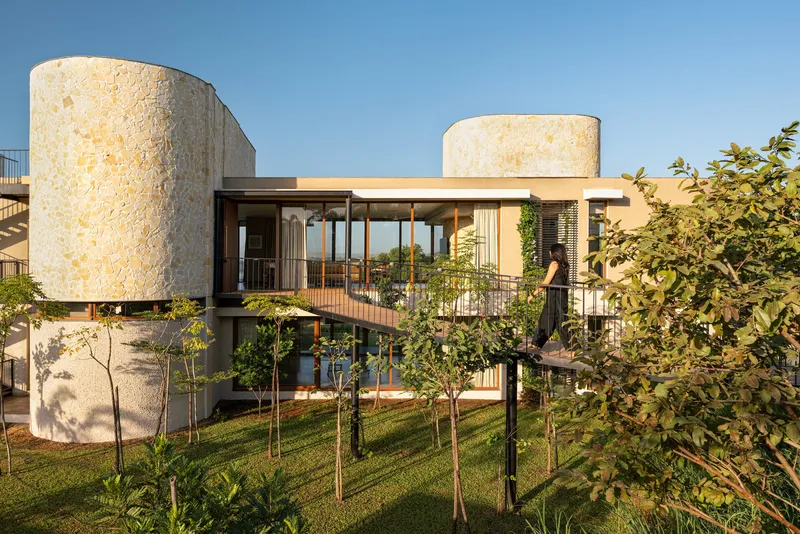
Atelier Landschaft lives up to its name. Stone paver pathways wind through planted beds below cantilevered balconies, creating a thickened threshold between architecture and terrain that is neither garden nor building but something in between. The entry sequence pulls visitors along a curving path through tropical foliage toward the cylindrical volumes, framed by a light metal canopy that telegraphs arrival without a heavy portico.
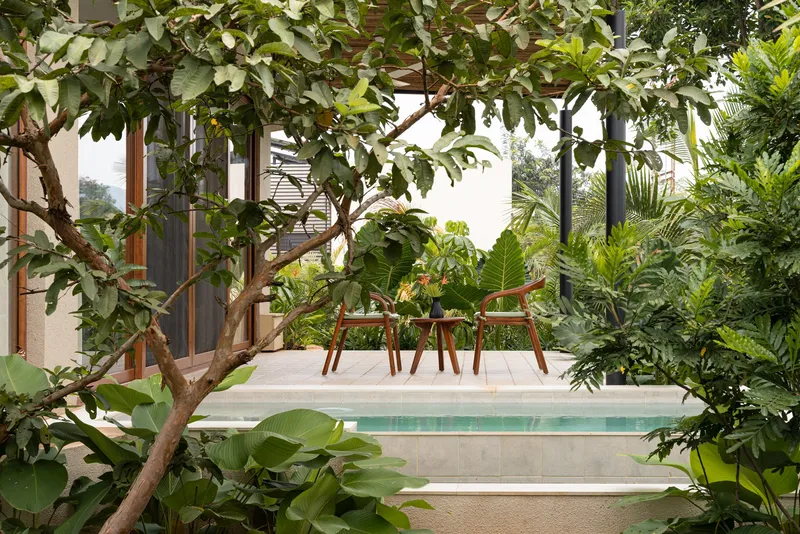
Deeper in the site, the planting becomes denser and more informal. Views through lush vegetation land on a terrace with timber furniture and a raised pool edge, collapsing the distance between interior comfort and exterior wildness. The landscaping is not decorative: it is a spatial tool that manages privacy, directs views, and tempers the microclimate.
Interior Atmosphere: Stone, Timber, Weave
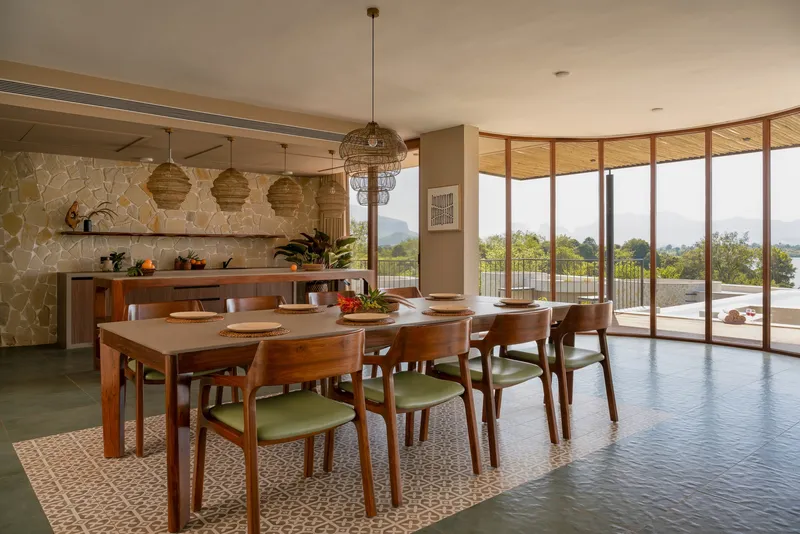
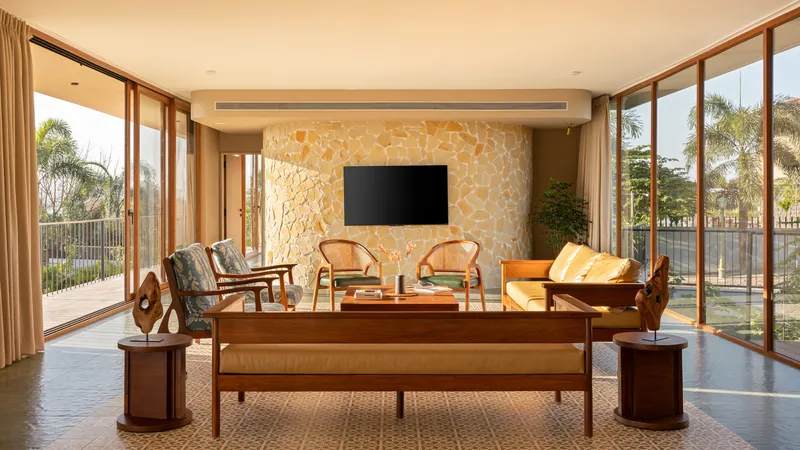
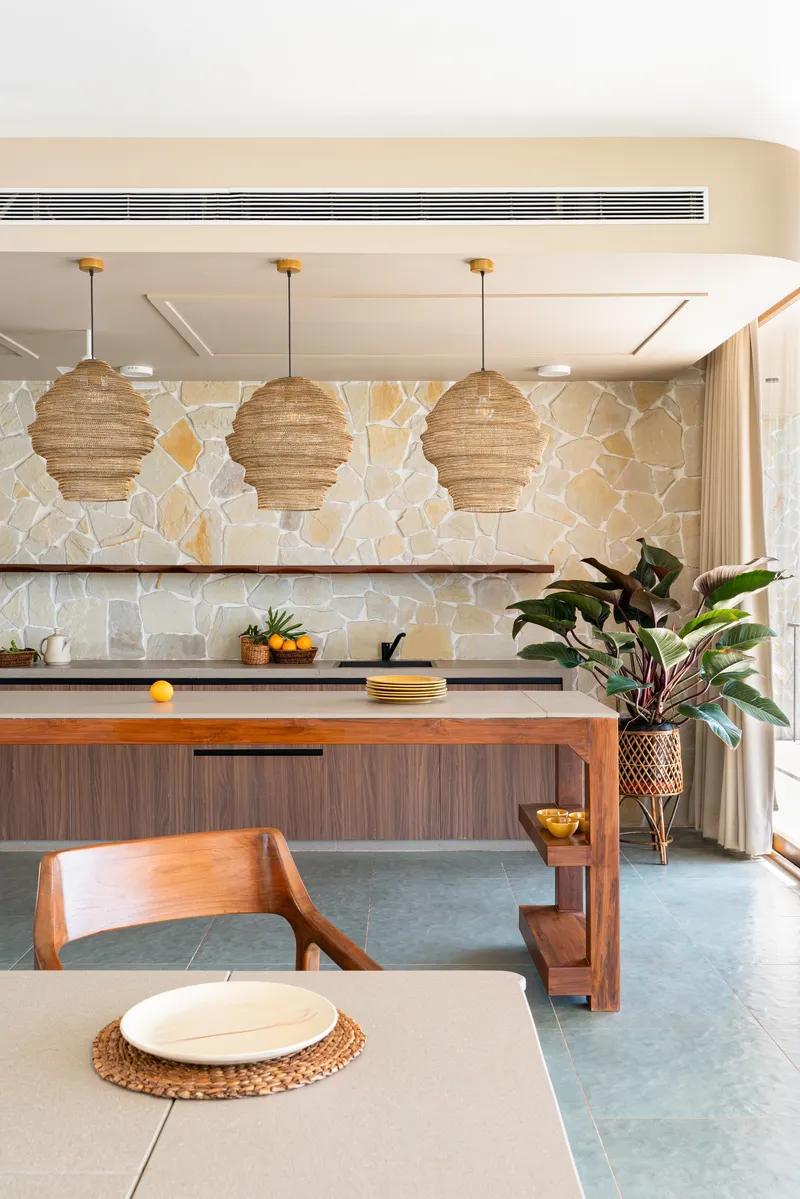
Inside, the material palette is tight: stone, timber, terrazzo, and woven natural fibers. The dining room pairs a solid timber table with tiered woven pendant lights under a curved glass wall that opens the room to distant hills. In the living space, a textured stone accent wall anchors the interior while floor-to-ceiling glazing on both flanks keeps the room from feeling heavy. The kitchen leans into texture with an irregular stone backsplash and three conical pendants above the island, echoing the woven fixtures elsewhere without repeating them.
Material consistency across rooms prevents the interiors from drifting into resort-hotel eclecticism. Every room shares a vocabulary, but the proportions, ceiling heights, and views shift enough to give each space its own character.
Bedrooms as Private Observatories
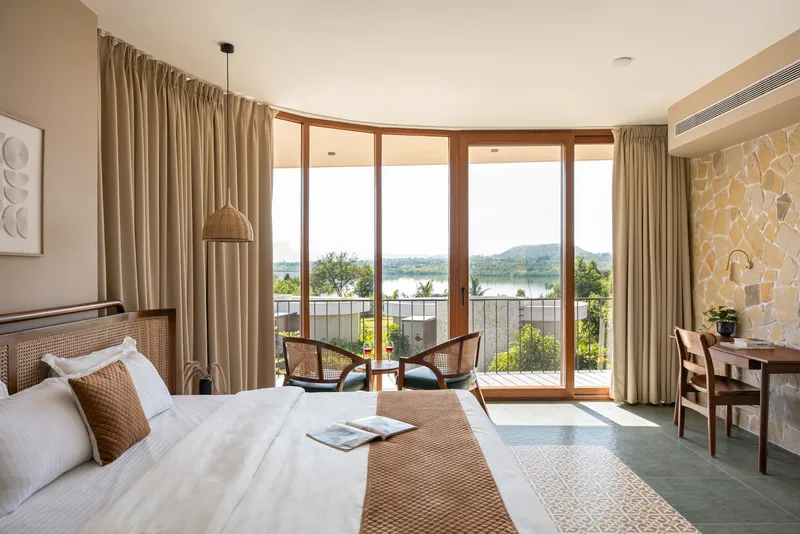
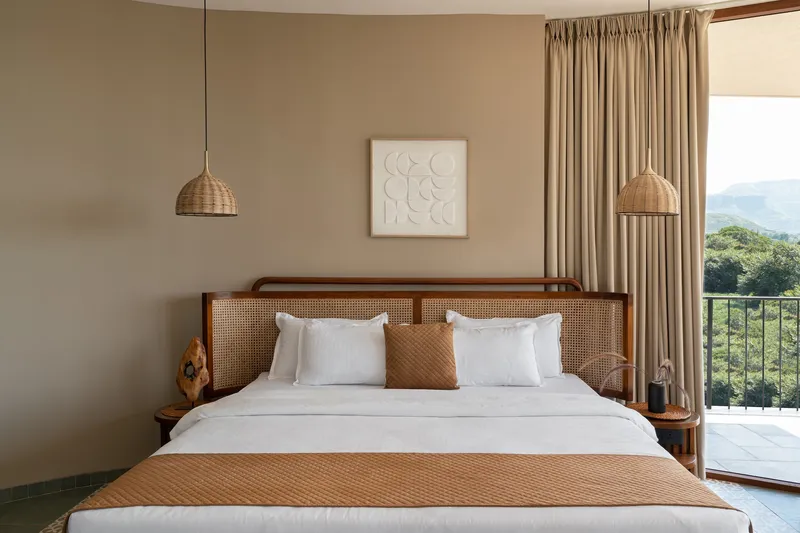
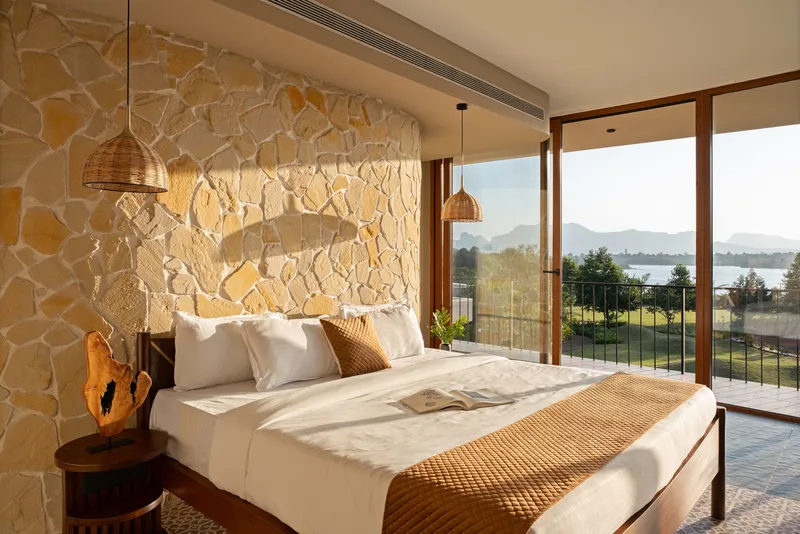
The cylindrical plan of the bedroom towers pays off at the human scale. Curved glazed doors open onto planted terraces with unobstructed lake views, turning each room into a private observatory pointed at the reservoir and the mountains beyond. Cane headboards and woven pendants soften the stone enclosure, while the curving wall itself creates a sense of intimacy that a rectangular room of the same area would not achieve.
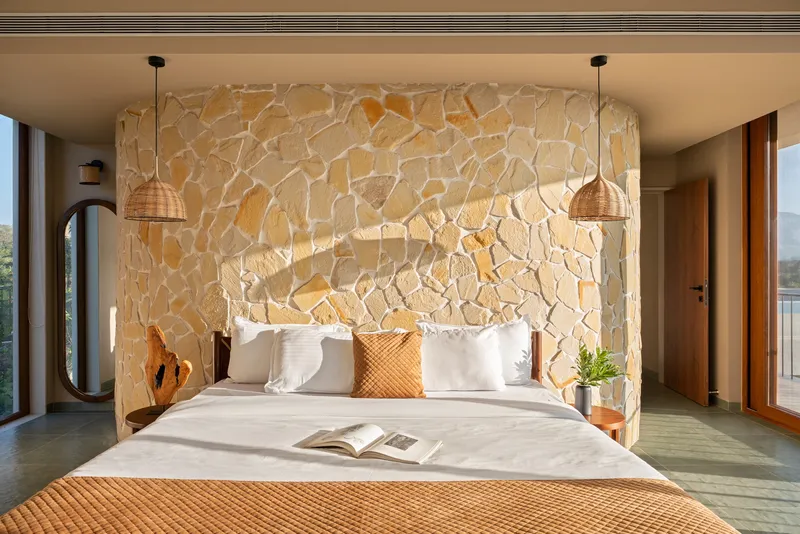
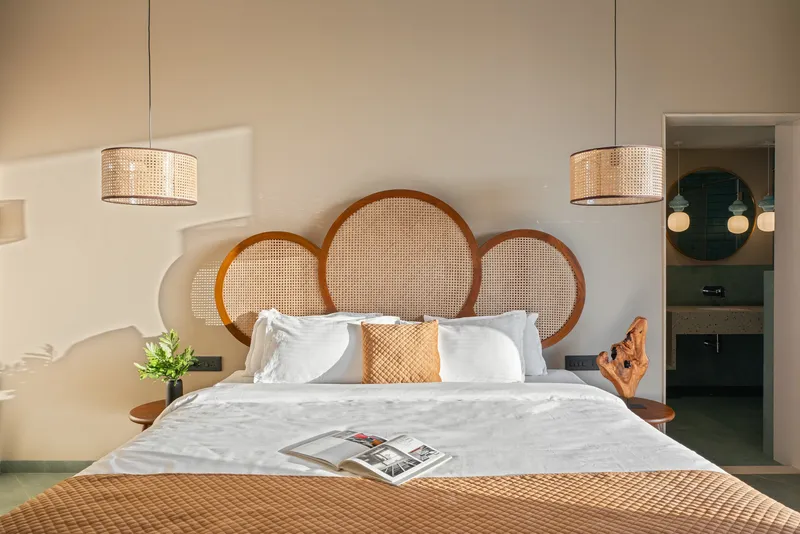
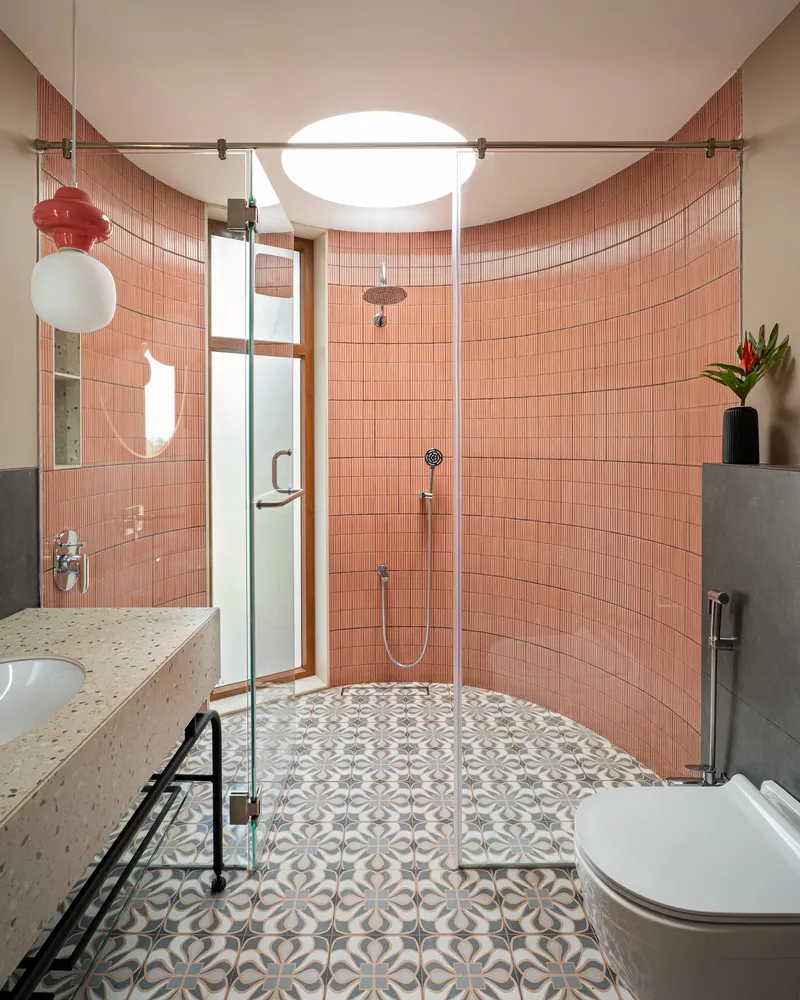
The carved limestone feature wall behind one bed, with integrated lighting and suspended fixtures, is the most theatrical moment in the project, yet it stays on the right side of restraint. The ensuite bathrooms continue the curvature with coral tile shower enclosures, patterned floor tiles, and oval skylights that wash the space in controlled natural light. These are rooms designed around the act of waking up and looking out.
Terraces, Pools, and the In-Between
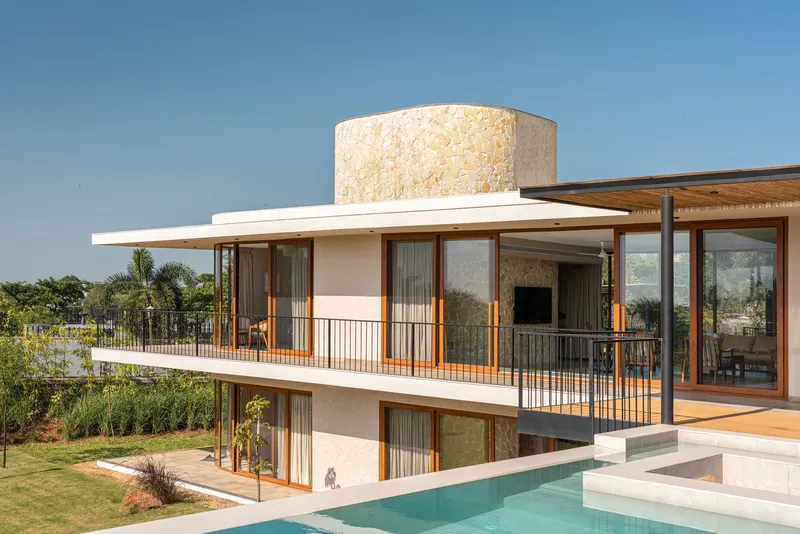
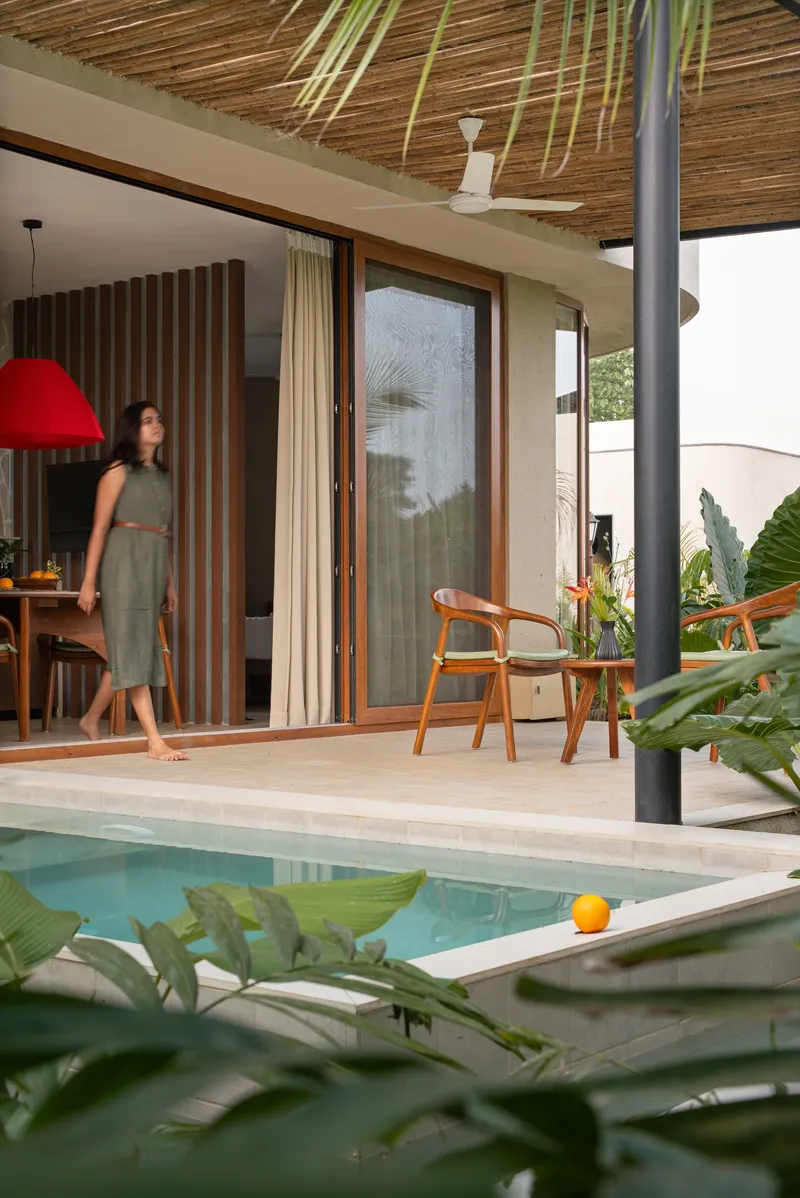
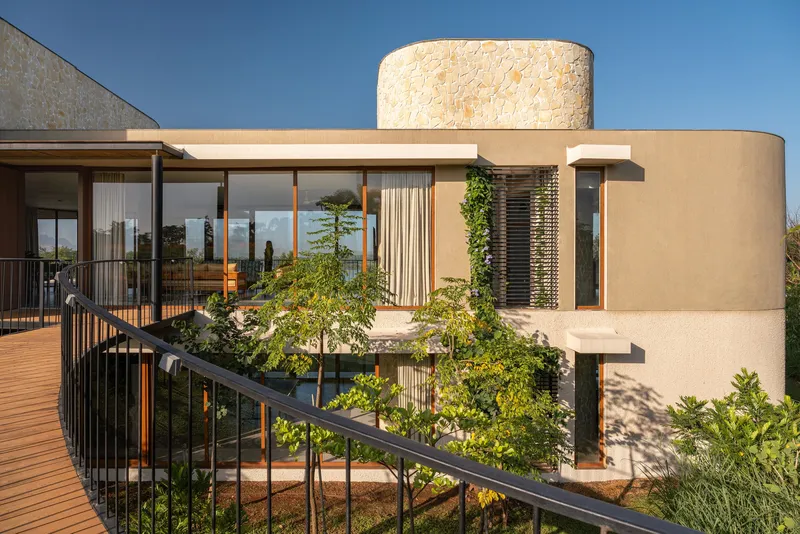
Amoha Villas is as much about its outdoor rooms as its enclosed ones. A covered terrace with a woven bamboo ceiling and a steel column provides a shaded pause between pool and interior. Stacked terraces with cantilevered roof planes create layered outdoor living zones where guests can occupy different altitudes and different relationships to the water. The exterior staircase, with its black metal railings, threads these levels together through planted courtyards, making vertical circulation a spatial event rather than a utility.
Golden Hour and the Dusk Elevations
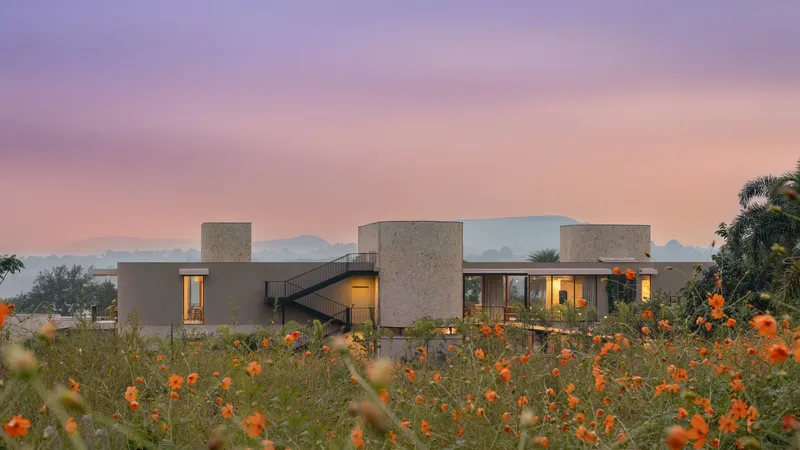
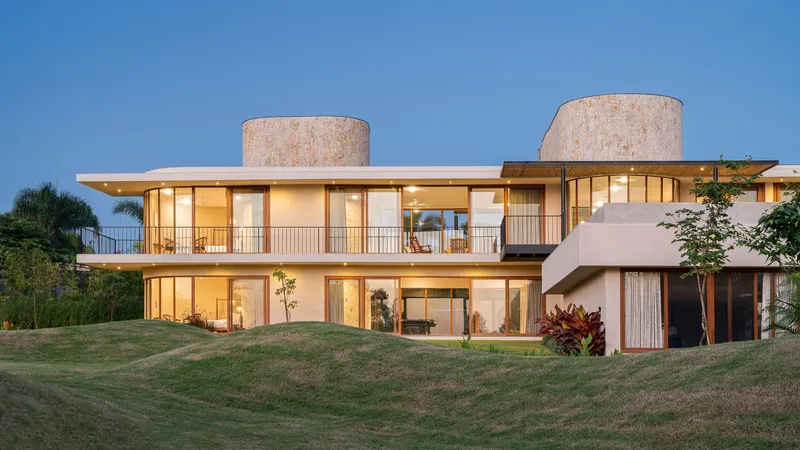
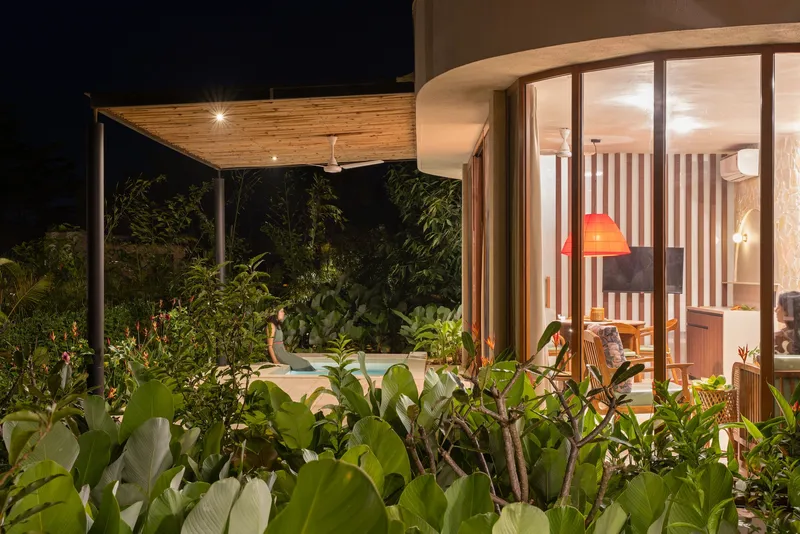
Some buildings reveal their best qualities only at dusk. Amoha Villas is one of them. The stone-clad volumes glow against a pink sunset sky while the glazed openings become lanterns, projecting the warm interior outward. Framed by a field of orange wildflowers, the villa's silhouette reads as a cluster of ancient forms animated by contemporary light. At night, the glazed living room and timber-lined overhang emerge from the garden like a stage set, dense plantings acting as curtains.
These dusk elevations are not accidental. The orientation of the towers, the depth of the overhangs, and the color of the cladding were clearly calibrated to perform at the hour when guests are most likely to be on the terrace with a drink. That kind of atmospheric precision is rare in hospitality architecture outside of major resort commissions.
Plans and Drawings
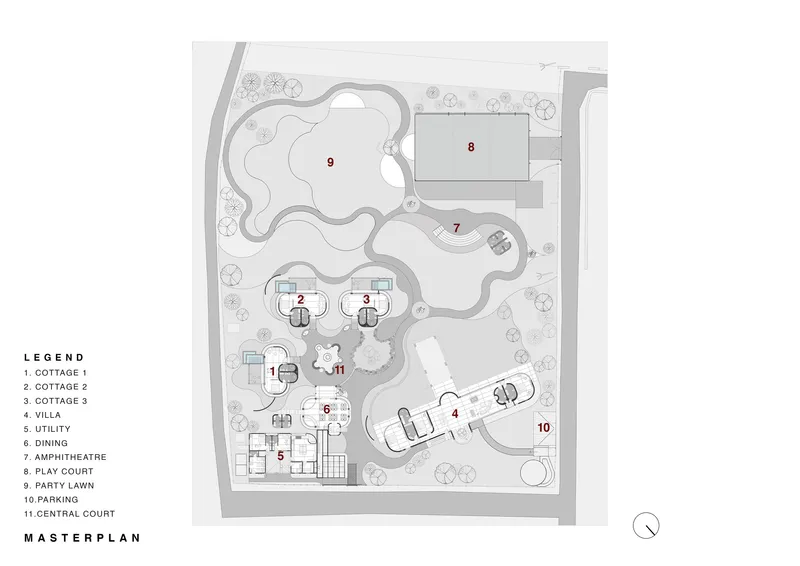
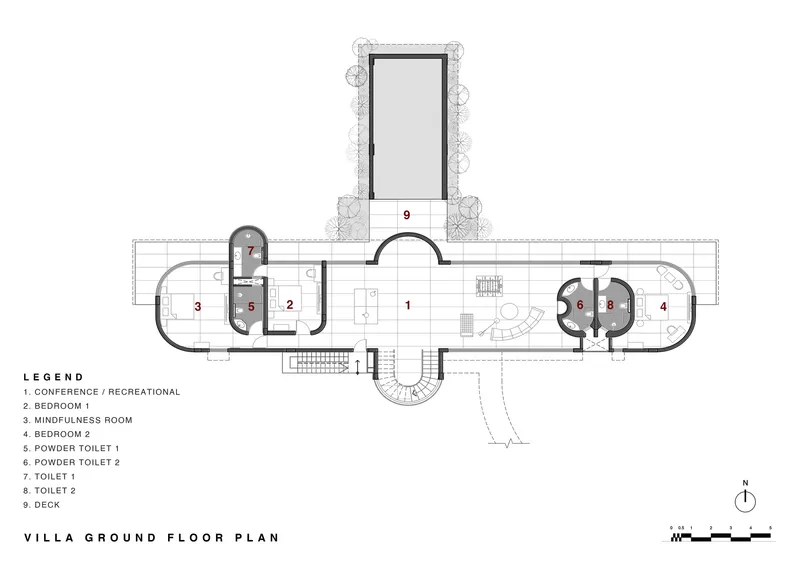
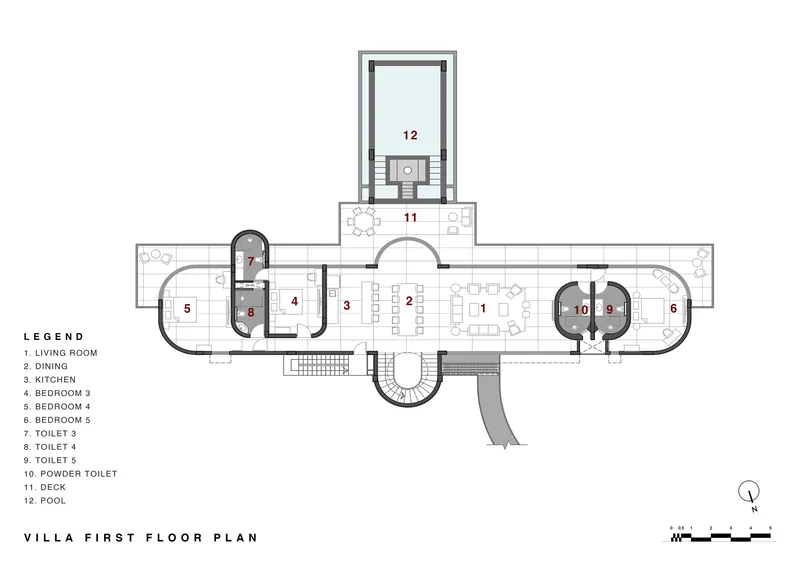
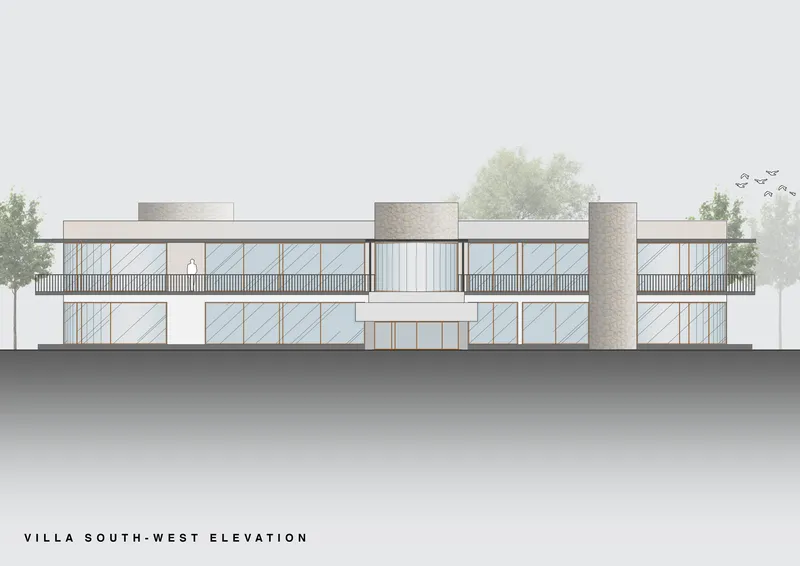
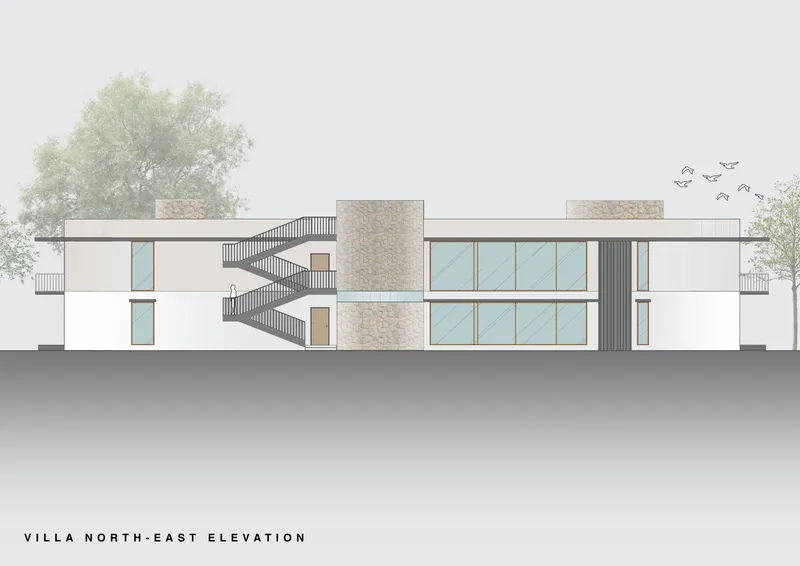
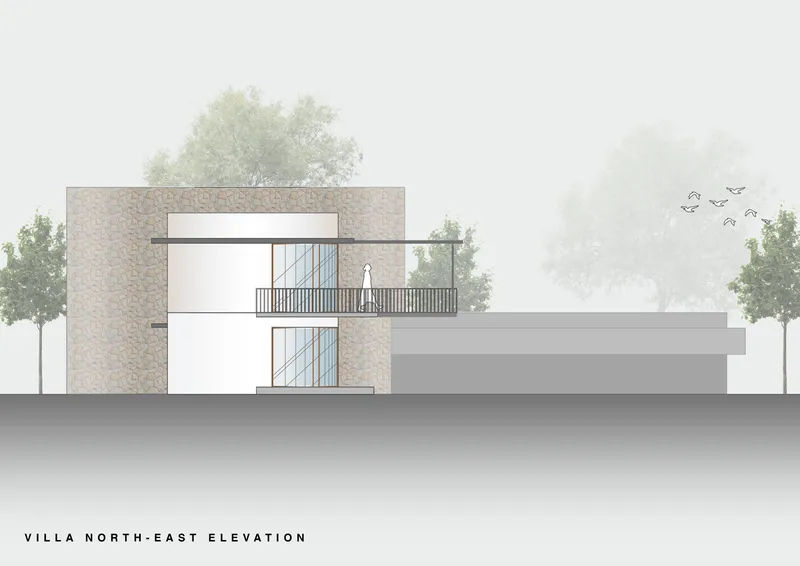
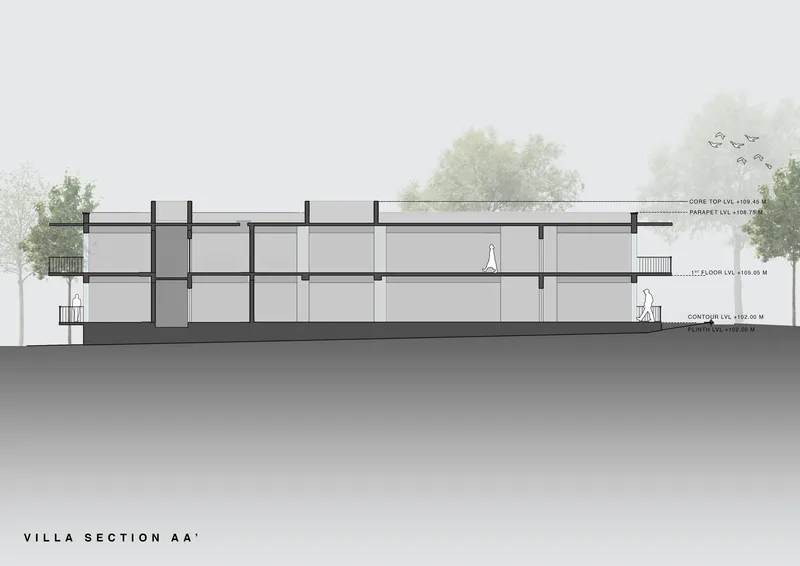
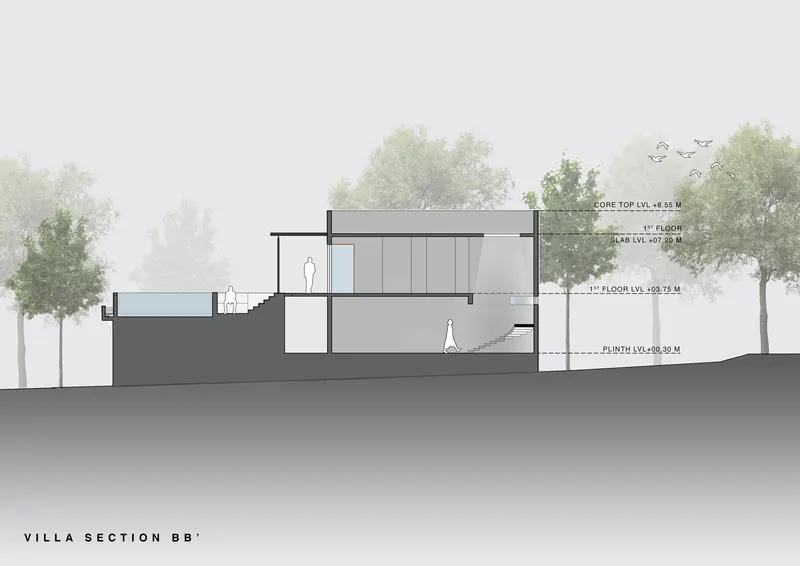
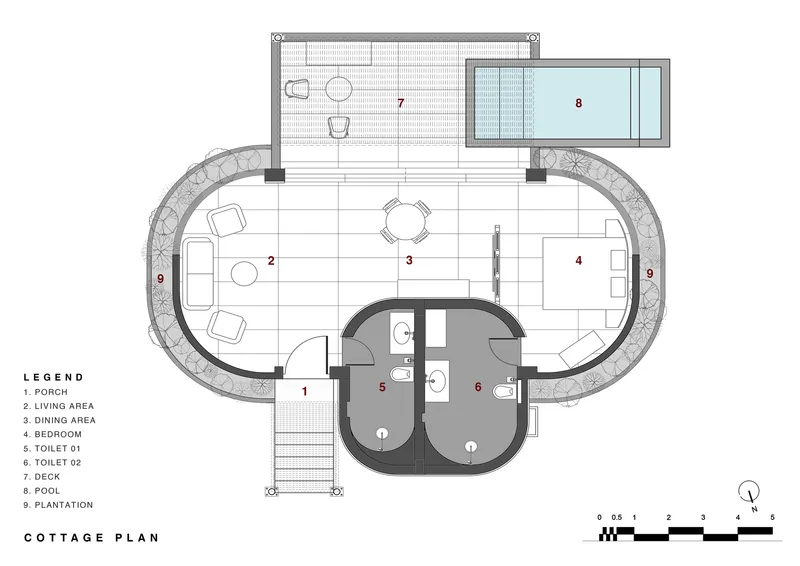
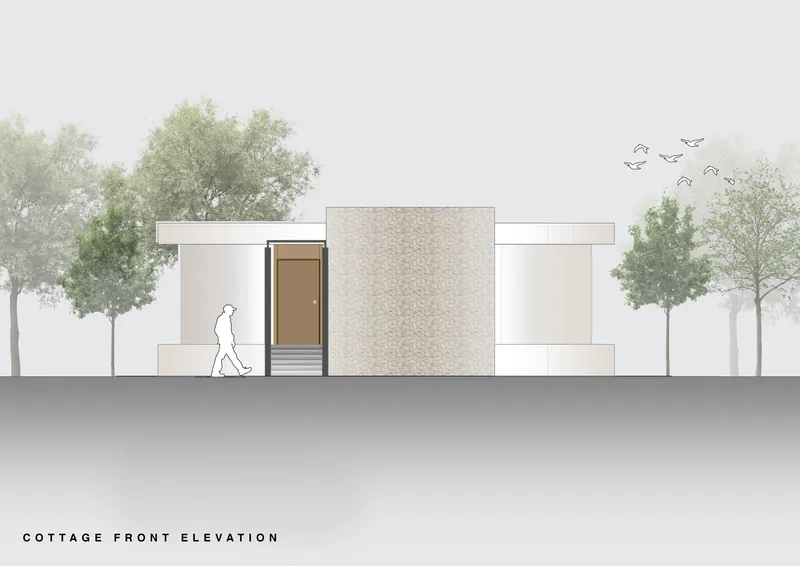
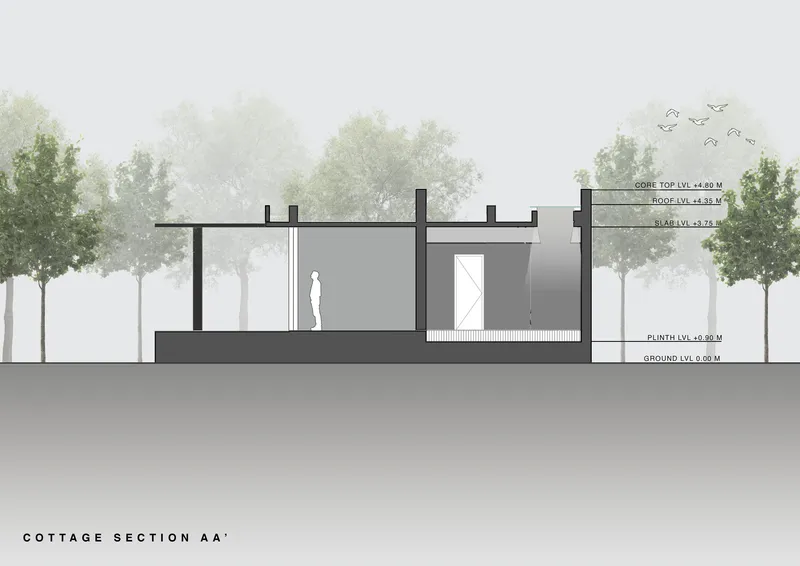
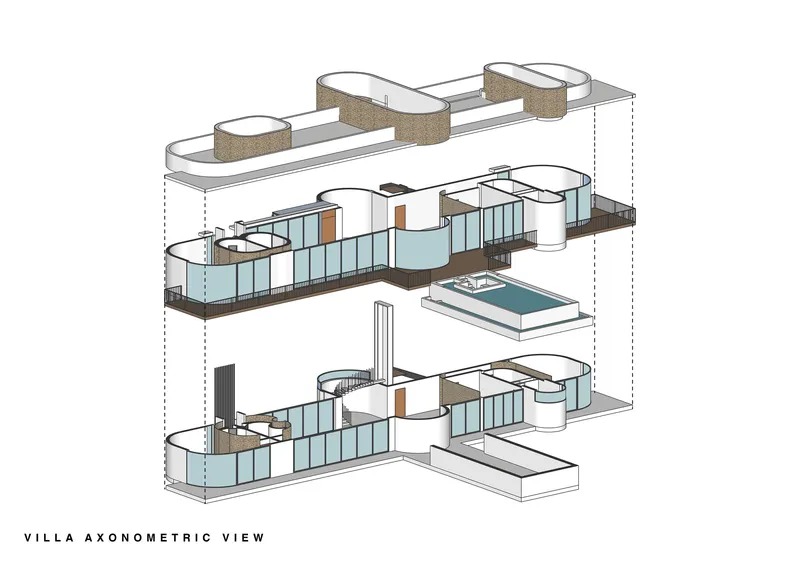
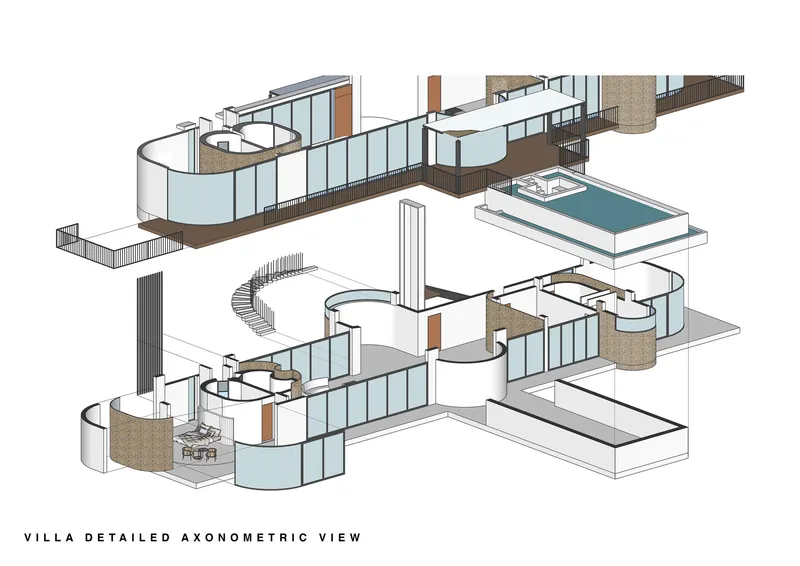
The master plan confirms what the photographs suggest: the clustered arrangement of cottages around a curved pool and lawn is deliberately informal, avoiding the rigid grid typical of resort planning. The ground floor plan shows a central open space bookended by curved volumes housing bedrooms and service areas. On the first floor, living and dining spaces occupy the transparent bands between cylindrical bedroom pods, with the pool terrace extending from the upper level to capture dam views over the landscape.
The sections reveal how the sloping site is put to work. Split-level floors connected by internal staircases allow the building to step down the terrain rather than sitting on a leveled platform. Ceiling heights vary from generous double-height living volumes to more intimate bedroom enclosures. The axonometric drawings are the most instructive, pulling apart the stacked floor plates to expose the relationship between the curved glass walls, the cylindrical towers, the spiral stairs, and the pool terrace. It is a compact project with a surprising amount of spatial complexity packed into its modest footprint.
Why This Project Matters
Amoha Villas is a convincing argument that small-scale hospitality architecture in India does not need to choose between craft nostalgia and imported modernism. The cylindrical stone towers draw on a formal language that feels locally grounded without quoting any specific vernacular, while the glass walls and cantilevered terraces deliver the openness and comfort that contemporary guests expect. The material discipline, spatial variety within a tight plan, and precise site response put it in a different league from most micro-resort projects in the region.
What stays with you is the project's relationship to its reservoir setting. The building does not compete with the landscape or retreat from it. It constructs a series of curated vantage points, from the private bedroom observatories to the communal terraces, that make the act of looking outward the primary architectural experience. That is a simple ambition, but Atelier Landschaft executes it with enough rigor and invention to make the result feel earned.
Amoha Villas, designed by Atelier Landschaft, Beze, India. Completed 2025. Photography by Pranit Bora.
About the Studio
Share Your Own Work on uni.xyz
If projects like this are the kind of work you want to make, uni.xyz is a place to publish your own, find collaborators, and enter design competitions.




Popular Articles
Popular articles from the community


Play: Fragments of Their World
Familiar architecture becomes modular playground design, creating safe spaces where displaced children can learn, connect, imagine and play.

Hill & Cross Opera: Sculptural Opera House Architecture Shaped by Tallinn’s Landscape and Identity
Hill & Cross Opera reimagines opera house architecture in Tallinn through its sculptural hill, civic plaza, glass wave and a luminous cross.

Co-Life: Senior Housing Design That Reconnects Older Adults With the City
Co-Life reimagines senior housing design through healing gardens, shared streets, workshops, and a sustainable community across generations.

The Musturak Paradise: Senior Living Architecture for a Connected Future in Temara, Morocco
The Musturak Paradise reimagines senior living architecture in Temara via private homes, social spaces, culture, community, and shared care.


Similar Reads
You might also enjoy these articles

Bao Huynh Watercolor Atelier: A Serene Art Retreat in Hội An
Bao Huynh Watercolor Atelier in Hội An blends multifunctional art spaces, sustainable design, local materials, and family-friendly living in a serene environment.

Atelier Macri Concept Store Interior Design by CASE-REAL
Atelier Macri store features a "ko" counter, walnut wood details, cork displays, blending retail, gallery, and seamless customer experiences.

Manuel Vargas Izquierdo Stadium and High-Performance Sports Center: Architectural Excellence in Jalpa de Méndez
The Manuel Vargas Izquierdo Stadium blends sustainable design, inclusive sports facilities, and cultural-inspired architecture, revitalizing Jalpa de Méndez’s public spaces.

KAKR Buluh Awar Hall: Revitalizing Community and Ecology Through Bamboo Architecture
Community built bamboo hall revitalizes Buluh Awar village, empowering youth, restoring ecology, celebrating vernacular craftsmanship through sustainable architecture and culture.




Comments (0)
Please login or sign up to add comments
No comments yet. Be the first to comment!