
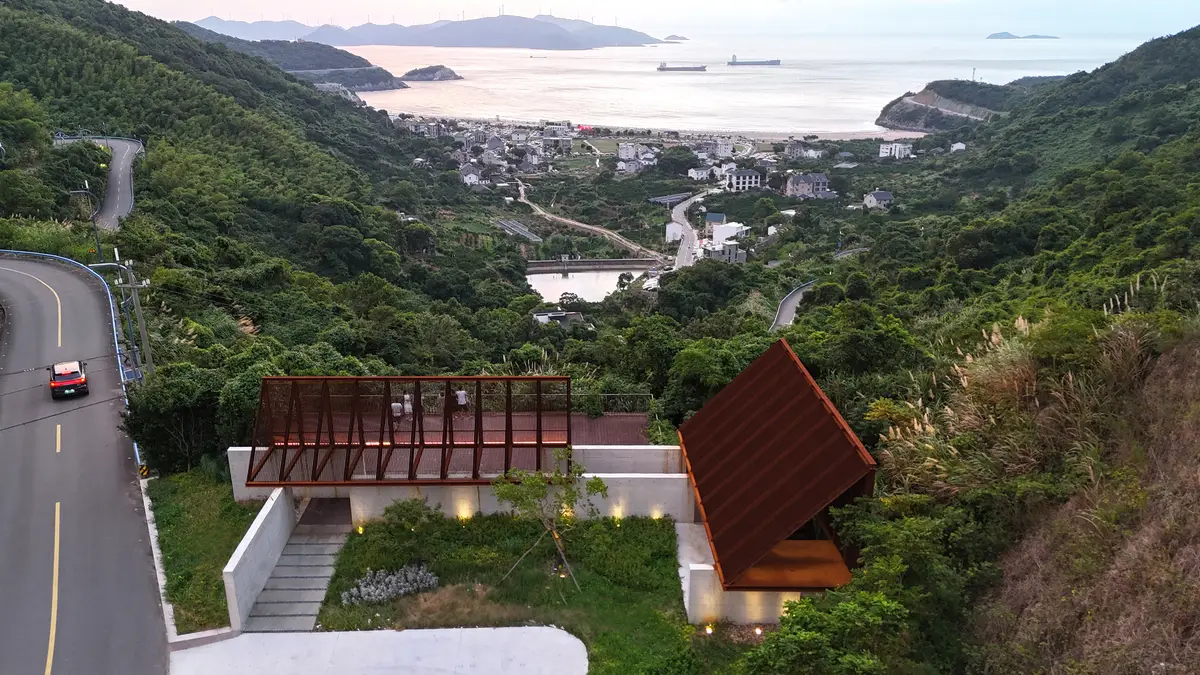
Atelier LuxNox and Found Projects Split a Gable Roof in Two to Frame the Ningbo Coast
A pair of steel and corten pavilions in a Xiangshan valley trade a single roofline for two perpendicular volumes that choreograph sea views.


The simplest architectural move can be the most consequential. At a coastal valley site in Xiangshan, Ningbo, the teams at Atelier LuxNox and Found Projects took what could have been a conventional gable-roofed pavilion and split it down the ridge. The resulting halves, rotated perpendicular to each other and set at different elevations on the hillside, become two distinct instruments for experiencing landscape: one vertical and compact, pressing close to the mountain; the other low and elongated, stretching parallel to the shoreline. Between them, concrete walls carve a semi-enclosed courtyard aimed squarely at the Pacific.
The project replaces an underutilized viewing deck, and that genealogy matters. Where a deck is passive, a single surface to stand on, the Twin Pavilions are active. They organize a sequence of movement, framed views, and carefully placed moments of pause. The 310 square meters of built area feel much larger because the architecture extends its spatial logic into the terrain itself, using retaining walls, stairs, and bridges to stitch the two volumes into the valley's topography.
A Valley Scaled to Two Volumes
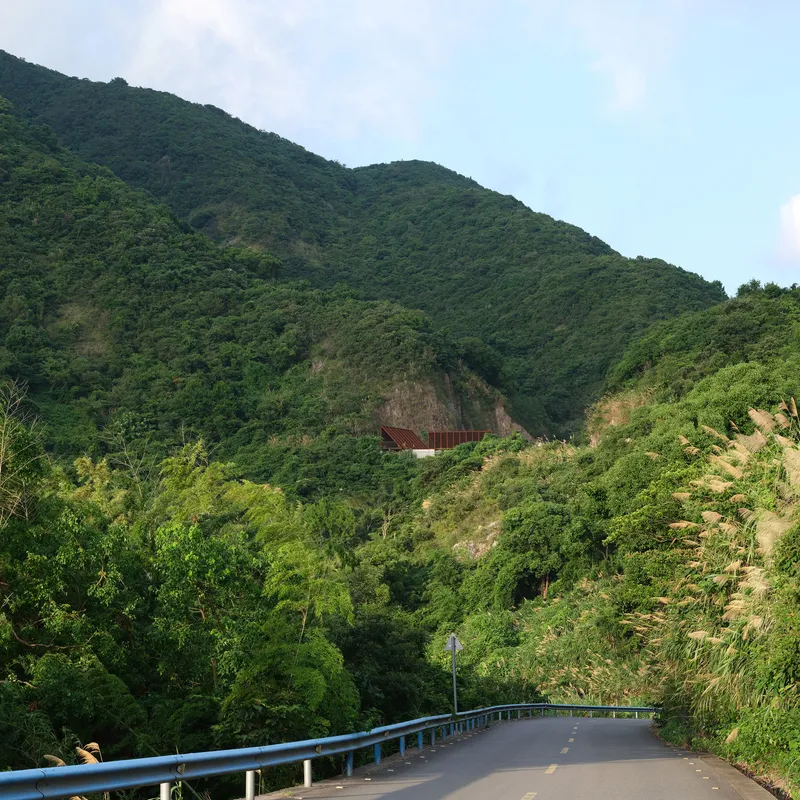
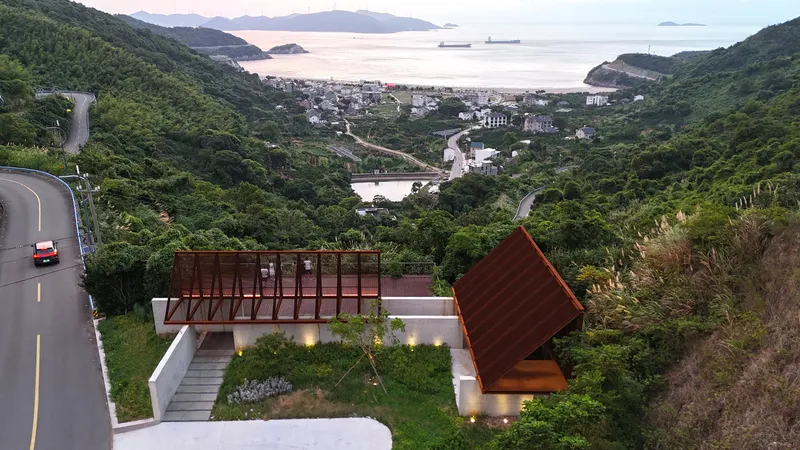

Seen from the road below, the pavilions almost disappear into the forested hillside. Their corten cladding reads as a warm mineral tone against the green canopy, and the single-pitch roofs, tilted at opposing angles, register less as buildings than as geological folds. The aerial view at dusk makes the logic legible: two sloped planes anchored to a shared structural spine, their open ends directed toward different horizons. An elevated steel bridge links them across a gap defined by concrete retaining walls, turning the space between the pavilions into a compressed canyon of its own.
The siting is deliberate. By nesting the structures into existing grade changes rather than sitting them on top of the hill, lead architects KAN Tianyu and ZHANG Miaojie keep the valley's ridgeline intact. The architecture participates in the slope rather than interrupting it.
Corten as a Variable Filter
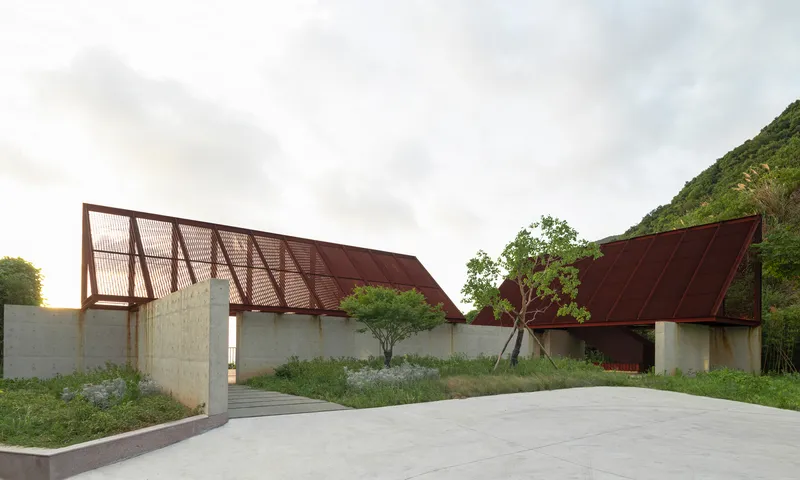
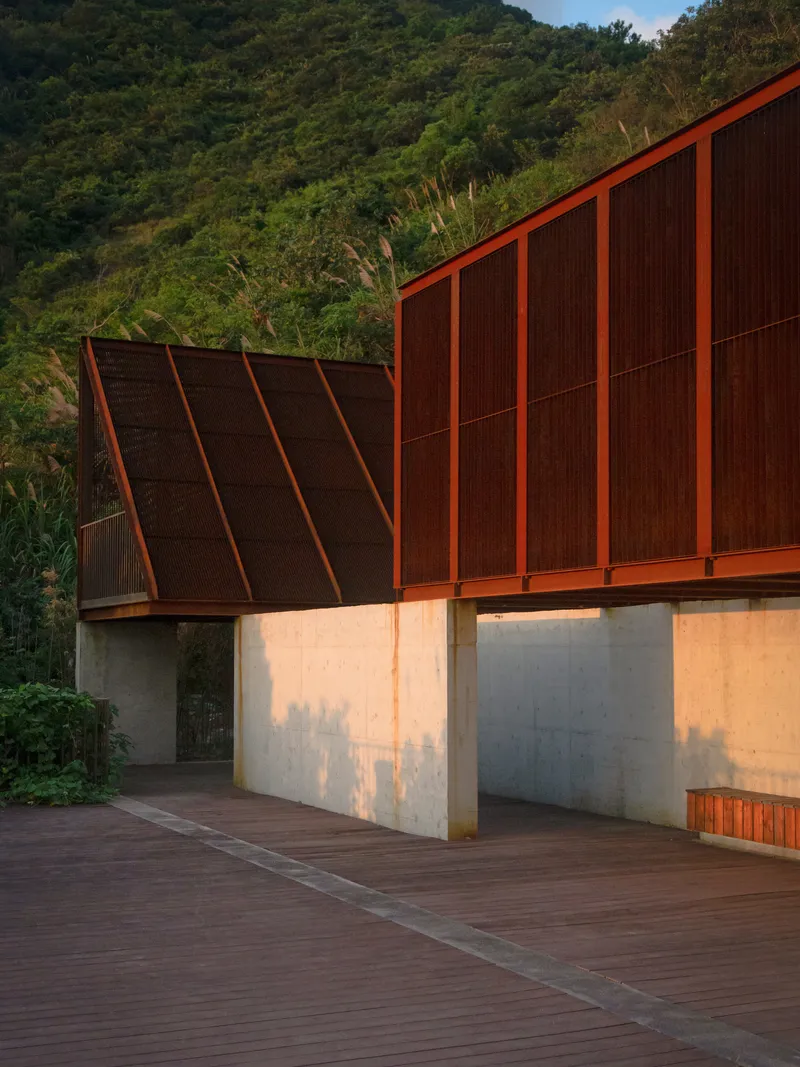
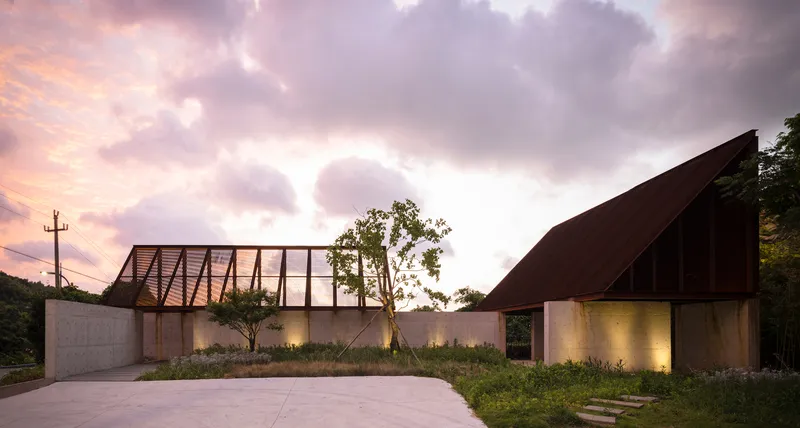
The pavilions' most tactile quality comes from their corten grating, specified in varied densities and thicknesses across the facades. At some points the mesh is nearly opaque, forming solid walls that block wind and define interior enclosure. At others it opens to a loose weave that lets daylight pour through and vines thread their way inward. The effect changes with the angle of the sun: morning light from the ocean turns one facade into a lantern, while afternoon shade renders the opposite screen almost solid.
The material choice is pragmatic as well as atmospheric. Corten develops its protective oxide layer without paint, making it well suited to the salt air and humidity of coastal Zhejiang. Over time the rust patina will deepen, pulling the pavilions closer in tone to the exposed earth of the hillside cuts.
Framing the Horizon
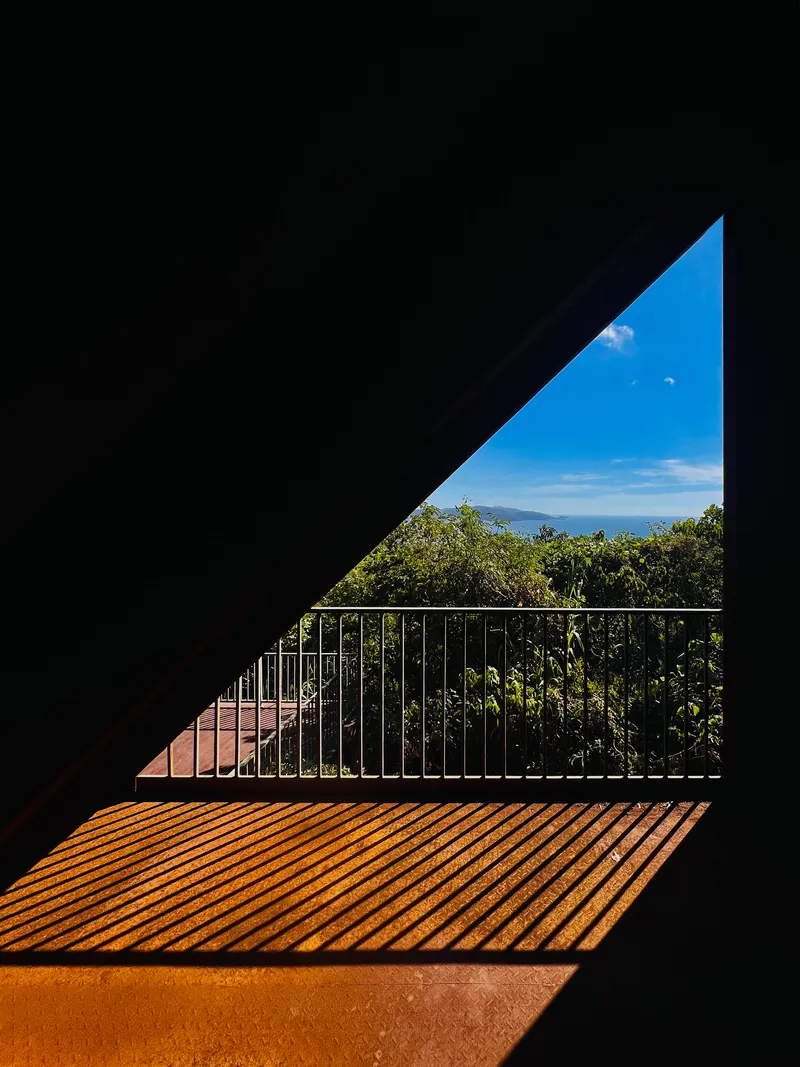

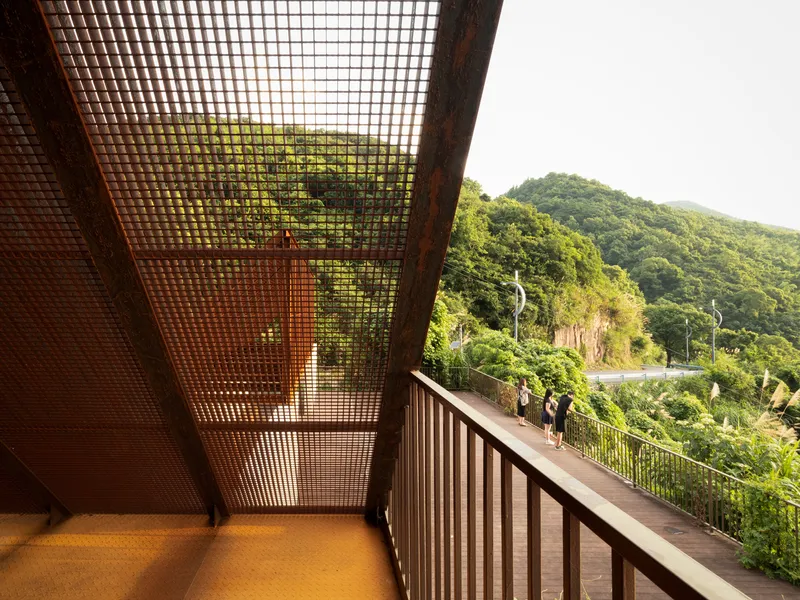
The triangular openings created by the single-pitch rooflines become the pavilions' signature gesture. Where each volume meets its low edge, a tall wedge of glass or open air frames a specific slice of the landscape: the ocean in one direction, the forested ridge in the other. These are not picture windows in the conventional sense. Their geometry narrows the field of view and exaggerates depth, making the sea feel farther and the hillside feel taller than they actually are.
Inside, concrete beams cast dappled shadows through tree canopies visible overhead, and the timber roof panels slope upward to reveal carefully composed vignettes. A wooden deck at one terminus catches direct morning sun, its seating oriented toward the sunrise over the water. The architecture does not simply offer views; it edits them.
Concrete Walls as Choreography
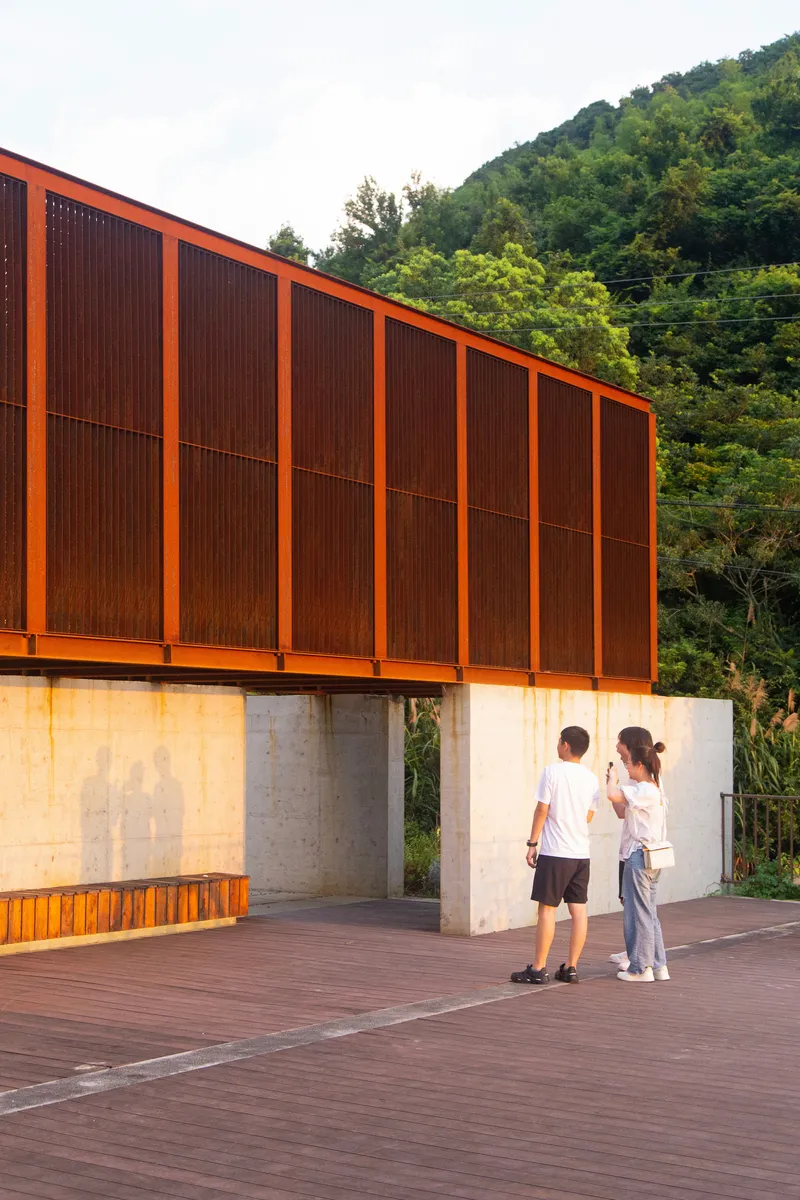
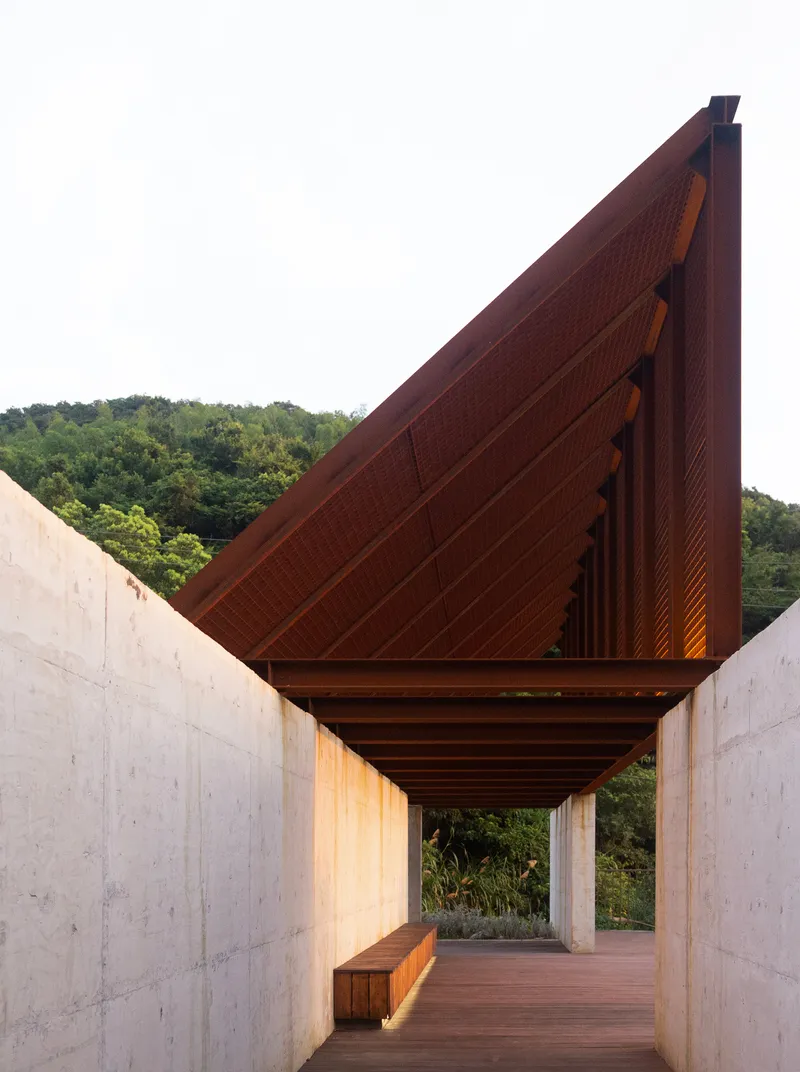
Beneath the steel-framed roofs, cast concrete walls do the heavy spatial work. They define the circulation path from arrival to courtyard to lookout, channeling visitors through a covered walkway with an exposed timber ceiling before releasing them into the open courtyard facing the coast. The walls also serve as the retaining structure that holds the hillside at bay, performing double duty in a way that keeps the material palette tight.
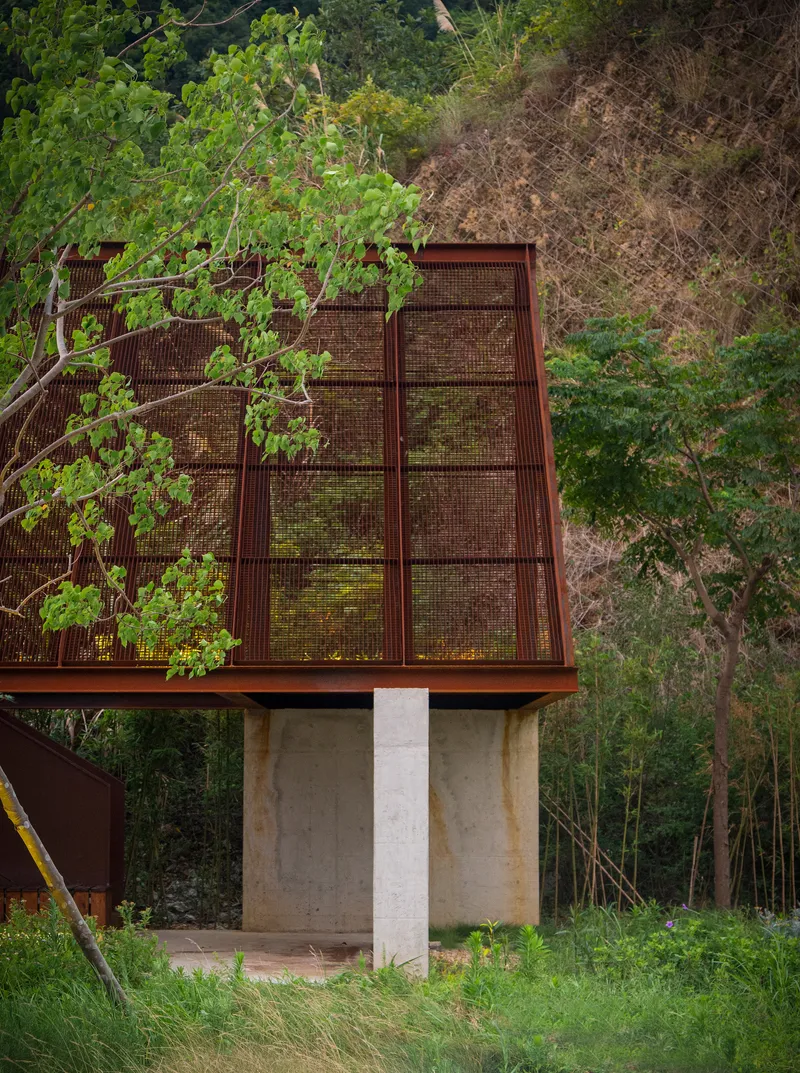
The cantilevered volume visible from below, where two visitors stand dwarfed by the mesh-clad overhang, demonstrates how the concrete piers transfer load while keeping the ground plane open. Young trees planted at the base are already beginning to soften the junction between building and terrain, a sign that the landscape strategy was designed to mature rather than to look finished on day one.
After Dark
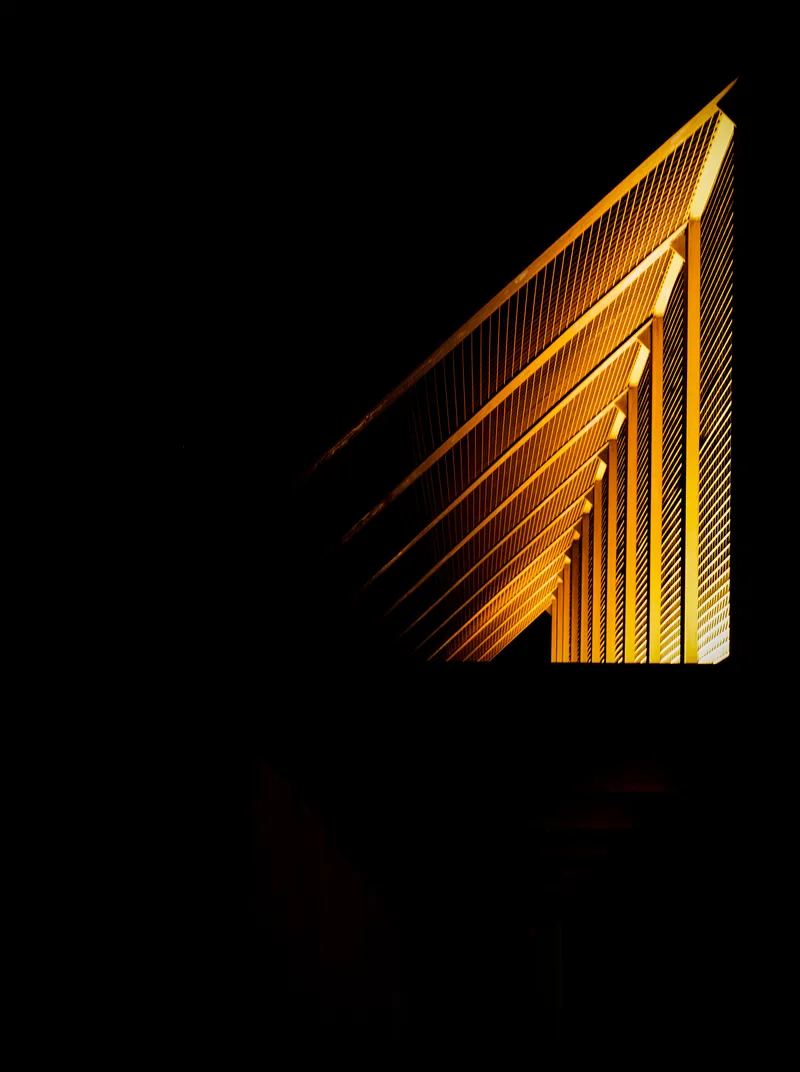
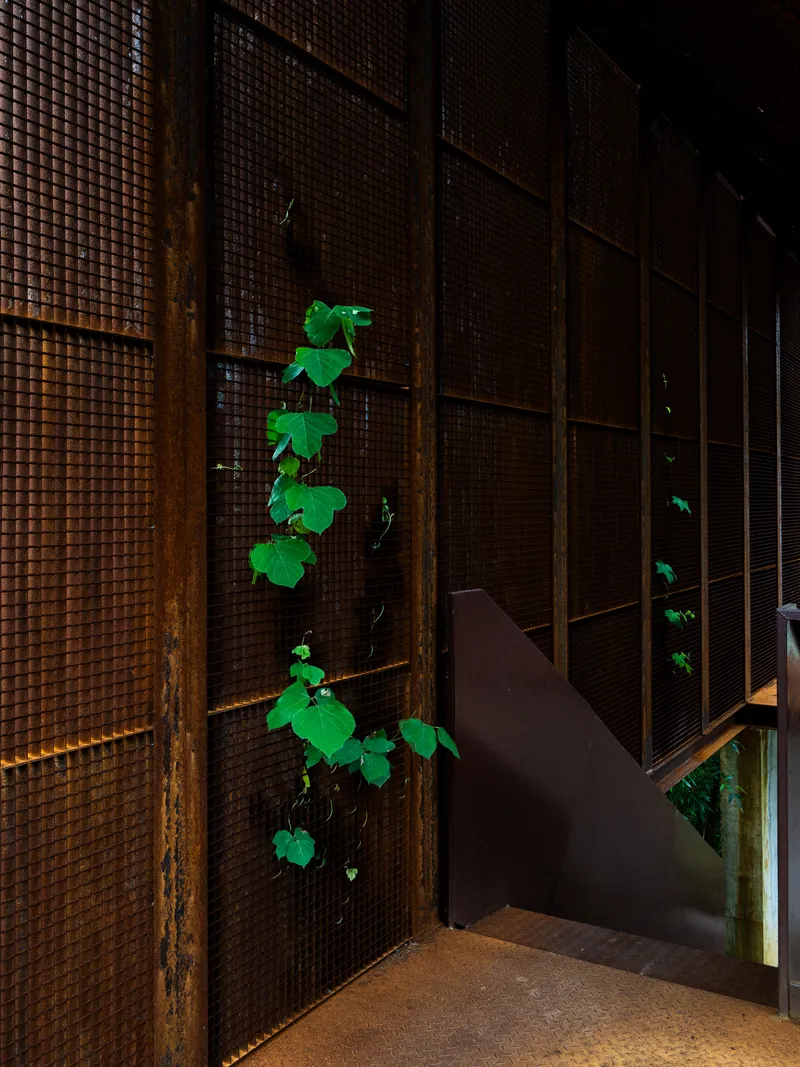
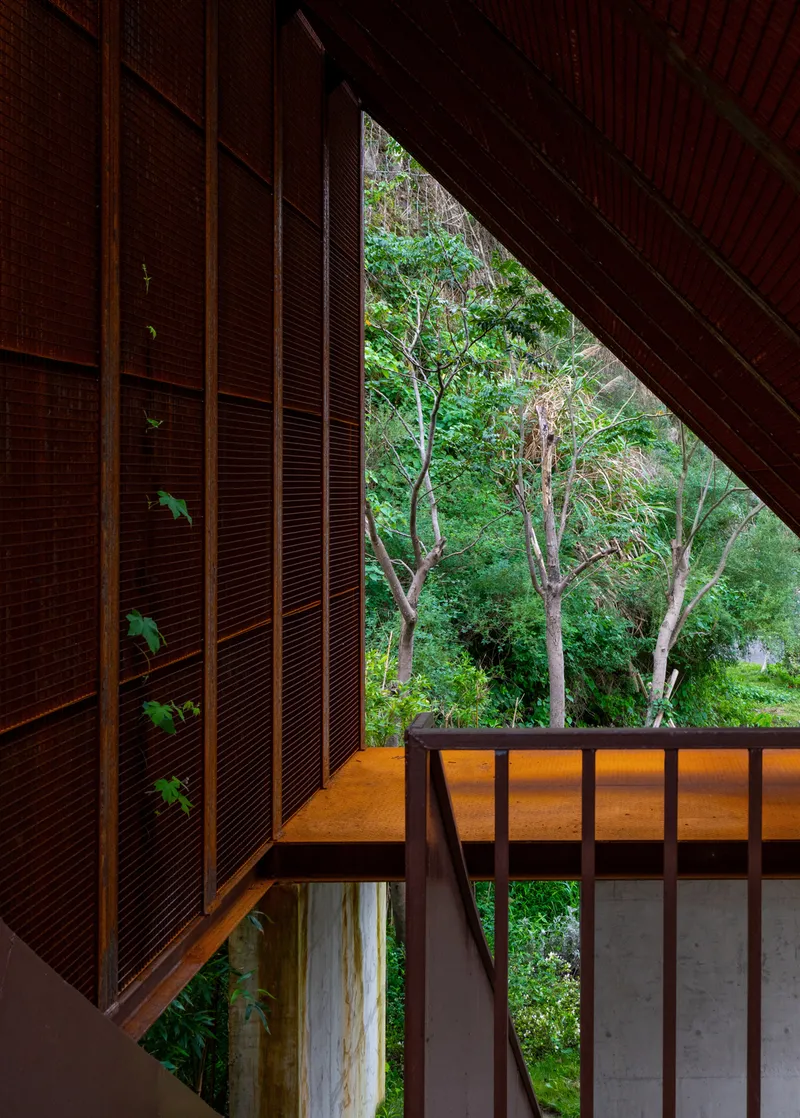
The pavilions take on a second life at night. Illuminated from within, the layered timber panels at the roof's triangular corner glow like a folded paper lantern, each lamination casting a thin shadow line. The perforated metal screens that feel solid by day become translucent scrims, revealing the vines that have begun to colonize the mesh. A descending stairwell, lit softly and framed by climbing plants, turns a utilitarian passage into something closer to a garden room.
This nocturnal character is not accidental. Landscape pavilions too often lose their purpose after sunset. Here the lighting strategy inverts the daytime reading of the corten: opacity becomes transparency, and the pavilions announce themselves to the valley as warm, inhabitable beacons.
Plans and Drawings
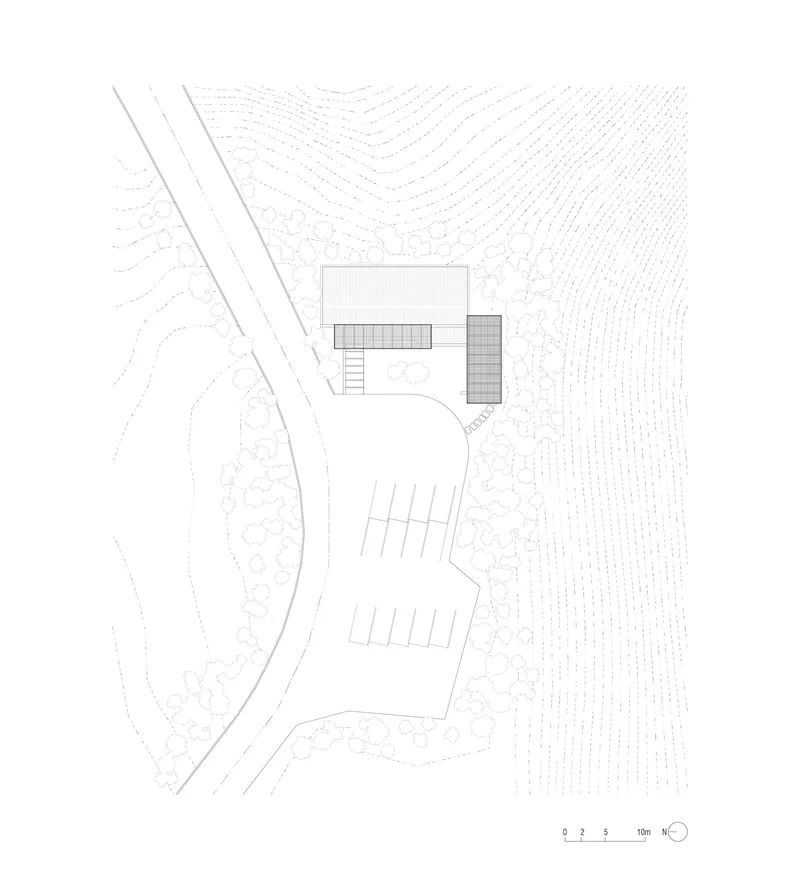

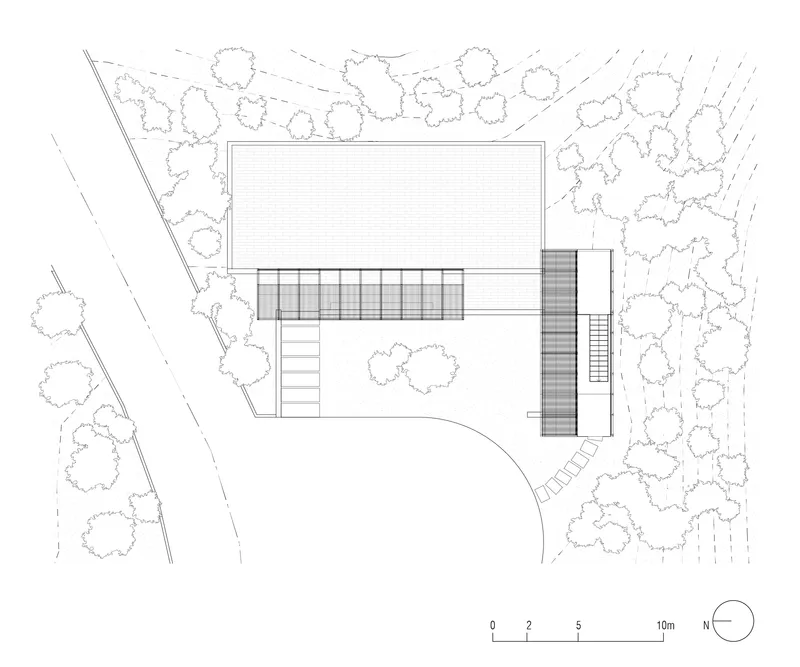
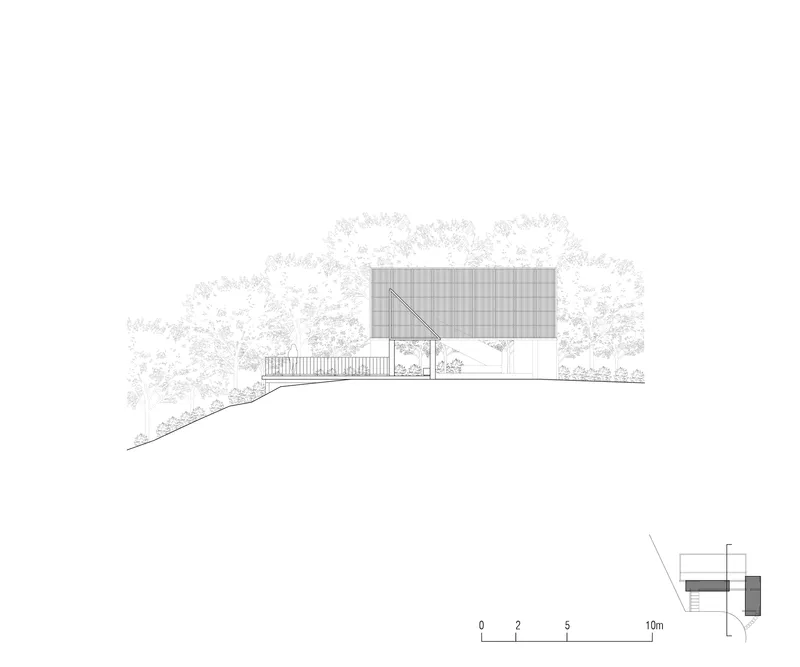
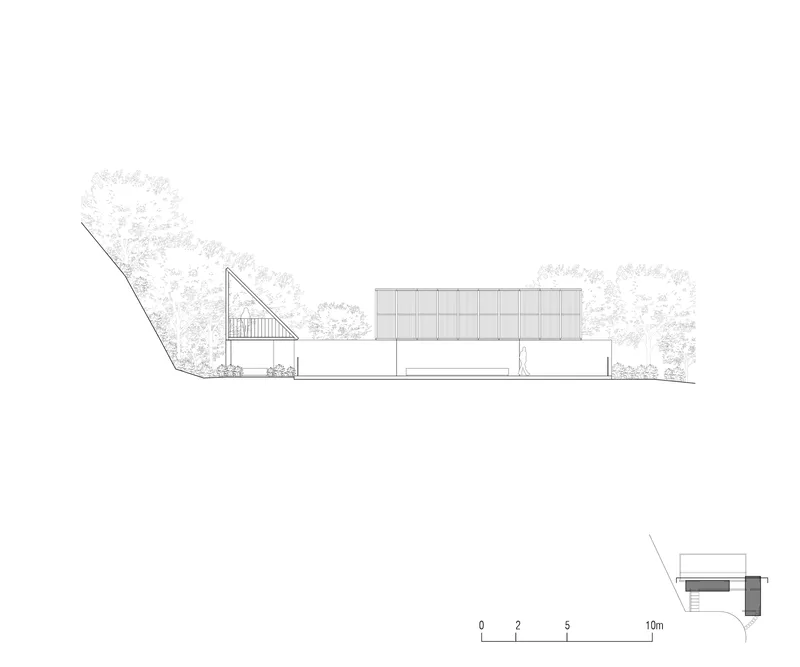
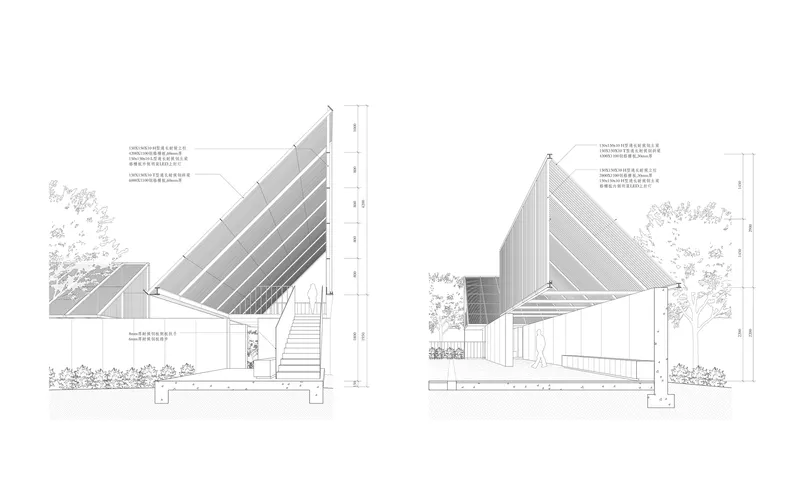
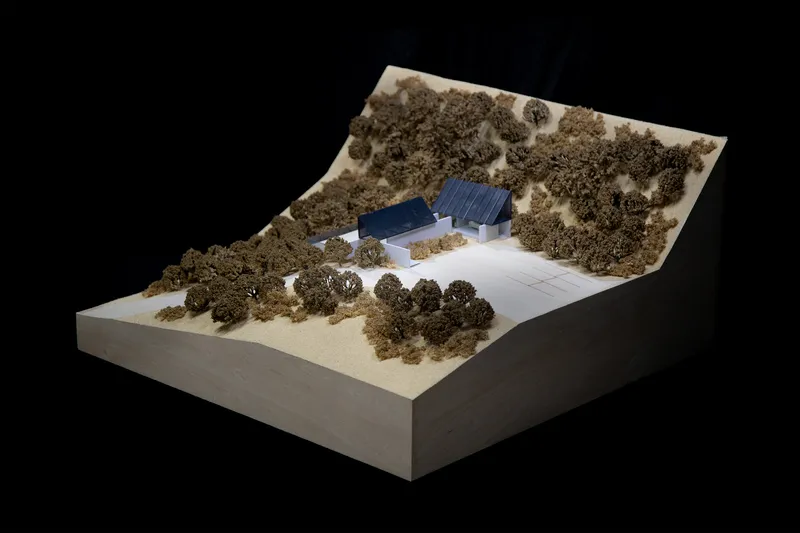

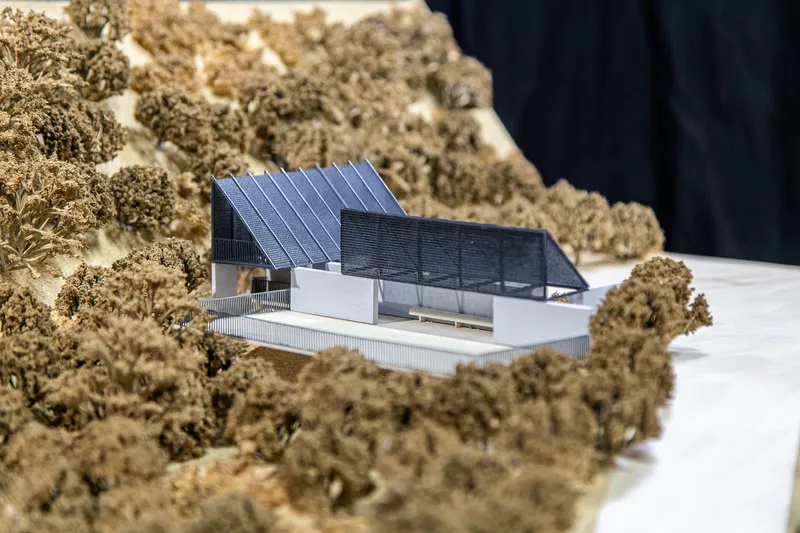
The site plan confirms how tightly the two volumes hug the curved driveway and the valley's contour lines, while the floor plans show the cantilevered terrace extending well beyond the building's structural grid. The elevations and section reveal the steep pitch of the roof planes and the surprisingly deep structure required to span the gap between concrete cores. Physical models, built at a scale that includes the surrounding tree canopy, make clear that the design was tested as much for its silhouette against the hillside as for its internal spatial sequence.
Why This Project Matters
China's coastal regions are filling with scenic-area pavilions, most of them conceived as Instagram landmarks rather than spatial experiences. The Twin Pavilions push back against that trend by investing in sequence over spectacle. The move of splitting a single gable into two perpendicular volumes is simple enough to explain in a sentence, but its spatial consequences, the compressed courtyard, the directed views, the shifting opacity of the screens, unfold slowly as you walk through the site. That kind of architectural patience is rare in a typology that usually aims for a single heroic photograph.
Atelier LuxNox and Found Projects have also demonstrated something worth noting about collaboration: the project reads as a single, coherent idea rather than a compromise between two offices. The material logic is disciplined, the structural system is shared, and the landscape integration suggests both teams were working from the same topographic model from the start. In a profession that still treats multi-office projects with suspicion, Twin Pavilions is evidence that shared authorship can sharpen rather than dilute a design.
Twin Pavilions, designed by Atelier LuxNox and Found Projects, led by KAN Tianyu and ZHANG Miaojie. Xiangshan, Ningbo, China. 310 m², completed 2024. Photography by Dingzong Yu and Miaojie Zhang.
About the Studio
Share Your Own Work on uni.xyz
If projects like this are the kind of work you want to make, uni.xyz is a place to publish your own, find collaborators, and enter design competitions.


Popular Articles
Popular articles from the community


David Ortega Stacks a Two-Story Mexico City Penthouse Around a Steel Stair and a Pergola-Shaded Roof Terrace
In Colonia Roma, a 300 m² penthouse uses oak joinery, a planted steel stair and a slatted roof pergola to make a new-build apartment feel like a house.


Opera on the Sea: Driftwood Logic Shapes a Timber Opera House on Estonia's Coast
Trevor Orgill's opera house translates the entangled drift of floating timber into a civic building where wood, water, and music converge.

The Amber Palace Opera: A Geological Fiction Surfaces on Tallinn's Baltic Waterfront
Pierre Brillard reimagines a Baltic legend as a public landscape, opera house, and waterfront promenade rooted in Tallinn's coastal identity.

Manzana Morphosis: Stretching Barcelona's Grid into a Living Landscape for 2050
A radical reworking of the Eixample manzana turns density into a tool for generous public space, vertical ecology, and environmental performance.

Similar Reads
You might also enjoy these articles

LAVA Architecten Gives Vocational Education a Sawtooth-Roofed Face on a Mechelen School Campus
In Mechelen, Belgium, a 2,053 m² STEM school on a 6×6 m grid turns workshops and classrooms into rooms that can be rearranged as teaching changes.

KEMA Studio Turns a Derelict Marvila Attic into a 60 m² Lighthouse Apartment Above Lisbon
In Lisbon's Marvila district, a rebuilt roof, four skylights and two plywood volumes turn an unlivable attic into a bright home facing the Tagus.

Pixel Gardens: One Repeated Module Stacked Into a Terraced Social Housing Tower for Famagusta
Salem Bader's shortlisted housing tower builds a vertical neighbourhood from one repeated module, offsetting units to carve terraces, light and air.

Bao Huynh Watercolor Atelier: A Serene Art Retreat in Hội An
Bao Huynh Watercolor Atelier in Hội An blends multifunctional art spaces, sustainable design, local materials, and family-friendly living in a serene environment.

Explore Pavilion Competitions
Discover active competitions in this discipline

Challenge to design a portable theatre

Challenge to design a portable music platform

Challenge to design an open learning module for the elderly
Comments (0)
Please login or sign up to add comments
No comments yet. Be the first to comment!