
Atelier Z Weaves a Timber Marketplace and Gymnasium into Shanghai's Residential Fabric
A low-carbon community nucleus of timber, steel, and planted courtyards anchors a new residential neighborhood in Shanghai.


Shanghai's residential superblocks tend to produce a familiar problem: towers full of people, ground planes full of nothing. Atelier Z, led by Zhang Bin, confronts that void with CHUNXI Marketplace and GULANG Gymnasium, a 3,500 square meter low-rise complex that slots between high-rises to serve as the social and commercial spine of a new community. The project is part of the NEXUS initiative, an experiment in building what its designers call an "Ideal Unit," a compact civic nucleus that combines retail, sport, and garden in a single legible structure.
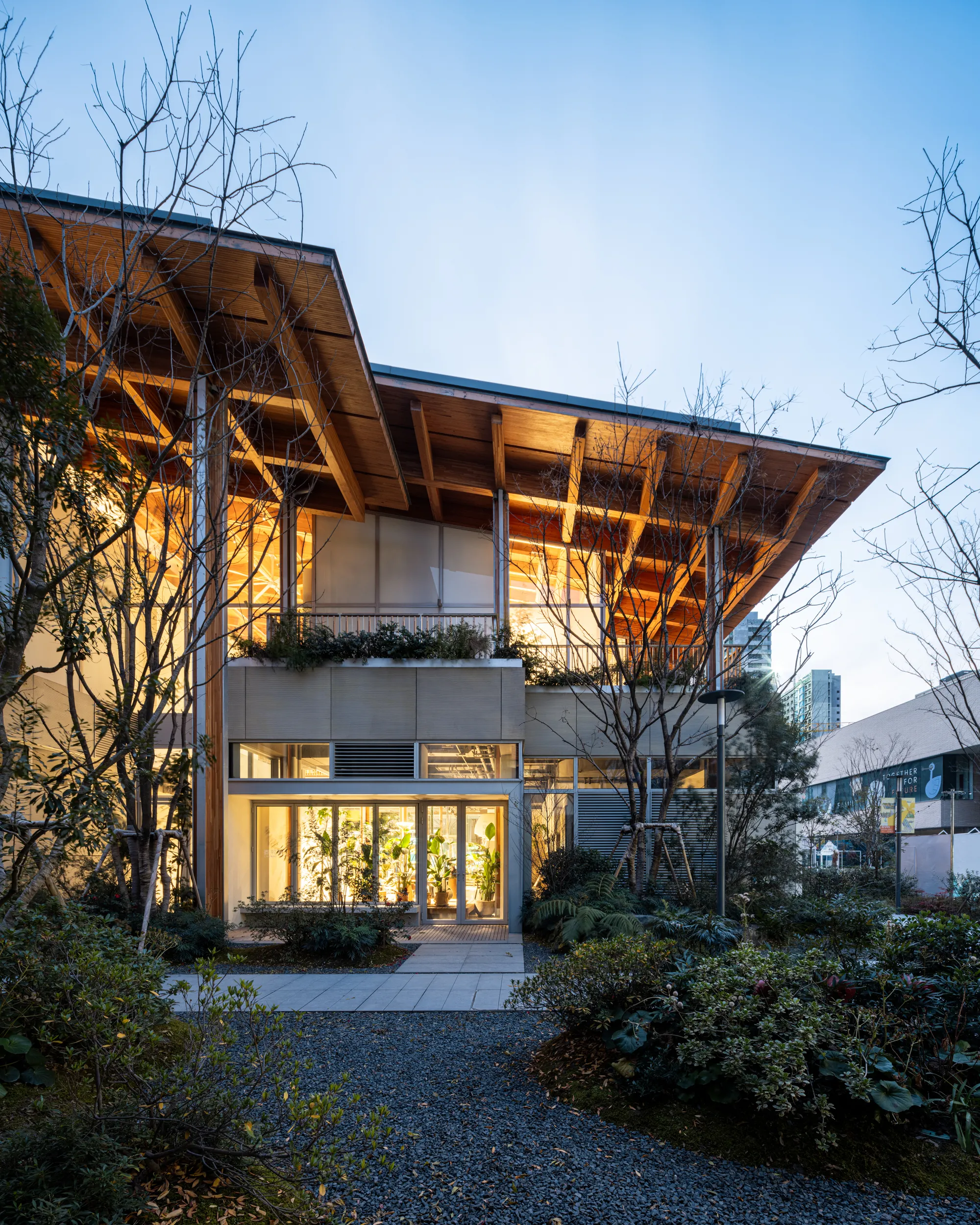
What makes this project genuinely interesting is not the program itself, which is familiar enough, but the structural and environmental strategy that delivers it. A deep timber coffered roof, supported by branching steel and timber columns, floats over two stories of activity and extends outward in broad cantilevering eaves that shade terraces, shelter entrances, and define a silhouette visible from surrounding towers. Planted courtyards punch through the floor plates, pulling daylight and ventilation into the center of the plan. The result is a building that reads simultaneously as a piece of infrastructure and as a garden pavilion, two things Shanghai could use more of.
A Roof That Does the Heavy Lifting
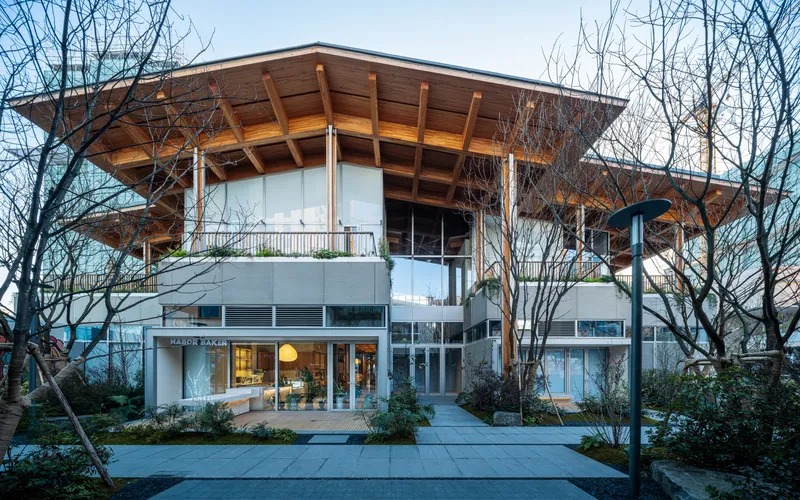
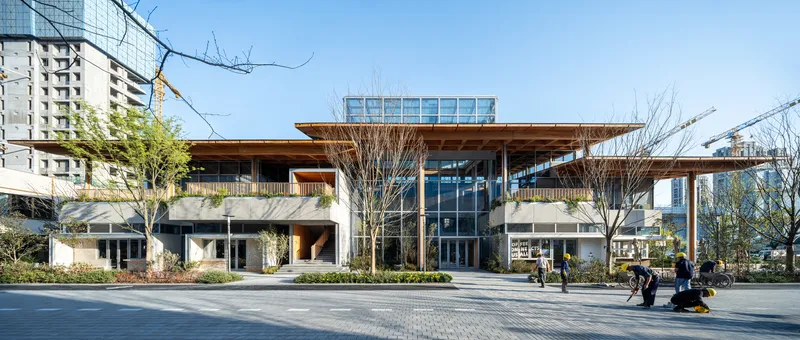
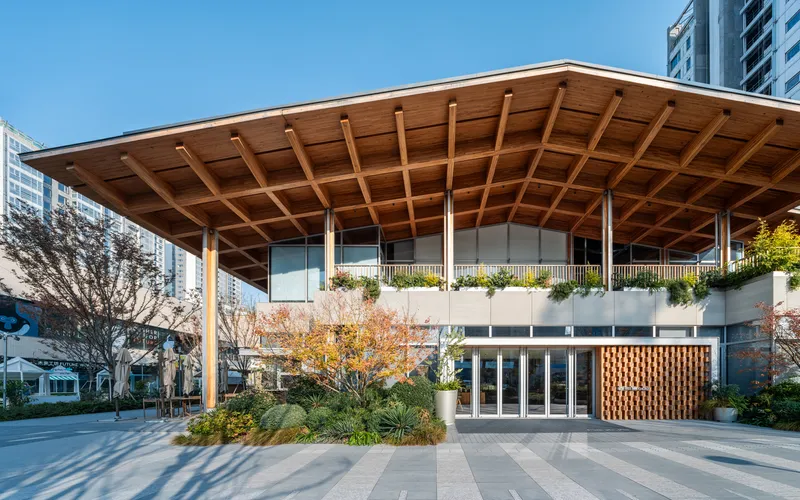
The defining architectural move here is the roof. Its layered timber coffers extend well beyond the building envelope, creating deep overhangs that shade the glazed ground floor and the planted terraces above. At dusk, when the structure is lit from within, the exposed rafters glow against the surrounding tower silhouettes, giving the low-rise building a presence that has nothing to do with height. From street level, the canopy reads as an invitation: it pulls pedestrians from the plaza into the building without requiring a formal threshold.
The roof is not simply decorative. Its sloped geometry channels rainwater, supports a green roof assembly, and works in concert with the atrium skylights to drive natural ventilation through the interior. Zhang Bin has used the roof as both the identity of the building and its primary environmental device, a move that collapses form and performance into a single gesture.
Branching Columns and the Exposed Skeleton
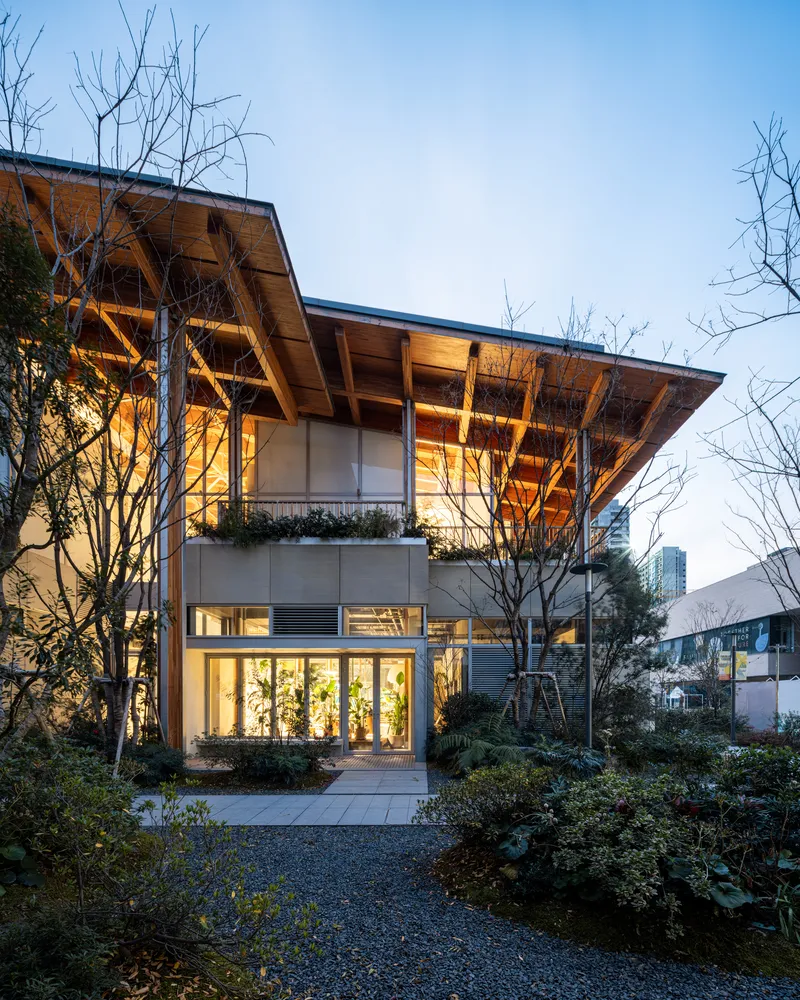
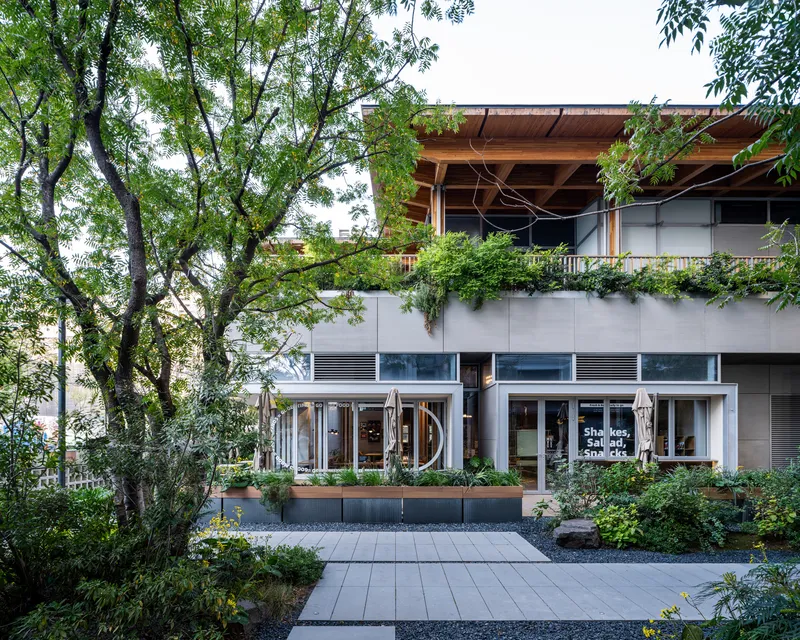
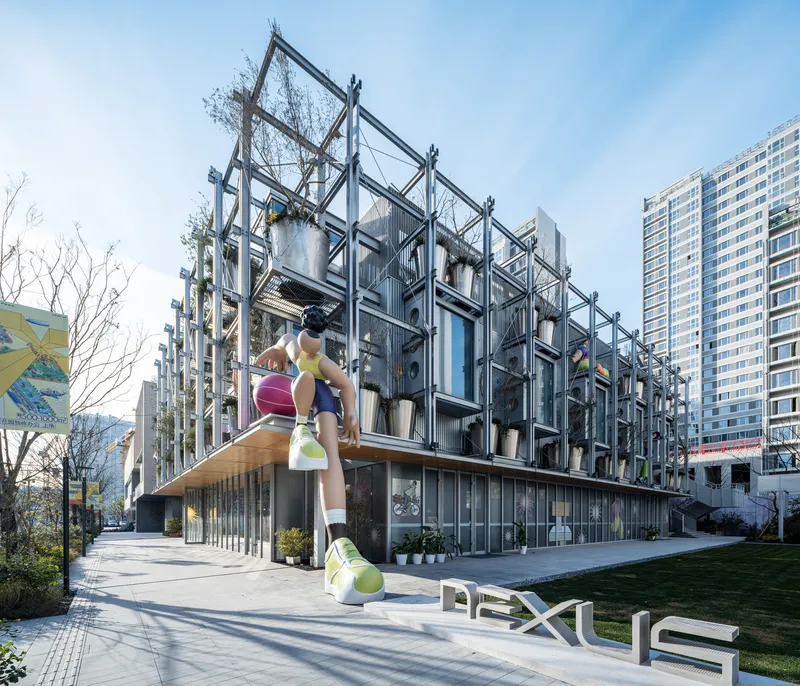
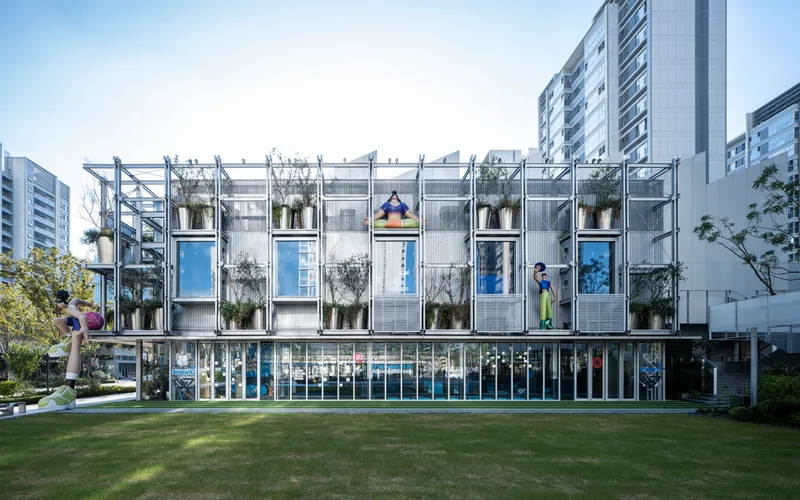
The structural system combines a steel exoskeleton with timber infill, and the architects make no effort to conceal the hybrid. Branching columns at the ground level split outward to meet the coffered roof, their steel arms supporting timber beams in a frank display of how loads travel. On the marketplace facades, the exoskeleton frames a mosaic of planted modules, climbing sculptures, and glazed shopfronts, an almost playful collage that avoids the monotony typical of mixed-use podiums.
The honesty of the structural expression is key to the building's character. Rather than wrapping the frame in cladding, Atelier Z lets it speak. The result is a building whose material logic is legible from every angle: steel where spans are long, timber where warmth and texture matter, glass where views and daylight are wanted.
Courtyards as Lungs
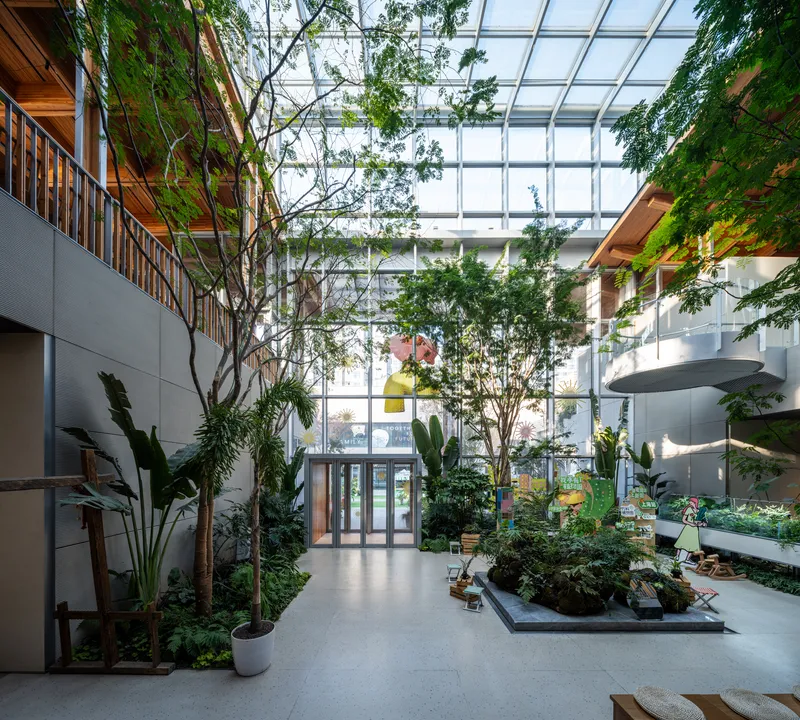
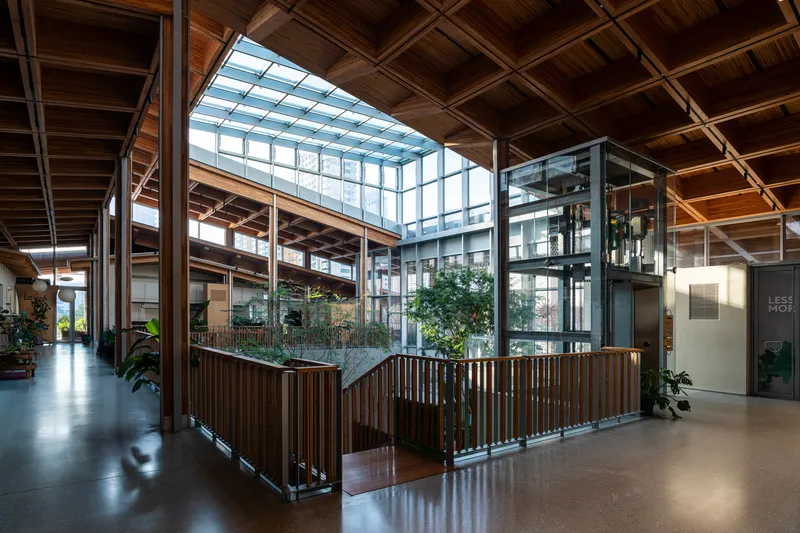
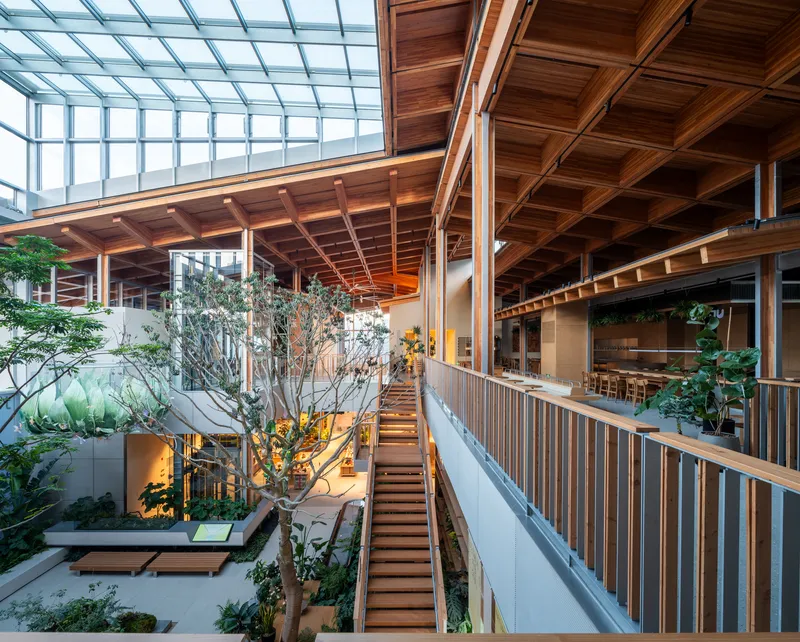
The plan is organized around a series of interior courtyards that cut through the floor plates and reach up to curved glass skylights. Mature trees rise from planted beds set into polished concrete floors, and timber staircases wrap around the voids, connecting ground level retail to upper level social spaces. These courtyards do triple duty: they bring daylight deep into the plan, they enable stack-effect ventilation through operable skylights, and they provide the kind of orienting spatial drama that keeps people circulating through the building rather than rushing past it.
The planting is not incidental. Potted trees, ground-level beds, and the green roof above create a continuous ecology that softens the acoustic and thermal environment. In a neighborhood dominated by glass and concrete towers, the building's interior courtyards register as a microclimate, cooler, quieter, and greener than anything around them.
The Marketplace Interior
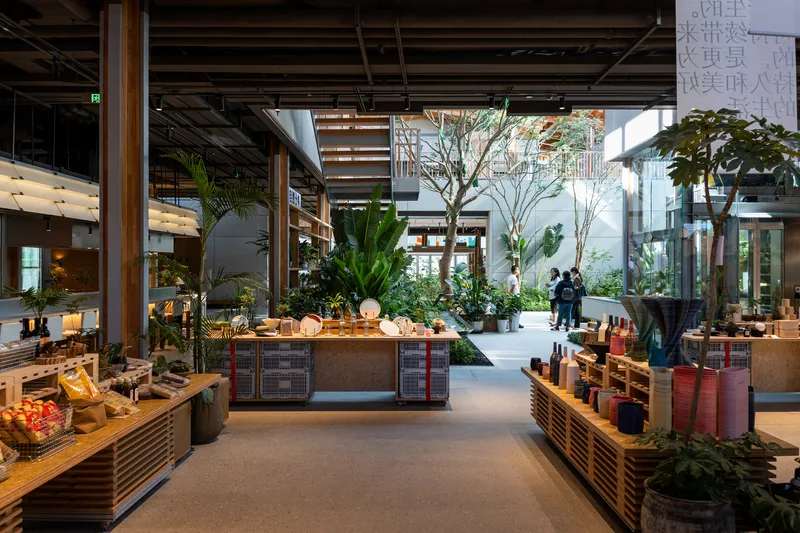
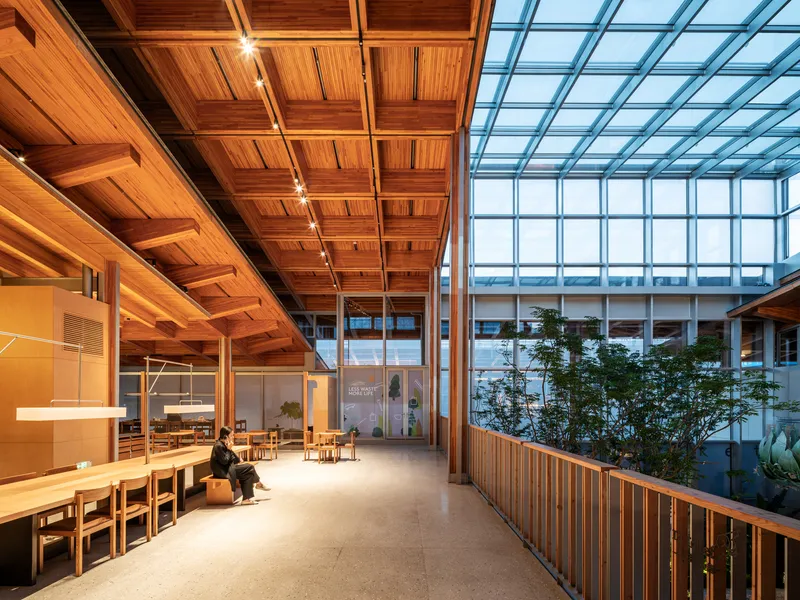
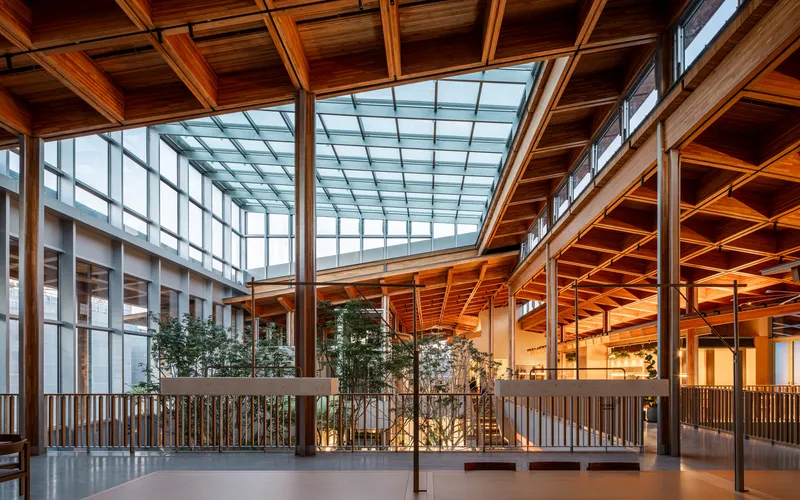
Inside the CHUNXI Marketplace, the coffered timber ceiling unifies a loose arrangement of retail stalls, display counters, and planted islands. Indoor trees punctuate the interior, breaking up sight lines and creating zones of intimacy within the open plan. The palette is deliberately restrained: timber above, polished concrete and stone below, with vegetation providing the primary color.
Corridors double as galleries, with the central glass atrium drawing the eye upward and through the building. At dusk, the warm interior light spills out through the full-height glazing, turning the marketplace into a lantern visible from the surrounding residential towers. It is a smart inversion: the commercial space becomes the neighborhood's ambient lighting.
GULANG Gymnasium: Steel Trusses and Clerestory Light
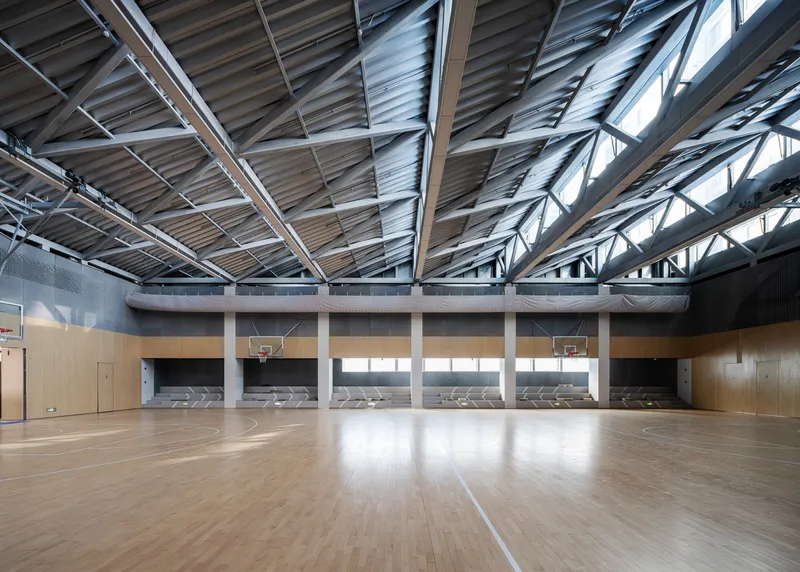
The gymnasium occupies a distinct volume within the complex, marked by an exposed steel truss ceiling and clerestory windows that wash the timber floor in even, glare-free light. Basketball hoops anchor the space, but the proportions suggest flexibility: the clear span is generous enough for multiple sports, and the ceiling height allows for badminton or volleyball without modification.
The gym's architectural character comes from the legibility of its structure. The steel trusses are left fully exposed, their geometry visible against the bright clerestory strip. It is an honest, efficient room, one that treats community sport as infrastructure worth investing in architecturally, not hiding behind drywall and drop ceilings.
Terraces, Water, and the Landscape Threshold
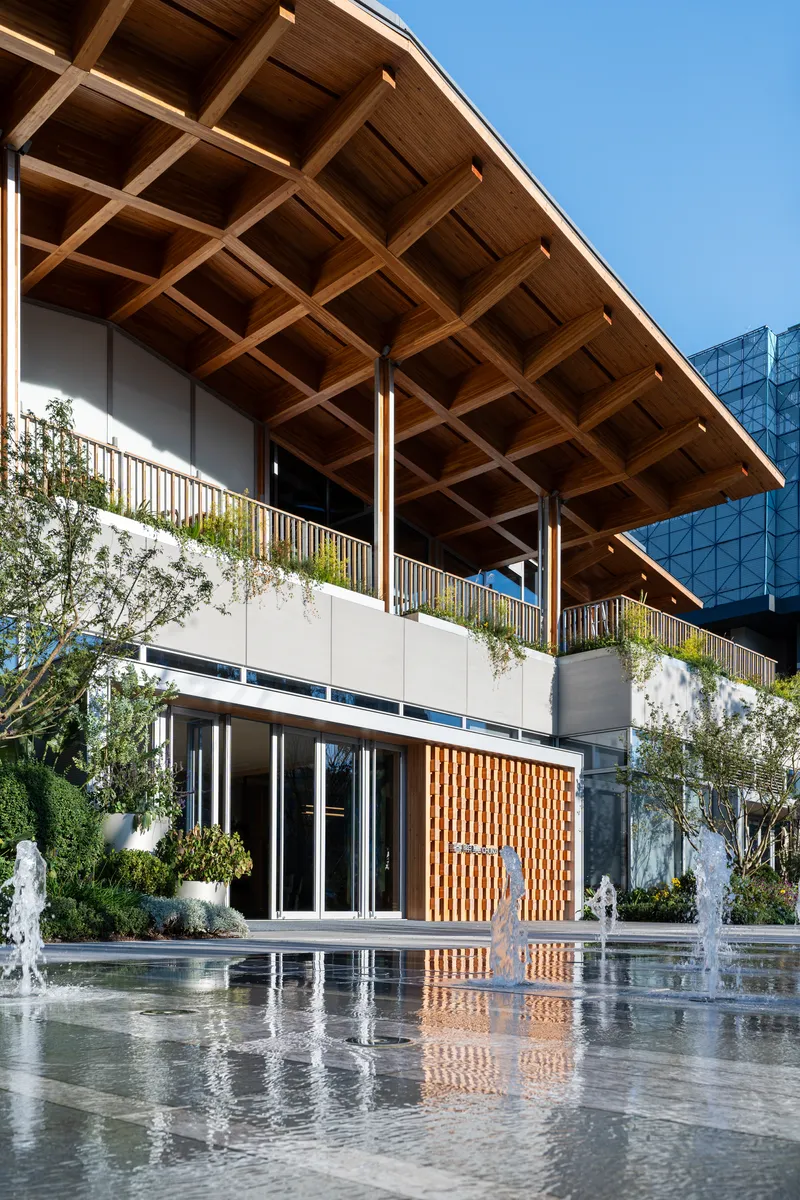
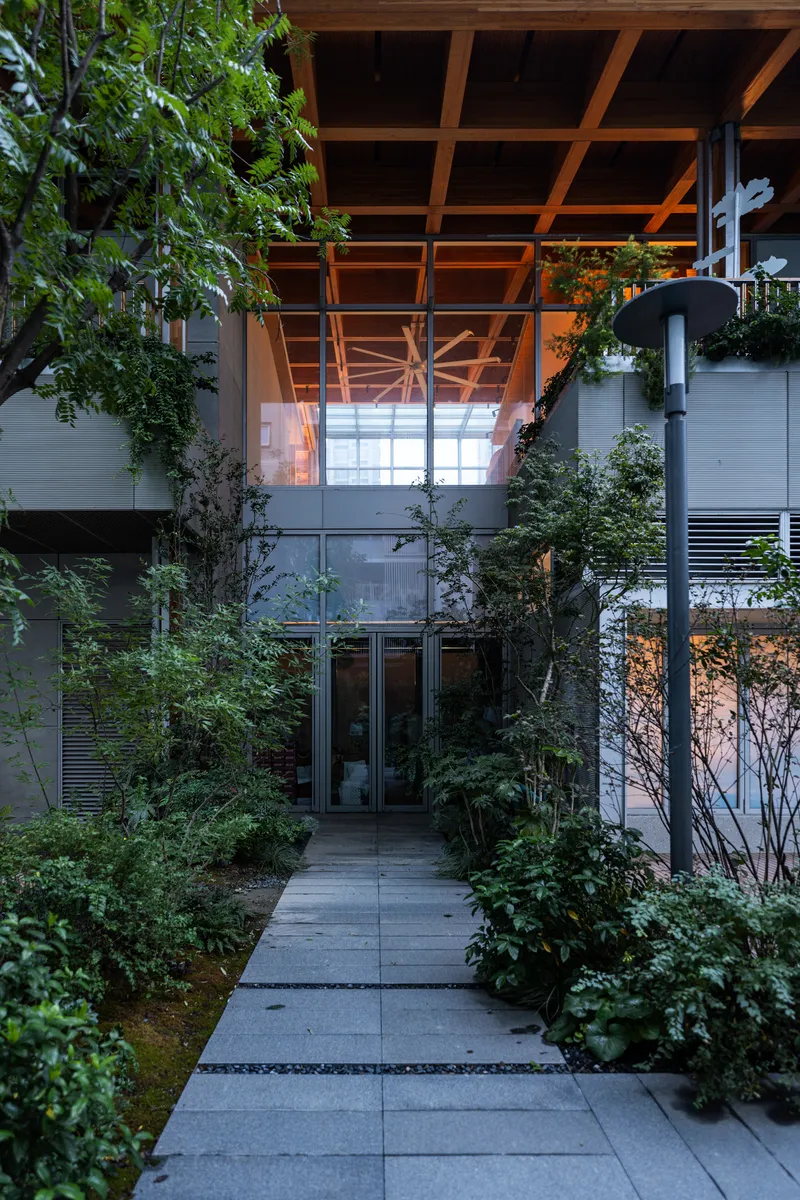
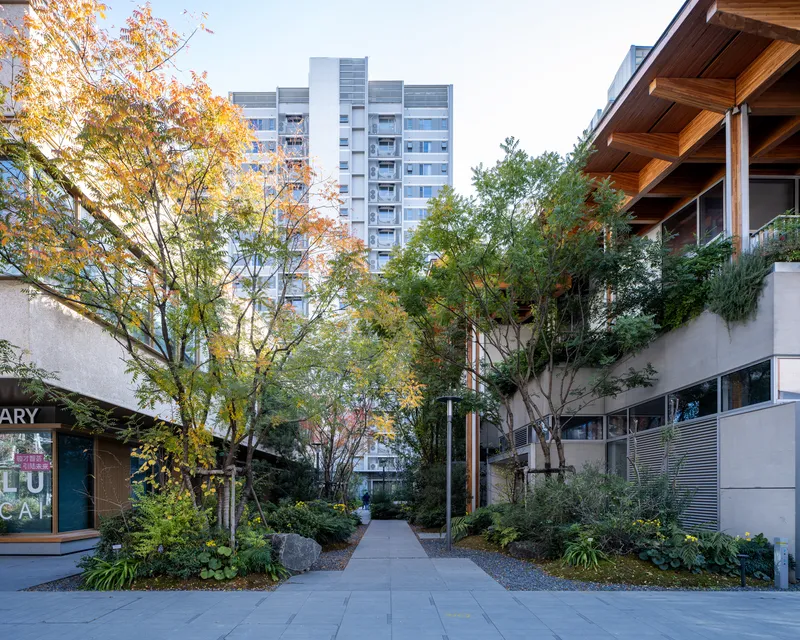
The building meets its landscape through a sequence of calibrated thresholds. A shallow reflecting pool with active fountains runs along one edge, mirroring the timber coffers and blurring the boundary between interior and exterior. Entry paths are lined with planted beds and flanked by autumn trees, channeling pedestrians from the surrounding residential blocks toward the glass doors beneath the cantilevering roof.
These landscape moves are not gratuitous. They manage stormwater, buffer noise from adjacent streets, and create a gradient of privacy from the open plaza to the enclosed marketplace. The transition from public park to semi-public courtyard to interior retail happens gradually, without gates or bollards, relying entirely on elevation changes, planting, and the shadow of the roof to signal shifts in program.
Living Above the Canopy
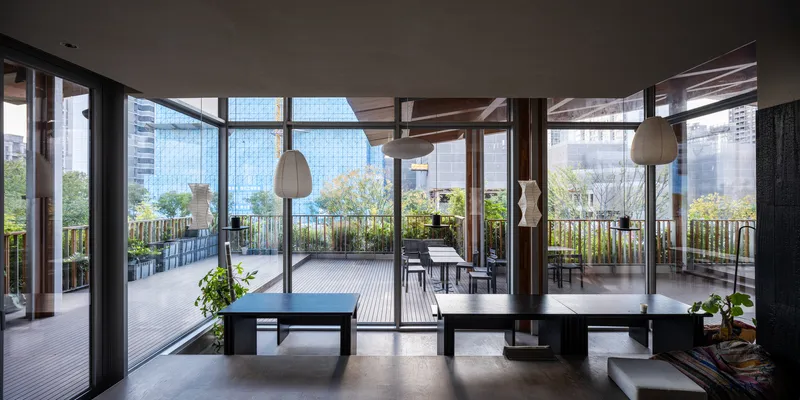
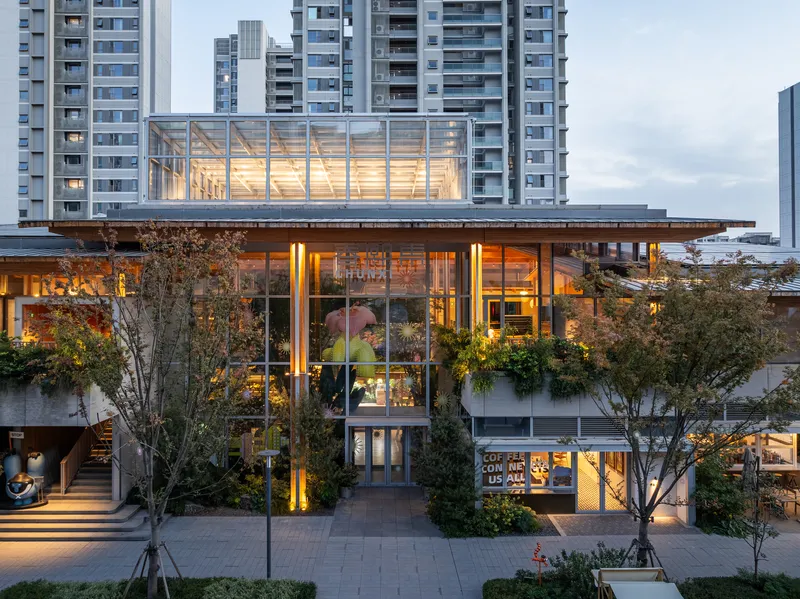
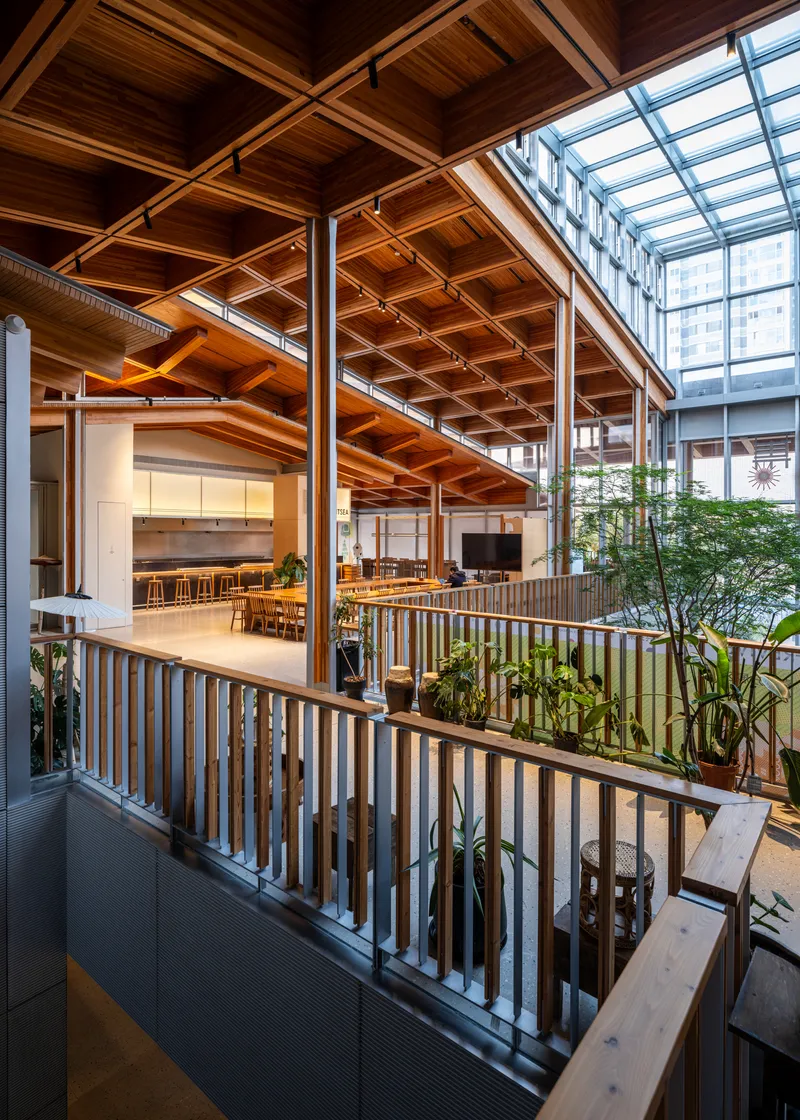
Upper level spaces open onto planted terraces with full-height glazing that frames the surrounding city. From the glass-enclosed pavilion on the second floor, residential towers recede into a skyline backdrop, and the timber structure of the roof becomes the dominant visual presence overhead. The balconies, with their vertical timber railings and exposed beam ceilings, feel more like garden rooms than corridors.
The aerial views confirm what the interiors suggest: the building's green roof and planted terraces create a landscape layer that reads as continuous with the ground-level planting. Seen from the towers above, the complex appears as a garden with a building inside it, not the other way around.
Aerial Context: A Pavilion Among Towers
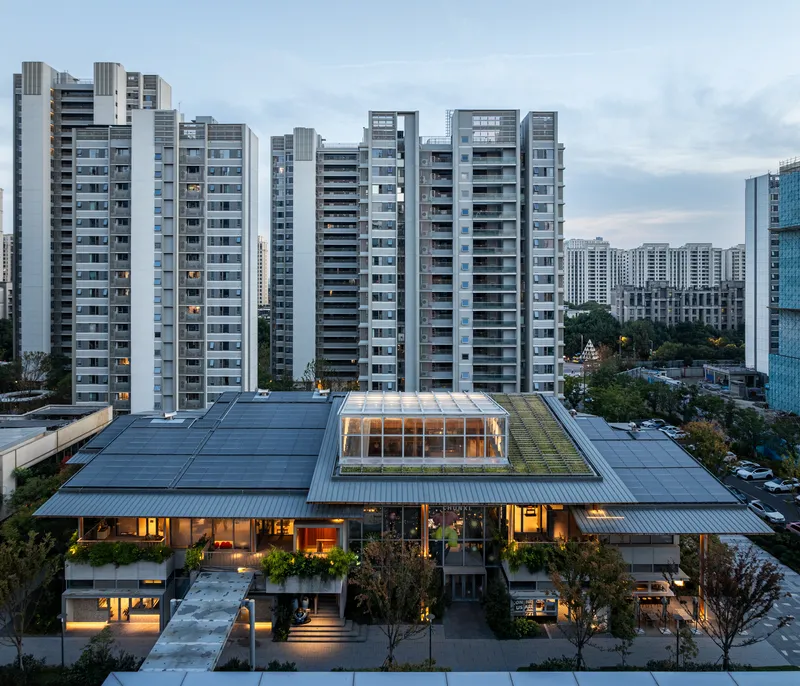
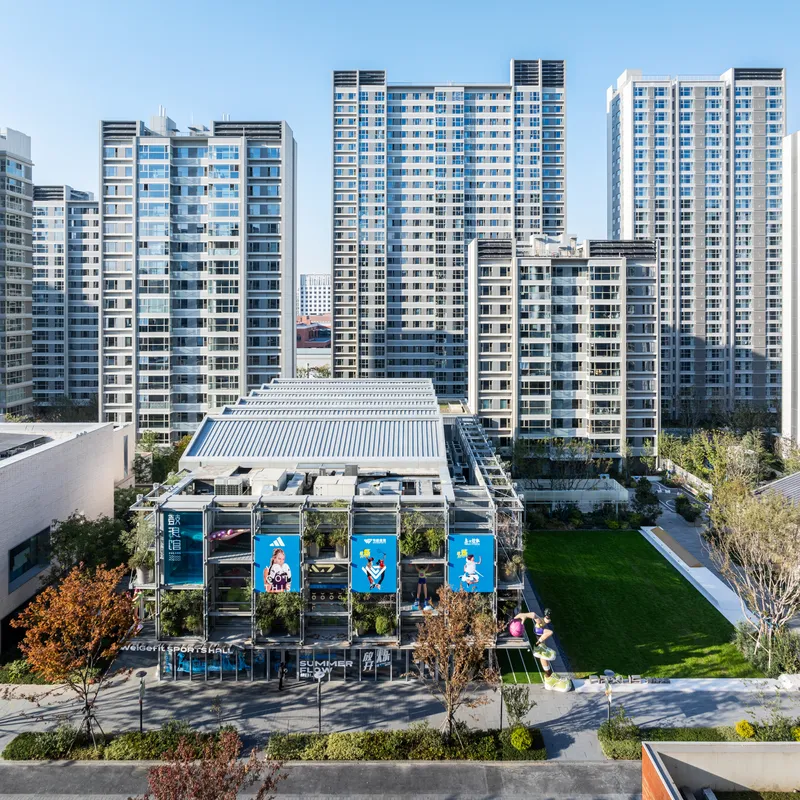
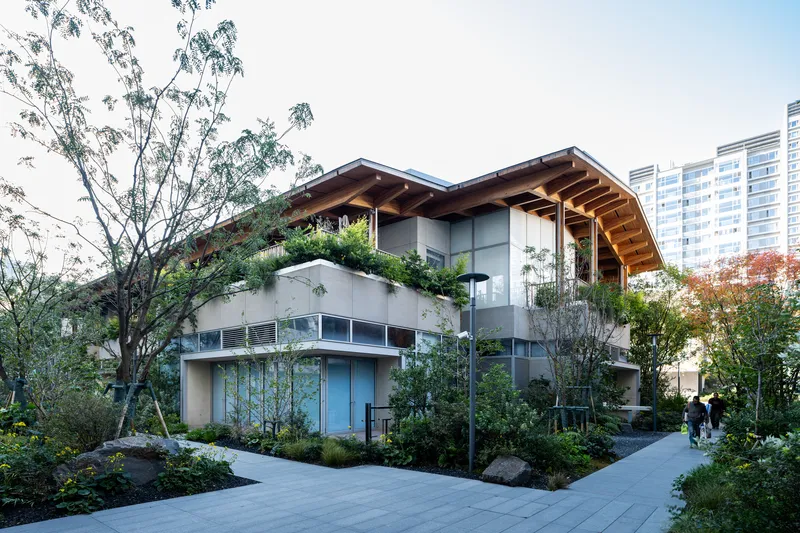
From above, the scale contrast between the low-rise pavilion and its residential tower neighbors is striking. The ribbed roof, with its green terraces and timber ribs, occupies a modest footprint at the center of a landscaped plaza. It is the kind of building that would be invisible in a site plan but is immediately legible in person, because its identity comes from material richness and spatial generosity rather than massing.
Plans and Drawings
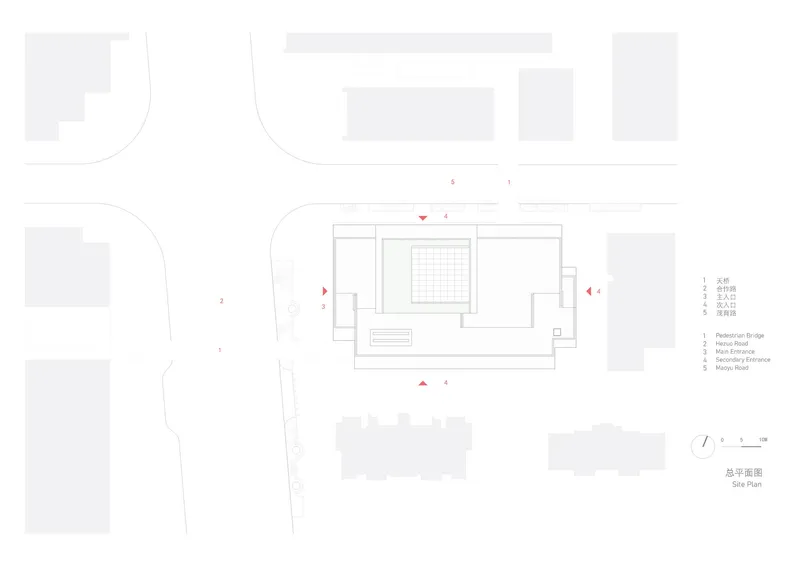
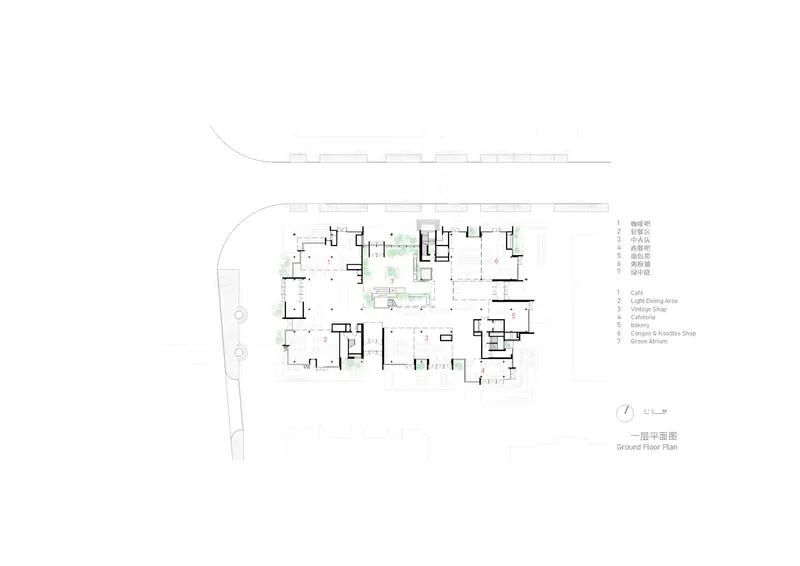
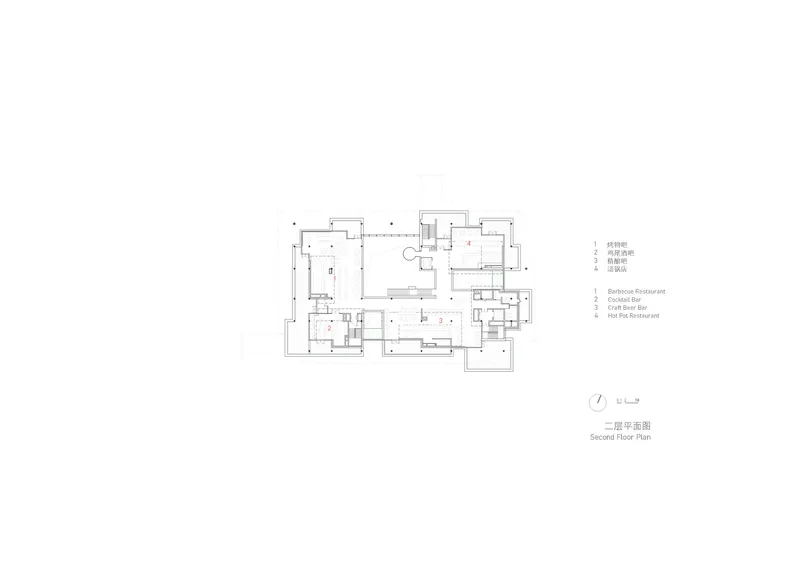
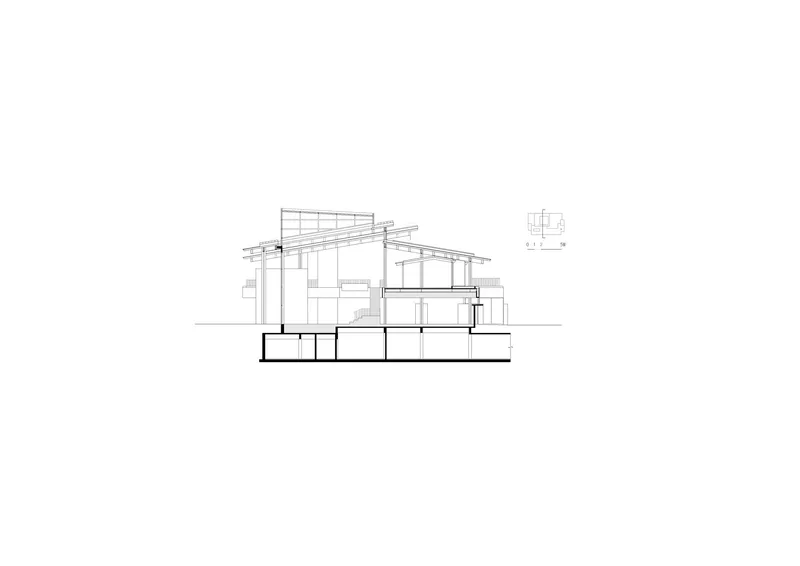
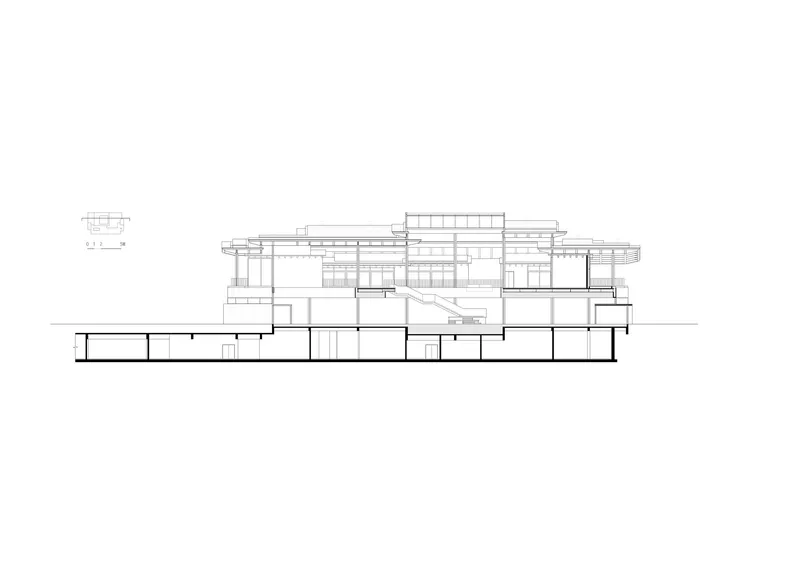
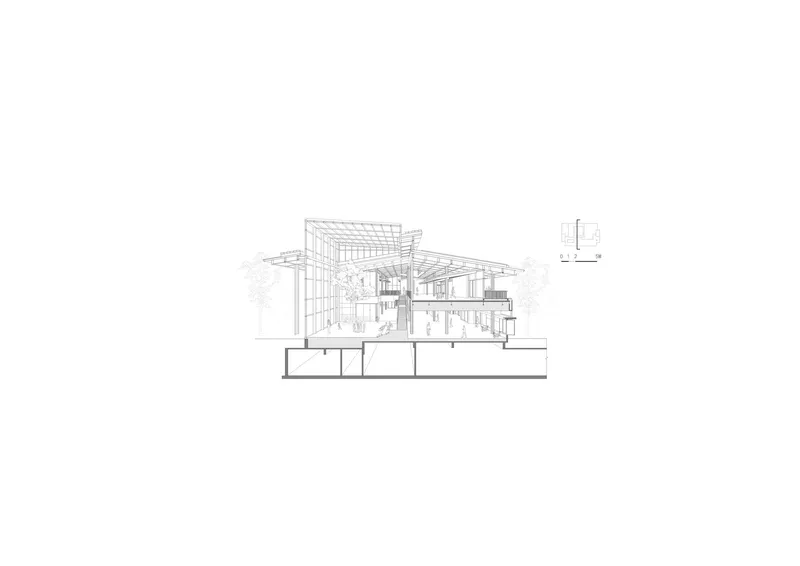
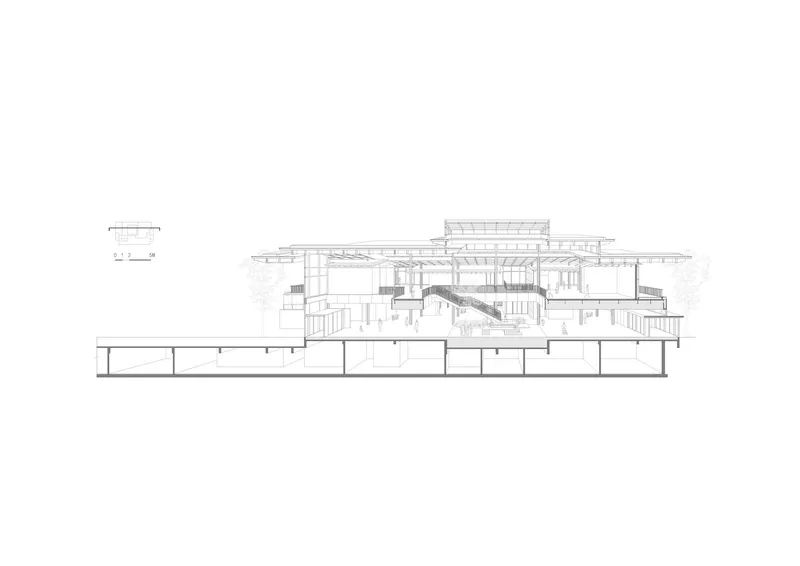
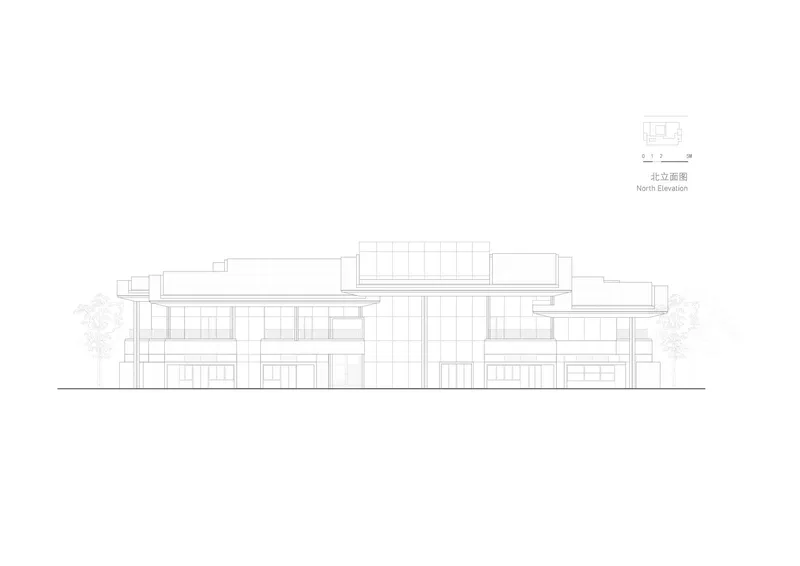
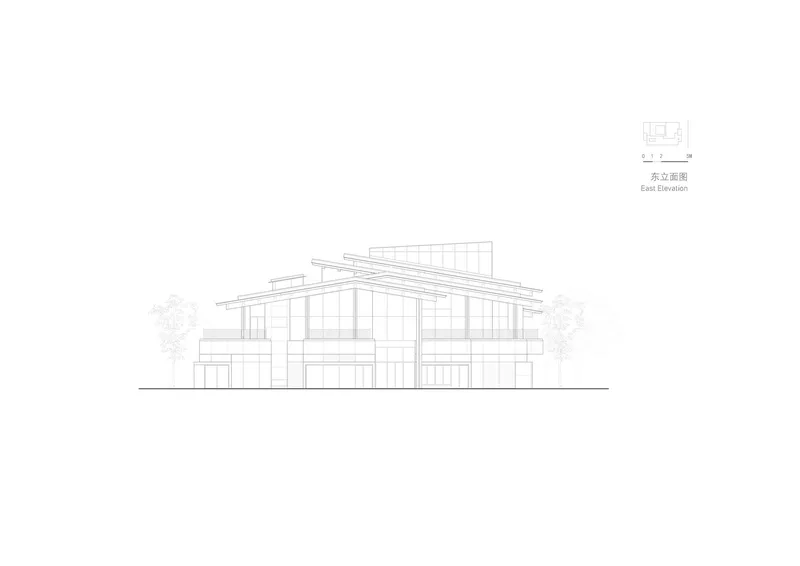
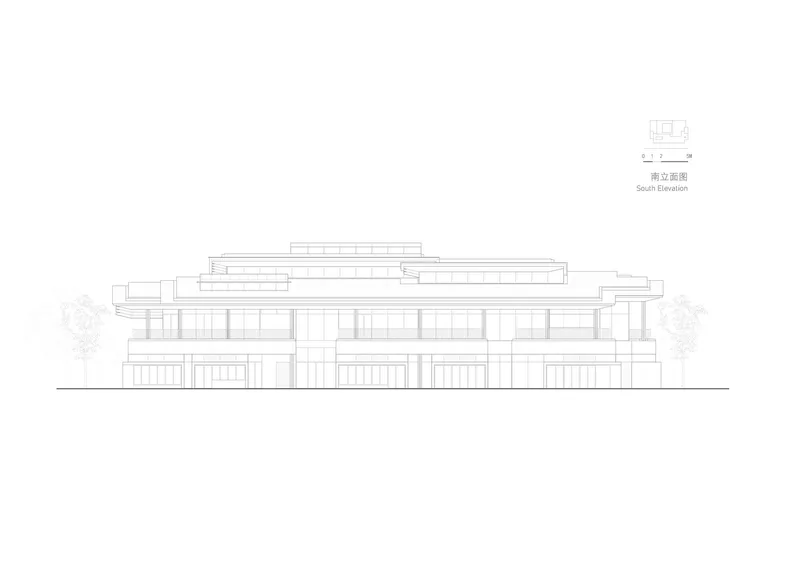
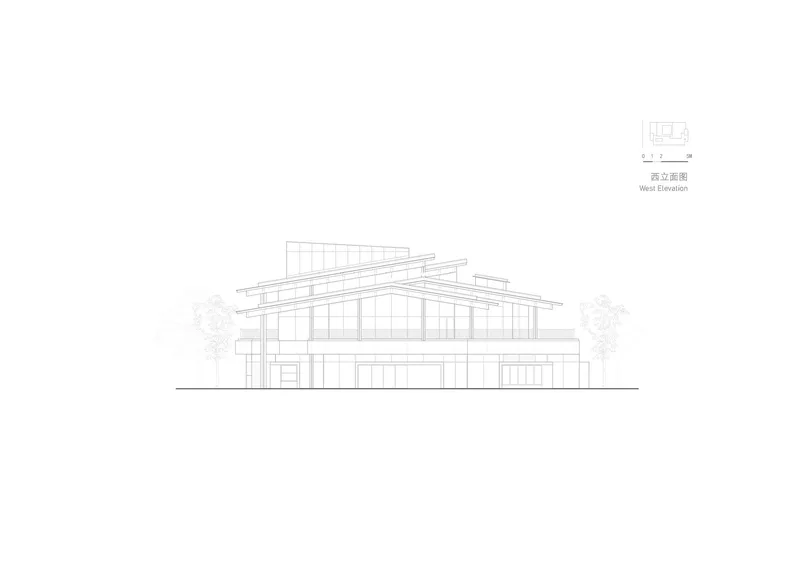
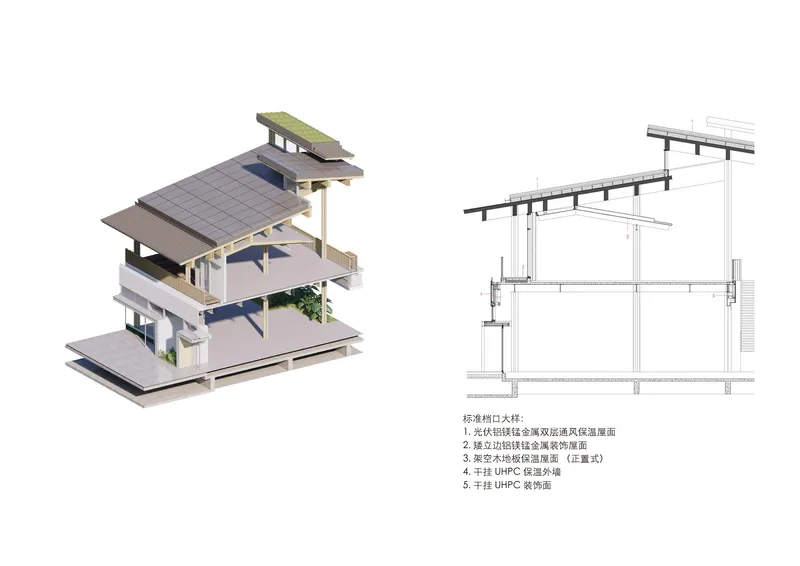
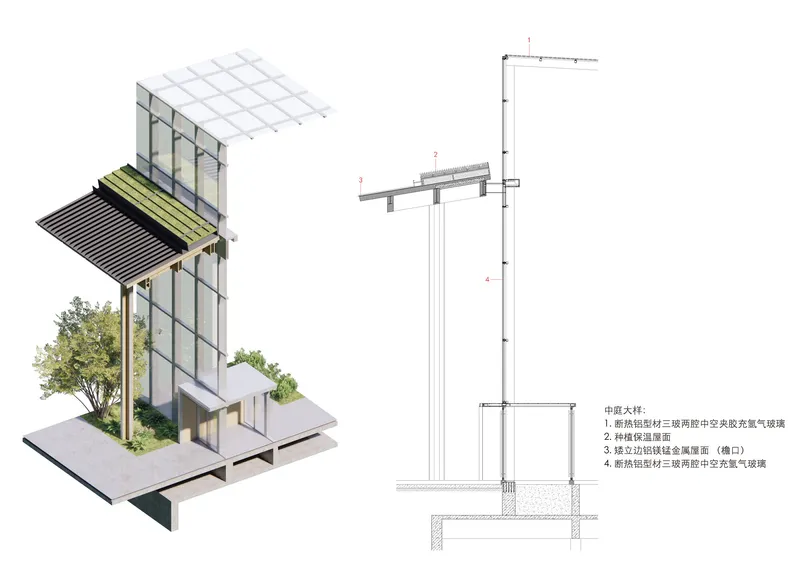
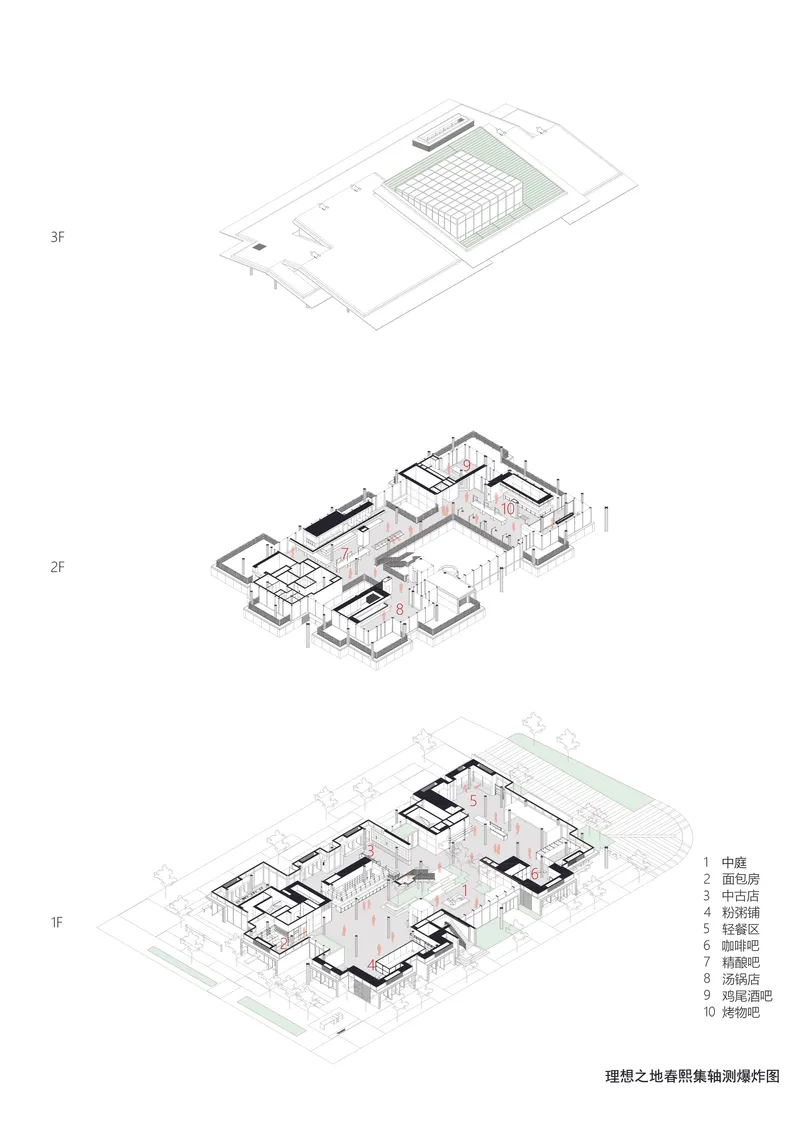
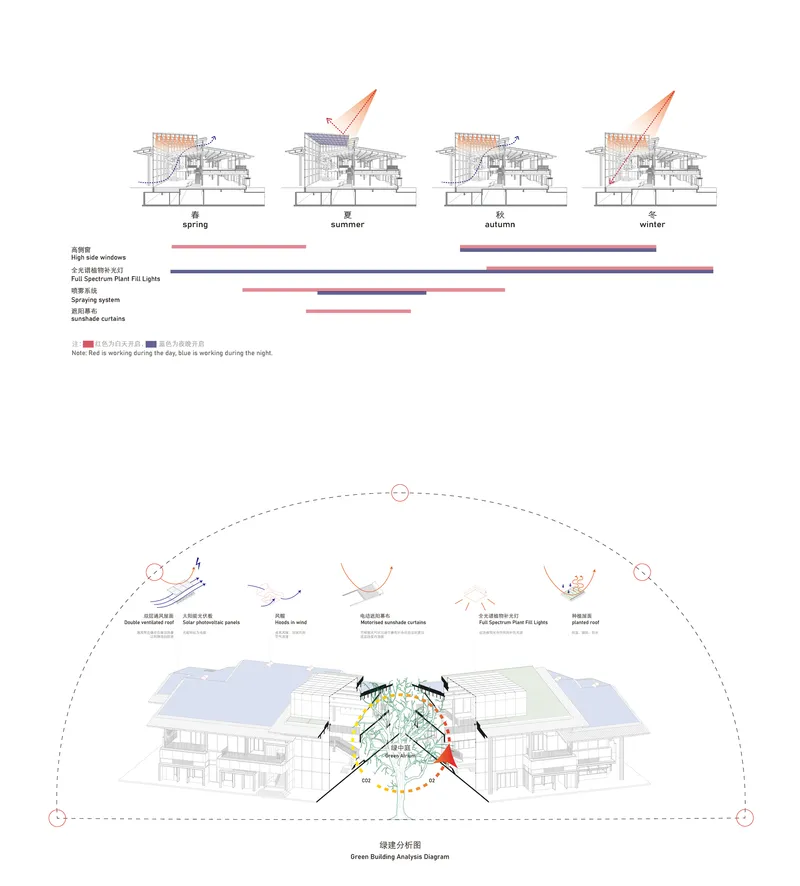
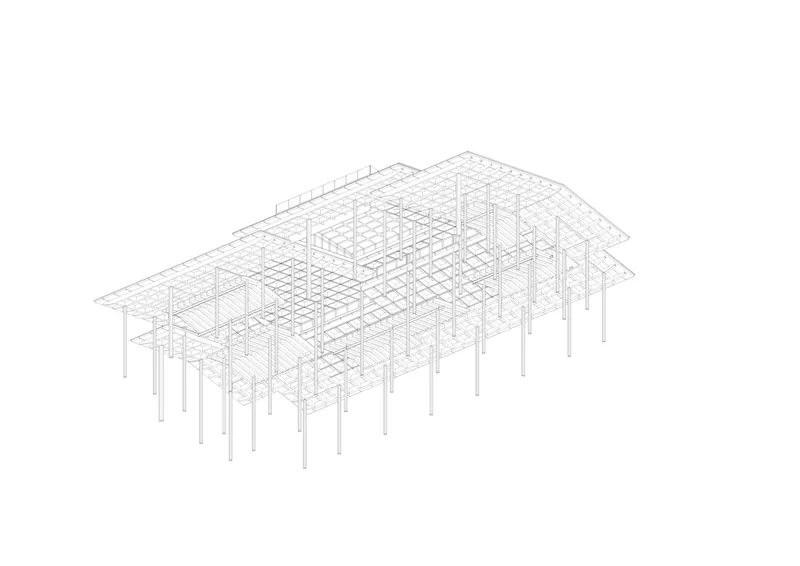
The drawings reveal a plan organized around two primary courtyards that penetrate the floor plates, with retail and marketplace spaces wrapping the perimeter at ground level and entertainment and social programs arrayed around the voids on the second floor. The sections are particularly instructive: they show how the layered, sloping roof planes cantilever over open terraces to create deep shade, and how a basement level accommodates back-of-house functions beneath the landscaped ground plane. The axonometric cutaways make the environmental strategy explicit, illustrating seasonal ventilation paths, the green roof assembly, and the relationship between the structural grid and the planted zones.
The structural wireframe drawing confirms the clarity of the column grid: a regular bay system that allows flexible subdivision of the retail floor while maintaining the generous clear spans needed for the gymnasium. The section details of the glazed facade with its louvered canopy show how solar control is integrated into the structural logic rather than applied as an afterthought.
Why This Project Matters
Chinese residential developments rarely invest in their community buildings with this level of architectural ambition. The typical model is a commercial podium clad in curtain wall, indistinguishable from a suburban mall, designed to sell units rather than sustain a neighborhood. Atelier Z has proposed something categorically different: a low-carbon timber structure with planted courtyards, honest detailing, and a spatial generosity that treats everyday commercial and athletic programs as civic infrastructure. The building's environmental performance, its natural ventilation strategy, green roof, and passive shading, is not a checklist of sustainability features but the direct consequence of its architectural decisions.
If the NEXUS initiative's "Ideal Unit" concept is to be replicated, this first realization sets a high standard. The building proves that a modest program and a modest footprint can produce architecture of real consequence when the structure, landscape, and environmental systems are designed as one thing. In a city where density often means anonymity, this small building gives an entire neighborhood a center of gravity.
CHUNXI Marketplace and GULANG Gymnasium by Atelier Z (lead architect: Zhang Bin). Shanghai, China. 3,500 m². Completed 2025. Photography by Min Yang.
About the Studio
Share Your Own Work on uni.xyz
If projects like this are the kind of work you want to make, uni.xyz is a place to publish your own, find collaborators, and enter design competitions.




Popular Articles
Popular articles from the community


Hill & Cross Opera: Sculptural Opera House Architecture Shaped by Tallinn’s Landscape and Identity
Hill & Cross Opera reimagines opera house architecture in Tallinn through its sculptural hill, civic plaza, glass wave and a luminous cross.

Co-Life: Senior Housing Design That Reconnects Older Adults With the City
Co-Life reimagines senior housing design through healing gardens, shared streets, workshops, and a sustainable community across generations.

Play: Fragments of Their World
Familiar architecture becomes modular playground design, creating safe spaces where displaced children can learn, connect, imagine and play.

Lunar Spiral: Space Architecture Shaped by the Mathematics of the Universe
Lunar Spiral reimagines space architecture through Fibonacci geometry, lunar regolith, levitating habitats, and self-sustaining Moon living.


Similar Reads
You might also enjoy these articles

Bao Huynh Watercolor Atelier: A Serene Art Retreat in Hội An
Bao Huynh Watercolor Atelier in Hội An blends multifunctional art spaces, sustainable design, local materials, and family-friendly living in a serene environment.

Atelier Macri Concept Store Interior Design by CASE-REAL
Atelier Macri store features a "ko" counter, walnut wood details, cork displays, blending retail, gallery, and seamless customer experiences.

Manuel Vargas Izquierdo Stadium and High-Performance Sports Center: Architectural Excellence in Jalpa de Méndez
The Manuel Vargas Izquierdo Stadium blends sustainable design, inclusive sports facilities, and cultural-inspired architecture, revitalizing Jalpa de Méndez’s public spaces.

KAKR Buluh Awar Hall: Revitalizing Community and Ecology Through Bamboo Architecture
Community built bamboo hall revitalizes Buluh Awar village, empowering youth, restoring ecology, celebrating vernacular craftsmanship through sustainable architecture and culture.


Explore Shopping Mall Competitions
Discover active competitions in this discipline



Challenge to design a barrier free sports center


Challenge to design an outdoor ice-rink and park


Challenge to design a portable theatre


Challenge to design a portable music platform
Comments (0)
Please login or sign up to add comments
No comments yet. Be the first to comment!