
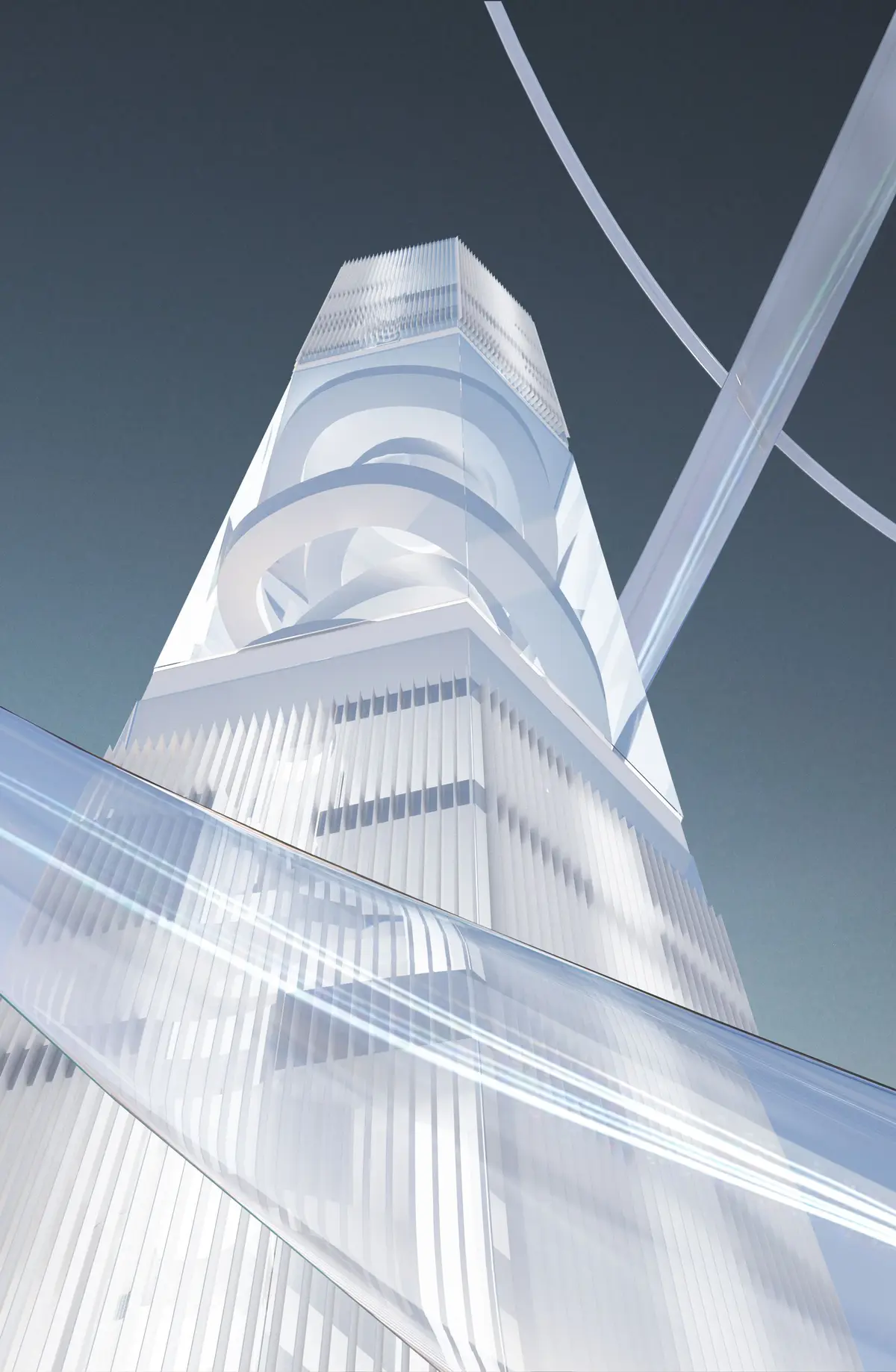
Automatic City: Vertical Urbanism for the Sahara
A tower city for one million people on a 2.5-mile footprint, built from sand and bacteria, moved by automated elevators, cooled by double-skin facades.


Land is the one resource the Sahara has in abundance. But building horizontally across it means fighting sun, sand, and distance on every square metre. Automatic City, a project by Siming Chen and Jieyu Zhou, inverts the assumption. Instead of spreading out, it stacks up. One million people in a 2.5 by 2.5 mile footprint, living vertically.
Shortlisted in the Extreme Habitat Challenge: Sahara on uni.xyz, this entry applies the logic of high-density vertical urbanism to one of the least dense landscapes on earth. The result is a tower city that touches the ground lightly and builds its complexity upward.
Going Vertical in the Desert

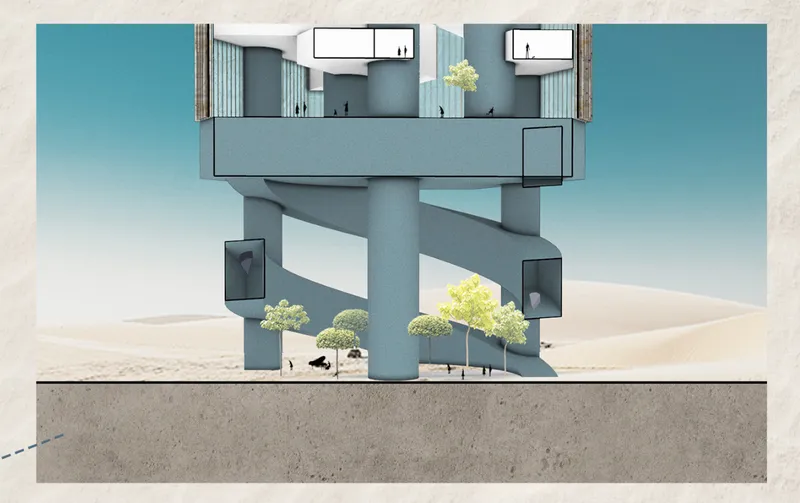
The core argument is straightforward. Horizontal settlement in the Sahara exposes the maximum surface area to solar radiation, requires long infrastructure runs for water and energy, and spreads population across distances that demand transport. Vertical settlement compresses all of this. Walls shade each other. Infrastructure runs are short. Walking distances are measured in floors, not kilometres.
The towers are lifted above the ground on structural legs, which keeps the inhabited space clear of sand accumulation and allows air to flow beneath the buildings. This is not a symbolic gesture. Sand burial is one of the primary failure modes of desert construction. Elevating the city is a maintenance strategy.
The Automatic Elevator: Vertical Transport as Infrastructure

The project's name comes from its transport system. Instead of streets and cars, movement is handled by automated elevators that run vertically and horizontally through the tower structure. These are not conventional lifts. They are a circulatory system: continuous, multi-directional, and automated, connecting every level without bottlenecks.
This is the idea that makes the vertical density viable. A 100-storey building with conventional elevators loses a quarter of its floor area to shafts and lobbies. Automated multi-directional systems recover that space and eliminate wait times. The transport infrastructure is embedded in the structure rather than occupying its own footprint.
Cooling, Materials, and the Double Skin
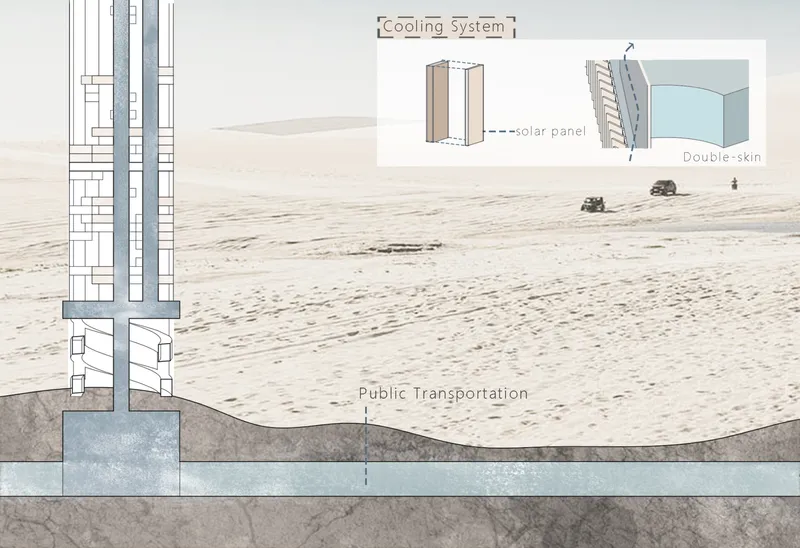
The environmental strategy is specific. A double-skin facade with integrated solar panels provides both energy generation and thermal buffering. The outer skin absorbs solar radiation and converts it to electricity. The air gap between the two skins ventilates passively, reducing the cooling load on the interior.
The construction materials are derived from site: sand and Bacillus pasteurii, a bacterium that binds sand particles into a cement-like material through biocementation. This means the primary building material is literally underfoot. No import required. The desert builds itself.
Underground Transit and Phased Growth
Below the towers, an underground hyperloop network connects city modules and links the settlement to external destinations. The transit sits below the sand line, shielded from heat, and connects directly to the elevator cores above.
Growth is phased in three stages: Phase 1 establishes core modules for 10,000 residents. Phase 2 expands to 100,000 by adding modules vertically and horizontally. Phase 3 reaches 1,000,000 through full network buildout. Each phase is self-contained. The city works at every scale.
Community in the Sky
The hexagonal floor plan creates shared terraces, green spaces, and communal areas at every level. The design merges living, working, and recreation into vertical neighbourhoods rather than separating them into zones. Sky bridges link towers, creating elevated public pathways that function as streets in the air.
This is the project's most optimistic claim: that density produces community rather than isolation. The terraces, the bridges, and the shared cores are designed to force encounter. In a building this tall, you cannot avoid your neighbours. The architecture makes that a feature rather than a problem.
Why This Project Matters
Most EHC Sahara entries spread their settlements across the landscape. Automatic City is one of the few that goes vertical. This makes it a useful counterpoint in the competition's broader conversation. If the desert's surface is the problem, one legitimate response is to leave it alone and build upward. The project takes that logic to its extreme and tests whether it holds.
For anyone studying vertical urbanism, automated transport, or bio-material construction, this entry provides a clear speculative framework. The biocementation detail alone is worth studying: a building material made from sand and bacteria, requiring no kiln, no quarry, and no supply chain.
View the Full Project
About the Designers
Designers: Siming Chen, Jieyu Zhou
Enter a Design Competition on uni.xyz
If vertical urbanism, automated infrastructure, or bio-material construction is the kind of work you want to explore, uni.xyz runs competitions year-round that reward structural ambition and systems-level thinking.
Project credits: Automatic City by Siming Chen and Jieyu Zhou. Shortlisted, Extreme Habitat Challenge: Sahara (uni.xyz).


Popular Articles
Popular articles from the community


GROUP A Strips a 1969 Rotterdam Harbor Headquarters to Its Frame and Wraps It in Timber Louvers
In Rotterdam's M4H harbor district, Ferro Offices reuses a 1969 frame, adds one timber storey and reaches BREEAM-NL Outstanding.

U.GA Architects Wraps an Oval Rooftop Pool in Curved Board-Formed Concrete on Busan's Jeollidan-gil
In Busan's Jeonpo-dong, a 454 m² mixed-use block stacks a neighborhood facility, guest rooms and an oval rooftop pool inside spiraling concrete walls.

longwave studio Reorganizes a 112 m² Tainan Apartment Around the Daily Routines of a Family and Two Cats
In Tainan, Taiwan, birch plywood, rust-red furniture and a freestanding plaster wall link arrival, storage, work and family life in one apartment.

Architekt Andreas Gruber Scatters 23 Dark Timber Chalets Across a South Tyrolean Forest Edge
In Molini di Tures, Amonti Chalets breaks a resort into a hamlet of gabled timber houses, with parking, storage and services pushed into the slope.

Similar Reads
You might also enjoy these articles


Vereda Arquitetos Renovates a 40-Square-Meter Apartment Inside Niemeyer's Copan Building
A compact unit in São Paulo's most iconic residential tower gets a material overhaul that pairs exposed concrete with bold blue Formica.

Shakur's House: Exposed Brick as an Interior Organiser in a 168 m² Mashhad Residence
Brick moves indoors in this Mashhad residence, where masonry walls, glass partitions and teal planes sequence a compact home without closing it off.

Day and Night Park: A Time-Based Urban Newsstand in Beijing
A temporary urban newsstand in Beijing blending travel, light, and reading through poetic colors, compact form, and community-focused design.

Modernist Patio Renovation in El Masnou, Barcelona by Oliver Segura Arquitectura + Cebrià Arquitectura
Modernist patio renovation blending tradition and innovation with a movable pool, leveled floors, and Catalan materials in El Masnou.

Explore Vertical City Competitions
Discover active competitions in this discipline

Challenge to visualize slums of 2080

Challenge to design a shop stop sunk in the city

Render competition to represent the city as a machine

Design challenge to equip cities with modern furniture
Comments (0)
Please login or sign up to add comments
No comments yet. Be the first to comment!