
Estudio Gonzalo del Val Rewires a Barcelona Flat with a Yellow Geometric Spine
The Avorio Renovation turns a single bold color and coffered ceiling geometry into a spatial navigation system across an entire apartment.


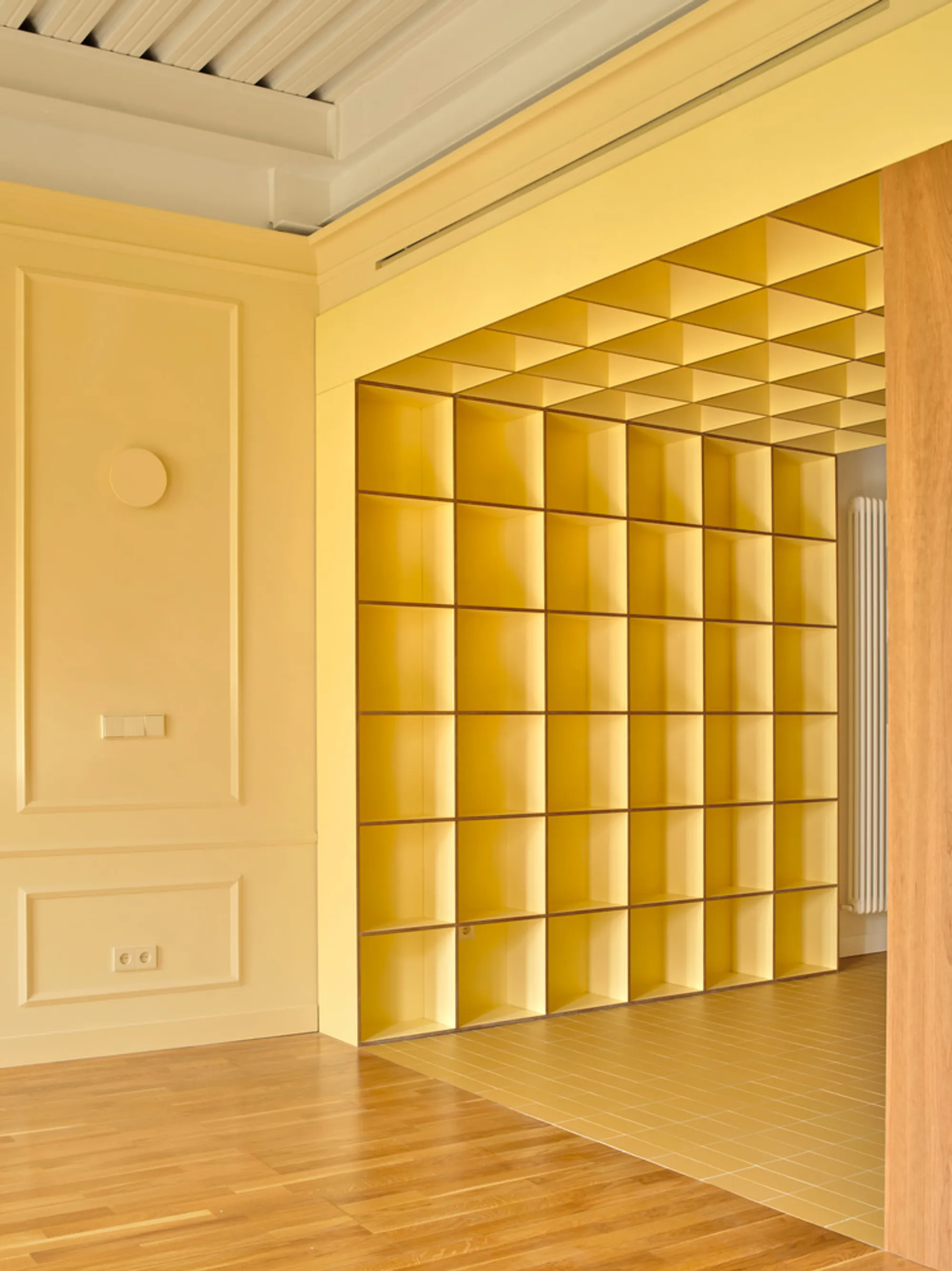
Color in residential architecture tends to land in one of two categories: accent or gimmick. Estudio Gonzalo del Val sidesteps both with the Avorio Renovation in Barcelona, deploying a saturated yellow not as decoration but as infrastructure. The color marks a continuous coffered ceiling and shelving system that threads through the apartment like a circulatory organ, linking rooms that might otherwise read as a disconnected sequence of timber-lined boxes.
What makes this project worth studying is its discipline. The yellow elements are always geometric, always gridded, always structural in their visual logic. They never bleed into the warm timber surfaces or the white walls that frame them. The result is a flat where orientation is intuitive: you follow the yellow. It is wayfinding dressed as interior design, and it works because the studio commits to the idea without hesitation.
The Yellow Grid as Connective Tissue
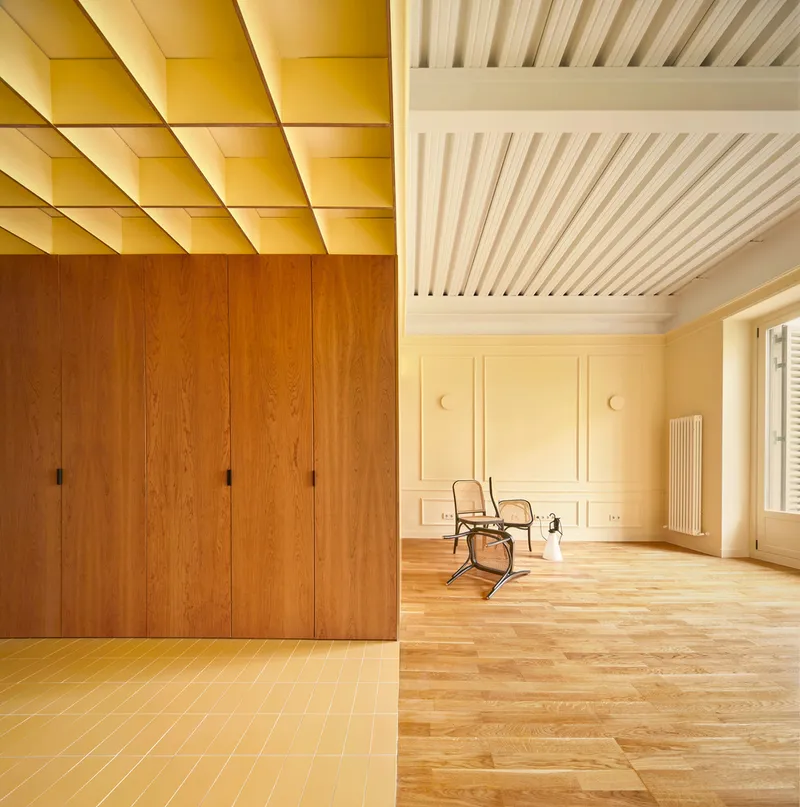
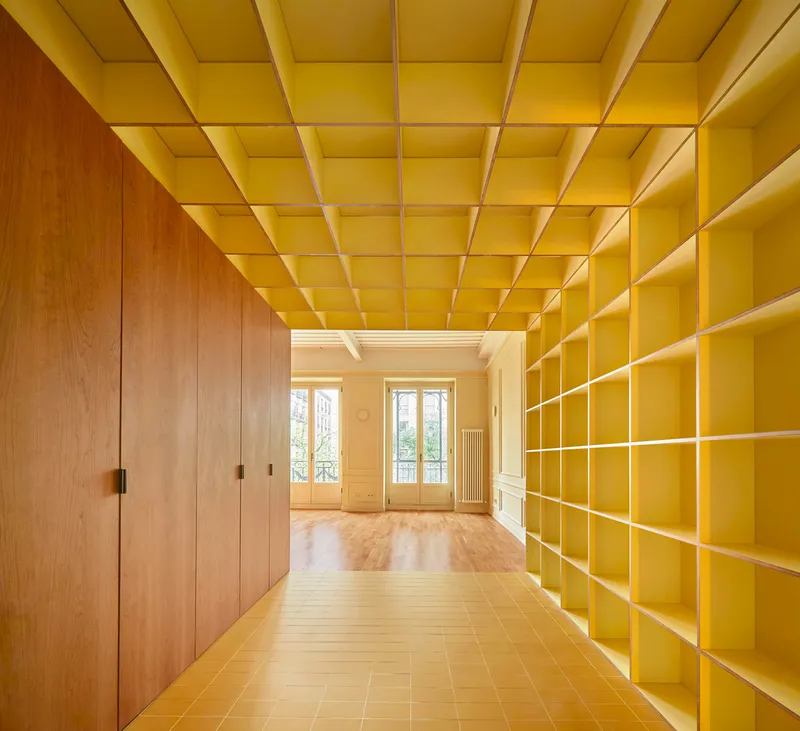
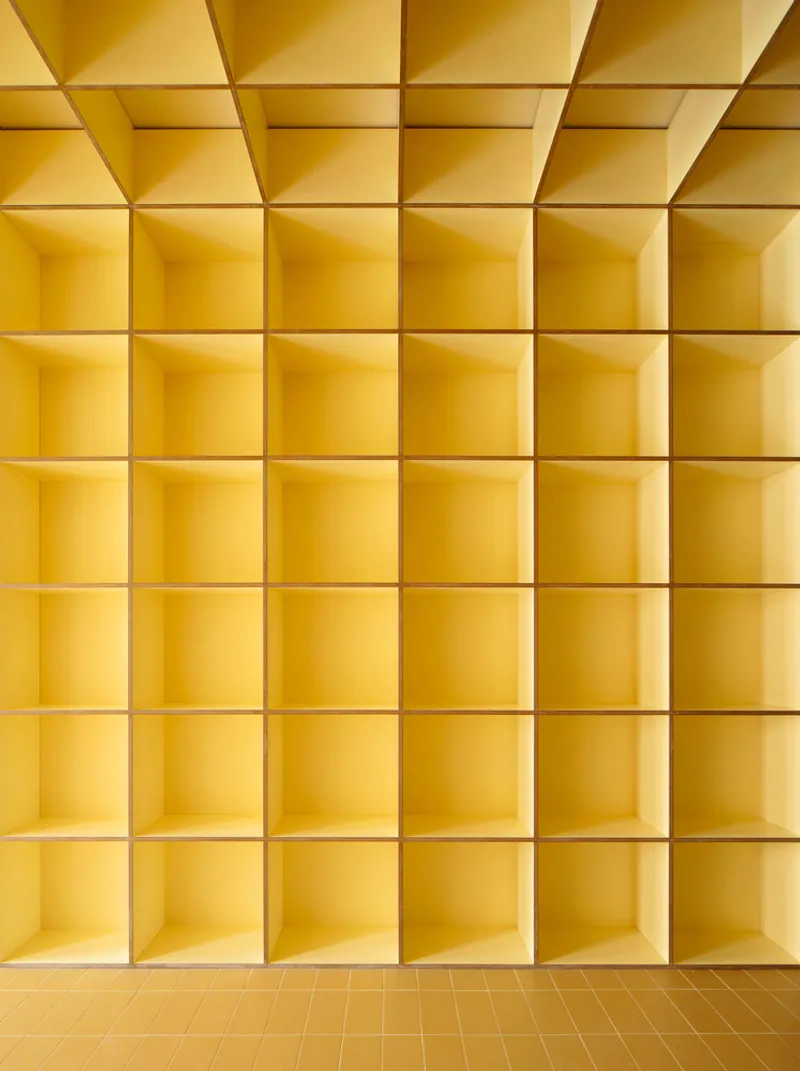
The coffered ceiling is the protagonist. Its deep square recesses, painted in a uniform matte yellow, run overhead through corridors and transitional spaces, pulling the eye forward and establishing rhythm. Where the ceiling meets a wall, the grid pivots into shelving, turning a two-dimensional surface pattern into a three-dimensional storage system. The consistency of the module across horizontal and vertical planes is what prevents this from feeling like a novelty.
Underfoot, the response varies. Parquet flooring in some areas and tiled surfaces in others create subtle zone shifts without disrupting the overhead continuity. The yellow grid never touches the floor, which keeps it hovering in the upper register of your peripheral vision, an almost subliminal guide through the plan.
Timber Rooms, White Frames
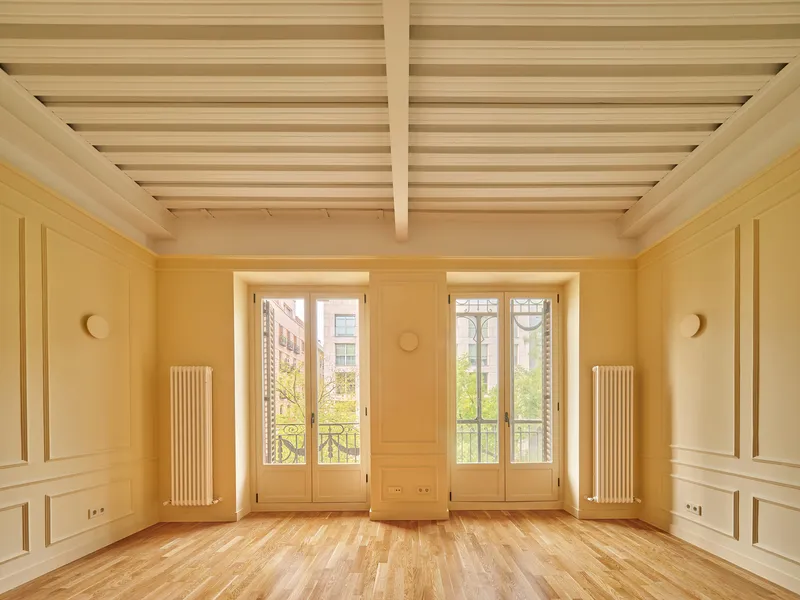
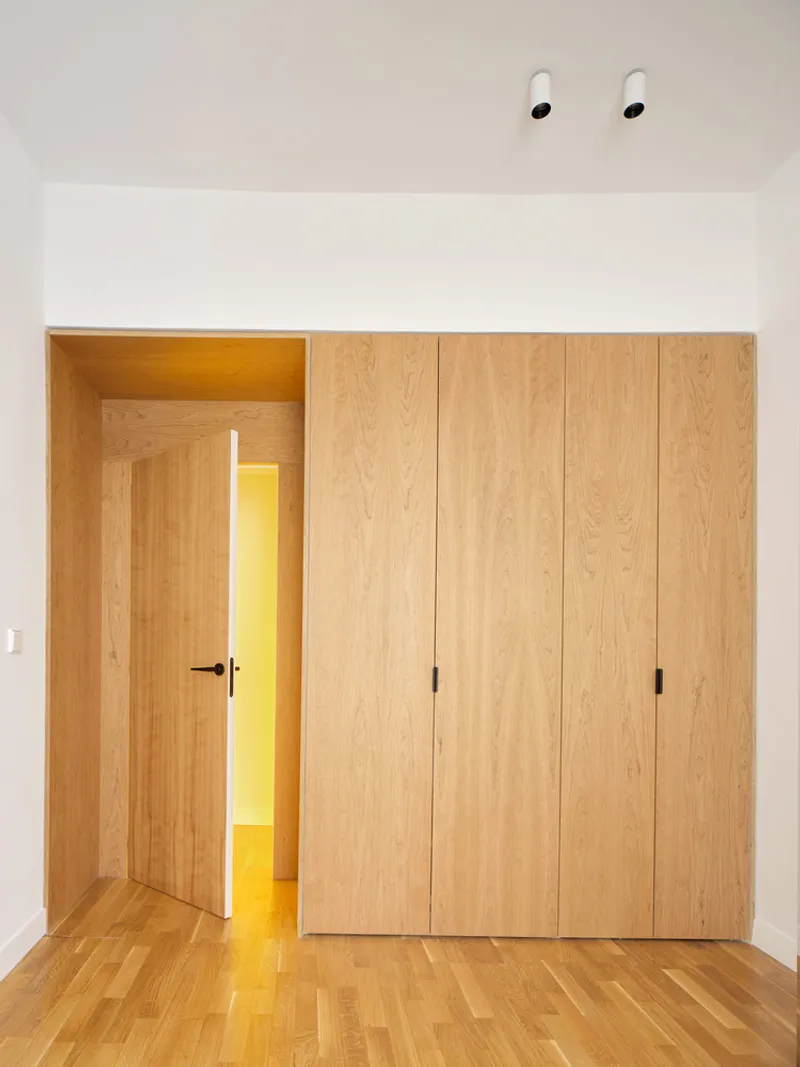
Step off the yellow spine and you enter rooms defined by a completely different material logic. Timber battens line ceilings, paneled walls wrap bedrooms, and tall French doors open onto balconies. These spaces feel warmer, quieter, and deliberately domestic. The contrast with the assertive yellow corridor is immediate and intentional: the yellow system is public, the timber system is private.
White walls and door frames act as mediators, absorbing the transition between the two palettes. Wardrobes clad in the same timber as the bedroom ceilings reinforce the sense that each room is a self-contained enclosure, while the glimpse of yellow light spilling through a doorway always reconnects you to the apartment's larger spatial order.
Shelving as Architecture
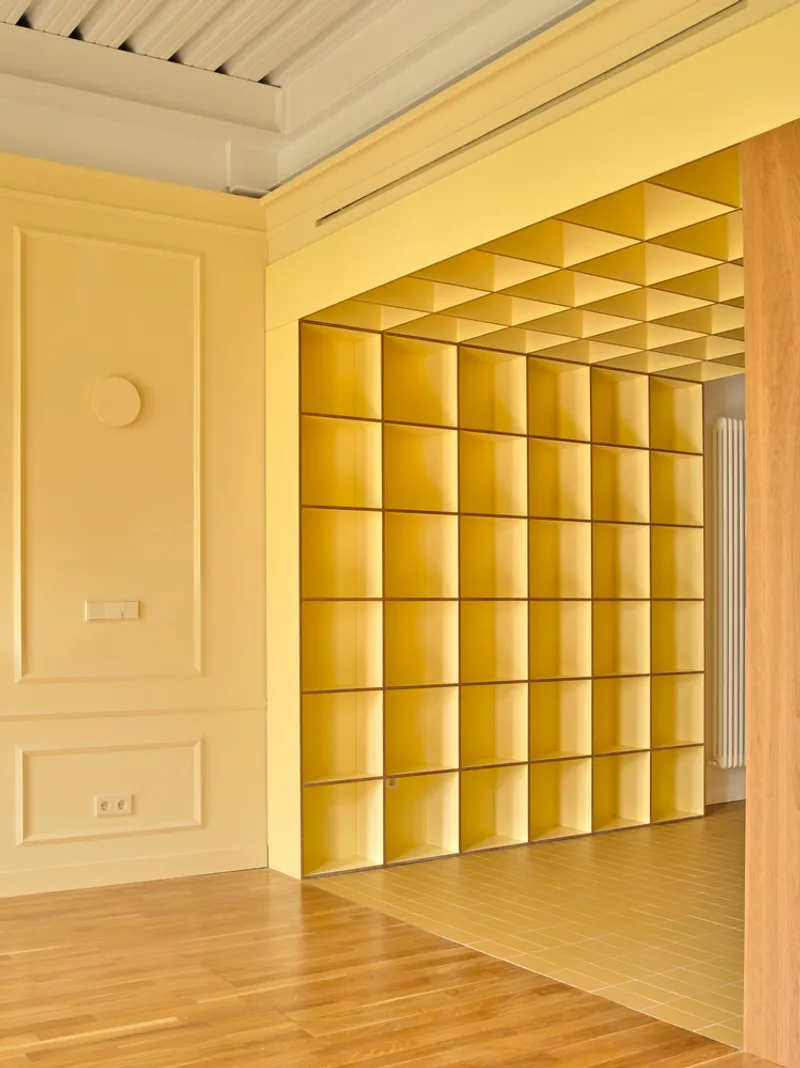

The yellow gridded shelving unit recessed into a wall opening is the clearest single expression of the project's thesis. It reads simultaneously as furniture, partition, and framed opening. A timber surround gives it the proportions of a doorway, while the slatted ceiling overhead signals the shift from one spatial zone to another. The shelves themselves are deep enough to be functional but visually restrained enough to operate as part of the wall plane.
Nearby, a cane chair sits below the coffered ceiling, its organic weave the only curved form in the entire composition. The contrast is generous: the grid tolerates the exception because the exception proves the grid's dominance.
Kitchen as Material Pivot

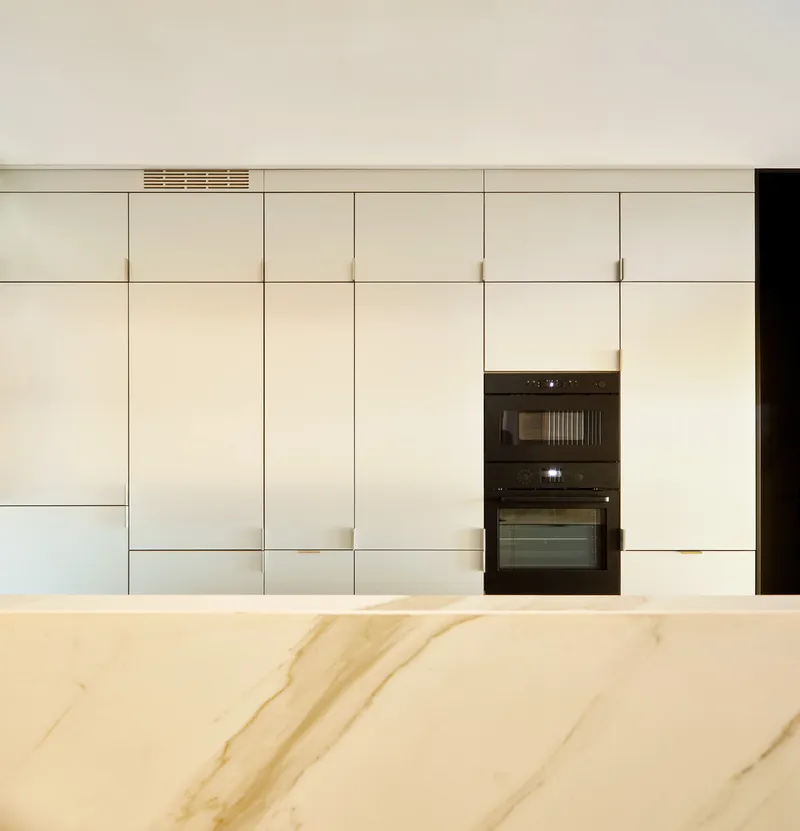
The kitchen introduces a third material register. A veined marble island anchors the room with geological weight, and a cylindrical range hood provides the only explicitly sculptural form in the apartment. Flush white cabinetry with integrated appliances keeps the perimeter clean and recessive. Through the opening behind the island, the yellow shelving is visible, tethering the kitchen back to the apartment's connective spine.
It is a smart move to let the kitchen be neutral territory. The marble and white cabinetry neither compete with the yellow system nor defer to the timber rooms. The kitchen belongs to both zones, a pragmatic hinge in the plan.
Thresholds and Framing
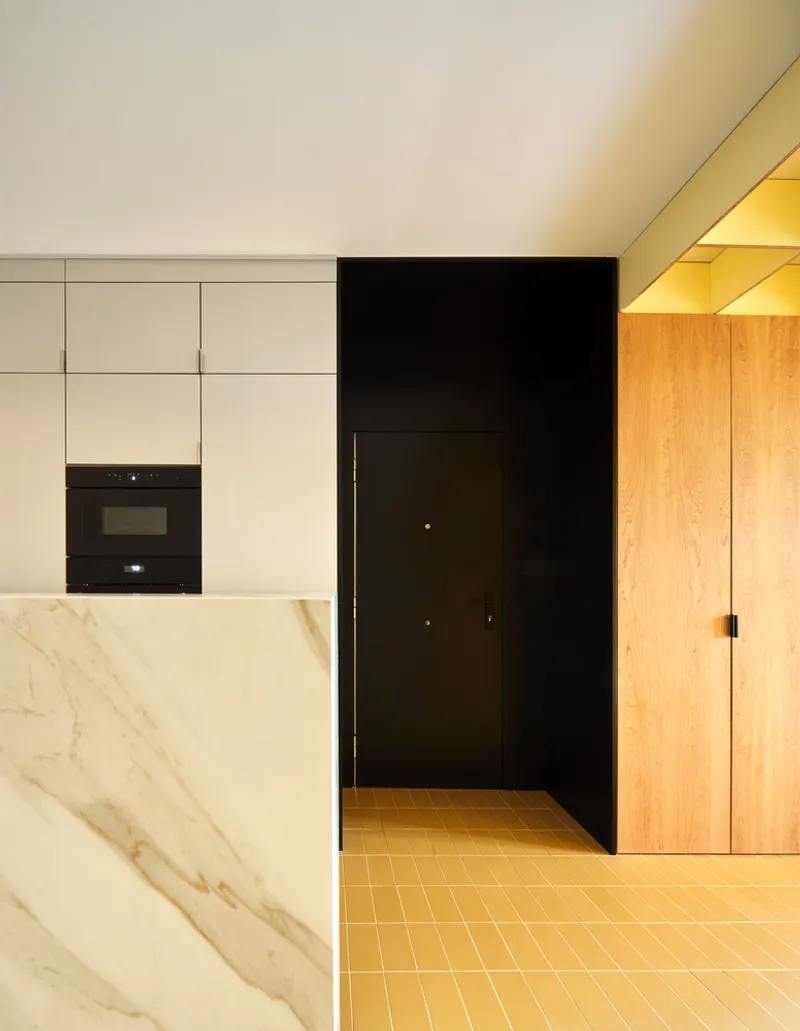
The black doorway framed by white cabinetry and a yellow tile floor is one of the most precisely composed moments in the project. The dark surround compresses the view, creating a telescopic depth that makes the rooms beyond feel larger than they are. Illuminated timber joinery at the edges introduces warmth at the exact point where the composition might have turned too graphic.
Throughout the apartment, door openings are treated as architectural events rather than leftover gaps. Each threshold calibrates the relationship between the space you are leaving and the one you are entering. The palette shift at each crossing, yellow to timber, timber to white, white to yellow, is legible in a single glance.
Plans and Drawings

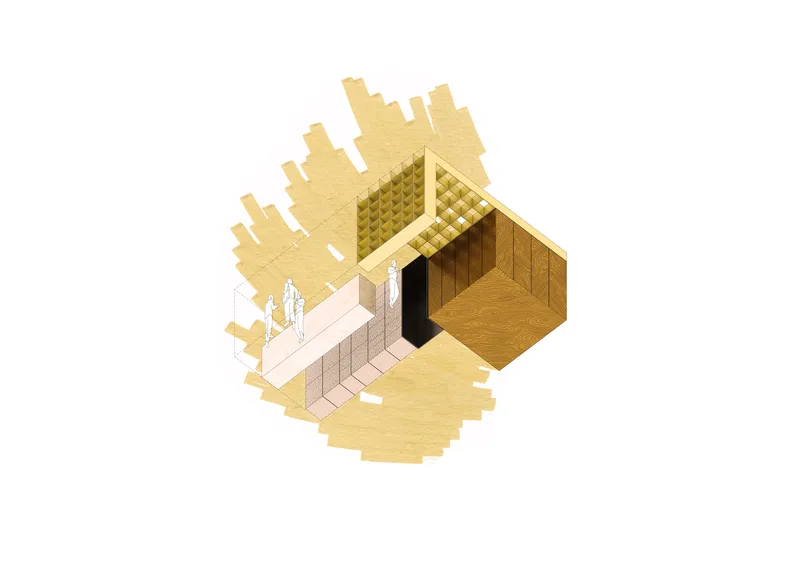
The section drawings reveal a three-level spatial organization with circulation paths indicated by arrows, confirming that the yellow ceiling plane is not merely cosmetic but corresponds to the apartment's primary movement routes. The axonometric drawing is especially instructive: it peels back walls to show how the gridded ceiling, timber-lined bedrooms, and entry sequence relate in three dimensions. Two figures in the entry provide scale and hint at the generosity of the ceiling height, which is essential for making the deep coffers feel expansive rather than oppressive.
Why This Project Matters
The Avorio Renovation is a case study in how a single design decision, rigorously applied, can organize an entire dwelling. The yellow grid is not a style choice. It is a spatial strategy that consolidates circulation, storage, and identity into one system. The discipline required to maintain that consistency across ceilings, walls, and shelving while keeping every other surface restrained is harder than it looks, and the apartment is better for it.
For architects working within the constraints of existing residential plans, this project offers a clear lesson: you do not need to demolish walls to transform a flat. Sometimes you just need to paint a ceiling, commit to the geometry, and let the color do the wayfinding.
Avorio Renovation by Estudio Gonzalo del Val, Barcelona, Spain. Photography by José Hevia.
About the Studio
Share Your Own Work on uni.xyz
If projects like this are the kind of work you want to make, uni.xyz is a place to publish your own, find collaborators, and enter design competitions.




Popular Articles
Popular articles from the community


Co-Life: Senior Housing Design That Reconnects Older Adults With the City
Co-Life reimagines senior housing design through healing gardens, shared streets, workshops, and a sustainable community across generations.

Riyadh For All: Intergenerational Urban Design for Active Aging in Rabat
Riyadh For All reimagines urban design in Rabat with intergenerational co-living, adaptive courtyards, and Moroccan cultural exchange today.

Co-life: Sustainable Architecture for Age-Friendly Community Living
Co-life reimagines sustainable architecture for seniors through courtyards, rammed earth, shared gardens, and spaces designed for belonging.

The Earth Pod: 3D Printed Homes for Resilient Refugee Communities
The Earth Pod reimagines refugee housing through 3D printed homes made from clay, combining resilience, self-sufficiency, and rapid shelter.


Similar Reads
You might also enjoy these articles


Hodi-Mandai Geram
Project Function: Preservation and revitalization of the Intangible heritage and socio-spatial identity of the Hodi by Housing, Cultural Memory Center, Sacred Grove, landscape, local tourism economy


Olio Towers: A Mid-Rise for Performers That Fuses Housing, Rehearsal, and Stage
Located blocks from Houston's Theater District, this modular tower stacks living units around a central performance atrium.

Oasis: Modular Green Housing Carved into Dhaka's Urban Fabric
A shortlisted Plugin Housing entry reclaims unauthorized settlements in Dhaka with stepped concrete volumes, green roofs, and ventilation-driven design.

Black Hole: A Floating Megastructure for the Post-Physical Era
Emiliano Mazzarotto envisions a spherical, self-scaling arena where e-sports, digital hotels, and holographic stadiums replace traditional public space.


Explore Interior Design Competitions
Discover active competitions in this discipline


Challenge to design luxury tourism on rails


Challenge to reimagine the Iron Throne


Photograph architecture without architects


VR headsets Storefront design competition
Comments (0)
Please login or sign up to add comments
No comments yet. Be the first to comment!