
Azure Wave: A Modular Stage System That Unfolds Across Madrid's Public Spaces
Folding platform modules and blue circulation ramps turn canal promenades and plazas into spontaneous performance venues.


What if a stage could arrive in pieces, lock together like origami, and reshape itself for every act? Azure Wave proposes exactly that: a modular performance infrastructure that treats Madrid's streets, plazas, and canal edges as a distributed theater. Instead of building one permanent venue, the project scatters folding platform modules across the city, each capable of tilting, stacking, and linking to others through a network of blue-painted ramps and pathways.
Designed by Tobias Maiden for the Madrid Art Bioscope competition, the project reimagines how temporary performance architecture can operate at the scale of a city. Rather than anchoring cultural programming to a single precinct, Azure Wave distributes its hardware across waterfront promenades and urban plazas, turning every deployment into a site-specific event. The result is a system that is as much about logistics and urban choreography as it is about the performances it hosts.
Folding Geometry as Structural Logic
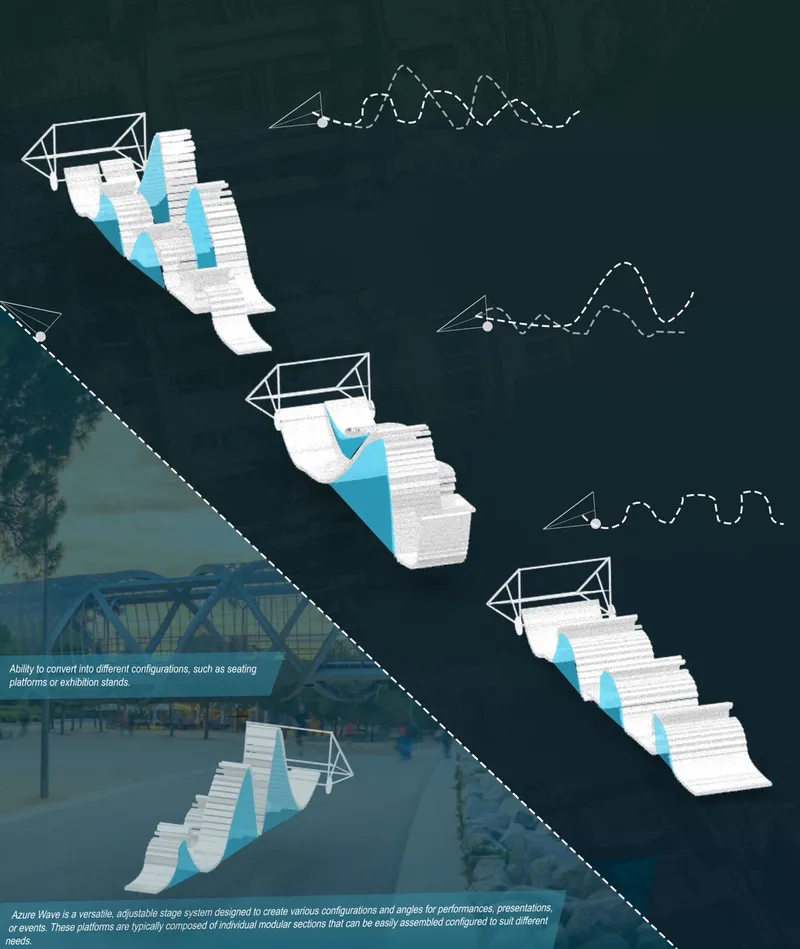
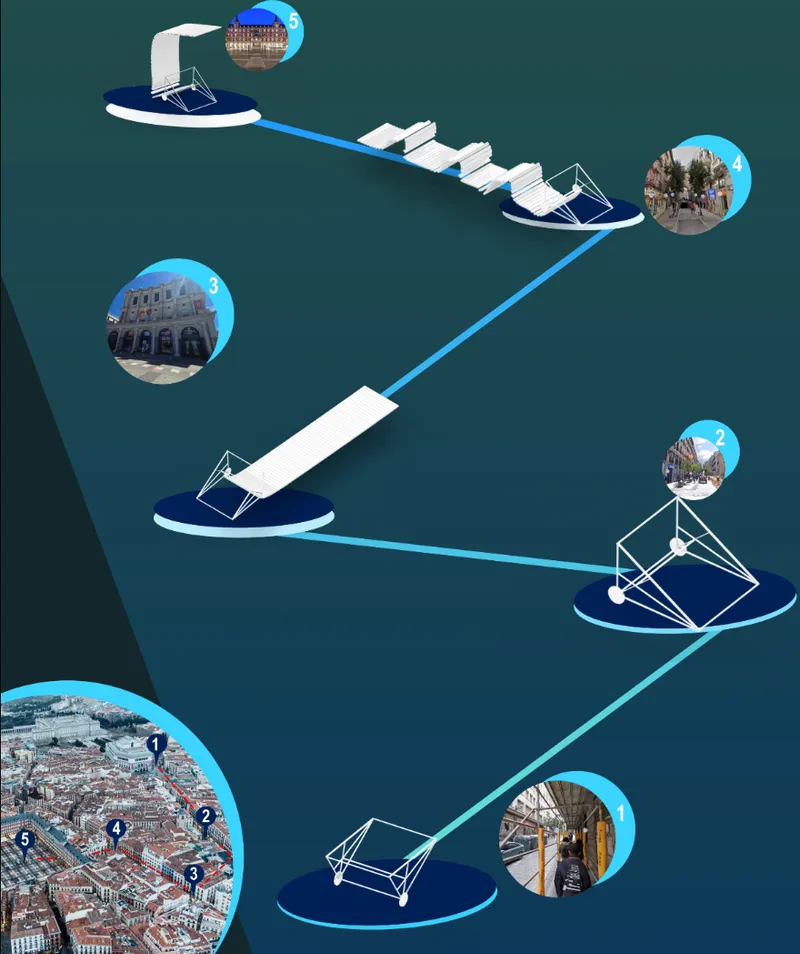
The diagrammatic work reveals the intelligence behind the system. Each module is a flat platform that can hinge along scored lines, folding upward into angled surfaces, ramps, or enclosures. Motion path arrows trace how performers and audiences circulate through various configurations, while axonometric views show how individual units snap together through blue-colored connective pathways. Circular photo insets ground the abstraction in real materials and textures, hinting at how these theoretical joints would perform in steel and composite panels.
The modularity here is not a gimmick. By standardizing the unit dimensions and hinge points, Maiden creates a kit of parts that can scale from a solo busking platform to a multi-level amphitheater. The blue pathways serve double duty: they are both structural links and wayfinding cues, signaling to passersby that they are entering a performance zone.
Breakdancing on a Folded Plinth
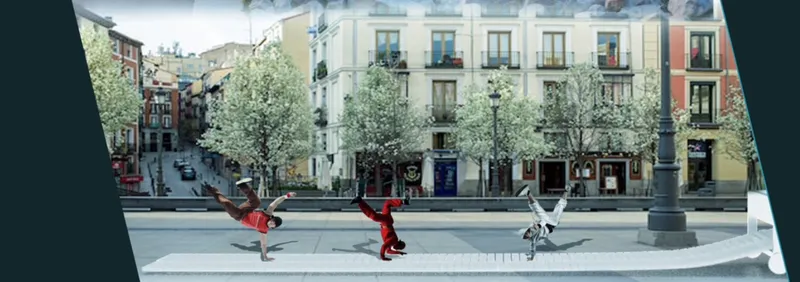
The most convincing render places three breakdancers on a white, angular platform in the middle of a tree-lined plaza. The stage reads as both furniture and sculpture: low enough to gather around, tilted enough to frame the performers against the sky. Pedestrians pause at the edges, and the boundary between audience and performer dissolves. There is no proscenium, no backstage. The city itself provides the backdrop, and the folded surface simply declares that something is happening here.
Canal Edge Activations
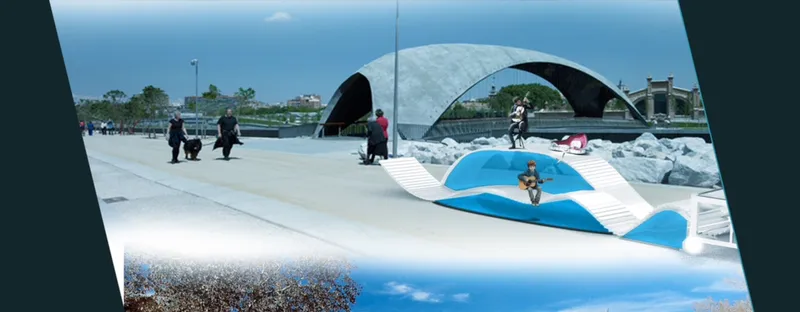
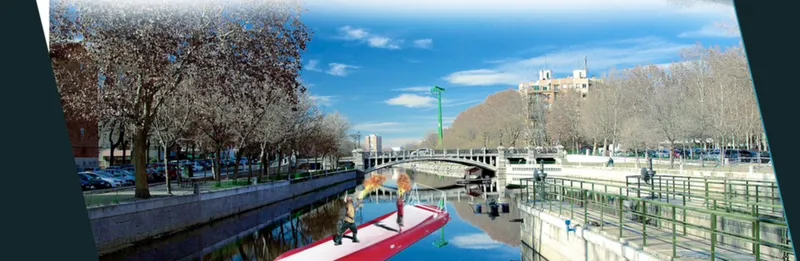
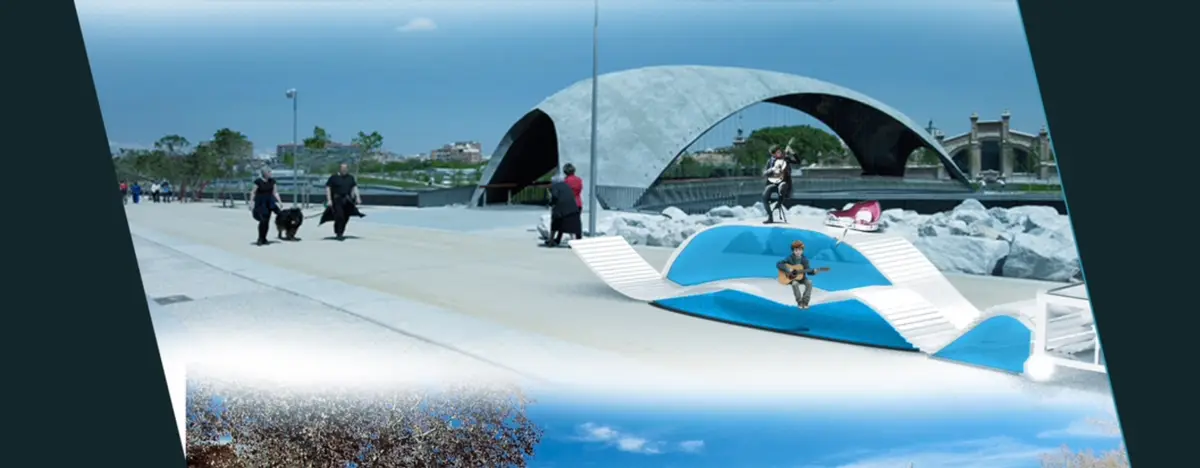
Two canal-side views demonstrate how the modules adapt to Madrid's waterfront infrastructure. A white ribbed platform with blue ramps draws visitors toward a curved pedestrian bridge, creating a threshold moment between the city grid and the water's edge. Nearby, a red and blue stage tilts along a promenade lined with bare winter trees, its angled surfaces catching low sunlight and broadcasting color against the muted urban palette. These are not renderings of isolated objects; they show the platforms in dialogue with existing bridges, guardrails, and tree canopies.
Siting the modules along the canal is a deliberate provocation. These are often Madrid's least programmed public spaces, linear corridors that people pass through rather than linger in. Azure Wave turns transit zones into destinations, using the spectacle of performance to slow people down and redirect their attention toward the water.
Framing the City as Venue
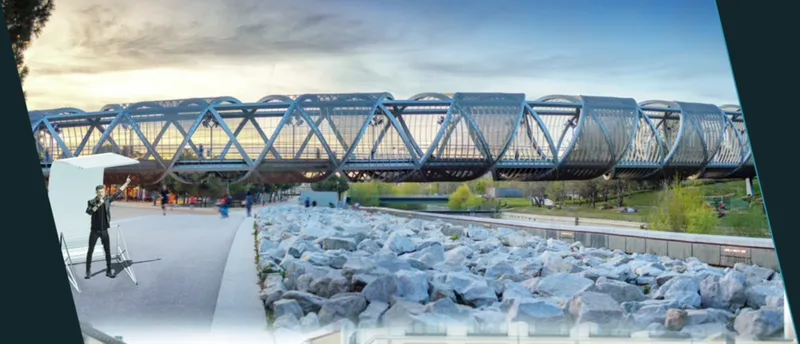
A striking view through an angular concrete frame captures a blue steel truss bridge spanning a rocky channel, with a photographer composing in the foreground. The image operates as a manifesto for the project's spatial philosophy: every piece of infrastructure is a potential stage, every vantage point a potential seat. The concrete frame becomes a proscenium, the bridge becomes scenography, and the photographer becomes both audience and performer. Azure Wave does not just provide stages; it reframes the act of looking at the city.
Why This Project Matters
Modular architecture proposals often stop at the diagram, presenting elegant component logic without demonstrating how the system actually feels at human scale. Azure Wave succeeds because it commits to both registers. The folding geometry is rigorous and clearly buildable, but the street-level renderings prove that the modules generate genuine social energy, not just spatial novelty. Breakdancers, photographers, and casual pedestrians populate these scenes with the kind of informal occupation that fixed performance venues rarely achieve.
Maiden's decision to distribute the system across Madrid rather than concentrate it in one location reflects a growing understanding that cultural infrastructure works best when it meets people where they already are. Azure Wave does not ask the city to come to the theater. It brings the theater to the canal, the plaza, and the bridge, folding open wherever a flat surface and a curious crowd converge.
View the Full Project
About the Designers
Designer: Tobias Maiden
Enter a Design Competition on uni.xyz
uni.xyz runs architecture and design competitions year-round that reward proposals with spatial conviction and real site intelligence.
Project credits: Azure Wave by Tobias Maiden Madrid Art Bioscope (uni.xyz).


Popular Articles
Popular articles from the community


Jaramillo Van Sluys Arquitectura and Urbanismo Turn a Demolished Registry Lot in Quito into an Orchard Plaza
In Quito's Centro Histórico, a 2,800 m² plaza exposes the San Agustín convent wall and redraws its lost Augustinian orchard in volcanic stone.

LT2A and OPEN Architectes Thread a Brick and Glass High School Through a Wooded Belgian Campus
In Braine-l'Alleud, a 3,000 m² wing for Collège Cardinal Mercier pairs pale brick with a glazed colonnade, deferring to a small chapel and a dense wood.

Cube Design Draws an Ecological Corridor Between Two Shenzhen Hills with the Nankai Building
Beside Shenzhen's container docks, the Nankai Building pairs stacked balconies with a climbing green screen to connect two hillsides across its height.

GROUP A Strips a 1969 Rotterdam Harbor Headquarters to Its Frame and Wraps It in Timber Louvers
In Rotterdam's M4H harbor district, Ferro Offices reuses a 1969 frame, adds one timber storey and reaches BREEAM-NL Outstanding.

Similar Reads
You might also enjoy these articles

Gil Mello Arquitetura Tilts a Single Roof Toward the Waterfalls on a Plateau Above Aiuruoca, Brazil
In Aiuruoca, Minas Gerais, a 200 m² house of local labor and reclaimed poles pairs a low valley veranda with a tall mountain one.

U.GA Architects Wraps an Oval Rooftop Pool in Curved Board-Formed Concrete on Busan's Jeollidan-gil
In Busan's Jeonpo-dong, a 454 m² mixed-use block stacks a neighborhood facility, guest rooms and an oval rooftop pool inside spiraling concrete walls.

Felipe Hess Arquitetos Turns a Blind Stone Wall to the Street and Opens a Brazilian House onto a Courtyard and Canal
A canal-front house in Brazil hides behind painted stone and planting, then opens to an olive-tree courtyard, a reed-ceilinged porch and a curving pool.

David Macias Steps a Doorless Stone and Plaster House Down a Tropical Colombian Hillside
In the humid hills of Colombia, Threshold House replaces the front door with an open void and terraces its 850 m² down the slope instead of fighting it.

Explore Urban Design Competitions
Discover active competitions in this discipline

Challenge to design a portable theatre

Challenge to design a portable music platform

Challenge to design an open learning module for the elderly

Design challenge to equip cities with modern furniture
Comments (0)
Please login or sign up to add comments
No comments yet. Be the first to comment!